

Fifth grade marks a pivotal moment in a child’s artistic development. At this age, typically between 10 and 11 years old, students are not just scribbling or coloring; they are becoming critical observers of the world around them. They are ready and eager to explore more complex art techniques, demanding projects that are both challenging enough to engage their growing cognitive skills and open-ended enough to foster personal creative expression.
This collection of easy drawing ideas for fifth grade combines fun, skill development, and self-expression, providing a balanced and comprehensive approach to an art lesson. The focus is on projects that use minimal, easily accessible materials – such as a pencil, colored pencils, oil pastel, and watercolor – making them ideal for an art class setting or a rewarding at-home art project. By following simple steps, fifth graders can build confidence in their abilities while exploring core art elements such as line, shape, value, and perspective – laying a solid foundation for future artistic growth.
Drawing and Coloring Projects for Grade 5 Art Lessons
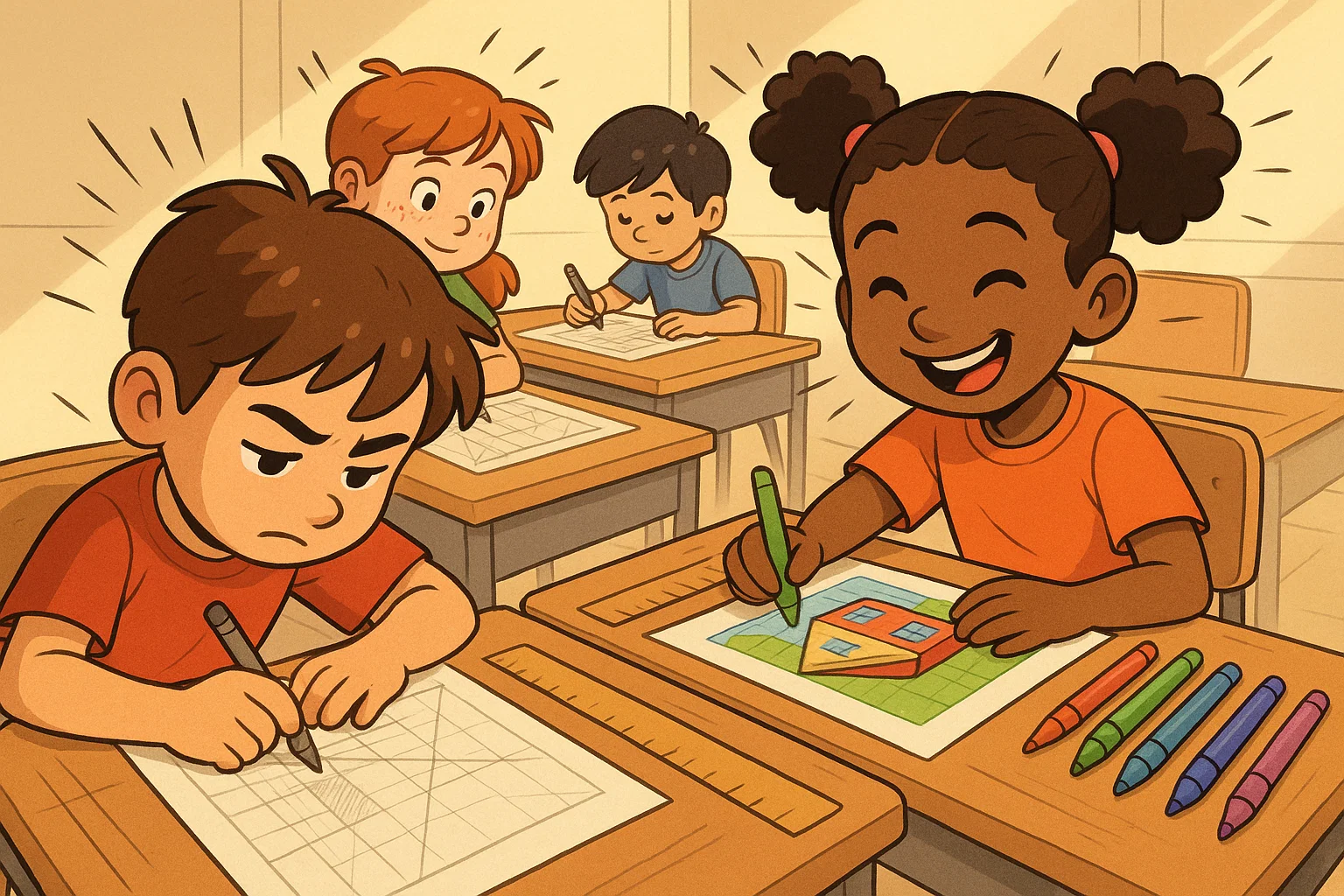
Drawing is a fundamental skill, and for fifth graders, these projects are designed to develop sharper observation, better proportion, and an understanding of shading. By focusing on detail and technique, these drawing ideas help students gain immense confidence in their sketching and overall artwork. The progression from basic shapes to intricate details is key to a successful drawing lesson.
One-Point Perspective Cityscape
Introducing a one-point perspective is a fantastic way to teach realistic depth – a core artistic concept for upper elementary students.
- The Concept: One-point perspective uses a single “vanishing point” on the horizon line to make objects look three-dimensional and farther away. This is a crucial concept in a formal art lesson for this age group.
- The Process: Students first draw a horizon line across their white drawing paper and place a single vanishing point in the center. From this point, they draw light diagonal lines (orthogonals) that will guide the top and bottom of buildings and roads. They then use a ruler and pencil to create the front plane of buildings, ensuring the sides converge back to the vanishing point. The final step is to add details like windows, doors, and roof lines before inking and coloring. This precise use of a ruler and pencil helps strengthen fine motor control.
Value Scale Drawings
Understanding value – the lightness or darkness of a color or tone – is essential for creating form and depth, transitioning a flat drawing into a three-dimensional illusion. This often-overlooked element of art value is critical.
| Material | Technique | Purpose |
| Pencil (H and B lead) | Hatching, Cross-Hatching | Demonstrates pressure control for different tones. |
| Charcoal | Smudging, Erasing | Teaches blending and lifting for smooth gradients. |
| Colored Pencils | Layering and Pressure | Shows how to create rich, deep shadows and bright highlights. |
Provide exercises where students create a 5-step value scale, progressing from white to black. The drawing lesson that occurs later should involve applying this skill, perhaps to a simple sphere or a folded piece of cloth, showing how an object’s form is defined by light and shadow. A black crayon can also be used for strong contrast against white paper.
Op Art – 3D Paper Cone Illusions
Op Art, short for Optical Art, is a mind-bending favorite for fifth graders. It’s an excellent way to introduce how lines and color can create the illusion of movement or depth.
- Step 1: Students first lightly in pencil draw a grid of squares on their paper.
- Step 2: In each square, draw a light circle at the center.
- Step 3: Starting from the circle and moving outward, students draw a series of concentric curved lines within the square. The direction of the curves can alternate between squares to enhance the illusion.
- Step 4: Using a black marker or a fine-tip black pen, they meticulously fill in the alternating sections. The contrasting black and white lines create a classic optical illusion art piece that seems to warp and pop off the page. This is a perfect project to review the element of art value with students.
Zentangle Initials
Zentangle is a meditative and focused art form that uses repetitive patterns. This is a superb activity to build focus and fine motor control.
- Process: Students start by drawing a large, bubble letter of their first initial onto art paper. They then draw a few simple, flowing curved line boundaries within the letter, breaking it into smaller sections. The final step involves filling each small section with a unique, non-overlapping pattern. Discuss how this process helps students concentrate and de-stress.
Nature-Inspired Drawing Ideas
Drawing natural elements encourages keen observation, appreciation for texture, and an environmental connection.
Leaf Impressions
This simple yet effective art project is a great activity for a fall art lesson.
- Step 1: Have students collect different textured leaves.
- Step 2: They place a leaf under a piece of thin art paper and rub the side of a crayon or brown oil pastel over it to capture the veining and texture – a great way to teach about texture as an element of art.
- Step 3: Students then add details by drawing stems, including small decorative elements, or creating a watercolor background.
Mixed-Media Bird Nests
This project combines different media for a rich textural result.
- Concept: Students first sketch a bird’s nest using drawing pencils – focusing on the contour lines of the interwoven twigs.
- Mixed-Media: They then use brown colored pencils and black marker to add details and shading. The final step involves adding actual texture by gluing small pieces of yarn, shredded paper, or fabric (mixed media) to represent the fluffy interior of the nest.
Flower Bouquets
This classic still life is perfect for teaching symmetry, layering, and color blending with oil pastel or colored pencils. Guide children in drawing various flower shapes, focusing on overlapping petals to create depth. Students can enhance contrast by applying oil pastel to dark paper areas, making the colors stand out vividly, or use the watercolor to create soft, blended petals.
Rainforest Animals
Encourage students to create vibrant drawings of animals like parrots, monkeys, or frogs. Kids love this subject because of the potential for bright colors.
- Focus: Have students draw the animal lightly in pencil first, then color with marker or colored pencils. Encourage bold, stylized rainforest patterns and vibrant tropical colors. The background can be an explosion of green and blue, utilizing the different colors of the jungle to contrast with the animal.
Creative Character Drawings
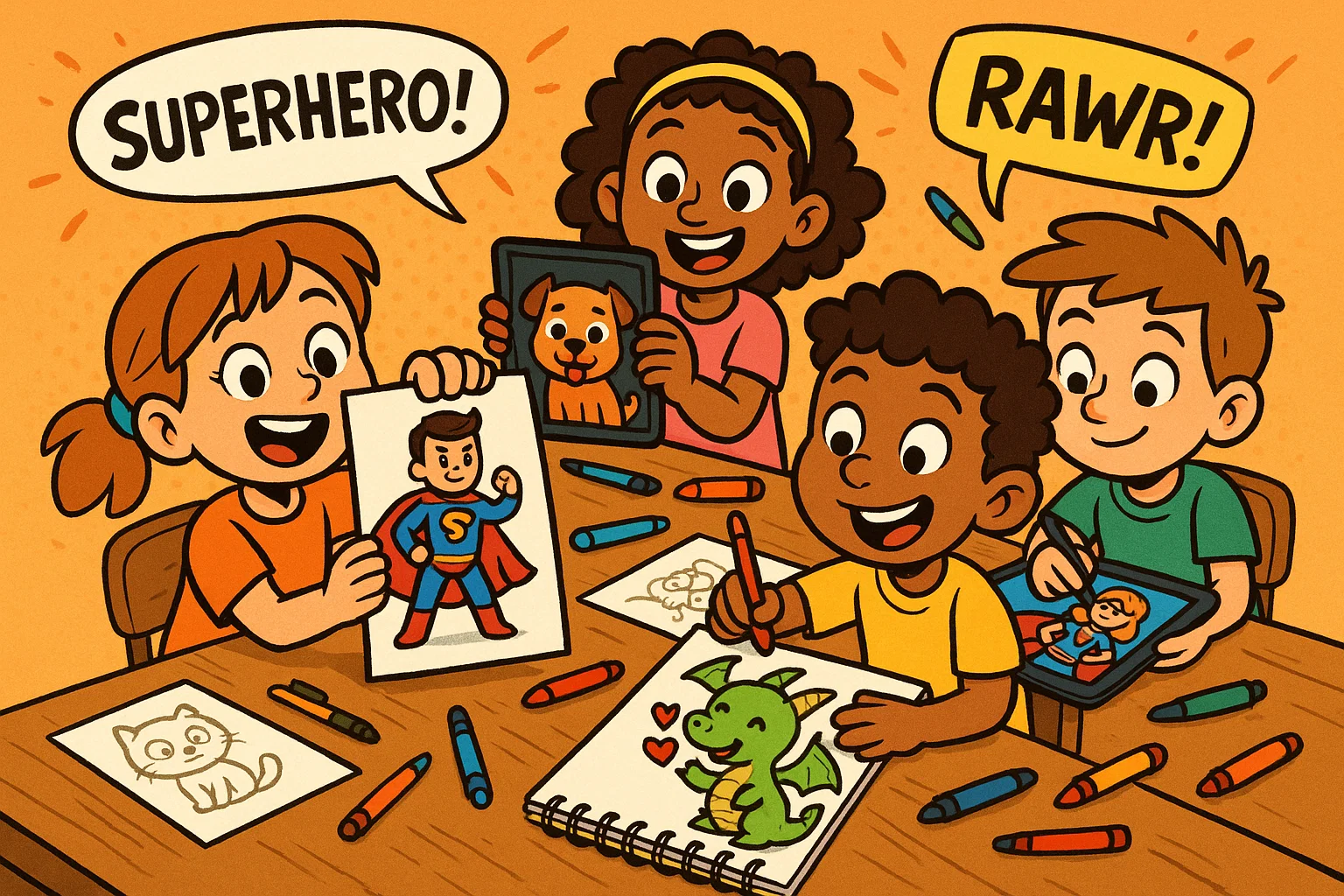
Cartooning and imaginative drawing are powerful tools that spark storytelling, humor, and individual design.
Superhero Sketchbook Covers
This project is highly engaging for fifth graders. It is a great way to let students explore design and identity.
- Design: Guide children to design their own unique superhero, complete with a name, detailed costume, and power symbol.
- Execution: After the students draw their character, they outline it precisely using a black marker.
- Coloring: They color the design with bright, bold marker colors, reinforcing the Pop Art aesthetic of comic books. This could be their personal art room sketchbook cover.
Fantasy Creatures – Dragons, Unicorns, Mermaids
This drawing lesson encourages the use of imagination and building complex forms from simple ones. Explain how to start with a simple oval shape for the body and add shapes for the head and limbs.
- Focus on Detail: Emphasize fantasy details like scales, fur texture, or flowing hair. Students can then draw an environment for their creature.
Cartoon Pets and Minions
This project is purely for fun. Have students also redraw a familiar character or invent a new one with exaggerated features, focusing on expressing emotion through facial features and body language, especially the nose and mouth. Students love this opportunity to be playful and expressive.
Seasonal and Holiday Drawing Ideas
Art can be a wonderful reflection of the seasons and cultural celebrations, adding relevant context to the art class.
Winter Forest Perspective
This combines the perspective skills from earlier with an atmospheric focus.
- Step 1: Start with the basics of one-point perspective on a snowy horizon.
- Step 2: Students first lightly draw trees fading into the distance.
- Step 3: Teach shading and layering with the pencil or colored pencils to create the illusion of depth in the snow and trees.
Holiday Lights
This is a favorite art project for demonstrating how color and light work.
- Technique: Students draw large, simple holiday light bulbs on black paper or black construction paper.
- Coloring: Using oil pastel or chalk, they color in the bulbs with vibrant hues. Using a white oil pastel, they add a small, concentrated white highlight on the bulb to create the illusion of a reflection and a glowing light against the dark background. This teaches about contrast and light source.
Chinese New Year Posters
Introduce cultural folk art themes.
- Design: Encourage bold, symmetrical designs using symbolic animals (dragons, rabbits, etc.) and traditional colors like red and gold.
Gingerbread Houses
This is a fun, imaginative architectural project.
- Process: Have students design their own elaborate gingerbread house. They outline the house and “candy” decorations precisely, then color with colored pencils or marker. This easy project allows for immense creative freedom in design and pattern.
Mixed-Media and Experimental 5th Grade Art
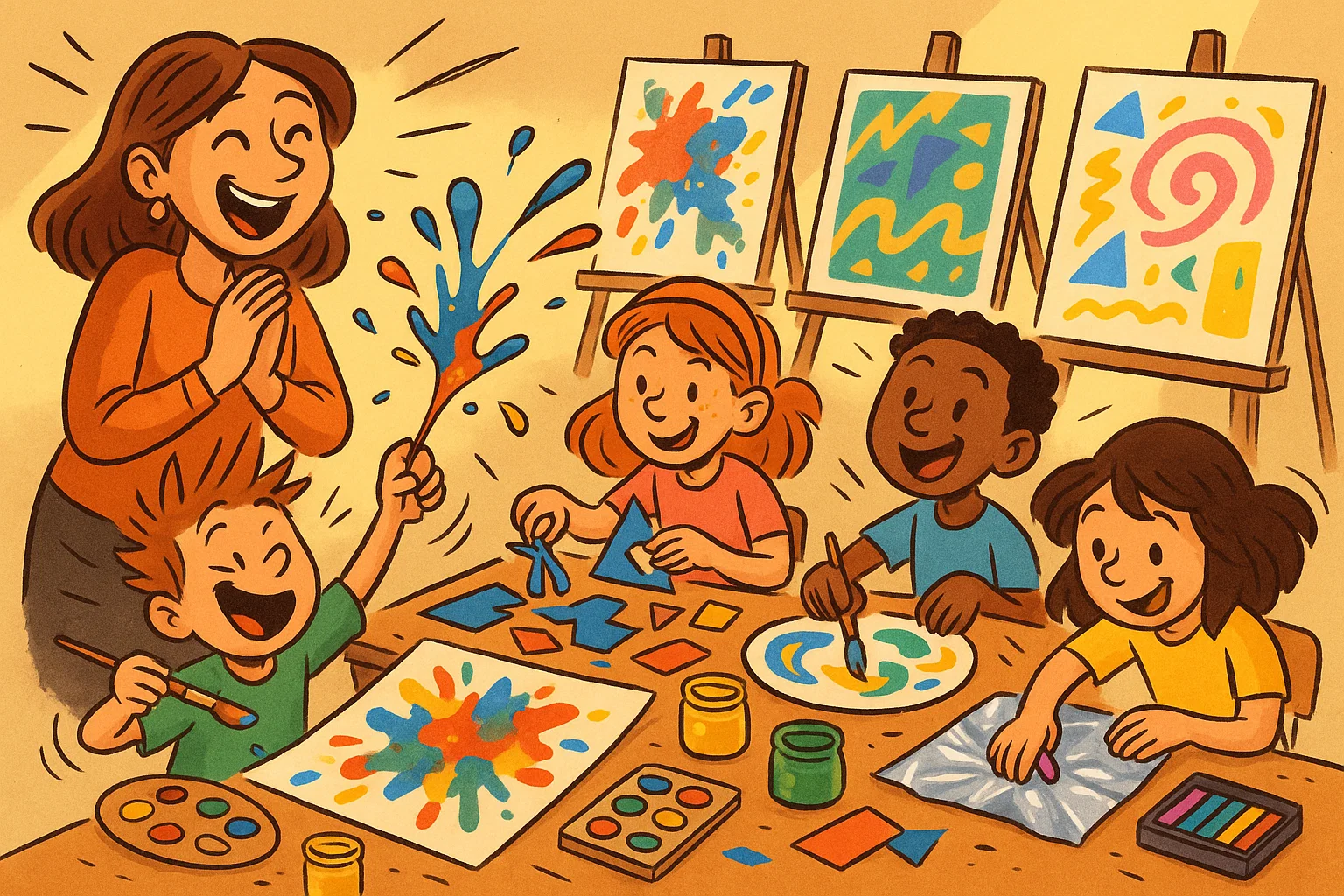
Moving beyond the drawing lesson with just a pencil, these projects encourage fifth graders to explore texture and unconventional applications of materials. The mixed media approach often yields unexpected and exciting results.
Foiled Scribble Flowers
This is a fantastic way to combine texture and color.
- Step 1: Students draw large, vibrant flowers with simple shapes.
- Step 2: They outline the flowers with a heavy black marker.
- Step 3: The center of the flower is filled with crumpled, then smoothed-out, metallic foil, which is secured with glue. The reflection of the foil against the vibrant colors creates a striking contrast.
Splattered Paintbrush Backgrounds
This helps students experiment with paint in a controlled, process-oriented way.
- Technique: Guide kids in using a toothbrush or stiff brush to create a fine, controlled splatter of watercolor or thin tempera paint onto their art paper and let it dry.
- The Drawing: Once dry, students draw a contour image – a silhouette or simple object – over the splattered background using a black drawing pencil or marker. This is a great exercise in layering.
Positive-Negative Space Designs (NOTAN)
NOTAN is a Japanese term meaning “dark-light harmony.” It’s a wonderful way to teach about positive and negative space.
- Process: Students cut simple geometric or organic shapes from a square of black paper and then glue the shapes onto a piece of white drawing paper. They then take the cut-out shapes and flip or rotate them, gluing them directly adjacent to the space they were cut from, creating a mirror image. This uses the negative space (the hole) as a guide.
Grid Drawing Inspired by Chuck Close
This popular art project is excellent for teaching proportion and scaling up images, as famously used by artist Chuck Close.
- Technique: Fifth graders learn about photorealist painter Chuck Close. Students place a simple photo (a face or an object) under a transparent grid. They then draw a corresponding, larger grid on their art paper.
- Execution: The students trace or copy the content of one small square from the photo grid into the corresponding, larger square on their art paper. This method simplifies complex images, making the final detailed artwork accessible. This project also teaches the discipline and patience required for detailed work.
Cultural and Artist-Inspired Projects
Grade level 5 is the perfect time to introduce art history. Learning from great artists offers deep inspiration and helps children adapt professional techniques to their own creative style.
Sandra Silberzweig Portraits
Silberzweig’s abstract portraits are fantastic for introducing bold color and pattern.
- Style: Students draw a simple head and shoulders outline. The face is then filled with a wild, non-realistic pattern of colors and lines, often involving a third eye or other symbolic face designs. This project is expressive, powerful, and fun – a perfect introduction to pop art.
Andy Warhol Pop Art Portraits
A quintessential Pop Art lesson, this project is simple and impactful.
- Technique: Students draw a simplified portrait (of themselves or a pet). They then trace and repeat this image four or six times on a single sheet. Each traced image is colored using a different, vibrant, and non-realistic color scheme – such as a green face with pink hair – using marker or paint. The repetition and exaggerated colors are hallmarks of a great Pop Art project. This lesson encourages creative color experimentation.
Georgia O’Keeffe Flowers
This introduces observation and soft blending.
- Focus: Guide children in choosing one flower and “zooming in” until it fills the entire paper. The immense scale forces a focus on shape and contour. The soft blending of colors is achieved using oil pastel or chalk pastel, creating a soft, luminous effect.
Kusama-Inspired Dot Pumpkins
Inspired by the work of Yayoi Kusama, this is a meditative and visually engaging art project.
- Process: Students draw a pumpkin or other simple object. The entire surface is then covered in a dense pattern of concentric curved lines and meticulously placed dots of various sizes. This exercise builds patience and helps develop visual texture.
Classroom and Group Drawing Activities
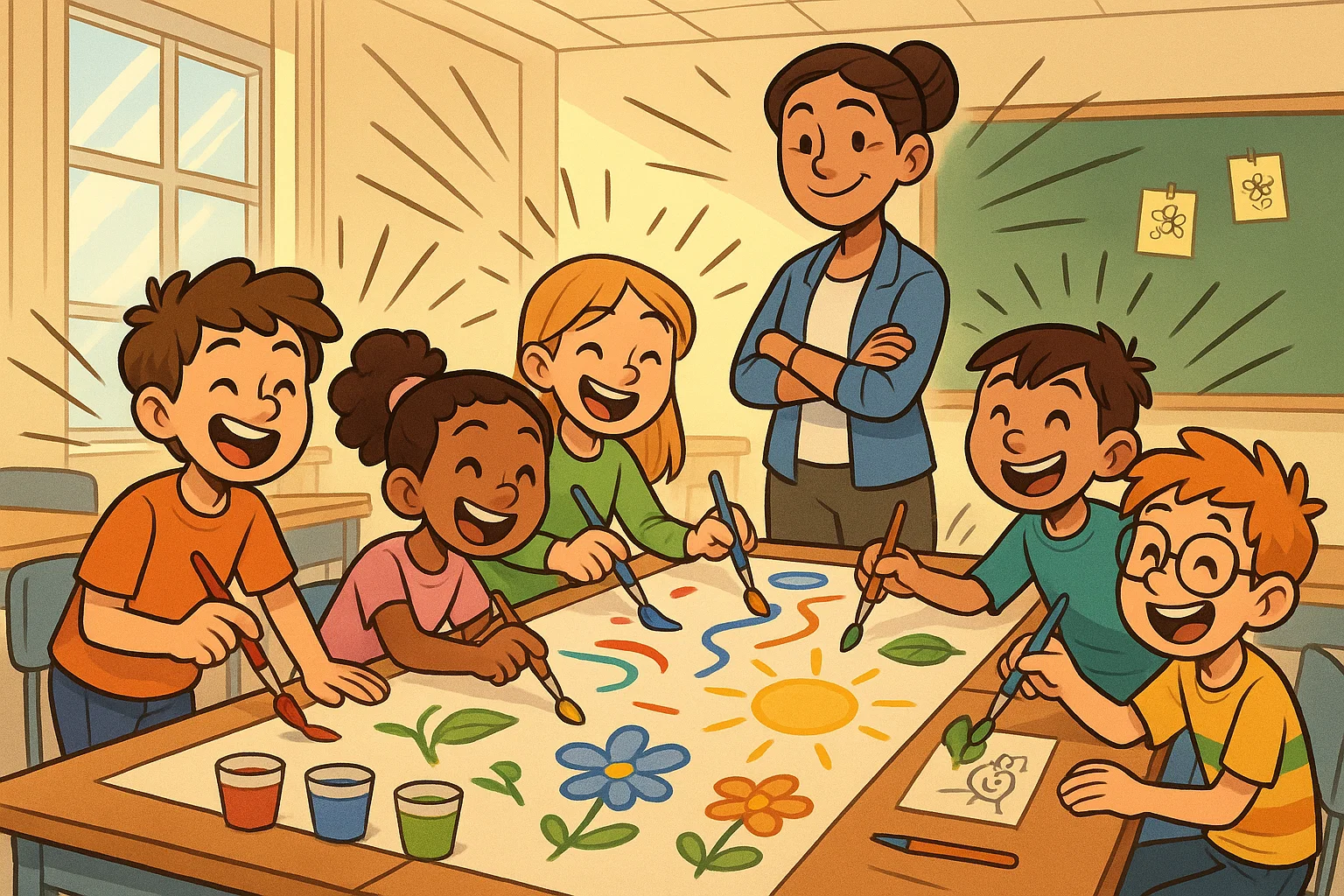
Collaborative projects encourage teamwork, social-emotional learning, and large-scale creativity within the art room.
Classroom Mural Project
- Concept: The whole class works together. A large piece of butcher paper is divided into equal-sized squares (similar to the grid in the Chuck Close lesson).
- Process: Each student is assigned one square to fill with a drawing that adheres to a central theme (e.g., “Our School Community” or “The Future”). Focusing on each student’s contribution to a collective whole provides a powerful lesson in shared artistic vision.
Art Games
- Quick Sketch Prompts: Time-limited warm-ups such as “Draw an angry robot in 60 seconds.”
- Drawing Relay: One student starts a drawing, passes it to the next to add details for 30 seconds, and so on. The hilarious final result is a fun way to conclude an art class.
Portfolio Challenge
- Concept: Suggest a semester-long, non-graded project: building a mini-collection of 5-7 drawings that reflect their growth and experimentation with different techniques (e.g., one value scale drawing, one perspective piece, one mixed media piece). This fosters accountability and a sense of professionalism – the perfect conclusion to their creative journey.
Conclusion: Building Artistic Confidence in Grade 5
The purpose of these easy drawing ideas is not just to teach technical skills, but to instill visual thinking, patience, and creative independence. The fifth grade art experience should be one of discovery and mastery. When students’ artwork is celebrated – regardless of “perfection” – they learn to take creative risks.
The ability to create realistic depth through perspective or to show form using the element of art value is empowering. This is where art truly intersects with critical thinking. As a parent or educator, your role is to provide the materials – the pencil, oil pastel, watercolor – and the encouragement to experiment and explore. Remember, a student with high arts participation is five times less likely to drop out of school than their peers, emphasizing that art is a core academic subject, not merely a fun distraction. Let the fifth graders create!