

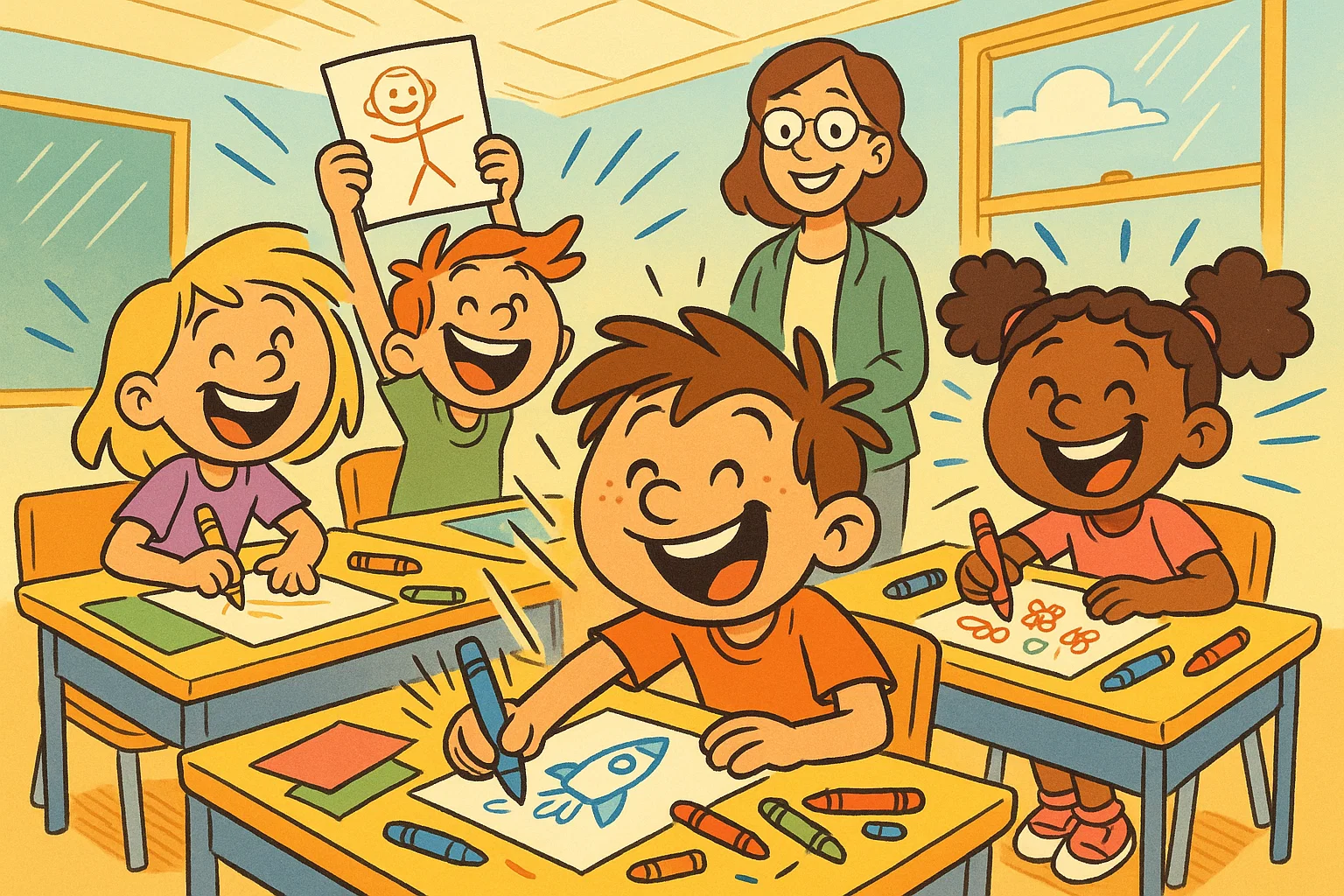
The benefits of integrating art, especially fun drawing activities, into the core curriculum are backed by child development research. Art is intrinsically linked to academic success. Studies show that children with stronger fine motor skills – the small muscle movements practiced when holding a crayon, pencil, or marker – tend to achieve higher academically, including earlier development of reading skills. Furthermore, creative activities enhance cognitive development, helping children think creatively, form new associations, and strengthen memory and focus.
A study published in Human Movement Science (Gaul & Issartel, 2016) found that 36% of Irish 6th-grade students (mean age ≈ 11 years) scored in the “below average” category on a standardized fine-motor-skills test (BOT-2), indicating that many children had not yet reached the normative benchmark for their age. This finding highlights the importance of activities such as drawing, which help develop and maintain fine motor coordination. Art activities help to address this gap, turning simple hand movements into meaningful acts of creation that support overall student well-being. As famed artist Pablo Picasso once said, “Every child is an artist. The problem is how to remain an artist once we grow up.”
Simple Drawing Projects for Beginners
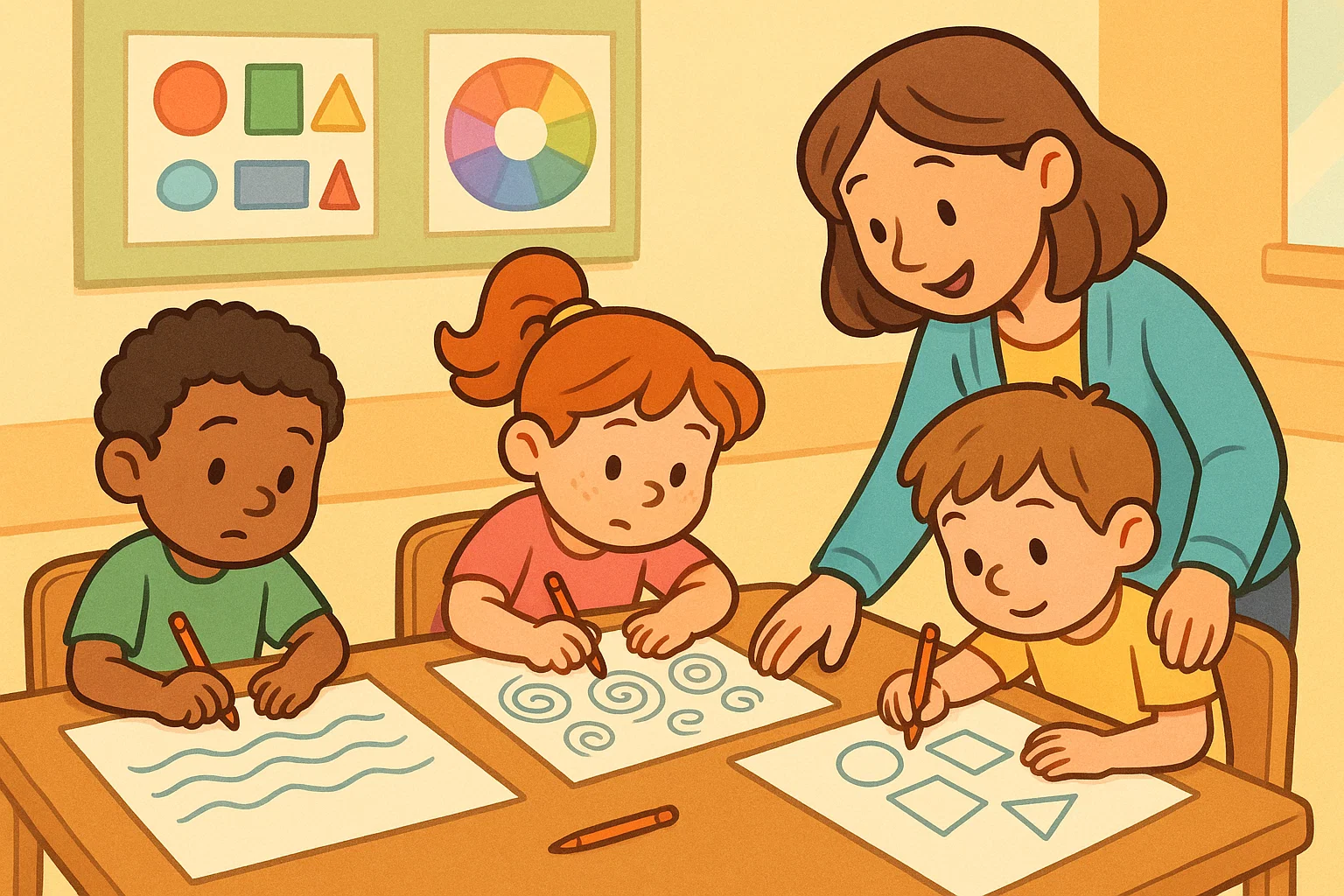
Starting an art lesson doesn’t require elaborate materials or complex ideas. By focusing on simple, easy-to-draw basics, you empower students to gain confidence and overcome the initial hesitation often associated with having to create a “perfect” piece of art.
- Materials: Keep it simple! Start with basic art supplies like a pencil, crayon, or marker, and standard copy paper. Colored pencils are also excellent for adding detail without the mess of paint.
- Goal: These activities focus on the process, not the product. They help students develop hand control and hand-eye coordination.
Basic Shapes and Lines Practice
The building blocks of all art are simple geometric shapes and lines. This foundational practice helps students see the world in terms of simple forms they can reproduce on paper.
- The Shape Transformation Game: Ask students to draw a large simple shape (circle, square, or triangle) on their piece of paper. Set a timer for three minutes. Challenge them to transform that single shape into an object or animal by adding just a few lines. A circle becomes an owl, a sun, or a tennis ball. A triangle becomes a roof, a mountain, or a slice of pizza.
- Texture Line Drawing: Focus on the elements of art by practicing different kinds of lines: straight, wavy, zig-zag, dotted, and swirl. Students can fill a pre-drawn grid with unique line-texture patterns using black markers.
Draw Your Favorite Object
This activity is fantastic for encouraging observation skills and helping young artists realize that they can draw the world immediately around them.
- Select the Object: Have students place one object from their desk or backpack in front of them (e.g., a glue stick, a book, a sticker, or their pencil case).
- Look and Sketch: Encourage them to spend more time looking at the object than at the paper. Focus on the object’s outline first.
- Add Details and Color: Once the outline (sketch) is complete, they can add smaller details, color, and texture. For older students, introduce basic concepts of light and shadow to create dimension.
Fun Warm-Up Doodles
A short, stress-free doodle session at the beginning of class can dramatically boost focus and creativity. These quick, fun activities signal the transition into a creative mindset.
- 5-Minute Doodle Challenge: Give students a prompt like “Draw something that makes a noise,” or “Draw a tiny world inside a glass jar.” They must stop when the five minutes are up.
- The Dice Drawing Game: Have a small group or the whole class play a drawing game with a six-sided dice. Assign a simple drawing element to each number (e.g., 1=a circle, 2=a zig-zag line, 3=a dot). Students roll the dice and add the corresponding element to their paper, building a totally random, unique image.
Seasonal Classroom Drawing Ideas
The changing seasons provide natural, built-in themes for art activities that can be integrated with science, literature, and social studies topics.
Fall Leaves and Pumpkins
The rich, warm palette of autumn is perfect for introducing color theory and shading.
- Warm Tones Texture: Provide materials in warm tones such as red, orange, and yellow crayons or colored pencils. Have students gather real or paper leaves to trace. Challenge them to fill the leaf outlines by rubbing the side of a crayon over a piece of textured material (like wood grain or a screen) placed beneath their paper for a unique leaf print.
- The Great Pumpkin Draw: Introduce basic shading by having students focus on the curved line drawing of a pumpkin. Using a dark orange or brown colored pencil, they can add shading to one side of the pumpkin to make it appear more three-dimensional.
Winter Snowmen and Polar Bears
These lessons emphasize cool colors, simple patterns, and contrasting backgrounds.
- Cool Color Snowflakes: Focus on the cool colors (blue, purple, white) of winter. Students can use white chalk or paint on dark blue or black paper to create striking, high-contrast snow scenes. Encourage different line drawing patterns for various snowflakes.
- Cozy Cabin Scene: Students sketch a simple log cabin and add a snowy background. This is a great time to teach perspective by making a faraway object (like a tiny pine tree) smaller than a close object (like a large snowman).
Spring Flowers and Butterflies
Spring lessons celebrate nature and vibrant colors, ideal for teaching symmetry and natural forms.
- Symmetrical Butterfly: Have students fold a sheet of paper in half vertically. They sketch half of a butterfly on one side, cut it out while the paper is folded, and then open it to reveal a perfectly symmetrical shape. They then use bright markers or colored pencils to fill in intricate patterns.
- Nature Dot Art: Inspired by pointillism, students use the tip of a marker to create a spring meadow or flower by filling in the scene entirely with small, colorful dots.
Summer Seaside Scenes
Perfect for end-of-year or pre-holiday fun activities, these ideas focus on movement and broad, open landscapes.
- Waves and Swirls: Focus on drawing the ocean. Use blue and green crayons or watercolors to create large, looping swirls to depict dynamic waves.
- Seashell Still Life: Bring in a few simple shells or pebbles (rocks) and set them up as a simple still life. Students can practice drawing what they see, paying attention to the light reflecting off the smooth surfaces, a great skill for older students to learn how to draw realistically.
Themed Drawing Ideas by Subject
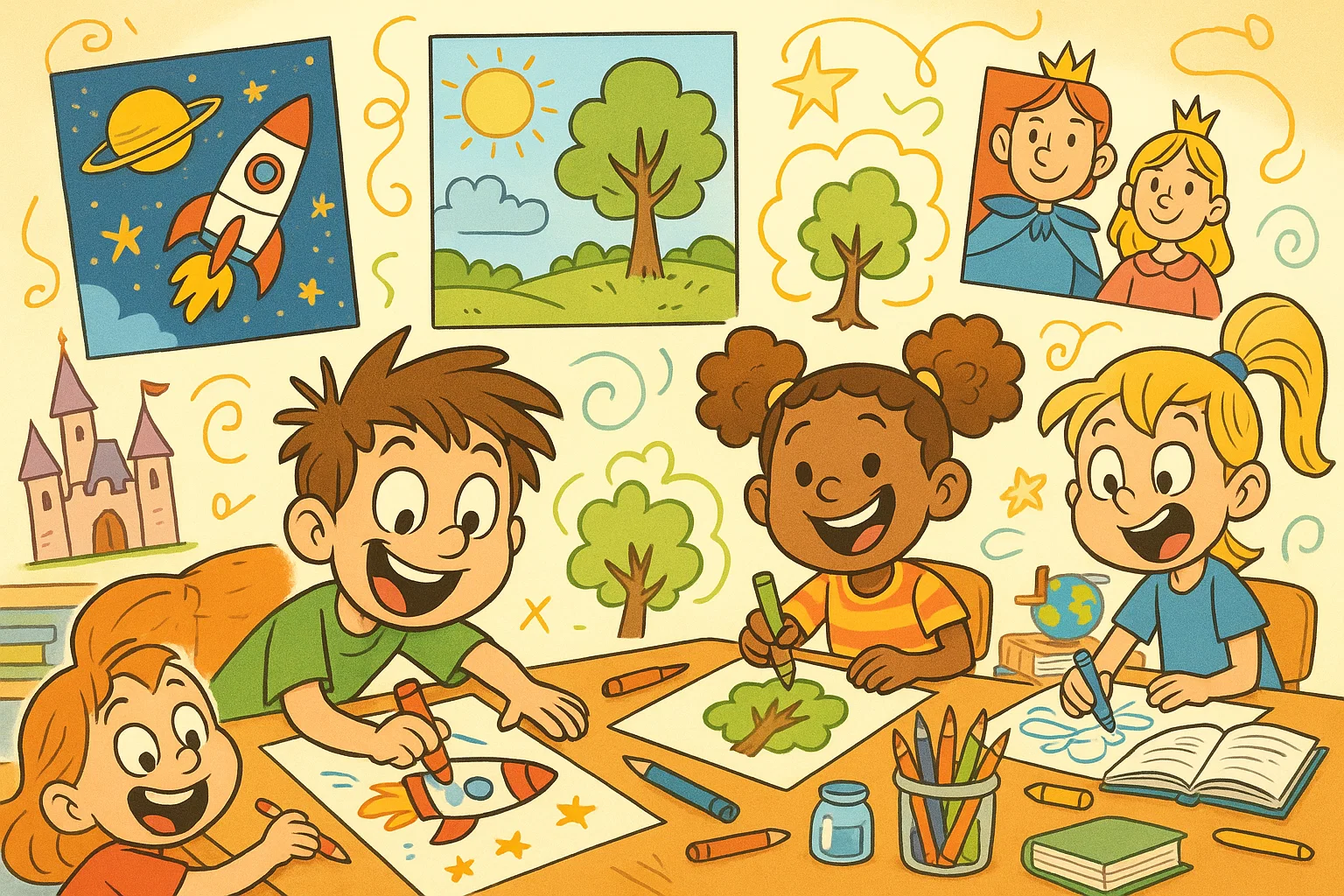
Connecting school art to other subjects not only reinforces learning but also demonstrates to students that art is a powerful tool for visual thinking and communication. As former US Secretary of Education William Bennett stated, “The arts are an essential element of education, just like reading, writing, and arithmetic.”
Space and Planets
This is a favorite topic that easily supports a science or astronomy unit.
- Galaxy Watercolor Wash: Students use dark watercolors (deep blue, black, purple) to create a background on their paper. While the paint is still wet, they can sprinkle table salt onto the paper to create a unique, grainy texture that resembles stars and distant galaxies. Once dry, they can add bright planet circles using a white marker or chalk.
- Draw an Alien: Ask students to draw a cartoon version of an alien based on a list of criteria you provide (e.g., “Must have three eyes, five tentacles, and a stripe pattern”). This combines following instructions with imaginative design.
Story Characters and Fairy Tales
Art helps students visualize and analyze literature. After a class reading, a drawing activity brings the characters to life.
- Illustrate a Key Scene: Have students create a piece of art depicting the climax of a story, like a frog transforming into a prince or a knight fighting a dragon. This requires them to comprehend and recall details from the text.
- Design a Book Cover: Students can design a new book cover for their favorite novel, focusing on a strong central image and using bold colors to convey the book’s mood. This is a great way to introduce graphic design concepts.
My Dream Classroom or Future City
These activities combine drawing skills with critical thinking and architectural design.
- Ideal Classroom Sketch: Students sketch their perfect learning environment. Where are the windows? What kind of desks? Is there a reading nook or a gaming corner? This allows them to think critically about functional design.
- Future Transportation: Challenge students to draw a vehicle that will exist in 100 years. Encourage fantastical elements that challenge gravity or traditional fuels, such as a flying bus or a sub-aquatic train.
Drawing Projects Inspired by Famous Artists
Introducing children to art history through hands-on creation is an engaging way for them to learn to draw new techniques and understand the vast world of art.
| Artist | Style/Movement | Classroom Activity | Supplies Recommended |
| Monet | Impressionism | Water Lilies: Teach dabbing/short brushstrokes with watercolor or pastels on wet paper to create a hazy, reflective pond surface. | Watercolor, chalk, or oil pastels |
| Picasso | Cubism | Abstract Faces: Students create a portrait using only geometric simple shapes (squares, triangles, circles) for the eyes, nose, and mouth, often looking at the viewer from multiple angles. | Marker, crayon, construction paper |
| Van Gogh | Post-Impressionism | Starry Night Recreate: Focus on movement. Use crayons, markers, or paint to make bold, visible swirling brushstrokes in a night sky, emphasizing the dynamic texture of the painting. | Crayon, marker, tempera paint |
Picasso’s Abstract Faces
This project is a high-quality example of how to introduce abstract art.
- Prep: Have students fold their piece of paper in half, then into quarters.
- Sketch: In each quarter, they draw a different version of a face feature (e.g., a sad eye, a large circle nose, a tiny triangular ear).
- Assemble: On a new piece of paper, they assemble these features randomly, overlapping and using bold, non-natural colors. This teaches them about geometric shape, color, and challenging perspective.
Collaborative Drawing Activities for Groups
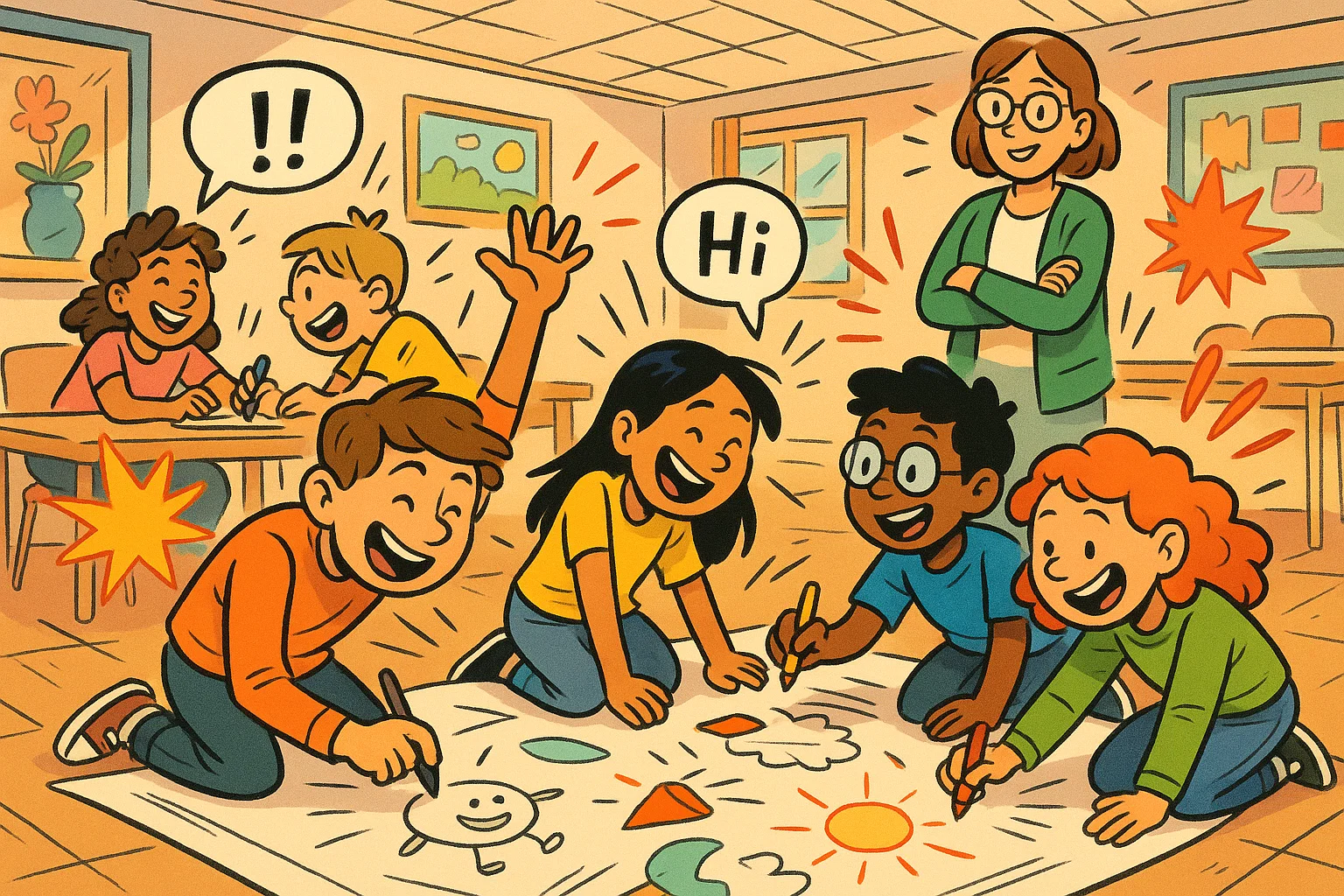
Group drawing activities are essential for building teamwork, encouraging communication, and developing social-emotional skills. They teach students that art can be a conversation.
Giant Classroom Mural
A mural is a spectacular way to engage the entire class.
- Theme: Choose a theme that relates to a current study (e.g., “The Rainforest Ecosystem,” “Our Community Heroes”).
- Execution: Affix a large sheet of butcher paper or several small sheets together on a wall. Give each student a defined area or a specific element to contribute (e.g., “Draw an owl and a frog,” “Add a unicorn”). The finished product becomes a collective piece of art and a shared source of pride.
Partner Drawing Challenge
This is one of the most fun and high-energy drawing games for the classroom.
- The Setup: Have students pair up. Each person gets a piece of paper and a pencil.
- Take Turns: Partner A starts a sketch – maybe a basic simple shape or a random line – and draws for 30 seconds. Partner B must then take turns adding to the drawing for the next 30 seconds, building on the first person’s idea. The drawing passes back and forth for 5-10 minutes. The resulting, often hilarious, drawings foster creative risk-taking.
Story Chain Illustration
A natural fit for an English Language Arts (ELA) lesson, this activity turns narrative writing into a visual experience.
- Start the Story: The teacher or a student writes a short opening sentence on a piece of paper (e.g., “A small frog hopped out of a mysterious swamp.”).
- Illustrate and Pass: The first student draws the illustration for the sentence, then folds the paper to hide the drawing, leaving only a small line showing where the drawing ends. They then write the next sentence of the story.
- Continue: The paper is passed to the next student, who reads only the previous sentence, illustrates it, and writes the next line. This continues until the paper is full, revealing an illustrated, progressive class story.
Drawing Games and Quick Creative Challenges
Sometimes you need a quick burst of creative energy to re-energize the class. These drawing games are excellent for brain breaks or managing time at the end of a long class period.
Blind Contour Drawing
This is a classic technique often used in an advanced art class, but it is also a silly, low-stakes game for all ages.
- The Rules: Students place their pencil on the paper, look at an object (like their hand, a flower, or even a classmate’s face), and must draw the object without looking at the paper and without lifting their pencil.
- The Outcome: The goal is to train the eye to observe closely, but the resulting drawings are always distorted and funny, acting as a great icebreaker and stress reliever.
Finish the Scribble Game
Perfect for inspiring new ideas from random forms.
- The Scribble: The art teacher (or a volunteer student) draws a large, random scribble on the whiteboard or on individual worksheets. The scribble can be a large swirl or just a few intersecting lines.
- The Challenge: Students have two minutes to turn that random scribble into a recognizable picture – perhaps a cartoon animal, an everyday object, or a fantastical creature like a unicorn. This is a powerful exercise in imaginative transformation.
Shape Transformation Race
This timed race helps students quickly associate abstract forms with real-world objects.
- The Race: Call out a simple shape (e.g., circle). Students have 60 seconds to draw that shape and then turn it into as many different items as possible by adding small details (a clock, a sun, a bubble, a beach ball). The student who creates the most variations wins a small prize (like being the next person to roll the dice in a drawing game).
Classroom Display and Art Sharing Ideas
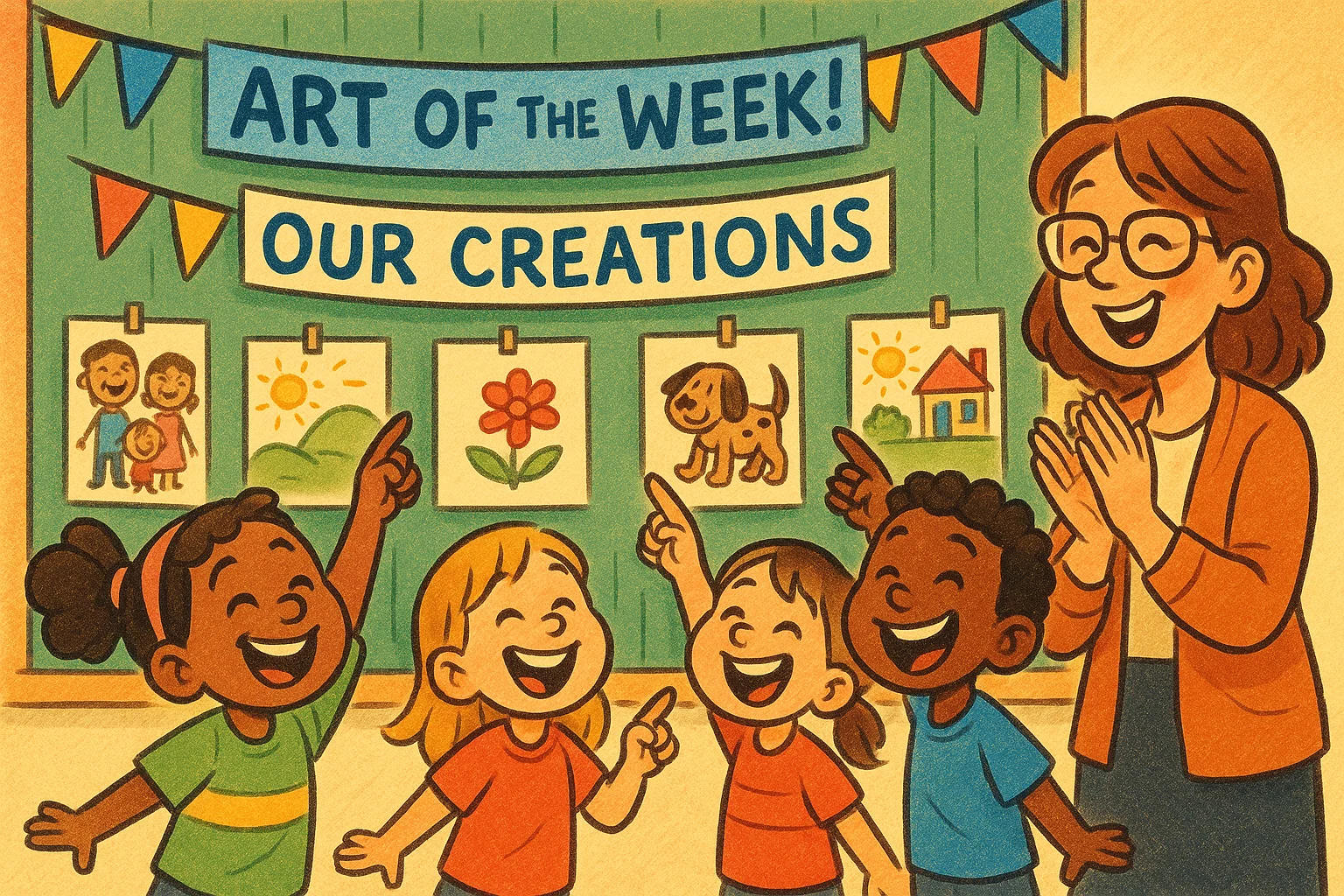
Celebrating student work is fundamental to boosting confidence and reinforcing the value of creativity. A well-displayed piece of art serves as a motivational tool for the entire class.
Rotating Art Wall
- Create a Section: Dedicate a prominent bulletin board or wall section as the “Featured Gallery.”
- The Rotation: Change the featured drawings weekly, ensuring every student’s work is showcased at some point. Label the display with the artist’s name and age, or the name of the art activities they completed (e.g., “Ms. Smith’s Third Grade: Van Gogh Swirl Recreations”).
Themed Exhibition Corners
- Connect to Curriculum: When finishing a unit (e.g., “Medieval History”), display all the related drawings (castles, knights, unicorns) in a designated “Exhibition Corner.” This reinforces the learning objective and adds a visual element to the lesson.
- Gallery Walk: For older students, arrange the artwork like a miniature museum exhibit. Have the students create a small title card for their piece of art and then conduct a gallery walk where they can view and respectfully critique each other’s work.
Digital Gallery or Portfolio
- Beyond the Classroom: Take the art-sharing outside the classroom walls. Use a simple, secure class website or a private slideshow (like Google Slides) to upload scanned or photographed artwork.
- Portfolio Building: This creates a digital art resources portfolio for each student, allowing them to share their progress with parents and view their own artistic journey over the school year.