Best Board Games for 3-Year-Olds: First Cooperative Games

 Discover a Free Education Video App for Kids
Pastory uses AI to personalize educational video content based on your child’s interests and personality. Safe, engaging, and built for curious young minds. Sign up now to stay updated and enjoy early access with a free trial
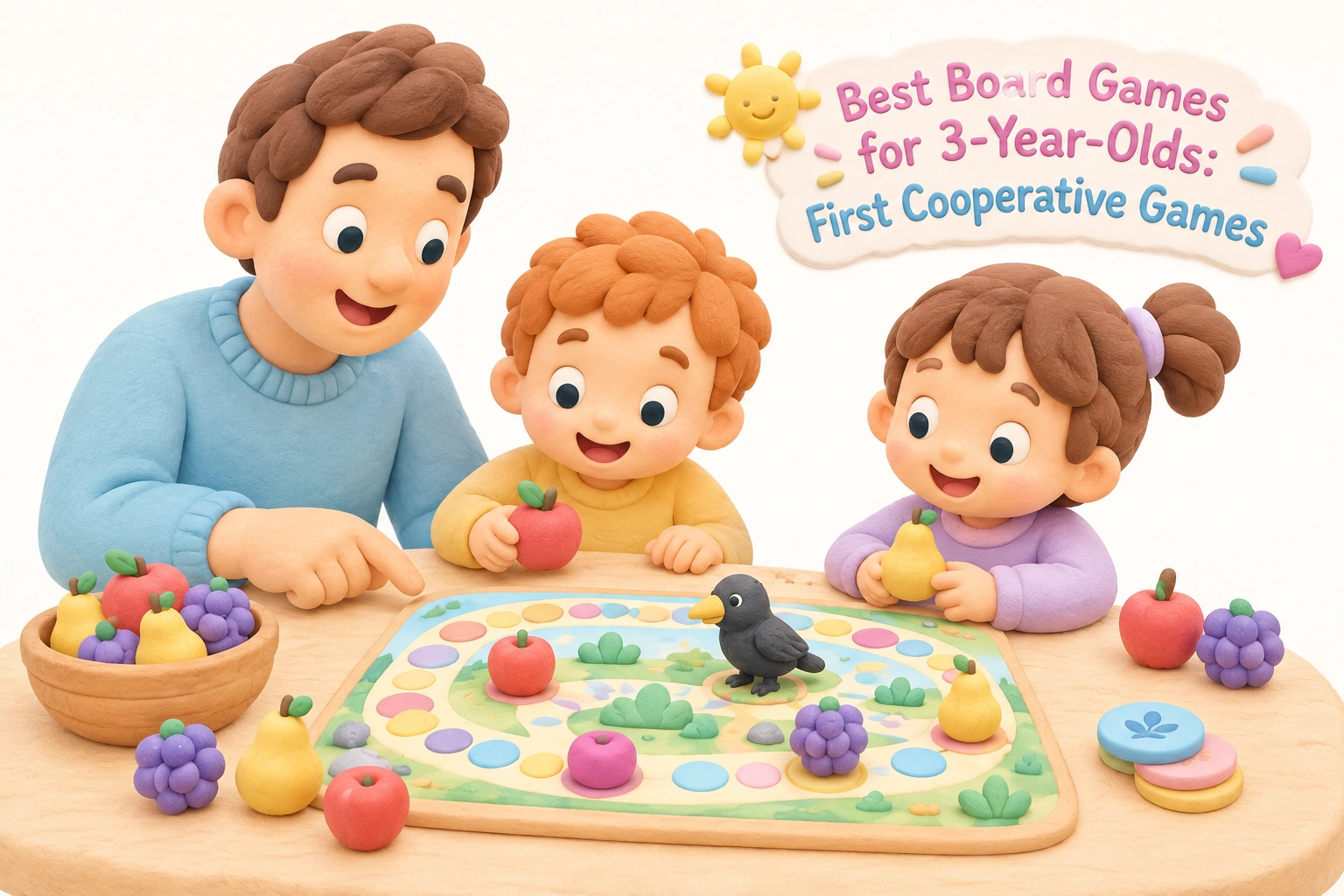
Choosing the right board game for a 3-year-old is less about finding something “educational” and more about finding something that actually works at the table — short enough to hold a preschooler’s attention, simple enough that rules don’t become a battle, and structured so that everyone finishes feeling good. Cooperative board games, where players work together toward a shared goal rather than competing against each other, are increasingly recognized by child development specialists and occupational therapists as an ideal starting point for this age group. This guide covers the best cooperative board games for 3-year-olds, explains what makes them developmentally appropriate, and gives practical advice for making game time genuinely enjoyable.
Key Takeaways
- Cooperative board games — where players win or lose as a team — are widely considered the most developmentally appropriate format for 3-year-olds because they remove the distress of losing while still building turn-taking, color recognition, and early problem-solving skills.
- The best preschool board games require no reading, use chunky wooden pieces or large cards, and can be completed in 10–15 minutes to match a young child’s attention span.
- Publishers such as Peaceable Kingdom and HABA dominate this category because their games are specifically designed around the social-emotional and cognitive needs of children aged 3 and up.
- A child’s readiness for board games varies within the 3-year age band; a child who has just turned 3 may need simpler mechanics than one approaching their fourth birthday.
- Playing board games with a 3-year-old requires caregiver flexibility — bending rules occasionally, managing frustration tolerance, and keeping sessions short are all normal parts of the process.
Why Cooperative Games Are the Right Starting Point for 3-Year-Olds
At age 3, children are in the early stages of understanding that other people have perspectives, feelings, and intentions separate from their own. This developmental window — sometimes called the beginning of theory of mind — makes cooperative play particularly valuable. When a 3-year-old plays a cooperative board game, they practice prosocial behavior in a structured, low-stakes context: waiting for their turn, contributing to a group effort, and experiencing a shared outcome. Research published in peer-reviewed developmental psychology literature suggests that cooperative play experiences in the preschool years are associated with increases in prosocial behavior and reductions in aggressive responses, though outcomes naturally vary by child, temperament, and the quality of adult involvement during play.
Competitive games, by contrast, ask a 3-year-old to accept losing — a concept that requires emotional self-regulation skills most children this age are still actively developing. The result is often tears, rule-bending, or a game that ends abruptly. Cooperative board games sidestep this entirely: there is a common obstacle (a raven stealing fruit, a fox chasing chickens, the sun rising before the owls reach home), and everyone either overcomes it together or doesn’t. This structure means no child leaves the table feeling singled out as the loser, which makes it far more likely that a 3-year-old will want to play again.
Occupational therapists and speech-language pathologists have also noted the practical value of cooperative preschool board games in therapeutic settings. Peaceable Kingdom, one of the leading publishers in this space, has documented use of their games in OT, speech therapy, and child psychology contexts — a meaningful signal that these games do more than entertain. They provide a repeatable, predictable social script that helps children practice communication, waiting, and emotional regulation in a safe environment.
What to Look for in a Board Game for a 3-Year-Old
Not every game labeled “ages 3+” is genuinely suitable for a child who has just turned 3. When evaluating preschool board games, the following criteria matter most.
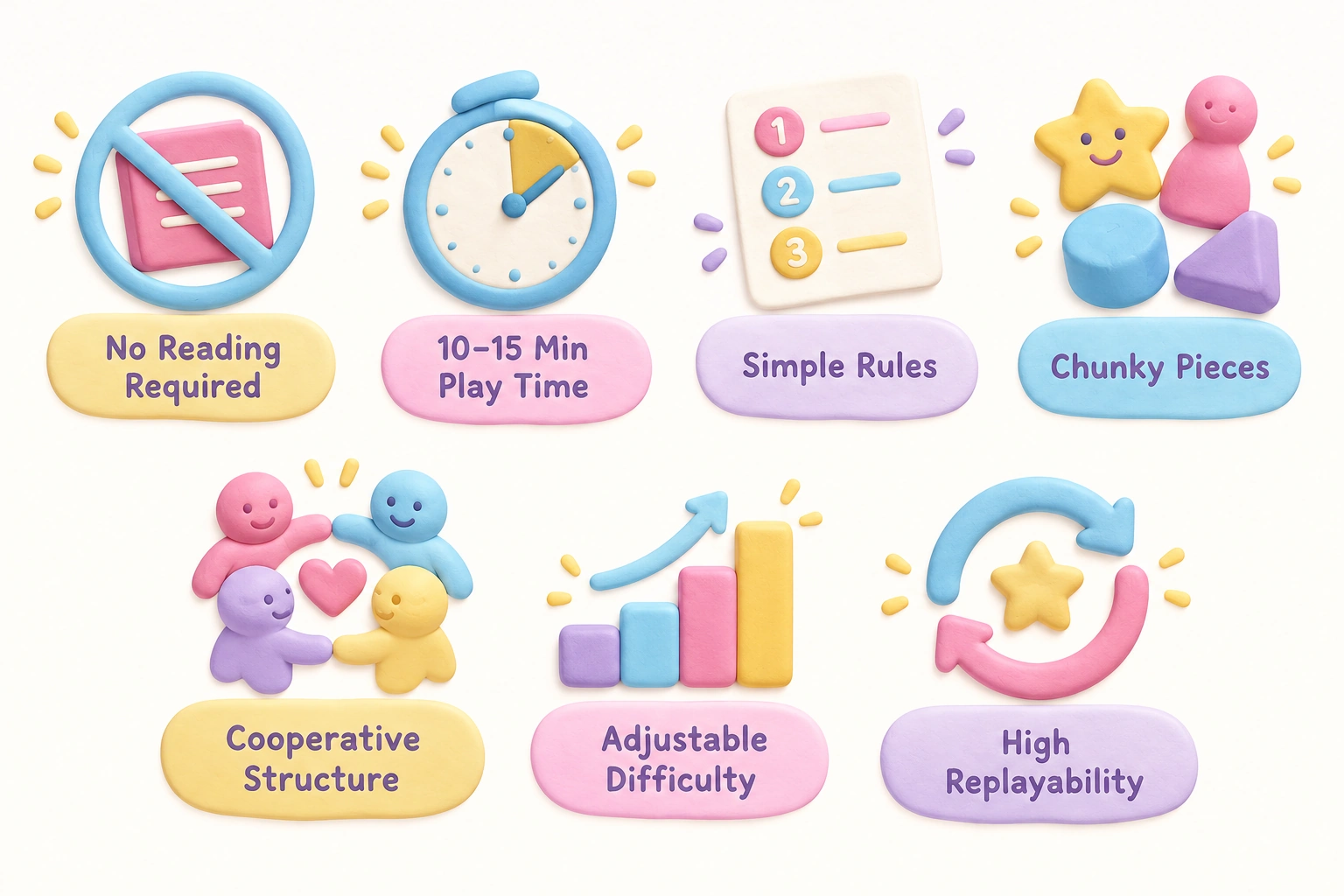
- No reading required: All game information should be communicated through pictures, colors, or simple symbols. A 3-year-old cannot read cards or instructions independently.
- Short play time: Games that run 10–15 minutes are ideal. A 3-year-old’s attention span is limited, and a game that drags past 20 minutes risks frustration and disengagement.
- Simple, consistent rules: One or two core mechanics (spin the spinner, move a piece, draw a card) are enough. Layered rules or exceptions are too cognitively demanding at this stage.
- Chunky wooden pieces or large components: Fine motor skills are still developing at age 3. Large, easy-to-grip pieces reduce frustration and are safer from a choking hazard perspective. Always check the manufacturer’s small parts warning before purchasing for younger children in the household.
- Cooperative structure: Look for a shared win condition and a common obstacle rather than player-versus-player competition.
- Adjustable difficulty: Some games offer multiple levels of play, which extends the game’s useful lifespan as the child develops.
- Replayability: Because 3-year-olds often want to play the same game repeatedly, games with randomized outcomes (spinner results, shuffled cards) hold up better over time than those with fixed paths.
- Theme engagement: Animals, farms, nature, and familiar characters tend to resonate strongly with this age group.
Age Within the Age: Younger vs. Older 3-Year-Olds
The developmental gap between a child who has just turned 3 and one who is approaching their fourth birthday is significant and often underestimated. A younger 3-year-old (roughly 3.0–3.5 years) typically benefits most from games with a single mechanic — spin and move, match the color, place the piece. Abstract concepts like strategy, counting beyond 5, or understanding a multi-step turn sequence may still be out of reach. Games like First Orchard by HABA, which involves rolling a die and placing fruit in a basket before a raven reaches the orchard, are well-suited to this stage because the entire game can be explained in one sentence.
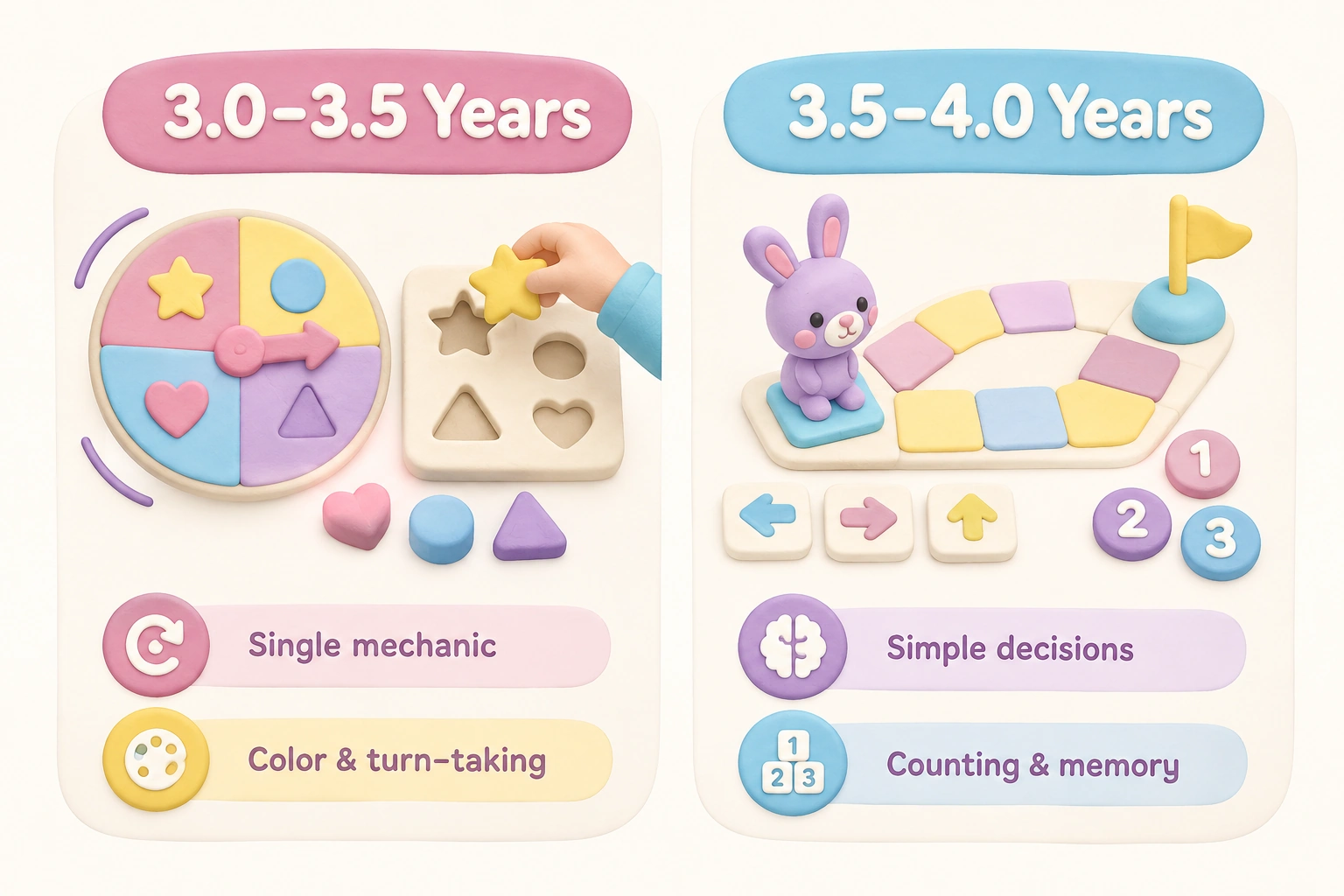
An older 3-year-old (roughly 3.5–4.0 years) can typically handle slightly more complexity: two-step turns, simple counting to 5 or 6, and a basic understanding of game strategy such as choosing which owl to move in Hoot Owl Hoot. At this stage, children also begin to show genuine interest in the social dimension of the game — celebrating a team win, encouraging a sibling, or noticing when the group is close to losing. This is the age at which cooperative board games begin to feel genuinely meaningful rather than just structured play.
Best Cooperative Board Games for 3-Year-Olds
First Orchard (HABA)
First Orchard is widely considered the gold standard first cooperative board game for children aged 2 and up, making it an excellent choice for younger 3-year-olds. Players roll a large wooden die and either pick a fruit from the orchard or move the raven one step closer to the trees. The goal is to harvest all the fruit before the raven arrives. The game requires no reading, uses large chunky wooden pieces in four colors, and is typically completed in under 10 minutes. Color recognition and turn-taking are the primary skills practiced. HABA’s component quality is notably high — the wooden fruit pieces and sturdy board hold up well to repeated play, which matters given that 3-year-olds often want to play the same game multiple times in a row. Replayability is strong because the die outcome is always random.
Hoot Owl Hoot (Peaceable Kingdom)
Hoot Owl Hoot is one of Peaceable Kingdom’s most recognized titles and is frequently recommended by occupational therapists for preschool-aged children. Players work together to fly all the owls back to their nest before the sun rises. On each turn, a player draws a color card and moves any owl to the next space of that color, or draws a sun card that advances the sunrise track. The cooperative mechanic is clean and intuitive, and the game introduces a very gentle element of decision-making — which owl should you move? — that makes it engaging for older 3-year-olds and approaching-4-year-olds. Hoot Owl Hoot also offers adjustable difficulty through the number of owls in play, which extends the game’s lifespan as children develop. The common obstacle here is the rising sun, a concept young children find easy to understand and emotionally engaging.
Count Your Chickens (Peaceable Kingdom)
Count Your Chickens combines cooperative gameplay with early counting skills, making it a strong choice for 3-year-olds who are beginning to count reliably to 5 or 6. Players spin a spinner and move the mother hen around the board, collecting baby chicks along the way. The goal is to get all the chicks into the coop before the game ends. The counting element is embedded naturally into the movement mechanic, so children practice number recognition without it feeling like a lesson. The game is no reading required, uses large colorful pieces, and plays in about 15 minutes. Count Your Chickens is particularly well-suited to sibling play involving a 3-year-old and a slightly older child, as the counting element gives the older child a meaningful role without making the game inaccessible to the younger one.
Feed the Woozle (Peaceable Kingdom)
Feed the Woozle introduces a fine motor skills element that sets it apart from most preschool board games. Players use a large spoon to carry plastic snacks across the board and feed them to the Woozle monster, working together to deliver a set number of snacks before the game ends. The spoon mechanic builds hand-eye coordination and dexterity alongside the cooperative and turn-taking elements. Feed the Woozle also features adjustable difficulty — players can choose how many snacks to carry on the spoon at once, making it accessible for younger 3-year-olds and more challenging for older ones. The game is a strong recommendation for families where a child is working on fine motor development, and it is used in some OT settings for exactly this reason.
Snug as a Bug in a Rug (Peaceable Kingdom)
Snug as a Bug in a Rug is a color-matching and shape-recognition game in which players work together to hide all the bugs under the rug before three stink bugs sneak under. Players roll dice showing colors, numbers, and shapes, then find a matching bug to place under the rug. The game practices color recognition, shape identification, and basic number matching simultaneously, making it one of the more cognitively rich options in the Peaceable Kingdom lineup. It also offers multiple levels of play, which means it can grow with the child from age 3 into the early primary years. The common obstacle — the stink bugs — gives the game a light sense of urgency that most 3-year-olds find genuinely exciting rather than stressful.
Dinosaur Escape (Peaceable Kingdom)
Dinosaur Escape is a cooperative memory and color-matching game in which players work together to rescue three dinosaurs from an island before the volcano erupts. Players flip stones to find matching colors, moving dinosaurs toward safety. The memory element makes this game better suited to older 3-year-olds and 4-year-olds, as working memory is still developing rapidly during this period. The dinosaur theme is highly engaging for children who are in a dinosaur-interest phase, which is common around ages 3–5. Dinosaur Escape is a good next step for families whose child has mastered simpler cooperative games and is ready for a slightly greater cognitive challenge.
Acorn Soup (Eeboo)
Acorn Soup is a cooperative pretend-cooking game in which players collect ingredients to make soup together. It is less structured than most games on this list — there is no competitive element and no losing condition — which makes it particularly well-suited to very young 3-year-olds or children who are not yet ready for even simple rule-following. The game supports imaginative play, color recognition, and early cooperative behavior in a very low-pressure format. Eeboo’s component quality is high, and the nature-themed artwork is calm and appealing. Acorn Soup is a useful bridge between unstructured pretend play and more formal cooperative board games.
A Quick Comparison of Top Picks
| Game | Publisher | Best Age Within 3 | Play Time | Key Skill | Adjustable Difficulty |
|---|---|---|---|---|---|
| First Orchard | HABA | 3.0–3.5 | ~10 min | Color recognition, turn-taking | No |
| Hoot Owl Hoot | Peaceable Kingdom | 3.5–4.0 | ~15 min | Color matching, simple decisions | Yes |
| Count Your Chickens | Peaceable Kingdom | 3.0–4.0 | ~15 min | Counting, color recognition | No |
| Feed the Woozle | Peaceable Kingdom | 3.0–4.0 | ~15 min | Fine motor skills, turn-taking | Yes |
| Snug as a Bug in a Rug | Peaceable Kingdom | 3.5–4.0 | ~15 min | Color, shape, number matching | Yes |
| Dinosaur Escape | Peaceable Kingdom | 3.5–4.0 | ~15 min | Memory, color matching | No |
| Acorn Soup | Eeboo | 3.0–3.5 | Open-ended | Imaginative play, cooperation | N/A |
Playing Board Games with a 3-Year-Old: What Actually Helps
Even the most developmentally appropriate cooperative board game will not run smoothly every time with a 3-year-old. Managing expectations — both the child’s and the caregiver’s — is as important as choosing the right game.
Keep sessions short and stop before the child loses interest rather than after. A 3-year-old who ends a game feeling satisfied is far more likely to want to play again than one who was pushed through to the end while already disengaged. If the game is going well, it is fine to play two rounds back-to-back; if attention is fading, it is fine to stop mid-game and celebrate what was accomplished.
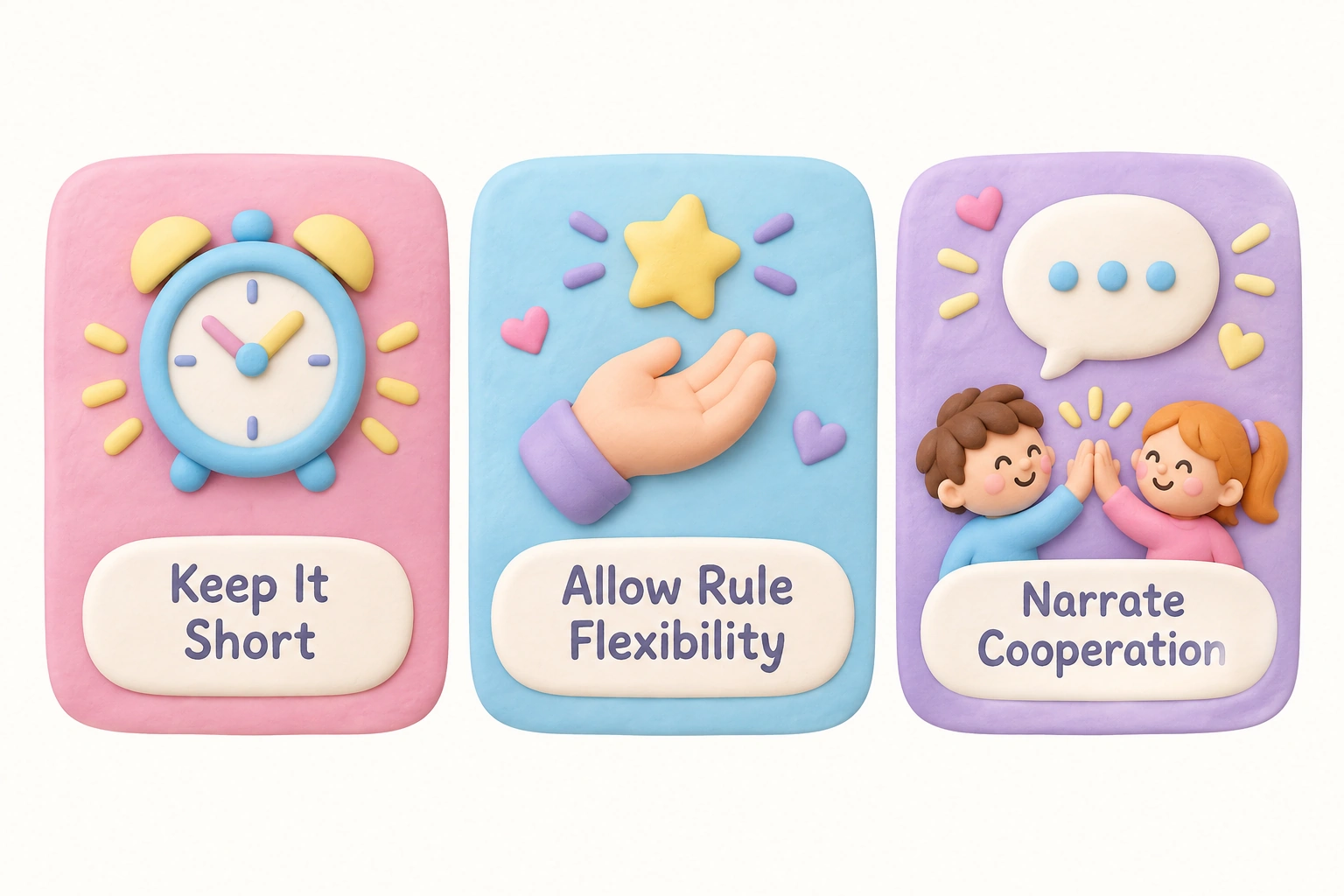
Expect rule flexibility, especially in the first several months of play-based learning with board games. A 3-year-old who rearranges the pieces, invents their own rules, or simply wants to sort the components by color is not doing something wrong — they are engaging with the materials at their current developmental level. Gently modeling the correct rules without insisting on rigid compliance tends to produce better long-term results than enforcing rules strictly.
Narrate the cooperative element explicitly. Saying “we’re working together to get all the owls home” or “let’s help each other beat the raven” reinforces the social-emotional purpose of the game and helps children internalize the concept of a shared goal. This kind of language scaffolding is one of the most effective ways caregivers can enhance the developmental value of cooperative board games.
When a 3-Year-Old Melts Down Mid-Game
Frustration tolerance is still developing at age 3, and even cooperative games can trigger a meltdown — particularly if the team is losing, if a turn doesn’t go as hoped, or if a sibling is perceived to be doing better. This is developmentally normal and does not mean the child is not ready for board games. It means the child is practicing emotional regulation in real time, which is itself a valuable outcome of play-based learning.
When a meltdown occurs mid-game, the most effective response is usually to pause the game calmly, acknowledge the feeling without dismissing it, and offer a choice: take a short break and come back, or stop for today. Forcing a child to continue through significant distress is unlikely to build positive associations with game time. Over repeated sessions, most children gradually develop greater frustration tolerance as they accumulate experience with the game’s structure and outcomes.
It can also help to adjust the game’s difficulty temporarily. If Hoot Owl Hoot is producing too many losses, reduce the number of owls in play so the team wins more often. Experiencing success regularly builds the emotional resilience children need to eventually handle losing gracefully.
Games to Approach with Caution at Age 3
Several classic games are frequently purchased for 3-year-olds but are not well-matched to this developmental stage. Understanding why helps parents make more informed choices.
- Candy Land: Despite its colorful theme, Candy Land is a competitive game with no decisions — players simply draw a card and move. There is no cooperative element, no skill development, and games can run long enough to exhaust a 3-year-old’s attention span. The competitive outcome (one winner, everyone else loses) is also poorly suited to this age group’s emotional development.
- Chutes and Ladders: Similar concerns apply — pure luck, competitive structure, and a play time that can stretch well beyond what a 3-year-old can sustain. The experience of sliding back down a chute after significant progress is particularly frustrating for children who are still developing frustration tolerance.
- Hi Ho Cherry-O: While the fruit theme is appealing, the competitive structure and the possibility of losing all your cherries due to a spinner result (the dog or bird eating them) can be genuinely upsetting for younger 3-year-olds. Some families play it cooperatively by house-ruling the win condition, which can work well.
- Games with small pieces: Any game with components small enough to be a choking hazard should be kept away from children under 3 and used with close supervision for children aged 3–4, particularly if younger siblings are present.
Playing with Siblings: Managing the Age Gap
One of the most common real-world scenarios is a 3-year-old playing alongside a 5- or 6-year-old sibling. Cooperative board games handle this situation better than competitive ones because the older child naturally takes on a supportive role rather than competing against the younger one. In Hoot Owl Hoot, for example, an older child can help a younger sibling understand which owl to move without it feeling like interference — they are working as a team.
For families with a very young child (under 2) also present, it is worth choosing games with no small parts and keeping the game at a table rather than on the floor. The older children can play while the youngest observes, which is itself a form of early exposure to cooperative play concepts.
When the age gap is larger — a 3-year-old and an 8- or 9-year-old — the older child may find the simplest cooperative games unstimulating. In this case, games with adjustable difficulty (Hoot Owl Hoot, Snug as a Bug in a Rug) allow the older child to take on a more complex role while the younger child participates at their own level.
The First Cooperative Game as a Developmental Milestone
Parents often mark milestones like first steps, first words, and first day of preschool. The first cooperative board game is a quieter milestone, but a meaningful one. It is often the first time a young child experiences a structured social activity with rules, shared stakes, and a collective outcome. The skills practiced in that first game — waiting for a turn, contributing to a group effort, managing the tension of an uncertain outcome — are foundational to social-emotional development in ways that extend well beyond the game table.
Play-based learning researchers consistently identify cooperative play as one of the most effective contexts for developing empathy, self-regulation, and prosocial behavior in preschool-aged children. A cooperative board game provides a repeatable, predictable version of that experience, which is particularly valuable for children who benefit from structure and routine. The fact that these games are also genuinely fun — for children and caregivers alike — makes them one of the more sustainable tools in a family’s early childhood toolkit.
Frequently Asked Questions
What age can children start playing cooperative board games?
Many cooperative board games designed for preschoolers are suitable from around age 2.5 to 3, depending on the child’s ability to follow simple instructions and take turns. First Orchard by HABA is often recommended as early as age 2. Most children are ready for a broader range of cooperative games by age 3 to 3.5.
How long should a board game session last for a 3-year-old?
Most developmental guidance suggests keeping sessions to 10–20 minutes for children aged 3. Games designed for this age group typically run 10–15 minutes, which aligns well with a preschooler’s attention span. Stopping while the child is still engaged — rather than after interest has faded — tends to build more positive associations with game time.
Are cooperative games better than competitive games for 3-year-olds?
For most children at age 3, cooperative games are a better fit because they remove the emotional challenge of losing, which requires self-regulation skills that are still developing at this stage. Competitive games are not harmful, but they often produce frustration and tears in younger preschoolers. Cooperative games allow children to experience the social and cognitive benefits of structured play without the added emotional complexity of competition.
What if my 3-year-old doesn’t want to follow the rules?
This is very common and developmentally normal. At age 3, children are still learning what rules are and why they matter. Gently modeling correct play, narrating what you are doing and why, and allowing some flexibility in the early stages tends to work better than strict enforcement. Over time, most children naturally become more interested in playing “the right way” as they develop a sense of fairness and enjoy the satisfaction of a genuine win.
Can these games be used in a preschool or therapy setting?
Yes. Cooperative board games from publishers such as Peaceable Kingdom are used in preschool classrooms, occupational therapy, speech therapy, and child psychology settings. Their structured cooperative format, simple mechanics, and no reading required design make them practical tools for practitioners working on turn-taking, communication, and social-emotional skills with young children.
How do I choose between games at different price points?
Most cooperative board games for 3-year-olds fall into a similar price range, with HABA games sometimes priced slightly higher due to their wooden component quality. For a first purchase, First Orchard (HABA) or Count Your Chickens (Peaceable Kingdom) are reliable starting points at a mid-range price. If budget is a consideration, Peaceable Kingdom titles are widely available and offer strong replayability relative to their cost. Investing in one high-quality game that will be played dozens of times is generally better value than several cheaper games that lose appeal quickly.
Which Cooperative Board Game Is the Right First Choice for Your Child?
The best first cooperative board game for a 3-year-old depends primarily on where the child is within the 3-year age band and what skills feel most relevant to your family’s goals. For a younger 3-year-old or a child who is new to structured play, First Orchard by HABA is the most consistently reliable starting point — it is simple enough to be genuinely accessible, short enough to hold attention, and engaging enough to be requested again. For an older 3-year-old who is ready for a small element of decision-making, Hoot Owl Hoot by Peaceable Kingdom offers a natural next step with the added benefit of adjustable difficulty as the child grows.
If fine motor development is a priority, Feed the Woozle adds a physical dexterity element that most other preschool board games lack. If you are looking for a game that works across a sibling age gap, Count Your Chickens or Snug as a Bug in a Rug tend to hold the interest of older children while remaining accessible to a 3-year-old. None of these games require a significant investment, and all of them offer strong replayability — an important practical consideration when a 3-year-old discovers a favorite and wants to play it every single day.
The cooperative format itself is the most important feature to prioritize at this age. A game where the whole family works together toward a shared goal, navigates a common obstacle, and finishes the session on the same side is not just more developmentally appropriate — it is more likely to make game time something everyone looks forward to.

Take a short quiz to find out what your everyday choices say about your parenting style
When your child is curious about something new, what’s your instinct?
Take a short quiz to find out what your everyday choices say about your parenting style
“Can I download this app?” What happens next?
Take a short quiz to find out what your everyday choices say about your parenting style
When it comes to rules at home, which sounds most like you?
Take a short quiz to find out what your everyday choices say about your parenting style
If you could give your child one life skill today, what would you pick?
Take a short quiz to find out what your everyday choices say about your parenting style
Your child gets to choose what to watch. What would your ideal setup look like?
Take a short quiz to find out what your everyday choices say about your parenting style
Pick your parenting superpower ✨