Best Board Games for 2-Year-Olds: Matching and Turn-Taking Picks

 Discover a Free Education Video App for Kids
Pastory uses AI to personalize educational video content based on your child’s interests and personality. Safe, engaging, and built for curious young minds. Sign up now to stay updated and enjoy early access with a free trial
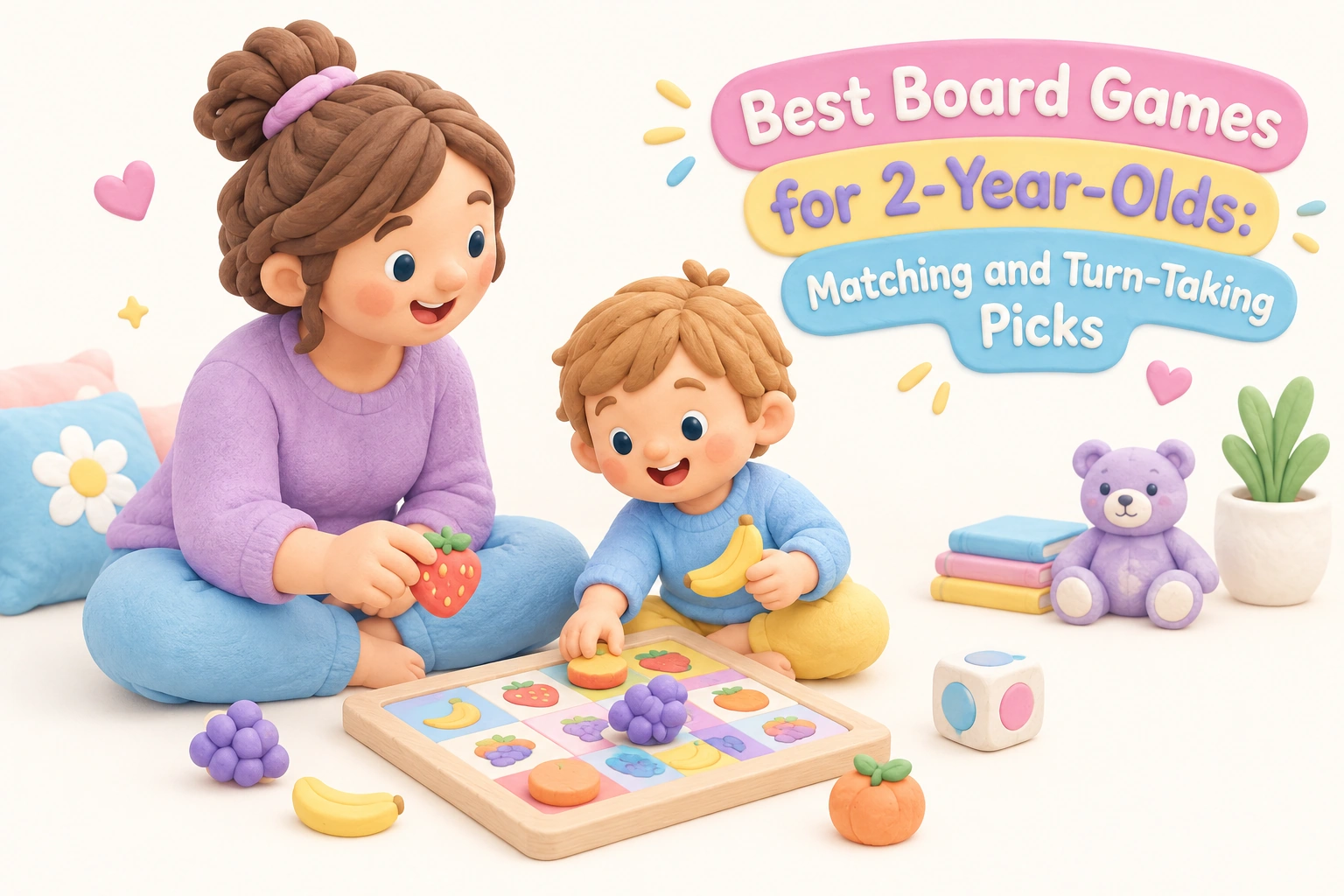
Two-year-olds can absolutely play board games — with the right expectations. At this age, the goal is not winning or following every rule precisely; it is the shared experience of sitting together, handling pieces, and beginning to understand that play has a rhythm. The best board games for 2-year-olds are built around two foundational skills that toddlers are actively developing: matching and turn-taking. This guide explains which games genuinely support those skills, how to choose age-appropriate options safely, and how to make early game sessions enjoyable rather than frustrating.
Key Takeaways
- Board games designed for 2-year-olds focus on color matching, simple picture recognition, and cooperative turn-taking rather than competition or reading.
- Chunky wooden pieces, simple rules, and short play times of 5–10 minutes are the most important design features for this age group.
- Cooperative toddler board games are developmentally better suited than competitive ones because most 2-year-olds are not yet ready to handle losing gracefully.
- Newly 2-year-olds may treat pieces as toys; children closer to 2.5 years typically engage more meaningfully with actual game mechanics.
- Brands such as HABA My Very First Games and Peaceable Kingdom consistently produce age-appropriate games that meet recognized safety standards.
Can a 2-Year-Old Really Play Board Games?
Yes, but the definition of “playing” looks different at this age than it does for older children. A 2-year-old’s attention span is typically no more than five to six minutes for a structured activity, and their understanding of rules is still emerging. In the early months of the second year, many toddlers will explore game pieces as objects — stacking them, sorting them by color, or simply carrying them around. This is not a failure; it is developmentally appropriate exploratory play.
Around 2.5 years, most children begin to engage more meaningfully with actual game mechanics. They can follow a simple one-step instruction, wait briefly for their turn, and respond to visual cues such as color matching or picture cards. This age-within-age distinction matters when choosing a first board game. A game that frustrates a newly 2-year-old may be genuinely enjoyable six months later. Keeping expectations flexible and sessions short is the most effective approach at this stage.
Why Matching and Turn-Taking Matter at Age Two
Matching and turn-taking are not arbitrary game mechanics — they map directly onto two developmental milestones that are active during the toddler years. Color recognition and visual matching support early cognitive development, including pattern recognition, memory skills, and the foundations of logical thinking. When a child matches a red apple card to a red apple space on a board, they are practicing visual discrimination and object categorization, skills that contribute to preschool readiness.
Turn-taking is a cornerstone of social-emotional learning. Waiting for a turn requires impulse control, an awareness that other people have needs, and the ability to tolerate a brief delay in gratification. These are genuinely difficult skills for a 2-year-old whose prefrontal cortex — the brain region responsible for self-regulation — is still in very early development. Board games that build in natural turn-taking moments give toddlers repeated, low-stakes practice with these skills in a context that feels playful rather than corrective.
Pairing matching and turn-taking in the same game session creates a particularly rich learning opportunity. The child is simultaneously exercising visual cognition and social awareness, with a caregiver present to model, encourage, and gently redirect. This kind of parent-child interaction during play is consistently associated with stronger language development and social skills in early childhood research.
Cooperative vs. Competitive: Why It Matters for Toddlers
Most developmental specialists and experienced game designers agree that cooperative toddler board games are far better suited to the 2-year-old age group than competitive ones. The reason is straightforward: competitive play requires an understanding of losing that most 2-year-olds simply do not yet have. When a toddler loses, the emotional response is often intense and disproportionate — not because the child is poorly behaved, but because emotional regulation is still developing. A game that ends with one winner and one loser can quickly derail the session and create a negative association with game play.
Cooperative games solve this by having all players work toward a shared goal. Everyone wins together or everyone faces the same outcome together. This structure removes the sting of individual failure and keeps the focus on the process — rolling the die, moving a piece, matching a color — rather than the outcome. It also naturally models collaborative behavior, which is a key social skill for the preschool years ahead.
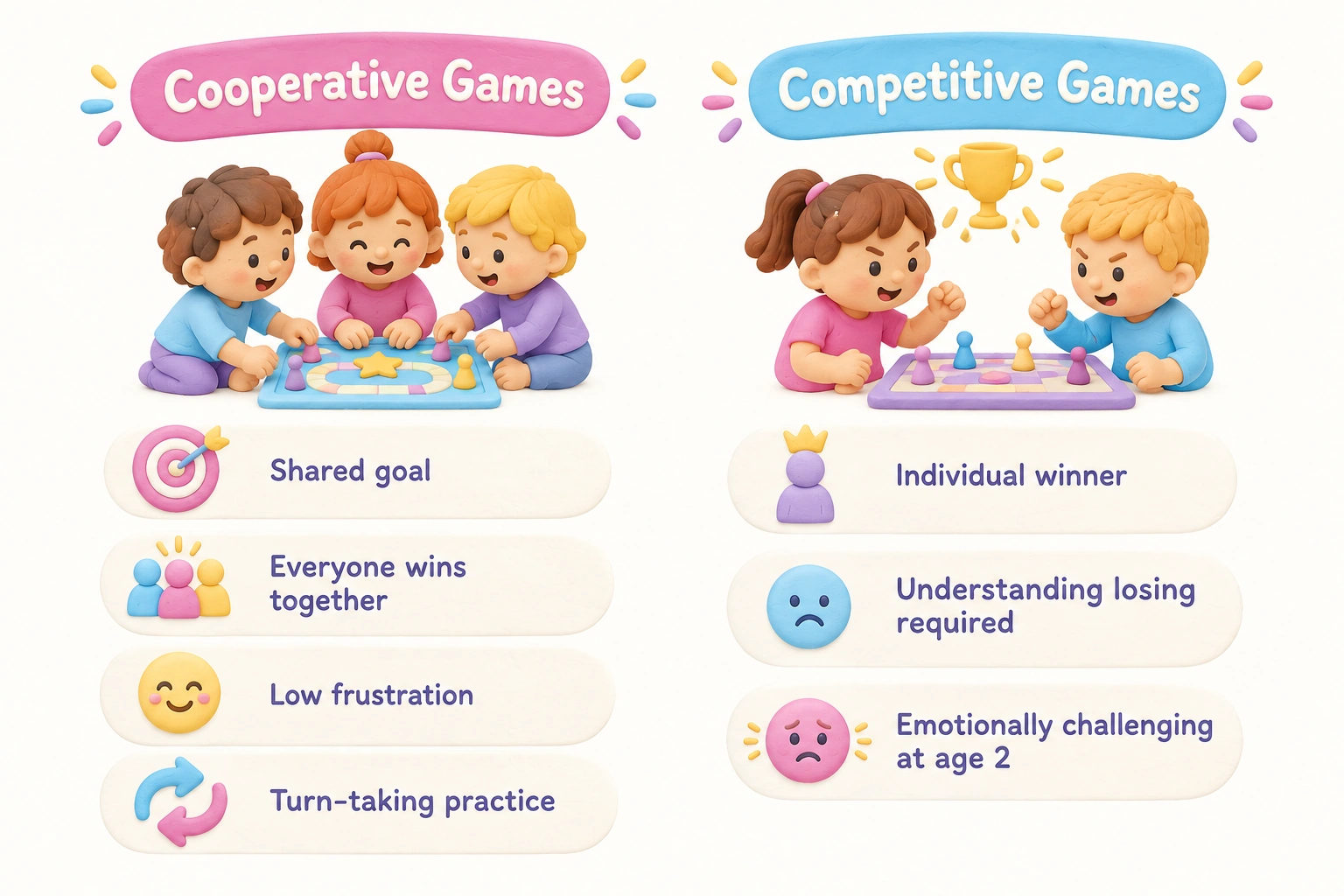
Competitive games such as Candy Land can still be introduced at this age, but they work best when the competitive element is downplayed and the focus is kept on color recognition and taking turns. Adapting the rules — for example, letting the child draw again if they land on a difficult space, or simply celebrating each move rather than tracking who is ahead — makes competitive-format games more accessible for 2-year-olds.
Best Board Games for 2-Year-Olds: Organized by Skill
Best for Color Matching and Visual Recognition
HABA My Very First Games — First Orchard is widely regarded as one of the best first board games for toddlers. Designed specifically for children as young as 2, it uses a large color die, chunky wooden fruit pieces, and a simple cooperative mechanic: players work together to harvest fruit before the raven reaches the orchard. No reading required, no individual winner, and the chunky wooden pieces are easy for small hands to grasp. The color matching element — matching the die color to the corresponding fruit — directly supports color recognition and hand-eye coordination. Play time is typically 5–10 minutes, which aligns well with the toddler attention span.
Colorama by HABA is another strong color-matching game. Players spin a spinner and place wooden discs onto matching colored spaces on a board. The mechanics are minimal, the pieces are satisfying to handle, and the game can be played with as few as two players, making it ideal for a parent-child session. Because the rules are so simple, a caregiver can focus entirely on narrating the play — naming colors, counting spaces, and celebrating each match — which adds valuable language development to the experience.
Peaceable Kingdom Snail’s Pace Race uses color dice and wooden snail tokens to create a gentle race format where no single player wins — all snails are racing together. Children choose a snail to cheer for and roll the die to advance the matching color. The game builds color recognition and introduces the concept of taking turns without any competitive pressure. It is one of the most reliably recommended toddler board games for the 2–4 age range.
Best Cooperative Toddler Board Games for Turn-Taking
Peaceable Kingdom Go Away Monster is a hide-and-find cooperative game in which players reach into a bag, feel a piece, and decide whether it belongs in their bedroom or whether it is a monster to be sent away. The tactile element is engaging for toddlers, and the cooperative structure means everyone plays together toward the same goal. Turn-taking is built naturally into the mechanic — each player takes a turn reaching into the bag — and the game’s playful theme tends to hold toddler attention well. Fine motor skills and tactile discrimination are also supported.
Peaceable Kingdom Monkey Around is a movement-based cooperative game that asks players to spin a spinner and perform a simple physical action — hop like a frog, balance on one foot, give someone a hug. This format is particularly well suited to toddlers who find it difficult to sit still for a traditional board game. Turn-taking is practiced through the spinner mechanic, and the gross motor element makes the game feel active and fun rather than sedentary. Play time is short, and the game can be stopped and restarted easily.
Roll and Play by ThinkFun is often described as the most accessible first board game for very young toddlers. A large plush cube acts as the die, and color-coded cards prompt simple actions — make an animal sound, point to something blue, give a hug. The game has no board, no pieces to lose, and no competitive element. It is particularly useful for children at the younger end of the 2-year-old range who are not yet ready for more structured game mechanics. Turn-taking is introduced gently, and the prompts support vocabulary building and color recognition simultaneously.
Best Matching Games for Memory and Cognitive Development
HABA My Very First Games — Here Fishy Fishy introduces a simple fishing mechanic in which players use a magnetic fishing rod to catch fish from a pond. Each fish has a color or pattern, and players match their catch to spaces on their board. The fine motor challenge of using the fishing rod adds hand-eye coordination practice, and the matching element supports early memory skills and visual recognition. The game is cooperative and plays in under 10 minutes.
Peaceable Kingdom Count Your Chickens is a cooperative counting and matching game in which players move a mother hen around a path, collecting chicks to bring back to the coop. The cooperative win condition — all chicks must be collected before the game ends — keeps the focus on shared effort rather than individual performance. Counting skills and number recognition are introduced alongside turn-taking, making this a useful bridge game for children approaching 3 years old.
Lucky Ducks uses a motorized pond that spins rubber ducks, and players try to match ducks by the symbols on their bottoms. The movement of the ducks adds a sensory and attention-holding element that works well for toddlers with shorter attention spans. Matching skills, color recognition, and turn-taking are all practiced, and the game’s novelty tends to sustain engagement longer than static matching games.
For a simpler matching game option, a standard picture memory game with a reduced tile count — eight to twelve pairs rather than the full set — is an effective and low-cost alternative. Reducing the number of tiles makes the game age-appropriate and keeps play time within the toddler attention span. This kind of rule adaptation is completely reasonable and developmentally sound.
How to Introduce Board Games to a 2-Year-Old
The most effective approach to introducing board games at this age is to treat the first several sessions as exploration rather than instruction. Place the game pieces on the table and let the child handle them freely before explaining any rules. This reduces the novelty of the pieces and makes it easier for the child to focus on the game mechanics once play begins.
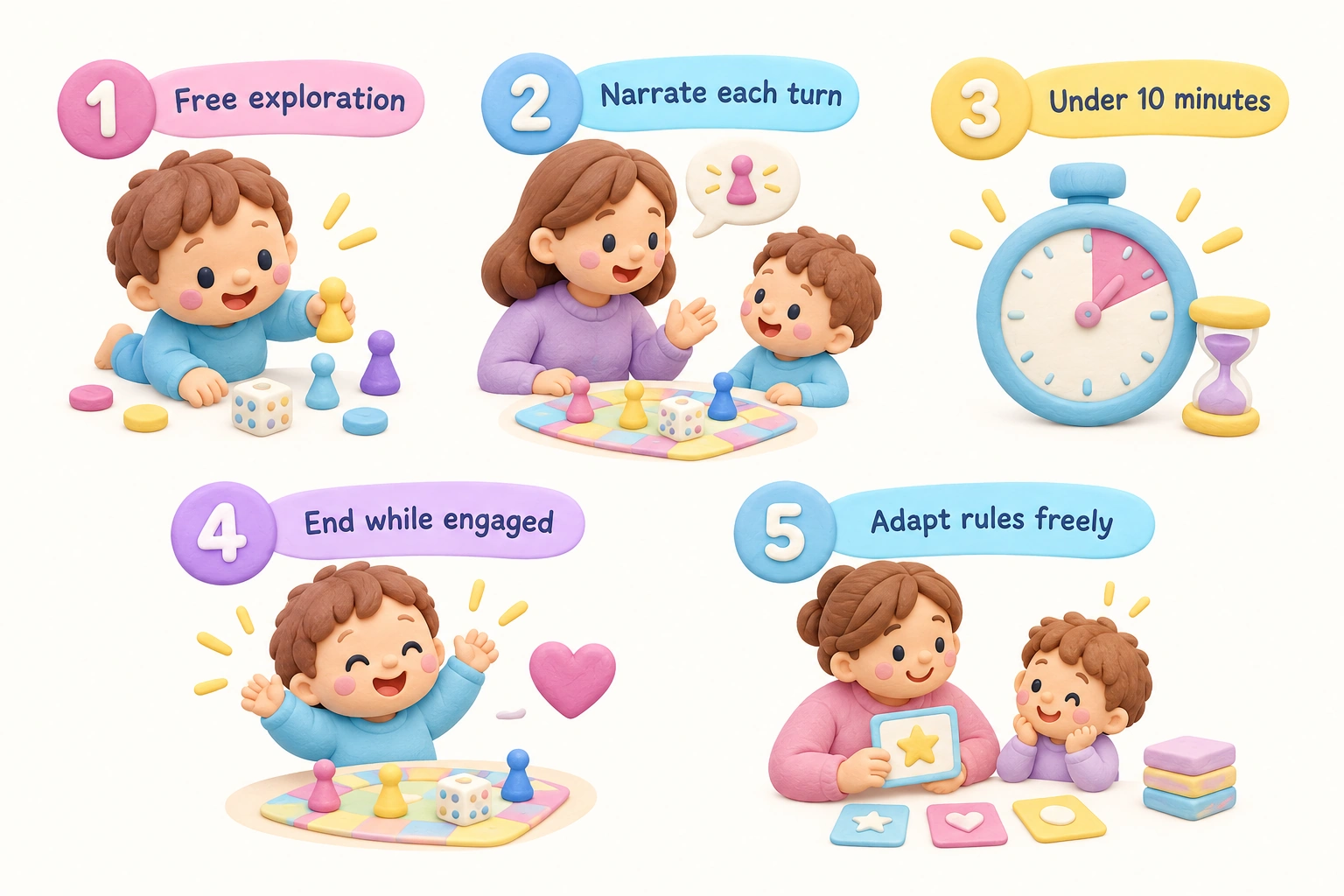
When introducing turn-taking, narrate each turn clearly and consistently: “My turn — I roll the die. Now it’s your turn — you roll the die.” Physical cues such as passing the die directly to the child help make the abstract concept of turn order concrete. Praise the act of waiting rather than the outcome: “You waited so patiently for your turn — well done.” This reinforces the behavior that matters most at this developmental stage.
Keep sessions short and end them before the child loses interest rather than after. A session that ends while the child is still engaged creates a positive association with game play and makes it easier to return to the game another day. If a child wants to stop mid-game, allow it without pressure. Forcing a 2-year-old to finish a game they have disengaged from is counterproductive and can create resistance to future play.
It is also worth adapting rules freely. Reducing the number of cards in a matching game, skipping complex rule elements, or simply playing without keeping score are all valid modifications. The goal at age 2 is not rule compliance — it is enjoyable, developmentally rich interaction.
How to Teach Turn-Taking Through Games: A Step-by-Step Approach
- Model the behavior first. Before asking the child to wait, demonstrate what waiting looks like. Take your turn, narrate it aloud, then explicitly hand the turn to the child.
- Use a physical object to mark whose turn it is. A small token, a special die, or even a stuffed animal can serve as a “turn marker” that the child passes to the next player. The physical act of passing reinforces the concept.
- Keep waiting time minimal. At age 2, waiting more than 30–60 seconds for a turn is genuinely difficult. Choose games with fast turn cycles or play with only two players to reduce wait time.
- Name the feeling. If the child struggles to wait, acknowledge it: “I know it’s hard to wait. Your turn is coming very soon.” This validates the emotion without abandoning the expectation.
- Celebrate the wait, not just the turn. When the child successfully waits, acknowledge it specifically before they take their turn. This reinforces the behavior in the moment when it is most meaningful.
- Gradually increase complexity. Once a child reliably takes turns with one other player, introduce a third player or a slightly longer wait time. Progress is gradual and individual.
Buying Guide: What to Look for in Board Games for 2-Year-Olds
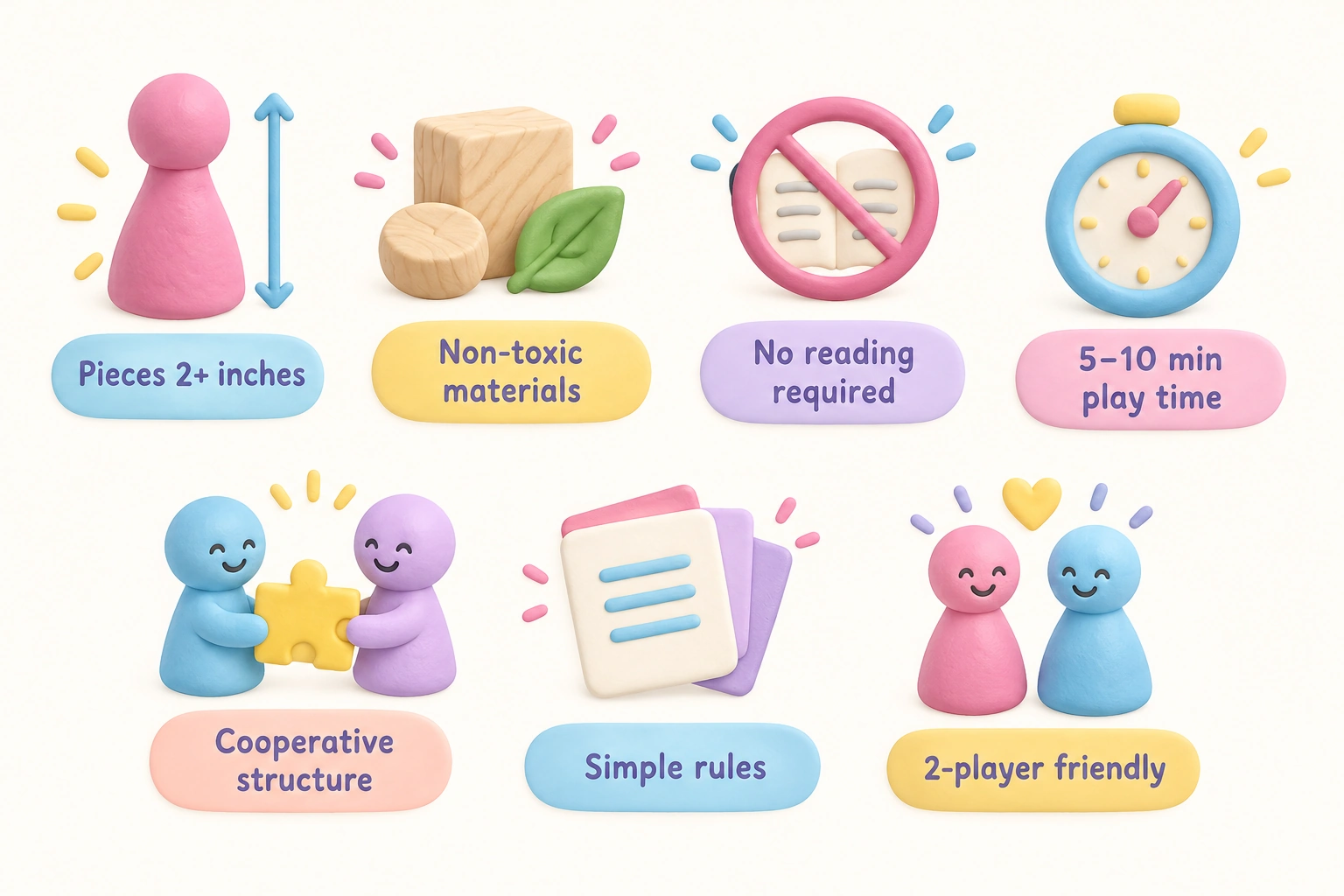
Choosing an age-appropriate game for a 2-year-old involves evaluating several practical factors beyond the age label on the box. The following checklist covers the most important considerations.
Safety Checklist
- Piece size: All components should be large enough to prevent a choking hazard. Look for pieces at least 2 inches in diameter. Avoid games with small tokens, beads, or thin cards that a toddler could put in their mouth.
- Materials: Chunky wooden pieces made from non-toxic, PEFC-certified or equivalent sustainably sourced wood are preferable. Thick cardstock with rounded corners is safer than thin, sharp-edged cards.
- Safety standards: Look for games that meet recognized safety standards such as ASTM F963 (US) or EN71 (Europe). Reputable brands such as HABA and Peaceable Kingdom consistently meet these standards.
- Durability: Toddler-proof construction matters. Games with flimsy boards or easily torn cards will not survive repeated play at this age.
Design and Gameplay Checklist
- Simple rules: The game should be explainable in one or two sentences. If the rulebook requires more than a page for the toddler version, the game is likely too complex.
- No reading required: All instructions and game elements should be icon-based, color-based, or picture-based. No reading required is a non-negotiable feature for this age group.
- Short play time: Target games with a play time of 5–10 minutes. Games that run longer than 15 minutes are unlikely to hold a 2-year-old’s attention.
- Cooperative structure: Cooperative games are strongly preferred over competitive ones for this age group, for the developmental reasons outlined earlier.
- Two-player compatibility: Many toddler game sessions involve one parent and one child. Confirm the game works well with just two players.
Games That Grow With the Child
Some games remain engaging well beyond age 2, while others are quickly outgrown. HABA First Orchard, for example, can be played in its standard form at age 2 and then extended with the more complex Big Orchard version as the child develops. Peaceable Kingdom games such as Hoot Owl Hoot and Count Your Chickens introduce slightly more complex cooperative mechanics that become more meaningful around age 3–4. Choosing games with some developmental range — rather than games that are only appropriate for a narrow window — offers better long-term value.
Low-Cost and DIY Alternatives
Not every matching and turn-taking activity requires a purchased game. A simple homemade color-matching game using paint chips from a hardware store, sorted into pairs and placed face-down for a memory game, costs almost nothing and can be tailored to the child’s current interests. Sorting household objects by color or shape into muffin tins practices the same visual discrimination skills as a commercial matching game. Turn-taking can be practiced through any shared activity — passing a ball, taking turns adding blocks to a tower, or alternating pages in a picture book. These open-ended play alternatives are genuinely valuable and can complement rather than replace structured board game sessions.
Frequently Asked Questions
What is the best first board game for a 2-year-old?
HABA My Very First Games — First Orchard is consistently recommended as one of the best first board games for toddlers. It uses chunky wooden pieces, a simple color die, a cooperative structure, and plays in under 10 minutes. Roll and Play is a strong alternative for children at the younger end of the 2-year-old range who are not yet ready for a board-based game.
How long should a board game session last for a 2-year-old?
Most 2-year-olds can sustain focused attention on a structured activity for approximately five to six minutes at a time. Aim for game sessions of 5–10 minutes and end the session while the child is still engaged rather than waiting until they lose interest. Shorter, positive sessions build a stronger association with game play than longer sessions that end in frustration.
Are competitive games like Candy Land appropriate for 2-year-olds?
Candy Land can be introduced at this age, but the competitive element is best downplayed. Focus on color recognition and turn-taking rather than who reaches the end first. Adapting the rules — for example, not tracking who is winning — makes the game more developmentally appropriate. Most developmental guidance suggests that cooperative games are better suited to 2-year-olds because competitive play requires an understanding of losing that most children at this age have not yet developed.
What if my 2-year-old just wants to play with the pieces rather than follow the rules?
This is completely normal, particularly for children in the earlier months of the second year. Allow free exploration of the pieces first, then gently introduce one simple game element at a time. There is no developmental harm in a toddler using game pieces as toys — it is a valid form of exploratory play. Structured game mechanics typically become more accessible around 2.5 years.
How do I know if a game is safe for a 2-year-old?
Check that all pieces are large enough to prevent a choking hazard — generally at least 2 inches in diameter. Look for non-toxic materials, sturdy construction, and compliance with recognized safety standards such as ASTM F963 or EN71. Avoid games with small tokens, thin cards, or components that could splinter. Brands such as HABA and Peaceable Kingdom are well-regarded for meeting these safety criteria consistently.
Do board games at age 2 actually support development, or is it just play?
The distinction between “just play” and developmental support is not meaningful at this age — play is the primary mechanism through which toddlers develop cognitive, social, and motor skills. Matching games may support color recognition, visual discrimination, and early memory skills. Cooperative turn-taking games may help develop impulse control, social awareness, and the foundations of collaborative behavior. Outcomes vary by child, and caregiver involvement during play significantly influences how much developmental benefit a child gains from any game session.
Choosing the Right Board Game for Your 2-Year-Old
The most important factor in choosing a board game for a 2-year-old is not the game itself — it is the quality of the shared experience it creates. A cooperative toddler board game with chunky wooden pieces, simple rules, and a short play time provides the structure; a present, engaged caregiver provides the developmental value. Matching games build the visual and cognitive foundations that support preschool readiness. Turn-taking games give toddlers repeated, low-stakes practice with one of the most important social skills they will need in the years ahead.
Start with one well-chosen game rather than a collection. HABA My Very First Games and Peaceable Kingdom both offer reliable starting points that are age-appropriate, safe, and genuinely enjoyable for parent and child alike. Adapt the rules freely, keep sessions short, and follow the child’s lead. As your child moves through the toddler years, the games can grow in complexity alongside their developing attention span, social awareness, and cognitive skills. The habit of sitting down together to play — more than any specific game — is the foundation worth building.

Take a short quiz to find out what your everyday choices say about your parenting style
When your child is curious about something new, what’s your instinct?
Take a short quiz to find out what your everyday choices say about your parenting style
“Can I download this app?” What happens next?
Take a short quiz to find out what your everyday choices say about your parenting style
When it comes to rules at home, which sounds most like you?
Take a short quiz to find out what your everyday choices say about your parenting style
If you could give your child one life skill today, what would you pick?
Take a short quiz to find out what your everyday choices say about your parenting style
Your child gets to choose what to watch. What would your ideal setup look like?
Take a short quiz to find out what your everyday choices say about your parenting style
Pick your parenting superpower ✨