15 Best Preschool Learning Games: Apps and Hands-On Picks

 Discover a Free Education Video App for Kids
Pastory uses AI to personalize educational video content based on your child’s interests and personality. Safe, engaging, and built for curious young minds. Sign up now to stay updated and enjoy early access with a free trial
Choosing the right preschool learning games can feel overwhelming when every app store and toy shelf promises to make your child smarter. The reality is more nuanced: the best games for preschoolers are those that match a child’s current developmental stage, hold their attention without frustration, and ideally invite a caregiver to join in. This guide covers 15 carefully selected picks — a mix of educational apps and hands-on board games — organized by skill area, with honest notes on age-appropriateness, cost, and what each game actually does for a young learner.
Key Takeaways
- Play-based learning remains one of the most evidence-supported approaches for children ages 3–5, whether the play happens on a screen or around a table.
- The American Academy of Pediatrics recommends limiting recreational screen time to about one hour per day for children ages 2–5, making screen-free board game picks a valuable complement to any app routine.
- Quality matters more than quantity: a single well-designed, ad-free app used with a caregiver is likely more beneficial than several passive or ad-interrupted alternatives used alone.
- Cooperative games — where players work together rather than compete — are especially well-suited to preschoolers who are still developing turn-taking and emotional regulation skills.
- No game, digital or physical, replaces open-ended play, conversation, and caregiver interaction as the foundation of early childhood development.
What Makes a Preschool Learning Game Worth Choosing?
Not every colorful app or box labeled “educational” delivers meaningful learning. When evaluating preschool learning games, child development researchers and early childhood educators generally look for a few consistent qualities. The game should target a specific developmental domain — such as early literacy skills, number sense, fine motor skills, or social-emotional learning — rather than offering a vague mix of activities with no clear progression. It should be genuinely age-appropriate, meaning the challenge level matches what a 3-, 4-, or 5-year-old can reasonably manage without adult intervention at every step.
For digital games, additional considerations include whether the app is ad-free, whether it offers a parent dashboard for tracking progress, and whether it can be used offline. For physical games, the key questions are whether the rules are simple enough for a preschooler to follow, whether the game supports turn-taking and cooperation, and whether it can be completed in a sitting of 10–20 minutes — roughly the attention span most preschoolers can sustain for a structured activity. Games that invite caregiver participation tend to produce better outcomes than those designed purely for independent use, because the adult interaction itself is a powerful driver of language development and cognitive growth.
Best Preschool Learning Apps (Digital Picks)
1. Khan Academy Kids — Best Free All-Around App
Khan Academy Kids is a fully free, ad-free educational app covering early literacy, early math, social-emotional learning, and creative activities for children ages 2–8. The app uses a cast of animal characters to guide children through structured lessons and open-ended activities, and it includes a parent dashboard that shows which skills a child has practiced. Khan Academy Kids is aligned with Head Start standards and Common Core frameworks, making it a useful tool for homeschooling parents and pre-K educators as well as families at home. A meaningful limitation is that the app works best when a caregiver occasionally reviews the dashboard and discusses completed activities with the child — passive solo use reduces its developmental impact.
2. ABCmouse — Best Comprehensive Curriculum App
ABCmouse offers a structured, step-by-step early learning curriculum for ages 2–8, covering reading, math, science, and art through more than 10,000 individual activities. The platform uses a “Learning Path” that adapts to a child’s progress, which can support kindergarten readiness by ensuring foundational skills are practiced before new ones are introduced. ABCmouse operates on a subscription model, which is a meaningful cost consideration for families. The breadth of content is a strength, but some children find the structured path less engaging than more open-ended alternatives; parental involvement in selecting activities can help maintain motivation.
3. Endless Alphabet — Best for Vocabulary Building
Endless Alphabet focuses specifically on vocabulary building and phonemic awareness through animated, interactive word puzzles. Each word is introduced with a short animated scene that illustrates its meaning, and children drag letter characters into place while hearing each letter’s sound. The app is well-suited to ages 3–6 and is particularly effective for children who are beginning to connect letters with sounds. Endless Alphabet is a one-time purchase with no in-app subscriptions, which many parents appreciate. Its limitation is narrow scope — it does not cover math or broader literacy skills — so it works best as a complement to a more comprehensive program.
4. PBS Kids Games — Best Free Screen-Time Option
PBS Kids Games offers a large collection of free, ad-free games featuring familiar characters from shows such as Daniel Tiger, Curious George, and Dinosaur Train. The games cover a range of early learning skills including counting, letter recognition, problem-solving, and social-emotional themes. Because the characters are already familiar to many preschoolers from television, engagement tends to be high. The app does not offer a structured learning path or parent dashboard, so it functions better as a supplementary activity than a primary educational tool. It is available on multiple platforms and works well for short, focused play sessions within a balanced screen time routine.
5. Pok Pok — Best Montessori-Inspired App
Pok Pok is a Montessori-inspired app designed for children ages 2–7 that emphasizes open-ended play rather than structured lessons. Activities include building, sorting, drawing, and imaginative play scenarios that encourage exploration without right-or-wrong outcomes. The app is subscription-based and ad-free, with no in-app purchases. Pok Pok is particularly well-suited to children who become frustrated by structured, goal-oriented apps, and it aligns with the Montessori principle that children learn most effectively through self-directed discovery. Its limitation is that it does not explicitly teach phonics or number skills in a sequential way, so families seeking measurable academic progress may want to pair it with a more structured option.
6. Duolingo ABC — Best for Early Literacy Skills
Duolingo ABC is a free, ad-free app focused specifically on early literacy skills for children ages 3–6. It covers letter recognition, phonics, and early reading through short, game-like lessons that typically take 5–10 minutes. The app uses a structured progression that builds phonemic awareness systematically, which research in early childhood education suggests is one of the most important predictors of later reading success. Duolingo ABC does not cover math or other developmental domains, but its focused approach to reading readiness makes it one of the stronger free options for families prioritizing early literacy.
7. Moose Math — Best Free Early Math App
Moose Math, developed by Duck Duck Moose, is a free app targeting number sense and early math skills for children ages 3–7. Activities cover counting, addition, subtraction, geometry, and measurement through a playful town-building narrative. The app is ad-free and does not require a subscription. Moose Math is particularly effective for children who are beginning to move beyond rote counting toward understanding quantity and simple operations. A parent dashboard is available, allowing caregivers to monitor which math concepts a child has practiced. The visual design is engaging without being overstimulating, which supports sustained attention during math activities.
8. Osmo — Best Hybrid Physical-Digital Learning System
Osmo is a hardware-and-software system that places a reflective attachment over a tablet camera, allowing the device to “see” physical objects placed in front of it. Children use real letter tiles, number blocks, or drawing materials, and the tablet responds to their physical actions in real time. This hybrid approach bridges hands-on learning and digital engagement in a way that few other products manage. Osmo offers game packs covering early literacy, math, coding, and creative drawing, and it is one of the most effective tools for developing fine motor skills alongside cognitive skills simultaneously. The significant limitation is cost: the starter kit and individual game packs represent a substantial investment compared to standalone apps or board games.
9. Sago Mini World — Best for Toddlers and Young Preschoolers
Sago Mini World is a subscription-based collection of gentle, open-ended apps designed for children ages 2–5. The apps feature simple, intuitive interactions — tapping, dragging, and exploring — with no text-based instructions, making them accessible to children who cannot yet read. The content is calm, unhurried, and free from competitive pressure or time limits, which suits the developmental needs of younger preschoolers who are still building basic cause-and-effect understanding. Sago Mini World does not offer structured academic content, but it supports early cognitive development through exploration and imaginative play scenarios.
Best Hands-On Preschool Learning Games (Screen-Free Picks)
10. Hoot Owl Hoot! — Best Cooperative Board Game
Hoot Owl Hoot! is a cooperative game for 2–4 players ages 4 and up in which all players work together to fly owls back to their nest before sunrise. Because it is fully cooperative — there are no individual winners or losers — it is exceptionally well-suited to preschoolers who are still developing emotional regulation and turn-taking skills. The game introduces basic color-matching and simple strategy without requiring reading. Research in early childhood social-emotional learning consistently highlights cooperative play as a meaningful context for developing empathy, communication, and frustration tolerance. Hoot Owl Hoot! is a one-time purchase and is widely available.
11. Sneaky Snacky Squirrel Game — Best for Fine Motor Skills
The Sneaky Snacky Squirrel Game asks children to use a squirrel-shaped spinner and a small plastic squirrel-claw tool to pick up acorns and sort them by color into a log. The physical manipulation of the claw tool provides meaningful fine motor skills practice — specifically the pincer grip that supports later pencil control and writing readiness. The game is designed for ages 3 and up, supports 2–4 players, and takes approximately 15 minutes to complete. Color recognition and turn-taking are the primary learning targets. The game is a one-time purchase and is durable enough for repeated play.
12. Hi Ho! Cherry-O — Best for Early Number Sense
Hi Ho! Cherry-O is a classic counting game for ages 3 and up in which children spin a spinner and add or remove plastic fruit from their tree, working toward a bucket of ten pieces. The game directly supports number sense by giving children repeated, concrete experience with counting, adding, and subtracting small quantities — exactly the kind of hands-on learning that early math researchers describe as foundational for later arithmetic understanding. The rules are simple enough for a 3-year-old to follow with minimal adult guidance, and the physical fruit pieces provide tactile engagement that purely digital math games cannot replicate. Hi Ho! Cherry-O is a one-time purchase and one of the most affordable options on this list.
13. First Orchard — Best for Youngest Preschoolers
First Orchard, by HABA, is a cooperative game specifically designed for children as young as 2 years old, making it one of the few board games genuinely appropriate for toddlers and young preschoolers. Players work together to harvest fruit from trees before a raven reaches the orchard. The game requires no reading, uses large wooden pieces that are easy for small hands to manage, and introduces basic color recognition and cooperative decision-making. Because it is cooperative, there is no losing — an important feature for children who are not yet developmentally ready to handle competitive outcomes without distress. First Orchard is a one-time purchase and is built to withstand the handling of very young children.
14. Zingo — Best for Letter Recognition and Early Reading
Zingo is a fast-paced matching game for ages 4 and up that functions similarly to Bingo but uses picture-and-word tiles rather than numbers. A sliding “Zingo Zinger” device dispenses tiles, and children race to match them to their cards. The game supports letter recognition, early literacy skills, and vocabulary in a high-energy format that many preschoolers find more engaging than quiet, seated activities. Zingo also exists in a number-focused version for early math practice. The competitive format means it is better suited to children who are developmentally ready to handle not winning — typically closer to age 4–5 than age 3. It is a one-time purchase.
15. Spot It! Jr. Animals — Best for Visual Attention and Processing Speed
Spot It! Jr. Animals is a simplified version of the popular Spot It! card game, designed for ages 3 and up. Each pair of cards in the deck shares exactly one matching image, and players race to find it. The game builds visual discrimination, attention, and processing speed — cognitive skills that support later reading and math readiness — in a format that takes only 5–10 minutes per round. The compact tin makes it portable, and the simple rules mean children can play with minimal adult instruction after the first session. Spot It! Jr. is a one-time purchase and works well for 2–5 players.
Quick Comparison: Apps vs. Hands-On Games at a Glance
| Game / App | Type | Ages | Cost Model | Key Skill | Cooperative? | Offline? |
|---|---|---|---|---|---|---|
| Khan Academy Kids | App | 2–8 | Free | Literacy, math, SEL | Partial | Yes |
| ABCmouse | App | 2–8 | Subscription | Full curriculum | No | Limited |
| Endless Alphabet | App | 3–6 | One-time purchase | Vocabulary, phonics | No | Yes |
| PBS Kids Games | App | 2–7 | Free | Mixed early skills | No | No |
| Pok Pok | App | 2–7 | Subscription | Open-ended play | No | Yes |
| Duolingo ABC | App | 3–6 | Free | Early literacy | No | Yes |
| Moose Math | App | 3–7 | Free | Number sense | No | Yes |
| Osmo | Hybrid | 3–10 | One-time purchase | Multi-domain | No | No |
| Sago Mini World | App | 2–5 | Subscription | Exploration, play | No | Yes |
| Hoot Owl Hoot! | Board game | 4+ | One-time purchase | Cooperation, colors | Yes | N/A |
| Sneaky Snacky Squirrel | Board game | 3+ | One-time purchase | Fine motor, colors | No | N/A |
| Hi Ho! Cherry-O | Board game | 3+ | One-time purchase | Counting, math | No | N/A |
| First Orchard | Board game | 2+ | One-time purchase | Colors, cooperation | Yes | N/A |
| Zingo | Board game | 4+ | One-time purchase | Letter recognition | No | N/A |
| Spot It! Jr. | Card game | 3+ | One-time purchase | Visual attention | No | N/A |
Balancing Screen Time and Hands-On Play
The American Academy of Pediatrics recommends that children ages 2–5 have no more than one hour of high-quality screen time per day, with a caregiver present when possible. This guidance applies to educational apps as much as to entertainment content — the quality of the digital experience matters, but so does the total daily amount. Families who use two or three of the apps listed above in a single day may find that screen time limits are reached quickly, which is one practical reason to include screen-free board games in a preschooler’s weekly routine.
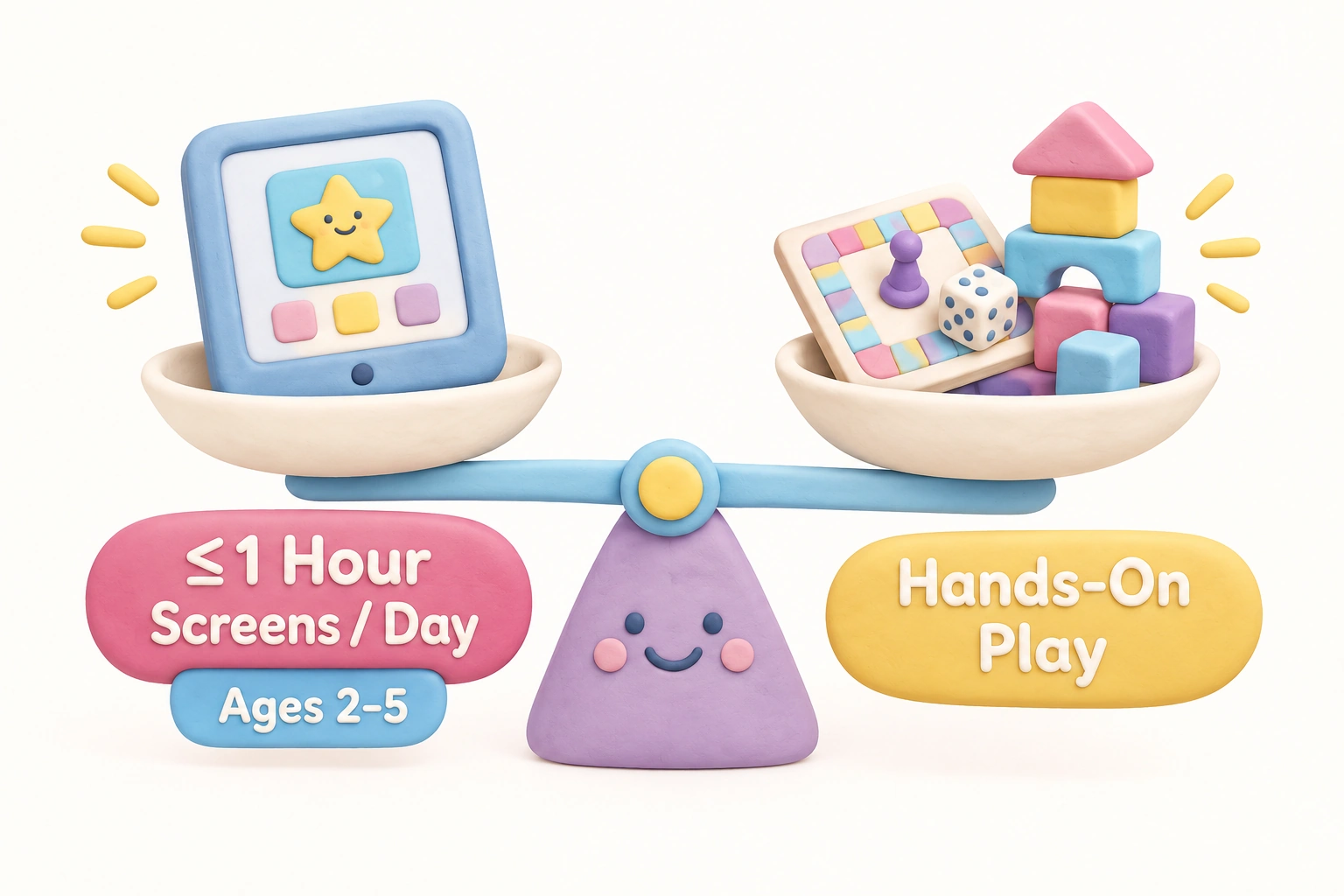
Screen time balance does not mean avoiding apps entirely. Well-designed educational apps can support early literacy skills, number sense, and vocabulary in ways that are genuinely useful, particularly when a caregiver co-plays or discusses the content afterward. The risk lies in using apps as a passive babysitting tool rather than an active learning experience. A child who uses Khan Academy Kids for 20 minutes while a caregiver asks questions about what they are doing is likely to benefit more than a child who uses the same app for an hour without any adult interaction.
Hands-on board games offer developmental benefits that apps cannot fully replicate: physical manipulation of game pieces builds fine motor skills, face-to-face play develops social-emotional learning and turn-taking, and the absence of a screen removes the risk of passive consumption. A practical approach for most families is to treat apps and board games as complementary rather than competing — using apps for focused skill practice and board games for social play and physical engagement.
Choosing Games by Developmental Stage
Age ranges on game packaging are useful starting points, but individual children vary considerably in their readiness for different types of play. A general framework based on early childhood development research can help parents make more informed choices.
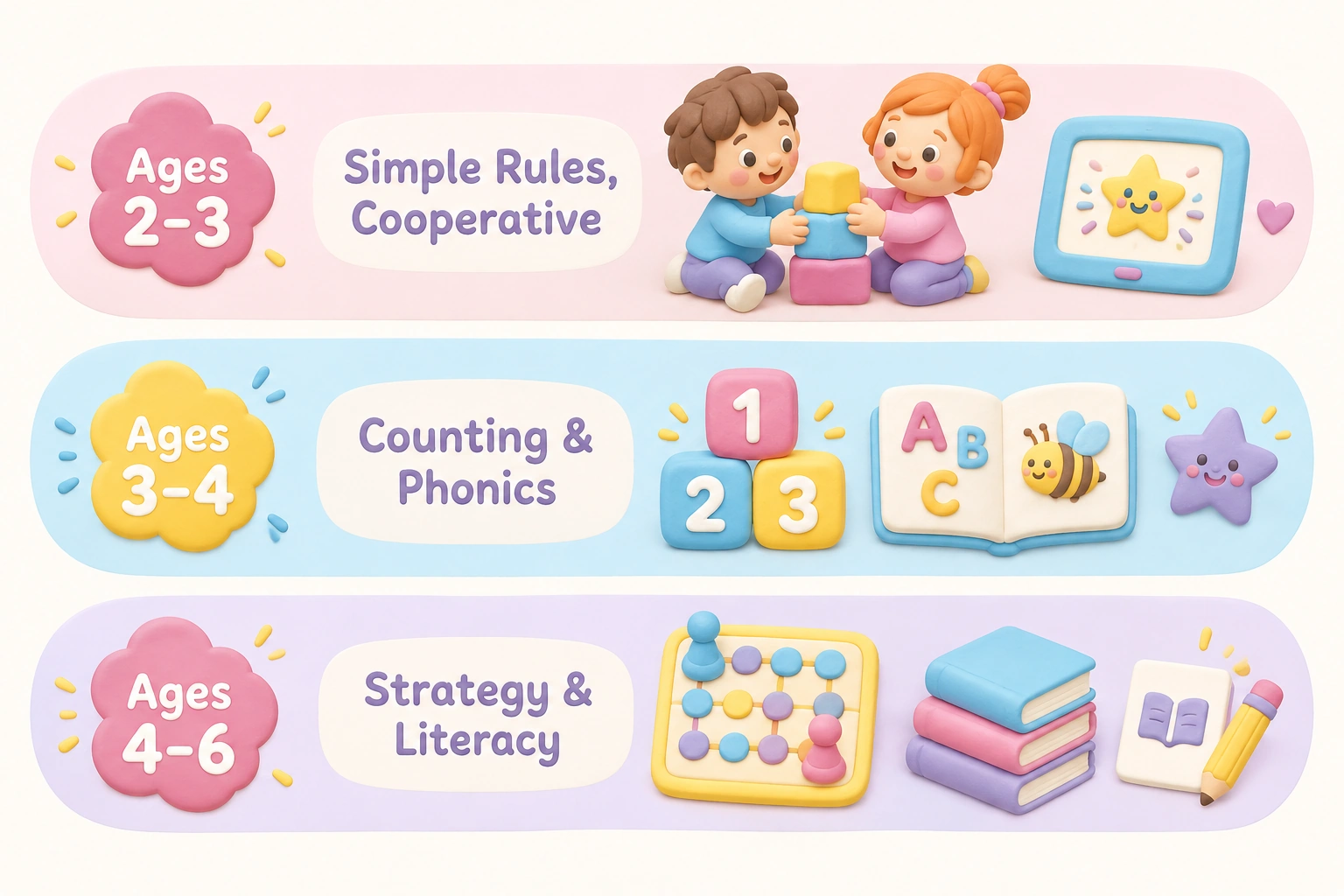
Children ages 2–3 are typically in the early stages of symbolic play and are beginning to understand simple cause-and-effect relationships. Games at this stage should have very few rules, large physical pieces, and no competitive pressure. First Orchard, Sago Mini World, and Khan Academy Kids are well-matched to this developmental window. Children ages 3–4 are developing more sustained attention and beginning to understand turn-taking, making them ready for slightly more structured games such as Hi Ho! Cherry-O, Sneaky Snacky Squirrel, and Endless Alphabet. Children ages 4–5 can typically handle simple strategy, mild competition, and more complex rule sets, opening up options like Hoot Owl Hoot!, Zingo, Duolingo ABC, and Moose Math. By age 5–6, most children approaching kindergarten readiness can engage with games that involve memory, planning, and reading simple words, making Spot It! Jr., ABCmouse, and Osmo appropriate additions.
What Skills Do These Games Actually Build?
Game-based learning in early childhood can support a range of developmental domains, though the strength of evidence varies by skill area and game type. Early literacy skills — including phonemic awareness, letter recognition, and vocabulary — are among the most consistently supported outcomes of well-designed educational games, both digital and physical. Apps like Duolingo ABC and Endless Alphabet, and physical games like Zingo, target these skills directly and systematically.
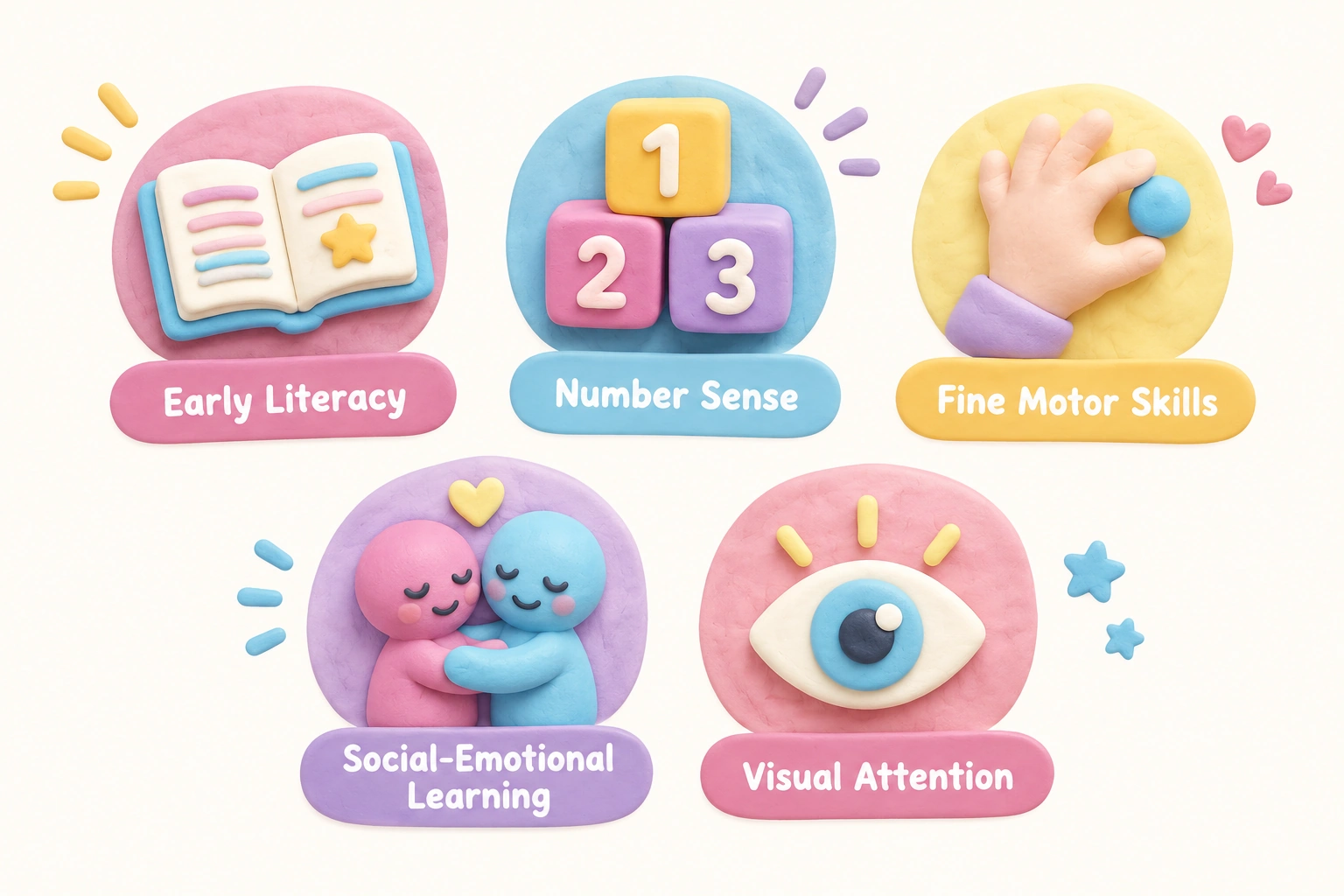
Number sense — the intuitive understanding of quantity, counting, and simple operations — is supported by games like Hi Ho! Cherry-O, Moose Math, and Osmo’s number packs. Fine motor skills develop through physical game play involving small pieces, as well as through Osmo’s hands-on components. Social-emotional learning, including turn-taking, cooperation, and managing disappointment, is most directly supported by cooperative board games like Hoot Owl Hoot! and First Orchard, where the shared goal removes the emotional challenge of losing. Cognitive skills such as visual attention, memory, and problem-solving are addressed across multiple picks, including Spot It! Jr. and Pok Pok.
It is worth noting that no single game covers every developmental domain, and outcomes depend significantly on how frequently a child plays, whether a caregiver is involved, and the child’s individual temperament and learning style. Game-based learning is most effective as part of a broader early childhood environment that includes free play, outdoor activity, conversation, and shared reading.
Frequently Asked Questions
What are the best preschool learning games for a 3-year-old?
For 3-year-olds, the best options are those with very simple rules, large physical pieces, and no competitive pressure. First Orchard, Hi Ho! Cherry-O, and Sneaky Snacky Squirrel are strong hands-on choices. For apps, Khan Academy Kids and Sago Mini World are well-matched to this age, with gentle pacing and no reading required.
Are educational apps actually effective for preschoolers?
Research suggests that high-quality, interactive educational apps can support early literacy and math skills in preschoolers, particularly when used with caregiver involvement. However, the evidence is stronger for some skill areas — such as vocabulary and phonics — than others. Apps are most effective when they are age-appropriate, ad-free, and used as part of a balanced routine that includes plenty of hands-on and outdoor play.
How much screen time is appropriate for a preschooler?
The American Academy of Pediatrics recommends no more than one hour of high-quality screen time per day for children ages 2–5, ideally with a caregiver present. This includes educational apps. Children under 2 should generally avoid screen time other than video calls with family members.
What is a cooperative game, and why does it matter for preschoolers?
A cooperative game is one where all players work together toward a shared goal rather than competing against each other. Cooperative games are particularly well-suited to preschoolers because children at this age are still developing the emotional regulation skills needed to handle losing gracefully. Games like Hoot Owl Hoot! and First Orchard allow children to experience the satisfaction of winning together without the distress of individual defeat.
Do I need to spend money on a subscription app, or are free options good enough?
Several high-quality, genuinely free and ad-free apps — including Khan Academy Kids, Duolingo ABC, Moose Math, and PBS Kids Games — offer strong early learning content without a subscription. Subscription apps like ABCmouse and Pok Pok offer broader content libraries or more distinctive approaches, but free options are a reasonable starting point for most families. One-time purchase apps like Endless Alphabet offer a middle ground.
Can preschool learning games replace preschool or pre-K programs?
No. Games — digital or physical — can meaningfully support early learning, but they are not a substitute for the structured social environment, trained educators, and peer interaction that quality preschool programs provide. Games work best as a supplement to, not a replacement for, early childhood education settings and rich caregiver interaction at home.
Choosing the Right Mix of Preschool Learning Games for Your Child
The most effective approach for most families is not to find one perfect game but to build a small, intentional mix of digital and screen-free options that together cover the key developmental domains — early literacy, number sense, fine motor skills, and social-emotional learning. A free app like Khan Academy Kids or Duolingo ABC can handle structured skill practice within a daily screen time limit, while a cooperative board game like Hoot Owl Hoot! or First Orchard provides the face-to-face social play that screens cannot replicate.
When selecting any game, consider your child’s current developmental stage rather than just the age range on the packaging, your family’s screen time habits and limits, and whether you can realistically co-play or at least check in on digital activity through a parent dashboard. A game that a child uses independently every day without any adult interaction is likely to deliver less developmental benefit than one used less frequently but with genuine caregiver engagement. The goal is not to maximize educational content but to make learning feel like play — because for preschoolers, that distinction barely exists.

Take a short quiz to find out what your everyday choices say about your parenting style
When your child is curious about something new, what’s your instinct?
Take a short quiz to find out what your everyday choices say about your parenting style
“Can I download this app?” What happens next?
Take a short quiz to find out what your everyday choices say about your parenting style
When it comes to rules at home, which sounds most like you?
Take a short quiz to find out what your everyday choices say about your parenting style
If you could give your child one life skill today, what would you pick?
Take a short quiz to find out what your everyday choices say about your parenting style
Your child gets to choose what to watch. What would your ideal setup look like?
Take a short quiz to find out what your everyday choices say about your parenting style
Pick your parenting superpower ✨