

If you’re looking for a way to spark a love of science without needing a laboratory, you’ve come to the right place. This guide offers safe, simple, and hands-on air pressure experiments using common household items, specifically designed for kids and parents to explore together at home. Whether you are helping a preschooler marvel at a “magic” water trick or guiding an older child through a science fair project, these activities turn your kitchen into a center of discovery.
Most of these experiments are suitable for children ages 5 to 12, though even toddlers can enjoy the visual “wow” moments with adult guidance. By using things you already have – like a balloon, a plastic bottle, or a straw – you can demonstrate air pressure in a way that sticks. Let’s dive into the invisible force that surrounds us and see how easy science experiments can make a lasting impact on your child’s development.
Introduction to Air Pressure Experiments
For parents and educators, finding activities that are both educational and entertaining is a constant quest. Air pressure experiments are among the most popular STEM activities because they provide immediate, often surprising, visual results. They take a concept that is normally invisible – the atmosphere around us – and make it tangible.
When children engage in science activities like these, they aren’t just memorizing facts; they are building a foundation for critical thinking. They learn that the world operates according to hidden rules, and by manipulating the gas inside a container or changing the air pressure, they can control the outcome. This hands-on exploration is the heartbeat of early childhood education, fostering a “can-do” attitude toward complex subjects.
Air Pressure Concept for Kids
How do you explain something kids can’t see? Imagine the molecules are like tiny, invisible bouncy balls. Millions of them are constantly bouncing off you, the floor, and the walls. Even though one “bouncy ball” is light, trillions of them together have mass and weight. This is what we call air pressure.
Everywhere you go, the pressure of the air is pushing on you. In fact, at sea level, it’s about 14.7 pounds per square inch. That’s like having a small dog sitting on every square inch of your body! We don’t feel it because the pressure inside our bodies pushes back with the same force. When we change how many particles are in a space, or how fast they move (temperature), we create changes in air pressure that can move water, crush cans, or lift objects.
Why Home Experiments Work Best
The best classroom is often the kitchen table. Performing a science experiment at home offers several unique advantages:
- Familiar Environment: Kids feel safe to fail and try again in their own space.
- Common Materials: Using a balloon or a bottle shows kids that science isn’t “special magic” reserved for people in lab coats – it’s part of everyday life; it’s part of their everyday world.
- Comfort and Pacing: You can follow your child’s lead. If they want to spend 20 minutes blowing into a funnel, you don’t have to move on because a school bell rang.
- Higher Engagement: When a child helps grab the vinegar or the plastic bottle, they are more invested in the “what happens next.”
Why Air Pressure Experiments Matter for Kids
Beyond the immediate fun, these activities serve a vital role in cognitive and developmental growth. Hands-on experiments help bridge the gap between abstract thought and concrete reality.
Curiosity and Scientific Thinking
Every air pressure experiment for kids starts with a question: “What do you think will happen?” This is the beginning of the scientific method. By encouraging kids to make predictions (hypotheses), you are teaching them to look at the world analytically. When a result is unexpected – like a balloon not inflating inside a bottle – it triggers curiosity, leading to deeper questions and a genuine desire to understand the science behind the phenomenon.
Real-World Connections
The atmospheric force isn’t just a textbook topic; it’s the reason we can live our daily lives.
- Weather: High pressure usually means sunny days, while low pressure can bring rain.
- Drinking: When you use a straw, you create lower pressure inside your mouth, and the higher pressure of the surrounding environment pushes the liquid up.
- Flight: Airplanes fly because of the way fast-moving currents create lower pressure on top of the wings.
- Breathing: Your lungs use changes in air pressure to pull in and push out oxygen.
Skills Built Through Experiments
| Skill Category | Benefit to the Child |
| Observation | Learning to notice small details, like bubbles or subtle movements. |
| Cause-Effect | Understanding that “If I do X, then Y happens.” |
| Fine Motor Skills | Squeezing bottles, pouring water, and stretching balloons. |
| Confidence | Feeling a sense of mastery over the physical world. |
Simple Air Pressure Experiments Using Household Items
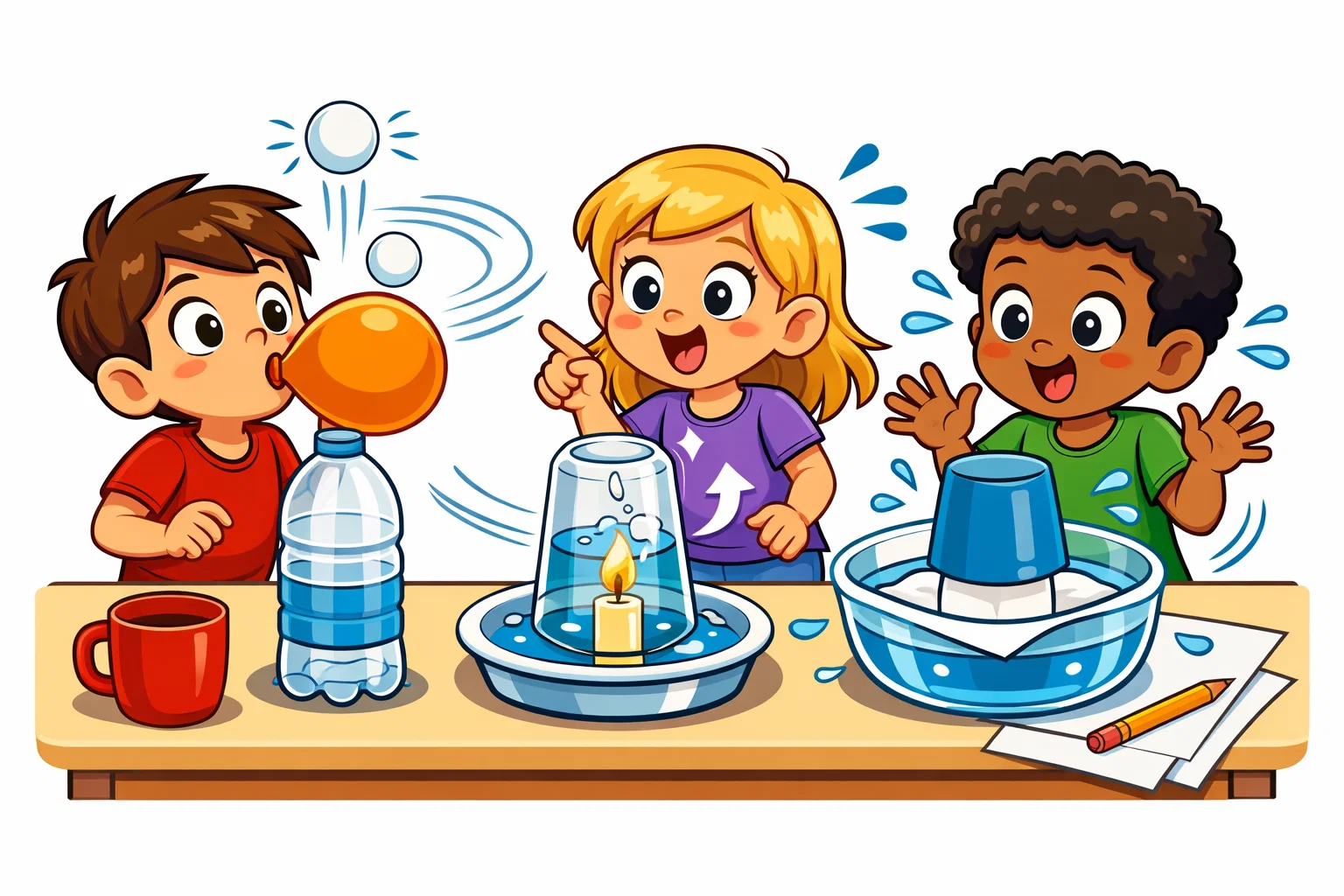
Ready to get started? These easy science activities require minimal setup but provide a huge “wow” factor.
Upside-Down Water Cup Experiment
This is a classic experiment that seems to defy gravity.
- Materials: A plastic or glass cup, water, and a stiff piece of cardstock or a postcard.
- Steps: Fill the cup to the brim with water. Place the card over the top. Hold the card firmly and flip the cup upside down over a sink. Slowly let go of the card.
- The Result: The card stays attached to the cup, and the water stays inside!
- How it Works: The external pressure outside the cup is stronger than the weight of the column of water inside. The pressure of the surrounding atmosphere (the 14.7 pounds per square inch we mentioned) pushes up against the card, keeping it in place.
Immovable Tissue Paper Experiment
Can you put a tissue underwater without getting it wet?
- Steps: Crumple a tissue and shove it into the bottom of a dry glass. Make sure it stays there when you turn the glass over. Submerge the glass straight down into a bowl of water.
- The Result: When you pull the glass out, the tissue is bone dry.
- How it Works: The gas inside the glass takes up space. As you push the glass down, the trapped air inside the glass prevents the water from entering. The contents keep the water out because the volume has nowhere to go.
Rising Water Candle Experiment
Note: This requires adult supervision as it involves a flame.
- Steps: Fix a small candle to the center of a plate. Fill the plate with a small amount of water (add food coloring for effect). Light the candle and place a clear glass over it.
- The Result: The candle goes out, and the water is sucked up into the glass.
- How it Works: The flame heats the air molecules, causing them to move faster and spread out. When the flame goes out, the contents contract as they cool. This creates a decrease in pressure inside. The higher pressure outside the glass pushes on the water, forcing it up into the glass until the force is equalized.
Fountain Bottle Experiment
This is a great way to demonstrate how pressure pushes on liquids.
- Steps: Poke a small hole near the bottom of a plastic bottle. Cover the hole with your finger, fill the bottle with water, and screw the cap on tight.
- The Result: When you take your finger off the hole, the water doesn’t leak out! But as soon as you unscrew the cap, a fountain starts.
- How it Works: With the cap on, the air pressure inside the sealed bottle is balanced, so water cannot flow out. When you open the cap, the atmosphere rushes in, increasing the air pressure on top of the water, which pushes the water out of the hole.
Can Crush Experiment
This demonstration of air pressure is best for older kids due to the heat involved.
- Steps: Put a tablespoon of water in an empty soda can. Heat it on the stove until steam comes out. Using tongs, quickly flip the can upside down into a bowl of ice water.
- The Result: The can implodes instantly with a loud “pop!”
- How it Works: The steam pushes the gas out of the can. When the can hits the cold water, the steam turns back into water, creating a very low pressure area inside. The ordinary pressure of the surrounding environment is so much stronger that it crushes the metal instantly.
Bernoulli Principle Experiments With Moving Air
Daniel Bernoulli discovered that fast-moving air has lower pressure than slower-moving air. These fun science experiments show this principle in action.
Funnel Ping-Pong Ball Experiment
Try to blow a ping-pong ball out of a funnel by blowing through the narrow end. You’ll find that the harder you blow, the more the ball stays stuck! This happens because the fast stream moving around the ball creates lower pressure, while the higher pressure in the room pushes the ball back into the funnel.
Levitating Ping-Pong Ball Experiment
Using a hairdryer (on the cool setting) pointed straight up, place a ping-pong ball in the path. The ball will hover! The fast-moving flow from the dryer creates a column of low pressure. The higher pressure zones around the column keep the ball centered.
Kissing Balloons Experiment
Hang two balloons from strings so they are about an inch apart. Blow a sharp gust directly between them. Instead of flying apart, they will “kiss” (clink together). The flow you blew moved fast, creating a decrease in pressure between them, allowing the pressure outside to push them together.
Air Pressure Experiments With Bottles and Balloons
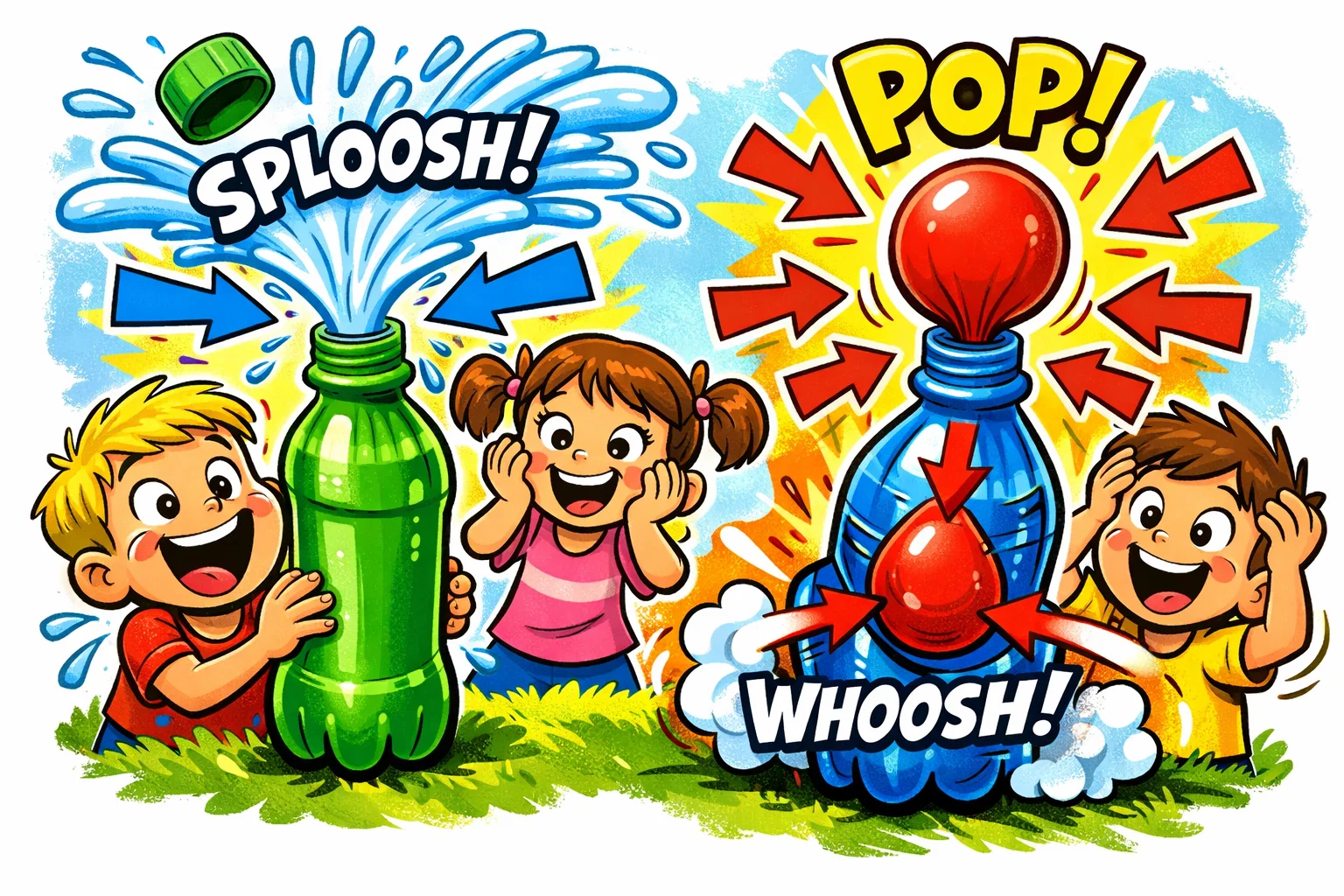
These two items are the “dynamic duo” of physics.
Egg in Bottle Experiment
“Science is simply common sense at its best.” — Thomas Huxley
By placing a piece of burning paper inside a glass bottle and setting a peeled hard-boiled egg on top, you can watch the egg get “sucked” inside. In reality, the cooling gas creates an area of much lower pressure, and the atmospheric pressure outside pushes the egg into the bottle.
Balloon Air Weight Experiment
To show that the atmosphere has mass, tape two inflated balloons to the ends of a yardstick and balance it on a string. Pop one. The stick will tilt toward the filled air balloon. This experiment showcases that molecules actually have weight, even if we can’t feel it!
Bottle Rocket Experiment
This is the ultimate science fair favorite. By using a pump to force more volume into a bottle half-filled with water, you are increasing the air pressure to an extreme level. When the seal is released, the built-up air pressure forces the water out, propelling the bottle into the sky. It’s a perfect demonstration of Newton’s Third Law and the power of compression.
Science Behind Air Pressure Experiments
To truly learn about air pressure, kids need to understand the “why” behind the “wow.”
Why Air Pushes Objects
The atmosphere isn’t “nothing.” It is a fluid made of nitrogen, oxygen, and other gases. Because these molecules have mass and are affected by gravity, they exert force. We call this air pushing. Whether it’s pressure underneath a wing or pressure pushing on water, it is always the result of particles colliding with surfaces.
Pressure Changes With Temperature
Temperature is just a measure of how fast molecules are moving.
- Warm gas: Molecules move faster and spread out (lower density; pressure depends on the container).
- Cold Gas: Molecules slow down and bunch together (The volume contracts, leading to higher density).
Pressure Balance and Movement
Nature hates an imbalance. Matter will always move from an area of high pressure to an area of low pressure. This movement is what we call wind! Most of our hands-on experiments work by creating an imbalance and watching the environment try to fix it.
Safety Tips for Air Pressure Experiments at Home
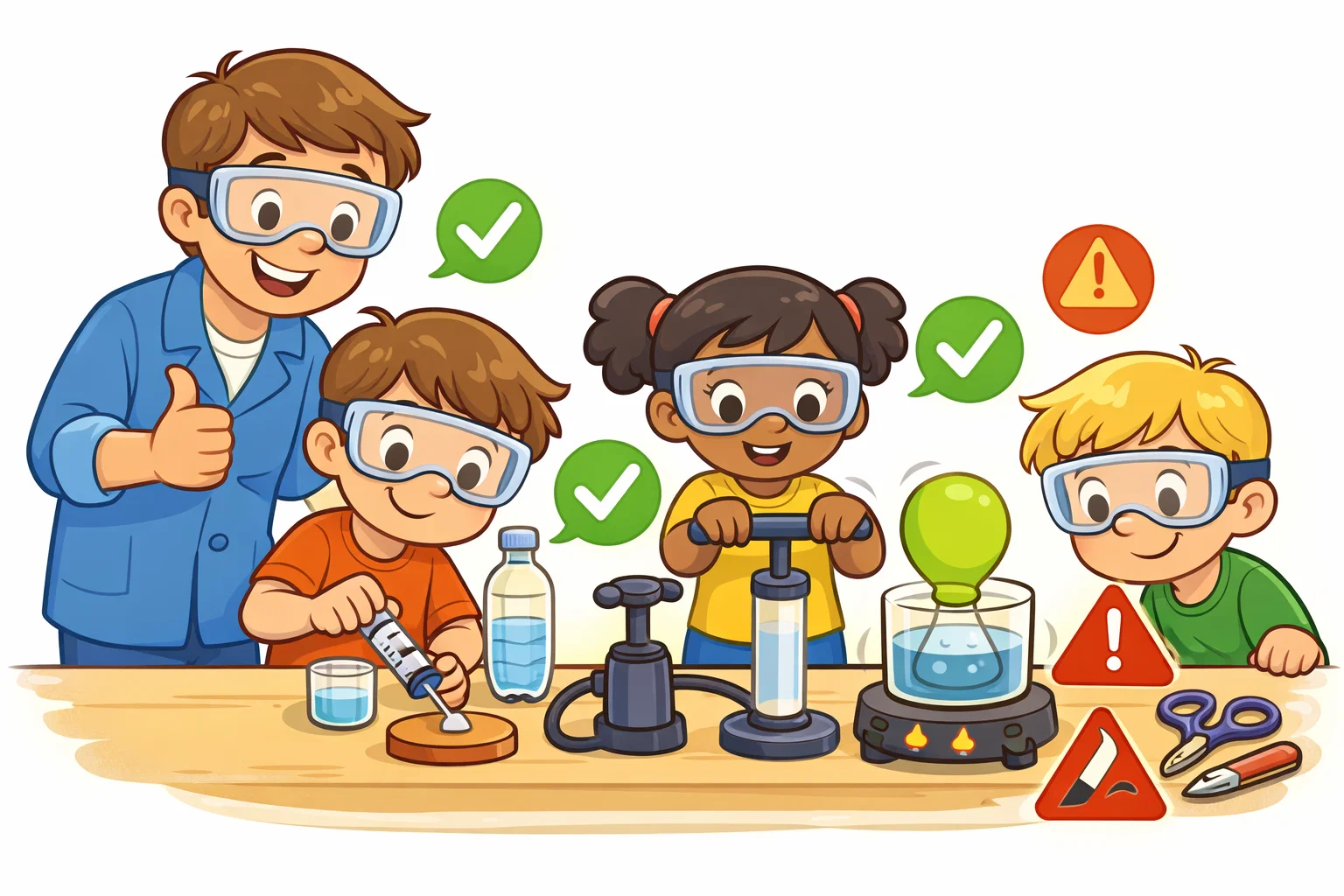
Safety is the foundation of any good science activity.
Adult Supervision Guidelines
- Heat & Fire: Any experiment involving candles, stoves, or boiling water (like the Can Crush or Egg in Bottle) must be done by or with an adult.
- Sharp Objects: Poking holes in plastic bottles should be handled by parents.
- Eye Protection: For “high-energy” experiments like the bottle rocket, wearing safety goggles is a great habit to start.
Safe Household Materials
Stick to these “green light” items:
- Plastic bottles (safer than glass if dropped).
- Food-grade dyes.
- Standard latex balloons (be careful with latex allergies).
- Vinegar and baking soda.
Avoid: Pressurized aerosol cans, harsh chemicals, or thin glass that might shatter under increased pressure.
Common Problems During Experiments
Sometimes, even the simplest experiments don’t go as planned. Here is how to troubleshoot:
Experiment Did Not Work
The most common culprit is a leak. Pressure depends on a sealed environment. If your bottle air pressure experiment fails, check the cap or the seal around your straw with some playdough or tape. Also, ensure your balloon doesn’t have a microscopic hole!
Child Lost Interest
If a child gets bored, shift from the “how” to the “what if.” Ask, “What if we used a bigger bottle?” or “What if the water was ice cold?” Let them lead the way to demonstrate a variation. Experiments create the best memories when they are collaborative, not a lecture.
Results Look Different Than Expected
In science, a “failed” experiment is just a different kind of data. If the water didn’t rise as high in the candle experiment, discuss why. Was the glass too big? Was the seal on the plate uneven? Exploring air pressure is about the process, not just the “magic” trick.
Air Pressure Experiments by Age Group
| Age Group | Recommended Activity | Focus |
| Preschool (3-5) | Tissue in a Cup, Blowing Bubbles | Sensory play and simple observation. |
| Elementary (6-11) | Upside-Down Cup, Kissing Balloons | Making predictions and basic cause/effect. |
| Middle School (12+) | Bottle Rockets, Can Crush | Data collection, measuring height, and physics. |