

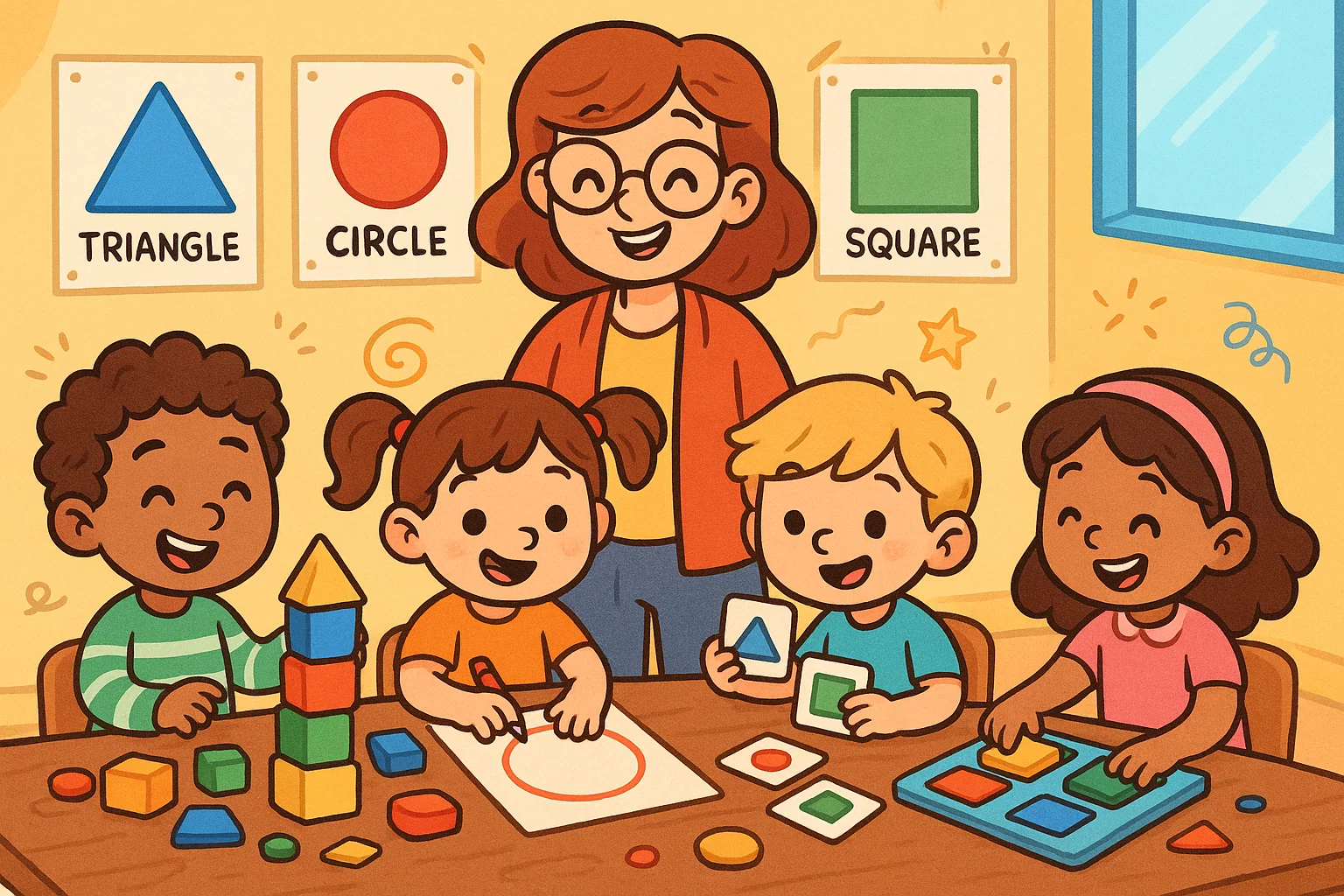
Teaching shapes to young children goes far beyond memorizing circles and squares. When you introduce shape activities thoughtfully, you’re building the foundation for spatial reasoning, problem-solving, and mathematical thinking that children will use throughout their lives. Geometric forms are all around us—from the round clock on the wall to the rectangular door frame—and helping children recognize shapes strengthens their ability to make sense of the world.
The best way to teach shapes combines playful exploration with structured learning. Whether you’re a parent looking for fun activities or an educator planning lessons for your primary classroom, the right approach helps children learn about shapes naturally. This guide offers practical shape games and hands-on methods that develop fine motor skills, visual recognition, and thinking skills while keeping young kids excited about discovery.
Quick Overview of Shape Activities
Learning activities serve multiple purposes in early childhood education. These games and activities help children identify shapes while strengthening hand-eye coordination, spatial awareness, and logical thinking. From toddlers just beginning to recognize shapes to kindergarten students ready to explore complex shapes, tasks can be adapted for various developmental stages.
The methods in this guide include shape activities for preschoolers, movement-based shape games, outdoor exploration, and problem-solving challenges. Each section addresses different learning styles—classroom stations, home routines, and outdoor settings where children can explore shapes in their environment.
Key Benefits of Shape Activities
| Skill Area | How Activities Help | Real-World Application |
| Visual Discrimination | Children identify shapes and notice differences | Prepares for letter and number recognition |
| Fine Motor Skills | Tracing, cutting, and sorting strengthen hand muscles | Essential for writing and drawing |
| Spatial Reasoning | Understanding how different shapes fit and rotate | Supports early math concepts |
| Language Development | Learning names and properties | Builds descriptive vocabulary |
| Critical Thinking | Categorizing and pattern-making develops thinking skills | Creates logical reasoning abilities |
Fast Setup Options
Busy educators and parents need activities that launch quickly without extensive preparation. Grab paper and markers to create instant hunts—draw various shapes and ask children to find matching objects in the room. Use painter’s tape to outline basic forms on floors or tables for sorting games.
Household items become immediate teaching tools. Gather circles (plates), rectangles (books), squares (napkins), and triangles (pizza slices) to teach children about shapes. Kids can sort items, trace them, or use them as stamps with washable paint.
Best Tools for Busy Teachers
Digital learning resources save preparation time while maintaining engagement. Apps like Endless Shapes and Montessori Geometry offer interactive tasks that help children learn best through play. These platforms adapt difficulty levels automatically as preschool children advance.
Printable worksheets from educational websites provide ready-made resources for matching activities. Look for sites offering free downloads with 2D shape activities and age-appropriate complexity. Physical manipulatives like pattern blocks and puzzles remain classroom essentials for hands-on skill development.
Creative Activities for Teaching Shapes
Creative tasks tap into children’s natural love of art and exploration. These fun and engaging activities allow kids to experiment while reinforcing geometric concepts.
Shape Books for Kids
Picture books make learning memorable through storytelling. Reading stories that feature different shapes helps preschoolers see geometry in context. Books like “The Shape of Things” by Dayle Ann Dodds or “Mouse Shapes” by Ellen Stoll Walsh integrate recognition into enjoyable narratives.
During read-alouds, pause to name the shape on each page. Ask questions like “What do you see?” or “Can you describe this?” After reading, allow children to create their own books by gluing cut out shapes onto paper and dictating simple stories.
Shape Collage Projects
Collages transform basic geometry into creative expression. Provide pre-cut pieces in various colors and sizes along with glue sticks and large paper. Children can create pictures, patterns, or abstract designs using combinations of shapes.
Step-by-step process:
- Cut shapes from colored construction paper (or have older children cut their own shapes)
- Demonstrate how big shapes can combine to form objects (triangle and rectangle make a house)
- Allow arranging and rearranging before gluing
- Encourage naming each piece as they work
- Display finished collages and discuss what was used
This activity builds fine motor skills through gluing and arranging while reinforcing shape understanding. Advanced learners can sort by properties before beginning their collage, exploring different categories.
Shape Printing with Sponges or Blocks
Stamping activities combine art with learning. Cut sponges into different forms or use wooden blocks with flat ends. Dip them in washable paint and press onto paper to create colorful patterns.
Children develop several skills simultaneously through printing. The physical action of pressing strengthens hand muscles while planning where to place each stamp builds spatial awareness. Identifying each form before and after stamping reinforces recognition.
Try these variations:
- Create patterns using different shapes
- Mix colors to explore overlapping prints
- Make creatures by combining stamped shapes
- Experiment with different textures by printing in multiple ways
Play Dough Shape Tasks
Play dough offers endless possibilities to explore shapes. This tactile medium engages children who learn best through play and manipulation. The hands-on nature helps kids make connections between 2D shape activities and 3D understanding.
Activities to try:
| Activity | Skills Developed | Age Group |
| Rolling dough into balls | Hand strength, 3D recognition | 2-4 years |
| Flattening circles with palms | Pressure control, transformation | 2-5 years |
| Using cookie cutters to create forms | Tool use, matching | 3-6 years |
| Building 3D structures | Spatial reasoning, creativity | 4-7 years |
| Tracing cards with dough snakes | Fine motor precision, 2D understanding | 4-7 years |
Giant Floor Art
Large-scale activities get children moving while learning. Use colored tape, rope, or chalk to draw large forms on the floor or pavement. Children can walk around the perimeter, count sides of a particular shape, or jump from corner to corner exploring different shapes.
This approach particularly helps kinesthetic learners who need physical movement. The size makes properties like “sides” and “corners” obvious and easy to discuss. Several children can explore the same shape at once, encouraging peer learning and conversation about geometry.
Practical Classroom Activities
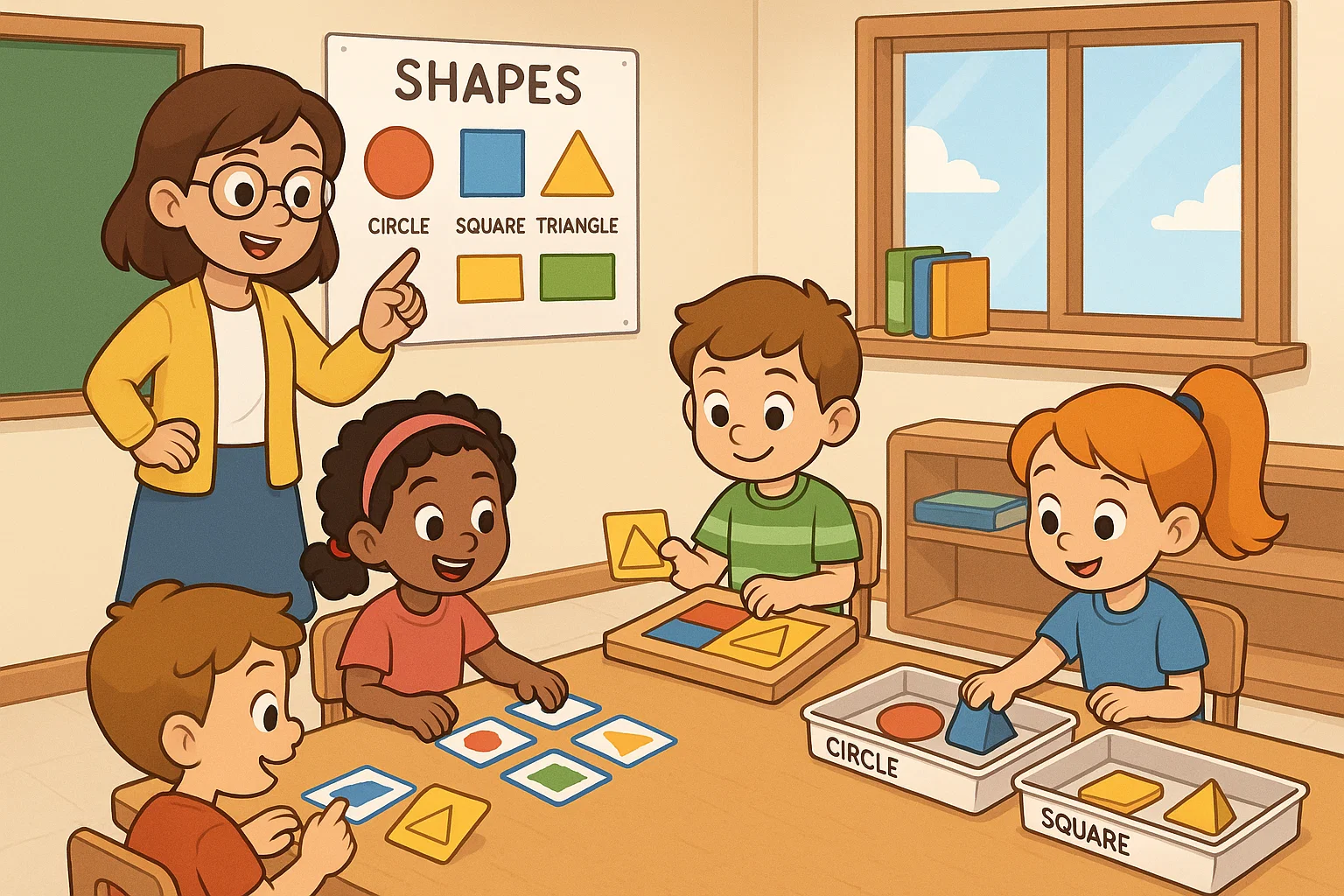
Structured classroom tasks provide consistency and allow teachers to assess progress systematically. These stations and shape games work well for centers, small group instruction, or whole-class participation.
Shape Sorting Station
Set up a dedicated area with objects and sorting trays. Children categorize items, developing classification skills and attention to detail while learning to identify shapes.
What you need:
- Collection of objects in basic forms (buttons, blocks, toys, cutouts)
- Sorting trays or bowls labeled with names
- Large floor mat or table space
- Optional: tweezers for extra fine motor challenge
Introduce the station by modeling how to examine an object, name it, and place it in the corresponding container. As children gain confidence, add more complexity like ovals and hexagons. Challenge advanced students to sort by multiple attributes: “Find all the red circles” or “Sort large triangles.”
Shape Puzzles and Matching Games
Puzzles develop visual-spatial skills and problem-solving abilities. Start with simple inset puzzles where each piece fits into one specific space. Progress to tangram puzzles requiring children to arrange various shapes to match a picture or pattern.
Puzzle progression by age:
- Ages 2-3: Single inset boards with knobs, focusing on basic shapes
- Ages 3-4: Multiple pieces in one board, no knobs
- Ages 4-5: Sorting boxes, simple tangrams with different shapes
- Ages 5-6: Complex tangrams, pattern cards
- Ages 6+: Geometric design challenges, tessellation puzzles
Matching games help children quickly identify and improve memory. Create matching card pairs featuring identical geometric forms, or match cards to real objects in the classroom. These shape games for preschoolers make learning fun and engaging.
Shape Memory Game
This classic game format makes practice engaging and social. Create cards with pairs of matching forms in different colors or sizes to teach children through play.
How to play:
- Lay all cards face down in rows
- First player flips two cards
- If they match, player keeps the pair and goes again
- If they don’t match, cards flip back over
- Next player takes a turn
- Player with most pairs wins
Modify difficulty by using only 2-3 basic forms for beginners, or include up to 8-10 different ones for advanced players. This matching activity reinforces recognition skills while developing memory.
Shape Road Mats
Road mats combine imaginative play with geometry learning. Draw or tape outlines on large paper or directly on the floor. Children “drive” toy cars along these roads, tracing the perimeter multiple times and learning to recognize through repetition.
The repetitive motion helps muscle memory develop while the play element keeps engagement high. Add small signs saying “Circle Drive” or “Triangle Trail” to reinforce names and help children learn new vocabulary naturally.
Movement-Based Shape Activities
Movement-based tasks engage children’s whole bodies in learning. These fun activities particularly benefit active learners who struggle with seated work and help all preschool children develop gross motor skills alongside cognitive understanding.
Shape Yoga
Combine mindfulness with geometry by teaching poses that mimic geometric forms. This fun way to incorporate learning works wonderfully for brain breaks or transitional moments in the school day.
Yoga poses:
| Form | Pose | Instructions |
| Circle | Seated ring | Sit and hold feet, forming a circular position |
| Triangle | Downward dog | Hands and feet on floor, hips raised high |
| Star | Star pose | Stand with arms and legs wide apart |
| Line | Mountain pose | Stand tall and straight with arms at sides |
| Square | Table pose | Hands and knees down, flat back |
Guide children through poses while emphasizing what their body creates. Ask them to feel the straight lines in their arms or notice where another form has corners. This embodied learning creates strong mental connections between concepts and physical experience.
Shape Jumping Game
Mark basic forms on the floor using tape, chalk, or printed laminated cutouts. Call out a name and children jump to stand in or on that particular area. This active game reinforces quick recognition while burning energy.
Variations to increase difficulty:
- Call out properties instead of names: “Jump to something with four sides”
- Add multiple options so children must choose the correct one
- Include movement types: “Hop to the circle” or “Tiptoe to the square”
- Play elimination style where last person to reach loses
- Combine colors: “Jump to the red triangle”
Obstacle Course with Stations
Design an obstacle course where each station represents a different form. Children might crawl through a circular hoop, jump over a triangle made from pool noodles, walk along a taped square, or toss balls at a rectangular target—creating a hunt that’s fun and active.
Number the stations and provide a simple map showing which form is at each stop. This integration teaches children while developing gross motor skills, following directions, and spatial navigation. These activities encourage physical development alongside cognitive learning.
Outdoor Shape Exploration
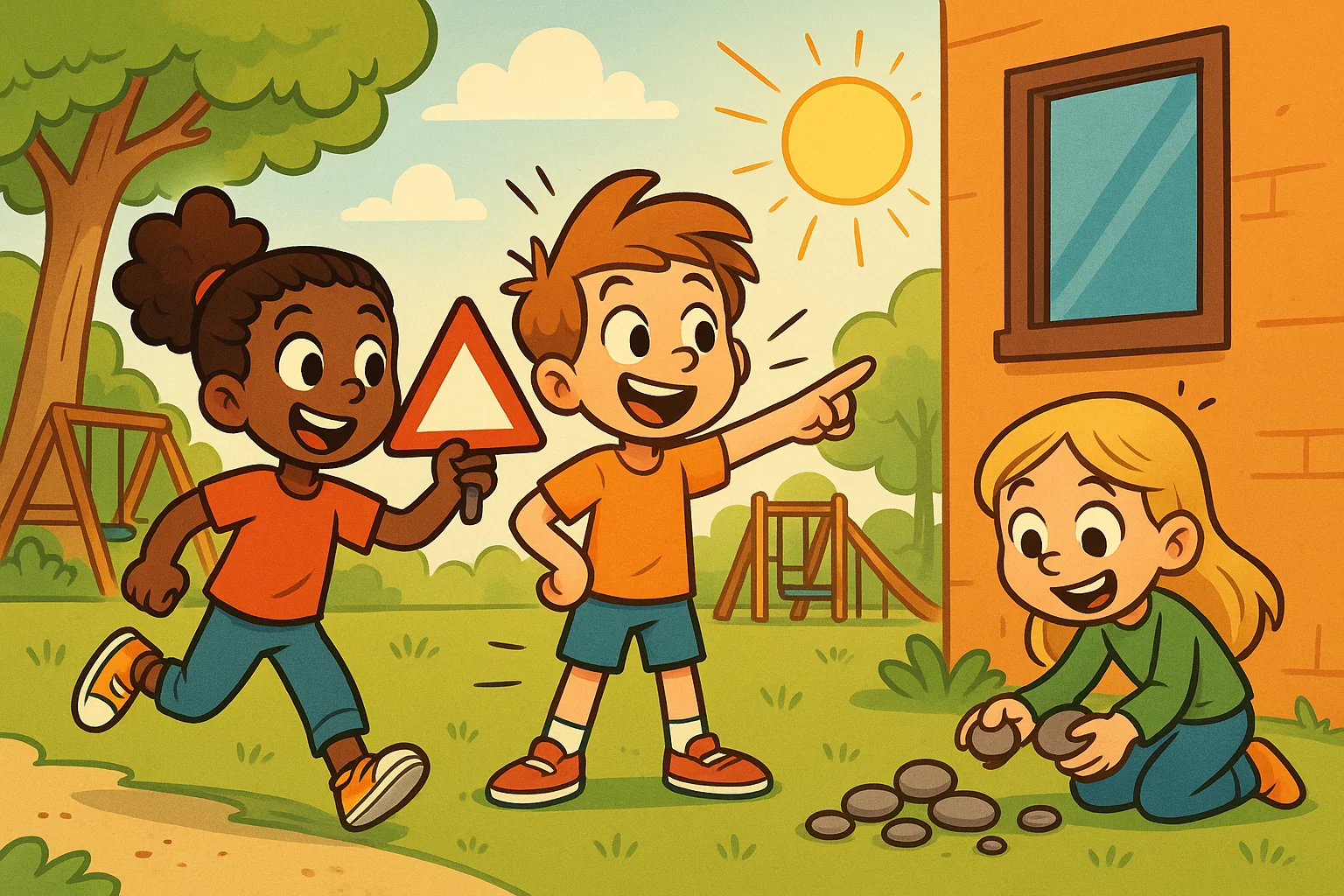
Taking learning outside provides fresh perspectives and connects geometry to the natural world. Outdoor activities show that shapes exist naturally in the environment, not just in classrooms.
Shape Scavenger Hunt
A hunt outdoors turns observation into adventure. Provide clipboards with a list or simply call out what to find. The playground equipment, building architecture, trees, and clouds all contain recognizable geometric forms.
Scavenger hunt checklist:
- Circle (tire swing, sun, ball)
- Square (window, tile, sandbox)
- Rectangle (door, brick, bench)
- Triangle (roof, slide support, yield sign)
- Oval (leaf, football, face)
- Rhombus (diamond, fence pattern, kite, road sign)
This hunt is a fun way to encourage children to think creatively about what counts as each form. Discussions deepen understanding of geometric properties and develop thinking skills naturally.
Nature Collection
Collecting natural objects that represent many forms connects geometry with science. Give young kids bags or baskets and send them to gather round pinecones, triangular rocks, long stick–shaped rectangles, or leaf ovals—finding shapes to explore in their surroundings.
Back in the classroom, children can sort their collections, create nature collages arranged by geometry, or use items for printing art projects. This activity demonstrates that many different shapes occur naturally in the world, not just in human-made objects.
Chalk Drawing on Pavement
Sidewalk chalk allows children to draw independently. They can trace around objects, create freehand, or follow demonstrations. The temporary nature of chalk encourages experimentation without fear of mistakes.
Try these chalk activities:
- Draw a form and invite children to decorate the inside
- Create a hopscotch path using different shapes
- Trace each other’s bodies, then identify forms within
- Make a family (big circle, medium circle, small circle)
- Create animals using combinations (circle head, triangle ears, rectangle body)
Shape Activities for Home
Parents can reinforce classroom learning through everyday home routines. These ideas require minimal materials and fit naturally into daily life, helping children learn about shapes consistently.
Shape Snacks
Transform snack time into learning by cutting food into recognizable forms. Use cookie cutters on sandwiches, slice fruit into circles and triangles, arrange crackers in patterns, or find naturally formed foods like rectangular granola bars.
Snack ideas:
- Circle: Apple slices, cucumber rounds, bagels, cookies
- Triangle: Sandwich quarters, tortilla chips, watermelon wedges
- Rectangle: Crackers, cereal bars, cheese sticks, bread slices
- Square: Waffles, brownies, cheese cubes, crackers
- Oval: Grapes, olives, cherry tomatoes, eggs
Children are more engaged when learning feels playful. Simply commenting “Look at these circular orange slices” as you prepare food helps reinforce names without formal lessons.
Forms on the Dinner Plate
Extend awareness by identifying geometry in everyday life already present in meals. Point out the circular plate, rectangular napkin, square place mat, or triangular pizza slices. This casual approach demonstrates forms all around us.
Make it interactive by asking questions: “What do you see on your plate?” or “Can you find something rectangle on the table?” Children learn to notice geometric properties naturally, understanding shapes in their environment rather than only during designated learning time.
Daily Routine
Choose one form each day and create simple tasks focused on it. Monday might be “Circle Day” where you hunt throughout the house, eat circular snacks, and read a circle-themed book. This repetition strengthens recognition without overwhelming children with many at once.
Weekly schedule example:
- Monday: Circle—find 10 circles at home
- Tuesday: Square—draw art with four equal sides
- Wednesday: Triangle—build towers with blocks
- Thursday: Rectangle—measure rectangle items
- Friday: Review—sort toys by all four basic forms learned
Problem-Solving and Critical Thinking with Shapes
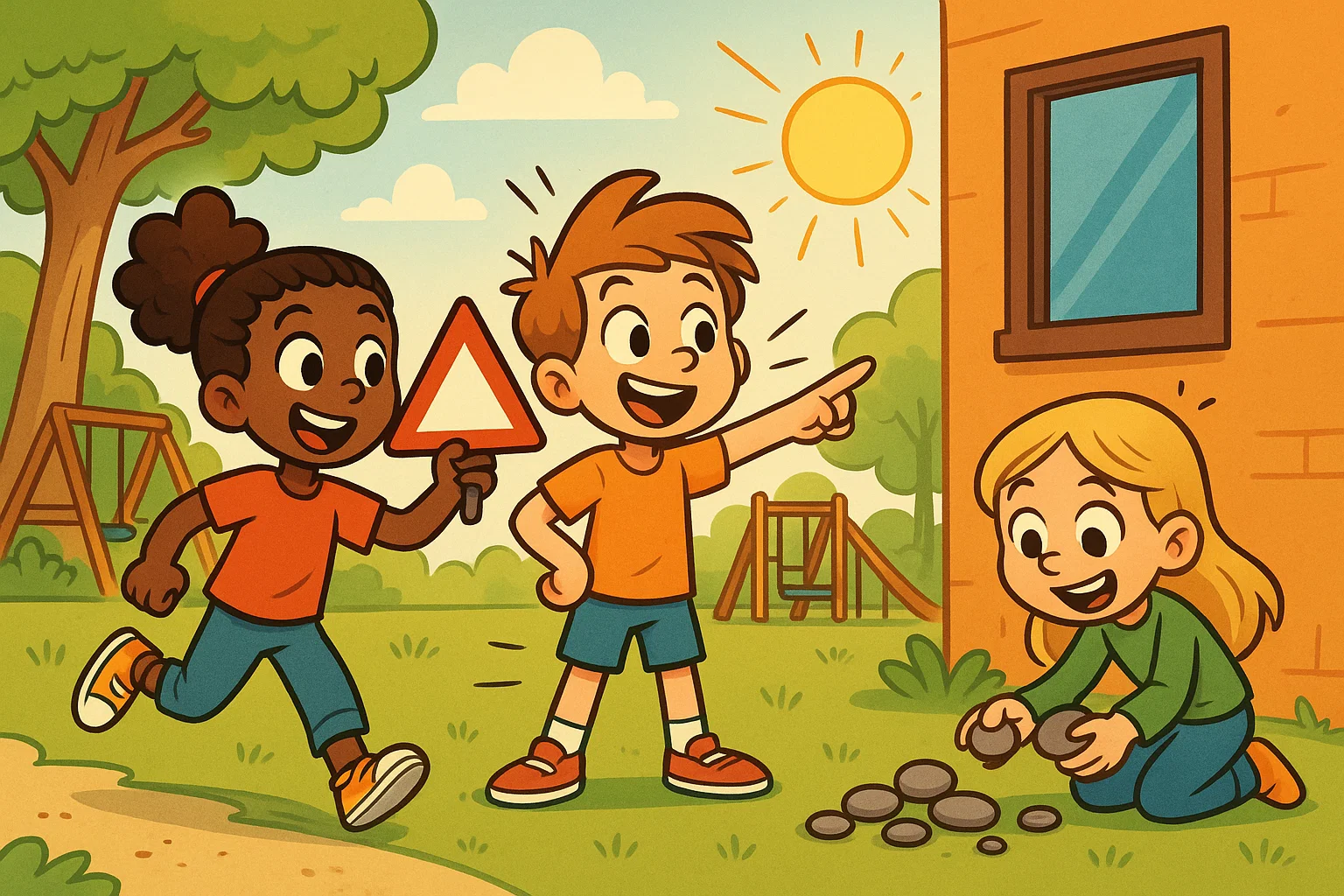
Advanced activities move beyond simple identification toward analysis, prediction, and creative problem-solving. These tasks develop higher-order thinking skills essential for shapes and mathematics.
Detective Games
Turn children into investigators searching based on verbal clues. Describe properties without naming: “I’m thinking of something with three straight sides and three corners.” Children look around to identify matching objects.
Detective challenge levels:
Level 1 (Easy): Direct descriptions
- “Find something that has four equal sides”
- “Look for something round with no corners”
Level 2 (Medium): Properties focus
- “This rolls easily”
- “This can stack neatly”
Level 3 (Hard): Comparative descriptions
- “This has more sides than a triangle but fewer than a hexagon”
- “This is not round and has no right angles”
This activity strengthens deductive reasoning and helps children understand that geometric forms have defining characteristics beyond appearance. It’s a fun way to learn new analytical skills.
Spatial Reasoning Challenges
Provide loose parts like craft sticks, straws, pipe cleaners, or building blocks. Challenge children to make a specific form or create their own three-dimensional structures using different materials. This open-ended exploration reveals understanding while encouraging creativity.
Set specific challenges:
- “Can you make a square using exactly four sticks?”
- “Build the tallest triangle possible”
- “Create something that uses curves and straight lines”
- “Make something using only six sticks”
Spatial reasoning develops as children manipulate materials, make predictions, test ideas, and revise approaches. These activities encourage exploration through hands-on problem-solving.
Categorization Games
Sorting by properties rather than just identifying pushes thinking deeper. Provide a mixed collection and ask children to create their own categories.
Categorization possibilities:
- Forms with/without curves
- Those with 3 sides, 4 sides, more than 4 sides
- Objects that roll vs. stack
- Symmetrical vs. asymmetrical geometric forms
- Closed vs. open structures
Allow children to explain their reasoning. There’s often more than one way to sort, and discussing different approaches develops flexible thinking and communication about geometry within different contexts.
Pattern and Sequence Activities
Creating and extending patterns builds algebraic thinking foundations. Start with simple AB patterns (circle, square, circle, square) and progress toward more complex sequences using various forms.
Pattern progression:
| Pattern Type | Example | Difficulty Level |
| AB | Circle, Square, Circle, Square | Beginner |
| ABC | Triangle, Circle, Square (repeat) | Intermediate |
| AAB | Circle, Circle, Square (repeat) | Intermediate |
| AABB | Triangle, Triangle, Square, Square | Advanced |
| Growing | Small, Medium, Large circle | Advanced |
Provide the beginning of a pattern and ask children to continue it. Then challenge them to create their own patterns for classmates to extend. This reinforces recognition skills while developing logical thinking.
Tips for Teachers and Parents
Successful teaching balances structure with flexibility. These strategies help create an environment where children feel confident to explore and develop genuine understanding.
Embrace Playfulness
Open-ended exploration often produces deeper learning than rigid instruction. When you allow children to play with geometric forms without predetermined outcomes, they discover properties through experimentation—learning that triangles don’t stack well but squares do, or that circles roll while rectangles slide.
Resist the urge to correct immediately if children are engaged. A child who calls a rectangle a “long square” demonstrates understanding of relationships. You can gently introduce correct names while validating their observation.
Encourage Making
Children develop stronger understanding when they create forms themselves rather than only identifying existing ones. Provide materials that allow construction:
- String or yarn: Lay on surfaces to make outlines
- Craft sticks or straws: Connect with putty to build 2D and 3D geometric forms
- Play dough: Roll into “snakes” and arrange into various forms
- Pipe cleaners: Bend to create different structures
- Building blocks: Stack to build using multiple pieces
As children manipulate these materials, they internalize properties like “triangles need three sides” or “circles have no straight edges.” This hands-on understanding transfers more effectively to abstract thinking.
Add Conversation Prompts
The language you use influences how children think about geometry. Ask questions that prompt observation and comparison to describe rather than just seeking correct answers.
Effective conversation starters:
- “What do you notice about this?”
- “How are these two the same? Different?”
- “Why do you think this is called a square?”
- “What happens if we turn this upside down?”
- “Can you find another object that’s the same?”
- “How many sides can you count?”
- “What do you see within this bigger form?”
These open-ended questions develop descriptive language and analytical thinking, showing that observation matters more than memorizing correct names.
Adapt Activities for Different Ages
The same activity can work across age groups with thoughtful modifications. Consider developmental appropriateness when planning.
Age-appropriate adaptations:
Ages 2-3 (Toddlers)
- Focus on 2-3 basic forms only
- Use large, easy-to-grip manipulatives
- Keep sessions very short (5-10 minutes)
- Emphasize sensory exploration to learn
- Accept approximate matching
Ages 3-4 (Preschool)
- Introduce up to 5-6 different forms
- Add simple sorting and matching activities
- Extend sessions to 15-20 minutes
- Begin discussing basic properties
- Encourage verbalization about geometry
Ages 4-5 (Pre-K)
- Work with 6-8 including ovals and diamonds
- Introduce simple 3D geometric forms
- Include complex sorting by multiple attributes
- Create and extend patterns using different pieces
- Begin early measurement concepts
Ages 5-7 (Kindergarten/1st Grade)
- Master all basic 2D and 3D forms
- Understand properties like sides, vertices, faces
- Create complex patterns and designs using combinations
- Solve spatial puzzles with many different pieces
- Connect to real-world applications in everyday life
Reinforce Vocabulary
Consistent language helps children build precise geometric understanding. Use correct names from the beginning, but don’t expect perfection immediately.
Essential vocabulary:
Basic terms: circle, square, rectangle, triangle, oval, diamond, star Properties: side, corner (vertex), edge, curve, straight, round, flat 3D terms: sphere, cube, cylinder, cone, pyramid, rectangular prism Descriptive words: big/small, thick/thin, wide/narrow, tall/short Comparative language: same, different, similar, matching
Model using these terms naturally. When a child says “pointy part,” affirm and extend: “Yes, that pointy part is called a corner.” Repetition across multiple contexts helps vocabulary stick while children learn through conversation.
Shapes in Daily Life
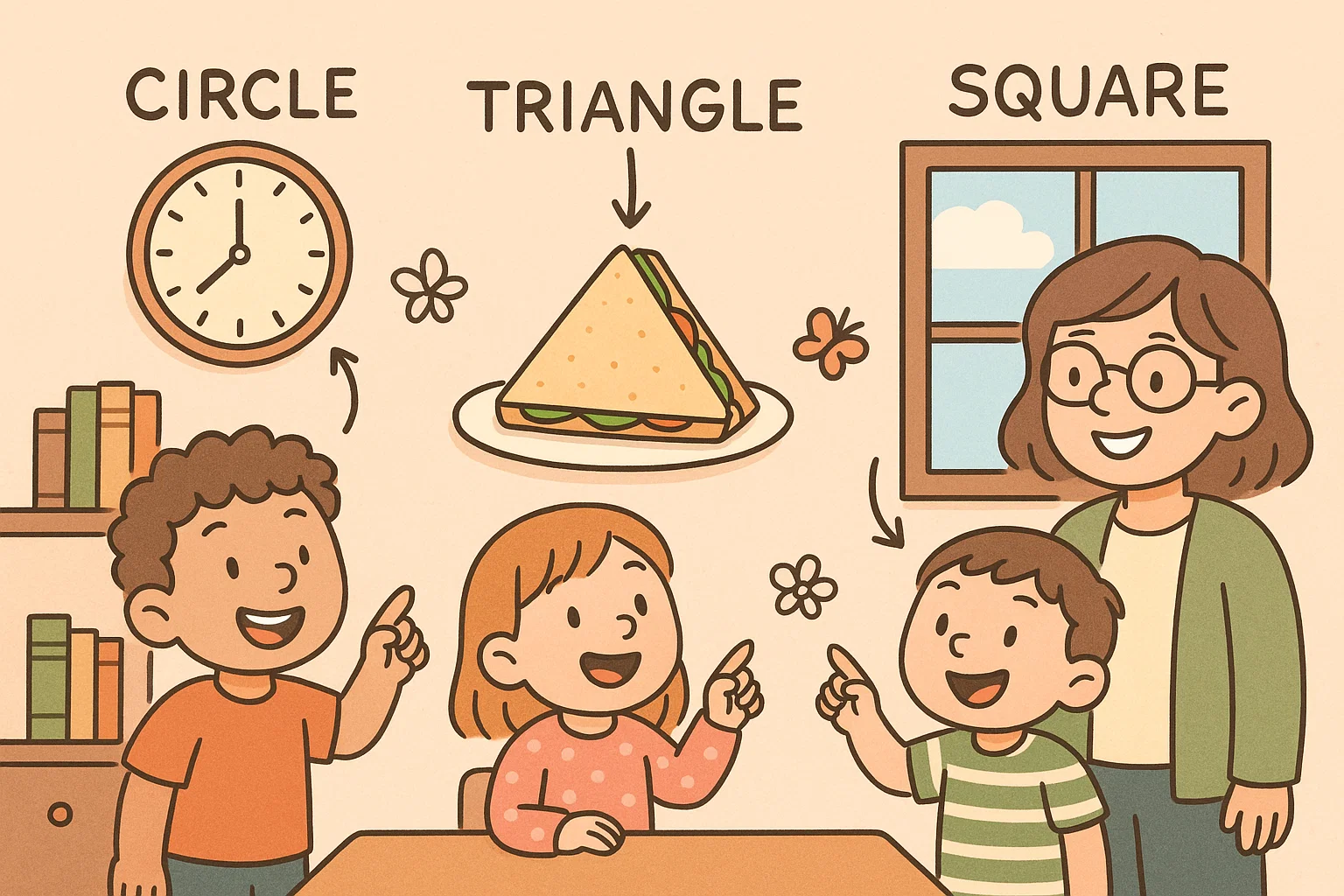
The most powerful learning happens when children recognize geometry in their natural environment. Pointing out forms in everyday life during ordinary activities reinforces that math isn’t confined to lessons—geometry all around exists everywhere.
Real-World Hunt
Transform ordinary errands into exploration. During car rides, walks, or shopping trips, play “I spy” to hunt for forms. Notice that street signs are specific for important reasons: stop signs are octagons, yield signs are triangles, speed limit signs are rectangles.
Where to spot:
- Buildings: rectangular windows, triangular roofs, arched doorways
- Signs: various geometric forms communicate different information
- Vehicles: circular wheels, rectangular truck beds, oval mirrors
- Packaging: cylindrical cans, cube-shaped boxes, pyramid tea bags
- Furniture: round tables, rectangular desks, triangular shelves
This ongoing observation helps children understand that many forms have functional purposes in everyday life. Wheels are circular because circles roll smoothly. Buildings use rectangles because they stack efficiently.
Using Household Objects
Your home contains hundreds of examples requiring no preparation. Gathering common items for exploration costs nothing and provides concrete experiences with everyday geometry to teach children naturally.
Sorting with household items:
| Form | Common Objects |
| Circle | Plates, lids, coins, clocks, rings, wheels |
| Square | Tissue boxes, coasters, sticky notes, pillows |
| Rectangle | Books, phones, tables, doors, envelopes |
| Triangle | Coat hangers, pizza slices, sandwich halves |
| Oval | Eggs, mirrors, footballs, spoons |
| Cylinder | Toilet paper rolls, cups, cans, bottles |
| Sphere | Balls, oranges, marbles, globes |
| Cube | Dice, boxes, sugar cubes, building blocks |
Create a museum by collecting items from around the house and displaying them sorted by geometric categories. Children can be curators, explaining why each object belongs in its category based on names and properties.
Finding Geometry Outdoors
Nature provides countless examples, though they’re often less perfect than human-made objects. This imperfection becomes a teaching opportunity—real circles in nature might not be as precise as drawn ones, but they still follow essential properties for children to explore.
Look for:
- Circular tree rings, flowers, pond ripples
- Triangular evergreen trees, leaf patterns, mountain peaks
- Rectangular fence posts, bricks in walls, garden beds
- Oval leaves, pebbles, bird eggs
- Linear grass blades, branches, paths
Discussing why certain geometric forms appear in nature leads to fascinating conversations bridging geometry with broader scientific thinking about mathematics in the natural world.
Digital Tools and Apps for Shape Learning
Technology offers interactive experiences that complement hands-on activities. Quality educational apps provide immediate feedback, adaptive difficulty, and engaging visuals. However, digital learning works best when balanced with physical manipulation and real-world exploration to help children holistically.
Best Apps for Lessons
When selecting apps, look for programs offering progressive difficulty, clear visuals, and educational design rather than flashy distractions that don’t reinforce recognition skills effectively.
Recommended features:
- Clear, accurate representations of geometric forms
- Multiple ways to interact (drag, tap, trace, sort)
- Verbal reinforcement of names
- Progress tracking for teachers and parents
- Minimal distracting sounds
- Opportunities for creativity beyond just matching
Top choices:
- Khan Academy Kids: Free comprehensive learning with excellent modules
- Endless Shapes: Recognition through engaging puzzles using different forms
- Montessori Geometry: Touch-based exploration to learn
- Starfall: Includes strong components for development
Printable Worksheets
Worksheets provide structured practice and documentation of progress. They work well for independent work time, homework, or assessment of recognition skills.
Effective worksheet types:
- Tracing sheets: Children trace dotted-line forms for fine motor control
- Matching activities: Draw lines connecting identical geometric forms
- Color-by-shape: Follow directions to color specific ones
- Hunt pages: Circle or mark particular forms within complex pictures
- Cut-and-paste: Cut out and glue onto corresponding outlines
- Pattern completion: Extend or create patterns using various pieces
- Drawing practice: Copy basic forms from models into blank spaces
Find free printables on educational websites organized by skill level, making it easy to incorporate learning for different abilities.
Online Videos
Short educational videos reinforce concepts through music, animation, and repetition. Songs particularly help auditory learners and make names memorable through rhythm.
Trusted video sources:
- Jack Hartmann: Educational songs covering all basic forms
- Super Simple Songs: Engaging content to teach children
- Numberblocks: Animated series incorporating many naturally
- PBS Kids: Episodes focused on different geometry
Watch videos together rather than using them as independent activities for young kids. Pause to discuss what you’re seeing, point out together, and answer questions. This interaction transforms passive viewing into active learning in their environment.
Interactive Sorting Games
Browser-based 2d games allow preschool children to practice independently while providing instant feedback. These simple activities work well for centers or home practice.
Game types:
- Drag-and-drop sorting: Move various forms into corresponding containers
- Attribute games: Sort by color and geometry together
- Memory matching: Find pairs of matching forms
- Pattern builders: Arrange different pieces following visual models
- Creators: Combine geometric forms to make pictures or designs
Many educational websites offer free, no-download games suitable for classroom computers or tablets. These fun and engaging activities develop recognition and quick identification skills.