

Fifth grade is a defining stage in a child’s growth as a writer. At this level, students move from building simple sentences to crafting thoughtful stories, persuasive arguments, and structured reports. Writing becomes more than an academic task – it’s a creative outlet that strengthens imagination, vocabulary, and confidence.
This collection of writing prompts supports every style of the fifth-grade curriculum, from narrative and persuasive writing to expository and poetic forms. Designed for teachers and parents alike, these engaging ideas inspire creativity, help students overcome writer’s block, and make daily writing both enjoyable and meaningful.
Why Writing Prompts Help Fifth Graders
Writing prompts are far more than just story starters; they are a pedagogical strategy that unlocks a student’s potential. For fifth grade learners, who are rapidly developing critical thinking abilities, a well-crafted prompt provides both a clear starting point and a challenge. They alleviate the blank-page anxiety known as writer’s block by offering a focused idea, allowing students to focus their mental energy on writing itself rather than struggling to find a topic..
- Encouraging Creativity and Emotional Expression: Writing prompts act as springboards for imagination, inviting students to step into new roles, explore “what-if” situations, and process complex emotions.
- Making Lessons Interactive: Prompts turn passive learning into an active, interactive experience, making lessons on grammar, syntax, and structure feel immediately relevant.
- Improving Core Writing Skills: Regular writing practice focused on diverse prompts helps improve clarity, refine fluency, and reinforce correct grammar and spelling in a practical, application-based manner.
How Prompts Boost Imagination
A great writing prompt idea is a window to a new world. By presenting a novel or unusual scenario, a prompt compels students to use their mind’s eye. Asking a student to pretend they have a power or asking what happens next in a strange situation forces them to build a world from the ground up, detailing characters, settings, and conflicts.
Observation: Research on elementary writers shows that when students are given structured, focused writing tasks – instead of being asked to “just write something” – they tend to produce more confident, more expressive writing. For example, a study in the Journal of Educational Psychology found that students with higher writing self-efficacy (a sense that “I can do this”) wrote stronger, more developed work.
Encouraging Independent Composition
The best prompts for kids foster independence. Opinion and persuasive writing prompts give students a platform to express their thoughts confidently and teach them the structure of a sound argument. This practice is crucial in the fifth grade because it’s a gateway to more complex essay writing and formal reporting in middle school. When a student has to compose a letter to the principal about a school rule or present a reasoned argument on a social topic, they learn that their voice matters.
Building Vocabulary and Structure
When a 5th grader uses a prompt like “Describe a mythical journey to find a lost kingdom,” they are forced to seek out richer, more domain-specific vocabulary (“catacombs,” “archipelago,” “awe-inspiring”) than they might use in daily conversation. Furthermore, different genre prompts – like a three-paragraph essay versus a narrative writing piece – require adherence to specific structures (thesis, supporting points; or exposition, rising action, climax). This regular engagement with varied forms naturally helps improve sentence formation, paragraph cohesion, and overall writing skills.
Narrative Writing Prompts
Narrative writing prompts are the heart of creative development, helping fifth grade students master the art of storytelling. These exercises not only solidify their understanding of the basic plot structure – beginning, middle, and end – but also nurture empathy by requiring them to walk in the shoes of a character.
Adventure Story Starters
- You find an old, rusted key in your backyard. When you put it in a lock on the wall of your shed, it opens a secret portal to a magical island. Draft a story about your first two hours there.
- Your class is on a field trip to the local museum when one of the statues winks at you. It needs your help to escape! What happens next?
- A message in a bottle washes up on shore. The note contains coordinates and a rhyme about hidden treasure. Detail your quest to find it.
Everyday Life Stories
- Compose a story about a time you tried something new and were scared, but it turned out to be amazing.
- You and your favorite book character accidentally swap bodies for a day. What is the most awkward thing that happens in the classroom?
- A new student joins your class who only speaks in rhymes. How do you try to encourage them to talk normally, and what happens when you fail?
Fantasy and Imagination
- Imagine you wake up and discover you have one superhero power, but it only works when you are singing. What is your power, and how do you use it?
- You meet a genie who grants you three wishes, but each wish can only benefit someone else. What do you wish for and why?
- Imagine a secret society of magical creatures living in your local park. What is their job, and what happens when they discover you’ve found them? What is their job, and what happens when they discover you’ve found them?
Opinion and Persuasive Writing Prompts
These prompts teach 5th grade students how to form and express a clear point of view. Persuasive writing requires critical thinking and the ability to organize facts and arguments logically – skills essential for academic success and real-world engagement.
School and Learning Topics
| Topic | Composition Style | Key Objective |
| Should students have homework every night? | Persuasive Essay | Present an argument using reasons and evidence (e.g., student well-being vs. practice). |
| Should we use these writing prompts instead of textbooks? | Opinion Paragraph | Express a preference and defend it, focusing on engagement and learning. |
| Is it fair for students to wear school uniforms? | Pen a letter to the school board | Understand audience and formal letter structure while making a case. |
Real-Life Issues
- Persuasive writing prompts asking: Should people have to pay a small fee every time they use a plastic bag? Develop an argument for or against this to help students understand environmental responsibility.
- Convince a friend that volunteering is the best way to spend a Saturday afternoon. Use examples of how it can make a difference.
- Compose a story about a time you had to defend a friend or stand up for what was right. What was your argument?
Fun and Creative Debates
- Draft a paragraph arguing for or against the idea: Would you rather be able to talk to animals or be able to speak every human language?
- Should pets be allowed in the classroom for a “Bring Your Pet to School” day? Use these writing prompts to practice a fun, lighthearted debate.
- Which is a better invention: the wheel or the lightbulb? Help students craft an argument for their choice.
Informational and Research Writing Prompts
Informative composition prompts help students practice structuring facts, describing processes, and organizing data. This is fundamental for developing research and literacy skills.
Science and Discovery
- Describe the life cycle of a butterfly, explaining each stage with clear details.
- Research a famous scientist (e.g., Marie Curie or George Washington Carver). Summarize the main achievements of their life’s work and describe one major discovery in a short report.
- Explain how a volcano erupts. Use vivid, descriptive language and label the key parts of the process.
History and Culture
- Choose a cultural tradition or holiday from another country. Formulate a letter to a relative describing how it is celebrated and why it is important.
- Who was your favorite book historical figure, and why? Develop a paragraph defending your choice, citing two key achievements.
- Draft a story as if you were a historical observer witnessing the building of the pyramids or the discovery of fire.
Everyday Curiosity
- Explain in simple steps how recycling happens after you throw a soda can into the blue bin.
- Produce a detailed, step-by-step guide on how to bake your favorite simple recipe from a book.
- How does the internet travel from a big server to your small computer or phone? Help students break down a complex system into understandable parts.
Descriptive and Emotion Writing Prompts
These writing prompts focus on sensory details and internal states, which are vital for developing expressive language and creating compelling scenes in narrative writing.
Describe Your Favorite Place
- Describe your favorite place to read. Focus on the sights, sounds, and smells of the area.
- Imagine a magical waterfall that changes color with your mood. Describe the waterfall and the color it is right now.
- Describe the feeling of jumping into a cold lake on a hot summer day. Use these writing prompts to focus on the contrast between the heat and the water.
Emotion Prompts
- Compose a story about a character who is experiencing enormous pride after achieving a difficult goal. How does that feeling affect their actions?
- Describe the emotion of fear by telling about a foggy night when you heard a strange sound. Do not name the emotion, but describe its physical effects on the character.
- Encourage self-expression by recounting a time when you experienced unexpected kindness from a stranger.
Using the Five Senses
Prompts will have students imagining the sensory details of the following:
- A busy school cafeteria at lunchtime.
- A garden right after a spring rain.
- A superhero landing on a rooftop in a silent city.
Funny and Creative Writing Prompts
Adding a lighthearted element is essential for making writing a daily habit and encouraging reluctant 5th graders to put pen to paper. Fun writing prompts demonstrate that the act of composition can be a source of joy and laughter.
Silly Scenarios
- What happens next when you discover your dog can talk, but he only talks about politics?
- Imagine waking up with bright blue hair that grows two inches every time you tell a lie. Create a story about your day.
- Pretend your backpack has come to life and now follows you everywhere, complaining loudly about its contents.
Unexpected Situations
- Develop a story where you switch roles with your teacher for a day. What is the first new rule you make?
- A baby alien lands in your classroom and asks you to teach it the most important thing about Earth. What do you teach?
- Imagine your favorite pair of shoes starts tapping out messages in Morse code. What is the message?
Comedy and Humor Practice
| Humor Prompt Type | Example | Key Writing Skill Practiced |
| Funny Dialogue | Pen a conversation between two inanimate objects, like a rubber band and a paperclip. | Developing character voice and playful language. |
| Short Comic Story | Detail a series of mishaps that occur when you try to make pancakes. | Using action verbs and sequencing events for comedic effect. |
| Exaggerated Description | Describe a messy room using so much exaggeration that it sounds like a disaster zone. | Descriptive language and hyperbole. |
Poetry Writing Prompts
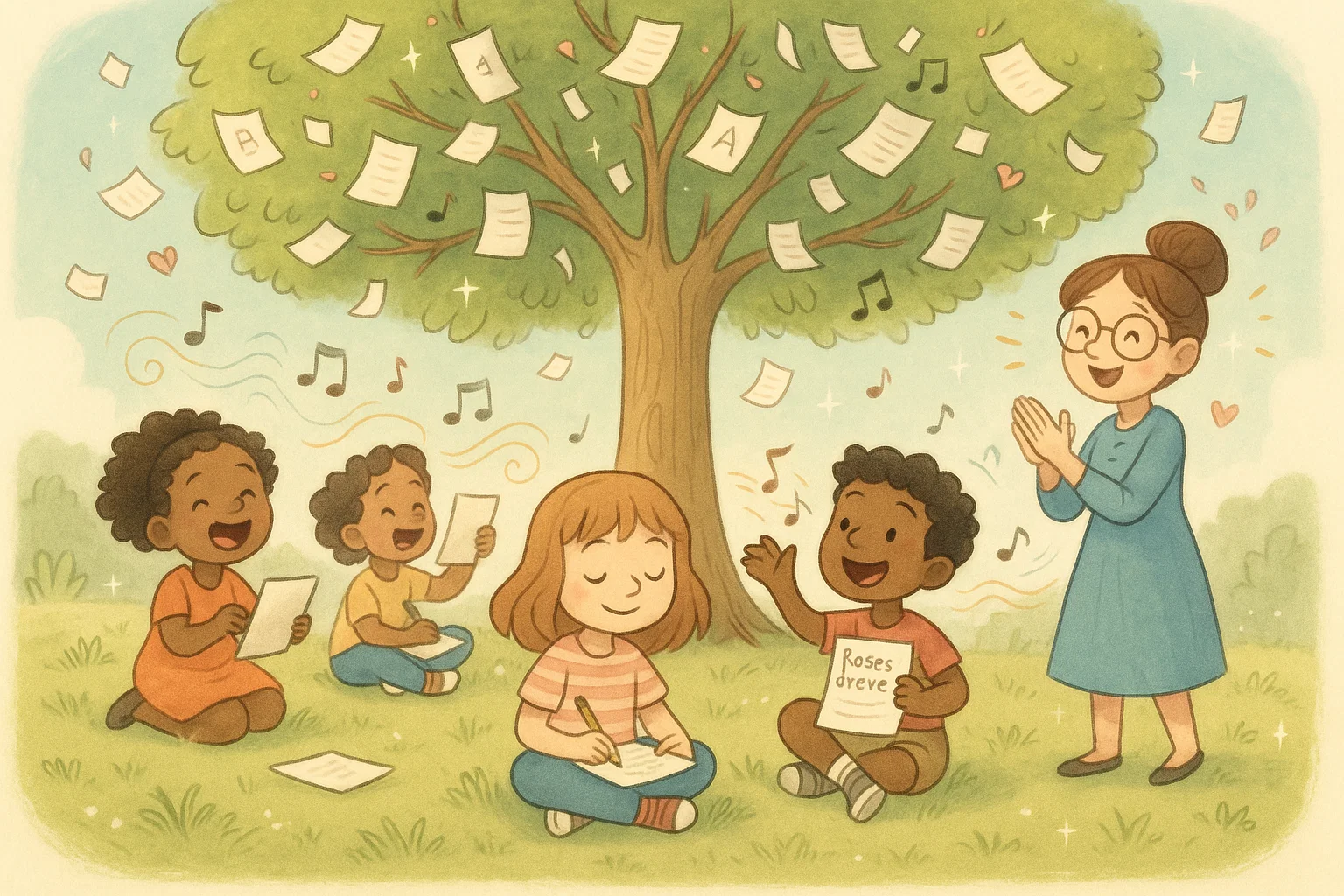
Poetry encourages artistic expression, rhythm, and the concise, powerful use of language, which is great for improving word choice. Even simple verses help improve a student’s ear for language.
Nature and Seasons Poems
- Draft a short poem about the way the leaves change color in the fall. Focus on color words and sensory details.
- Compose a poem from the point of view of a raindrop falling to the ground.
- Encourage your students to create a simple haiku about a cat, focusing on the syllable count (5, 7, 5).
Emotional Poems
- Compose a simple poem about the feeling of wishing for something deeply.
- Formulate an acrostic poem using the letters of the word “COURAGE.”
- Write a poem about the quiet comfort of reading your favorite book.
Animal and Science Writing Prompts
These prompts combine fifth grade curiosity about the natural and engineered world with the need for creative expression, blending the informative with the fictional.
Animal Adventures
- Imagine you spend a day as a zookeeper for magical creatures. What is the most challenging creature to care for?
- Develop a story about discovering a new species of glowing insect in the forest behind your house.
- Pretend you are a pet dog composing a diary entry about the strange habits of your human family.
Science Experiments and Exploration
- Prompts will have students imagining they are the first humans to land on a new planet. Describe the landscape, the sky, and the challenges.
- Record a persuasive speech convincing the world to help fund your new invention: a robot that cleans up all the ocean pollution.
- Draft a paragraph explaining what it would be like to shrink down to the size of an ant and explore your kitchen counter.
Nature Connections
Use these writing prompts to compose from the perspective of a plant trying to reach the sun, or a river describing its journey to the sea.
Holiday and Seasonal Writing Prompts
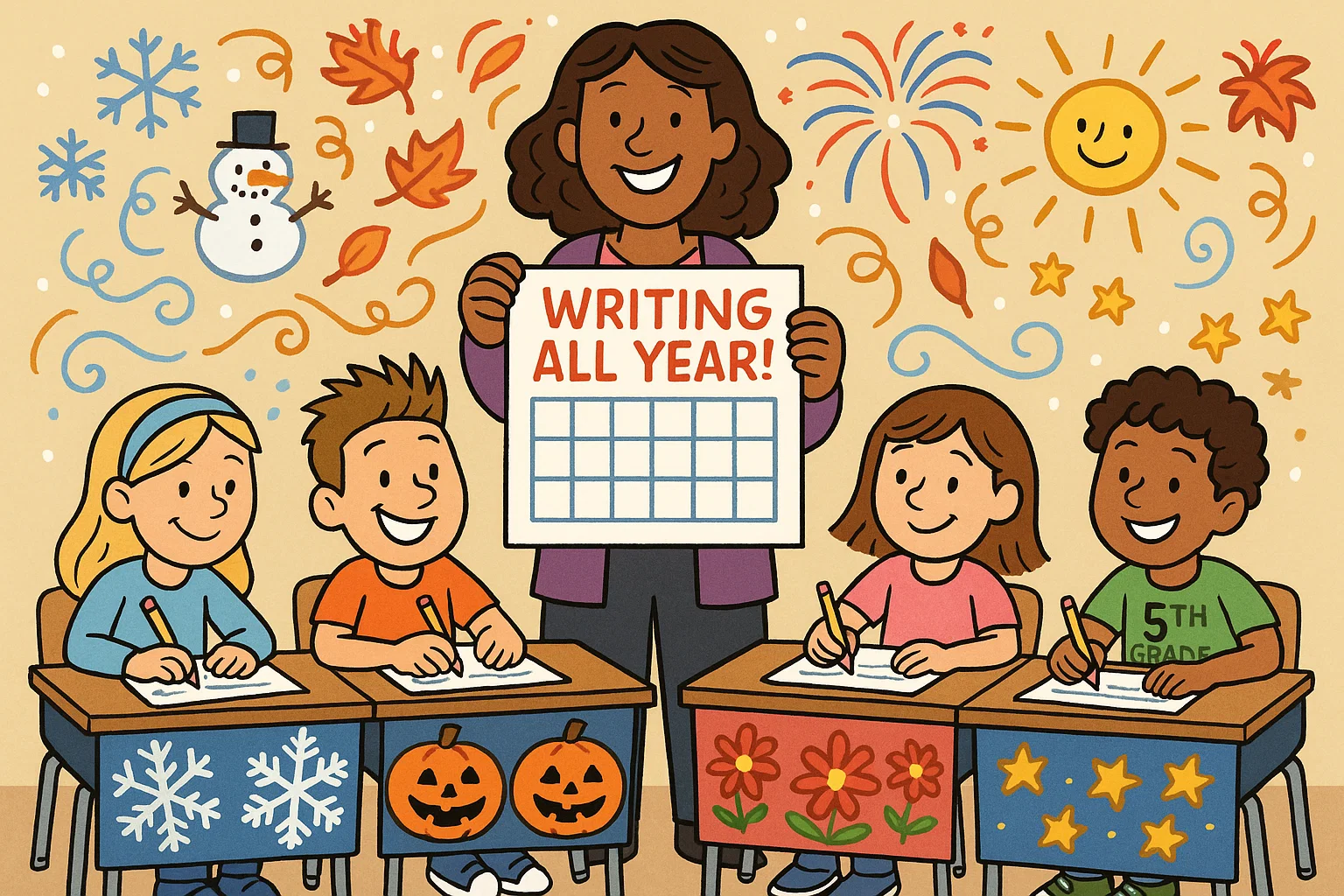
These seasonal prompts help keep writing relevant and engaging throughout the school year, connecting writing prompts for fifth grade to real-world events and celebrations.
Winter and New Year Prompts
- Compose a story about a holiday tradition that your family invents this year.
- What is one big wish or resolution you are making for the upcoming year, and why is it important to you?
- Creative writing prompts for a short story about a talking snowman who needs help finding his magic hat before he melts.
Spring and Summer Ideas
- Formulate a letter to your future self about what you hope to achieve during the summer break.
- Creative thinking prompt: Describe a secret fort you build in the woods that is guarded by a superhero squirrel.
- Journal prompts about the most exciting thing you saw on a nature walk this spring.
Fall and Halloween Fun
- Develop a story about a person who has the worst, most embarrassing costume at the Halloween party.
- Summarize the plot of a haunted house experience you go through with your friends.
- Persuasive writing argument: Is Halloween the best holiday of the year? Defend your opinion.
Journal Writing Prompts
Journal prompts are invaluable for emotional growth and personal reflection, helping children develop self-expression in a private, non-judgmental space. This type of regular writing encourages critical thinking about personal experiences.
Daily Reflection Prompts
- What is the kindest thing someone did for you today, and how did it make you feel?
- If you could talk to yourself from the beginning of the grade 5 school year, what is one piece of advice you would give?
- Journal prompts to get students thinking about the funniest thing that happened during their day.
Gratitude and Mindfulness
- List five things you are truly grateful for right now and explain why each one matters.
- Develop a paragraph about a time you felt very peaceful and calm. What was happening around you?
- What is one wish you have for your community, and how could you help make it happen?
Personal Growth Topics
- Draft a story about a time you learned a hard lesson. What did you learn?
- What is the most challenging thing you are currently working on in the classroom or at home, and what is your plan to improve?
- If you could have a conversation with your favorite book character, what would you ask them about their courage or wisdom?
Encourage Fifth Graders to Become Writers
The most powerful strategy to inspire writing growth is creating an environment where composing text is valued and practiced consistently. For 5th grade students, consistency beats intensity every time.
Create a Routine
- Set a “Warming Up” Time: Start the day with a 10-15 minute “Quick Draft,” where students respond to a single thought-provoking prompt. This primes their brain for the rest of the day.
- Design a Fun Writing Corner: Whether at home or in the classroom, designate a cozy, clutter-free space stocked with fun pens, different colored paper, and a journal prompts booklet.
Make Writing Interactive
- Group Storytelling Games: Start a narrative writing piece with a story starter, and have each student or group add one paragraph before passing it on. This shows the endless possibilities for their writing and encourages teamwork.
- Creative Sharing Sessions: Dedicate time for students to share their work, but keep participation optional. This builds a supportive audience and increases the desire to compose well.
Celebrate Progress
- Create a Class Anthology: At the end of the year, collect the best short stories and poems into a printed or digital book.
- Parent-Teacher Communication: Encourage your students by sending home their strong pieces, noting specific areas of improvement (e.g., “Note how expertly they used figurative language to describe the magical setting”).
More Writing Prompts and Activities
These supplementary resources help expand beyond the basic prompts and provide concrete tools for teachers and parents.
Story Starters and Worksheets
Writing prompt ideas are also easily incorporated into structured worksheets:
- Downloadable Character Profile Sheet: A worksheet that prompts students to detail a character’s name, superhero power, personality traits, and greatest wish before starting a story.
- Plot Diagram Template: A graphic organizer to help students map out the exposition, rising action, climax, falling action, and resolution before they craft a story.
Creative Classroom Activities
- Picture Prompts: Show an unusual image – like a robot playing a guitar or a city floating in the sky – and ask students to compose a paragraph or short story about it.
- “What If” Jar: Fill a jar with folded pieces of paper that start with “What if…” These spontaneous fun writing prompts are excellent for filling small gaps of time or overcoming writer’s block.
Home Practice Tips
Encourage parents to support literacy at home by:
- Composing a Letter: Suggest parents and children exchange handwritten letters each week about their day or a shared favorite book.
- Creating Captions: Challenge the fifth grade student to formulate funny, creative, or descriptive captions for family photos.