Easy Drawing Ideas for Grade 6: Art Projects and Art Lessons

 Discover a Free Education Video App for Kids
Pastory uses AI to personalize educational video content based on your child’s interests and personality. Safe, engaging, and built for curious young minds. Sign up now to stay updated and enjoy early access with a free trial
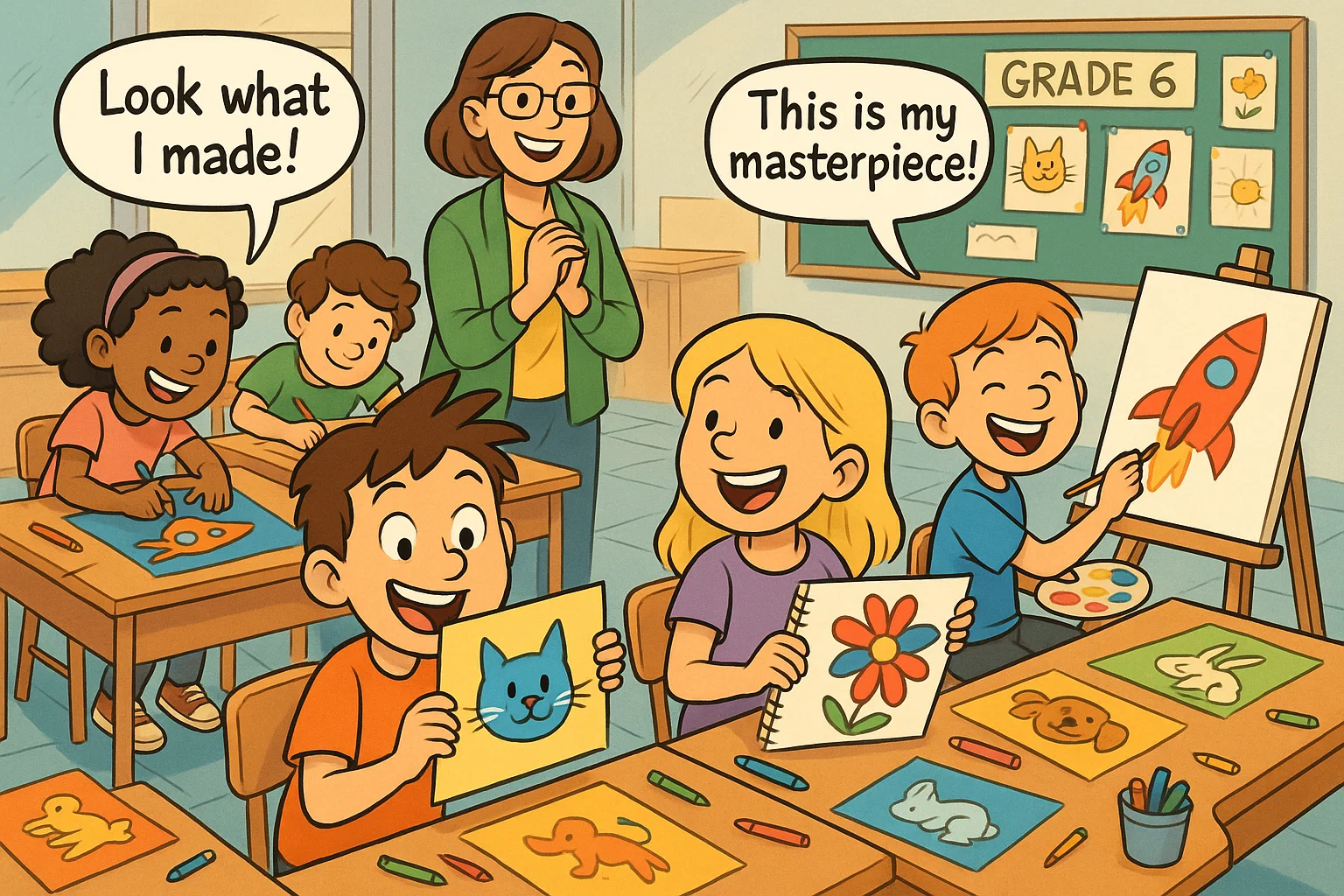
Sixth grade is a fascinating crossroads in a child’s artistic development. Students in this age group (typically 11-12 years old) are transitioning from the more symbolic, imaginative art of their elementary years to a new, often critical, phase where realism and technical skill become incredibly important. This shift can be a challenge, sometimes leading to frustration when their artistic vision exceeds their current ability. That’s why providing engaging, easy-to-follow art lesson ideas that still offer room for technical growth is crucial.
These projects are designed not only as fun art activities but also as stepping stones to help middle school students – whether in the classroom or at home – build confidence, improve their drawing skills, and experiment thoughtfully with fundamental elements of art like color, line, and composition. Utilizing simple art materials like pencil, markers, oil pastel, and watercolor, these step-by-step instructions ensure success while laying the groundwork for more advanced grade levels in the future.
Fun Drawing Projects for Grade 6 Students

Variety is the spice of life in any middle school art curriculum. At this age level, students thrive on projects that balance playful creativity with tangible skill development. Each of these art project ideas is versatile enough to fit into a standard art lesson plan (perhaps a 45-60 minute session) or to be expanded into a multi-day art unit.
Falling Leaves Art Project
This beautiful, nature-inspired art project is an excellent introduction to color blending and creating visual texture.
Concept Focus: Watercolor washes, creating contrast, and layered mediums.
Step-by-Step Instructions:
- Begin by drawing a few simple, overlapping leaf shapes onto heavy paper. Keep your pencil lines light and simple.
- Using watercolor, apply a wet-on-wet technique to create a rich, variegated wash of warm colors (red, orange, yellow) within and around the leaves. Let the colors bleed naturally.
- After the paper dries, outline the leaves with a fine-tip black marker or pen, adding delicate vein patterns. The sharp, crisp outlines contrast beautifully with the soft watercolor, making the subject pop.
Georgia O’Keeffe Inspired Graphic Flowers
This art lesson is a fantastic way to teach bold composition and the power of close-up views. It appeals to sixth graders’ desire to create bold, impactful artwork.
- Concept Focus: Composition (filling the frame), large-scale drawing, and bold color choices.
- Art Materials: Pencils, erasers, and either oil pastel or bright markers.
- Process: Students select a simple flower (real or photo) and focus on just the center, drawing it so large that it touches all four edges of the paper. The focus moves from drawing the whole flower to detailing the patterns, shades, and forms within a small section. The use of oil pastel allows for rich color layering and blending, mimicking O’Keeffe’s depth.
Winter Folk Art Trees (+ step-by-step guide)
Embrace pattern and symmetry with this stylized winter scene. It’s an easy art idea that yields sophisticated results.
Concept Focus: Symmetry, cool color palettes (blues, purples, white), and pattern repetition.
Easy to Follow Steps:
- Draw a simple, stylized tree form, focusing on the trunk and primary branches.
- Divide the paper horizontally to create the ground and sky.
- Use simple shapes (circles, dots, waves) to fill the tree, branches, and the background with repeating patterns. The restricted cool color palette gives it a unified, wintry feel.
- The final result is an excellent example for discussing how cultural art and design (specifically folk art) uses pattern to tell a story.
Recycled Tropical Fish
This project introduces sustainability and texture using collage techniques.
- Concept Focus: Mixed media, texture, and environmental awareness.
- Materials: Old magazines, colored paper scraps, cardboard, glue, and markers.
- The Art Project: Students begin by drawing a simple tropical fish outline. They then use torn and cut pieces of recycled paper and magazines to create the texture and color of the fish’s scales and fins. The different paper types create a layered, unique collage effect.
Line and Shape Based Art Lessons
For advancing drawing art skills, focusing on the basics – line and shape – is essential. These exercises are the building blocks of all successful art lesson plans.
Happy Lines
This abstract exercise uses line as an expressive tool to convey emotion.
- Concept Focus: Expressive line quality (thick, thin, jagged, smooth), rhythm, and abstraction.
- Lesson Plan Goal: Students will learn to use line as a language. Platforms such as Teachers Pay Teachers offer excellent supplemental printables for this lesson type.
- Activity: Assign a different emotion (e.g., joy, confusion, fear, excitement) to a section of the paper. Using only black marker or ink, the students create abstract compositions in each section that visually represent that emotion, focusing on movement, density, and line type.
Weighted Contour Line Drawing
Contour drawing is foundational to observational skill, a key area for grade 6 students.
Concept Focus: Observation, line weight variation, and capturing form/proportion.
Step-by-Step:
- Place a simple object (still life setup, like a shoe or a piece of fruit) in front of the student.
- Instruct them to draw the outline without lifting their pencil, focusing intently on the edges.
- Introduce weighted contour drawing by asking students to press harder for darker lines and more lightly for thinner ones. This subtle variation instantly adds dimension.
Op Art Hands
A classic middle school art project, Op Art (Optical Art) is highly engaging because it creates a magical optical illusion.
Concept Focus: Op art, line curvature, and creating the illusion of three dimensions (3D) on a flat surface.
Drawing Lesson:
- Students trace their hand lightly in the center of the paper.
- Using a ruler, they draw straight lines across the entire page, from one edge to the other.
- Step-by-step instructions then show them how to curve the line inside the hand outline to make it look like the straight lines are bulging out, giving the hand a 3D, inflated appearance.
- Coloring with markers or oil pastels in alternating hues enhances the optical illusion effect.
Lines Landscape
This project trains students in using basic linear techniques to achieve atmospheric perspective.
- Concept Focus: Perspective (creating depth), line direction, and line weight for distance.
- The Project: A simple landscape art drawing showing rolling hills or mountains. Students use very thick, dark lines for objects in the foreground and progressively thinner, lighter, and fainter lines for objects moving into the background. This is an easy art method for representing depth without complex shading.
Creative Pop Culture Drawings
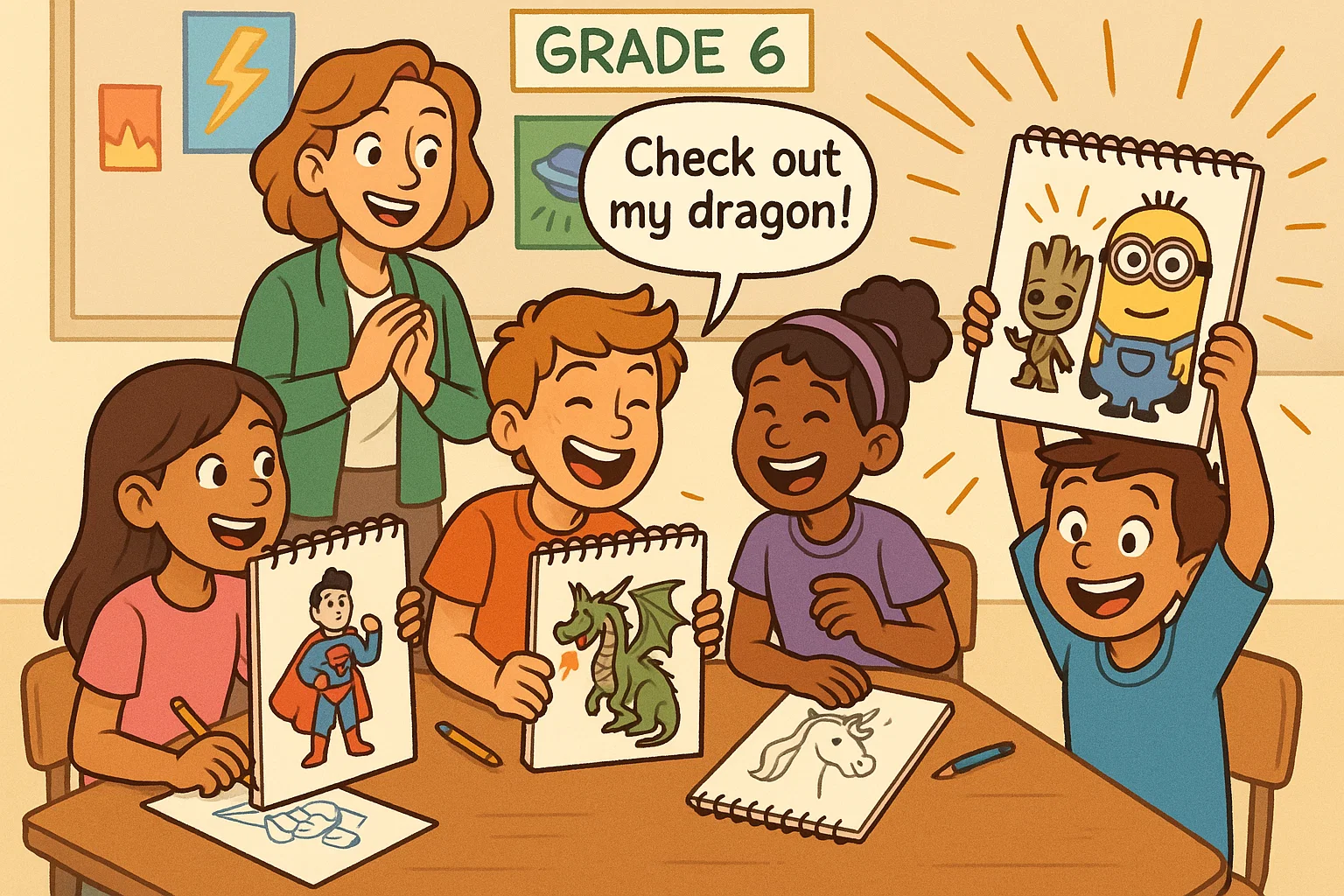
Tapping into students’ interests, like current pop culture, is a powerful tool for an art teacher to foster engagement and make a drawing lesson relatable.
| Project | Skill Focus | Suggested Materials |
| Baby Groot | Geometric simplification, organic vs. geometric shapes | Pencil, eraser, brown markers/pencils for bark textures |
| Minion | Basic body proportions, cartooning, expressive eyes | Marker, colored pencils, focus on yellow/blue shading |
| Dragon | Breaking down complex forms, texture (scales), basic shading | Pencil, charcoal (optional), focus on form and implied texture |
| Unicorn | Imaginative detailing, color layering, rendering “sparkle” effects | Oil pastel for vibrant color, glitter/gel pens for effect |
These projects help students practice stylization – transforming realistic subjects into simplified, graphic forms – an advanced drawing skill.
Realistic and Observational Drawing
As students enter the middle school grades, they often crave realism. These projects directly address that desire, training the eye and the hand simultaneously. According to child-development research, the Pseudo-Naturalistic Stage (ages 10–13) is when students become more critical of their work, viewing success through the lens of realism; therefore, supportive instruction in these areas is key.
Water Droplet Drawing
This deceptively simple drawing teaches students the principles of light, shadow, and reflection.
Concept Focus: Value (light/dark), highlights, and core shadows to create a 3D illusion.
Step-by-Step Instructions:
- Draw a small, organic shape for the droplet.
- Determine the light source.
- Apply a soft, dark shadow on the side away from the light source (the droplet’s shadow).
- Add a bright highlight on the side facing the light source to show reflection.
- A second, smaller highlight opposite the light source makes the droplet appear convincingly wet. This small detail is a huge confidence-booster and a great art idea.
Personal Soda Can Label
This combines drawing with key graphic-design principles.
- Concept Focus: Typography, branding, illustration, and layout design.
- The Project: Students design the full art and design of a new soda brand. They must illustrate a central image, incorporate a unique font, and consider color psychology (e.g., using red for energy, blue for calm). This is a fun way to use their drawing skills practically.
Crushed Soda Can Drawing
An advanced still life setup that focuses entirely on observation of complex texture and form distortion.
- Concept Focus: Texture, shading with charcoal or pencil, and light reflection on metal.
- The Lesson: Students observe the complex planes, shadows, and highlights on a crushed aluminum can. The challenge lies not in the shape but in mastering value – balancing bright highlights on smooth metal with deep shadows in the creases. This is a critical art lesson for moving beyond simple outlines.
Self-Portrait
A timeless art project that requires patience and instruction on proportion.
- Concept Focus: Facial symmetry, relative proportion, and tonal shading.
- Art Teacher Tip: Always begin by drawing the basic egg-shape of the head and using proportional guidelines (eye line, nose line, mouth line). Emphasize that the space between the eyes is roughly the width of one eye, and the eyes are centered halfway down the head. This makes the challenging task manageable and helps build skills.
Color and Pattern Experiments: Lesson Plan
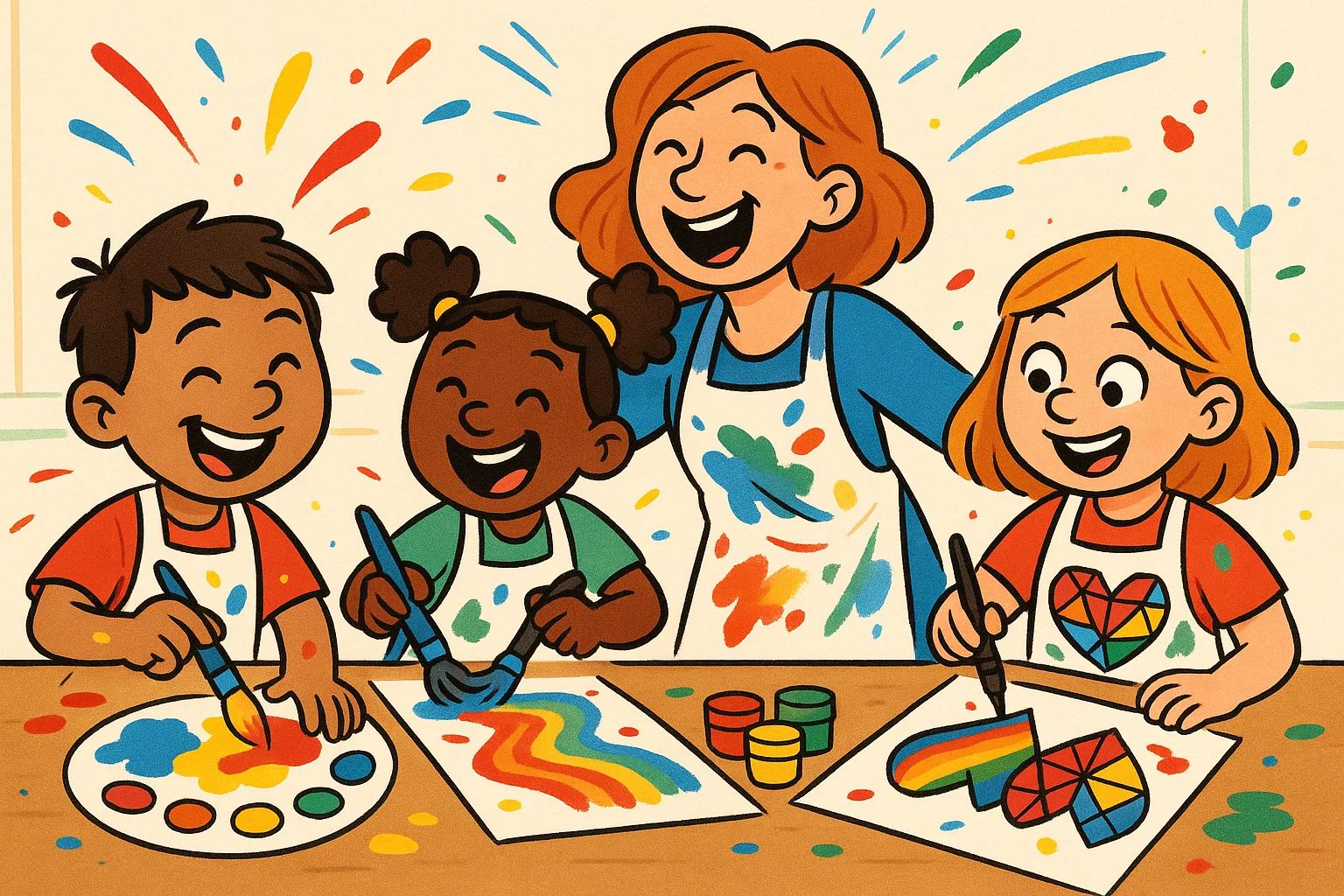
Sixth graders need dedicated time to explore color theory without the pressure of pure realism. These art activities are focused on the creative possibilities of different mediums.
Color Mixing Lines
- Concept Focus: Blending, warm vs. cool colors, and linear composition.
- Activity: Using oil pastel or paint, students draw a large, abstract composition using a series of parallel lines. They then explore how warm tones (red, orange, yellow) and cool tones (blue, green, purple) blend and interact where the lines intersect or overlap, resulting in a vibrant, rhythmic visual.
Foiled Scribble Flowers
- Concept Focus: Texture transfer, mixed media, and vibrant color.
- Materials: Drawing paper, foil, glue, markers/oil pastels.
- Process: Students sketch abstract “scribble” flowers. Glue a piece of crumpled aluminum foil onto the background surface. Once dry, they can color over the foil lightly with markers, making the texture of the foil stand out. This combines drawing with a unique tactile element, a fun art idea.
Geometric Hearts
- Concept Focus: Geometry, symmetry, and pattern within a stylized shape.
- The Project: Draw a heart shape and subdivide it into smaller geometric sections (triangles, squares, diamonds). Each small section is then filled with a different line pattern or contrasting color, creating an intense, visually rhythmic pattern. This is great for an easy art lesson using markers or fine-line pens.
Rainbow
- Concept Focus: Gradient blending (value and hue), watercolor layering, and emotional color symbolism.
- Technique: Students practice creating a smooth color gradient with watercolor to depict a realistic rainbow. Focus on the gradual transition between colors (e.g., how the blue fades into the green). This helps students gain control over a fluid medium and offers a creative way to explore color symbolism.
Thematic and Seasonal 6 Grade Art Ideas
Connecting an art lesson to current events, holidays, or seasons helps middle school grades find immediate relevance and encourages storytelling in their work.
Martin Luther King Jr. Portrait (Symbolic)
- Concept Focus: Integrating portraiture with symbolism, social themes, and meaningful composition.
- The Project: Students create a stylized portrait of MLK Jr., using collage or graphic shapes to represent key concepts like peace, justice, or equality in the background or within the portrait itself. This combines drawing skills with history and social-studies context.
Valentine’s Day Project (Mixed Media)
- Concept Focus: Layering, collage, pattern, and mixed media.
- Activity: Using paper scraps, string, markers, and drawings, students create a festive, layered piece. The focus is on using different materials to create depth and texture, moving beyond simple pencil-on-paper.
Earth Day Fish Art
- Concept Focus: Environment, collage, and using drawing to advocate.
- The Project: Similar to the Recycled Tropical Fish, but focused on marine life and the use of “trash” or recycled art materials to draw attention to pollution. Incorporating real plastic packaging or bottle caps strengthens the environmental message.
Winter Tree Silhouette
- Concept Focus: Contrast, negative space, and light source.
- Technique: Students draw a detailed, bare tree silhouette against a dramatic sunset or moonlight sky. The art project emphasizes the power of contrast, using only black to define the tree and then filling the entire sky with vibrant oil pastel or deep watercolor to make the dark silhouette pop.
Skill Development Through Drawing
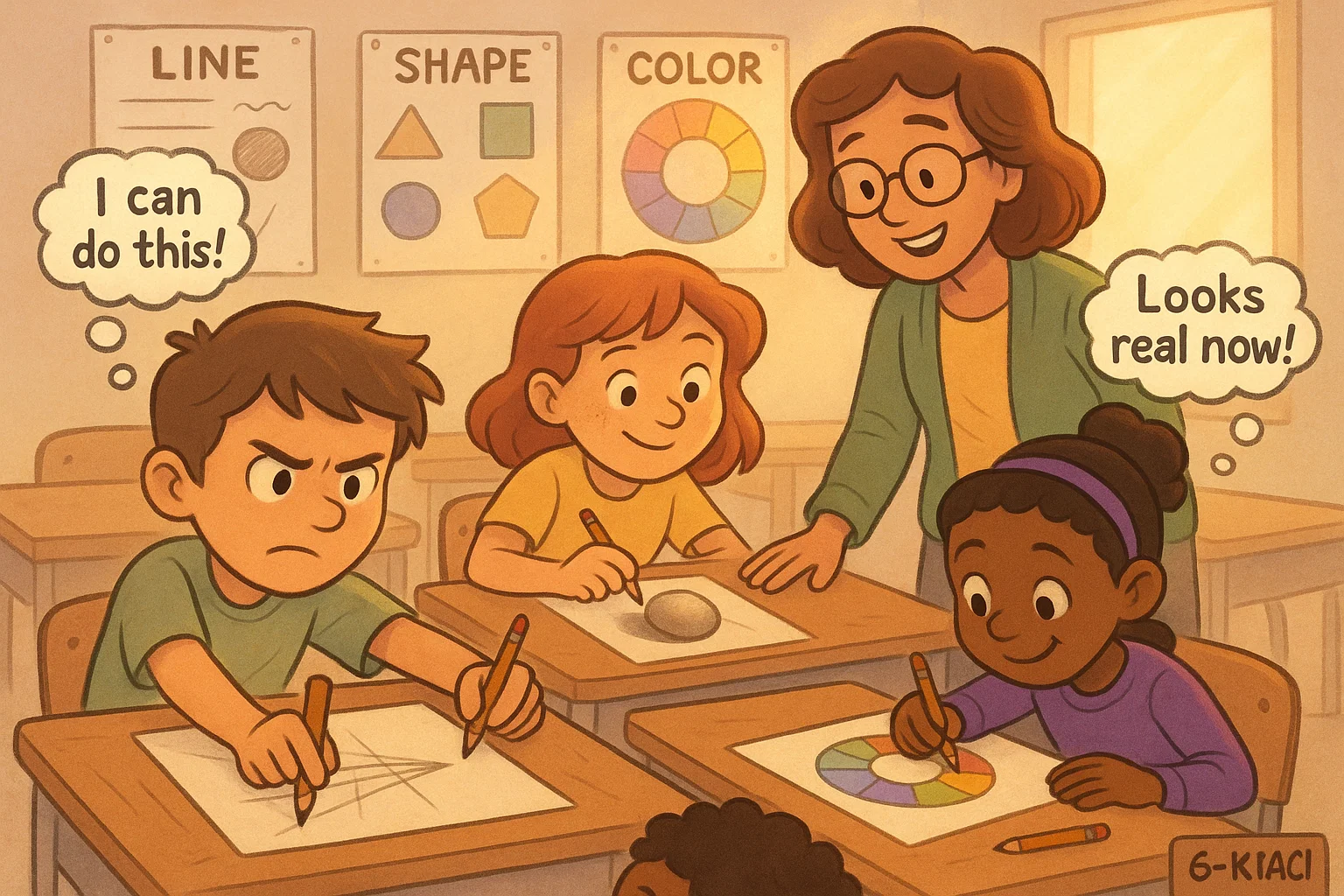
An effective scheme of work for grade 6-8 should explicitly target key areas for artistic growth. These concepts build skills essential for future artistic endeavors.
Developing Perspective
Mastering true perspective drawing marks a defining moment in middle-school art.
- Discussion & Exercise: Introduce the concepts of horizon line and vanishing point. Start with a one-point perspective (a simple road or train track receding to a single point) before moving to a more complex two-point perspective (drawing a cube or simple building). This directly trains spatial awareness, a critical component of drawing skill.
Experimenting with Texture
- Methods: Students use cross-hatching, stippling, and scumbling to mimic the feel of different surfaces. Ask students to replicate textures – fabric, rough wood, smooth metal, fluffy clouds – using only pencil or oil pastel. This helps them see and translate texture into line work.
Exploring Color Harmony
- Concept: Understanding how colors interact. Elementary students learn the color wheel, while middle-schoolers apply it in creative contexts.
- Activity: Use simple geometric drawings or a piece of fruit (still life). Students apply analogous colors (colors next to each other on the color wheel, like blue, blue-green, green) for one study and complementary colors (colors opposite each other, like red and green) for another. The comparison clearly demonstrates the visual impact of different color relationships.
Tips for Teachers and Parents
Creating a supportive environment and offering consistent encouragement are just as vital as the art lesson itself.
Setting Up Drawing Space
- Home/Art Room Setup: Create a dedicated, clutter-free space with good lighting. A dedicated container for art materials (oil pastel, markers, pencils) ensures that the student can easily access and put away supplies. The easier it is to start, the more likely they are to engage.
Encouraging Experimentation
This is the most critical aspect for a pre-teen artist. They are highly self-critical.
- Focus on Process: Emphasize that the goal is not a perfect picture but a learning experience. Use phrases like, “What did you learn from that?” or “Tell me about your process” rather than focusing solely on the outcome.
- Art Teacher Tactic: Encourage them to try different mediums. For instance, if their line drawing is rigid, suggest switching to a looser medium like watercolor or charcoal. This allows students to explore new techniques without fear of ‘ruining’ a detailed drawing.
Displaying Finished Art
- Boost Confidence: Displaying a student’s artwork (at home or in a class exhibition) is a powerful affirmation. It validates their hard work and creativity, significantly helping them to build confidence. A simple bulletin board or a rotating display space at home makes an excellent starting point.
Frequently Asked Questions
What are easy drawing ideas for sixth graders?
The best art ideas for sixth graders offer an easy entry point yet allow significant room for skill growth. Excellent starting points include:
- Op Art Hands: Highly visual and focuses on simple line curvature.
- Falling Leaves: Easy watercolor blending with simple line work.
- Weighted Contour Line Drawing: A foundational drawing lesson using everyday objects to train observation.
How can drawing improve focus and confidence?
Art-making is a profound psychological and educational tool. For middle school grades, the benefits are numerous:
- Focus: Projects requiring detail (shading, precise line drawing) demand sustained attention, strengthening focus and patience. For example, the detailed value study in the Crushed Soda Can Drawing demands deep concentration.
- Confidence: Completing an intricate art project provides a tangible sense of accomplishment. When students create a successful optical illusion or a realistic still life, the result is a massive boost to their self-efficacy, a vital ingredient for success in all academic areas.
How much time should each art project take?
The duration depends heavily on the project and the setting (classroom vs. home practice).
| Project Type | Recommended Timeframe |
| Quick Warm-ups (e.g., Happy Lines, Quick Contour) | 10–20 minutes |
| Single Lesson (e.g., Op Art Hands, Simple Landscape Art) | 45–60 minutes |
| Multi-Part Unit (e.g., Portraiture, Collage with Drying Time) | 2–3 sessions (90–180 minutes total) |
Offering a variety of timeframes lets students choose projects that match their schedule and engagement level. The goal is consistent practice, not just marathon sessions.
Take a short quiz to find out what your everyday choices say about your parenting style
When your child is curious about something new, what’s your instinct?
Take a short quiz to find out what your everyday choices say about your parenting style
“Can I download this app?” What happens next?
Take a short quiz to find out what your everyday choices say about your parenting style
When it comes to rules at home, which sounds most like you?
Take a short quiz to find out what your everyday choices say about your parenting style
If you could give your child one life skill today, what would you pick?
Take a short quiz to find out what your everyday choices say about your parenting style
Your child gets to choose what to watch. What would your ideal setup look like?
Take a short quiz to find out what your everyday choices say about your parenting style
Pick your parenting superpower ✨