40+ Art Projects for First Graders: Easy Drawing Ideas for Grade 1

 Discover a Free Education Video App for Kids
Pastory uses AI to personalize educational video content based on your child’s interests and personality. Safe, engaging, and built for curious young minds. Sign up now to stay updated and enjoy early access with a free trial
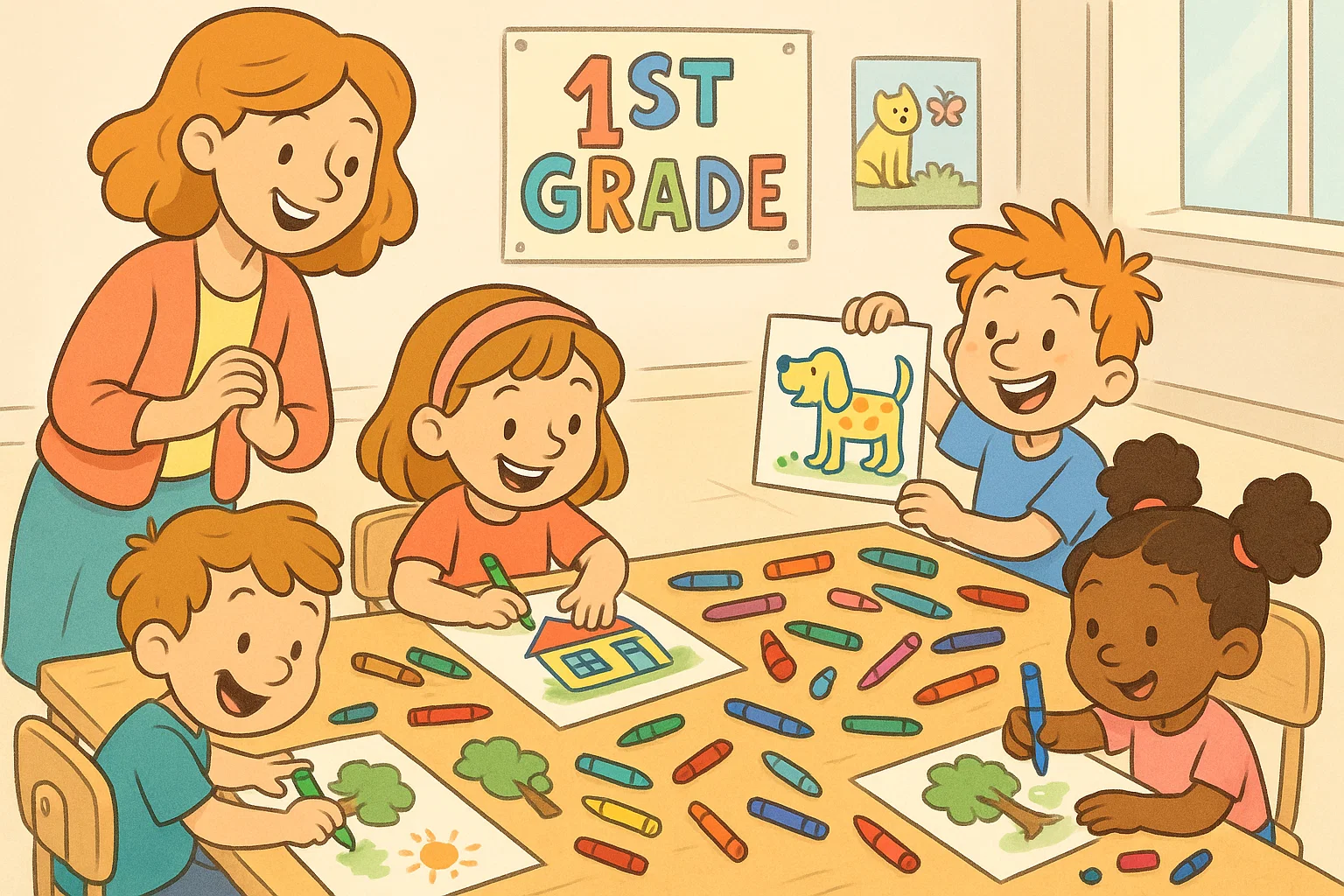
Finding the right art projects for first graders means balancing creativity with skills that six- and seven-year-olds are actually ready to build. This article brings together 40+ easy drawing ideas for Grade 1, covering step-by-step projects, themed lessons, seasonal activities, and mixed-media ideas that work in the classroom or at home.
Each idea is designed to support fine motor development, build drawing confidence, and keep young learners genuinely engaged. Whether you are a teacher planning art lessons or a parent looking for after-school activities, you will find practical, beginner-friendly options here.
Key Takeaways
- This article covers 40+ art projects for first graders, including drawing lessons, themed projects, and mixed-media activities.
- Step-by-step drawing ideas help Grade 1 students build fine motor skills and hand-eye coordination at their own pace.
- Seasonal and holiday drawing ideas are included, covering spring, summer, autumn, and winter themes.
- Activities are linked to famous artists to introduce young learners to art history in an accessible way.
- Tips for teachers and parents cover setting up an art space, encouraging expression, and displaying finished work.
Fun Drawing Projects for First Graders
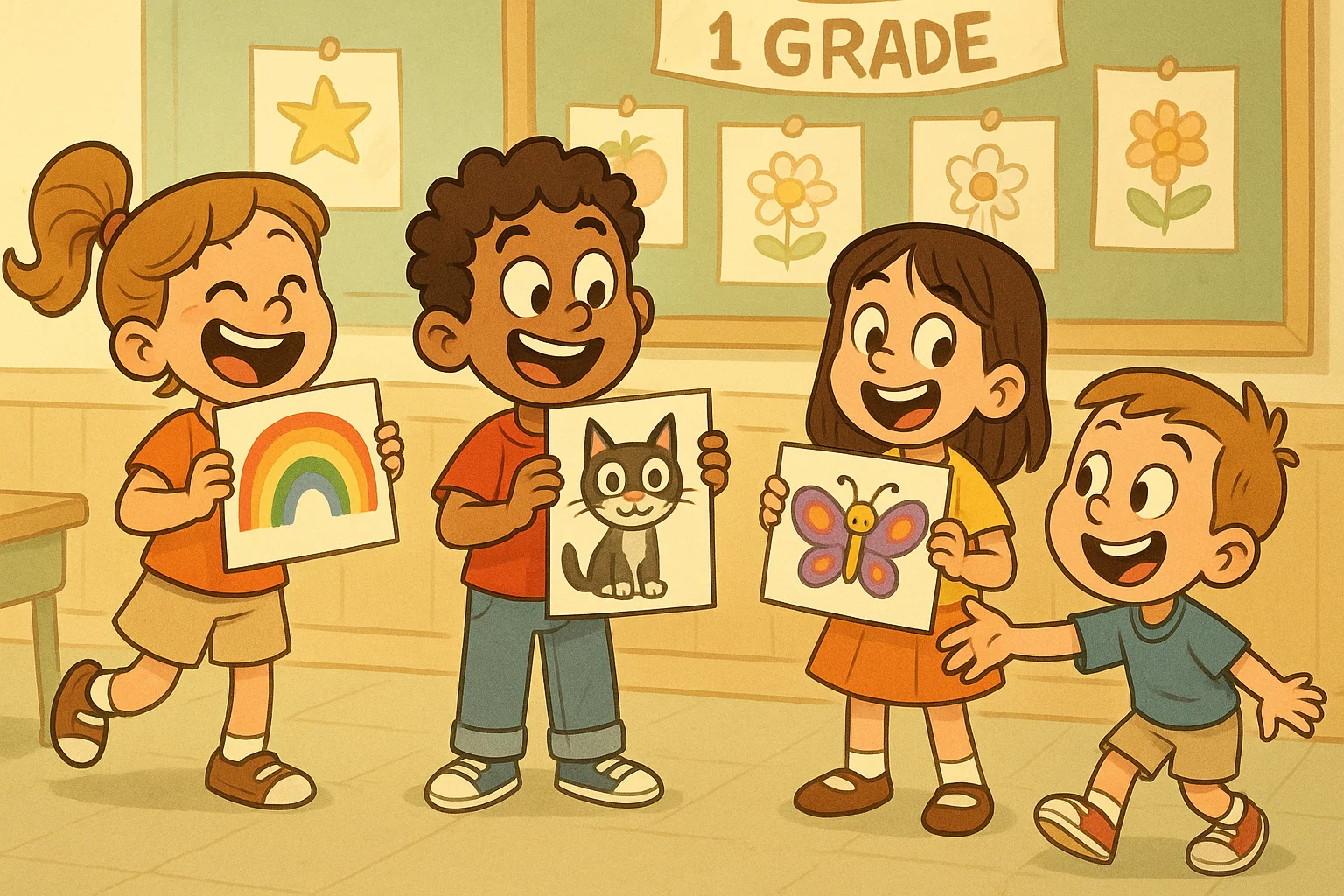
These fun art project ideas are intentionally beginner-friendly, ensuring success and confidence for every grade one student. They require only basic art materials like paper, crayons, markers, and colored pencils, making them highly accessible. The goal isn’t technical perfection but rather encouraging imaginative expression and enjoyment.
Drawing a House
The house is a familiar and comforting subject, making it an excellent starting point for a guided drawing.
- Step 1: The Base. Begin by drawing a large square to create the main body of the house.
- Step 2: The Roof. Add a triangle on top of the square for the roof.
- Step 3: Details. Draw a rectangle for the door and smaller squares or rectangles for the windows.
- Tip: Encourage kids to make their house unique! They can add a chimney, a curly path, flowers, or a simple stick-figure family nearby. This encourages them to personalize their creation.
Drawing a Tree
A drawing lesson on trees can explore nature and seasonal changes.
- Step 1: The Trunk. Draw two simple vertical lines for the trunk of the tree.
- Step 2: The Branches. Guide students to draw a few lines extending upward and outward from the top of the trunk.
- Step 3: The Foliage. Show how to make a large circle or a scribble cloud shape around the branches to represent the leaves.
- Seasonal Variation: Use vibrant red, orange, and yellow oil pastel or crayon colors for autumn, or small, light green scribbles for spring blossoms.
Drawing a Cat
Learning to draw a cute animal can be highly motivating.
- Step 1: Head and Body. Start with a circle for the head and a slightly larger oval for the body.
- Step 2: Ears and Facial Features. Add two small triangles on top of the head for the ears. Show how to draw a simple nose and mouth, and don’t forget the whiskers!
- Step 3: Legs and Tail. Simple drawing 2 parallel lines for the legs and a curved line for the tail completes the cat.
Drawing a Butterfly
This art project is a wonderful way to teach symmetry.
- Step 1: The Body. Draw a long oval with a circle for the head on top.
- Step 2: The Wings. Show how to draw two large curved lines on either side of the body, making them match.
- Step 3: Pattern. Encourage little artists to decorate the wings with dots, stripes, hearts, or small simple shapes. Bright crayons or watercolor paint enhance the overall effect.
Drawing a Rainbow
A simple, colorful art activity that introduces the order of colors.
- Step 1: The Arch. Draw a large, simple arch (a curve).
- Step 2: The Colors. Guide them to draw parallel curves inside the large one, reminding them of the color order (red, orange, yellow, green, blue, indigo, violet).
- Step 3: Background. Add puffy white clouds at the ends or simple raindrops using a black marker. This is a great, easy project to discuss color and weather.
Creative Themed Drawing Lessons
These creative 1st grade art projects move beyond simple object drawing and often incorporate inspiration from the wider art world, helping kids learn visual storytelling and color mixing. They’re perfect for a classroom setting or a dedicated home art lesson.
“Pumpkin’s Starry Night”
This project is a delightful way to introduce the concept of style, blending Van Gogh’s famous work with a seasonal theme.
- Guide students to create a large, smiling pumpkin on black paper.
- Using oil pastel or tempera paint, students use short, swirling strokes in blues, yellows, and white for the background, mimicking the movement in Van Gogh’s “Starry Night.” The dark background helps the vibrant colors truly pop.
Hot Air Balloon Collage
This art project introduces composition and the mixed media technique.
- Step 1: The Sky. Students painted a light blue, white, and pink sky background using watercolor.
- Step 2: The Balloons. Use brightly colored construction paper to cut out large oval or teardrop shapes for the balloons.
- Step 3: Assembly. Glue the shapes onto the sky. Add details like ropes and baskets with a black marker. This balloon collage project helps with scissor skills and perspective.
Watermelon Weavings
A fun seasonal project focused on shapes and texture.
- Step 1: Drawing. Kids draw two large arcs to create a watermelon slice and color the inside red/pink and the rind green.
- Step 2: Texture. Draw black seeds and white or light green lines in the rind.
- Step 3: Weaving. Cut parallel slits into the red part of the slice and weave thin paper strips of various colors (black, green, red) through them. This is a great introduction to texture and pattern.
Tanglebird Collage
This project encourages doodle and line exploration, a wonderful way to improve drawing skills.
- Ask students to draw a simple bird outline on white paper.
- Inside the bird, they fill each section with different repetitive lines that wiggle – zigzags, dots, spirals, or tiny small circles.
- The bird is then cut out and glued onto a colorful, abstract background, making a vibrant collage.
Not-So-Scary Scarecrow
This cheerful art activity is great for autumn or a farm unit.
- Step 1: Shapes. Guide 1st graders to draw the scarecrow using geometric shapes: a circle for the head, squares to create the body, and rectangles for the arms and legs.
- Step 2: Details. Add details like stitched patches, straw hair (yellow strips of paper), and a floppy hat. The focus is on making the face friendly, not frightening.
Simple Step-by-Step Drawing Ideas
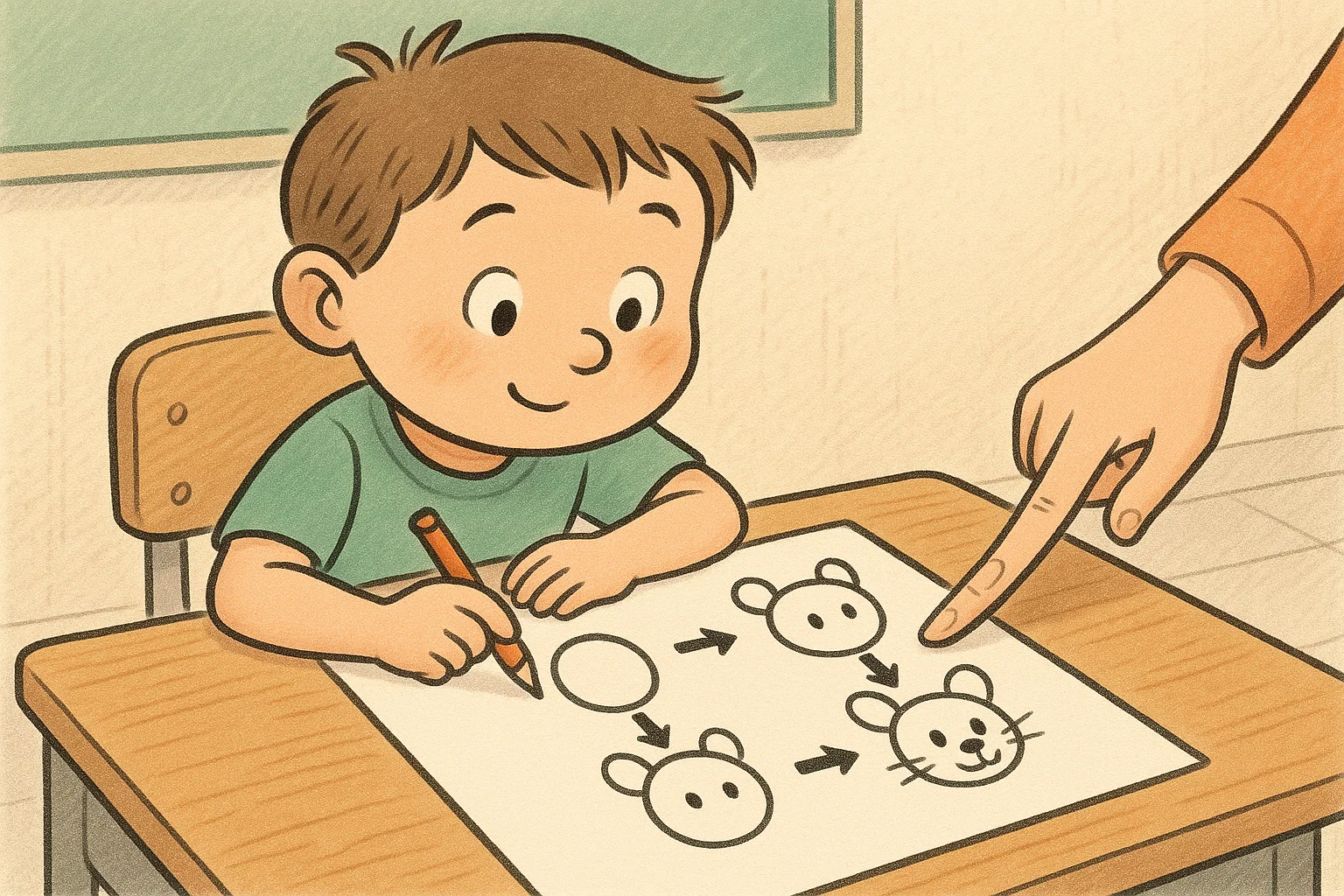
These quick, simple art activities are ideal for warm-ups, brain breaks, or when 1st graders finish other work early. They usually take less than 15 minutes but still deliver a sense of accomplishment.
| Subject | Starting Shapes | Key Details | Focus Skill |
| Rocket Ship | Cone, large rectangle | Flames, porthole windows | Geometric Assembly |
| Puppy | Circle for head, oval for body | Floppy ears, paws, happy face | Curved lines |
| Unicorn | Simple horse body sketch | Horn, sparkly mane/tail | Fantasy & Detailing |
| Self-Portrait | Oval for face, lines for the neck | Facial features, hair, favorite shirt | Observation & Tracing |
Drawing a self-portrait is particularly valuable. It helps first graders observe their own facial features and practice symmetry – an ideal activity for an “All About Me” classroom theme.
Drawing Exercises to Build Confidence
To truly develop drawing skills and confidence, repetition and focused practice on the fundamentals are key. These exercises help improve motor control and artistic self-esteem.
Lines That Wiggle ️
Before attempting a complex picture, give kids a few minutes to fill a page with playful lines:
- Wavy, continuous lines.
- Sharp, zigzagging lines.
- Loops and spirals.
- Dotted and dashed lines.
These movements warm up the small muscles in the hand and wrist, making the transition to actual guided drawing smoother.
Shape Practice Sheets
Provide worksheets where the goal is to create objects using only a few basic shapes.
- Combine squares and rectangles to make a robot or a skyscraper.
- Use circles and triangles to make a simple animal (like the cat above).
This practice teaches children to see complex objects as collections of simpler components.
Color Mixing Activities
First graders will love this practical introduction to the color wheel.
Using watercolor paint or oil pastel, have students explore how the primary colors and secondary colors are related.
- Mix red and yellow to create orange.
- Mix blue and yellow to make green.
- Mix red and blue to create purple.
This exercise is not just about drawing but understanding the fundamental science of color.
Texture and Pattern Play
Encourage students to fill an abstract shape with different patterns to understand texture.
- Dots: Small, large, spread out, or clustered together.
- Stripes: Vertical, horizontal, or diagonal.
- Waves: Tight, loose, or overlapping.
This is an early introduction to design thinking and filling space purposefully.
Drawing Activities Linked to Famous Artists
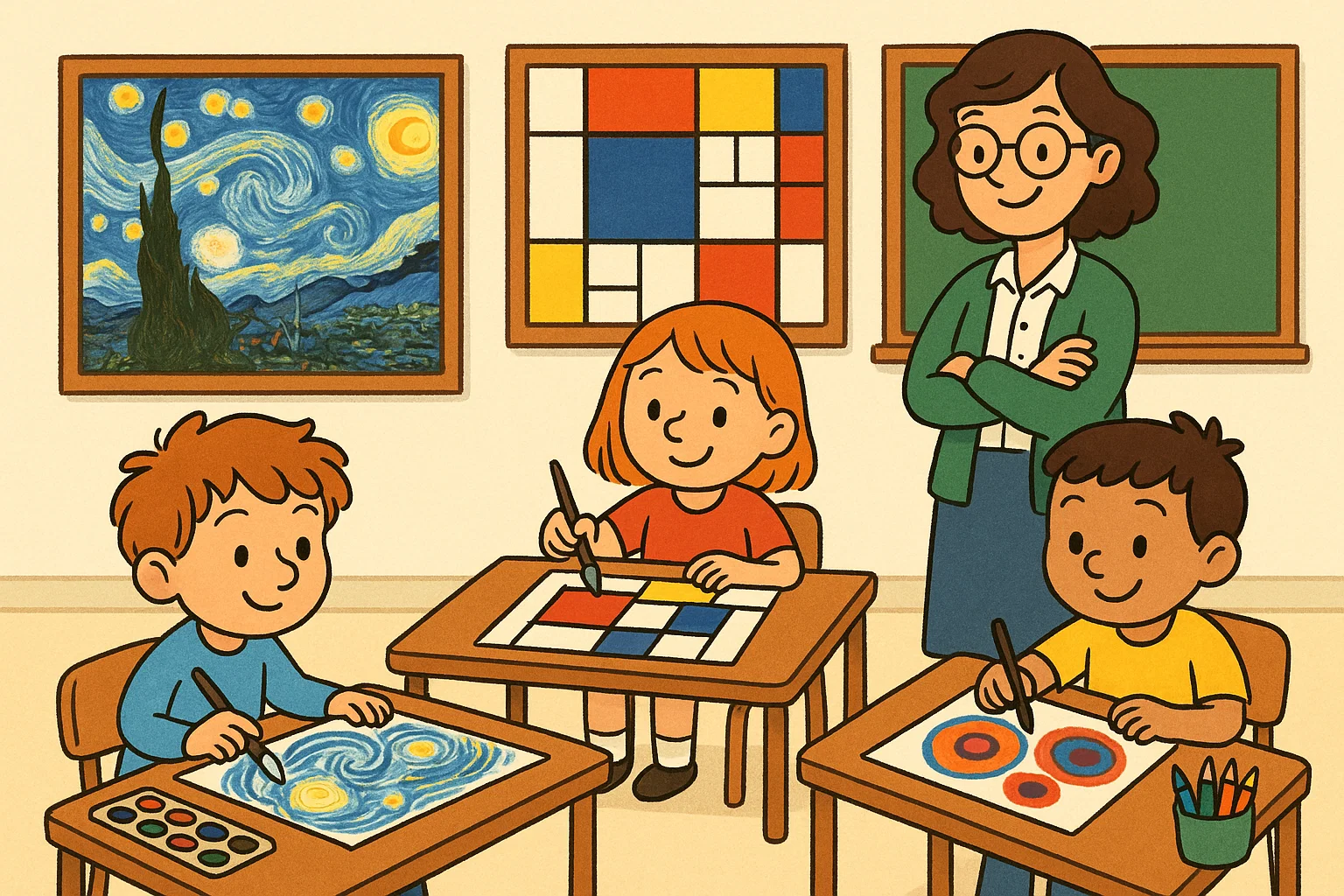
Introducing famous artists to 1st graders can be incredibly inspiring. These projects simplify complex styles into age-appropriate, accessible art lessons – showing children that art can take many forms and encouraging them to draw like masters.
| Artist | Project Name | Technique Focus | Materials |
| Piet Mondrian | Mondrian-Inspired Collage | Rectangles, straight lines, primary colors | Ruler, black marker, construction paper |
| Wassily Kandinsky | Kandinsky Circles | Concentric circles, color balance, emotion | Crayons, oil pastel, or tempera paint |
| Vincent van Gogh | Van Gogh’s Starry Sky | Short, swirling strokes, movement, light | Yellow/white paint on black paper |
| Claude Monet | Monet’s Lily Pads | Soft strokes, blended colors, nature scenes | Using watercolor, light pencils |
The Monet’s Lily Pads project, for example, perfectly illustrates blending and softness using watercolor. Students use light green, blue, and white to create the pond and then add small circles of pink and white for the lily pads.
Seasonal and Holiday Drawing Ideas
Connecting drawing to the current season or a holiday makes the art lesson more relevant and exciting for grade one students.
Spring Flowers
- Draw a simple tulip shape (a cup on a stick) and a daisy (a small circle with petals around it). Encourage them to add bugs or butterflies.
Summer Beaches
- Guide children to sketch a horizon line, draw two large waves using curved lines, and add a simple sun and a sandcastle made of squares.
Autumn Leaves
- Teach kids how to draw different leaf shapes (oak, maple). Focus on color mixing using warm colors (red, orange, brown) and blending the hues for a realistic fall look.
Winter Snowman
- A simple, three-tiered snowman using circles. Add accessories like a scarf made of strips of paper and a top hat. They can use white tempera paint or cotton batting to create a fluffy look.
Mixed-Media and Collage Drawings
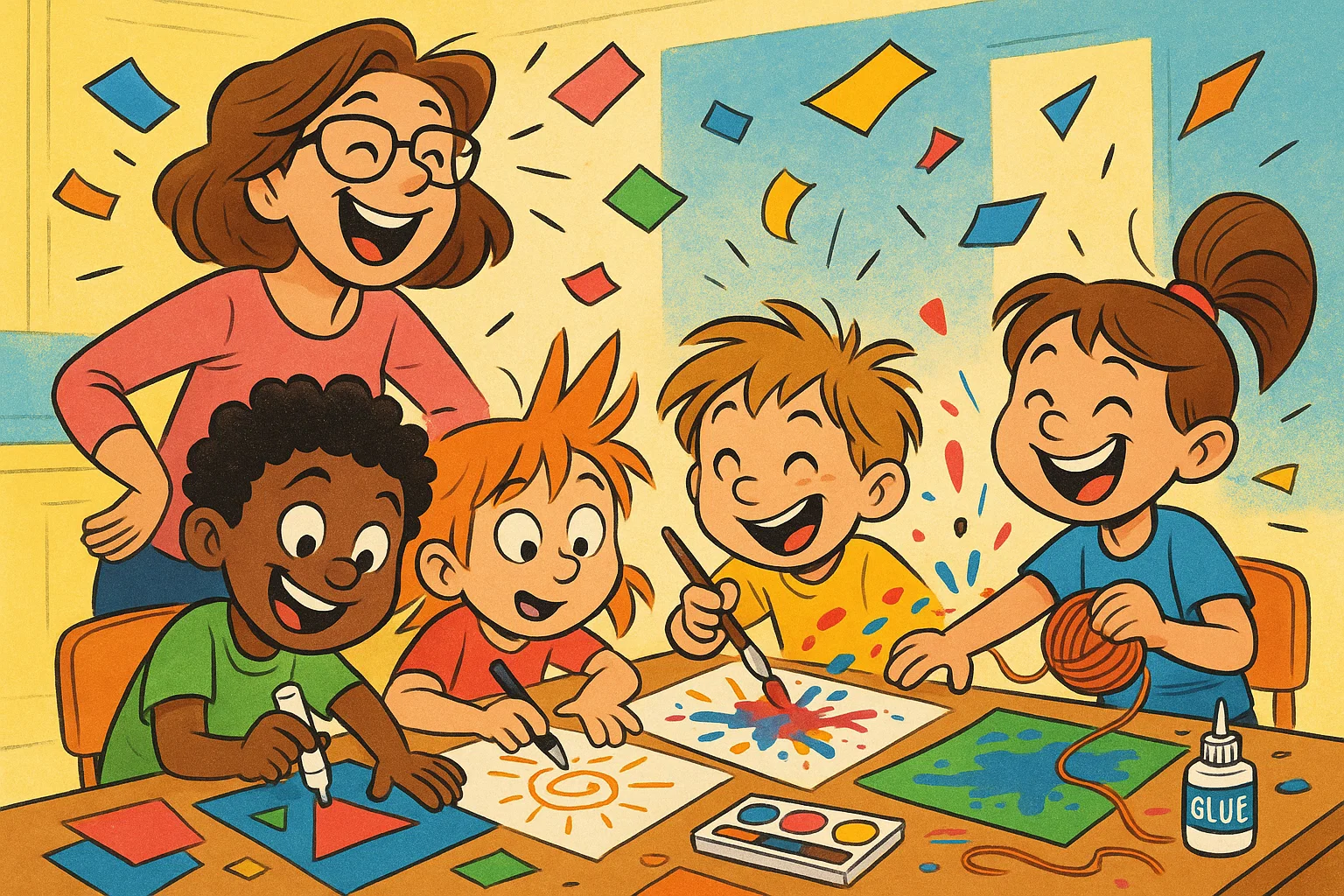
Mixed media projects are a favorite art form for 1st graders because they allow them to combine drawing with other fun techniques like cutting, gluing, and painting, adding texture and depth to their masterpiece.
Paper Mosaic Owls
- Kids draw a simple owl outline. Instead of coloring, they fill the shape by gluing down tiny, colorful paper squares (cut from magazines or construction paper). This project strengthens attention to detail and patience.
Yarn Collage Sunflowers
- Draw a simple sunflower head and stem. Glue yellow yarn around the petals and brown yarn or small pebbles in the center for a 3D texture.
Crayon Resist Drawings
- This resist painting technique is always a hit! Using crayons (especially white), students draw a hidden picture (stars, a simple animal, or curved lines).
- They then wash over the entire white paper with a thin layer of dark watercolor or diluted tempera paint. The wax crayon resists the paint, revealing the hidden image. This is a fun and highly satisfying art project.
Tips for Teachers and Parents
Fostering a child’s creative spirit – not just focusing on the finished product – is the key goal of art education. Here is practical advice for guiding little artists.
Setting Up an Art Corner
A dedicated space, whether a classroom table or a corner in your home, makes art time inviting.
- Affordable Supplies: Stock up on basic, high-quality art materials such as large sketchpads, washable tempera paint, wide crayons, oil pastels, and glue sticks. Keep simple things like construction paper and magazine scraps handy for collage.
- Organization: Use clear bins or drawers to organize items. This teaches responsibility and reduces time wasted looking for supplies.
Encouraging Expression, Not Perfection
The most critical part of an art lesson for first grade is the process, not the product.
- Praise Effort: Instead of saying, “That’s perfect!”, try, “I love the story you told with those colors!” or “Your hard work on the small details really paid off.”
- Open-Ended Questions: Ask, “What is your favorite part of this picture?” or “Tell me about this character.” This encourages them to view their work as a form of communication. Avoid asking, “What is it?” if it’s not immediately clear.
Displaying Kids’ Artwork
Celebrating a child’s masterpiece is crucial for boosting their confidence and motivation.
- Create a rotating bulletin board or art display dedicated solely to their artwork. Change it frequently to show that every piece matters.
- Digital Gallery: Take photos of their work before it gets damaged or thrown away. This is an easy way to teach them about preservation and sharing their talents with family.
Frequently Asked Questions
What can a first grader draw easily?
1st graders can easily draw a simple house, basic animals like cats and dogs using circles and triangles, vehicles like a rocket ship, and simple nature scenes such as flowers and rainbows. Projects involving tracing or guided drawing with simple step-by-step instructions are especially successful.
How do you teach drawing to a 6-year-old?
To teach drawing to a 6-year-old, start by breaking down complex objects into simple shapes (circles, squares, triangles). Use guided drawing – draw a line and have them copy it. Emphasize storytelling over accuracy, and encourage the exploration of different drawing tools like crayon, oil pastel, and black marker.
What are some fun art projects for first grade?
Fun art projects for first grade include crayon-resist drawings with watercolor, collages made from construction paper and magazine cutouts, simple clay pinch pots, and color-mixing activities inspired by artists like Kandinsky.
How does drawing help development?
Drawing significantly aids development by improving fine motor skills and hand-eye coordination (crucial for handwriting), enhancing focus and concentration, fostering creative problem-solving, and providing a healthy outlet for emotional expression and imagination. It’s an essential way to teach creativity and academic readiness simultaneously.
Take a short quiz to find out what your everyday choices say about your parenting style
When your child is curious about something new, what’s your instinct?
Take a short quiz to find out what your everyday choices say about your parenting style
“Can I download this app?” What happens next?
Take a short quiz to find out what your everyday choices say about your parenting style
When it comes to rules at home, which sounds most like you?
Take a short quiz to find out what your everyday choices say about your parenting style
If you could give your child one life skill today, what would you pick?
Take a short quiz to find out what your everyday choices say about your parenting style
Your child gets to choose what to watch. What would your ideal setup look like?
Take a short quiz to find out what your everyday choices say about your parenting style
Pick your parenting superpower ✨