What Children Learn in Reception UK

 Discover a Free Education Video App for Kids
Pastory uses AI to personalize educational video content based on your child’s interests and personality. Safe, engaging, and built for curious young minds. Sign up now to stay updated and enjoy early access with a free trial
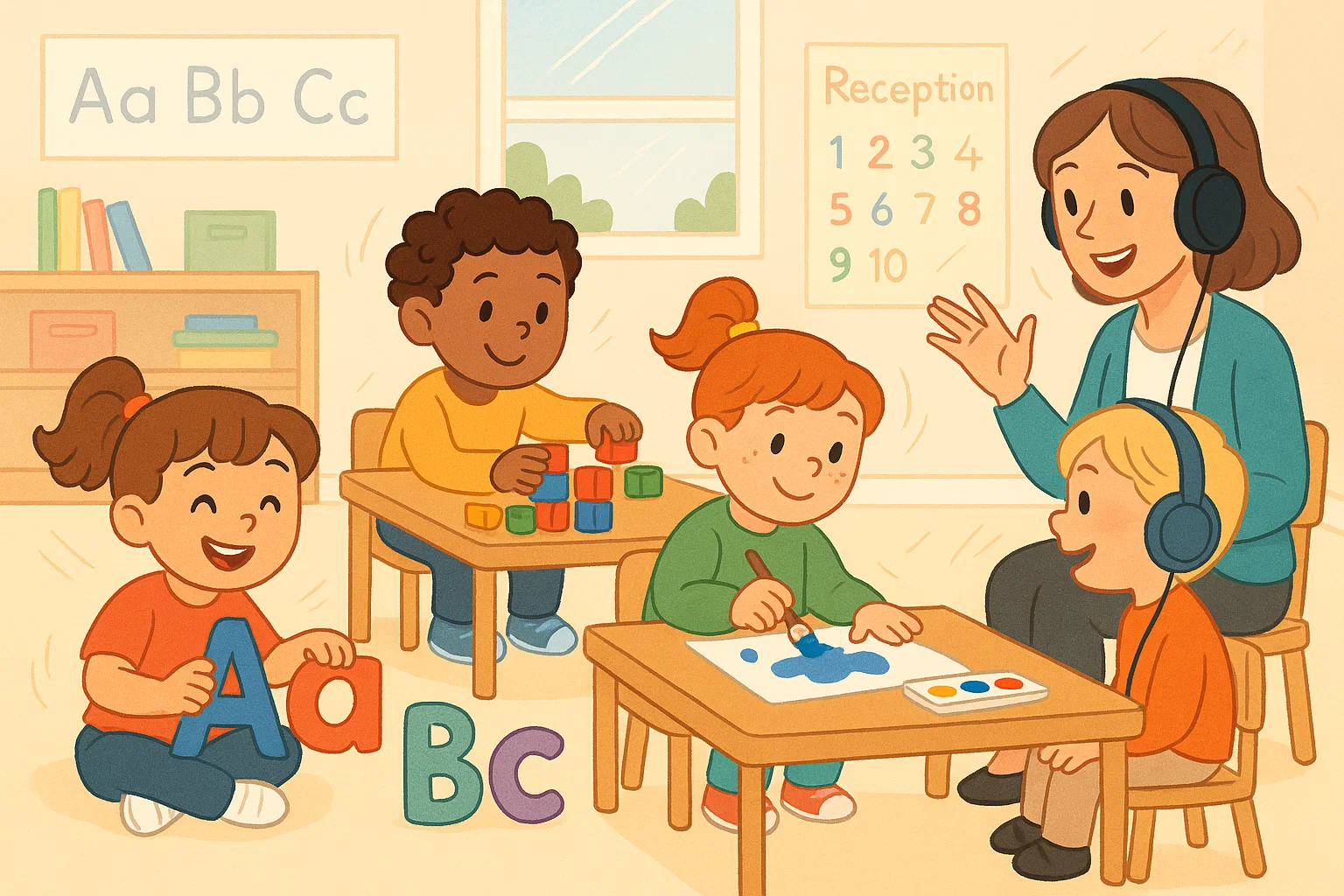
The Reception year marks a significant and exciting milestone: the start of your child’s formal learning journey in primary school. It is often referred to as the final year of early years education in the UK, bridging the gap between pre-school or nursery and the more structured environment of Key Stage 1 (KS1). This critical stage of school is where the foundations for all future learning are laid, focusing not just on literacy and math, but fundamentally on ensuring children develop the social, emotional, and physical skills they need to thrive.
The Reception class is a unique and wonderfully playful learning environment guided by the Early Years Foundation Stage (EYFS) framework. This framework sets the standards for the learning and care of children from birth to five years old. As a parent, understanding the EYFS areas of learning and the goals your child will learn and work towards can help your child feel confident and well-prepared. This comprehensive guide breaks down what to expect in Reception, how children learn best at this age, and actionable ways you can support your child’s learning at home.
Reception Class Overview
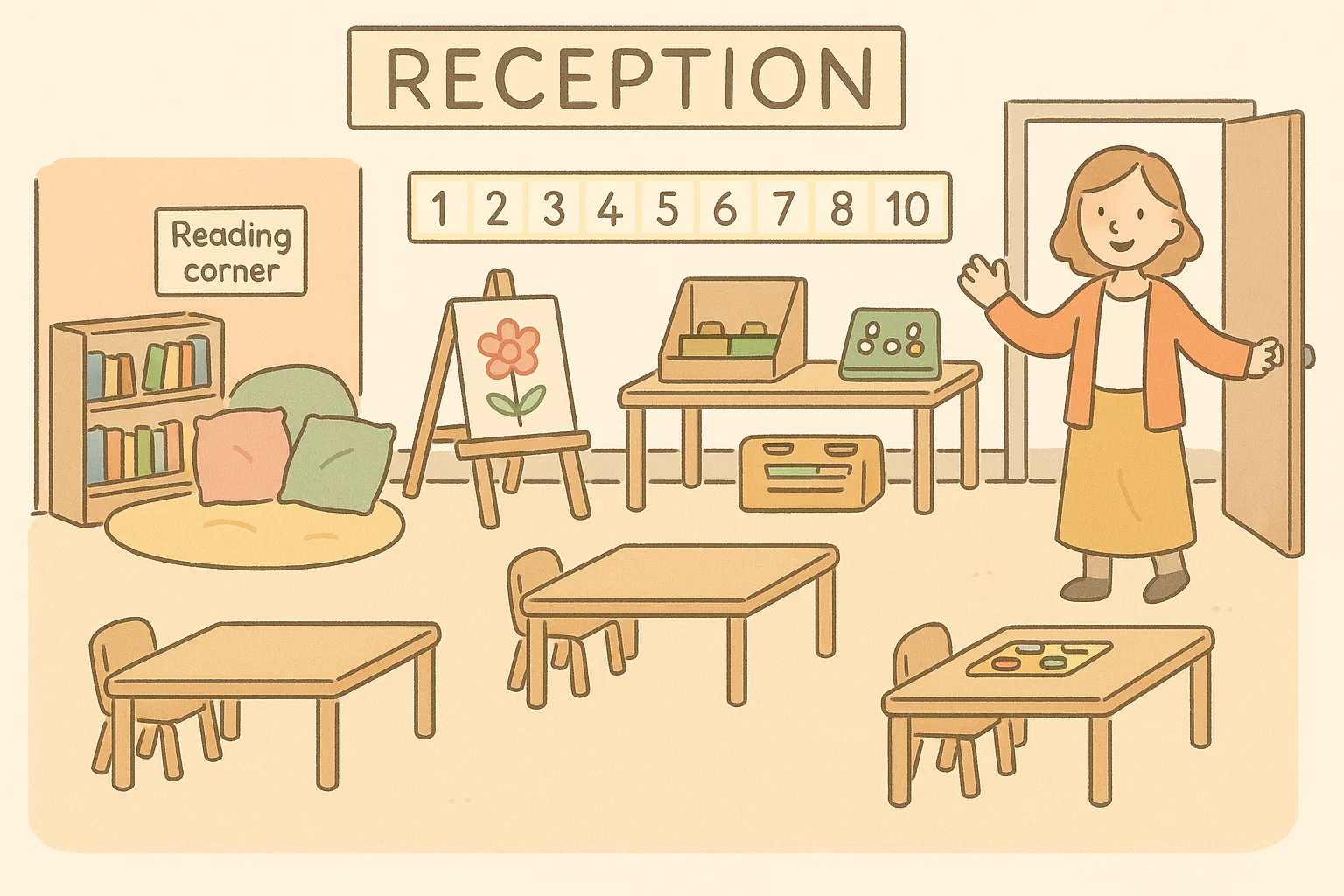
The Reception class is the first academic year in a UK primary school, typically for children who are aged four, turning five during the school year. Its role is pivotal: to provide a secure, stimulating, and rich environment that fosters curiosity and a love of learning. It operates under the statutory Early Years Foundation Stage (EYFS), which governs how early years providers, including reception year settings, deliver education.
Reception Year Purpose
The primary developmental goals of the reception year are comprehensive, ensuring a smooth and effective transition from home or nursery settings. The focus is on holistic development, encompassing everything from social skills to early academic concepts.
- School Readiness: Preparing children for the routines, structure, and expectations of school life.
- Early Learning Habits: Encouraging key characteristics of effective learning, such as playing and exploring, active learning, and creating and thinking critically.
- Social Growth: Developing essential social skills, learning to share, form positive relationships, and understand how to manage emotions.
- Fundamental Skills: Acquiring basic literacy (e.g., phonics) and math (e.g., counting) knowledge as outlined in the EYFS early learning goals.
Reception Class Age Range
In England, a child is eligible to start reception in the September of the school year they turn five years old (between September 1st and August 31st).
- Typical Entry Age: Most children start reception at the age of four.
- Summer-Born Children: Parents of children born between April 1st and August 31st (summer-born children) have the right to request that their child starts reception class a year later, entering Year 1 at the age of five (skipping Reception) or entering Reception a year later (at age five). This is an important consideration that parents must discuss with the school and local authority.
Reception and EYFS Link
The Reception curriculum is the framework that puts the Early Years Foundation Stage (EYFS) into practice. The EYFS specifies seven areas of learning and development which are taught through a blend of adult-led activities and child-initiated play.
Entry to Reception
Navigating the entry to reception class involves understanding the age requirements, attendance laws, and practical steps for a smooth transition from earlier childcare. The journey into primary school is a major life change, and clarity on the legal and practical aspects is key.
Start Age in UK Regions
While the general rule remains that children are eligible to start school the September after their fourth birthday, compulsory school age varies slightly:
| Region | Compulsory School Age (When Attendance is Mandatory) |
| England | Beginning of the term following their fifth birthday. |
| Wales | Beginning of the term following their fifth birthday. |
| Scotland | Children are generally not required to start school until August after their fifth birthday, with different arrangements for earlier nursery/school entry. |
| Northern Ireland | Starts in September following their fourth birthday. |
Is Reception Compulsory
School attendance is generally not compulsory in the reception year for the entire period.
- The Law: A child is legally required to start school at the beginning of the term following their fifth birthday. For children who start reception at age four, the initial attendance is non-compulsory until this legal milestone.
- Practical Choice: Nearly all parents choose for their children to begin reception in the September they are eligible, as the year provides the best possible start and is free. Deferring entry or taking a part-time place must be agreed upon with the school’s governing body.
Moving from Nursery to Reception
Making a decision about the right time to transition from nursery or pre-school to Reception should be centred on the child’s individual learning and developmental needs.
“A child’s readiness is far more important than their chronological age. We look for curiosity, a willingness to separate from parents, and basic self-care skills, not just the ability to recognise letters.” – A Reception Teacher in London (с)
If your child is attending a private nursery that follows the EYFS framework, the transition is often seamless as the areas of learning and development remain the same. If you have concerns, speak to your child’s key person at the nursery and the future reception teacher about your child’s emotional and social preparedness.
What Children Learn in Reception
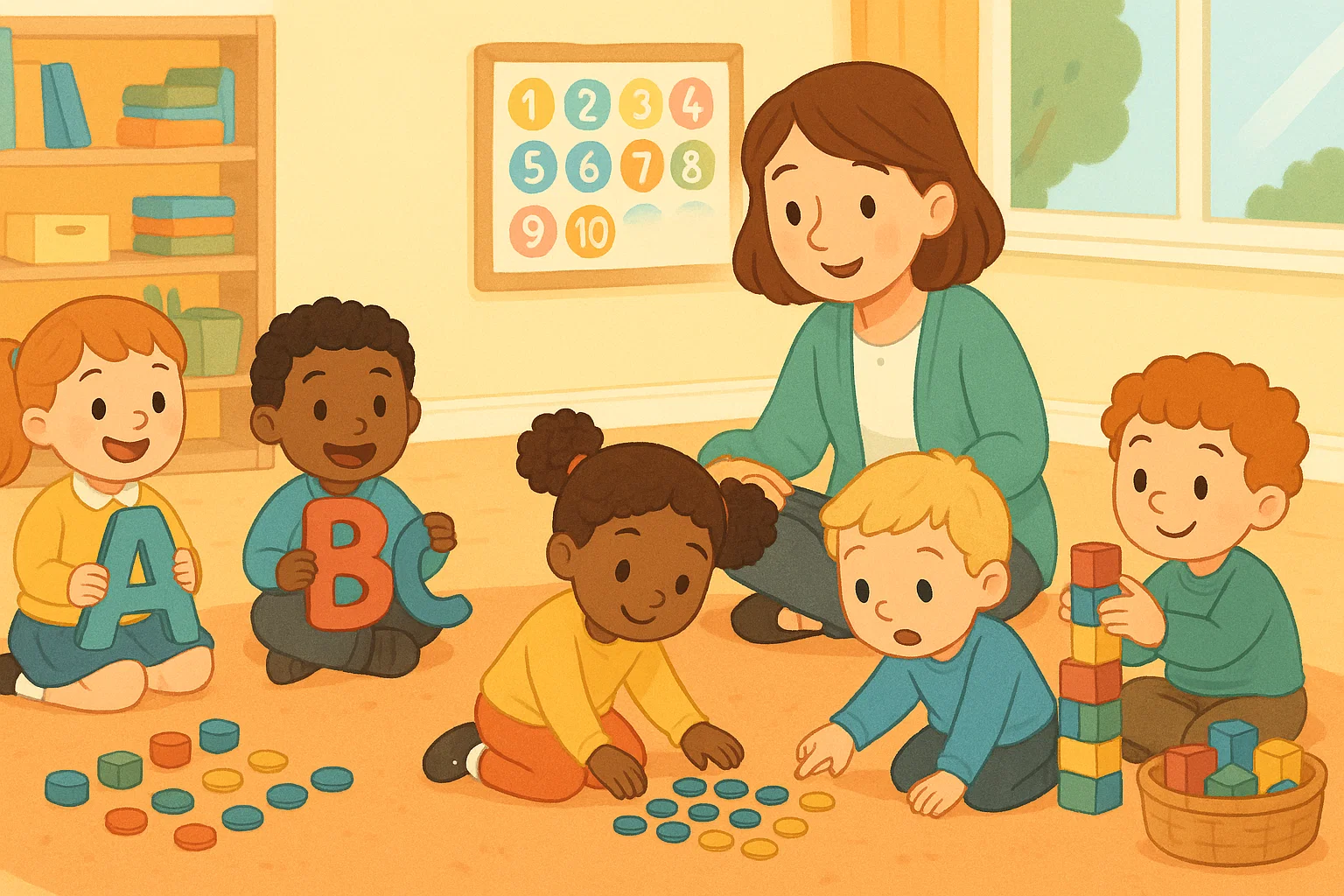
The programme of study in reception is based on the seven areas of learning and development from the EYFS. These areas ensure that children are provided with opportunities to learn best through a wide range of practical and purposeful activities.
Early Literacy Skills
This area focuses on communication and language and on laying the groundwork for learning to read. The main method used is phonics, a systematic approach to teaching reading.
- Phonics: Reception children typically begin with Phase 2 of a government-approved phonics programme such as Letters and Sounds. This involves learning the sounds that single letters make (graphemes) and how to blend these sounds together to read simple words (e.g., c-a-t).
- Blending and Segmenting: Children learn to blend sounds for reading and segment sounds for spelling.
- Speaking and Listening: Activities focus on developing skills in taking part in a conversation, listening attentively, and following multi-step instructions.
Early Writing Skills
Writing development is a gradual process that starts with mark-making and develops into forming legible letters and simple sentences. It is heavily reliant on physical development—specifically fine motor skills.
- Fine Motor Skills: Activities like threading beads, using playdough, and cutting with scissors are vital for strengthening the hand muscles needed to hold a pencil correctly.
- Letter Formation: Children are taught the correct formation of letters, often using rhymes or actions.
- Short Sentences: By the end of the year, many reception children can attempt to write short, simple sentences that they can sound out themselves.
Early Maths Skills
The math curriculum in reception is highly practical and hands-on, encouraging children to explore mathematical concepts through play and real-life scenarios.
- Counting: Children will need to practise counting accurately, knowing the number sequence, and matching numerals to amounts (up to 20 or more).
- Simple Calculations: Introducing number bonds (pairs of numbers that make a total, e.g., 5 = 3 + 2) and basic addition and subtraction using practical objects (manipulatives).
- Shape, Space, and Measure: Learning about 2D and 3D shapes, understanding terms like ‘longer/shorter,’ ‘heavier/lighter,’ and exploring patterns.
Creative and Expressive Activities
This area covers expressive arts and design, a crucial part of the early years experience where children develop their imagination and self-expression.
- Role-Play: Taking on different characters, which is essential for developing communication and language and empathy.
- Music and Movement: Learning songs, rhythm, and exploring movement to express ideas and feelings.
- Art: Experimenting with various materials (paint, clay, collage) to communicate and express ideas, feelings, and thoughts.
Physical Development Skills
Physical development is divided into gross and fine motor skills. Both are critical for successful school life.
- Gross Motor Skills: Large movements like running, jumping, climbing, and balancing, which develop core strength and coordination.
- Fine Motor Skills: The smaller movements used for grasping, holding, drawing, and fastening clothes. A strong foundation in these skills is a prerequisite for successful writing.
- Health and Self-Care: Learning about healthy eating, safe and happy choices, and personal independence (e.g., managing their own clothing).
Social and Emotional Development
This area helps children become emotionally resilient and socially capable individuals. It is one of the three prime areas of the EYFS curriculum.
- Positive Relationships: Learning to share, take turns, understand boundaries, and work cooperatively in groups.
- Emotional Regulation: Developing the ability to understand and manage their own feelings and behaviours.
- Confidence and Self-Awareness: Building a positive sense of self and developing independence.
Communication and Language Skills
The third of the three prime areas, this focuses on listening, attention, and speaking, forming the basis for literacy.
- Vocabulary Growth: Teachers use rich language and story-telling to expand the child’s word bank.
- Conversational Skills: Engaging in meaningful dialogue with peers and adults, asking questions, and expressing needs.
- Listening Tasks: Following stories, attending to instructions, and participating in group discussions (circle time).
Reception Curriculum Framework
The Early Years Foundation Stage (EYFS) provides the framework for all teaching and learning that takes place in reception. It is a statutory framework that all schools must follow.
EYFS Areas of Learning
The seven areas of learning are split into two groups:
| Three Prime Areas (Crucial for sparking curiosity and building capacity to learn) | Four Specific Areas (Which include the essential skills and knowledge) |
| Communication and Language | Literacy |
| Physical Development | Mathematics |
| Personal, Social and Emotional Development (PSED) | Understanding the World |
| Expressive Arts and Design |
All areas of the curriculum are interlinked; for example, a child building a model train (Expressive Arts) is also using physical development (fine motor skills) and mathematics (counting pieces).
Learning Objectives for Reception
The specific learning objectives for reception are designed to ensure all children make consistent progress toward a set level of development by the end of the year. Key goals include:
- Literacy Basics: Recognising common sounds and letters, being able to sound out and read simple words, and attempting to write their own name and simple words.
- Number Fluency: Counting reliably to at least 10 (and often beyond 20), recognising numerals, and solving simple problems involving addition and subtraction.
- Social Skills: Being able to share, take turns, and manage small conflicts with minimal adult intervention.
End of Reception Year Goals
By the time children move from reception to year 1 (Key Stage One), they are assessed against the Early Learning Goals (ELGs). These are a set of 17 goals across the seven areas of learning that define what a child should be able to do. The reception teacher will determine if the child has met the expected level of development for each ELG.
- Achieving the ELGs: A child is deemed to be achieving at the expected level if they are assessed as meeting all the goals. This assessment informs the Year 1 teacher about the child’s starting point.
Daily Activities in Reception
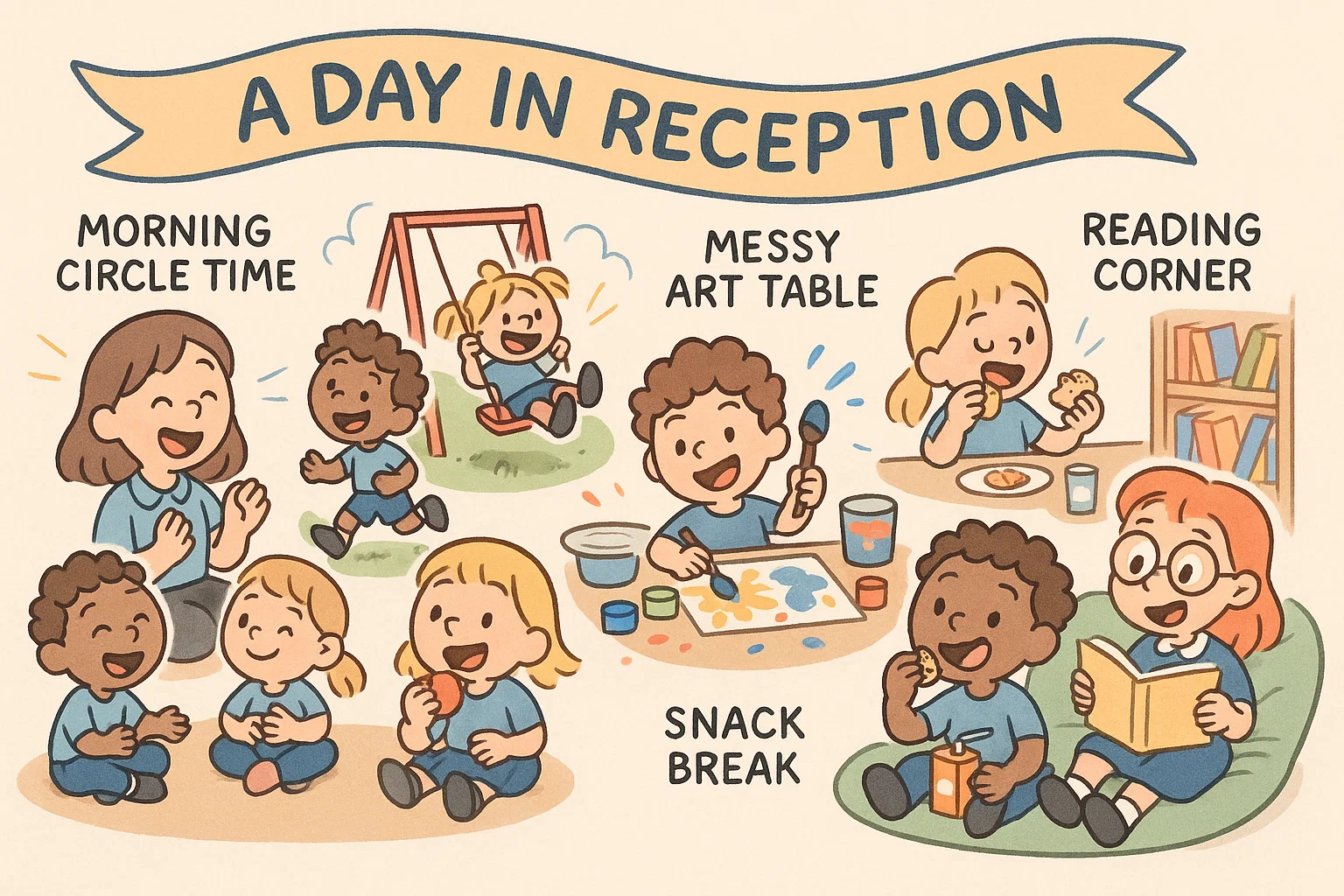
A typical day in a reception class is characterised by a balance between structured, adult-led teaching and unstructured, child-initiated learning through play. This approach ensures effective learning and meets the needs of children starting school.
Reception Class Activities
The schedule is varied and fluid, reflecting the early years philosophy that children learn best when they are engaged and active.
- Phonics Sessions: Short, daily, and highly structured sessions (often 15–20 minutes) where children are taught new sounds, segmenting, and blending.
- Maths Groups: Small groups where a reception teacher or teaching assistant delivers a focused, practical math lesson using manipulatives (e.g., blocks, counters).
- Continuous Provision: The majority of the day is spent in continuous provision, where children can choose from a range of activities (e.g., sand, water, construction, role-play, writing tables) to practise and embed their new skills.
- Outdoor Learning: Spending time outdoors is mandatory and essential for physical development and exploration. This often includes access to climbing frames, mud kitchens, and areas for large-scale construction.
Learning Through Play
Play is not just a break; it is the cornerstone of the EYFS programme. Through play, children explore and make sense of their world, developing the characteristics of effective learning.
- Exploration: A child building a tower is exploring concepts of balance, height, and shape (Maths).
- Decision-Making: A child deciding who will be the doctor and who will be the patient in a role-play is exercising social negotiation and communication and language skills.
- Creativity: Using junk modelling to create a spaceship encourages design and problem-solving.
Small Group Work
To ensure every child’s learning is targeted and effective, teachers conduct focused small-group sessions.
- Guided Reading: The teacher works with 3–6 reception children on a specific reading book or comprehension task, observing their ability to learn to read using phonics and discussing the story.
- Targeted Interventions: Brief, focused sessions to support children who need extra help in a specific area, such as fine motor control or number recognition.
Reception Learning Games
Games are the primary tool for introducing and reinforcing concepts.
- Phonics Games: ‘Sound hunting’ outdoors, I-spy with sounds, or matching sound cards to pictures.
- Math Games: Board games with dice (for counting and subitising), sorting objects by size or colour, or treasure hunts involving shapes.
- Physical Tasks: Obstacle courses that build gross motor skills and coordination.
Reception Reading Levels
Learning to read is arguably one of the most significant new academic skills acquired in Reception. The school will use a systematic approach, heavily focused on phonics.
Reading and Phonics
Schools must use a validated, synthetic phonics programme. This teaches children the 44 basic sounds of the English language.
- Phonics Phases: Reception children typically begin at Phase 1 (developing listening skills) and quickly move to Phase 2 (single-letter sounds) and sometimes Phase 3 (introducing digraphs like ‘sh’ and ‘ai’).
- Decoding: This is the ability to sound out a word. For example, knowing the sounds ‘p-i-g’ and blending them to say ‘pig’.
- Daily Phonics Routines: These are short, engaging sessions that include saying sounds, reading words, and writing letters (segmenting).
Speaking and Listening Skills
These skills are fundamental to successful reading and are continuously practised throughout the day.
- Classroom Discussions: Circle time and group sharing are key ways to encourage all children to speak and listen respectfully.
- Teacher Modelling: The reception teacher constantly models good speaking and listening behaviour, such as asking open-ended questions and listening carefully to responses.
Reading Progress Indicators
Parents are often curious about how to gauge reading progress.
| Progress Indicator | Description |
| Phonics Mastery | Consistently knowing all Phase 2 sounds and being able to blend them to read simple CVC (consonant-vowel-consonant) words. |
| Book Bands | Schools use coloured book bands to match books to a child’s phonics knowledge. Children typically start on Pink/Red bands, reading simple, decodable texts. |
| Fluency Basics | Reading words smoothly and not sounding out every single one. |
| Comprehension | Being able to talk about the story or information they have read, which shows they understand the world and narrative. |
Reception Assessments
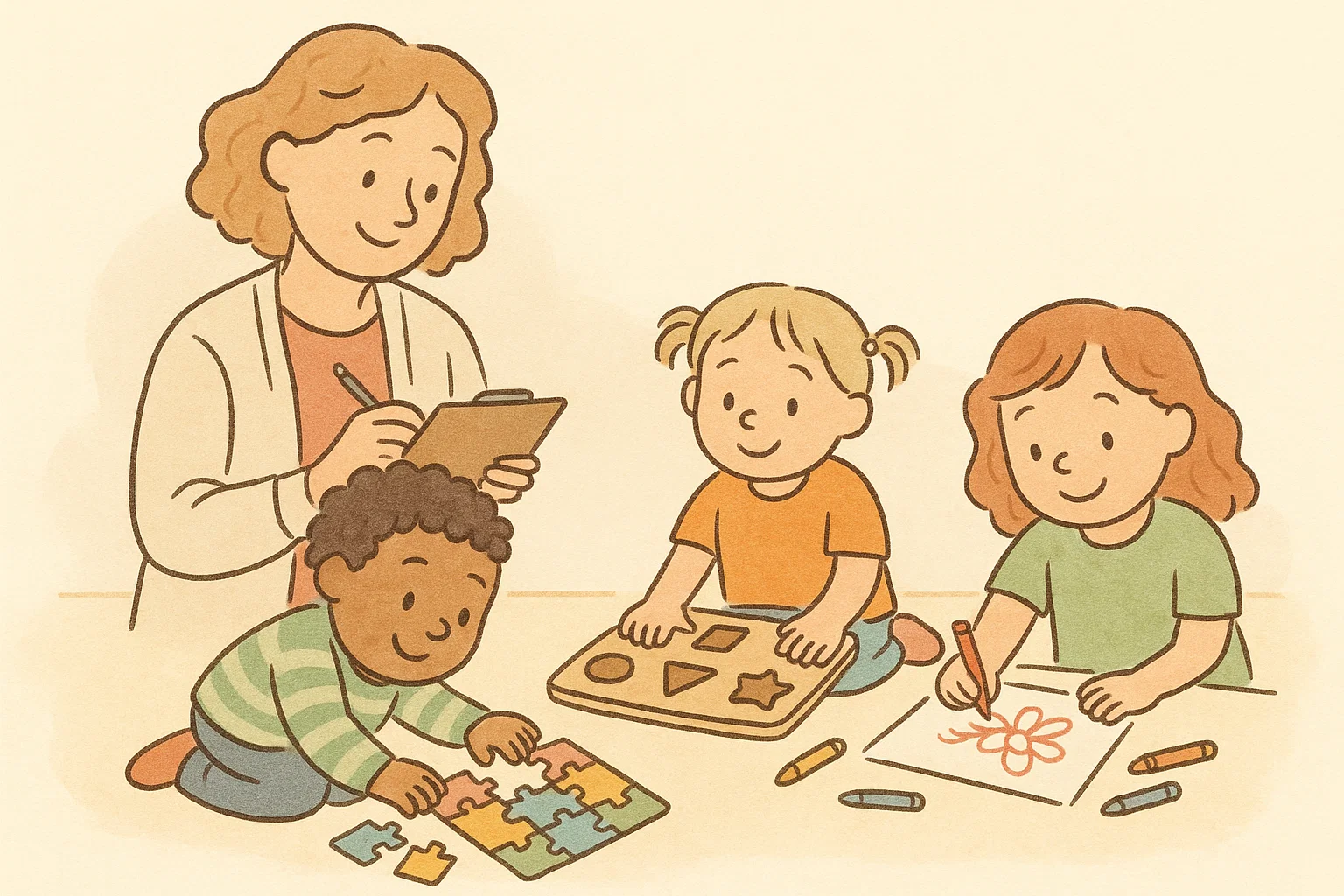
Formal testing is rare in the early years. Instead, assessment is primarily continuous, informed by observation, and designed to monitor progress across all aspects of learning.
Reception Baseline Assessment (RBA)
The RBA is a statutory assessment carried out in the first six weeks that children start reception.
- Purpose: It is a short, task-based assessment focusing on communication and language, literacy, and maths. It creates a starting point from which the child’s progress can be measured at the end of Key Stage 2.
- Format: It is delivered one-to-one by the reception teacher and is play-based and practical, meaning children are often unaware they are being assessed.
Early Years Profile (EYFS Profile)
This is the main end-of-reception year assessment.
- Purpose: It summarises a child’s attainment across the seven areas of learning against the Early Learning Goals (ELGs).
- Outcome: The reception teacher decides if the child is working at either the ‘Expected’ level or ‘Emerging’ (below the expected level) for each ELG.
Ongoing Classroom Observation
The most common and valuable form of assessment.
- Evidence Collection: The reception teacher constantly observes children during play and structured activities, gathering photos, written notes (Learning Together journals), and examples of work to track their progress and plan the next steps in their learning journey. This ensures the curriculum is tailored to the individual child’s early years needs.
What Children Should Know by End of Reception
By the time the academic year ends and the child transitions to Year 1, they should have achieved a secure grounding in the Early Learning Goals (ELGs).
Literacy Milestones
- Reading Confidence: Confident in blending and segmenting simple words and reading short, decodable sentences.
- Basic Writing: Can write their name and other simple words/sentences that can be phonetically sounded out, and has a correct pencil grip.
- Phonics Mastery Expectations: Secure with Phase 2 and Phase 3 sounds and can use them to learn to read and write.
Maths Milestones
- Number Recognition: Recognise and write numerals 1 to 9 (often beyond) and use counting to solve problems.
- Counting Fluency: Can count reliably to 20.
- Simple Addition/Subtraction: Can solve practical problems of addition and subtraction using small numbers (e.g., 5+3=8) using physical objects.
- Shape Awareness: Can recognise and name common 2D and 3D shapes.
Personal and Social Milestones
- Independence: Can dress and undress themselves (coat, shoes) and manage their personal care (toileting, handwashing).
- Self-Care: Can independently choose and look after equipment, and tidy up after themselves.
- Emotional Control: Can usually regulate their emotions, deal with disappointment, and confidently ask for help.
- Routines: Understands and follows the basic routines and rules of school life.
How to Help Children in Reception
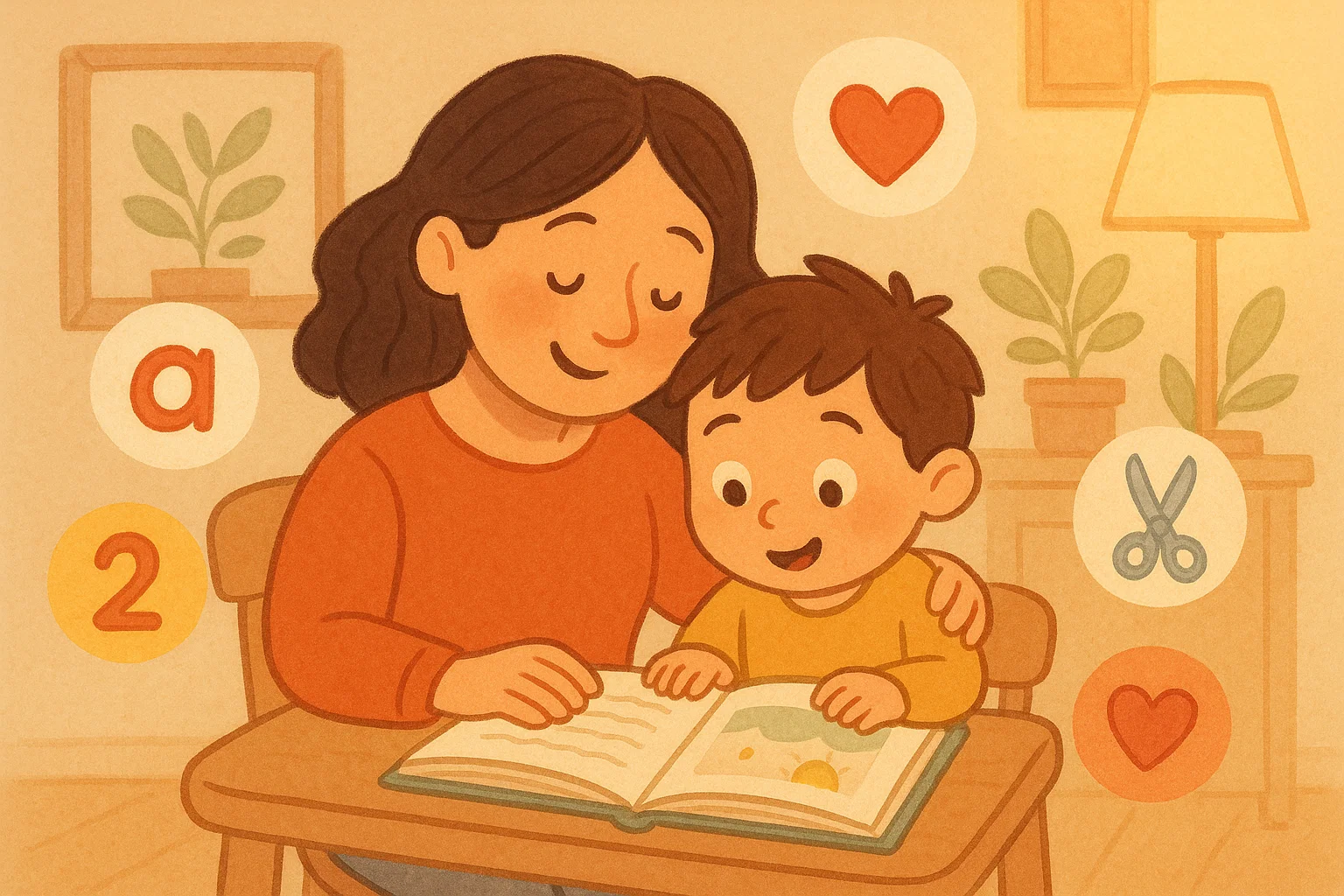
Parental involvement is the greatest predictor of a child’s success. Support your child by making learning and development fun and part of everyday life.
Read to Child
The single most impactful thing you can do.
- Daily Reading: Read to your child every day, even after they begin learning to read independently. This builds vocabulary, comprehension, and a lifelong love of books.
- Picture Discussion: Before reading the words, ask your child what they think will happen based on the pictures. This is a vital communication and language skill.
Explore Phonics
- Fun Home Phonics Activities: Turn phonics into a game. Practise ‘I Spy’ with sounds (‘I spy with my little eye something that sounds like /c/’).
- Letter Sounds: Always use the pure sound (e.g., /m/ not ‘muh’, /s/ not ‘suh’) as this is how they are taught in school.
Introduce Maths
- Practical Maths at Home: Help children with simple counting tasks: counting out plates for dinner, sorting clothes, or giving children the opportunity to measure ingredients while cooking.
- Counting Objects: Ask them to count the apples in the fruit bowl or the number of red cars they see.
Support Independence
The less your reception teacher has to help with coats and shoes, the more time they have for teaching and learning.
- Encourage Dressing: Allow extra time for your child to put on their own clothes and shoes. Velcro fastenings are particularly helpful.
- Small Choices: Encourage your child to make small choices, like choosing what snack to have, to develop self-confidence.
Build Confidence
- Positive Reinforcement: Focus on effort rather than outcome. Praise them for trying hard at a tricky task (characteristics of effectiveness) rather than just for getting the answer right.
- Easing Transitions: Talk openly and positively about school; a parent’s anxiety is easily absorbed by a child.
Preparing for Reception Start
A little preparation goes a long way to ensure a smooth transition when children begin reception.
Skills to Practise Before Starting
Focus on self-care and gross and fine motor skills.
- Toileting: Being fully toilet-trained (occasional accidents are normal, but independence is key).
- Dressing: Can independently put on a coat, open a lunchbox, and manage basic fastenings.
- Simple Routines: Practise sitting to eat and listening during story time.
Social and Communication Skills
- Playdates: Hosting playdates is an excellent way to practise sharing and negotiation.
- Listening Tasks: Help children with simple, multi-step instructions, like “Please take your cup to the sink and then put your shoes on.”
Getting Used to Instructions
The classroom environment requires children to follow instructions quickly.
- Stage One Tasks: Begin with one-step instructions and gradually move to two- and three-step commands to improve their attention and listening skills, which is a key part of communication and language.
Physical Readiness
- Fine Motor Practice: Continue drawing, cutting, playdough, and threading—all activities that strengthen the hands for writing.
- Outdoor Play: Regular active play for gross motor skills and to give children the energy and focus they need to engage in learning.
Calming Nerves
- Familiarization: Visit the school playground, read books about starting school, and talk positively about the exciting things they will learn in reception.
- Safe Item: Allow a transitional object (if the school permits) for the first few days to provide comfort.
Reception Resources for Home
Complementing the school’s efforts with a few targeted resources can be highly beneficial.
Free eBook Library
- Phonics-Linked Books: Many schools use online book resources that provide free, decodable books aligned with their phonics programme. Ask your reception teacher for recommendations.
Activity Books for Reception
- Tracing and Phonics: Workbooks can be useful for practising letter formation, tracing, and phonics consolidation, but keep sessions short and fun.
Learning Apps and Digital Tools
- EYFS-Aligned Apps: There are numerous child-safe digital learning tools designed to support early numeracy and literacy (e.g., number games, letter formation apps). Review these carefully to ensure they align with the UK National Curriculum rather than serving solely as entertainment.
Additional Needs in Reception
The reception year is often the first time a child’s development is observed by professional educators outside the family. Schools have a duty to support children with Special Educational Needs (SEN).
Identifying Additional Needs
- Early Signs: Teachers look for significant developmental differences compared to the level expected for a five-year-old child, such as difficulties with speech (communication and language), struggling to form positive relationships (PSED), or noticeable delays in motor skills.
- Screening: If a reception teacher has a concern, they will raise it with the school’s Special Educational Needs Coordinator (SENCO) to consider early screening processes.
Support Options in School
- SENCO Role: The SENCO oversees the provision for children with special educational needs (SEN) and can plan targeted, small-group support.
- Targeted Interventions: This might include specific phonics booster groups, small-group social skills work, or fine motor skills activities.
Resources for Families
If your child is identified as needing extra support, the school is the first port of call.
- Local Services: The SENCO can direct you to local external support, such as speech and language therapists or occupational therapists, to ensure your child gets the best possible start in life and that their learning and development continues successfully.
Take a short quiz to find out what your everyday choices say about your parenting style
When your child is curious about something new, what’s your instinct?
Take a short quiz to find out what your everyday choices say about your parenting style
“Can I download this app?” What happens next?
Take a short quiz to find out what your everyday choices say about your parenting style
When it comes to rules at home, which sounds most like you?
Take a short quiz to find out what your everyday choices say about your parenting style
If you could give your child one life skill today, what would you pick?
Take a short quiz to find out what your everyday choices say about your parenting style
Your child gets to choose what to watch. What would your ideal setup look like?
Take a short quiz to find out what your everyday choices say about your parenting style
Pick your parenting superpower ✨