6 Key Areas of Year 1 at Primary School in the UK

 Discover a Free Education Video App for Kids
Pastory uses AI to personalize educational video content based on your child’s interests and personality. Safe, engaging, and built for curious young minds. Sign up now to stay updated and enjoy early access with a free trial
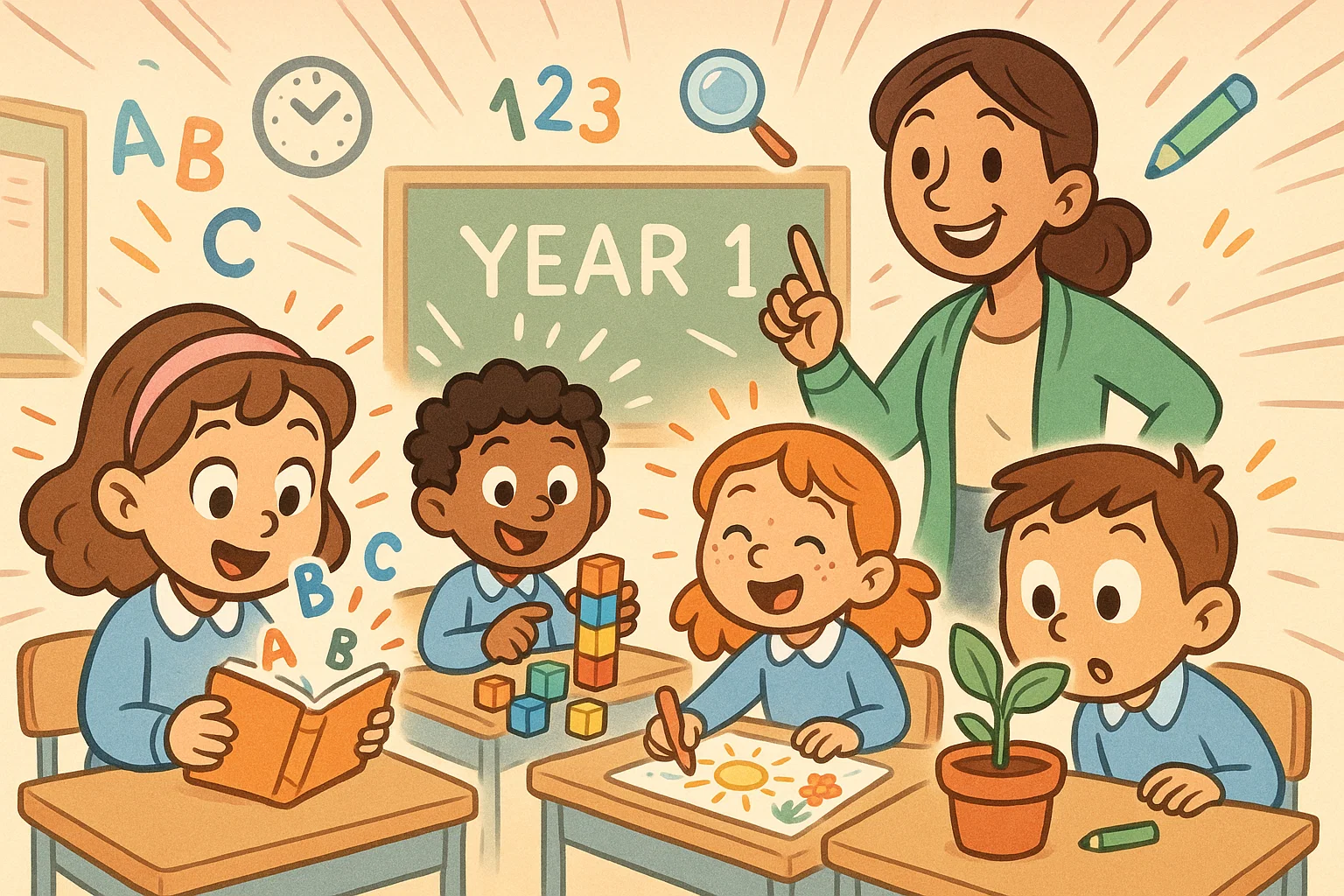
Year 1 at primary school in the UK is the first year of Key Stage 1, designed for children aged 5 to 6. It introduces a structured national curriculum covering core subjects like English and maths, alongside foundation subjects including science, art, and physical education.
This guide covers six key areas of Year 1: English, maths, assessments, home support strategies, the UK key stage structure, and answers to common parent questions. Whether your child is about to start Year 1 or is already in it, this overview helps you understand what to expect and how to help at home.
Key Takeaways
- Year 1 is for children aged 5 to 6 in England and forms part of Key Stage 1 (Years 1 and 2), the first formal stage of the national curriculum.
- The Year 1 curriculum covers core subjects — English, Maths, and Science — plus foundation subjects including History, Geography, PE, Art, Music, Computing, RE, and PSHE.
- English in Year 1 focuses on phonics, early reading, and writing, with a formal Phonics Screening Check taken in June.
- Maths covers number and place value, shapes, measurements, and problem-solving activities.
- Assessments include teacher-led monitoring and an end-of-year progress review alongside the Phonics Screening Check.
- Parents can support Year 1 learning through home reading, everyday maths practice, and creative play activities.
Key Stage 1 Overview
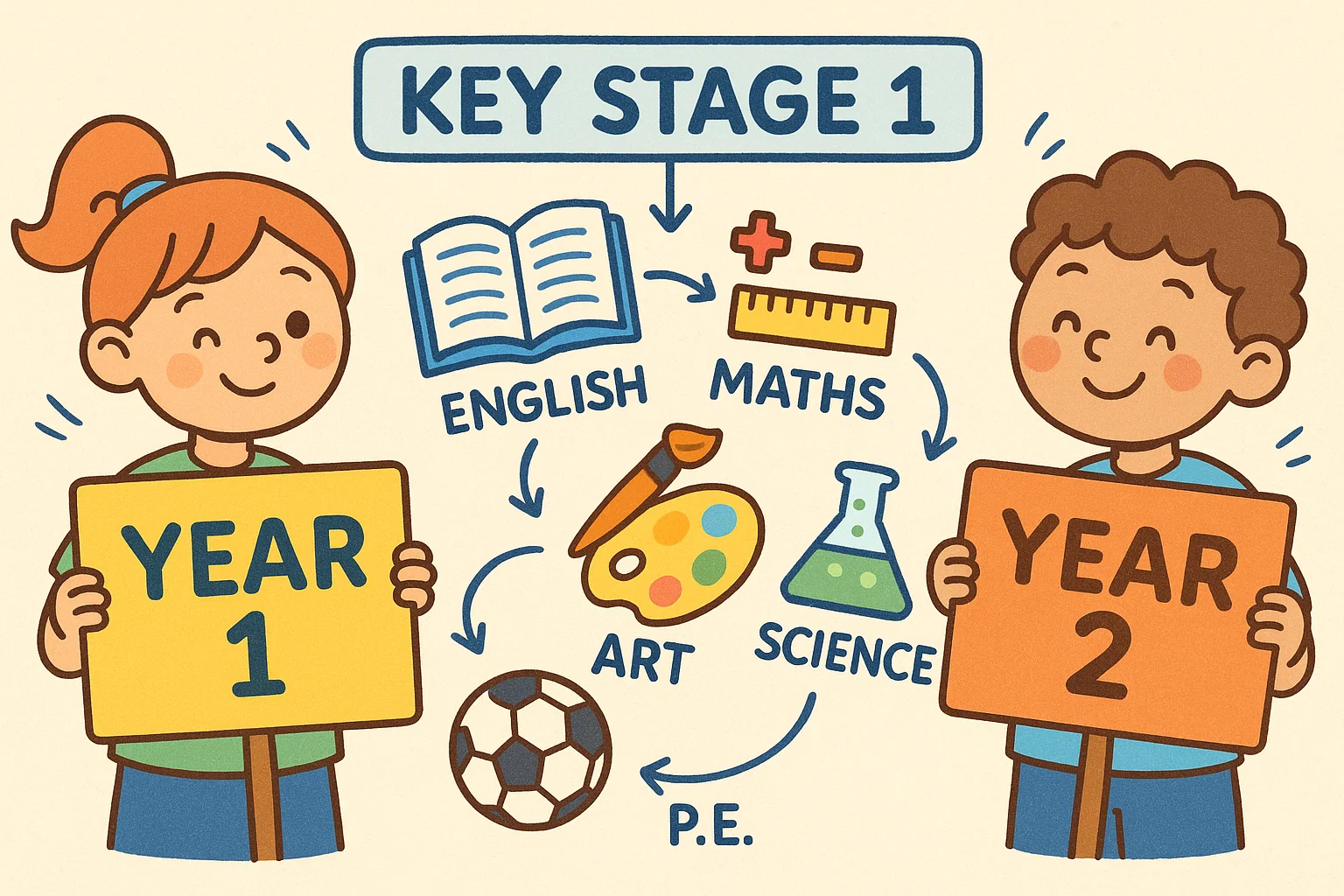
Key Stage 1 is the foundational stage of primary education, typically covering years 1 and 2. It caters to children aged 5 to 7. The primary learning goal of KS1 is to build solid foundations in literacy and numeracy, preparing children for the next stage. It’s a period of gentle but significant transition, moving from the predominantly child-initiated, discovery-based learning of the EYFS to a more structured, subject-specific approach aligned with the national curriculum.
This shift helps children develop their reading fluency, begin learning to write coherent sentences, and master core skills like addition and subtraction. It’s the stage where they solidify their starting points in language and mathematical understanding.
Year 1 Position in British National Curriculum
Year 1 is the bridge between the EYFS and the rest of KS1. The EYFS focuses on seven areas of learning, culminating in the Early Years Foundation Stage Profile, alongside the Reception Baseline Assessment (known as the Reception Baseline). Year 1 takes those holistic EYFS skills and begins to apply them within the structure of specific subjects like English, Maths, and Science.
- EYFS (Reception): Focus is on learning through play, with broad goals like Communication and Language, and Physical Development.
- Year 1 (KS1 Start): The focus narrows slightly to more formal teaching of literacy and maths while still maintaining elements of play-based learning. Children begin following the National Curriculum programmes of study.
Year 1 School Routine
For many parents, Year 1 can feel like a sudden leap into ‘proper’ school. The routine becomes more formal and structured than Reception.
| Element | Reception (EYFS) | Year 1 (KS1) |
| Pace | Often self-paced, flexible | More structured, teacher-led sessions |
| Play | Large, dedicated blocks of play-based learning | Integrated Continuous Provision that decreases over the year; more structured outdoor time |
| Lessons | Short, group-based inputs | Longer whole-class teaching for English and Maths |
| Breaks | Frequent access to outdoor area | Timed morning break and lunch break |
A typical Year 1 day involves dedicated lessons in phonics, English, and math (often in the morning), followed by foundation subjects and creative time in the afternoon. Children learn to sit for longer periods, listen to instructions, and manage simple tasks independently.
Year 1 Development Goals
The goals for a child aged 5 to 6 are about balancing academic progress with social-emotional maturity.
- Academic Targets: Achieving initial fluency in reading and writing, knowing number bonds to 10 and 20, and grasping basic scientific concepts for Year 1 Science.
- Social-Emotional Targets: Developing confidence in speaking to a group, learning to cooperate in group work, demonstrating independence by managing their belongings, and following the classroom rules.
To answer one of the most common parent questions directly: Key Stage 1 covers Years 1 and 2, for children aged 5 to 7 in England. Year 1 is for children who turn 6 during the school year (born 1 September 2018 – 31 August 2019 for the 2024–25 academic year). Year 2 is for children who turn 7. The table below summarises the KS1 year groups and typical ages at a glance.
| Year Group | Typical Age | Key Stage |
| Reception | 4–5 | EYFS |
| Year 1 | 5–6 | Key Stage 1 |
| Year 2 | 6–7 | Key Stage 1 |
| Year 3 | 7–8 | Key Stage 2 |
So yes — Year 1 is KS1, and KS1 spans Years 1 and 2. Children who do not reach the expected standard in the Phonics Screening Check in Year 1 will receive additional support and retake it in Year 2.
Year 1 Curriculum: Subjects and Topics
The broad curriculum in Year 1 is structured around the national curriculum for schools in England. A good school will make sure this curriculum is broad and balanced, ensuring that while core skills are taught rigorously, children still experience a range of subjects.
Core Subjects in Year 1
These subjects form the foundation of KS1 learning:
- English: Focuses heavily on phonics, learning to read, and learning to write.
- Mathematics: Emphasizes counting, number recognition, simple addition and subtraction, and beginning to look at concepts like multiplication and division practically.
- Science: Introduces children to scientific enquiry through observing the world around them.
Foundation Subjects in Year 1
These subjects provide breadth and allow children to develop a wider skill set:
- History & Geography: Simple themes about the past (e.g., family history) and local area/country.
- PE (Physical Education): Focus on fundamental movement skills, coordination, and simple team games.
- Art & Design Technology (DT): Exploring different materials, tools, and artistic techniques.
- Music: Singing songs, identifying sounds, and using tuned and untuned instruments.
- Computing: Basic digital literacy, understanding how to use technology safely.
- RE (Religious Education) & PSHE (Personal, Social, Health and Economic Education): Developing an understanding of the world, different cultures, and personal well-being.
Cross-Curricular Activities
In Year 1, teachers often use cross-curricular projects to make learning more engaging and meaningful. For example, a project on ‘minibeasts’ could combine Year 1 Science (observing insects), English (writing a report), Art (drawing the insects), and Maths (counting the legs). This integrated approach helps children learn to apply their core skills in different contexts.
English in Year 1
English is arguably the most crucial subject in Year 1, as it directly supports learning across the entire broad curriculum.
Phonics Learning in Year 1
Phonics is the method used to teach children to read and write by sounding out letters and groups of letters. Year 1 is the peak year for structured phonics instruction.
- Key Skills: Decoding skills (sounding out words), blending (pushing the sounds together to read the word, e.g., c-a-t becomes ‘cat’), and segmenting (breaking words up to spell them, e.g., ‘dog’ becomes d-o-g).
- The Goal: By the end of Year 1, children will have covered Phonics Phases 2, 3, and 4, and be moving into Phase 5. They will be using high-frequency words (tricky words) and simple spelling rules.
Early Reading Skills
As children in year 1 master phonics, they move from simple reading and writing tasks to more complex texts.
| Reading Skill | Description | Home Support Idea |
| Decoding | Sounding out unfamiliar words using phonic knowledge. | Use resources like Oxford Owl for practice texts. |
| Fluency | Reading at a steady pace, with expression (prosody). | Re-read favourite books and use shared reading time. |
| Comprehension | Understanding the meaning of the text. | Asking ‘who, what, where, when, why’ questions. |
Guided reading groups in school are essential for developing these skills, as they allow the teacher to address individual needs.
Writing and Spelling Skills
Moving from Reception’s emergent writing, Year 1 focuses on forming proper sentences.
- Sentence Writing: Learning to start a sentence with a capital letter, end it with a full stop, and leave finger spaces between words.
- Punctuation: Practicing the basic use of a capital letter and a full stop; introduction to question marks and exclamation marks.
- Spelling: Learning to spell common irregular words and words following the current phonics phase.
Maths in Year 1
Year 1 Maths is the formal introduction to number and calculation, building on the practical maths skills learned in EYFS. Teacher assessments in Maths look at both knowledge and application.
Number and Place Value
This is the foundation of all future maths learning.
- Counting: Counting reliably to 100, both forwards and backwards.
- Number Operations: Securing addition and subtraction facts to 20, understanding concepts like ‘more than’ and ‘less than’.
- Place Value: Recognizing that the ‘1’ in ’12’ represents 10, not just 1.
Shapes and Measurements
Children begin to categorize and compare the physical world using mathematical language.
- Geometry: Recognizing and naming 2D shapes (square, triangle, circle) and 3D shapes (cube, cuboid, sphere).
- Measurement: Comparing and ordering objects by size, length, mass, and capacity; telling the time to the hour and half-hour.
Problem-Solving Activities
Maths in Year 1 is not just about calculations. Children need to apply their skills. Simple word problems and practical tasks (e.g., dividing a set of objects equally) help them understand the real-world application of number skills.
Year 1 Assessments
The Year 1 curriculum focuses on continuous progress, monitored mainly through teacher assessments rather than formal national tests.
Teacher-Led Monitoring
The most common form of assessment is formative. Teachers track progress daily by:
- Observing children during group work and independent tasks.
- Marking work and providing verbal or written feedback.
- Keeping detailed records on children’s attainment in core skills.
Phonics Screening Check
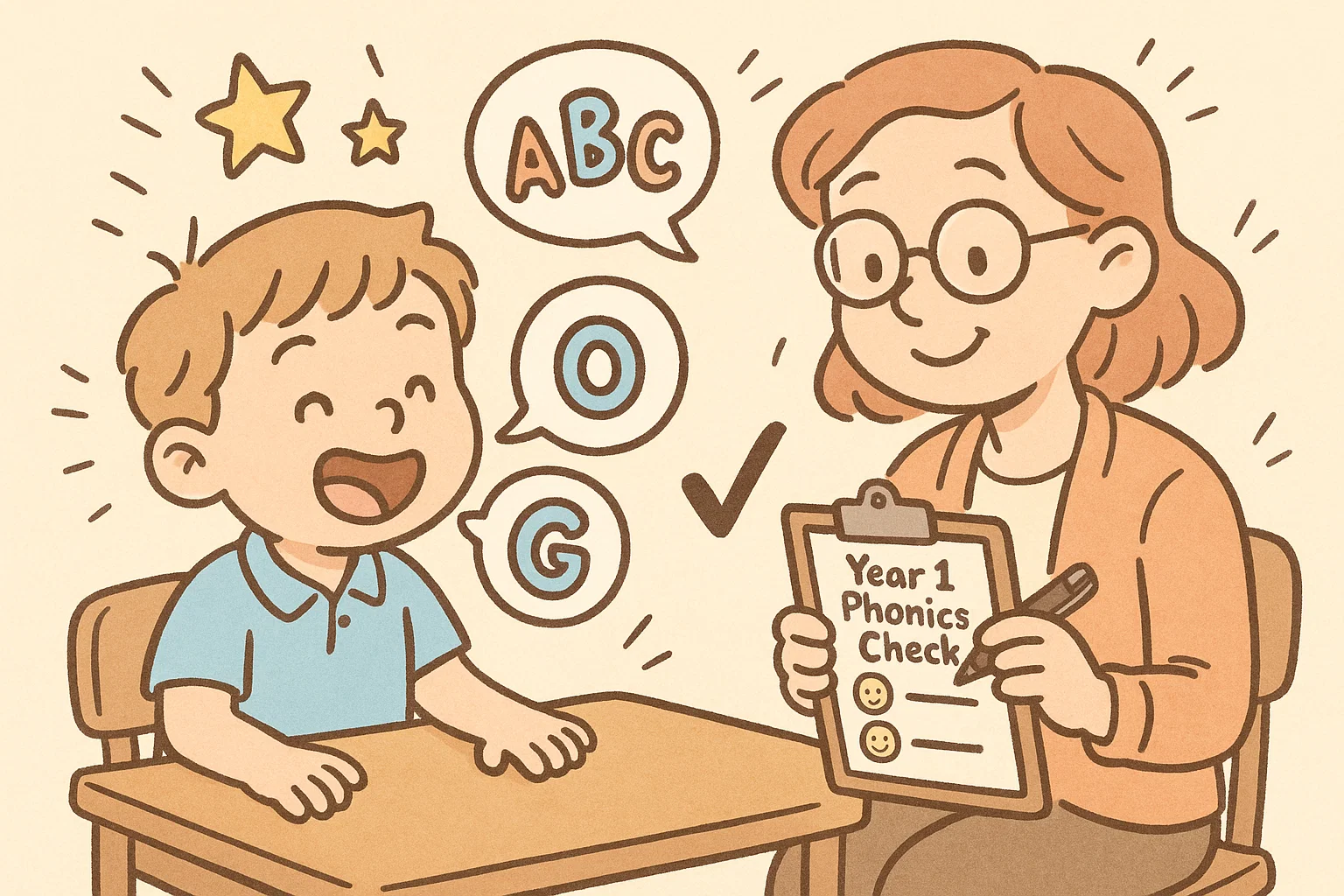
The Phonics Screening Check is a short, statutory assessment taken by children in year 1 in June.
- Purpose: To confirm whether a child has reached the expected standard of phonics decoding skills.
- Format: Children read 40 words and ‘non-words’ (or ‘pseudo-words’, e.g., ‘treg’ or ‘splut’) to their teacher.
- Outcome: If a child does not pass the phonics screening check in Year 1, they will receive extra support and re-take it in Year 2.
End-of-Year Progress Review
Parents typically receive a comprehensive report at the end of year summarizing their child’s progress across all subjects against the national curriculum expectations. This review outlines whether the child is working ‘below,’ ‘at,’ or ‘above’ the expected standard for their year group.
How to Support Year 1 Learning at Home
Your role as a parent is vital, particularly during the transition into Year 1. Simple, consistent support can make a huge difference.
Home Reading Activities
- Shared Reading: Read to your child daily—not just their school books. Choose fun stories to build vocabulary and imagination.
- Phonics Practice: Use the letters and sounds your child is learning at school to sound out words on signs, cereal boxes, or simple flashcards.
- Book Choice: Visit the library and let your child choose books they find engaging. Reading enjoyment is key to developing their reading and writing skills.
Everyday Maths Practice
- Counting Games: Count steps, stairs, or items in a shopping basket.
- Money Skills: Let them handle simple coins and practice addition and subtraction while working out change.
- Time Awareness: Use an analogue clock to talk about ‘on the hour’ and ‘half past’ to reinforce skills learned in Year 1 Maths.
Creative Home Play Ideas
Encourage imaginative play to support social and emotional development:
- Role-Play: Set up a ‘shop’ to practice counting and money, or a ‘post office’ to practice writing addresses and simple sentences.
- Outdoor Exploration: Turn a walk into a Year 1 Science lesson: collect leaves, talk about different everyday materials, and observe the weather.
Key Stage Structure in the UK
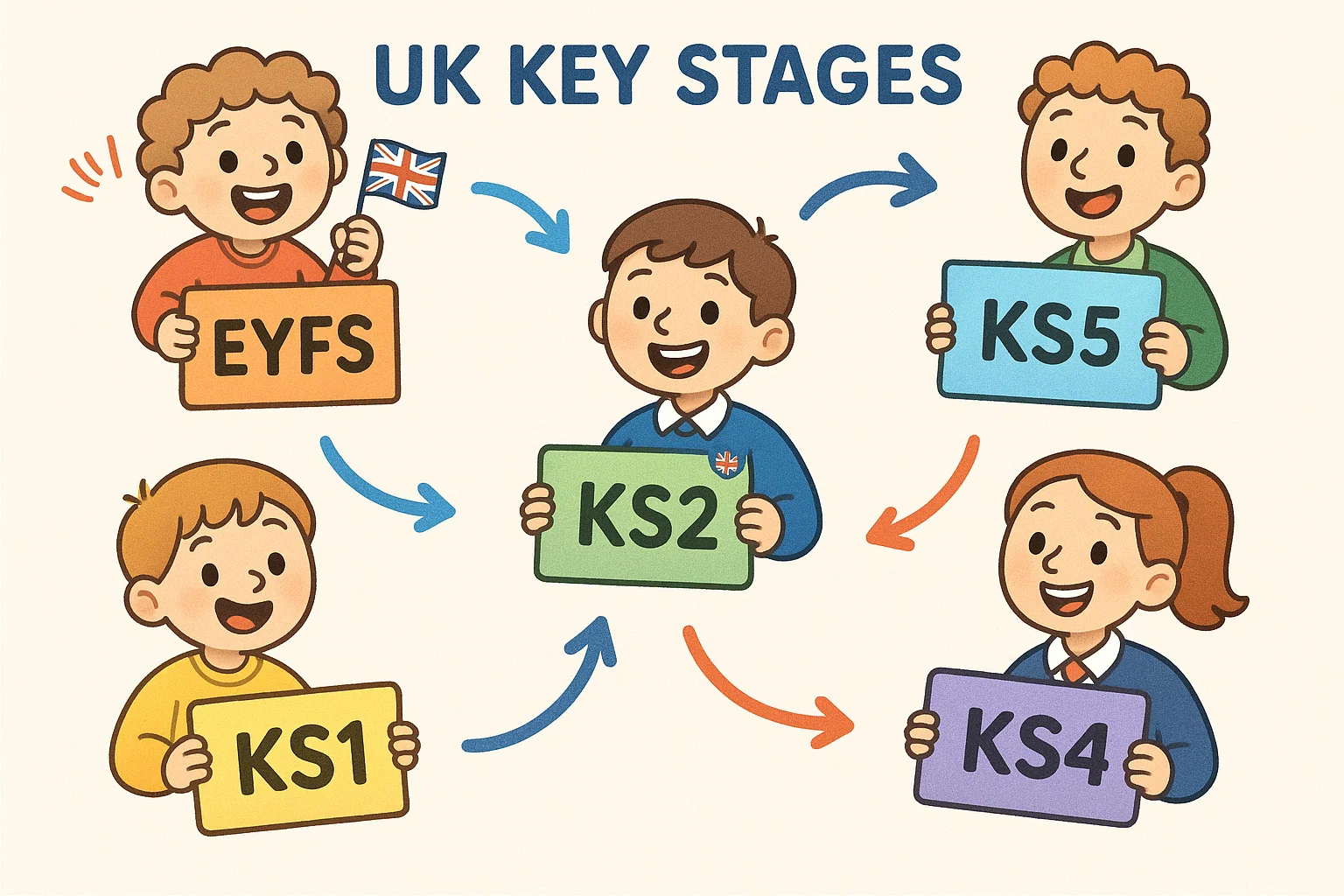
The UK education system is divided into distinct stages to ensure a logical progression of learning. Understanding the whole structure helps contextualize Year 1’s importance.
Early Years Foundation Stage (EYFS)
This stage covers children from birth to the age 5, typically concluding with the Reception year. The focus is on holistic development through play, culminating in the Reception Baseline Assessment, which provides an early measure of a child’s starting points in language and maths.
Key Stage 1 and Year 1 Role
Key Stage 1 covers Years 1 and 2. It is the first formal implementation of the national curriculum, where core literacy and maths skills are established. Year 1 is the transitional entry point, focusing on building fluency in reading and writing and number sense.
Key Stages 2–5 Overview
- Key Stage 2 (Years 3–6): The later years of primary education. This stage builds significantly on KS1 foundations, preparing children for national tests (SATs) at the end of year 6.
- Key Stage 3 (Years 7–9): The start of secondary school. The curriculum becomes much broader and subject-specialized.
- Key Stage 4 (Years 10–11): The GCSE years, culminating in the main set of national exams.
- Key Stage 5 (Years 12–13): Post-16 education (A-Levels or equivalent).
What Age Is Year 1 in the UK? (KS1 Age Guide)
Year 1 in the UK is for children aged 5 to 6. Children typically start Year 1 in September after their fifth birthday. In England, the school year runs from September to July, and year groups are determined by a child’s age on 31 August each year.
Year 1 sits within Key Stage 1 (KS1), which covers Years 1 and 2 (ages 5–7). KS1 is the first formal key stage of the national curriculum in England. Here is a quick reference for the KS1 age range:
| Year Group | Typical Age | Key Stage | Key Assessment |
| Year 1 | 5–6 | KS1 | Phonics Screening Check (June) |
| Year 2 | 6–7 | KS1 | KS1 SATs (teacher assessment) |
If your child was born between 1 September and 31 August of the relevant year, they will be in Year 1 together regardless of whether they turn 5 or 6 during that school year. Children who turn 5 after the September start date will still be placed in Year 1 if they have already completed Reception.
In Scotland, the equivalent of Year 1 is Primary 2 (P2), and in Northern Ireland it is Year 2 — so age groupings can differ slightly across the UK nations. The information on this page refers specifically to England.
FAQs
What Age Is Year 1?
Children are typically aged 5 at the start of Year 1 (September) and turn 6 during the school year. The age range is generally age 5–6.
Difference Between Reception and Year 1?
The primary difference is the shift from a high degree of play-based learning in Reception to more structured, teacher-led lessons in Year 1. While play still exists, the expectation for focused work in literacy and maths increases, particularly in areas like phonics and correct punctuation.
What Should Children Read in Year 1?
Children should primarily read phonics-based books that align with the specific sounds they are learning in class. Resources from publishers like Oxford Owl and others that match the phonics screening phases are ideal. They should also read a wide range of stories to expand vocabulary and general knowledge.
How to Help a Child Who Struggles in Year 1
If your child seems to be behind as they move into Year 2, the best approach is communication and consistent, targeted practice.
- Talk to the Teacher: Teachers have detailed records of teacher assessment and can identify the specific areas (e.g., blending sounds in phonics or addition and subtraction).
- Focus on Core Skills: Dedicate 10-15 minutes a day to the area of struggle. Short, high-quality practice is more effective than long, frustrating sessions.
- Positive Reinforcement: Focus on effort and improvement, not just the final outcome. Celebrate the small wins to build confidence.
Take a short quiz to find out what your everyday choices say about your parenting style
When your child is curious about something new, what’s your instinct?
Take a short quiz to find out what your everyday choices say about your parenting style
“Can I download this app?” What happens next?
Take a short quiz to find out what your everyday choices say about your parenting style
When it comes to rules at home, which sounds most like you?
Take a short quiz to find out what your everyday choices say about your parenting style
If you could give your child one life skill today, what would you pick?
Take a short quiz to find out what your everyday choices say about your parenting style
Your child gets to choose what to watch. What would your ideal setup look like?
Take a short quiz to find out what your everyday choices say about your parenting style
Pick your parenting superpower ✨