3 Steps to Make Riddles for Primary Students (Plus Easy & Hard Examples)

 Discover a Free Education Video App for Kids
Pastory uses AI to personalize educational video content based on your child’s interests and personality. Safe, engaging, and built for curious young minds. Sign up now to stay updated and enjoy early access with a free trial
Riddles for primary students are a practical and enjoyable way to build critical thinking, vocabulary, and problem-solving skills in children ages 6–11. This collection includes easy riddles for Grades 1–2, tricky brain teasers for Grades 3–5, subject-themed puzzles, seasonal riddles, and a clear 3-step guide to help students write their own.
Whether you are a teacher planning a morning warm-up or a parent making learning feel like play, the riddles here are organized by grade level and topic so you can find the right challenge for every child.
Key Takeaways
- Easy riddles for Grades 1–2 and tricky riddles for Grades 3–5 are organized by difficulty and grade level.
- Subject-themed riddles cover math, science, English, and geography to support learning across subjects.
- Seasonal and holiday riddles are included for back-to-school, Halloween, Christmas, summer, and spring.
- A 3-step guide walks students through choosing a topic, building clues, and testing riddles with peers.
- Classroom activity ideas include morning warm-ups, group competitions, and themed lesson integration.
What Makes a Good Riddle for Students
A truly effective riddle transcends a simple question; it’s a carefully crafted linguistic puzzle that encourages kids to think outside the box. A good riddle for primary students should strike a balance – challenging enough to engage critical thinking yet simple enough for age-appropriate understanding.
The best riddles stimulate:
- Critical Thinking: They require analysis of clues, recognizing hidden meanings, and spotting patterns.
- Creativity: They prompt the child to shift perspective and consider multiple, non-obvious solutions – a form of “sideways thinking.”
- Vocabulary: They often rely on puns, double meanings, or figurative language, providing a fun, playful lesson in semantics.
Using these simple, age-appropriate logic puzzles in class or at home not only sharpens the mind but also fosters a growth mindset – the belief that intelligence can improve with effort. Every solved puzzle delivers a burst of dopamine, reinforcing the pleasure of perseverance.
Elements of Age-Appropriate Riddles
Choosing the right riddle means matching its complexity to the child’s developmental stage. You wouldn’t give a first-grader the same wordplay challenge as a fifth-grader.
| Primary Level | Age Range | Ideal Complexity | Key Focus Areas |
| Lower Primary | Grades 1–2 (Ages 6–8) | Simple, rhyming, short sentences, concrete objects. | Observation, basic vocabulary, rhyming, and recall. |
| Upper Primary | Grades 3–5 (Ages 8–11) | Multi-step clues, wordplay, abstract concepts, logic. | Deductive reasoning, lateral thinking, tricky riddles, and academic themes. |
For younger children, riddles should use rhyme and concrete, visible objects. For older students, you can introduce abstract concepts, numerical sequences, and linguistic tricks.
Tips for Selecting Riddles for the Classroom
Teachers know that variety is the spice of learning. When choosing riddles for the classroom, aim for a mix that is both fun and educational.
- Align with Curriculum: Select math riddles, science riddles, or English riddles that relate directly to the current lesson plan. This reinforces learning through a playful lens.
- Mix Difficulty: Start with easy riddles as a warm-up, then introduce a few hard riddles to challenge kids. This keeps every student engaged – from those who need confidence boosts to advanced learners eager for a challenge.
- Encourage Collaboration: Present some puzzles that are best solved as a group. Have the children try to solve the riddle together. This promotes positive social interaction and essential teamwork skills.
- Incorporate Humor: Funny riddles are always a hit. Laughter boosts endorphins and has been shown to help learning stick, making the experience memorable.
Why Students Love Solving Puzzles
The human brain is wired for curiosity. When presented with a riddle, a primary student experiences a natural, powerful urge to solve it. This drive is fueled by:
- The “Aha!” moment: The sudden cognitive shift when the answer clicks is incredibly rewarding, triggering a burst of positive emotion.
- Intellectual Competition: In a group setting, the friendly race to see how many they can solve first provides motivation.
- Empowerment: Success in solving a tricky riddle builds self-esteem and confidence, signaling to the child, “I can do hard things.”
Easy Riddles for Lower Primary Students (Grades 1–2)
These are simple, concrete riddles – perfect for first- and second-grade students. They use familiar words and everyday objects to start developing crucial analytical skills.
Everyday Object Riddles
- I have keys, but open no locks. I have a space, but no room. You can enter, but can’t go outside. What am I? (A keyboard)
- I have a spine but no bones. I have pages but no bed. I hold stories but can’t talk. What am I? (A book)
- I get shorter every time I am used. What am I? (A pencil)
- What has a head and a tail, but no body? (A coin)
- What can you catch, but not throw? (A cold)
- I have cities, but no houses; forests, but no trees; and water, but no fish. What am I? (A map)
- What has to be broken before you can use it? (An egg)
Funny Animal Riddles
Kids love animals, making animal riddles a perfect tool to keep kids busy.
- I fly without wings and cry without eyes. What am I? (A cloud)
- What is full of holes but still holds water? (A sponge)
- I have a long neck, but no head. I wear a cap but have no hair. What am I? (A bottle)
- What has four legs, and is always in bed but never sleeps? (A bed)
- I have a tail, but I’m not a dog. I live on a farm, and I love to be muddy. What am I? (A pig)
- What is always coming, but never arrives? (Tomorrow)
- I don’t have lungs, but I can breathe. I don’t have legs, but I can run. What am I? (A fire)
Quick Brain Teasers
These short questions are ideal for classroom warm-ups or quick transitions.
- What is light as a feather, but even the strongest person can only hold for a few minutes? (Breath)
- What begins with T, ends with T, and has T in it? (A teapot)
- What is orange and sounds like a parrot? (A carrot)
- What has one eye but can’t see? (A needle)
- What don’t have lungs or a voice, but can speak all languages? (An echo)
Tricky Riddles for Upper Primary Students (Grades 3–5)
These puzzles introduce wordplay, logic, and more abstract concepts, requiring kids to think deeply and exercise their critical thinking skills.
Word and Language Riddles
These riddles can also be great for vocabulary and spelling lessons.
- I have an ocean, but no water, a town but no people, and a mountain range but no land. What am I? (A globe or a map)
- What word is spelled wrong in every dictionary? (Wrong)
- What question can you never answer yes to? (Are you asleep yet?)
- What has many words but never speaks? (A book)
- Take away the whole and some still remains. What is it? (The word “Wholesome”)
- It is the beginning of eternity, the end of time and space, the beginning of the end, and the end of every race. What is it? (The letter ‘E’)
Logical Thinking Riddles
These hard riddles require reasoning and deduction.
- If you’re running a race and you pass the person in second place, what place did you finish the race in? (Second place)
- A man found himself shut up in a wooden box that was empty. He had nothing with him but a candle and a saw. How did he escape? (He sawed the candle in half – he literally “saw a candle.”)
- A poor man lives in a small house, but the house is full. How does he make room? (He opens the door and lets the rain out)
- What can you hold in your left hand but not in your right? (Your right elbow)
- What is taken from a mine and shut up in a wooden case, from which it is never released, and yet used by almost everybody? (Pencil lead/graphite)
Classic Brain Teasers
These riddles with answers are timeless favorites that test observation.
- What is always in front of you but can’t be seen? (The future)
- What has a neck but no head? (A shirt or a bottle)
- What has an eye but cannot see? (A needle)
- What has to be full to work, but surrounds you even when it’s empty? (The air)
- Two fathers and two sons sat down to eat eggs for breakfast. They ate exactly three eggs, with each person having one. How is this possible? (They are a grandfather, a father, and a son – three people)
Subject-Themed Riddles for Students
Group these fun riddles for kids by subject to link directly to your educational topics, providing an effective, playful way to enhance learning.
Math Riddles for Primary Students
These help kids apply simple arithmetic and logic to real-world scenarios.
- I am an odd number. Take away one letter, and I become even. What number am I? (Seven)
- What has six faces, but no mouth, and 12 edges, but no body? (A cube or dice)
- What occurs once in a minute, twice in a moment, but never in a thousand years? (The letter ‘M’)
- If grandpa went for a walk and said it took him one hour, but the clock said it was 60 minutes, what’s the difference? (No difference)
- I have no beginning and no end. I have no sides or corners. What shape am I? (A circle)
- What can you put on the table and cut, but can’t eat? (A deck of cards)
Science Riddles for Primary Students
Perfect for discussing the natural world and basic physical concepts.
- I have cities, but no houses. I have mountains, but no trees. I have water, but no fish. What am I? (A map)
- I am a fluid that you can see, but I fly without wings. I can be light or dark, and I fall to the ground. What am I? (Rain or a cloud)
- What goes up but never comes down? (Your age)
- What has a big mouth and you fill it up with water? (A river)
- I can be broken but not held, given but not taken. What am I? (A promise)
English and Word Riddles
These riddles also enhance vocabulary and understanding of word structures.
- What word contains all 26 letters but only five syllables? (Alphabet)
- What word looks the same backward and forward? (Palindromes like ‘level’ or ‘madam’)
- I have two letters, but I am an abbreviation for a very long month. What am I? (An abbreviation for ‘September’ – ‘Sep.’)
- What word contains a female, a male, and a whole family? (Human)
- What letter of the alphabet is a drink? (T – tea)
Geography and Nature Riddles
Great for discussing environments, bodies of water, and natural landmarks.
- I have no voice, but I tell you of the world. I have mountains and plains, but no real ground. What am I? (A globe or map)
- I have a mouth, but never speak; a bed, but never sleep. I can run fast but have no legs. What am I? (A river)
- What is all around the house and in the house, but never touches the house? (The air or a fence around the property)
- What has a tongue but cannot eat? (A shoe)
- I can be high or low, strong or weak, but I’m never still. What am I? (The tide or wind)
Seasonal and Holiday Riddles
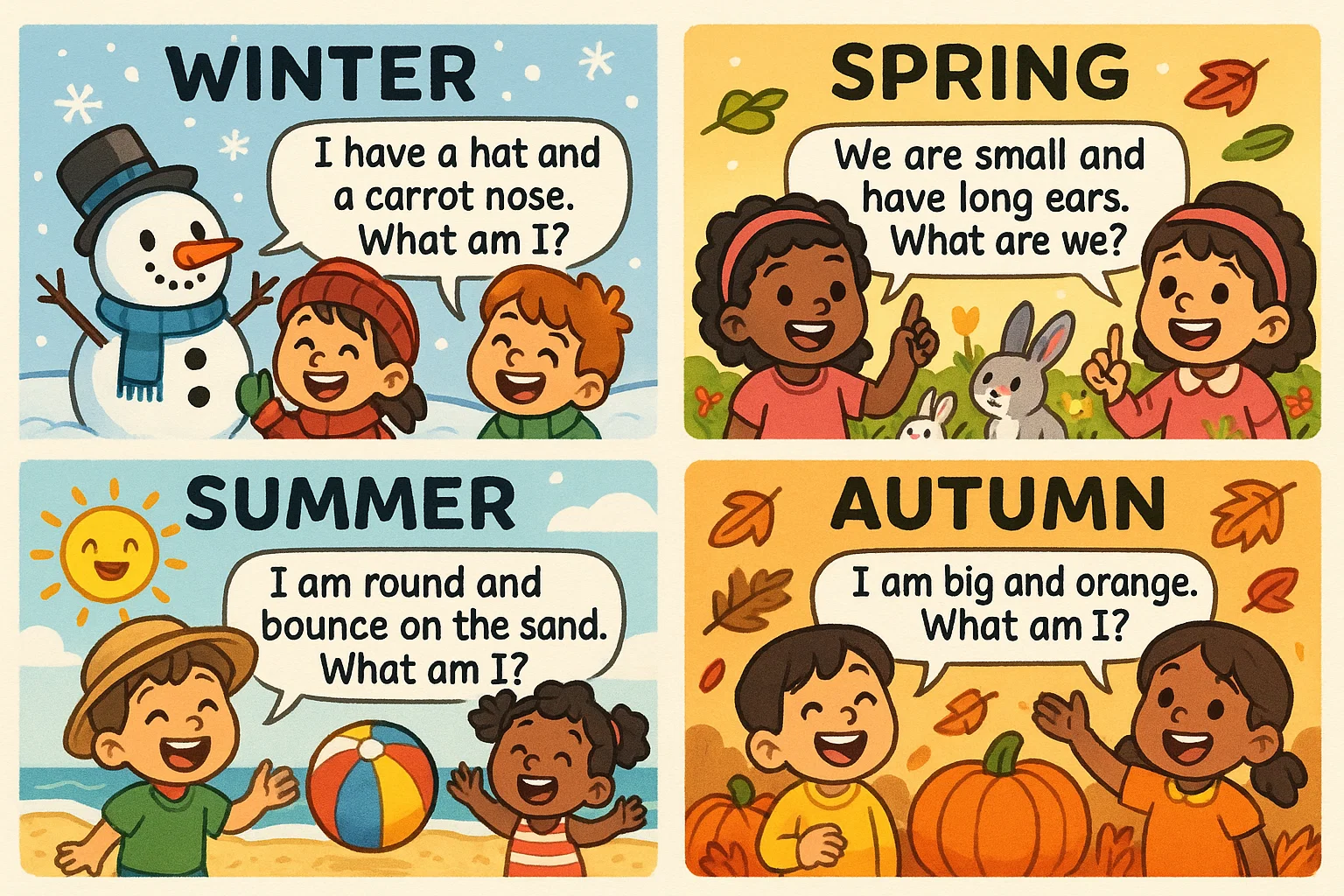
Use these to celebrate the changing seasons and make learning timely. These holiday riddles work perfectly for themed classroom displays and seasonal discussions.
Back-to-School Riddles
These fun riddles for kids can be used to encourage kids at the beginning of the academic year.
- I have a pointy head, and a lead heart, but I never write with ink. What am I? (A pencil)
- What has 88 keys but can’t open a single door? (A piano)
- I have many tables, but no chairs. What am I? (A school)
- I have a desk, but I’m not a bank. I hold papers but don’t have hands. What am I? (A folder or notebook)
- I’m a building where you learn to read and write. What am I? (A school)
Winter and Christmas Riddles
- I wear a coat in winter, but I don’t go outside. I hold warmth but don’t have a fire. What am I? (A fireplace or an oven)
- What do you get when you cross a snowman with a vampire? (Frostbite)
- What has a light as a feather touch, but can bury a house? (Snow)
- I am round and red, but I’m not an apple. I hang on a tree, but I’m not a leaf. What am I? (A Christmas ornament)
Summer Riddles
- I have a thumb and four fingers, but I am not alive. I keep your hands clean. What am I? (A glove or a mitt)
- What has no voice but can tell you where to go? (A compass or map)
- What is white when it’s dirty and black when it’s clean? (A chalkboard)
- I have a crown but no kingdom. I have an eye but no vision. What am I? (A pineapple)
Halloween Riddles
- I have a face but no body. I have eyes but cannot see. I sit on a porch and scare away ghosts. What am I? (A jack-o’-lantern)
- I am slightly spooky, but I’m not a ghost. I have a hat, but I wear it on the ground. What am I? (A mushroom)
- What is scary, has four wheels, and flies? (A monster on a skateboard)
Spring and Easter Riddles
- I come in many colors and can be hidden in the grass. What am I? (An Easter egg)
- I grow tall, have petals, and smell sweet. What am I? (A flower)
- I can be a pet, but I like to hop. What am I? (A rabbit)
Riddles by Grade Level
This section helps teachers and parents choose the right level of challenge for their students. Riddles play a key role in developing age-specific skills.
Riddles for 1st Grade Students
Focus on easy riddles with simple rhyming and direct answers.
- I am red and round, I grow on a tree, and I am very crunchy. What am I? (An apple)
- What is big and yellow and wakes you up in the morning? (The sun)
- I have four legs, but I can’t walk. You sleep on me at night. What am I? (A bed)
- I have a face and two hands, but no arms or legs. What am I? (A clock)
- I can be long or short. I have an hour hand and a minute hand. What am I? (Time or a clock)
Riddles for 2nd Grade Students
Slightly longer, promoting early reading comprehension and simple logic.
- I have a mouth, but never speak. I have a bank, but no money. I run day and night. What am I? (A river)
- I have an ocean that never moves, I have a bed but never sleep. What am I? (A map)
- What is full of holes but still holds water? (A sponge)
- What has a neck, but no head, and wears a cap? (A bottle)
- What can you break, even if you never pick it up or touch it? (A promise)
Riddles for 3rd Grade Students
Introduce multi-step or basic logic challenges that require kids to process more information.
- What is it that lives if it is fed, and dies if you give it a drink? (Fire)
- What can be swallowed, but can also swallow you? (Pride)
- I am always in the background, but never miss a moment. What am I? (A shadow)
- I have cities, but no houses; forests, but no trees; and water, but no fish. What am I? (A map)
- What has to be broken before you can use it? (An egg)
Riddles for 4th and 5th Grade Students
These tricky riddles need vocabulary, pattern recognition, and more abstract reasoning.
- What belongs to you, but everyone else uses it more? (Your name)
- What is so fragile that saying its name breaks it? (Silence)
- What has no voice but can speak all languages? (An echo)
- A woman shoots her husband, then holds him underwater for five minutes. Afterward, they enjoy a lovely dinner together. How is this possible? (She is a photographer, and she shoots a picture and develops it in the water)
- I have no life, but I can die. What am I? (A battery)
Funny and Silly Riddles for Students
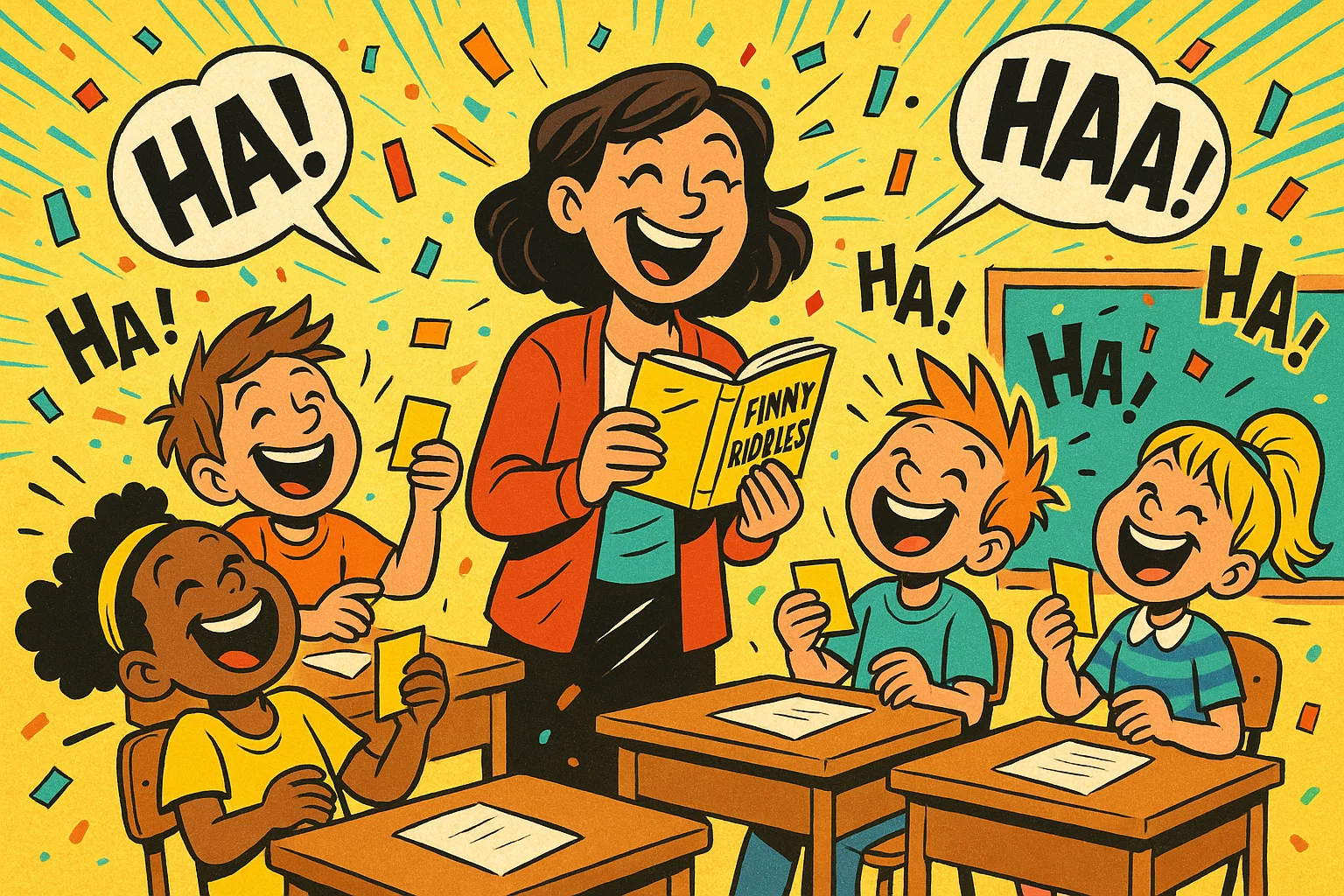
Humor is a powerful tool for engagement. This section offers a dose of lighthearted fun, combining laughter with clever wordplay.
School-Themed Jokes
- What is a teacher’s favorite time of day? (Recess)
- Why did the student eat his homework? (Because the teacher said it was a piece of cake)
- What is a pirate’s favorite letter of the alphabet? (The C – sea)
- Why did the pencil get sent to the principal’s office? (For being too blunt)
- What room can no one enter? (A mushroom)
Food and Animal Humor Riddles
Food and animal riddles are naturally entertaining.
- What do you call a fake noodle? (An impasta)
- Why did the banana put on sunscreen? (Because it was peeling)
- What do you call a lazy kangaroo? (Pouch potato)
- What do you call a sleeping bull? (A bulldozer)
- I’m a vegetable that is orange and sounds like a parrot. What am I? (A carrot)
Short and Giggle-Worthy Puzzles
- What has a thumb and four fingers but is not alive? (A glove)
- I have no life, but I grow. I have no lungs, but I need air. I have no mouth, but water kills me. What am I? (Fire)
- What can you always find right in the middle of trouble? (The letter ‘o’)
- What goes around the world but stays in a corner? (A stamp)
- Where does success come before work? (In the dictionary)
How to Create Riddles with Students
Creating riddles is an outstanding project that leverages the creative power of the young minds in your class. It encourages students to use precise language, think metaphorically, and step into the role of a creator – all invaluable skills.
Step 1 – Choose the Topic
Start by picking a subject that is familiar to the students, or one that directly links to a recent lesson.
- For Younger Kids: Everyday objects (shoes, backpack, banana), common animals (kids love animals), or simple weather (rain, sun).
- For Older Kids: Abstract concepts (time, gravity, silence), figures of speech, or specific academic concepts (subjects like math or science).
Expert Tip: Encourage students to select a subject with a double meaning or a surprising action. For example, instead of a simple “cat,” they might choose an object that “runs” but has no legs, like a clock or a nose.
Step 2 – Think About the Clues
Guide students to form logical but playful clues by describing their object’s:
- Appearance: It has one eye, but cannot see. (A needle)
- Action/Function: It speaks without a mouth and hears without ears. (An echo)
- Figurative Language: Use similes (“as light as a feather”) or metaphors to make the description misleading.
Tell them to write down 3–4 clues, starting with the most abstract and ending with the most descriptive one. This process encourages kids to analyze their subject in depth.
Step 3 – Test and Share
The final step is to share the creation!
- Class Presentation: Have students read their original riddle aloud to the class. The student who solves it first can then read their own.
- Riddle Wall/Worksheet: Create a “Riddle Wall” where a new worksheet or riddle is posted daily. You can also compile their creations into a class book or list of riddles to share with lower grades.
This reinforces collaboration and builds immense pride and confidence in their language skills.
Educational Benefits of Riddles
Riddles are a great way to enhance learning because they engage the whole brain, turning abstract concepts into concrete, enjoyable challenges. The benefits go far beyond simple entertainment.
| Skill Development Area | How Riddles Help | Supporting Data |
| Problem-Solving & Logic | They demand lateral thinking, forcing students to analyze clues and deduce non-obvious answers. This is a practice in “productive struggle.” | According to a 2023 study “Success in Solving Riddles and Psychometric Intelligence of Students”, higher performance on riddle-tasks showed a significant positive correlation with measures of intellectual ability. |
| Cognitive Flexibility | They expose children to the idea that words have multiple meanings and that initial assumptions can be wrong. | Solving a riddle often requires the brain to abandon a working theory and pivot to a completely new strategy, a core component of cognitive flexibility. |
| Vocabulary & Language | English riddles frequently rely on puns and wordplay, subtly introducing new vocabulary and enhancing a child’s grasp of grammar and rhythm. | Children who can explain the double meanings in riddles are shown to have better vocabulary development. |
Boosting Memory and Focus
Solving riddles strengthens a child’s working memory – the mental notepad used to temporarily hold and manipulate information. To solve a riddle, a child must remember all the clues, test various hypotheses, and sometimes backtrack. This mental juggling act improves concentration and the ability to hold attention, making it easier for kids to think deeply and retain information.
Enhancing Vocabulary and Expression
Riddles, particularly word-based and funny riddles, are sneaky language lessons. They force students to engage with words that have double meanings or unexpected applications (e.g., a “bed” that never sleeps). This exposure enriches their vocabulary and improves their ability to use words with greater precision and creativity – essential for reading comprehension and effective communication.
Encouraging Collaboration
When kids can help one another solve a tough puzzle, it naturally fosters teamwork and collaboration. They learn to:
- Listen Actively: Hear their teammates’ different perspectives and reasoning.
- Communicate Clearly: Express their own logical deductions and theories.
- Build Confidence: Experience the shared success of finding the solution, which increases their self-esteem in group settings.
Classroom Activities Using Riddles
Integrating riddles into the daily routine is easy and highly effective. They’re perfect for classroom use – quick, low-prep, and instantly engaging.
Morning Warm-Up Game
Start the day with a Daily Riddle. Before getting into the core subject, present one of the easy riddles or a math riddle.
- The Routine: Write the riddle on the board or screen. Give students three minutes to jot down their best guess on a slip of paper.
- The Reveal: Discuss possible answers as a class, encouraging students to explain their reasoning before the answer is revealed. This activates their problem-solving skills right away and prepares young minds for learning.
Group Competition
Divide the class into small teams of 3–4 students. Use a list of riddles for kids spanning various subjects.
- Game Mechanics: Read a riddle. The first team to raise their hand and give the correct answer – with clear reasoning – earns a point.
- Goal: This method turns solving riddles into a high-energy game for kids that promotes quick thinking and encourages teams to solve the riddle together.
Themed Lesson Integration
Link a riddle directly to a topic you are teaching.
- Science Class Example: Before a lesson on the water cycle, use the riddle: “I fly without wings and cry without eyes. What am I?” (A cloud/rain). Discuss how the answer relates to the science topic.
- Math Class Example: Use a math riddle about a shape or a time problem to introduce the day’s concept. For instance, “I have 12 numbers, but only two hands. What am I?” (A clock) before teaching how to tell time.
Frequently Asked Questions
How often should riddles be used in class?
The optimal frequency is daily or at least three to four times per week. They should be used briefly (3–5 minutes) as a morning warm-up game or a transition activity. This consistency ensures students’ critical thinking skills are constantly being exercised without becoming a time-consuming chore that burns out their interest. The key is to keep kids engaged by making it a fun, low-stakes routine.
What types of riddles are best for primary ages?
The best types are those that align with cognitive development:
- Lower Primary (Grades 1–2): Easy riddles focusing on concrete objects, animals (animal riddles), and rhyming patterns.
- Upper Primary (Grades 3–5): Tricky riddles that incorporate wordplay, lateral thinking, and subject-specific themes (math riddles, science).
Always aim for variety – mixing humor, logic, and curriculum-based riddles.
Can riddles be used for assessments?
Yes, riddles can be an excellent tool for formative evaluation. You can use them to:
- Assess Understanding: Present a subject-themed riddle to quickly gauge if students grasp a concept. For example, a riddle about fractions for a math lesson.
- Evaluate Expression: Ask students to write down the answer and why they chose it. This shows their reasoning and writing process, which riddles also enhance.
- Creative Assessment: Task students with creating a riddle (how to create riddles with students) as a project, assessing how creatively they apply language and critical thinking.
The process of solving riddles demonstrates applied knowledge and reasoning more creatively than a simple quiz.
Take a short quiz to find out what your everyday choices say about your parenting style
When your child is curious about something new, what’s your instinct?
Take a short quiz to find out what your everyday choices say about your parenting style
“Can I download this app?” What happens next?
Take a short quiz to find out what your everyday choices say about your parenting style
When it comes to rules at home, which sounds most like you?
Take a short quiz to find out what your everyday choices say about your parenting style
If you could give your child one life skill today, what would you pick?
Take a short quiz to find out what your everyday choices say about your parenting style
Your child gets to choose what to watch. What would your ideal setup look like?
Take a short quiz to find out what your everyday choices say about your parenting style
Pick your parenting superpower ✨