Simple Opposite Words for Kids: Easy Pairs to Learn and Practice

 Discover a Free Education Video App for Kids
Pastory uses AI to personalize educational video content based on your child’s interests and personality. Safe, engaging, and built for curious young minds. Sign up now to stay updated and enjoy early access with a free trial
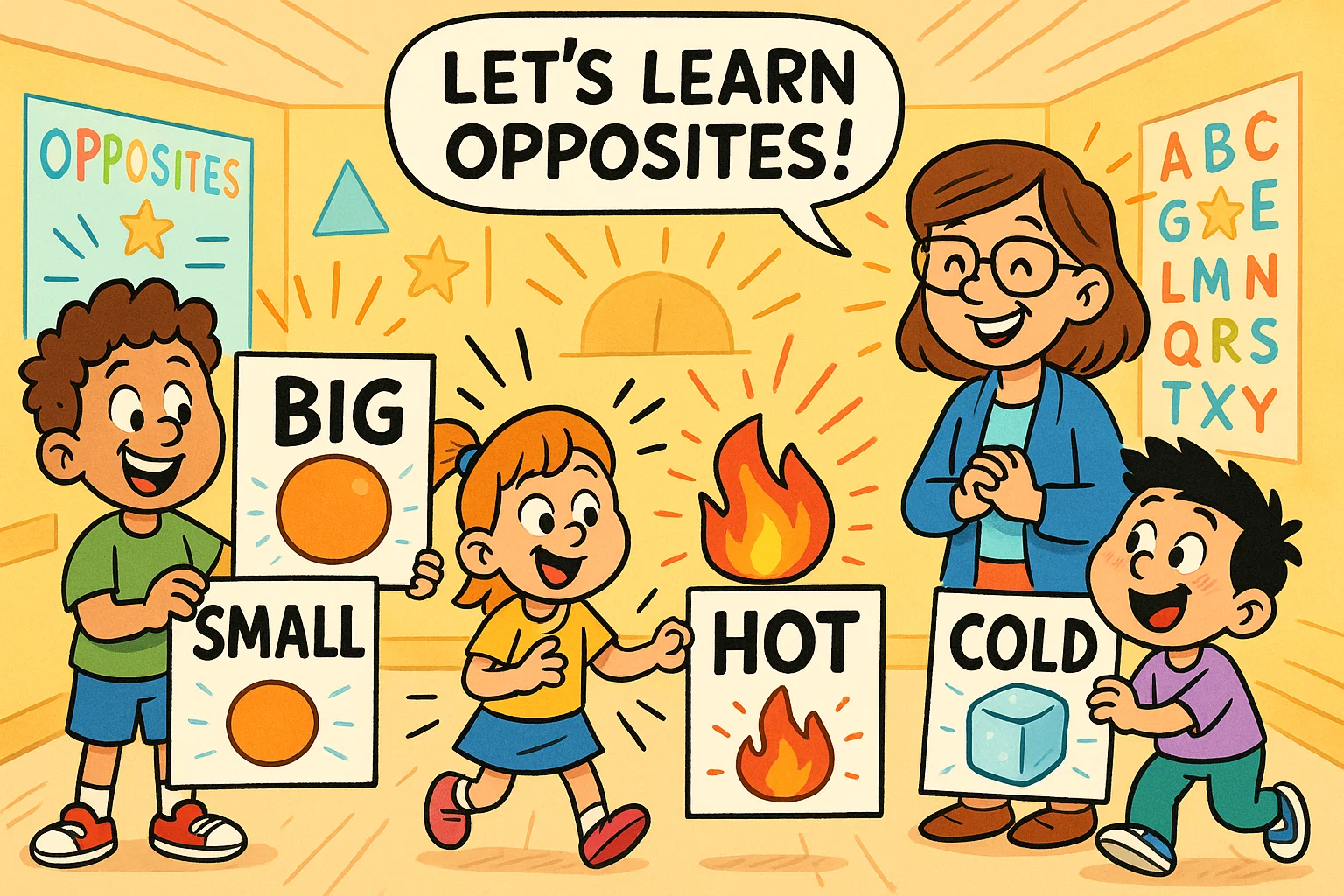
Simple opposite words for kids form the foundation of early language development and logical thinking. Learning basic antonym pairs such as big–small, hot–cold, and up–down helps children move beyond naming objects toward understanding relationships between concepts and the boundaries that define them. This shift strengthens vocabulary, improves clarity of expression, and supports structured communication.
Mastering simple contrasting pairs also accelerates cognitive growth. When children compare two clearly different ideas, the brain practices classification, differentiation, and contextual reasoning. This guide provides age-appropriate word lists, practical teaching strategies, and engaging activities designed to make early vocabulary learning clear, structured, and effective for both home and classroom environments.
What is the opposite?
An opposite, or antonym, is a word that has a completely different or contrasting meaning from another word. For example, hot and cold describe two different temperature conditions, while big and small refer to different sizes. This simple explanation helps children understand that language often works in pairs that show clear differences.
Opposite Words for Kids: Big List With Examples
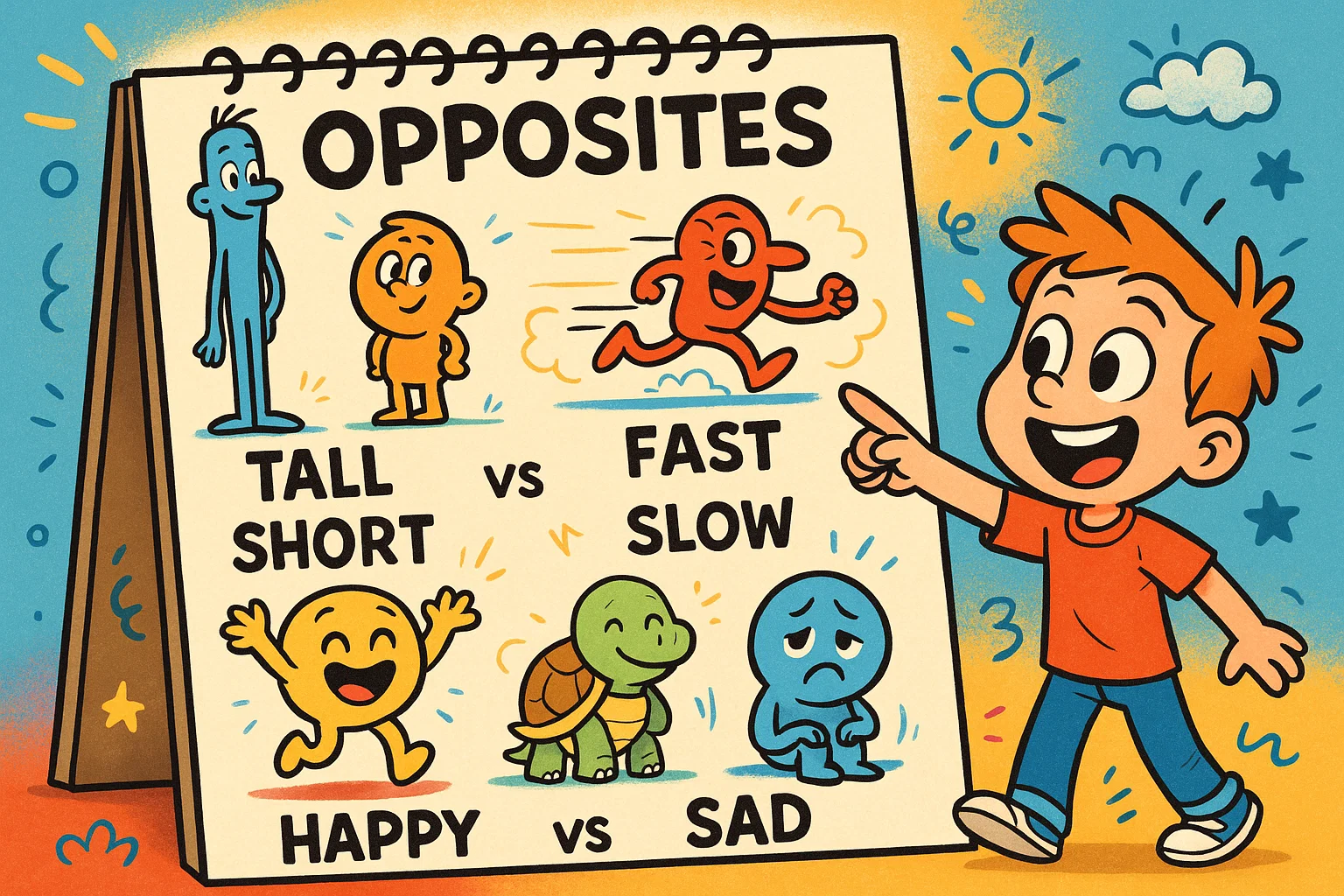
This section offers a large, easy-to-read set of pairs with contrasting meanings for kids, thoughtfully grouped by difficulty and category. Using these pairs will help children to learn about opposites in a structured and effective manner.
Basic Contrasting Pairs for Beginners
These are the foundational contrasting concepts that kids learn first, often around the age of 3, when they begin comparing and contrasting objects. Using real-world examples helps solidify these simple opposite words.
| Term | Contrasting Term | Example Application |
| Big | Small | The big dog and the small puppy. |
| Hot | Cold | A hot drink versus cold ice cream. |
| Fast | Slow | Running fast and walking slow. |
| Up | Down | Climbing up the slide and sliding down. |
| Open | Close | Open the door, then close it. |
| Happy | Sad | A happy face and a sad face. |
| In | Out | Putting toys in the box and taking them out. |
| Light | Dark | Turning the light on or making the room dark. |
Contrasting Pairs for Preschool and Kindergarten
For kindergarten kids (ages 4–6), we introduce slightly more abstract or complex terms. Teaching children these relationships at this stage builds foundational language skills for school.
- Long – Short
- Tall – Short (use tall for people and long for objects)
- New – Old
- Wet – Dry
- Clean – Dirty
- Thick – Thin
- Empty – Full
- Stop – Go
- Push – Pull
- Day – Night
- Love – Hate
- Soft – Hard
Tip for Adults: When introducing contrasting pairs, always pair them with a physical demonstration or a clear picture. For example, use a sponge for soft and a rock for hard.
Contrasting Pairs by Category: Actions, Feelings, Time, Size, Directions
Grouping words with contrasting meanings by category is a powerful strategy that parents and teachers can use to help your kids organize their knowledge of language.
| Category | Pair | Category | Pair |
| Actions | Stand – Sit | Sounds | Loud – Quiet |
| Actions | Give – Take | Feelings | Excited – Bored |
| Time | Before – After | Time | Early – Late |
| Size/Quantity | Many – Few | Size/Quantity | Heavy – Light |
| Directions | Inside – Outside | Directions | Left – Right |
Contrasting Pairs for Primary School Kids
For children in grades 1–3, these slightly more advanced words in English for kids expand their descriptive abilities and aid in more complex sentence construction. This helps kids describe things more precisely.
- Appear – Disappear
- True – False
- Simple – Difficult
- Shout – Whisper
- Near – Far
- Sink – Float
- Rough – Smooth
- Awake – Asleep
- Guest – Host
- Entrance – Exit
- Future – Past
- Accept – Refuse
This selection of opposite word pairs provides a strong foundation. You can expand the list by adding more categories depending on the child’s level.
Why Contrasting Concepts Matter for Kids
Understanding opposite words is much more than just memorizing a list of words. It’s crucial for cognitive and language development, laying the groundwork for stronger communication skills.
How Antonyms Build Vocabulary and Thinking Skills
When a child learns opposite words, they are acquiring two new concepts for the price of one. This dual learning greatly accelerates vocabulary expansion. More importantly, it fosters conceptual thinking. Antonyms force the brain to compare, classify, and understand boundaries.
- Conceptual Development: Grasping big and small helps children learn about measurement and scale. Near and far introduce spatial awareness.
- Classification: Learning antonym pairs helps kids understand that concepts exist on a spectrum (gradable pairs like hot and cold) or as two distinct states (complementary pairs like on and off).
- Abstract Reasoning: It provides a mental framework for analyzing the meanings of terms and opposite concepts.
How Contrasting Language Supports Daily Communication
A robust understanding of contrasting pairs means being able to help kids express themselves with greater nuance and clarity. If a child wants a cup of milk but says “My cup is big,” the parent may not understand the problem. If they say, “My cup is full! I need an empty one,” the communication is effective and precise.
- Clearer Descriptions: Knowing these pairs helps kids use descriptive words to paint a clearer picture of their wants, needs, and observations.
- Following Instructions: Children learn better how to follow two-step directions, such as “Stand up and then sit down.”
How Antonyms Help With Early Reading and Writing
The concept of opposites is a fundamental component of language development that transfers directly to literacy. In reading, understanding opposite words helps a child infer meaning from context, a key critical thinking skill.
- Context Clues: Seeing “The turtle was slow, not fast like the rabbit,” immediately makes the concept clearer through comparison.
- Sentence Structure: Children learn how to structure comparative and contrastive sentences, which is vital for effective writing.
Effective Ways to Teach Opposite Words

Teaching opposite words to kids doesn’t have to be tedious. The best way to teach is through a mix of visual, auditory, and kinesthetic methods that make learning fun and memorable.
Visual Techniques for Teaching Antonyms
Visual aids are extremely effective because they allow children to learn by connecting the new terms directly to a tangible or observable concept.
- Picture Cards and Flashcards: Create or purchase flashcards that illustrate each contrasting pair. For example, one card shows a picture of a wide road (wide) and its partner shows a narrow path (narrow).
- Object Comparisons: Use everyday objects. Hold up a full glass of water and an empty one. Compare a long jump rope with a short piece of string.
Movement-Based Contrasting Pairs for Active Learning
Children learn best when their bodies are involved. These activities make learning fun and help kids learn through action.
- Action Calls: Call out a term, and the child must perform the contrasting action. Example: You say “Stand,” the child must sit. You say “Jump,” they must stop.
- Fast and Slow: Have children walk slow when you whisper the term and run fast (safely in place) when you shout it. This connects volume (loud and quiet) with speed (fast and slow).
Storytelling Activities With Contrasting Themes
Storytelling helps place the opposite concepts within a meaningful context, aiding comprehension and retention.
- Narratives: Read a book or tell a story where the main plot revolves around contrasting terms. For instance, a tale about a happy little bear who becomes sad when he can’t find his favorite toy, but then becomes happy again when he finds it.
Tips for Parents to Reinforce Antonyms at Home
Consistent, low-pressure reinforcement is the key to helping kids understand and internalize these pairs of opposites.
- Use descriptive language: “Please put the big book on the small table.”
- Ask comparative questions on opposite words: “Is the bathwater hot or cold?”
- Label daily tasks: “Turn on the light, then turn it off.”
Fun Activities to Learn Opposites at Home or in Class
These hands-on fun activities like opposite games make learning opposites fun and memorable, turning practice into enjoyable playtime.
Contrasting Concept Hunt Game
This fun activity is a scavenger hunt style game where the child must find a real-world object that is the contrasting idea of one you name.
- Preparation: Create a list of opposite words you want to practice.
- Play: Say, “Go find something soft.” The child finds a blanket. Then, say, “Now, find the contrast to soft.” The child finds a toy block (hard).
Picture Match Challenge
Use visual association to strengthen memory.
- Preparation: Gather pairs of pictures or flashcards showing contrasting pairs (e.g., a clean shirt and a dirty shirt).
- Play: Lay all the cards face up. The child picks one picture (e.g., day) and must find the matching antonym (night).
Action Concept Game
This is an excellent activity for kindergarten kids to expend energy while learning new words.
- Instructions: The parent or teacher calls out a term (e.g., “Whisper!”). The child acts it out.
- Challenge: The child then must act out the antonym action without being prompted. If the adult says “Whisper,” the child must whisper, and then immediately shout (or talk loud).
Create Contrasting Concept Stories
Encourage creativity and applied understanding of language.
- Have the child draw a picture, then describe it to you, ensuring they are using opposite words to describe the elements (e.g., “The cat is above the mat, but the ball is below it.”).
- For older kids to learn, ask them to write a very short story (3-5 sentences) that must include at least three contrasting pairs.
Opposite Word Practice Exercises for Kids
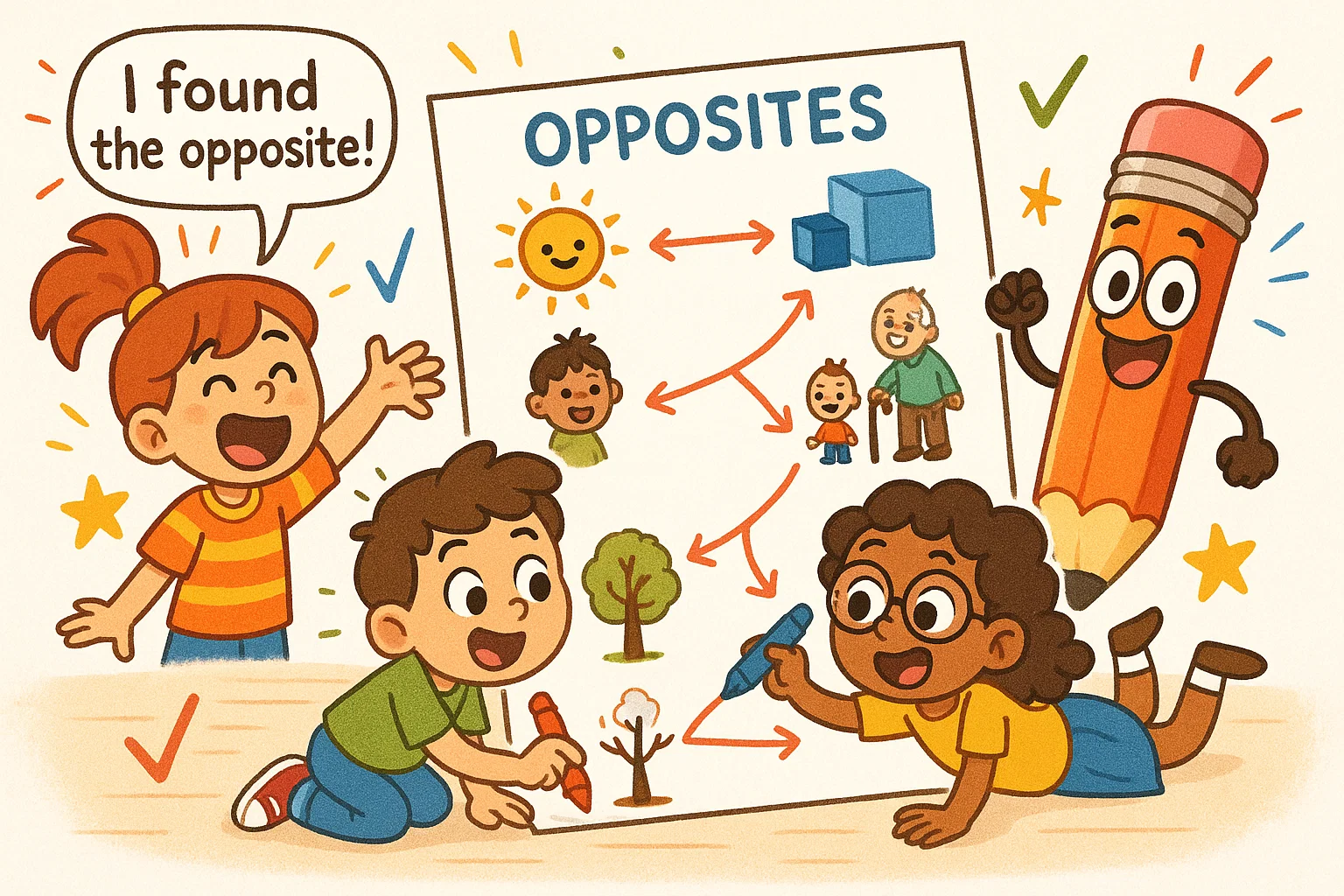
Structured practice, like worksheet exercises, helps consolidate the knowledge gained through play and visual learning.
Fill-in-the-Blank Exercises With Antonyms
This exercise helps reinforce context and term relationships.
- The sun is up, and the moon is ____. (Answer: down)
- The road was wide, but the alley was ____. (Answer: narrow)
- She said yes, but I said ____. (Answer: no)
Select-the-Antonym Tasks
Ideal for early graders, this multiple-choice format checks comprehension.
Question: What is the term with contrasting meaning for AWAKE?
A) Sleepy
B) Tired
C) Asleep
D) Dream
Opposite Word Quiz for Kids
A short quiz format, either verbal or written, is a great way to check understanding and build confidence in their language development.
| Concept | Quiz Question | Answer |
| Give | What is the antonym of give? | Take |
| Strong | What is the term for the opposite of strong? | Weak |
| Buy | What is the term for the opposite of buy? | Sell |
Facts About Opposite Words for Kids
Sharing interesting facts can deepen a child’s understanding of language and the structure of pairs of opposites.
Types of Contrasting Pairs Kids Should Know
Not all pairs are created equal. Knowing the difference aids critical thinking skills.
- Complementary: These are all-or-nothing pairs. If it’s not one, it must be the other. Example: True or False, Dead or Alive, On or Off.
- Gradable: These exist on a spectrum. Something can be very hot, a little hot, or a little cold, very cold. Example: Hot and cold, Big and Small, Happy and Sad.
- Relational: These define a relationship where one term cannot exist without the other. Example: Teacher and Student, Give and Receive, Host and Guest.
How Kids Naturally Learn Contrasting Concepts Through Everyday Life
Intuitive language learning happens all the time. Kids see and experience opposites naturally in their daily routines.
- They feel the difference between a clean shirt and a dirty one after playing.
- They learn day and night through sleeping and waking cycles.
- They experience full when they finish a meal and empty when the plate is empty. These moments provide organic, meaningful context.
Why Antonyms Support Critical Thinking
Learning terms with contrasting meanings helps kids establish a framework for comparison and analysis. It allows them to:
- Compare and Contrast: Understand how things are different. “This apple is red, and this one is green.”
- Classify: Group terms into related categories, such as “things that are fast” and “things that are slow.”
- Analyze: Understand nuances in communication, such as sarcasm or exaggeration, by recognizing when something is described as the opposite of what it truly is.
Kids See Fun
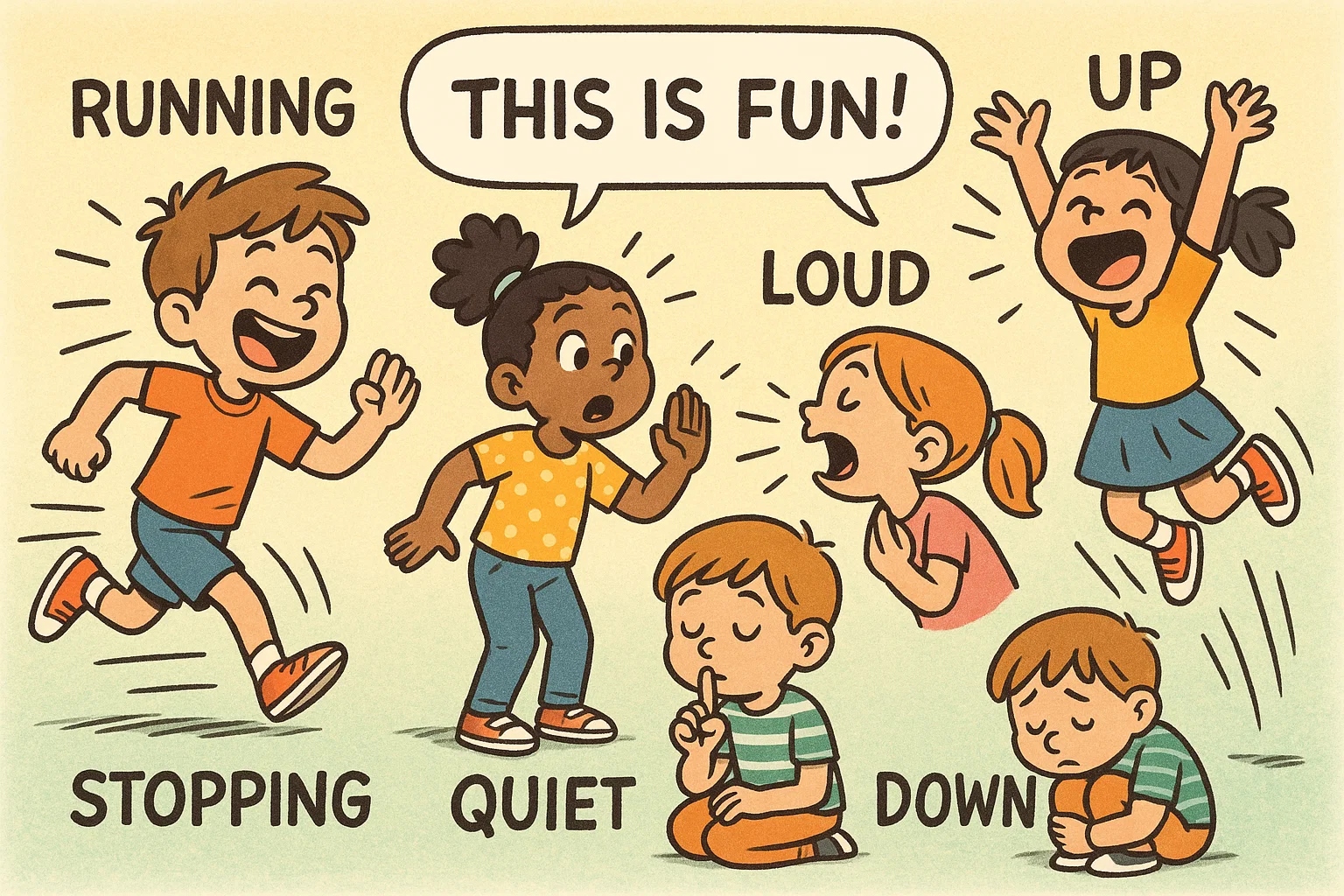
Making learning fun is not just a pleasant extra; it’s a proven method for better retention and engagement. When kids learn through play, they are highly motivated.
How Learning Through Play Boosts Language Skills
Play reduces the stress associated with formal instruction, allowing the brain to be more receptive to learning new words. When a child laughs while playing a fun opposite game, the positive emotion attaches to the opposite concepts, making them more memorable.
Simple Games That Make Pairs Memorable
- “Simon Says” Antonyms: Play “Simon Says” but require the child to do the opposite of what Simon says. If Simon says, “Touch your head,” they touch their feet.
- Contrasting Drawing: Ask the child to draw an object, and then draw its antonym. For example, a loud fire engine and a quiet mouse.
You See Real Learning Outcomes
For parents and teachers, the effort spent on teaching opposite words yields tangible and significant benefits across all early academic and communication domains.
How Contrasting Pairs Strengthen Early Academic Skills
Mastery of these contrasting concepts is a strong indicator of readiness for higher-level language development. It strengthens:
- Reading Comprehension: Better understanding of descriptive text and plot contrasts.
- Math Concepts: Concepts like add/subtract, more/less, and before/after are fundamental math terms.
- Writing: The ability to use varied and vivid descriptive words.
How Antonyms Improve Daily Communication
When a child can express that they are excited rather than just happy or that the toy is broken (not just bad), their interactions become richer and less frustrating. This improves their understanding of language and their social confidence.
Turn Play Into Progress
You don’t need dedicated lesson time every day to teach opposites. The real magic happens when you integrate these contrasting pairs into your regular routine.
How to Turn Everyday Moments Into Lessons
- Meal Time: “Big spoon, small cup.” “The bowl was full, and now it’s empty.”
- Bath Time: “The water is hot, let’s add some cold water.” The toy will float, but the bar of soap will sink.”
- Getting Dressed: “Put on your coat, then take off your shoes.”
Benefits of Short Daily Practice Sessions
Consistency is far more effective than long, infrequent sessions. Five minutes a day of playing an easy opposite words game or simply using opposite words naturally in conversation will lead to rapid progress. This consistent, low-stakes exposure helps children learn without feeling pressured.
Jumpstart Learning Now
Learning opposite words and their antonym pairs is a crucial investment in your child’s future communication and cognitive abilities. Start today!
Quick Start Tips for Parents and Teachers
- Start Simple: Focus on the simple opposite words like up and down, in and out.
- Be Physical: Use your body and movement (stand/sit, fast/slow) to teach the concepts.
- Read Opposite Books: Find children’s books specifically focused on opposite concepts.
- Stay Positive: Keep the practice light and make learning english fun to ensure a lifelong love of learning new words.
FAQs
What are opposite concepts and how are they different from opposite words?
Opposite concepts refer to broader ideas that exist in contrast, such as light and darkness or past and future. Opposite words are the specific vocabulary terms that represent those contrasting ideas. Understanding opposite concepts supports deeper comprehension because children begin to see patterns in how ideas relate, not just memorize vocabulary pairs.
Can you give examples of opposite pairs for kindergarten and early grades?
For preschool and kindergarten, basic opposite word pairs include up–down, in–out, happy–sad, and fast–slow. In early elementary grades, children progress to pairs such as true–false, near–far, and accept–refuse. These examples of opposites for kids reflect increasing language complexity and support gradual skill development.
What are the learning objectives and outcomes of learning opposite words?
The primary learning objectives include vocabulary expansion, improved sentence construction, and stronger classification skills. Expected learning outcomes of opposite words instruction involve clearer communication, better reading comprehension through context clues, and improved ability to compare and contrast ideas across subjects such as math and literacy.
How can simple opposite words for kids be illustrated effectively?
Visual representation strengthens comprehension. For example, to show that “hot” is an antonym of “cold,” an illustration might display a steaming cup beside a snowman or a warm sun next to falling snow. Clear imagery allows preschool opposite words to become concrete, supporting memory and faster recall during learning opposite words activities.
How to teach antonyms to kids effectively?
The most effective way is to use a multi-sensory approach: visual tools (flashcards), movement (acting out opposite pairs), and contextual learning (stories). Consistency and making the learning fun are key for deep understanding.
Are visual tools helpful for teaching antonyms?
Yes, visual tools like picture cards and flashcards are extremely helpful for teaching children antonyms. They create a direct link between the new words and the opposite concepts they represent, aiding in memory and comprehension, especially for younger learners.
Take a short quiz to find out what your everyday choices say about your parenting style
When your child is curious about something new, what’s your instinct?
Take a short quiz to find out what your everyday choices say about your parenting style
“Can I download this app?” What happens next?
Take a short quiz to find out what your everyday choices say about your parenting style
When it comes to rules at home, which sounds most like you?
Take a short quiz to find out what your everyday choices say about your parenting style
If you could give your child one life skill today, what would you pick?
Take a short quiz to find out what your everyday choices say about your parenting style
Your child gets to choose what to watch. What would your ideal setup look like?
Take a short quiz to find out what your everyday choices say about your parenting style
Pick your parenting superpower ✨