
Easy Riddles for Kindergarten With Answers

 Discover a Free Education Video App for Kids
Pastory uses AI to personalize educational video content based on your child’s interests and personality. Safe, engaging, and built for curious young minds. Sign up now to stay updated and enjoy early access with a free trial
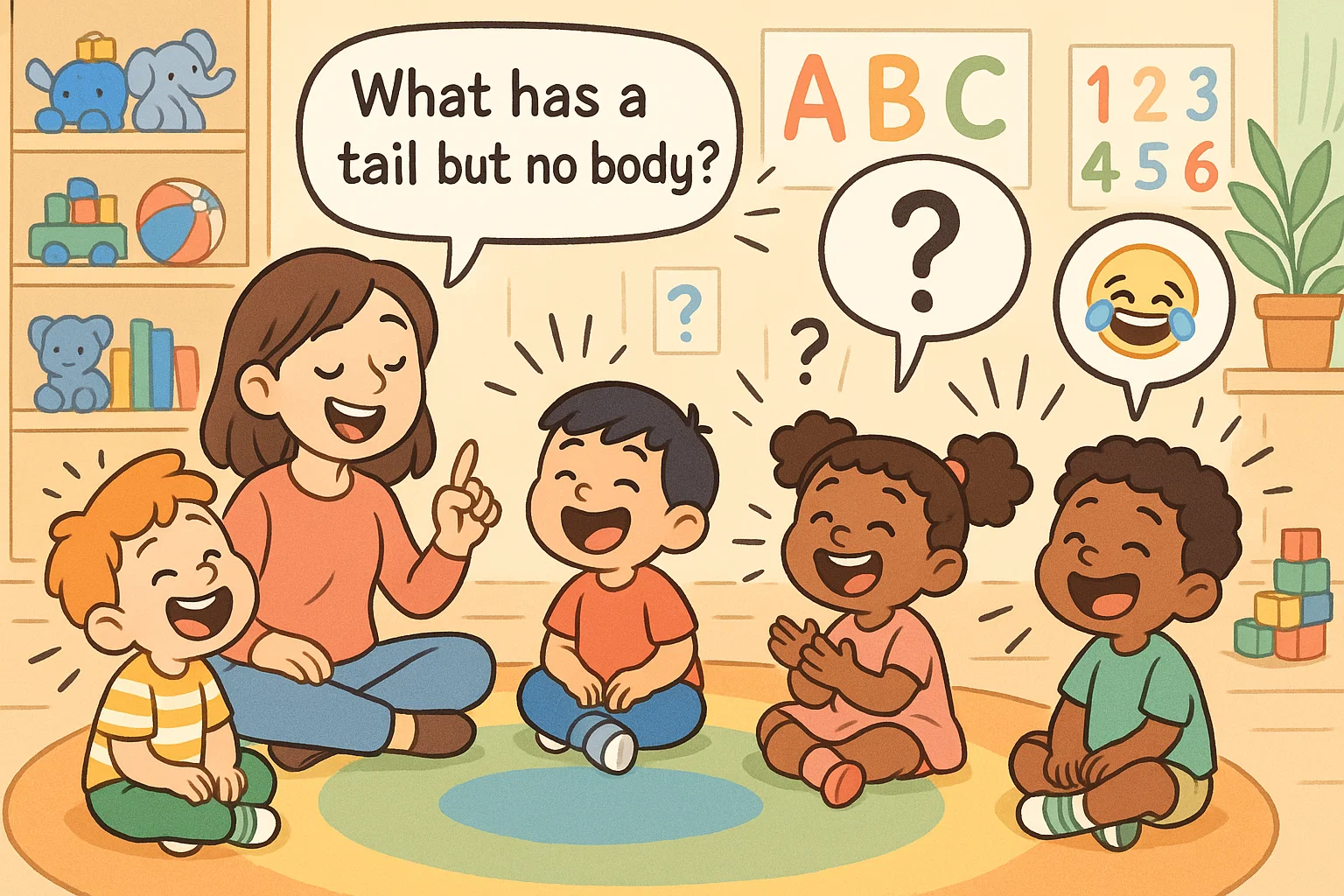
Parents, teachers, and caregivers often look for simple, low-prep ways to keep young children engaged during transitions. A simple riddle can turn a routine pause into a fun, age-appropriate learning moment. These interactive brain teasers use short clues, familiar vocabulary, and clear answers that fit early childhood development.
This collection of riddles with answers is designed for preschool and kindergarten children who are learning to connect clues with familiar words and real-world objects. They can be used during preschool morning meetings, classroom brain breaks, long car rides, or family game nights to support early language and thinking skills.
Key Takeaways
- Targeted Age Group: Designed for children ages 4 to 6, from preschool through kindergarten.
- Core Skill Development: Supports critical thinking, phonological awareness, active listening, and vocabulary growth.
- Best Uses: Ideal for circle time, car rides, family games, quick transitions, and other simple activities for children.
- Format Structure: Short clues featuring concrete objects, animal traits, and mostly simple answers.
- Flexible Difficulty: Includes easy, silly, clever, and slightly more challenging riddles that keep children engaged without causing frustration.
- Printable-Friendly Format: Easy to adapt into a printable guide for teachers and parents.
Best Use Cases
Kindergarten classrooms can benefit from adding a daily riddle to morning meetings because it encourages participation and shared thinking. A teacher can introduce riddles during transitions to capture attention, reduce restlessness, and redirect energy between core subjects.
| Step | How to Use Riddles During Transitions |
| 1 | Start with a home or classroom transition. |
| 2 | Introduce 1–2 simple riddles. |
| 3 | Ask children to listen, compare clues, and guess. |
| 4 | Give immediate affirmation and check key vocabulary. |
Homeschooling parents can use these riddles as quick warm-up activities before lessons begin. Families looking for low-prep car games can use these verbal puzzles to keep children entertained and reduce screen time.
Riddles also work well during snack time, cleanup, waiting periods, and quiet group moments. Because they require no special materials, they are an easy way to help children listen closely, make guesses, and practice language in a relaxed setting.
Main Categories
The collection includes a variety of categories tailored to young children’s interests and developmental needs. These categories include easy riddles, funny riddles, animal riddles, food riddles, school riddles, rhyming riddles, nature riddles, science riddles, math riddles, holiday riddles, and gentle brain teasers.
| Category | Primary Focus Area | Developmental Benefit |
| Easy / Simple | Everyday household objects | Builds immediate confidence and familiarity |
| Funny / Silly | Humorous concepts and wordplay | Encourages social bonding and a positive view of learning |
| Animal Clues | Pet, farm, and wild animal traits | Builds animal vocabulary and sorting skills |
| Food & Snacks | Fruits, vegetables, and lunchbox items | Reinforces sensory attributes such as color, taste, and texture |
| School & Classroom | Learning tools and school routines | Helps children feel familiar with classroom routines and objects |
| “What Am I?” | First-person descriptive clues | Promotes perspective-taking and abstract reasoning |
| Rhyming Puzzles | Word families and sound patterns | Strengthens early literacy and phonics awareness |
| Nature & Weather | Earth science and seasonal elements | Encourages observation of the natural world |
| Science | Basic properties and cause-and-effect clues | Introduces observation and simple scientific thinking |
| Math & Shapes | Counting, geometry, and size vocabulary | Builds early counting, shape, and size vocabulary |
| Tricky / Clever | Simple twists and unexpected solutions | Supports flexible thinking |
| Holiday | Seasonal objects and traditions | Builds vocabulary around familiar celebrations |
Skill Benefits
Using riddles regularly helps children build active listening skills because they need to remember several clues before guessing. The process also helps children practice taking turns, listening to others, and speaking in front of a group.
This approach aligns with the idea of developmentally appropriate, play-based learning, especially when riddles are used as joyful language play. Solving simple riddles helps children compare clues, make guesses, and build confidence over time.
Riddles can also help children compare details, eliminate unlikely options, and explain their thinking. For many teachers and parents, the best riddles for kids are not necessarily the hardest ones; they are the ones that stimulate children’s minds while still feeling playful, achievable, and age-appropriate.
How Guessing Questions Work for Kindergarten Kids
Simple Definition
A riddle is a playful guessing game presented as a question or a short series of clues about a specific person, animal, or object. The goal is to use the clues to guess the correct answer. For a kindergartener, a riddle is a fun guessing game that builds vocabulary and thinking skills.
Example for Beginners
A good beginner riddle gives direct, concrete clues about an object the child already knows. Here is a simple example:
- I am round. You can bounce me, throw me, and catch me. What am I? (A ball)
This example shows how simple clues help children connect spoken words with real objects.
Why Simple Clues Matter
Young children process information best when clues are concrete, familiar, and based on tangible traits rather than abstract concepts. Because young children have limited working memory, short sentences and clear hints make riddles easier to follow.
Providing clear answers quickly helps children stay motivated and avoid frustration. When a riddle uses familiar topics, children can compare clues, rule out wrong answers, and find the solution on their own.
Easy Riddles for Kindergarten Kids
Easy Questions With Short Answers
- I shine bright in the daytime sky and warm up the earth. What am I? (The sun)
- I have four legs, a wagging tail, and I say “woof.” What am I? (A dog)
- I have soft fur, whiskered cheeks, and I say “meow.” What am I? (A cat)
- I am a crunchy fruit that can be bright red, green, or yellow. What am I? (An apple)
- You put me on your foot before you tie your laces and walk outside. What am I? (A shoe)
- I have pages filled with words and pictures, and you can read me at story time. What am I? (A book)
- I have four legs and a flat back, and you sit on me at the table. What am I? (A chair)
- You sleep on me every single night with your favorite pillow and blanket. What am I? (A bed)
Easy Questions With One-Word Answers
- I fall from gray clouds in the sky and make the grass wet. What am I? (Rain)
- I am white, cold, and soft, and you use me to build a snowman. What am I? (Snow)
- You open me to let fresh air inside, or you look through my glass pane. What am I? (A window)
- I hold your water or milk, and you lift me up to take a drink. What am I? (A cup)
- I have bristles and a handle, and you use me to brush your teeth. What am I? (A toothbrush)
- I fly high up in the windy sky on a long string. What am I? (A kite)
- I tick and tock all day long to show you the current time. What am I? (A clock)
Tricky Riddles for Kids
Funny riddles work well when adults want to keep the mood light, playful, and social. These riddles are simple enough for young children but still include a small surprise that makes the answer memorable.
Giggle-Friendly Riddles
- What soaks up more water the more it dries your hands? (A towel)
- What has a long neck but no head? (A bottle)
- What kind of room has no walls, doors, or windows? (A mushroom)
- What has a face and two moving hands but cannot smile or wave at you? (A clock)
- What gets bigger and bigger when more rain falls? (A puddle)
Funny Animal Riddles
- What animal wears a warm, fluffy wool coat that it can never take off? (A sheep)
- Why did the turtle cross the playground? (To get to the other slide.)
- What kind of cat loves to swim around in the ocean depths? (A catfish)
- What animal sits on a lily pad and says “ribbit, ribbit” all day long? (A frog)
- What farm animal loves to roll around in messy mud to stay cool? (A pig)
Funny Classroom Riddles
- What has a spine but no bones? (A storybook)
- Why did the pencil get sent to the principal’s office? (Because it was too sharp.)
- What has a tongue but can never speak? (A shoe)
- I hold your crayons, pencils, and folders, and I ride on your back every morning. What am I? (A backpack)
- I start out tall and brand new, but the more you draw with me, the shorter I get. What am I? (A crayon)
Animal Riddles for Kindergarten Kids
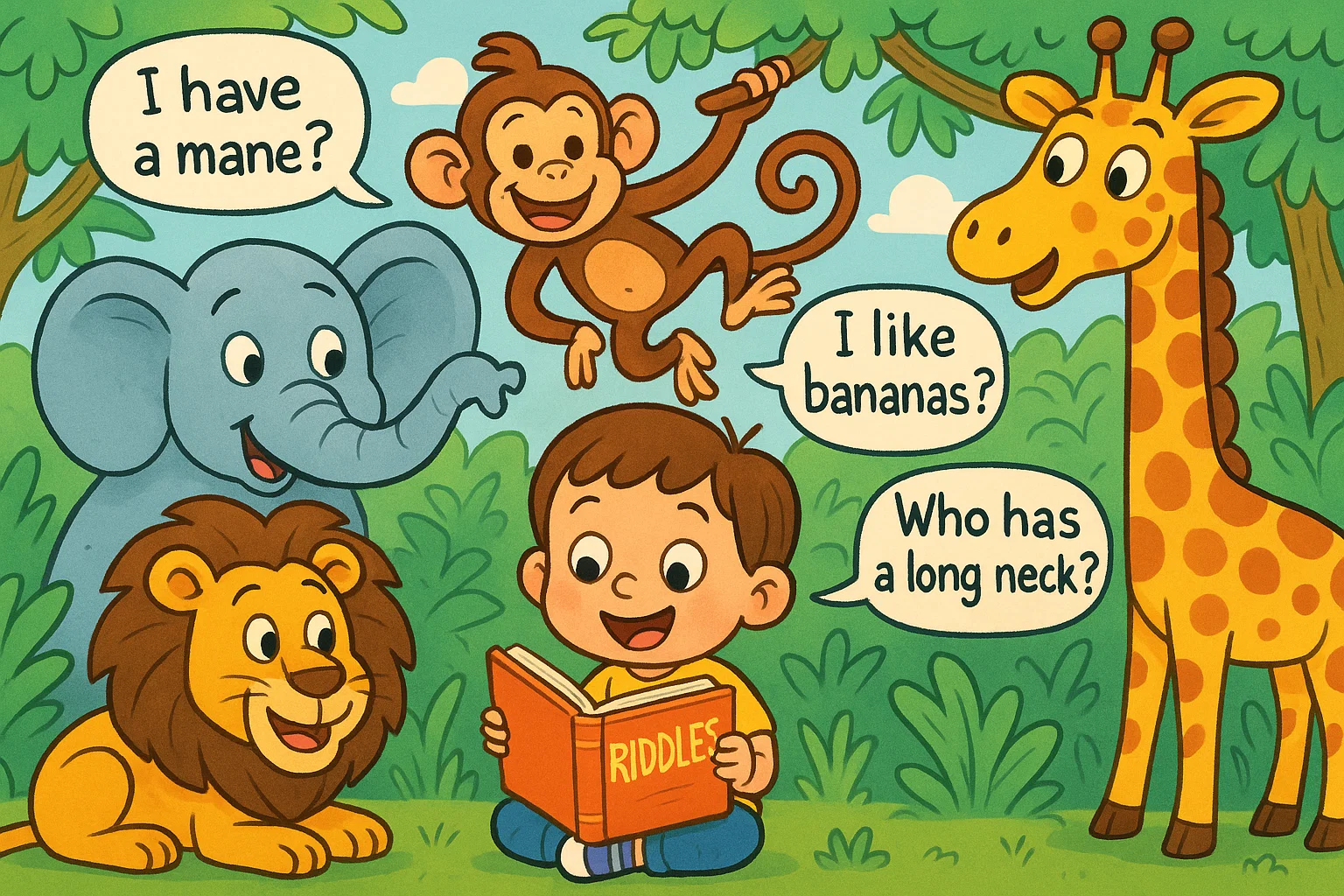
Animal riddles are especially effective for young learners because they rely on familiar sounds, movements, habitats, and physical traits.
Farm Animal Riddles
- I live in a big red barn, eat sweet green grass, and give you white milk. What am I? (A cow)
- I have feathers, two wings, and I wake up the whole farm with a “cock-a-doodle-doo!” What am I? (A rooster)
- I am a bird that loves to swim in the pond and say “quack, quack.” What am I? (A duck)
- I have a long mane, a flowing tail, and you can ride on my back while I gallop. What am I? (A horse)
Pet Riddles
- I live inside a glass bowl, have shiny orange scales, and swim around all day. What am I? (A goldfish)
- I have long floppy ears, a tiny twitching nose, and I hop around the yard eating carrots. What am I? (A rabbit)
- I am a tiny pet with fluffy cheeks that loves to run on a squeaky exercise wheel at night. What am I? (A hamster)
- I have bright feathers and can copy the words you say. What am I? (A parrot)
Wild Animal Riddles
- I have a big furry mane, strong paws, and a loud roar. What am I? (A lion)
- I am a very tall animal with a long neck that lets me eat leaves from the tops of trees. What am I? (A giraffe)
- I am a large gray animal with big floppy ears and a long, useful trunk. What am I? (An elephant)
- I live in the trees, have a long swinging tail, and love to peel and eat yellow bananas. What am I? (A monkey)
Food Riddles for Kindergarten Kids
Food riddles are a natural fit for early learning because children can connect clues to color, taste, texture, size, and familiar mealtime routines.
Fruit Riddles
- You have to peel my bright yellow skin off before you can take a sweet bite. What am I? (A banana)
- I am a round citrus fruit, and my name is exactly the same as my bright color. What am I? (An orange)
- We are small, round, and juicy fruits that grow together in big bunches on vines. What are we? (Grapes)
- I am a sweet red fruit shaped like a little heart, with tiny seeds covering my skin. What am I? (A strawberry)
Snack Riddles
- I am cold, sweet, and served on a crunchy cone on warm summer afternoons. What am I? (Ice cream)
- I am baked in an oven, shaped like a circle, and filled with delicious chocolate chips. What am I? (A cookie)
- I am made from two slices of bread with peanut butter and jelly inside. What am I? (A sandwich)
- I am a crunchy, salty snack shaped like a little twist or a thin stick. What am I? (A pretzel)
Colorful Food Riddles
Children often recognize foods by color, shape, taste, and texture.
| Step | How Children Match Food Clues |
| 1 | Notice color or another visual trait. |
| 2 | Identify shape, taste, and texture clues. |
| 3 | Match the clues to a familiar food. |
- I am bright yellow, oval, sour, and often squeezed into cold water. What am I? (A lemon)
- I am round, green on the outside, bright red on the inside, and filled with black seeds. What am I? (A watermelon)
- I am a bright orange root vegetable that grows underground and has nutrients that help your eyes. What am I? (A carrot)
School Riddles for Kindergarten
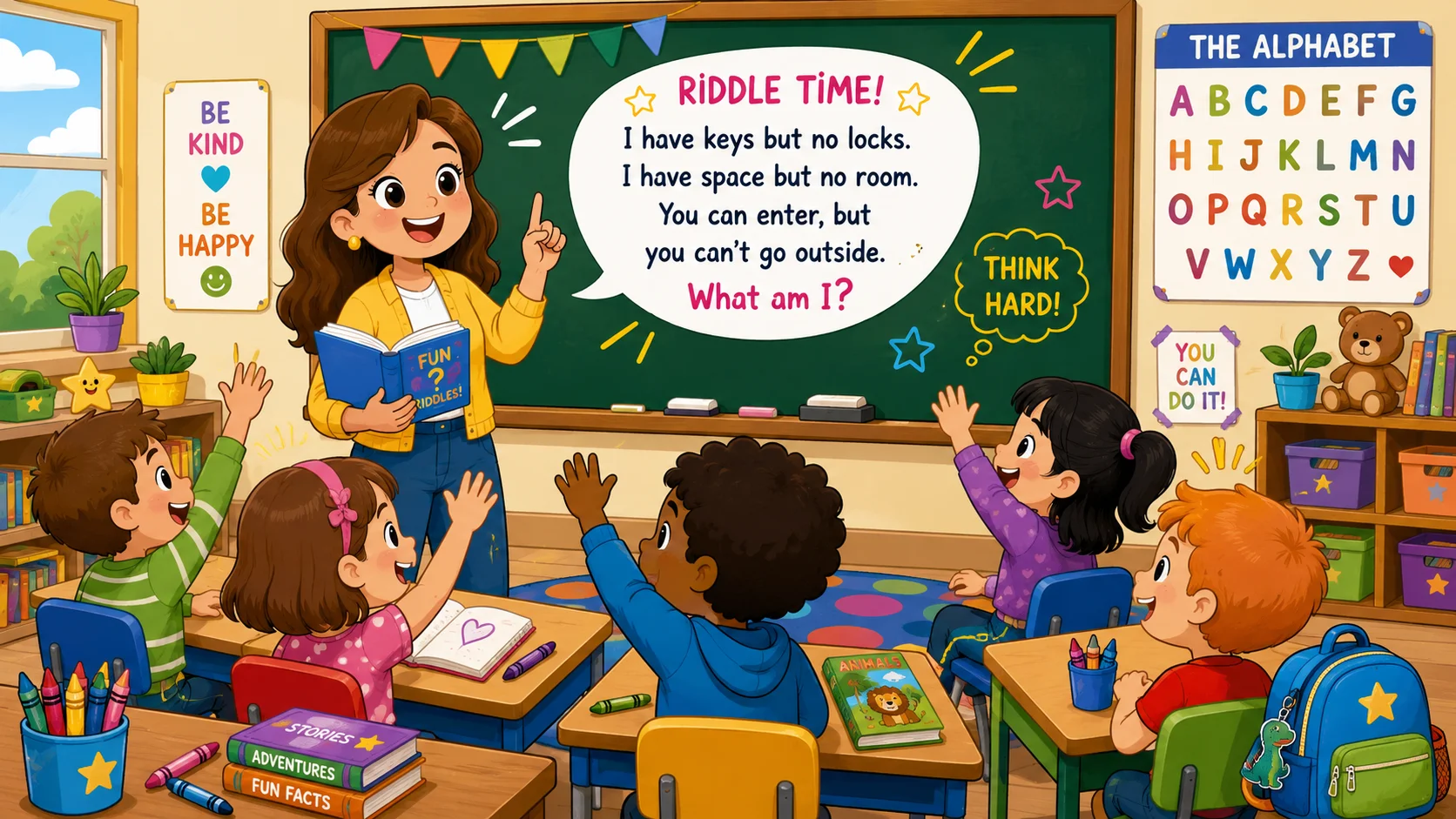
Classroom riddles help children connect language play with the objects and routines they experience every day at school.
Classroom Object Riddles
- I have two metal blades and handles, and you use me to cut paper. What am I? (Scissors)
- I come in a bottle or a stick, and I help you attach papers together. What am I? (Glue)
- I sit on top of your pencil and help wipe away mistakes. What am I? (An eraser)
- I am a large board on the classroom wall where the teacher writes daily lessons. What am I? (A whiteboard)
Morning Meeting Riddles
Using an interactive riddle game during morning check-ins can help children focus and get ready for the next activity. Teachers can share one riddle before the next lesson or group activity begins.
- I have seven days in my week, and you look at my grid to see today’s date. What am I? (A calendar)
- I make a loud ringing sound to tell you it is time for school. What am I? (A bell)
- We are two parts of your body that help you listen closely to instructions. What are we? (Your ears)
Back to School Riddles
- I am a big yellow vehicle with flashing lights that carries children to school every morning. What am I? (A school bus)
- I am the helpful person who greets you at the classroom door and teaches you to read. What am I? (Your teacher)
- I am a room filled with toys, building blocks, books, and learning centers. What am I? (The kindergarten classroom)
What Am I Riddles for Kindergarten
“What am I?” riddles are especially useful for young children because they use a simple first-person format and familiar clues.
Easy What Am I Riddles
- I look like a giant white cotton ball floating high up in the blue sky. What am I? (A cloud)
- I have a metal handle and bright fabric that opens up to shield you from raindrops. What am I? (An umbrella)
- I am a warm, cozy piece of clothing with sleeves that you wear outside when it gets cold. What am I? (A jacket)
Animal What Am I Riddles
- I have no legs at all, a long scaly body, and I make a “hiss” sound in the grass. What am I? (A snake)
- I have two wings, soft feathers, and I build a round nest on a tree branch. What am I? (A bird)
- I have eight long legs, spin a silky web, and crawl up the classroom wall. What am I? (A spider)
Object What Am I Riddles
- I am a little switch that turns the lights on or off when you flip me. What am I? (A light switch)
Rhyming Riddles for Kindergarten
Rhyming puzzles combine language play with sound clues and help children notice words that end with similar sounds.
Simple Rhyming Riddles
- I rhyme with hat. I sit on a rug and might chase a mouse. What am I? (A cat)
- I rhyme with toy. I am a child who might play with a truck on the rug. What am I? (A boy)
- I rhyme with red. You lie down on my soft mattress when it is time to go to sleep. What am I? (A bed)
Fill-in-Rhyme Riddles
- Look up high to see me glow, warming everything below. I rhyme with run, I am the… (Sun)
- I bark out loud when guests arrive, and chasing sticks keeps me happy. I rhyme with log, I am a… (Dog)
- I hold your stories on the shelf. Open me up and read it yourself. I rhyme with look, I am a… (Book)
Sound Pattern Practice
Rhyming riddles support phonological awareness by encouraging children to notice beginning sounds, ending sounds, and common word families. Rhyming activities can support early literacy skills connected to later reading development.
By focusing on word endings, children begin to connect spoken sounds with early reading skills.
Nature Riddles for Kindergarten Kids
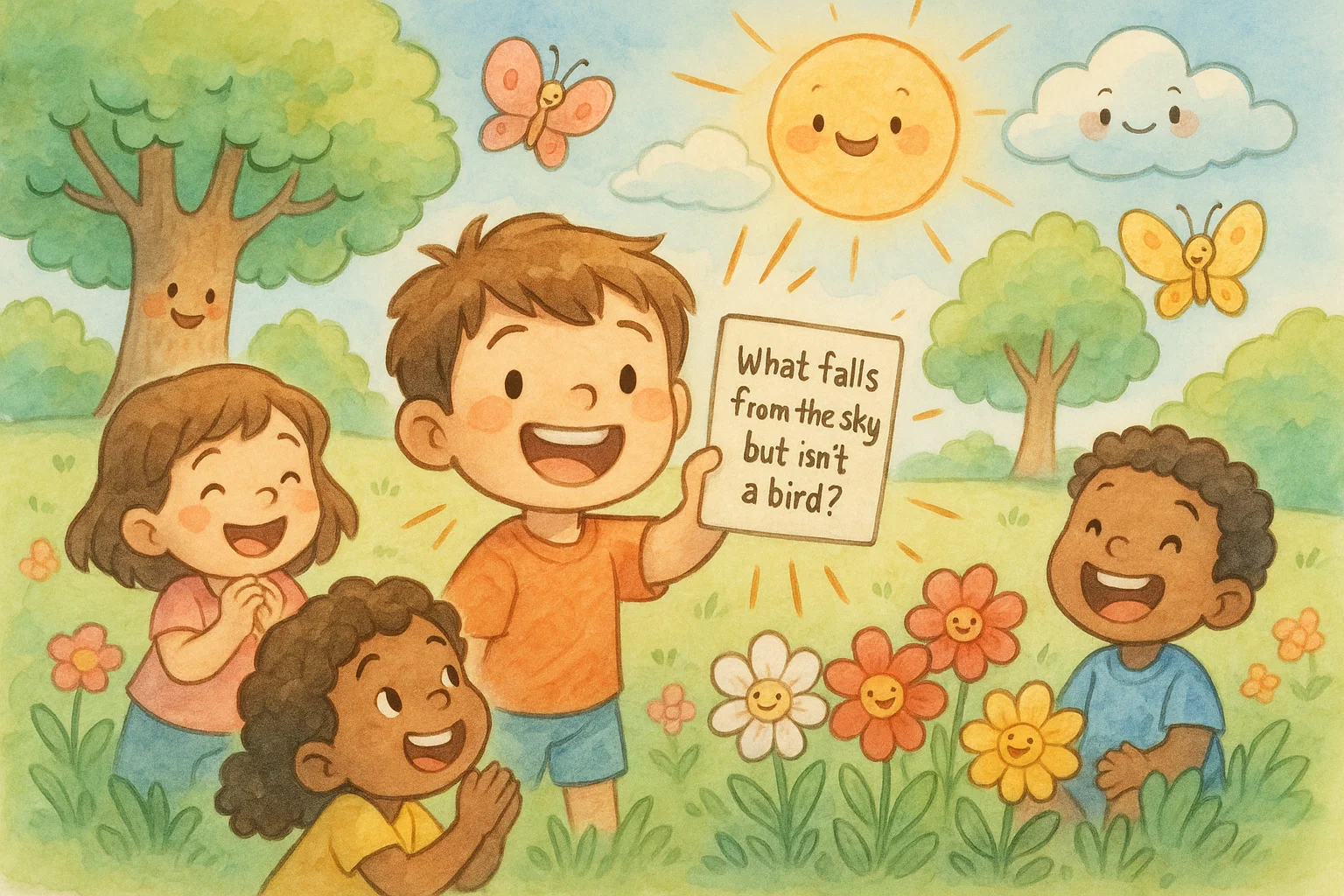
Nature-themed questions help children observe weather, plants, animals, and outdoor spaces more closely.
Weather Riddles
- I look like a giant colorful arch stretching across the blue sky after a rainstorm. What am I? (A rainbow)
- I am invisible, but you can feel me on your cheeks and hear me rustle the leaves. What am I? (The wind)
- I am a loud, booming noise that echoes through the sky during a heavy rainstorm. What am I? (Thunder)
Plant Riddles
- I start as a tiny seed in the dirt, grow a tall trunk, and sprout green leaves. What am I? (A tree)
- I am a bright, beautiful plant that grows in the garden and has soft, colorful petals. What am I? (A flower)
- I form a thick, soft green carpet across the ground for you to run and play on. What am I? (Grass)
Outdoor Riddles
- I am a small, hard piece of stone that you can hold in your hand. What am I? (A rock)
- I am a small pool of rainwater on the ground that you love to jump into with your boots. What am I? (A puddle)
- I have a long slide, tall swings, and a big sandbox where you play with your friends. What am I? (The playground)
Science Riddles for Kindergarten Kids
Simple science riddles introduce children to observation, cause and effect, and basic properties of the world around them.
Simple Science Riddles
- If you place me in water, I stay on top instead of sinking. What do I do? (Float)
- I can pull some metal objects, like paperclips, toward me. What am I? (A magnet)
- I disappear into a glass of warm water when you stir me with a spoon, and I make it taste sweet. What am I? (Sugar)
Planet Riddles
- I am the big blue and green planet where people, animals, and plants live. What am I? (Earth)
- We look like tiny, twinkling points of light in the dark night sky. What are we? (Stars)
- I seem to change shape throughout the month and glow softly outside your window at night. What am I? (The moon)
Body Riddles
- We sit below your eyebrows, and you blink us to see the world. What are we? (Your eyes)
- I sit right in the middle of your face, and you use me to smell flowers or fresh cookies. What am I? (Your nose)
- We are inside your mouth, and you use us to chew crunchy apples. What are we? (Your teeth)
Math Riddles for Kindergarten Kids
Math puzzles introduce early counting, size comparison, spatial language, and shape vocabulary in a playful way.
Counting Riddles
- I am the number of fingers you have on both hands. What number am I? (Ten)
- If you have two shiny red apples and your teacher gives you one more, how many do you have? (Three)
- I am the number that comes right after four when you are counting out loud to ten. What number am I? (Five)
Shape Riddles
- I am completely round like a fresh donut or a bicycle wheel, with no corners at all. What shape am I? (A circle)
- I have four straight sides that are all exactly the same length, like a toy building block. What shape am I? (A square)
- I look like the roof of a little house, and I have three straight sides. What shape am I? (A triangle)
Size Riddles
- I am enormous like an elephant, while an ant is the opposite of me. What word describes me? (Big)
- A flagpole stretches high into the sky, while a blade of grass stays low. What word describes the flagpole? (Tall)
Tricky Riddles for Kindergarten Kids
Tricky riddles should remain gentle at this age. The goal is not to frustrate children, but to invite them to pause, compare clues, and consider a less obvious solution.
Gentle Brain Teasers
- What has to be completely broken open before you can cook it or eat it for breakfast? (An egg)
- What kind of coat is put on with a brush and comes from a paint can? (A coat of paint)
- What has a long neck but never wears a winter scarf to keep warm? (A guitar)
Clever Riddles With Clear Answers
- What is full of tiny holes and can hold water, but is dry when empty? (A sponge)
- What goes up over your head when rain starts to fall? (An umbrella)
- What has an anchor and sails but never moves from the page? (A drawing of a ship)
Challenge Riddles for Older Kindergarten Kids
These slightly harder riddles are best for children who already enjoy easy riddle games. Adults can use them to challenge kids in a positive way and encourage flexible thinking.
- I follow you around on a sunny day, but you can never touch me. What am I? (Your shadow)
- The more of me you take out of a sandbox, the bigger I get. What am I? (A hole)
- I have cities but no houses, mountains but no trees, and water but no real fish. What am I? (A map)
Silly Riddles for Kindergarten Kids
Silly riddles bring humor into learning and can help reluctant children participate more comfortably.
Nonsense-Style Riddles
- What kind of key has long ears and says “hee-haw”? (A donkey)
- What goes “tick-tock, woof-woof”? (A watchdog)
- What sweet treat do ghosts love on a hot day? (I-scream)
Laugh-Out-Loud Riddles
- Why did the little cookie visit the doctor’s office after school? (Because it felt crummy.)
- What do you call a very cold dog sitting outside in the snow? (A chilly dog)
- What kind of tree can easily fit right inside the palm of your hand? (A palm tree)
Group Game Riddles
To run an interactive group game, teachers can read a riddle aloud and ask children to raise their hands or vote on a response rather than shout it out. This method gives all participants time to process the clues at their own pace.
- I fly through the air when you kick me across the soccer field. What am I? (A soccer ball)
- I sit on your head to block the bright sun or keep your hair tidy. What am I? (A hat)
Holiday Riddles for Kindergarten Kids
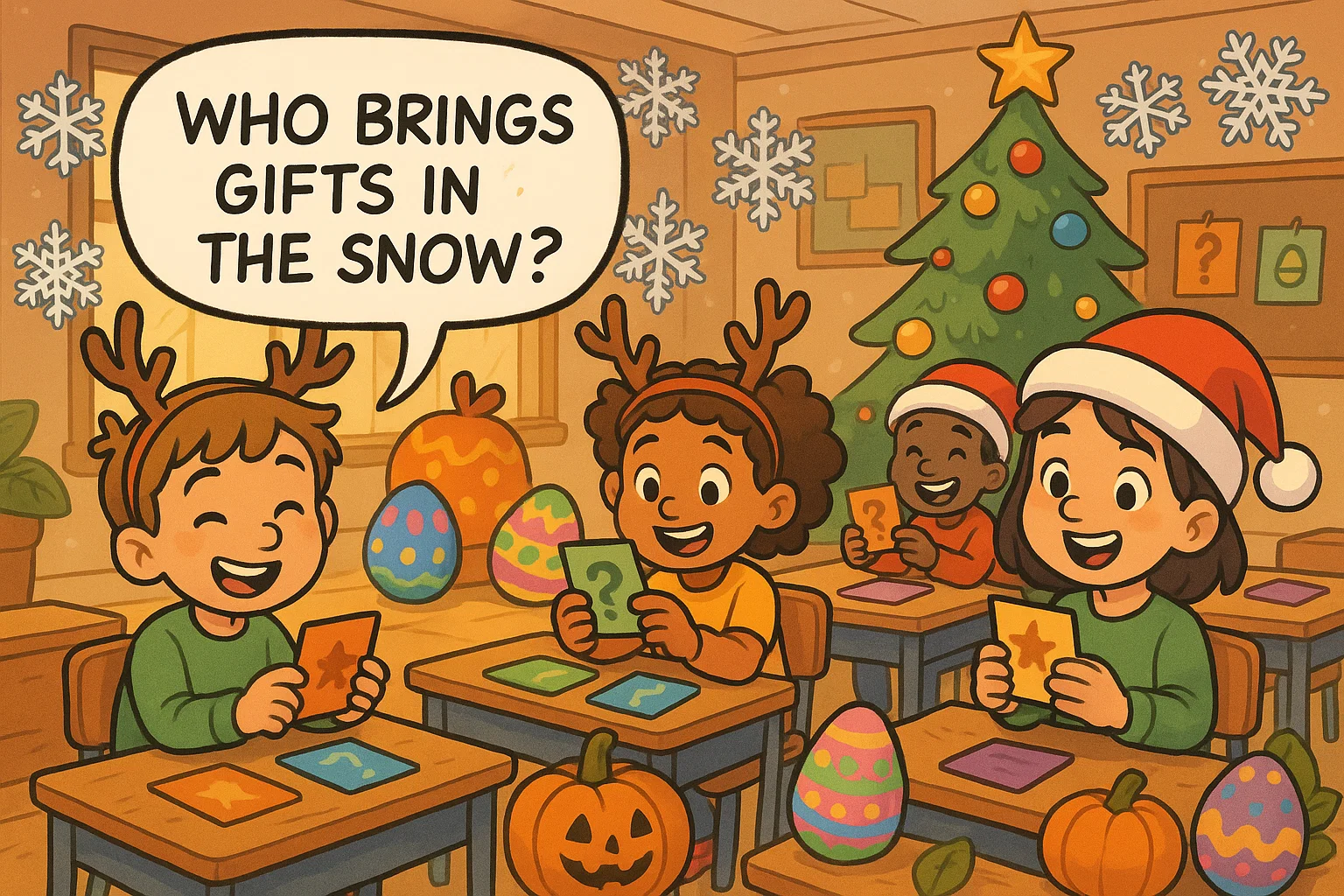
Holiday-themed questions can be adapted for kids of all ages, but kindergarten learners benefit most from clear seasonal clues, familiar objects, and simple vocabulary.
Halloween Riddles
- I am a bright orange pumpkin with a funny carved face that glows on the porch. What am I? (A jack-o’-lantern)
- I wear a white sheet, fly through the air, and say “boo!” to make you smile. What am I? (A ghost)
- I am a tiny black creature with eight legs that spins a web across the front door. What am I? (A spider)
Thanksgiving Riddles
- I am a large farm bird that gobbles loudly and looks like a fan when I spread my feathers. What am I? (A turkey)
- I am a delicious, round dessert baked with pumpkin or apples for a holiday dinner. What am I? (A pie)
Winter Riddles
- I am built from three big balls of cold snow, and I wear a carrot for a nose. What am I? (A snowman)
- We are two warm fabric pockets that you slide onto your hands before playing in the snow. What are we? (Mittens)
Valentine Riddles
- I am a colorful paper card, often shaped like a heart, that you give to a friend. What am I? (A valentine)
- I am the bright color of a sweet strawberry or a valentine heart. What color am I? (Red)
Easter Riddles
- I have long fuzzy ears, hop down the garden path, and carry a basket filled with colorful eggs. What am I? (The Easter Bunny)
- I am a tiny, yellow baby bird that breaks out of a smooth eggshell in springtime. What am I? (A chick)
Summer Riddles
- I am cold, sweet, red on the inside, and you eat me in big slices at a backyard picnic. What am I? (A watermelon)
- I am an outdoor pool filled with cool water where you splash around on hot days. What am I? (A swimming pool)
Benefits of Riddles for Kindergarten Kids
Vocabulary Growth
Themed clue games introduce children to descriptive words, prepositions, and context clues that support vocabulary growth. A riddle places new vocabulary inside a familiar setting, helping children understand meaning through clues. Children often remember new words more easily when they learn them in a familiar context rather than as isolated word lists.
Listening Practice
These activities require focused attention because a child must process multiple clues before choosing an answer. This structure helps train young minds to resist distractions and focus on spoken details, a skill that supports phonological awareness and auditory comprehension.
Developing strong listening habits at an early age provides a foundation for following multi-step instructions within a school environment.
Critical Thinking Skills
Solving clue-based puzzles helps children develop critical thinking skills by teaching them to evaluate evidence, compare traits, and eliminate incorrect options. When children analyze clues, they sort objects by criteria like color, size, shape, and function.
| Step | Thinking Process |
| 1 | Notice the clue pattern. |
| 2 | Rule out answers that do not match. |
| 3 | Use the remaining clues to make a guess. |
This kind of sorting encourages children to make a guess and check it against the clues.
Confidence Building
Easy riddles provide immediate positive reinforcement, giving young learners a quick sense of success and boosting their learning confidence. When a child solves a puzzle independently, the success can feel rewarding and encourage them to try another challenge.
This positive association with problem-solving can help children approach new learning tasks with more confidence over time.
How to Help Kindergarten Kids Create Riddles
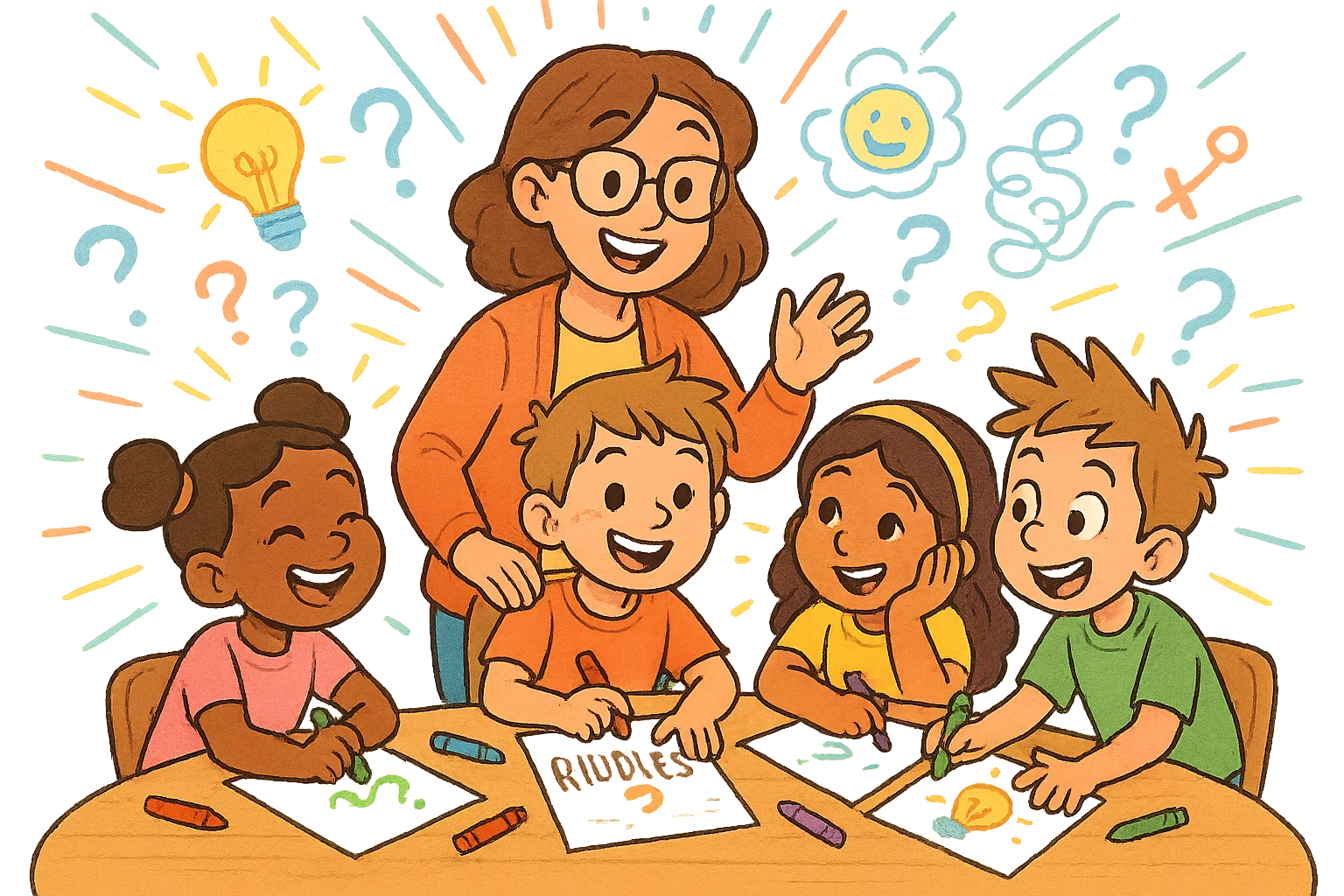
1. Start With the Answer
| Step | Example |
| 1. Select a concrete target answer | A yellow pencil |
| 2. Brainstorm physical attributes | Yellow color, used for drawing and writing |
| 3. Assemble a “What am I?” riddle | I am yellow. I help you draw. What am I? |
The first step in helping a kindergartener create a riddle is choosing a familiar answer from their everyday environment. Choosing a tangible object, such as a favorite toy, a household pet, or a specific piece of fruit, gives the child a clear mental image to describe.
2. Brainstorm Clues
Once the child has selected a solution, guide them to brainstorm clear physical attributes by asking targeted questions about the object. Parents and educators can encourage the child to identify the item’s color, shape, size, typical sounds, and specific functions.
Listing these details gives the child simple clues to use in the riddle.
3. Think Like the Answer
Encourage the child to use creative thinking by pretending to be the chosen object or animal. Ask questions like, “If you were a red apple, where would you live?” or “What do people do with you when they hold you?”
This exercise helps young children practice perspective-taking, which supports abstract reasoning and storytelling.
4. Write a Simple Riddle
Help the child turn their clues into a simple, repeatable sentence pattern. A reliable framework for young children is:
I am [color or shape]. I can [action or sound]. What am I?
Using a structured formula allows children to organize their thoughts without feeling overwhelmed by sentence construction. For children who are ready for more challenging riddles, adults can add one extra clue or include a small twist while still keeping the final solution familiar.
5. Share the Riddle Aloud
The final step is for the child to read or speak their completed riddle aloud to classmates, parents, or siblings during a group activity. Sharing the riddle gives children practice speaking clearly in front of others.
The immediate feedback of having someone guess their riddle reinforces the child’s communication skills and builds a sense of pride in their creative work.
FAQ
What Makes a Good Guessing Game for Kindergarten?
A good kindergarten guessing game uses short clues, familiar objects, simple vocabulary, and a clear answer. The best easy riddles for kids are playful but not confusing, so children can listen, make a guess, and feel successful. For this age group, riddles for kids with answers are especially helpful because young learners need quick feedback. Clear solutions help children connect each clue with the correct word or object.
How Can These Activities Help Kids Learn?
Clue-based questions can help kids build vocabulary, listen carefully, and compare details before choosing an answer. When children hear a clue, think about possible options, and explain their guess, they begin to build important problem-solving skills. These short activities also stimulate their minds in a playful way. They encourage children to notice patterns, remember details, and make connections between words and real-life objects.
Are Funny Questions Good for Kindergarten Kids?
Yes, funny riddles for kids are great for kindergarten because they keep the mood light and help children enjoy learning. A silly answer or gentle joke can make the activity more memorable. Fun riddles for kids also work well during circle time, snack time, or classroom transitions because they give children a quick mental break while still keeping them engaged.
What Types of Clues Work Best for Young Children?
The best clues are simple, concrete, and familiar. Animal riddles for kids work well because children often know animal sounds, movements, and traits. Food riddles for kids are also useful because children can connect clues to color, taste, shape, and texture. Teachers and parents can also use themed riddles for kids, such as weather questions, holiday prompts, classroom clues, or shape-based puzzles. Themes make it easier for children to understand the context and guess the answer.

Take a short quiz to find out what your everyday choices say about your parenting style
When your child is curious about something new, what’s your instinct?
Take a short quiz to find out what your everyday choices say about your parenting style
“Can I download this app?” What happens next?
Take a short quiz to find out what your everyday choices say about your parenting style
When it comes to rules at home, which sounds most like you?
Take a short quiz to find out what your everyday choices say about your parenting style
If you could give your child one life skill today, what would you pick?
Take a short quiz to find out what your everyday choices say about your parenting style
Your child gets to choose what to watch. What would your ideal setup look like?
Take a short quiz to find out what your everyday choices say about your parenting style
Pick your parenting superpower ✨



