100 Best Riddles for 6 Year Olds With Answers

 Discover a Free Education Video App for Kids
Pastory uses AI to personalize educational video content based on your child’s interests and personality. Safe, engaging, and built for curious young minds. Sign up now to stay updated and enjoy early access with a free trial
Riddles are a fun, foundational activity that supports children’s cognitive development. This collection of 100 riddles for kids offers a curated mix of themes tailored to the interests and developmental stage of 6-year-olds. Parents, educators, and caregivers can use these brain teasers to build critical thinking, expand vocabulary, and create moments of connection during daily routines or structured learning time.
Riddles for Kids: Ground Rules
Selecting the right content ensures that the experience remains positive and stimulating for young learners. Effective engagement with riddles requires balancing challenge with accessibility to maintain a child’s interest and confidence.
Choose the Right Difficulty Level
At age 6, children benefit most from riddles about concrete, familiar things. Using subjects such as pets, fruits, toys, and everyday objects helps children picture the answer more easily. Overly abstract concepts may decrease engagement; therefore, keeping themes grounded in daily life supports better comprehension.
Keep the Answer Reveal Simple
Providing answers immediately after the question allows for an uninterrupted flow of play. Presenting the answer clearly – perhaps by using a slightly different font weight or placing it in parentheses – maintains the excitement of the discovery. This approach turns reading into an interactive experience rather than a formal test.
Turn Riddles Into a Game
Integrating these puzzles into existing routines creates natural opportunities for intellectual play. Families can use riddles during car rides, as a bedtime ritual, or as a brief energizer between homework tasks. Teachers can implement these as warm-up activities in the classroom to focus attention before starting a lesson.
What Is a Riddle?
Understanding the basic structure of a riddle allows children to learn how to deconstruct information and look for clues. A riddle is a question that encourages logical thinking through descriptive clues.
Riddle vs Joke vs Puzzle
A riddle functions as a question that requires identifying a specific entity through clues. A joke relies on a humorous or unexpected twist to create laughter. A puzzle typically involves a mechanical or visual problem that requires manipulation or logical arrangement to reach a solution.
Best Riddle Length for Age 6
Short-form riddles consisting of one to three sentences are most effective for 6-year-olds. This length prevents cognitive overload and ensures that the child can retain the descriptive details while formulating an answer. Avoiding complex grammatical structures and extended narratives keeps the focus on the core clues.
Best Clue Style for Early Readers
Clues based on sensory attributes such as color, shape, sound, and movement offer the highest success rate for early readers. For example, a clue that describes an object by its function (“I help you eat soup”) is often more effective than one based on what it is made of. Connecting riddles to objects like a “red apple” or a “soft pillow” provides immediate context for the learner.
100 Fun Riddles for 6 Year Olds
This list contains 100 fun riddles for kids, organized by theme to match different interests. Each entry includes a question followed by the answer in parentheses.
Easy Riddles for 6 Year Olds
- I have hands but cannot clap. What am I? (A clock)
- I have legs but cannot walk. What am I? (A table)
- I am hot and bright in the sky. What am I? (The sun)
- I come out when the sun goes down. What am I? (The moon)
- I have laces and you wear me on your feet. What am I? (A shoe)
- I help you eat your soup. What am I? (A spoon)
- I have a bed but I never sleep. What am I? (A river)
- I am full of holes but I hold water. What am I? (A sponge)
- I have keys but cannot open locks. What am I? (A piano)
- I am white and cold and fall from the sky. What am I? (Snow)
Funny Riddles for 6 Year Olds
- What has to be broken before you can use it? (An egg)
- What gets wetter the more it dries? (A towel)
- What has many eyes but cannot see? (A potato)
- What has teeth but cannot bite? (A comb)
- What has a neck but no head? (A bottle)
- What kind of band never plays music? (A rubber band)
- What has a thumb and four fingers but is not alive? (A glove)
- What gets bigger the more you take away? (A hole)
- What has legs but no feet? (A pair of pants)
- Why are fish so smart? (They live in schools)
Tricky Riddles for Clever Kids
- What starts with T, ends with T, and has T in it? (A teapot)
- What month of the year has 28 days? (All of them)
- What has words but never speaks? (A book)
- What can you catch but not throw? (A cold)
- What goes up but never comes down? (Your age)
- What has many keys but can’t open a single door? (A keyboard)
- What is always in front of you but can’t be seen? (The future)
- What can you hold in your left hand but not in your right? (Your right elbow)
- What has one eye but can’t see? (A needle)
- What has a tail and can fly, but is not a bird? (A kite)
Hard Riddles for Confident Kids
- I am tall when I am young, and I am short when I am old. What am I? (A candle)
- What belongs to you, but other people use it more than you do? (Your name)
- I speak without a mouth and hear without ears. What am I? (An echo)
- What can travel all around the world while staying in a corner? (A stamp)
- The more of this there is, the less you see. What is it? (Darkness)
- I have cities, but no houses. I have mountains, but no trees. What am I? (A map)
- What has a heart that doesn’t beat? (An artichoke)
- What is so fragile that saying its name breaks it? (Silence)
- What is black when it’s clean and white when it’s dirty? (A chalkboard)
- What can you break, even if you never pick it up or touch it? (A promise)
Animal Riddles for 6 Year Olds
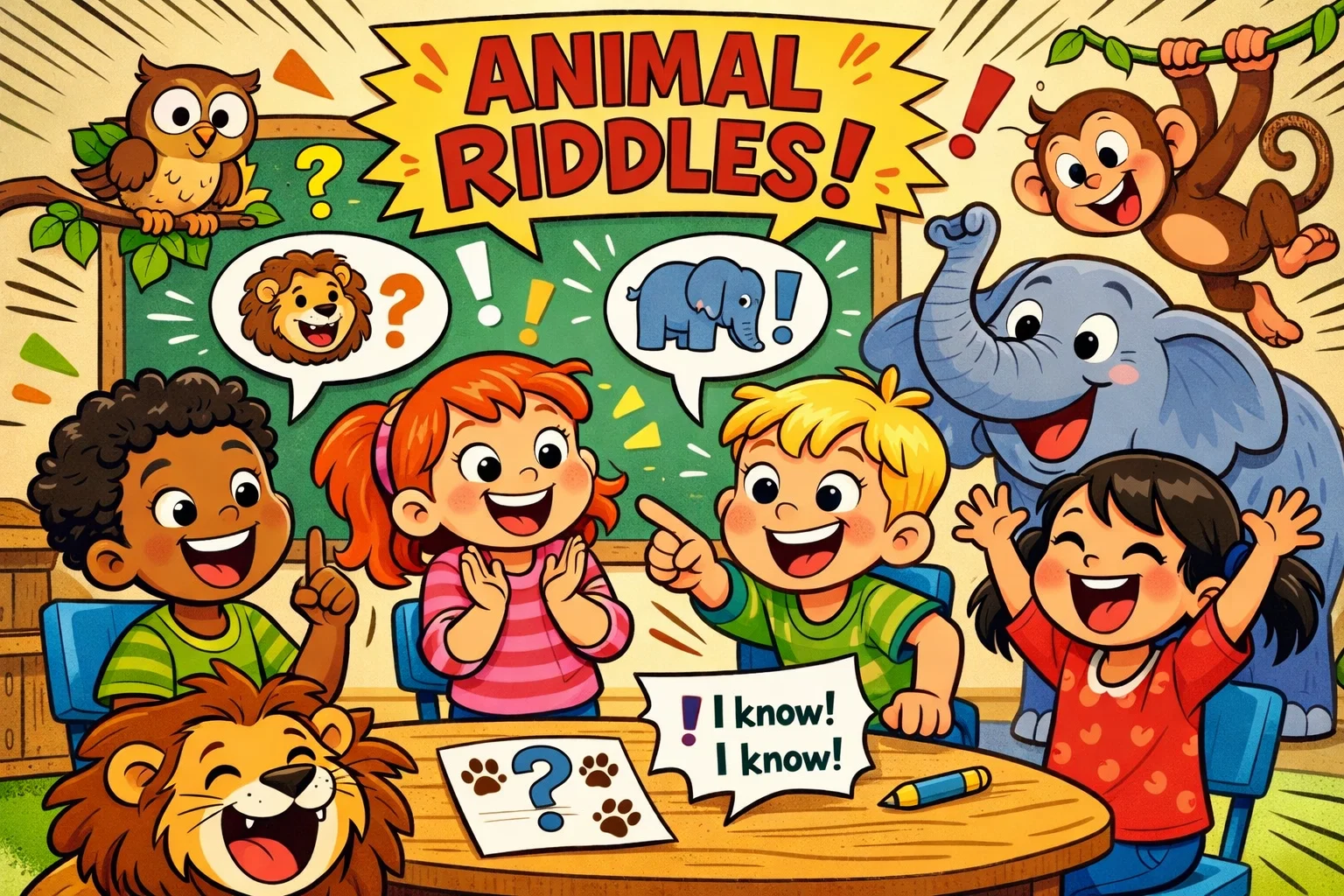
Children are naturally drawn to the animal kingdom, making these riddles highly effective for engaging young minds.
Farm Animal Riddles
- I say “moo” and give you milk. What am I? (A cow)
- I have a long tail and I like to eat hay. What am I? (A horse)
- I am pink and I love to roll in the mud. What am I? (A pig)
- I say “cluck” and lay eggs. What am I? (A chicken)
- I have soft wool and say “baa”. What am I? (A sheep)
Wild Animal Riddles
- I have a very long neck and eat leaves from tall trees. What am I? (A giraffe)
- I have a big mane and a loud roar. What am I? (A lion)
- I have a long trunk and big floppy ears. What am I? (An elephant)
- I swing through trees and love bananas. What am I? (A monkey)
- I have a bushy tail and I am known to be clever. What am I? (A fox)
Ocean Animal Riddles
- I have eight arms and I live in the sea. What am I? (An octopus)
- I am the largest animal in the ocean. What am I? (A whale)
- I have a hard shell and I move very slowly. What am I? (A turtle)
- I have sharp teeth and I swim very fast. What am I? (A shark)
- I have a hard shell and walk sideways. What am I? (A crab)
Funny Riddles for Young Children
Humor serves as a powerful engagement tool, helping children associate learning with positive emotions.
Silly Sound Riddles
- I go “ribbit” and jump on lily pads. What am I? (A frog)
- I go “woof” and like to chase balls. What am I? (A dog)
- I go “meow” and like to nap in the sun. What am I? (A cat)
- I go “quack” and love to swim in the pond. What am I? (A duck)
- I go “oink” and have a curly tail. What am I? (A pig)
School Laugh Riddles
- I have many pages but I am not a newspaper. What am I? (A book)
- I hold your books and sit on your back. What am I? (A backpack)
- I have a point and help you write. What am I? (A pencil)
- I help you draw straight lines. What am I? (A ruler)
- I ring to tell you the lesson is over. What am I? (A school bell)
Giggle Friendly Trick Questions
- What do you call a bear with no teeth? (A gummy bear)
- What is a ghost’s favorite fruit? (A boo-berry)
- Why did the student eat his homework? (The teacher said it was a piece of cake)
- What has four wheels and flies? (A garbage truck)
- Where do cows go for entertainment? (To the moo-vies)
Food Riddles for Kids
Food-themed riddles leverage familiar sensory experiences, making them excellent for building descriptive vocabulary.
Fruit and Vegetable Riddles
- I am red and round and crunch when you bite me. What am I? (An apple)
- I am yellow and long and you have to peel me. What am I? (A banana)
- I am orange and grow underground. What am I? (A carrot)
- I am yellow and grow on a cob. What am I? (Corn)
- I am orange and sweet and round. What am I? (An orange)
Snack and Dessert Riddles
- I am cold and sweet and melt on a hot day. What am I? (Ice cream)
- I am round and sweet and often have chocolate chips. What am I? (A cookie)
- I am baked for birthdays and covered in frosting. What am I? (A cake)
- I am crunchy and you eat me at the movies. What am I? (Popcorn)
- I am small, sweet, and come in many colors. What am I? (Candy)
Kitchen Riddles
- I am flat and you eat off me. What am I? (A plate)
- I keep your food cold. What am I? (A fridge)
- I have a handle and you drink tea from me. What am I? (A cup)
- I am sharp and help you cut your food. What am I? (A knife)
- I get hot and help you cook your meals. What am I? (A stove)
Math and Science Riddles for Kids
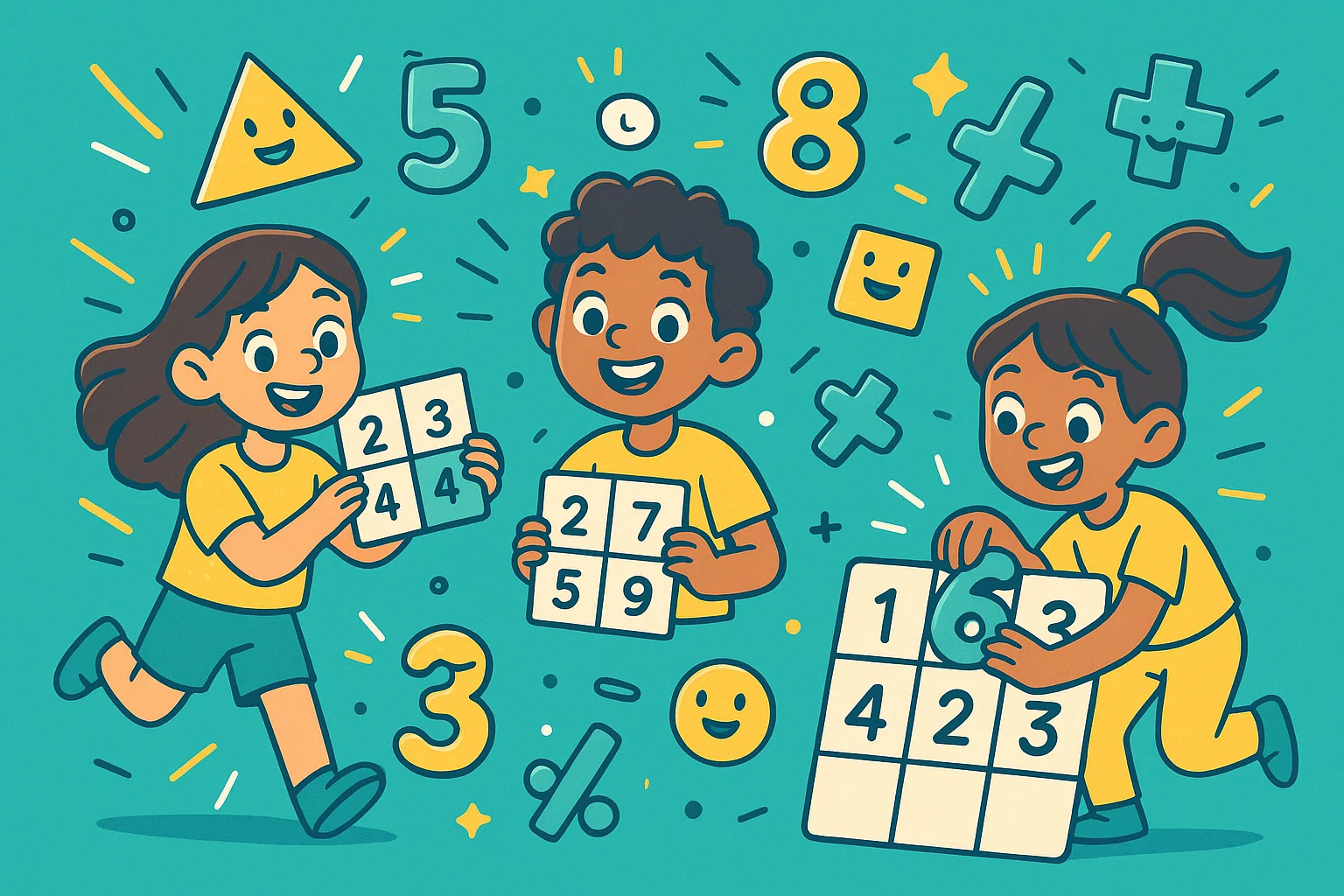
These riddles introduce children to foundational concepts in a playful, low-pressure environment.
Counting Riddles
- I have five fingers but no bones. What am I? (A glove)
- If you have three apples and take away two, how many do you have? (Two)
- I have two hands and twelve numbers. What am I? (A clock)
- How many legs do two cats have? (Eight)
- I have four legs but I cannot walk. What am I? (A chair)
Shape and Number Riddles
- I have no corners and I am perfectly round. What am I? (A circle)
- I have four sides that are all the same. What am I? (A square)
- I have three sides. What am I? (A triangle)
- What number comes after nine? (Ten)
- I am the number between one and three. What am I? (Two)
Simple Science Riddles
- I fall from the sky but I am not snow. What am I? (Rain)
- I move the trees but you cannot see me. What am I? (Wind)
- I follow you when you walk in the sun. What am I? (A shadow)
- I provide light but I need electricity. What am I? (A lightbulb)
- All living things need me to survive. What am I? (Water)
Benefits of Riddles for Kids
Engaging with riddles can support several important language and thinking skills in children.
Vocabulary Growth
Riddles require children to associate specific adjectives and nouns with familiar objects. This process forces the child to access their existing vocabulary and apply it in new, descriptive contexts, which enhances both retention and retrieval.
Logic and Focus
Solving riddles demands the ability to identify essential attributes while filtering out irrelevant information. This exercise improves sustained attention and teaches children to evaluate multiple possibilities before reaching a conclusion, which is a core component of executive function.
Confidence and Family Bonding
Successful problem-solving triggers a sense of achievement in 6-year-olds. When performed in a family setting, the shared experience creates positive reinforcement and strengthens interpersonal relationships through collaborative play.
How to Help Your Child Create Their Own Riddles
Helping children create their own riddles turns them from passive readers into active creators and encourages deeper creative engagement.
Start With the Answer
The easiest way to start is to choose a familiar object, such as a cat or a pencil. Once they choose the object, they can focus on describing its most distinctive features.
Brainstorm Clues
Encourage the child to list attributes using a structured approach:
- Appearance: Color, shape, size.
- Function: What the object does.
- Context: Where it is found.
Think Like the Answer
Instruct the child to imagine themselves as the object. By asking, “If you were a spoon, what would you say about yourself?”, the child can develop more vivid, first-person clues that make the riddle more engaging.
Go Beyond Obvious Clues
Help the child refine their riddle by avoiding overly direct descriptors. Suggest replacing “I am a red apple” with “I am a crunchy, red fruit that grows on a tree,” which adds a layer of mystery and complexity.
Write, Test, and Improve the Riddle
After drafting, have the child test the riddle on a family member or friend. If the listener guesses too quickly or is completely confused, work with the child to adjust the clues – adding a hint if it is too hard or removing one if it is too obvious.
Make Learning Fun With Riddles
Integrating riddles into daily life transforms routine moments into learning opportunities.
Self-Guided Riddle Time
Give children printed lists or simple digital activities so they can work through riddles at their own pace. Letting them reveal the answer on their own encourages independence and reinforces a simple read-guess-check routine.
Classroom Warm-Up Ideas
Teachers can use one riddle each morning to settle the class and prepare students for focused work. Alternatively, grouping riddles by theme can supplement specific curriculum areas, such as using animal riddles during a science unit.
Car Ride and Bedtime Play
These portable, low-prep activities are ideal for travel or quiet time. By using riddles to structure these transitions, parents can manage behavior and maintain a focus on intellectual engagement without requiring physical toys or screens.
Frequently Asked Questions
Why are riddles effective for early development?
Riddles introduce new ideas in a simple, playful format. They help children build vocabulary and strengthen language skills by using descriptive clues to define familiar objects. As children work through the clues, they also practice analysis and critical thinking.
What is the ideal progression for difficulty?
The best approach moves from easy to hard levels to maintain confidence. For a first grader, start with simple, concrete objects. As they become more proficient, introduce math riddles or those with abstract concepts. This progressive structure encourages children to think critically without becoming discouraged by material that feels too difficult.
How do brain teasers benefit students in the classroom?
Brain teasers make excellent mental warm-ups before tasks that require deep focus. Teachers often use these puzzles to keep students productively engaged during transitions and to manage classroom energy. Furthermore, solving riddles fosters essential problem-solving skills that are applicable across various subjects, including basic arithmetic and logic.
Are these riddles suitable for all developmental stages?
While this collection is designed for 6-year-olds, the format can be adapted for children at different developmental stages. By adjusting the complexity of the clues, parents and teachers can continue to challenge children as their language and reasoning skills grow.
How can I make riddle-solving a consistent habit?
Riddles are a great way to build a daily routine, especially for a 1st grade student. You can keep kids busy during car rides or while waiting in line by posing one or two short questions. Incorporating the best riddles for kids from our list into bedtime or mealtime ensures that you consistently get their brains working, which can feel as light as a feather when it becomes a natural part of your family’s interaction.
Take a short quiz to find out what your everyday choices say about your parenting style
When your child is curious about something new, what’s your instinct?
Take a short quiz to find out what your everyday choices say about your parenting style
“Can I download this app?” What happens next?
Take a short quiz to find out what your everyday choices say about your parenting style
When it comes to rules at home, which sounds most like you?
Take a short quiz to find out what your everyday choices say about your parenting style
If you could give your child one life skill today, what would you pick?
Take a short quiz to find out what your everyday choices say about your parenting style
Your child gets to choose what to watch. What would your ideal setup look like?
Take a short quiz to find out what your everyday choices say about your parenting style
Pick your parenting superpower ✨