
Fun Facts for First Graders: 200+ Cool, Weird, and Easy Facts Kids Love

 Discover a Free Education Video App for Kids
Pastory uses AI to personalize educational video content based on your child’s interests and personality. Safe, engaging, and built for curious young minds. Sign up now to stay updated and enjoy early access with a free trial
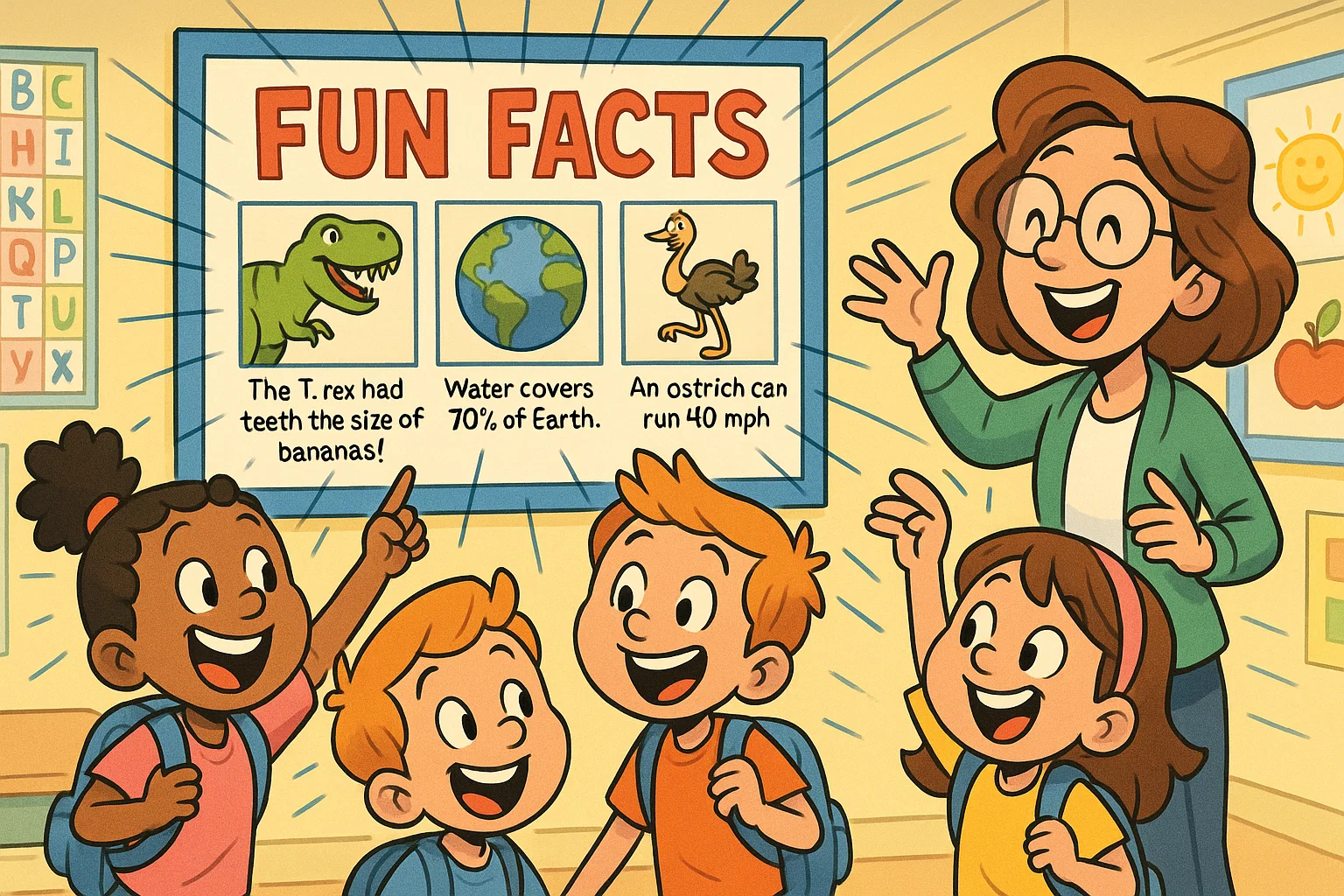
Welcome to a fun collection of facts for young learners! First graders are naturally enthusiastic learners who are developing rapidly both cognitively and socially. Around ages 6 and 7, children are rapidly building vocabulary, reading confidence, and comprehension skills. Providing them with curated, high-interest information helps spark their curiosity and builds a foundational love of learning.
This comprehensive guide is designed for parents, teachers, and curious kids to explore together. Inside, you will find short, safe, and school-friendly snippets across a wide range of subjects. From amazing creatures in the deep ocean to the mysteries of outer space, these pieces of information are structured specifically to support early reading skills and critical thinking.
Key Takeaways
- Boosts Literacy: Short, punchy sentences help first graders practice reading fluency without feeling overwhelmed.
- Encourages Critical Thinking: Surprising facts invite children to ask “how” and “why,” building early curiosity and reasoning skills.
- Versatile Educational Tool: Perfect for morning work, transitions, classroom trivia, or bedtime bonding.
- Safe, Curated Discovery: Offers a structured alternative to unrestricted online browsing, with age-appropriate facts for young readers.
Quick Facts Build Curiosity
First graders enjoy short, surprising facts because they are easy to read aloud, remember, and share. At ages 6 and 7, children are still developing working memory, so bite-sized information is often easier to understand and remember than long explanations. When children learn an interesting fact, they feel a sense of mastery and pride when repeating it to friends or family members.
Topics Cover School-Friendly Learning
The facts in this guide cover common early elementary themes, including science, animals, space, food, history, geography, math, weather, sports, and the human body. Introducing children to a variety of topics can help build vocabulary and background knowledge. This baseline of information makes future reading comprehension tasks easier as students progress through elementary school.
Facts Work for Home or Classroom
Parents and teachers can use facts for morning work, trivia games, reading practice, writing prompts, or discussion starters. Teachers often use high-interest trivia as a “hook” before a longer lesson. Incorporating these interesting facts into a daily routine turns learning into an engaging, collaborative activity rather than a chore.
Fun Facts for First Graders: Quick Overview
Before exploring the individual topics, this overview explains why curated content can support young readers and how adults can use these facts with children.
| Feature of First-Grade Content | Educational Purpose | Benefit for the Child |
| Concrete Examples | Connect to real-world objects | Make abstract ideas easier to visualize |
| High Visual Appeal | Create a clear mental picture | Help children remember facts more easily |
| Controlled Vocabulary | Use age-appropriate wording | Encourage independent reading practice |
What Makes a Fact Right for First Grade
Every statement for this age group should be short, safe, concrete, and easy to picture. Young children learn best when abstract concepts are tied to tangible realities they can observe. For example, instead of explaining complex astrophysics, focusing on the bright color of a planet creates an immediate mental image that supports cognitive development.
How the List Is Organized
This list is organized clearly by topic so kids can jump to favorite sections based on their current interests. Giving children some choice in what they read can make reading feel more personal and engaging. Whether a child is passionate about giant sharks, fast cars, or baking, they can navigate straight to the subject that excites them most.
Best Way to Read Facts with Kids
Adults can read a few facts at a time, ask kids to guess answers, or let kids pick favorite facts. Turning reading into an interactive game builds conversational confidence and reinforces emotional bonding between adults and children. Pausing to ask, “Why do you think that happens?” exercises a child’s reasoning skills and deepens their conceptual understanding.
Random Fun Facts for First Graders
These random facts for kids offer fun surprises across everyday topics.
Silly Facts Kids Can Repeat
- The word “alphabet” comes from the first two letters of the Greek alphabet, which are alpha and beta.
- In some places, people have hidden small charms or coins in cakes for good luck, but adults should always make sure treats are safe for children.
- A standard pencil can draw a very long line — sometimes said to be about 35 miles long.
Weird but True Facts
- A clever eleven-year-old boy named Frank Epperson accidentally invented the ice pop in 1905 when he left a cup of soda mix and a stirring stick outside on a freezing night.
- The original rules of early basketball stated that players had to use a soccer ball and a peach basket instead of a modern hoop and net.
- A famous baseball player named Babe Ruth used to keep a wet, cold cabbage leaf underneath his baseball cap during games to stay cool.
Quick Did-You-Know Facts
- Did you know that tooth enamel is the hardest substance in the human body?
- Did you know that cows do not have top front teeth, using their hard gums to press against grass instead?
- Did you know that the human nose can tell apart far more smells than scientists once thought?
Science Fun Facts for First Graders
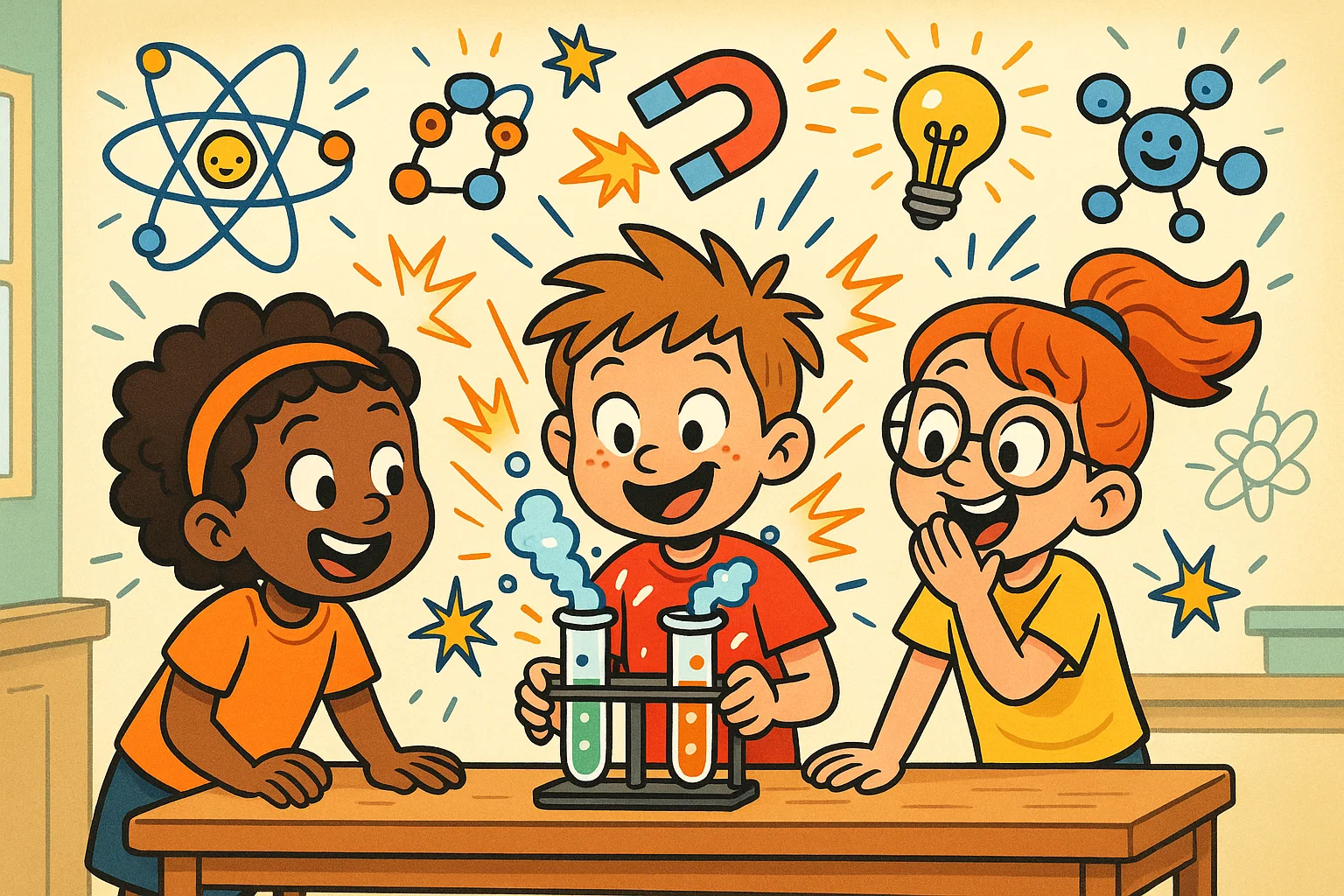
Science facts for kids introduce basic principles of the natural world through visible, real-world examples.
Everyday Science Facts
- A magnet produces an invisible magnetic field that pulls on specific metals like iron and steel.
- A shadow forms when an opaque object blocks light from passing through a specific space.
- Free-floating bubbles are usually round because the soapy film pulls itself into the smallest possible shape.
Simple Experiment Facts
- Objects that are denser than water sink, while objects that are less dense than water float.
- When you mix red paint and blue paint, they usually make purple paint.
- Ice changes from a solid to a liquid when it absorbs heat.
Nature Science Facts
- A rainbow can appear when sunlight shines through tiny drops of water in the air.
- Soil consists of a mixture of tiny broken rocks, decaying leaves, and living organisms like earthworms.
- Most pine trees keep green needles through winter, though they still shed older needles over time.
Space Fun Facts for First Graders

Space facts for kids allow young learners to look up at the night sky and understand the cosmos.
Planet Facts
- Venus is the hottest planet in our solar system, with surface temperatures of about 872°F (467°C).
- Saturn is a gas giant that features a large ring system made of billions of pieces of ice and rock.
- Mars is known as the Red Planet because its surface soil contains iron oxide, which looks like rust.
Moon Facts
- Footprints made by astronauts on the Moon can stay there for a very long time because there is no wind or rain to wash them away.
- The Moon looks different throughout the month because we see different amounts of its sunlit side as it moves around Earth.
- High and low ocean tides are mostly caused by the Moon’s gravity, while the Sun also plays a role.
Astronaut Facts
- Astronauts must wear specialized spacesuits that provide oxygen and protect their bodies from extreme cold and heat.
- In space, astronauts eat many foods from sealed packages so crumbs do not float away and get into equipment.
- Spacecraft in low Earth orbit, like the International Space Station, travel at about 17,500 miles per hour (28,000 km/h).
Animal Fun Facts for First Graders
Animal facts are favorites for kids of all ages because they highlight the many traits of living creatures.
Wild Animal Facts
- An adult elephant can use its long trunk to smell water from far away.
- A kangaroo can jump a distance of 30 feet (9.1 meters) in a single leap to travel across the land.
- A wild penguin uses its stiff wings as flippers to swim through the cold ocean water like a bird flying through the air.
Animal Superpower Facts
- A cheetah can accelerate from a standstill to about 60 miles per hour (96.5 km/h) in about three seconds.
- An owl has specialized eyes that help it see well in low light during nighttime hunting.
- A chameleon can change skin color for several reasons, including temperature, light, mood, communication, and sometimes camouflage.
Baby Animal Facts
- A baby kangaroo is called a joey, and it stays safe in its mother’s pouch for about six months.
- A baby elephant can stand up on its own feet just twenty minutes after it is born.
- A baby duckling learns to recognize and follow its mother soon after hatching through a process called imprinting.
Cat Facts for First Graders
Domestic cats offer a great opportunity for kids to learn interesting details about household pets.
Cat Body Facts
- A cat uses its long whiskers as measuring tools to feel if a tight space is wide enough for its body to fit through.
- A cat has sharp claws that retract inside its paws to keep them clean and sharp when walking.
- A cat uses its flexible tail to help it balance when jumping across high places.
Cat Behavior Facts
- A cat often purrs when it feels happy, relaxed, or comfortable near people it trusts.
- A cat sleeps for about 12 to 16 hours a day to conserve energy.
- A cat kneads its paws against soft blankets to show contentment and mark the spot with its scent.
Pet Cat Facts
- Pet cats need fresh water every day, and cow’s milk can upset many cats’ stomachs.
- A pet cat shows it is annoyed by waving its tail back and forth very quickly.
- Gentle handling, like stroking a cat smoothly from its head to its tail, helps the animal feel safe.
Lion Facts for First Graders
Lions represent the wild side of the cat family, introducing concepts of habitats and animal groups.
Lion Family Facts
- A group of lions living together is called a pride, which usually includes related females, their cubs, and one or more adult males.
- Lion cubs are born with dark spots on their fur that help them hide in the grass when they are little.
- Mother lions work together to hunt for food and take care of all the babies in the pride.
Lion Sound Facts
- An adult male lion can produce a loud roar that can be heard by humans up to five miles (8 km) away.
- Lions use different sounds, like grunts and purrs, to talk to other members of their family group.
- A lion’s roar can warn other lions to stay away from the pride’s territory.
Lion Habitat Facts
- Wild lions live in warm, open grasslands called savannas, where they can find plenty of space to run.
- Lions can spend up to 20 hours a day resting, often in the shade, to save energy and stay cool.
- The color of a lion’s tan fur matches the dry grass of the savanna, acting as natural camouflage.
Shark Facts for First Graders
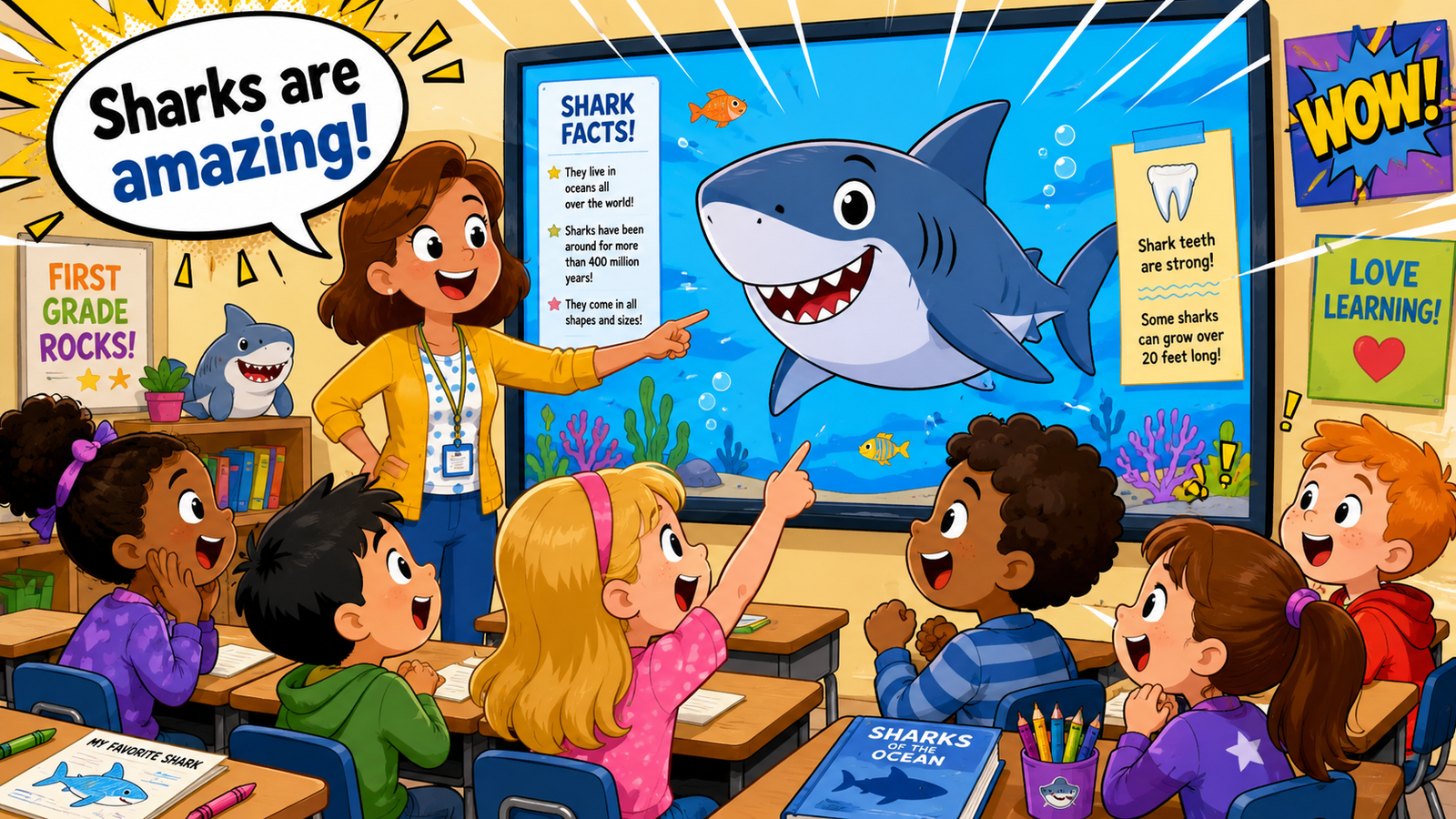
Sharks are fascinating ocean creatures that play an important role in marine ecosystems.
Shark Body Facts
- A shark does not have any bones; its entire skeleton is made of flexible cartilage, which is the same soft material found in human ears.
- A great white shark keeps replacing teeth throughout its life, and sharks can lose thousands of teeth over time.
- A shark uses gills to take oxygen from ocean water.
Shark Ocean Facts
- Sharks inhabit every ocean on Earth, from warm tropical seas to icy Arctic waters.
- Some sharks must keep swimming to move water over their gills, but many sharks can pump water over their gills while resting.
- The blue whale holds the record as the biggest creature in the ocean, but the whale shark is the largest shark species, growing up to 40 feet (12 meters) long.
Shark Safety Facts
- Sharks are important ocean animals that keep the sea healthy by eating sick fish, acting as natural caretakers.
- Sharks usually do not target humans, and many bites happen when a shark is confused, curious, or investigating movement in the water.
- Marine scientists study sharks carefully to learn how to protect ocean habitats for all sea creatures.
Dinosaur Fun Facts for First Graders
Dinosaurs spark the imagination, allowing kids to practice historical thinking by examining the past.
Big Dinosaur Facts
- The Brachiosaurus was a giant plant-eating dinosaur with a long neck that allowed it to eat leaves from the tops of tall trees.
- A Tyrannosaurus rex had large, powerful back legs for moving its heavy body, but its front arms were very short.
- Giant plant-eating dinosaurs had to eat hundreds of pounds of leaves every day just to keep their large bodies moving.
Small Dinosaur Facts
- The Microraptor was a tiny dinosaur that was about the same size as a modern crow, and it was covered in shiny feathers.
- Some small dinosaurs were incredibly fast runners that used their speed to escape from larger predators.
- Some small dinosaurs laid eggs in nests, just as many birds do today.
Fossil Facts
- A fossil is the preserved remains or trace of an ancient living thing, such as a bone, tooth, shell, or footprint.
- Paleontologists are scientists who dig up dinosaur bones to learn how these ancient creatures lived.
- Dinosaur footprints pressed into ancient mud tell scientists whether a dinosaur walked on two legs or four legs.
Human Body Fun Facts for First Graders
Human body facts for kids teach children about their own anatomy and physiological functions.
Bone and Muscle Facts
- An adult human skeleton contains 206 bones, but a baby is born with around 300 bones that slowly fuse together as they grow.
- Your tongue is made of several muscles that work together to help you chew, swallow, and speak clearly.
- Walking uses many muscles in your body to move your feet, balance your hips, and swing your arms.
Brain and Sense Facts
- Your brain acts like a powerful computer that controls everything you do, including your thoughts, memory, and movements.
- The human eye can identify millions of different colors, while your ears can hear thousands of unique sounds.
- Your skin is the body’s largest organ, and tiny nerves in it help your brain notice whether something feels hot, cold, rough, or smooth.
Heart and Breathing Facts
- Your heart is a muscle that pumps blood through your body, beating about 100,000 times every single day.
- Your lungs act like two balloons that fill up with air every time you take a breath to give your body oxygen.
- When you run fast, your heart beats quicker to send extra energy to your leg muscles so you can keep moving.
Food Fun Facts for First Graders
Food facts for kids introduce the surprising science behind the items we eat every day.
Fruit Facts
- A strawberry looks like it has tiny yellow seeds on the outside, but those “seeds” are actually tiny fruits called achenes.
- Bananas grow upside down on large plants, curving upward toward the sun as they get bigger.
- A tomato is scientifically classified as a fruit, not a vegetable, because it develops from a flower and contains seeds.
Snack Facts
- Popcorn pops because each kernel contains a tiny drop of water that turns into steam and expands when heated.
- It can take hundreds of peanuts to make one jar of peanut butter.
- Dark chocolate comes from the seeds of the cacao tree, which grows in warm tropical rainforests.
Food History Facts
- The first ice pop was invented by an eleven-year-old child in 1905 when he left his sweet drink outside on a cold night.
- A popular story says potato chips became famous in 1853 after a cook sliced potatoes extra thin and fried them until they turned crunchy.
- Honey can last for a very long time when it is sealed and stored properly.
Ocean Fun Facts for First Graders
The ocean covers most of our planet, containing fascinating geographical and biological wonders.
Sea Animal Facts
- A blue whale is the largest animal ever known to have lived on Earth, and it can grow longer than three school buses.
- An octopus has three working hearts and blue-colored blood running through its body.
- A jellyfish does not have a brain, a heart, or bones, and it consists almost entirely of water and thin tissue.
Ocean Water Facts
- Ocean water tastes very salty because it carries dissolved minerals washed down from rivers and rocks over millions of years.
- Many ocean waves are created when wind blows across the surface of the water.
- The deep ocean is completely dark and very cold because sunlight cannot travel through deep water.
Coral Reef Facts
- A coral reef is like a busy underwater city built by tiny animals called coral polyps, providing a home for many sea creatures.
- Sea turtles visit coral reefs to find food like sea sponges and to get their shells cleaned by small fish.
- Coral reefs protect beaches from big waves by slowing down the water before it crashes onto the sandy shore.
Insect Fun Facts for First Graders
Insects teach kids about micro-ecosystems and the vital roles tiny bugs play in our environment.
Butterfly Facts
- A butterfly starts its life as a crawling caterpillar before spinning a chrysalis and turning into a winged insect.
- A butterfly tastes its food by standing on it, using special sensors located directly on its feet.
- The colorful patterns on a butterfly’s wings are made of thousands of tiny, delicate scales that reflect light.
Bee and Ant Facts
- Ants are incredibly strong insects that can lift and carry objects that weigh twenty times more than their own bodies.
- Honeybees work together as a team, visiting many flowers each day to collect nectar for their hive.
- Ants live in organized colonies underground, where every ant has a specific job like digging tunnels or collecting food.
Beetle and Bug Facts
- A firefly uses a special chemical reaction in its lower abdomen to glow in the dark and communicate with other fireflies.
- The rhinoceros beetle is one of the strongest creatures on Earth, capable of lifting objects 850 times its own weight.
- A ladybug’s bright colors can warn birds that it may taste bad, helping protect the insect from being eaten.
Weather Fun Facts for First Graders
Weather facts help children understand daily environmental changes and seasonal patterns.
Rain and Cloud Facts
- Clouds look light and fluffy, but a single medium-sized cloud can weigh as much as 100 regular elephants.
- A raindrop falls from the sky at an average speed of seven miles per hour (11.2 km/h) before hitting the ground.
- Puddles disappear after a rainstorm because the sun heats the water, turning it into invisible vapor that rises into the sky.
Snow and Ice Facts
- Most snowflakes have six-sided shapes, and each one forms in its own unique way.
- Frost forms on cold mornings when invisible water vapor in the air touches a freezing windowpane or blade of grass.
- Hail forms when thunderstorm updrafts carry raindrops upward into very cold parts of a cloud, where they freeze into balls of ice.
Wind and Storm Facts
- Wind is moving air, usually flowing from areas of high pressure toward areas of low pressure.
- Lightning is a giant flash of electricity in the sky, and thunder is the loud sound made when lightning heats the air very quickly.
- If you hear thunder, it means a storm is close by, and the safest action is to head indoors immediately.
Tornado Facts for First Graders
Tornadoes are powerful weather events that can be explained simply and safely to young children.
How Tornadoes Look
- A tornado looks like a giant funnel-shaped cloud that stretches from a dark storm cloud all the way down to the ground.
- The air inside a tornado spins around in a fast circle, picking up dust and leaves from the earth below.
- Tornadoes can form during severe thunderstorms when changing winds and unstable air help create strong rotation.
Where Tornadoes Happen
- Tornadoes can happen anywhere in the world, but they occur most frequently in a part of the United States known as Tornado Alley.
- In many places, tornadoes are more common in spring and early summer, when warm, moist air and cooler air can meet.
- Tornado Alley has many storms because warm, moist air, cool dry air, and changing winds often meet there.
Tornado Safety Facts
- When a tornado warning occurs, a safe plan is to listen to adults, go to a basement or an interior room, and stay away from windows.
- Schools and homes can practice safety drills so everyone knows where to go to stay safer during a big storm.
- Weather scientists use powerful radar tools to spot dangerous storms and give families more time to find shelter.
Geography Facts for First Graders
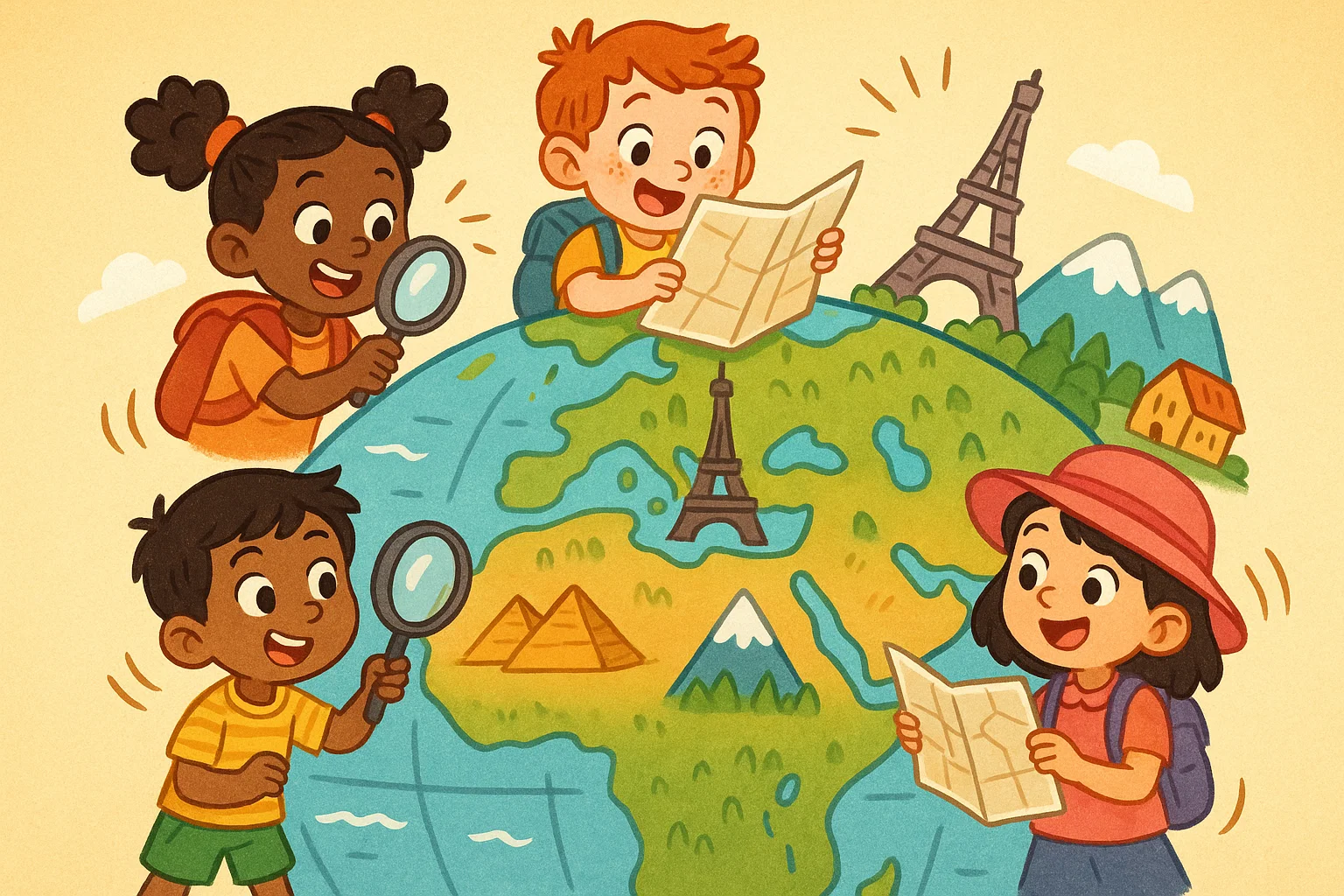
Geography expands a child’s worldview, introducing maps, landmarks, and the scale of our planet.
Country and Continent Facts
- The planet Earth is divided into seven large areas of land called continents, with Asia being the largest of them all.
- The Atacama Desert in South America is one of the driest non-polar deserts on Earth, with some areas receiving almost no rain.
- Mawsynram, a village in India, is often called one of the wettest places on Earth because it receives enormous amounts of rain.
Map and Globe Facts
- A globe is a round model of Earth that shows how the continents and blue oceans look from outer space.
- Maps use a small drawing called a compass rose to show travelers which way is north, south, east, and west.
- A map key uses simple symbols, like a tiny tree for a park or a wavy line for a river, to explain the drawing.
Landmark Facts
- Mount Everest is the highest mountain above sea level on Earth, reaching 29,031.69 feet (8,848.86 meters).
- The Eiffel Tower is a famous iron landmark located in Paris, France, and it can become slightly taller in hot weather because heat expands the metal.
- The Grand Canyon is a giant valley carved into the rock by the flowing waters of the Colorado River over millions of years.
Place Facts for First Graders
Connecting geography to local and global locations builds spatial awareness in early childhood development.
School and Neighborhood Facts
- A public library is a community space where people can borrow books and sometimes games, tools, or other materials for free.
- In many places, street signs help mail carriers and emergency workers find homes quickly.
- Large trees in city parks provide shade, fresh air, and natural spaces where children can play and exercise.
Amazing World Places
- A tropical rainforest is a warm, wet forest that is home to an enormous variety of plants, animals, and other living things.
- A volcano is an opening in Earth’s crust where hot rock, gases, and ash can escape; once magma reaches the surface, it is called lava.
- Antarctica is Earth’s southernmost continent, and most of it is covered by a thick sheet of ice.
Record-Breaking Places
- The Pacific Ocean holds the record as the largest and deepest ocean on Earth, covering more area than all the dry land combined.
- Death Valley in California is one of the hottest places in North America, with temperatures reaching over 120°F (49°C).
- The Nile River is often listed as the longest river on the planet, winding through northeastern Africa.
History Fun Facts for First Graders
History facts introduce the concept of time, helping children understand how daily life has evolved over generations.
Invention Facts
- The first box of Crayola crayons was introduced in 1903 and contained eight basic colors: red, orange, yellow, green, blue, violet, brown, and black.
- Before modern smartphones were invented, people used rotary phones that were plugged into a wall with a long, curly cord.
- The bicycle was invented over 200 years ago, and early versions did not even have pedals, requiring riders to push along with their feet.
Famous People Facts
- Inventor Thomas Edison helped make electric light practical for homes, and his incandescent lamp patent was granted in 1880.
- Amelia Earhart became the first woman to fly solo across the Atlantic Ocean in 1932.
- George Washington was the first president of the United States, and his face is printed on the American one-dollar bill.
Old-Time Life Facts
- Long ago, many school students used small slates and chalk for daily lessons instead of paper notebooks.
- Before cars were common, families traveled from place to place using wooden wagons pulled by horses.
- Before zippers became common, people often used buttons, hooks, laces, or strings to fasten their clothes.
Royal Facts for First Graders
Royal history provides an engaging look at past traditions, castles, and old-world customs.
Castle Facts
- Castles were built out of thick stone blocks with high towers so guards could spot approaching visitors from far away.
- A moat is a wide ditch filled with water dug all around a castle to keep the building safe from intruders.
- A royal flag flying over a castle could show that a king or queen was inside.
Crown and Ceremony Facts
- A crown is a specialized headpiece made of precious metals like gold and decorated with sparkling gems like rubies and diamonds.
- A royal parade features marching bands, horses, and open carriages to let citizens wave at the royal family.
- Velvet robes worn by ancient kings and queens were often dyed bright purple because purple dye was very rare and expensive long ago.
Royal Animal Facts
- In the United Kingdom, the Crown has traditionally had the right to claim ownership of unmarked mute swans in open waters.
- Royal families throughout history kept specialized stables of white horses to pull their ceremonial gold coaches.
- In 1252, Norway’s King Haakon IV gave King Henry III of England a white bear, probably a polar bear, that was allowed to swim and catch fish in the River Thames.
Sports Facts for First Graders
Sports facts present real-world examples of math, physics, and teamwork through familiar games.
Ball Game Facts
- A classic soccer ball has 32 panels: 12 pentagons and 20 hexagons.
- A golf ball has hundreds of tiny dimples on its surface to help it fly more smoothly through the air.
- Bowling pins are arranged in a triangle pattern, numbered one through ten, for players to knock down.
Olympic Facts
- The Olympic Games began thousands of years ago in ancient Greece, where athletes competed to win crowns made of olive leaves.
- Modern Olympic gold medals are actually made mostly of sterling silver, covered with a thin layer of pure gold.
- American swimmer Michael Phelps holds the record for the most Olympic gold medals, with 23 golds.
Funny Sports Facts
- In 2010, John Isner and Nicolas Mahut played a professional tennis match that lasted more than 11 hours.
- The earliest golf balls used hundreds of years ago were made of carved wood or leather sacks stuffed full of feathers.
- Early basketball used peach baskets with closed bottoms, so someone had to retrieve the ball after each score.
Football Facts for First Graders
Whether discussing global soccer or American football, these sports facts emphasize cooperation and fair play.
Soccer Facts
- Soccer is called football in most countries outside of North America because players use their feet to kick the ball.
- A professional soccer team has eleven players on the field at one time, including one goalkeeper who can use their hands inside the penalty area.
- The main goal of soccer is to get the ball into the opponent’s net without using your hands or arms, except for the goalkeeper in allowed situations.
American Football Facts
- An American football has an oval-like shape, which makes it bounce in surprising ways when it hits the ground.
- Football players wear hard plastic helmets and thick shoulder pads to protect their bodies during a game.
- A team scores six points for a touchdown when a player carries the ball across the opponent’s goal line or catches it in the end zone.
Teamwork Facts
- Professional athletes spend hours practicing passing and sharing the ball because teamwork wins games.
- Cheering for your teammates when they make a mistake is an important example of good sportsmanship.
- Coaches use specific hand signals to communicate strategies to players quickly across a loud stadium.
Math Facts for First Graders
Math facts for kids connect numbers, shapes, and measurements to tangible objects in a child’s environment.
Number Facts
- When you count by twos, you are naming even numbers, which always end in zero, two, four, six, or eight.
- The number zero helps show that there is nothing to count, and it also works as an important placeholder in numbers.
- Number patterns appear in many places in nature, such as the spiral shapes found inside sunflower centers.
Shape Facts
- A sphere is a round three-dimensional shape, just like a marble or a basketball.
- A triangle is a strong geometric shape used by architects to build sturdy bridges and tall roofs.
- A cube is a solid shape that has six flat faces that are all equal squares, just like a playing die.
Measurement Facts
- A standard year has twelve months, about 52 weeks, and 365 days.
- A clock uses two rotating hands to measure time, with the short hand tracking hours and the long hand tracking minutes.
- A ruler measures length using small marks called inches or centimeters to show exactly how long an object is.
Left-Handed Facts for First Graders
Exploring unique human traits like left-handedness fosters inclusivity and self-awareness among early learners.
Left Hand Facts
- About 10% of all people worldwide are left-handed, meaning they naturally prefer using their left hand to write and draw.
- Scientists think handedness is influenced by genetics and early development, but it is not controlled by one single factor.
- Some people are ambidextrous, which means they can use their left hand and their right hand equally well.
Famous Left-Handed People
- Leonardo da Vinci, a famous artist who painted the Mona Lisa, was left-handed and wrote his notes backward from right to left.
- Several American presidents, including Barack Obama, have been left-handed writers.
- Many professional baseball players prefer throwing with their left hand because it gives them a strategic advantage during games.
Lefty School Facts
- Left-handed students can use special scissors that make it easier to see the cutting line clearly.
- Writing from left to right means left-handed kids sometimes get ink smudges on their hands as they move across the page.
- Some schools provide left-handed desks so students can rest their left arm more comfortably while writing.
Weird but True Fun Facts for First Graders
These weird but true fun facts focus on the unusual surprises of life to spark a sense of wonder.
Weird Animal Facts
- A sea otter sleeps while floating on its back, holding hands with another otter so they do not drift apart in the ocean current.
- Some flamingos can drink very hot, salty, or alkaline water and eat algae that many animals could not handle.
- Some snails can seal themselves inside their shells and rest for a very long time when the weather is too dry.
Weird Food Facts
- A watermelon is actually a giant berry, while a fresh raspberry is not technically a true berry at all.
- In some historical cultures, people used solid blocks of salt as money to buy clothes and tools.
- Carrots were originally purple or yellow long ago, before farmers in Europe bred orange carrots in the 1600s.
Weird History Facts
- In ancient Egypt, some wealthy people used carved headrests made of wood, stone, or ivory instead of soft pillows.
- Before modern alarm clocks became common, some people paid workers called “knocker-ups” to tap on their windows or use pea shooters to wake them up.
- The Anglo-Zanzibar War is often described as the shortest war in history, lasting about 38 minutes.
Fun Facts for First Graders FAQs
What fun facts work best for first graders?
The best fun facts for kids are short, visual, surprising, and easy to understand. First graders connect well with facts about animals, space, food, weather, and everyday life because these topics feel familiar and exciting. Good facts also help children ask questions, build vocabulary, and develop early critical thinking skills.
How many facts should first graders read at once?
Small groups of 5–10 facts usually work best for young readers. This gives children enough variety to stay interested without feeling overwhelmed. When facts are read in short sets, kids can remember things more easily and enjoy the process of learning.
Which topics do first graders like most?
Many first graders enjoy animal facts for kids, space facts, fun science facts for kids, history fun facts for kids, weather facts, and fun food facts. Kids are curious by nature, so they often love learning about a fast mammal like a cheetah, a strange ocean animal, the driest place on Earth, or a funny story from long ago.
Can fun facts help reading practice?
Yes, fun facts can make reading practice feel less like work and more like play. Short facts are easy to read aloud, repeat, and discuss, which helps kids build confidence with words. Fun and educational facts also make learning fun because children can share what they learned with friends, parents, or classmates.

Take a short quiz to find out what your everyday choices say about your parenting style
When your child is curious about something new, what’s your instinct?
Take a short quiz to find out what your everyday choices say about your parenting style
“Can I download this app?” What happens next?
Take a short quiz to find out what your everyday choices say about your parenting style
When it comes to rules at home, which sounds most like you?
Take a short quiz to find out what your everyday choices say about your parenting style
If you could give your child one life skill today, what would you pick?
Take a short quiz to find out what your everyday choices say about your parenting style
Your child gets to choose what to watch. What would your ideal setup look like?
Take a short quiz to find out what your everyday choices say about your parenting style
Pick your parenting superpower ✨



