Fun Facts for 13 Year-Olds: 80+ Cool, Weird, Smart Facts

 Discover a Free Education Video App for Kids
Pastory uses AI to personalize educational video content based on your child’s interests and personality. Safe, engaging, and built for curious young minds. Sign up now to stay updated and enjoy early access with a free trial
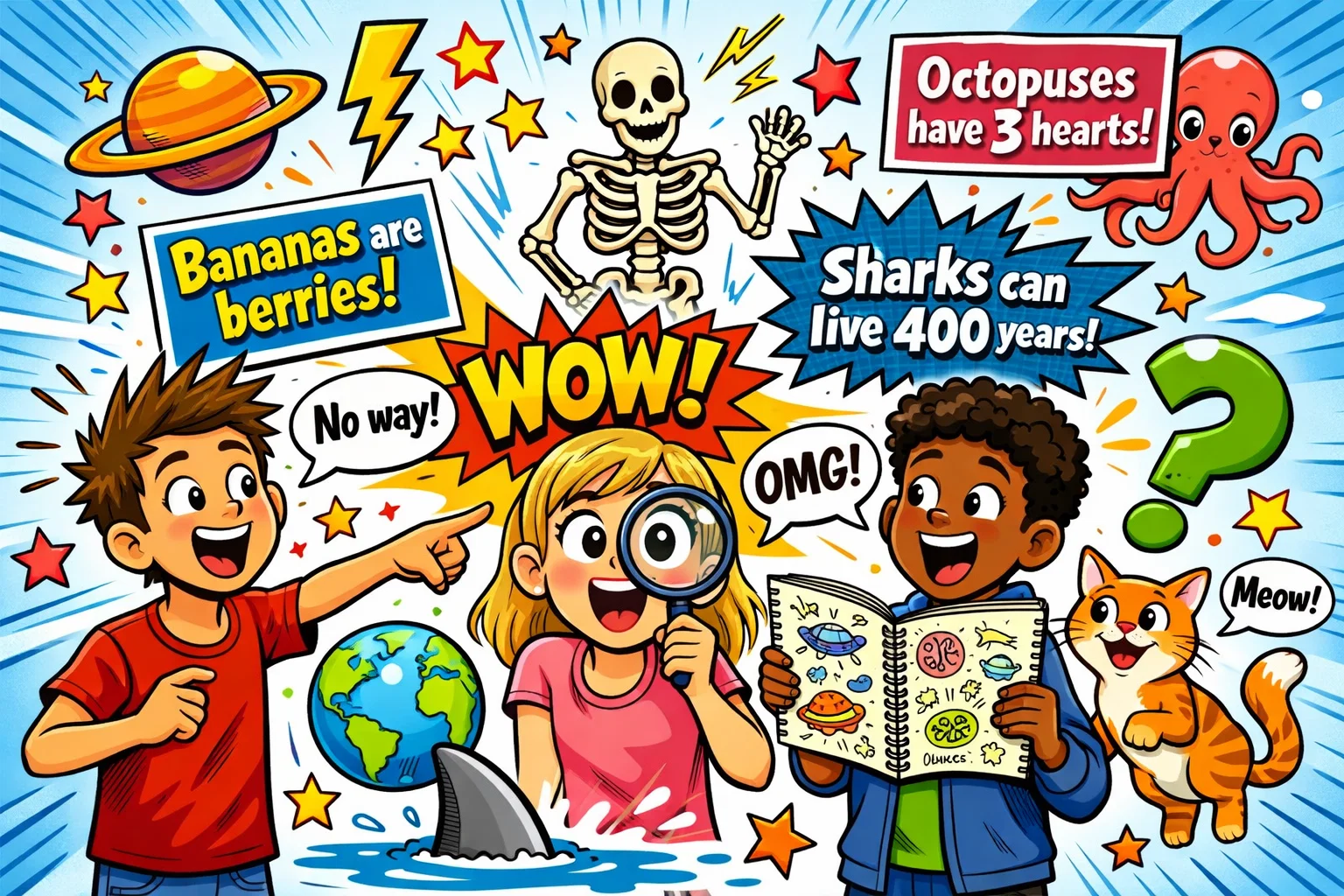
Welcome to the ultimate collection of fun facts for kids and young teens! Turning 13 is a major milestone—it marks the official start of the teenage years, a time of rapid cognitive development and expanding curiosity. This guide is specifically curated for middle-school readers, offering a mix of science fun facts, animal facts for kids, and weird fun facts that are perfect for breaking the ice at a dinner party, impressing friends at school, or winning your next family trivia night.
According to developmental psychologists, 13-year-olds are transitioning into a stage of ‘formal operational’ thought, which means they crave information that challenges their logic and broadens their worldview. From the depths of the deep sea to the edge of the galaxy, these amazing facts are designed to spark critical thinking and provide high-value entertainment for the modern high school student in training.
Random Fun Facts for 13 Year Olds

Random fun facts provide an instant hit of dopamine by revealing the hidden strangeness of our world. These high-impact tidbits cover everything from nature to history, ensuring you always have a “did you know?” moment ready for any conversation.
- The Immortal Jellyfish (Turritopsis dohrnii) can effectively live forever by reverting its cells to their earliest form after reaching maturity or facing a physical threat.
- The Eiffel Tower grows taller during the summer; because of thermal expansion, the iron structure can expand by up to 15 centimeters (6 inches) in high heat.
- A Blue Whale’s heart is the size of a bumper car, and its tongue alone weighs as much as an entire elephant.
- The American flag currently has 50 stars, but a 17-year-old high school student named Robert G. Heft designed it for a class project in 1958 and originally received a B- for his work.
Number and Word Facts
The English language and the world of mathematics are filled with weird fun facts that defy common logic. For instance, the word “alphabet” comes from the first two letters of the Greek alphabet: Alpha and Beta.
The ‘Trivium’ was a historical grouping of three subjects—grammar, logic, and rhetoric—that formed the core of education during the Victorian era. Today, we use ‘trivia’ to describe ‘tri-vial’ or ‘three-way’ points of intersection where general knowledge meets.
| Entity | Attribute | Value |
| “Forty” | Alphabetical order | Only number with letters in alphabetical order |
| “One” | Letter ‘B’ | First number name containing the letter ‘B’ (at one billion) |
| “Dreamt” | Ending | Only English word ending in “mt” |
Daily Life and Tech
Your daily routine is influenced by amazing facts that most people overlook. For example, the “Qwerty” keyboard layout was actually designed to slow down typists so the mechanical arms of early typewriters wouldn’t jam.
NASA’s technology doesn’t just stay in space; items like memory foam, scratch-resistant lenses, and even the CMOS sensors in your smartphone camera were originally developed for space missions. Modern social media platforms use algorithms designed to mimic the dopamine release of a slot machine, which is why ‘infinite scrolling’ feels so addictive to the teenage brain.
Record-Breaking Weird Facts
The World Record for the longest hiccups lasted 68 years; Charles Osborne started hiccuping in 1922 and didn’t stop until 1990. In architecture, the Burj Khalifa in Dubai is so tall that you can watch the sunset from the ground floor, take the elevator to the top, and watch the same sunset all over again.
Facts to Challenge Friends
Challenge your friends with “impossible” body feats: most people cannot lick their own elbow, and it is physically impossible to hum while holding your nose closed. Another great challenge is the “Stroop Effect,” where your brain struggles to say the color of a word if the word itself spells a different color (e.g., the word “Red” printed in blue ink).
Fun Facts About 13
This section is a tribute to the number 13 itself, offering a query-specific edge that moves beyond generic trivia for kids. While many cultures view 13 as unlucky, in the world of science and history, it is a number of great significance.
Number 13 in Math
In mathematics, 13 is a prime number, meaning it can only be divided by 1 and itself. It is also the sixth number in the Fibonacci sequence ($0, 1, 1, 2, 3, 5, 8, 13$), a pattern frequently found in nature, such as in the arrangement of leaves on a stem or the petals of a flower.
Number 13 in Pop Culture and Books
In the Harry Potter series, there is a superstition that when 13 people dine together, the first to rise will be the first to die. Similarly, in J.R.R. Tolkien’s The Hobbit, the company of dwarves specifically recruits Bilbo Baggins because they have 12 members and fear that a group of 13 would be cursed with bad luck.
Number 13 in Sports and Famous Moments
The legendary baseball player Babe Ruth wore the number 3, but many modern stars have reclaimed 13. NBA basketball legend Wilt Chamberlain wore number 13 throughout his career, proving that the “unlucky” number could dominate the court. In the NFL, quarterback Dan Marino famously wore 13 and became one of the greatest passers in history.
Turning 13 Milestone Facts
Turning 13 marks the biological onset of adolescence. During this year, the brain undergoes ‘synaptic pruning,’ clearing out unused neural connections to make room for more complex thinking. This is the year many students enter the trivium of middle school life, balancing new social identities with increased academic independence.
Science and Space Facts for 13 Year Olds

Science fun facts about the universe help us understand our tiny place in the vast galaxy. Space is not just empty; it is a laboratory of extreme physics and mind-blowing scales.
Planet and Moon
Jupiter is the fastest-spinning planet in our solar system, completing a full rotation in under 10 hours despite its massive size. Conversely, Venus has a day longer than its year; it takes 243 Earth days to rotate once, but only 225 days to orbit the Sun.
Physics and Chemistry
A single lightning bolt is five times hotter than the surface of the sun, with temperatures reaching roughly 30,000 Kelvin. In chemistry, the human body contains enough carbon to make 9,000 lead pencils and enough iron to forge a 3-inch nail.
Space Records and Extreme Facts
NASA’s Apollo missions showed that footprints on the moon will likely stay there for at least 100 million years because there is no wind or water to erode them. The largest known star, UY Scuti, is so big that if it replaced our Sun, its surface would extend beyond the orbit of Jupiter.
Experiment-Style Facts
You can demonstrate the “Mpemba effect” at home: under certain conditions, hot water can actually freeze faster than cold water. Another fun fact is that bananas are slightly radioactive because they contain potassium-40, though you would need to eat 10 billion bananas in one sitting to die of radiation poisoning.
Science Myths Teens Believe
Many people believe that sharks can smell a single drop of blood from miles away. While sharks have an incredible sense of smell, they can actually detect one part of blood per million parts of water—roughly one drop in an Olympic-sized swimming pool, not the entire ocean.
Geography Facts for 13 Year Olds
Geography is more than just maps; it is the study of the most extreme places on earth.
Country and Border
Russia has a larger surface area than the dwarf planet Pluto. On the other end of the spectrum, Vatican City is the smallest country in the world, measuring only about 0.2 square miles—it is smaller than many city parks in the U.S.
City and Landmark
The Eiffel Tower was originally intended to be a temporary installation for the 1889 World’s Fair and was nearly torn down for scrap metal. In Istanbul, Turkey, you can physically walk from Europe to Asia across a single bridge, as the city sits on two continents.
Ocean, Desert and Continent
The South Pole is located in Antarctica, which is technically the world’s largest desert because it receives so little moisture. The Dead Sea is the lowest point on Earth’s land surface, sitting over 1,400 feet below sea level, and its water is so salty that humans float effortlessly on the surface.
Map Facts That Feel Fake
Even though it looks further north on many maps, Rome, Italy, is actually further north than New York City. Additionally, the closest U.S. state to Africa is actually Maine, not Florida, due to the curve of the Earth.
Earth and Weather Facts for 13 Year Olds

Our planet’s atmosphere is a chaotic system capable of producing terrifying and beautiful phenomena.
Lightning, Thunder and Storm Facts
At any given moment, there are approximately 2,000 thunderstorms happening around the world. Lightning doesn’t just strike from the sky down; “upward lightning” can travel from the tops of skyscrapers or towers up into the clouds.
Tornado Facts
The fastest winds ever recorded on Earth were inside a tornado in Oklahoma, reaching speeds of more than 300 miles per hour. Most tornadoes occur in ‘Tornado Alley’ in the U.S., but they have been documented on every continent except for Antarctica.
Cloud, Rain and Wind Facts
A single fluffy cumulus cloud can weigh over one million pounds—about the same as 100 elephants. Raindrops aren’t actually tear-shaped; as they fall, they flatten out and look more like the top of a hamburger bun.
Volcano and Earthquake Facts
There are about 1,500 potentially active volcanoes worldwide. The “Ring of Fire” in the Pacific Ocean is home to 75% of the world’s volcanoes and 90% of the world’s earthquakes.
Animal Facts for 13 Year Olds
Animal fun facts are a staple of trivia because the natural world is full of “alien” behaviors and incredible biology.
Record-Breaking Animal Facts
The Blue Whale is the largest animal to ever live—bigger even than the largest dinosaur. A Hummingbird is the only bird that can fly backward, and its heart can beat up to 1,200 times per minute during flight.
Ocean Animal Facts
The Octopus has three hearts, nine brains, and blue blood. Two of the hearts pump blood to the gills, while the third circulates it to the rest of the body. Dolphin pods are highly social animals that have been observed using unique “signature whistles” to call each other by name.
Cat Facts
Cats and dogs have very different sensory worlds. A cat’s muzzle and whiskers are so sensitive they can detect changes in air currents to navigate in total darkness. Interestingly, domestic cats share 95.6% of their genetic makeup with tigers.
Lion and Big Cat Facts
A lion’s roar can be heard from up to five miles away. Unlike other cats, lions live in social groups called prides, where the females do the majority of the hunting while the males protect the territory.
Shark Facts
Sharks have been around for more than 400 million years—they are older than trees and dinosaurs! Unlike humans, sharks do not have bones; their skeletons are made entirely of cartilage, the same flexible material in your nose and ears.
Human Body Facts for 13 Year Olds
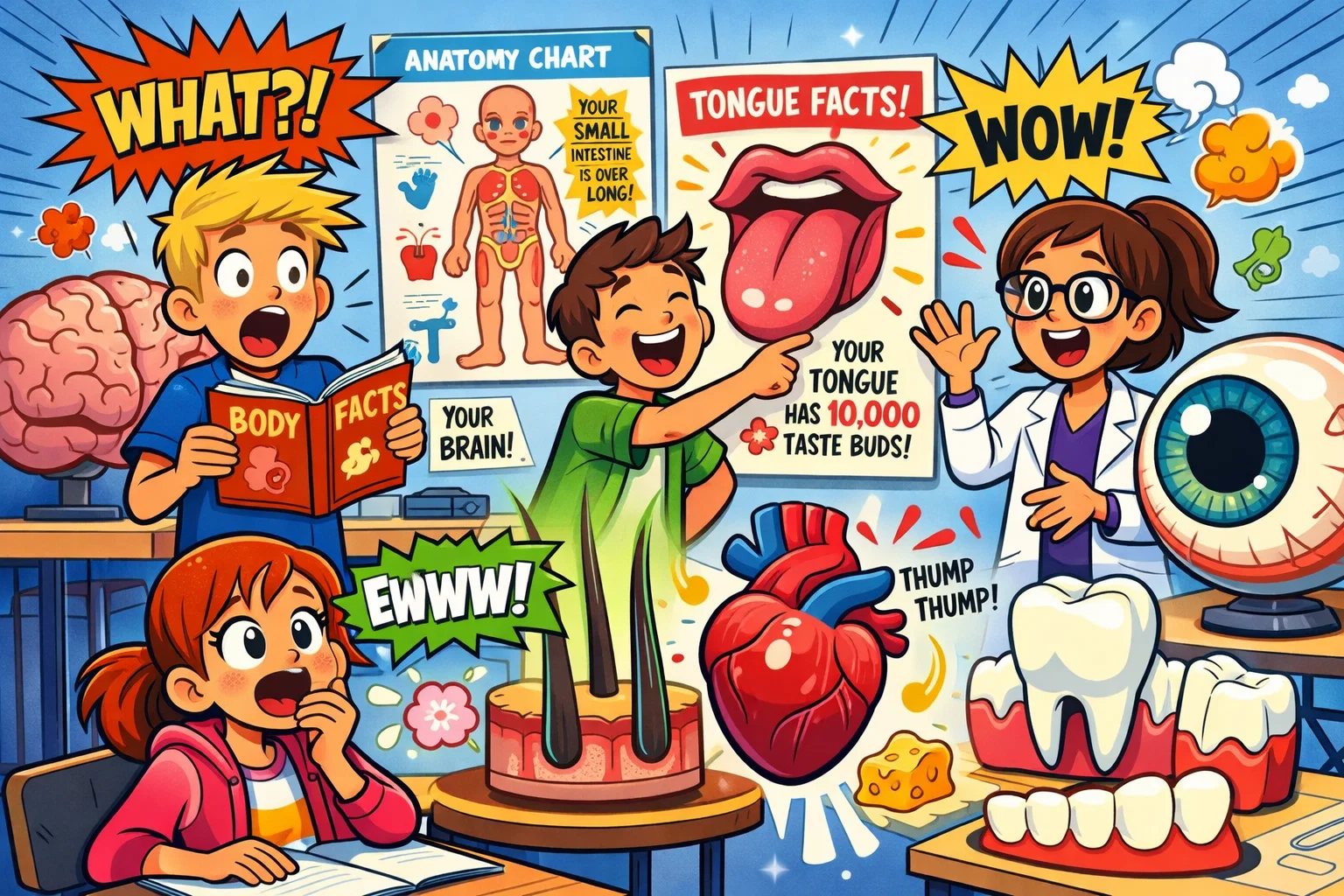
The human body is a biological marvel. By age 13, you have already gone through several “upgrades” as your adult teeth replace your baby teeth and your bones fuse together.
Brain and Senses Facts
Your brain generates enough electricity to power a small LED light bulb. While every person has a unique fingerprint, we also have a unique “tongue print” that is different from everyone else on Earth.
Bones, Muscles and Growth Facts
You are born with about 300 bones, but by the time you reach adulthood, you only have 206. This is because many bones, like those in your skull, fuse together as you grow. The strongest muscle in the human body relative to its size is the masseter, the muscle used for chewing.
Sleep, Energy and Food Facts
During a typical night’s sleep, the brain flushes out toxins and consolidates memories from the day. The human body is roughly 60% water, and your heart will beat about 2.5 billion times over an average lifetime.
Left-Handed Facts
About 10% of the world is left-handed. A southpaw (a common nickname for a lefty) often has a more developed right side of the brain, which is associated with creativity. Many famous figures, including Beethoven and several U.S. presidents, were lefties.
Gross but Safe Body Facts
The average person produces enough saliva in their lifetime to fill two swimming pools. Also, a sneeze travels at about 100 miles per hour, which is why it’s so important to cover your mouth!
Food Facts for 13 Year Olds
Food fun facts show that what we eat is often stranger than we realize.
Fruit and Vegetable Facts
A strawberry is not technically a berry because its seeds are on the outside, but a banana and a watermelon are botanically considered berries. If you drop a fresh cranberry on the floor, it will bounce like a rubber ball because of the small air pockets inside.
Candy, Snack and Fast Food Facts
The first chocolate bars were actually quite bitter; it wasn’t until the Victorian era that milk and sugar were added to create the candy we know today. Nutella was invented during World War II when cocoa was scarce, and hazelnuts were used to stretch the supply.
Cooking and Kitchen Facts
A chef’s hat (the toque) traditionally has 100 folds, said to represent the 100 ways a chef knows how to cook an egg. Also, honey is one of the few foods that never spoils; archaeologists have found 3,000-year-old pots of honey in Egyptian tombs that are still perfectly edible.
History and Royal Facts for 13 Year Olds
History is the story of humans doing weird, brave, and sometimes accidental things.
Ancient World Facts
The Egyptian pyramids were not built by slaves, but by paid laborers who took great pride in their work. In Ancient Rome, people used crushed snail shells as toothpaste to keep their teeth white!
Weird School History Facts
Before the 1920s, many students used small pieces of stale bread to erase pencil marks. It wasn’t until the invention of the rubber eraser that “bread erasers” went out of style.
Royal Facts
Queen Elizabeth II did not have a passport; because all British passports were issued in her name, she didn’t need one to travel. Similarly, the British monarch is the only person in the UK allowed to drive without a license.
Accidental Invention Facts
The Popsicle was invented by an 11-year-old boy in 1905 who accidentally left a glass of soda and a stirring stick out on his porch during a freezing night. He discovered the frozen treat the next morning and originally called it the “Epsicle.”
Sports Facts for 13 Year Olds
Football Facts
The first “football” games in the U.S. looked more like rugby and were so violent that President Theodore Roosevelt had to intervene to change the rules to make the sport safer.
Olympic Facts
In the early 1900s, the Olympics used to hand out a medal for architecture, literature, music, and painting. Today, the gold medal is actually mostly made of silver—only about 6 grams of it is actual gold.
Weird Sports Facts
There is a sport called “Chess Boxing” where players alternate between a round of chess and a round of boxing. There is also “Underwater Hockey,” where players push a puck along the bottom of a pool using short sticks.
Fun Facts for Teens and Middle Schoolers
Middle school is a unique time of life, and these facts reflect the social and academic world of a 13-year-old.
School and Homework Facts
The word “school” comes from the Greek word schole, which actually meant “leisure.” In the past, only people with free time (leisure) could afford to sit around and learn!
Social Media and Screen Time Facts
The average person spends about 2 hours and 24 minutes on social media every day. Curated, educational content can boost critical thinking and creativity more than mindless scrolling.
Daily Routine and Life Hack Facts
If you’re feeling a “mid-afternoon slump” at school, it’s often because the human body has a natural dip in core temperature around 2:00 PM. A quick walk or a glass of water can reset your energy levels more effectively than a sugary snack.
FAQ About Fun Facts for 13 Year Olds
What Random Fun Facts Fit 13 Year Olds?
Random facts for this age group should be surprising and intellectually stimulating. Good examples include science fun facts (like space records), animal facts (like the octopus having three hearts), and geography (like the size of Russia vs. Pluto).
What Cool Science Facts Fit Kids?
The best science facts are visual and easy to explain. For instance, telling a kid that Saturn would float in a giant bathtub because it is less dense than water is a great way to visualize planetary physics.
What Weird Facts Make Kids Laugh?
Harmless “gross” facts are usually the biggest hits. Mentioning that we swallow about a liter of snot a day or that wombat poop is cube-shaped will almost always get a laugh.
What Fun Fact Can You Tell Kids?
A great “go-to” fact is that a shrimp’s heart is located in its head. It’s short, surprising, and easy to remember for a dinner party or school break.
What Fun Facts Work for Middle Schoolers?
Middle schoolers respond best to facts involving tech, sports, and human body oddities. They are at an age where they enjoy debunking myths and learning the “why” behind the “what.”

Take a short quiz to find out what your everyday choices say about your parenting style
When your child is curious about something new, what’s your instinct?
Take a short quiz to find out what your everyday choices say about your parenting style
“Can I download this app?” What happens next?
Take a short quiz to find out what your everyday choices say about your parenting style
When it comes to rules at home, which sounds most like you?
Take a short quiz to find out what your everyday choices say about your parenting style
If you could give your child one life skill today, what would you pick?
Take a short quiz to find out what your everyday choices say about your parenting style
Your child gets to choose what to watch. What would your ideal setup look like?
Take a short quiz to find out what your everyday choices say about your parenting style
Pick your parenting superpower ✨