Best Party Games for 4-Year-Olds: Easy Birthday Activities

 Discover a Free Education Video App for Kids
Pastory uses AI to personalize educational video content based on your child’s interests and personality. Safe, engaging, and built for curious young minds. Sign up now to stay updated and enjoy early access with a free trial
Planning party games for 4-year-olds is genuinely different from organizing activities for older children. At this age, preschoolers are energetic and enthusiastic, but their attention spans typically last only 6 to 10 minutes per activity, and the emotional weight of losing a game can quickly derail an otherwise joyful celebration. The good news is that with the right game choices, simple rules, and a few no-elimination adaptations, a 4th birthday party can be both manageable for adults and genuinely fun for every child in the room.
Key Takeaways
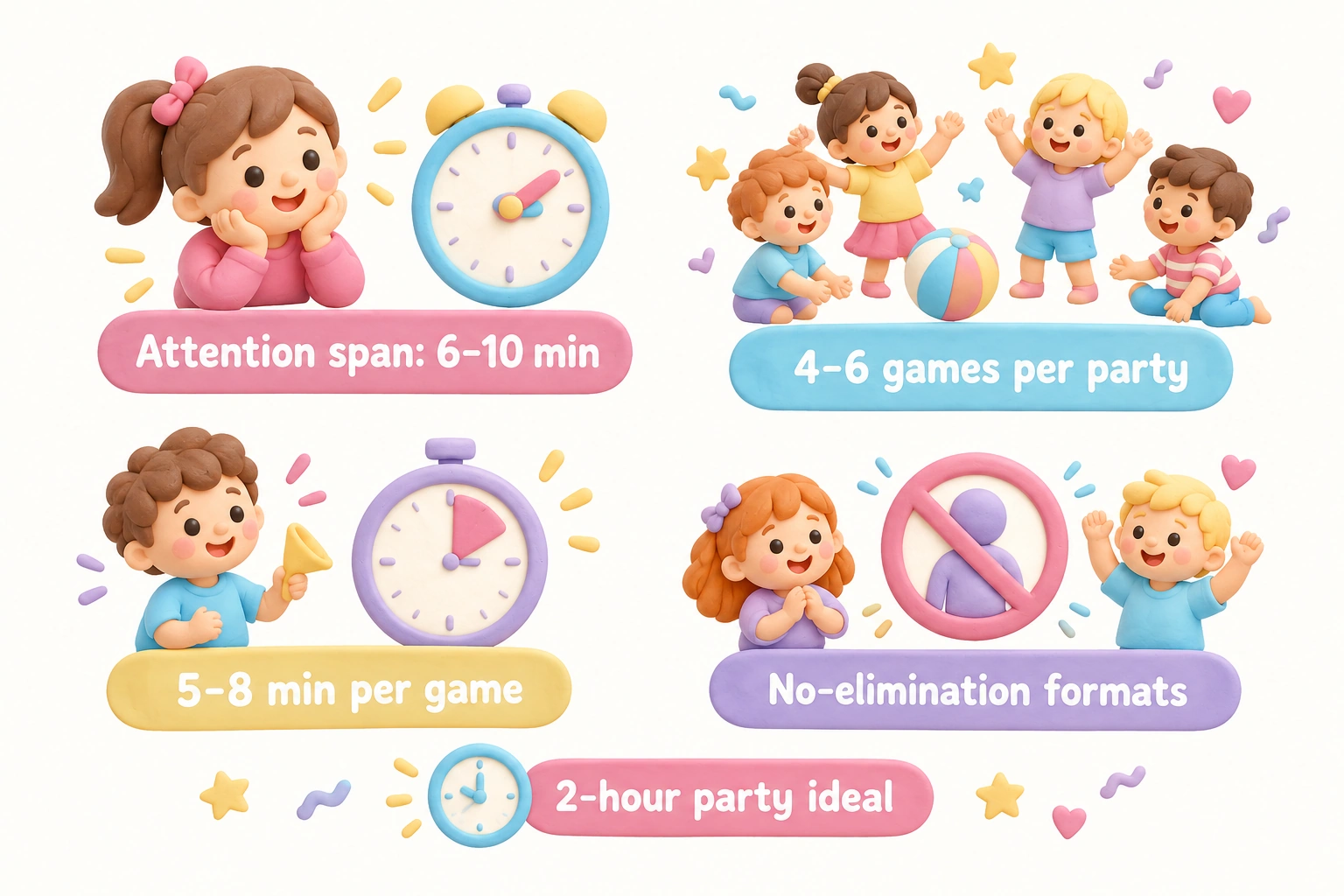
- Four-year-olds do best with games that have simple rules, short durations of 5 to 10 minutes, and no elimination — keeping every child involved from start to finish.
- A mix of high-energy and calm activities across a 2-hour party helps manage energy levels and reduces meltdowns before cake time.
- Classic games like freeze dance, pass the parcel, and duck duck goose remain highly effective because they match preschoolers’ gross motor development and love of movement.
- No-elimination adaptations of traditional games such as musical chairs make the experience more inclusive and reduce the risk of tears.
- Planning 4 to 6 games with a loose running order gives the party structure without feeling rigid.
Why Game Design Matters at Age Four
Four-year-olds are in a rich developmental window. Their gross motor skills are expanding rapidly — they can run, jump, balance, and throw with growing confidence — but their ability to regulate emotions when things do not go their way is still maturing. Research in early childhood development consistently shows that preschool-age children are not yet reliably able to handle competitive elimination without distress. When a child is sent to sit out of musical chairs after the first round, they may spend the rest of the game feeling excluded rather than enjoying the party.
This is not a reason to avoid structured games altogether. Structured play at this age supports turn-taking, listening skills, and early rule comprehension. The key is choosing age-appropriate party games that keep every child moving and engaged, rather than games that progressively remove participants. Developmental educators often describe this as shifting from competitive formats to participatory formats — everyone plays, everyone belongs, and small prizes or participation tokens replace the single-winner model.
Attention span is the other critical factor. Most 4-year-olds can sustain focused engagement with a single activity for roughly 6 to 10 minutes before interest begins to drift. Planning games that run for 5 to 8 minutes each, with brief transitions in between, tends to produce the smoothest parties. Trying to stretch a single game to 20 minutes almost always results in children wandering off or becoming disruptive — not because they are misbehaving, but because the activity has simply exceeded their developmental capacity for sustained attention.
Classic Indoor Party Games for 4-Year-Olds
Indoor games are the backbone of most 4th birthday parties, particularly when weather is unpredictable or the venue is a home or community hall. The games below are consistently effective because they require minimal equipment, have simple rules that preschoolers can grasp quickly, and keep the whole group moving.
Freeze Dance
Freeze dance is one of the most reliably successful birthday activities for 4-year-olds. Play music and encourage children to dance freely; when the music stops, everyone freezes in whatever position they are in. In the no-elimination version — strongly recommended for this age — nobody is ever out. Children simply freeze, giggle at each other’s poses, and start dancing again when the music resumes. This game supports gross motor skills, body awareness, and listening, and it can run happily for 6 to 8 minutes before naturally winding down.
Musical Chairs for 4-Year-Olds (No-Elimination Version)
Traditional musical chairs removes one chair and one child each round, which tends to produce tears at preschool parties. The no-elimination adaptation keeps all chairs in place and simply asks children to find a seat when the music stops — the fun comes from the scramble, not from anyone being excluded. You can add a silly challenge each round, such as sitting with a stuffed animal on your lap or making a funny face, to keep energy high. Musical chairs adapted this way remains one of the most popular indoor party games for preschoolers precisely because the core mechanic — moving and then stopping — is developmentally satisfying without the emotional cost of elimination.
Duck Duck Goose
Duck duck goose is a preschool classic for good reason. Children sit in a circle while one child walks around tapping heads and saying “duck” until they choose a “goose” who must chase them. The rules are simple enough for most 4-year-olds to follow after one demonstration, and the game naturally rotates participation. Keep rounds short and ensure every child gets a turn as the tapper to maintain engagement and fairness.
Pass the Parcel
Pass the parcel works especially well for calmer moments in the party schedule. Wrap a small prize in multiple layers of paper, with a small treat or sticker between each layer. Children sit in a circle and pass the parcel while music plays; when the music stops, the child holding the parcel unwraps one layer. Pre-planning the music stops so that every child unwraps at least one layer ensures no one feels left out — a small but meaningful adjustment that reflects the participation prizes ethos appropriate for this age group.
Simon Says
Simon Says builds listening skills and body awareness while keeping children active. At age four, children are just beginning to reliably follow two-step instructions, so keeping commands simple — “Simon says touch your nose,” “Simon says jump three times” — works best. Rather than eliminating children who move at the wrong time, treat mistakes as funny moments and keep everyone playing. The game can be themed to match the party: a dinosaur party might feature “Dinosaur Simon” giving roaring instructions.
Hot Potato
Hot potato involves passing an object quickly around a circle while music plays, with the child holding it when the music stops completing a fun challenge — such as doing five star jumps or making an animal sound — before the game continues. Avoiding elimination keeps all children engaged and prevents the anxiety that can arise when a 4-year-old realizes they might be singled out.
Pin the Tail on the Donkey
Pin the tail on the donkey is a gentle, low-energy game that works well as a transition activity between higher-energy games. Children take turns being blindfolded (or simply closing their eyes), spinning gently, and trying to place a paper tail on a poster. At age four, the blindfold can feel unsettling for some children, so offering the option to simply close their eyes is a sensible inclusive adjustment. The game can be themed — pin the horn on the unicorn, pin the tail on the dinosaur — to align with the party’s visual theme.
Outdoor Birthday Games for Kids
When space and weather allow, outdoor birthday games for kids offer more room for the large-movement play that 4-year-olds genuinely crave. Outdoor settings also reduce the noise and chaos that can build indoors when a group of preschoolers is fully energized.
Egg and Spoon Race
The egg and spoon race is a wonderful outdoor game because it challenges balance and hand-eye coordination without requiring any prior skill. Use plastic eggs and large spoons for safety and ease. Rather than racing competitively, frame it as a personal challenge — “Can you make it to the cone without dropping your egg?” — so that children focus on their own achievement rather than comparing themselves to others. Plastic eggs can be filled with a small treat so every finisher gets a reward.
Bean Bag Toss
A bean bag toss station is a flexible outdoor activity that works well as a drop-in game during arrival or free play periods. Set up a simple target — a hula hoop on the ground, a bucket, or a painted board with holes — at a distance appropriate for 4-year-olds (roughly 1 to 2 metres). Children take turns tossing bean bags and counting how many land in the target. This game supports hand-eye coordination and early counting skills, and it can run continuously without adult facilitation once the setup is in place.
Treasure Hunt for Preschoolers
A treasure hunt for preschoolers works best when clues are picture-based rather than text-based, since most 4-year-olds are pre-readers. Draw or print simple images of locations around the garden — under the slide, next to the flower pot, behind the big tree — and lead children as a group from clue to clue. Running the treasure hunt as a group activity rather than a competitive individual race keeps the experience collaborative and ensures no child is left behind. The treasure at the end can be a shared box of small prizes or a goody bag for each child.
Obstacle Course
A simple obstacle course using hula hoops, cones, a tunnel, and a low balance beam provides excellent gross motor challenge for 4-year-olds. Children at this age are developing balance, coordination, and spatial awareness, and navigating a physical course satisfies all three. Keep the course short — five to seven elements — and time each child individually rather than racing children against each other. Cheering for each participant as they complete the course creates a celebratory atmosphere without competitive pressure.
Sack Race
Sack races are a perennial outdoor favourite. Use pillowcases or purpose-made sack race bags, and run the race in short heats so children are not waiting too long. At age four, the physical challenge of staying upright in a sack is entertaining enough on its own; framing the activity as a fun challenge rather than a strict competition helps prevent frustration when children inevitably tumble.
Bubble Games
Bubble activities — whether chasing and popping bubbles from a bubble machine or competing to catch the most bubbles — are universally appealing to preschoolers and require almost no setup. Bubble games work particularly well as a transition activity between structured games or as a calming wind-down before food. They also adapt easily to small outdoor spaces or even indoor use near an open door.
Creative and Sensory Activities as Party Fillers
Not every moment of a 4th birthday party needs to be a structured game. Creative stations give children something to do during arrival, while other guests are still being dropped off, and during quieter moments in the schedule. A simple craft station — decorating a party hat, stamping a picture, or moulding a shape from Play-Doh — gives children a focused, calm activity that also produces a take-home keepsake. Sensory play trays filled with kinetic sand, water beads, or coloured rice can occupy small groups of children for surprisingly long stretches and are particularly useful for shy or anxious children who may find group games overwhelming at first.
Face painting is another popular filler activity that works well when a patient adult or older helper is available to manage the queue. Keep designs simple — a star, a butterfly, a paw print — so that each child’s turn is brief and the line moves quickly. Offering sticker alternatives for children who do not want their face painted ensures inclusivity.
No-Elimination Adaptations: Making Classic Games More Inclusive
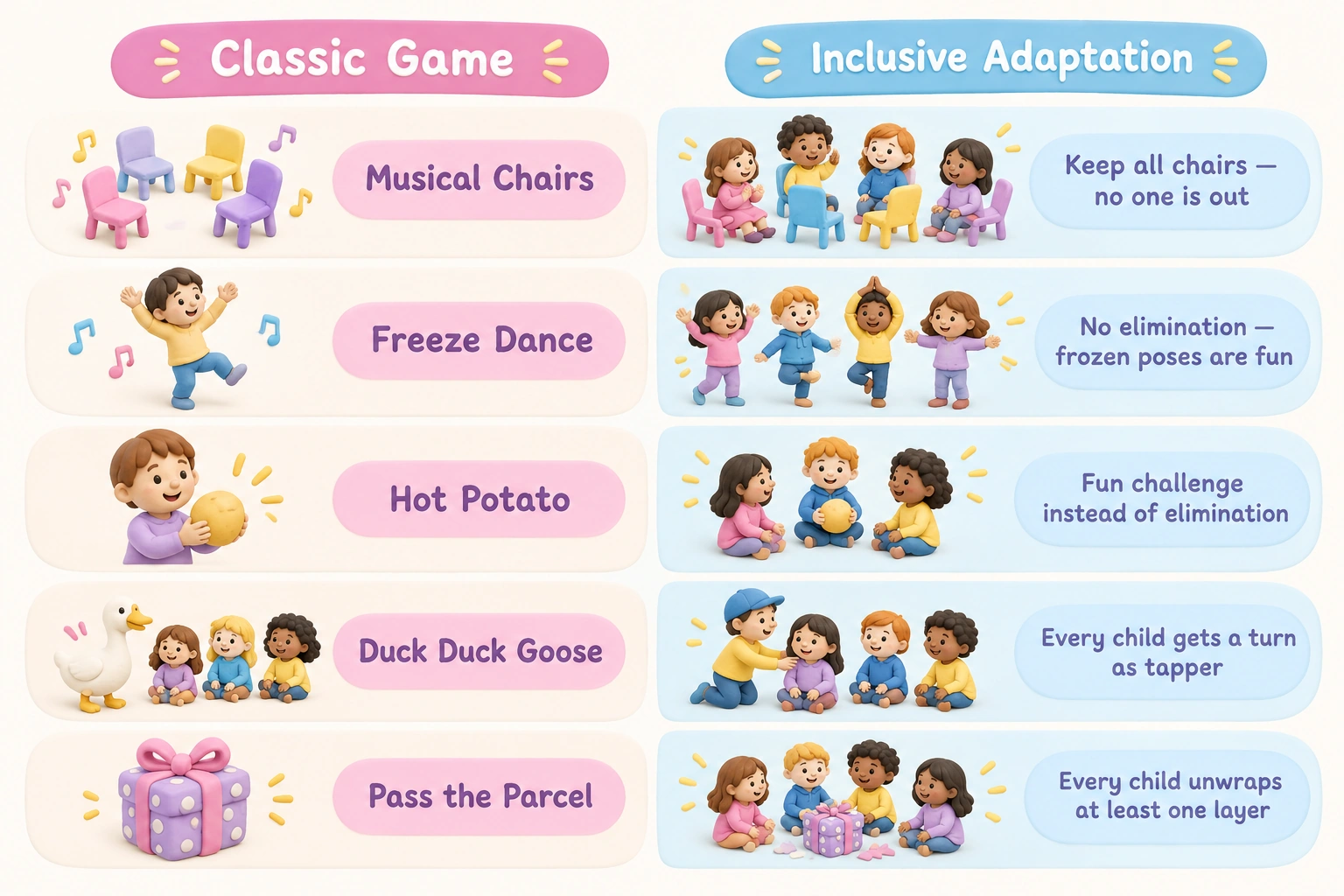
Many classic party games were designed for older children or adults and include elimination mechanics that do not suit preschool-age children well. Adapting these games for 4-year-olds is straightforward and significantly improves the experience for every child at the party.
- Musical chairs: Keep all chairs; focus on the fun of finding a seat rather than removing players.
- Freeze dance / musical statues: No one is ever out; frozen poses become a group comedy moment.
- Hot potato: The child holding the object completes a fun challenge rather than being eliminated.
- Duck duck goose: Ensure every child gets a turn as the tapper, regardless of who is caught.
- Pass the parcel: Pre-plan music stops so every child unwraps at least one layer.
The underlying principle is that at age four, the goal of a party game is shared enjoyment and movement, not identifying a winner. Participation prizes — small stickers, a lolly, a tiny toy — given to every child at the end of a game reinforce this ethos without diminishing the fun.
Sample Party Game Running Order for a 2-Hour Party
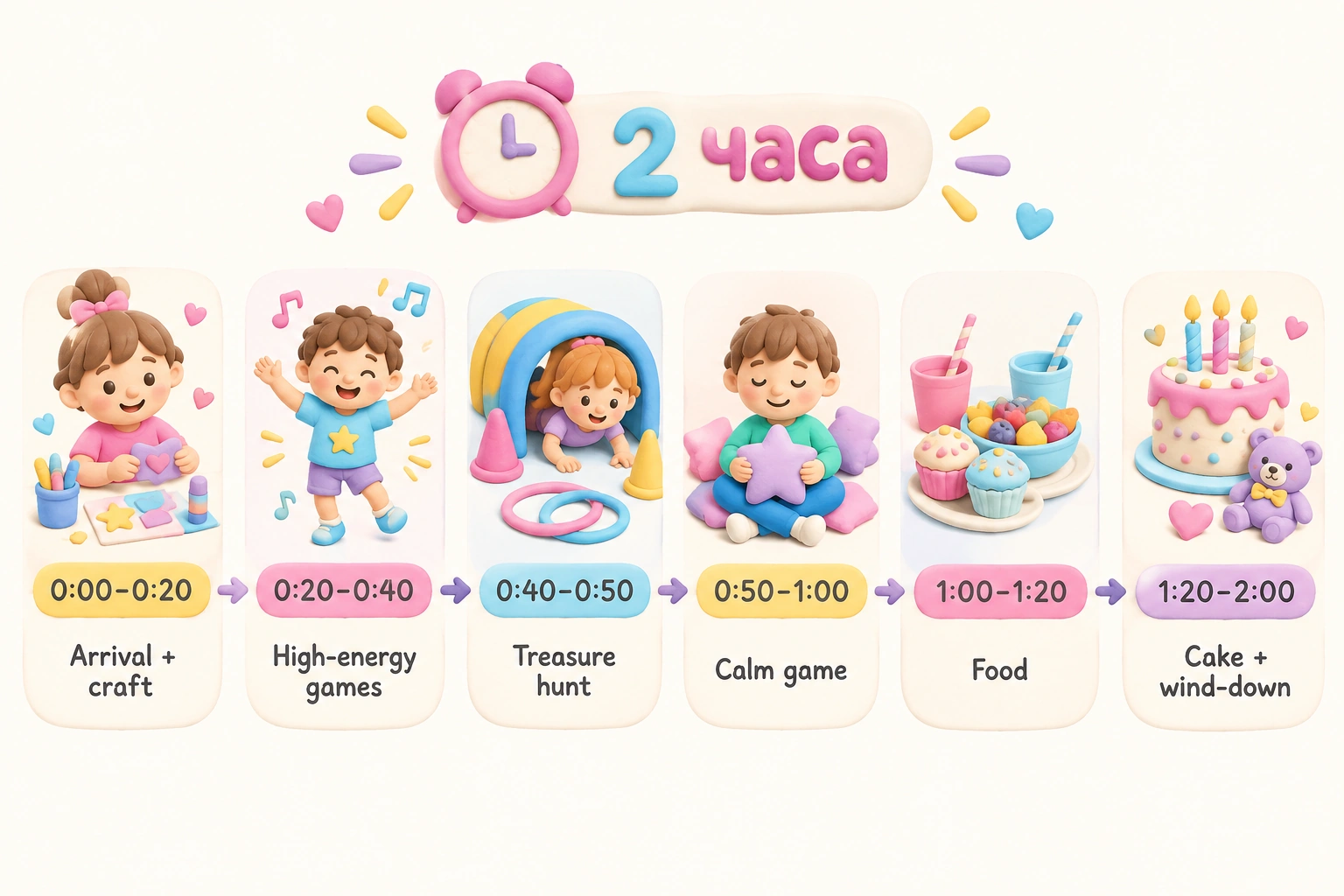
A loose running order helps the party flow smoothly and prevents the energy spikes and crashes that can occur when games are chosen on the fly. The following schedule is a practical starting point that can be adjusted to suit the venue, the number of children, and the specific games chosen.
| Time | Activity | Energy Level |
|---|---|---|
| 0:00 – 0:20 | Arrival + craft station or free play | Low / self-directed |
| 0:20 – 0:30 | Freeze dance or duck duck goose | High |
| 0:30 – 0:40 | Obstacle course or egg and spoon race (outdoor) / Simon Says (indoor) | High |
| 0:40 – 0:50 | Treasure hunt or bean bag toss | Medium |
| 0:50 – 1:00 | Pass the parcel or hot potato | Low / calm |
| 1:00 – 1:20 | Food and drinks | Rest |
| 1:20 – 1:35 | Birthday cake, singing, candles | Celebratory |
| 1:35 – 2:00 | Free play, bubbles, or craft station wind-down | Low |
This structure moves from high-energy games toward calmer activities before food, which aligns with how preschoolers manage their energy and reduces the likelihood of overtired meltdowns at the table. Keeping the party to approximately 2 hours is generally recommended for this age group, as longer events tend to exceed children’s capacity for sustained social engagement.
Tips for Mixed-Age Groups and Shy Children
Many 4th birthday parties include siblings and cousins ranging from toddlers to early primary age. Games like freeze dance, bubble activities, and treasure hunts adapt naturally to mixed ages because they do not require a specific skill level. For obstacle courses and races, simply adjust the starting distance or challenge level for younger children. Older siblings can be given a helper role — holding the music player, handing out bean bags, or guiding younger children through the treasure hunt — which keeps them engaged without making the games feel too easy.
Shy or anxious children often do best when they can observe a game for one round before joining. Avoid singling out a reluctant child or insisting they participate immediately. Offering a low-pressure entry point — standing near the circle rather than in it, or helping to hold the parcel — allows shy children to warm up at their own pace. Sensory stations and craft activities are particularly valuable for children who find group games overwhelming, as they provide a calm, self-directed alternative that still feels like part of the party.
Zero-Equipment and Budget-Friendly Game Options
Several of the most effective party games for 4-year-olds require no special equipment at all. Duck duck goose, Simon Says, freeze dance (using a phone and a free music app), follow the leader, and sleeping lions need nothing beyond a group of children and a small amount of floor space. For parents working with a tight budget, these games are genuinely sufficient for a full party schedule. When equipment is needed — bean bags, hula hoops, a parachute — many items can be borrowed from a local playgroup, school, or community centre rather than purchased.
A piñata is a popular budget-friendly addition that doubles as decoration and activity. Fill it with small wrapped sweets or stickers rather than choking-hazard items, and supervise carefully. Balloon games — keeping a balloon in the air, balloon tennis with paper plate paddles — are similarly low-cost and highly engaging for preschoolers.
Frequently Asked Questions
What games do you play at a 4-year-old birthday party?
The most effective party games for 4-year-olds are movement-based, have simple rules, and keep every child involved. Freeze dance, duck duck goose, pass the parcel, musical chairs (no-elimination version), Simon Says, and a picture-clue treasure hunt are consistently popular choices. Outdoor options like the egg and spoon race, bean bag toss, and a simple obstacle course work well when space allows.
How many games should I plan for a 4-year-old’s party?
For a 2-hour party, planning 4 to 6 games is generally sufficient. Each game typically runs for 5 to 10 minutes, and transitions between games add a few minutes. Having one or two backup games in mind is useful if a particular activity does not land well with the group.
Should games have winners at a 4-year-old’s party?
Developmental guidance consistently suggests that competitive elimination formats are not well-suited to preschool-age children. At age four, children are still developing the emotional regulation skills needed to handle losing gracefully. No-elimination formats and participation prizes — where every child receives a small reward — tend to produce a more positive experience for the whole group.
How long should each game last at a 4-year-old’s party?
Most games work best when kept to 5 to 10 minutes. Four-year-olds typically sustain focused attention for 6 to 10 minutes per activity, so ending a game while children are still enjoying it — rather than waiting for interest to fade — keeps energy and mood positive throughout the party.
Are indoor or outdoor games better for 4-year-olds?
Both work well, and the best choice depends on the venue, weather, and number of children. Outdoor games offer more space for large-movement activities like races and obstacle courses. Indoor games are more controllable and weather-proof. A combination of both, or a set of indoor games with outdoor adaptations as backup, gives the most flexibility.
How do I keep shy children involved in party games?
Allow shy children to observe for one round before joining. Offer low-pressure entry points such as helping to hold equipment or standing near the group rather than in the centre. Sensory stations and craft activities provide a calm parallel option for children who find group games overwhelming. Avoid drawing attention to a child’s reluctance in front of the group.
How long should a 4-year-old’s birthday party last?
A 2-hour party is generally considered the sweet spot for preschool-age children. Shorter parties can feel rushed; longer parties tend to exceed children’s capacity for sustained social engagement and increase the likelihood of overtired behaviour. Starting the party in the mid-morning or early afternoon, when children are typically at their most energetic, also helps.
Choosing the Right Games for Your Child’s Party
The best party games for 4-year-olds share a few consistent qualities: simple rules that can be explained in under a minute, enough movement to satisfy preschoolers’ physical energy, and formats that keep every child involved rather than progressively excluding participants. Classic games like freeze dance, pass the parcel, duck duck goose, and the egg and spoon race have remained popular across generations precisely because they deliver on these qualities reliably.
The most important adjustment parents can make is shifting away from elimination-based formats toward participatory ones. This single change — keeping every child in the game from start to finish — tends to produce noticeably calmer, happier parties at this age. Pair that with a loose party game running order that moves from high-energy to calm before food, plan 4 to 6 games with simple setup, and keep each activity to around 5 to 10 minutes. With those foundations in place, the specific games matter less than the overall structure and atmosphere you create. A 4th birthday party does not need elaborate equipment or complex planning — it needs movement, laughter, and the reassurance that every child belongs in the fun.

Take a short quiz to find out what your everyday choices say about your parenting style
When your child is curious about something new, what’s your instinct?
Take a short quiz to find out what your everyday choices say about your parenting style
“Can I download this app?” What happens next?
Take a short quiz to find out what your everyday choices say about your parenting style
When it comes to rules at home, which sounds most like you?
Take a short quiz to find out what your everyday choices say about your parenting style
If you could give your child one life skill today, what would you pick?
Take a short quiz to find out what your everyday choices say about your parenting style
Your child gets to choose what to watch. What would your ideal setup look like?
Take a short quiz to find out what your everyday choices say about your parenting style
Pick your parenting superpower ✨