Best Party Games for 3-Year-Olds: Movement and Music

 Discover a Free Education Video App for Kids
Pastory uses AI to personalize educational video content based on your child’s interests and personality. Safe, engaging, and built for curious young minds. Sign up now to stay updated and enjoy early access with a free trial
Planning age-appropriate party games for 3-year-olds is one of the most rewarding — and occasionally chaotic — parts of organizing a toddler birthday celebration. Three-year-olds are at a fascinating developmental crossroads: they are moving from parallel play toward early cooperative play, they love music and movement, and they have a toddler attention span that typically sustains focused engagement for around three to five minutes per activity. The games that work best at this age are non-competitive, physically active, musically driven, and simple enough to understand in one sentence. This article covers the most effective movement and music games for a 3-year-old party, explains why each one works developmentally, and gives you practical guidance on sequencing, adapting rules, and keeping the energy just right from start to finish.
Key Takeaways
- Three-year-olds thrive with short, no-elimination games that use music as a cue — freeze dance and musical statues are consistently the most successful choices at this age.
- Games should be non-competitive and cooperative wherever possible; winning and losing is a concept most 3-year-olds are not yet developmentally ready to manage without distress.
- Sequencing games from warm-up to peak energy to calm-down helps manage the group’s arousal level and prevents meltdowns before cake time.
- Movement-based party games support gross motor skills, body awareness, impulse control, and early listening skills — making them genuinely developmental, not just entertaining.
- Simple props such as scarves, balloons, cushions, and a Bluetooth speaker are all you need; elaborate setups are unnecessary and often counterproductive with this age group.
What Makes a Party Game Work for a 3-Year-Old?
Three-year-olds are preschool-age children who are developing rapidly across physical, cognitive, and social-emotional domains, but they are not yet miniature school-age kids. Their working memory is still maturing, which means multi-step rules are genuinely confusing rather than simply ignored. Their impulse control — governed by the still-developing prefrontal cortex — is limited, so games that require waiting, sitting still, or accepting elimination are likely to produce tears rather than fun. What 3-year-olds do have in abundance is enthusiasm for music, a strong drive to move their bodies, and a growing delight in doing things alongside other children.
The most effective age-appropriate party games for this group share a few consistent features. Rules can be explained in one or two sentences. The game starts almost immediately after explanation. Music provides a clear, exciting cue for action and stopping. Every child stays involved throughout — no elimination means no child is left sitting on the sidelines feeling excluded. Rounds are short, typically two to four minutes, so the game ends before attention drifts. And the overall tone is joyful and low-stakes, with adults facilitating rather than judging.
Developmentally, movement and music games at age three can support gross motor skills such as jumping, balancing, and coordination; early self-regulation through the stop-start structure of freeze games; listening skills as children respond to musical cues; and the beginnings of cooperative play as children share space and take turns. These are genuine developmental benefits, though outcomes will vary by child and depend significantly on how engaged and supportive the adult facilitators are.
How to Sequence Games by Energy Level
One of the most practical things a party host can do — and something most party planning guides overlook — is to think about energy sequencing. Rather than picking games at random, arrange them in a deliberate arc: start with a gentle warm-up game that gets children moving without overwhelming them, build toward one or two high-energy peak activities, then use a calm-down game to bring the group back to a manageable level before food or cake. This approach mirrors the structure used in early childhood music and movement classes, where tempo and intensity are deliberately varied to support self-regulation.
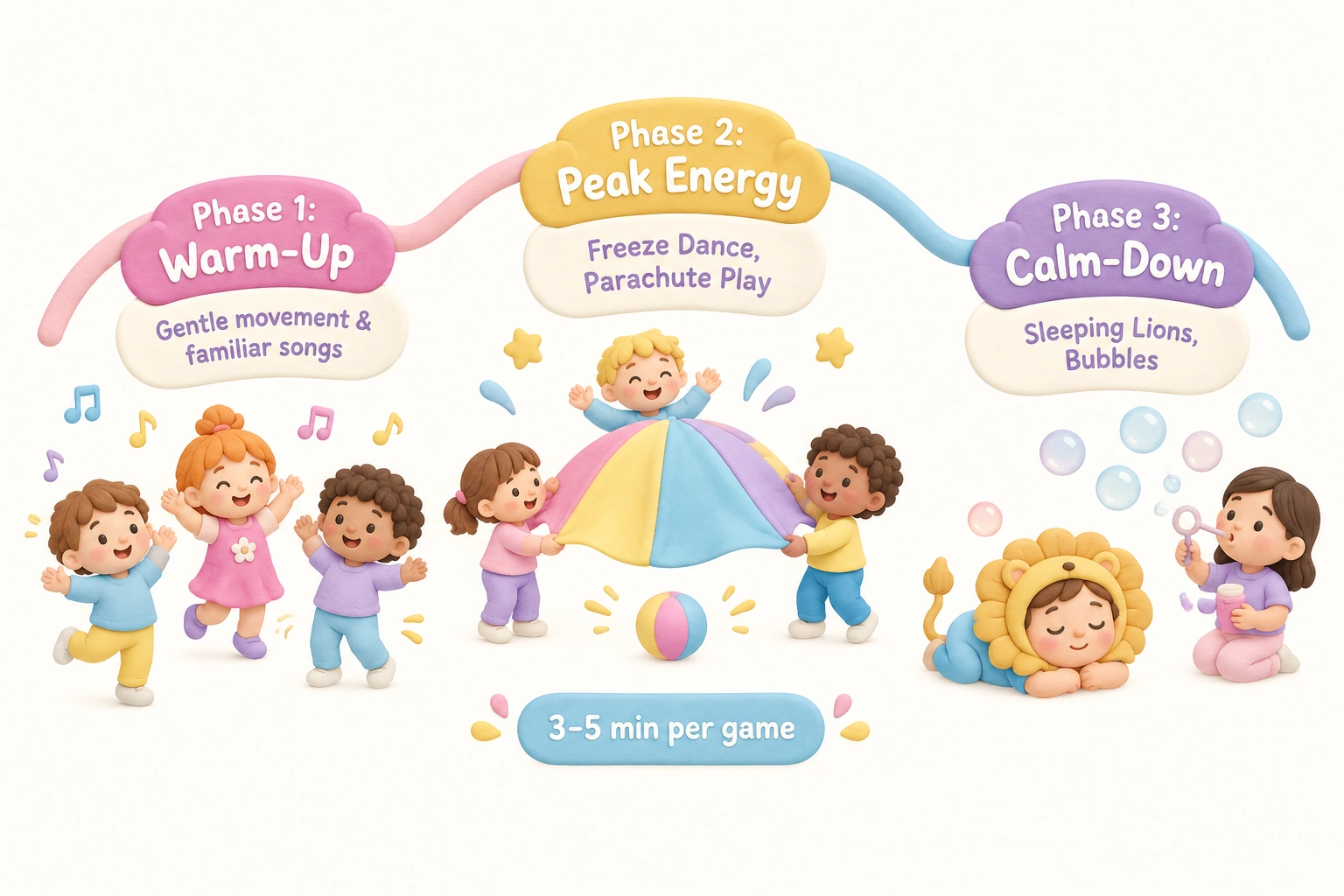
A simple three-phase structure works well for a 3-year-old party lasting around 90 minutes of active time. In the warm-up phase (roughly the first 15–20 minutes), use games with gentle movement and familiar songs that help children settle into the group. In the peak energy phase (the middle 30–40 minutes), introduce the most physically active games such as freeze dance and parachute play. In the calm-down phase (the final 10–15 minutes before food), use quieter activities such as Sleeping Lions or scarf dancing to bring arousal levels down. This sequencing reduces the likelihood of overstimulation and makes transitions to eating or cake-cutting much smoother.
Warm-Up Games: Getting Everyone Moving Together
Follow the Leader
Follow the Leader is an ideal opening game because it requires no explanation beyond “do what I do” and immediately gets every child moving. An adult leads the group around the space, performing simple actions — marching, stomping, tiptoeing, flapping arms like a bird — while upbeat kids’ music plays in the background. Children follow along, mirroring the movements. After a minute or two, a child can take a turn as leader. This game supports body awareness, imitation skills, and early cooperative play, and it works equally well indoors or outdoors with any group size.
Hokey Pokey
The Hokey Pokey (also known as the Hokey Cokey) is a classic circle game that works beautifully as a warm-up because the song itself provides all the instructions. Children put body parts in, take them out, and shake them about — a sequence that is repetitive, predictable, and genuinely funny to a 3-year-old. The repetitive structure is developmentally appropriate because 3-year-olds learn through repetition and find comfort in predictable patterns. The Hokey Pokey also introduces early body-part identification and left-right awareness in a completely pressure-free context.
Scarf and Ribbon Dancing
Give each child a lightweight scarf or ribbon stick and play a mix of upbeat and flowing songs. Encourage children to wave, swirl, and dance freely with their scarves. This is a low-structure activity that works well at the start of a party when children are still arriving and the group size is uneven. Scarf dancing supports fine motor skills through gripping and waving, gross motor skills through whole-body movement, and imaginative play as children invent their own movements. It also functions as a gentle sensory experience — the visual movement of the scarves is calming and engaging simultaneously.
Peak Energy Games: The Heart of the Party
Freeze Dance
Freeze dance is the single most cited and most successful party game for 3-year-olds, and for good reason. The rules are immediately understandable: dance when the music plays, freeze like a statue when the music stops. An adult controls the music, pausing it at unpredictable intervals to keep children alert and engaged. In the no-elimination version — which is strongly recommended for this age — every child simply unfreezes and dances again when the music restarts. There are no winners or losers, just repeated cycles of joyful movement and sudden stillness.
Freeze dance is particularly valuable because the stop-start structure directly exercises impulse control and self-regulation, which are key developmental tasks for 3-year-olds. When the music stops, children must inhibit their movement — a genuine cognitive challenge at this age that becomes more manageable through repeated, playful practice. For music, fast-paced children’s songs work well for the dancing sections; pausing mid-song creates the most excitement. Songs from familiar children’s playlists — including action songs and popular toddler tracks — keep children engaged because they recognize and respond to the music.
Musical Statues (Musical Bumps Variation)
Musical statues is essentially freeze dance with a slightly different physical challenge: children must hold a still pose when the music stops rather than simply freezing in place. Musical bumps is a related variation where children sit down quickly on the floor when the music stops. Both games use the same when-the-music-stops mechanic and work best in the no-elimination format. For 3-year-olds, the sitting-down version (musical bumps) is often easier to manage because it gives children a clear, unambiguous action to perform. Run short rounds of 60–90 seconds each to maintain excitement.
Musical Spots
Musical spots is the most inclusive adaptation of traditional musical chairs. Instead of chairs, place colorful mats, cushions, or carpet squares on the floor — one per child, or even more than one per child to remove any competitive element entirely. When the music stops, children find a spot to stand or sit on. Because there are enough spots for everyone, no child is ever out. This version preserves the excitement of the when-the-music-stops mechanic while completely eliminating the distress of elimination. It also introduces color recognition if you use differently colored mats, and spatial awareness as children navigate the space.
Animal Movement Game
The animal movement game combines imaginative play with gross motor activity in a way that 3-year-olds find irresistible. An adult calls out an animal — elephant, frog, butterfly, crab — and children move around the space imitating that animal’s movement while music plays. When the music stops, a new animal is called. This game supports body awareness, coordination, balance, and imaginative play simultaneously. It also works well with animal-themed birthday parties and can be extended by having children make the animal’s sound as they move, adding a language and auditory dimension to the activity.
Hot Potato
Hot Potato involves passing an object — a beanbag, a soft ball, or even a wrapped parcel — around a circle while music plays. When the music stops, the child holding the object does a fun action (jumps three times, does a spin, roars like a lion) rather than being eliminated. This no-elimination adaptation keeps every child engaged and turns the moment of holding the potato into something exciting rather than something to dread. Hot Potato supports turn-taking, listening skills, and fine motor coordination, and the circle format encourages early cooperative play as children work together to keep the object moving.
Pass the Parcel
Pass the parcel is a traditional party game that works well for 3-year-olds when adapted thoughtfully. Wrap a small prize in multiple layers of paper, with a small treat or sticker between each layer. Children sit in a circle and pass the parcel while music plays; when the music stops, the child holding it unwraps one layer. For this age group, it helps to ensure every child gets a turn unwrapping a layer by controlling the music carefully. The anticipation of unwrapping, the social experience of passing, and the reward of a small treat make this a satisfying activity that also supports turn-taking and patience — both genuinely challenging skills for 3-year-olds.
Duck Duck Goose
Duck Duck Goose is a circle game where one child walks around the outside of the circle, tapping each seated child’s head and saying “duck” until they choose one child and say “goose” — who then chases them around the circle. For 3-year-olds, the chasing element is the highlight, and the game works best with adult facilitation to keep the pace moving and ensure every child gets a turn as the tapper. Keep rounds very short and rotate quickly so no child waits too long. Duck Duck Goose supports gross motor skills through running, spatial awareness, and early social interaction.
Parachute Play
If you have access to a play parachute, parachute play is one of the most engaging and developmentally rich activities for a group of 3-year-olds. Children stand around the edge of the parachute, each holding a handle, and work together to make waves, lift it high, or keep a balloon bouncing on top. Parachute play is inherently cooperative — the activity only works when everyone participates — making it an excellent vehicle for early cooperative play skills. It also supports gross motor development through pulling, lifting, and coordinating arm movements. Play upbeat kids’ music during parachute activities to add energy and rhythm to the movement.
Calm-Down Games: Bringing the Energy Back Down
Sleeping Lions
Sleeping Lions is one of the most strategically useful games in a 3-year-old party toolkit, and it is significantly underused. Children lie down on the floor as still and quiet as possible, pretending to be sleeping lions. An adult (or older child) walks around trying to make the lions move or laugh without touching them. The last child to move wins, but in practice the real value is the transition: Sleeping Lions reliably brings a group of overstimulated toddlers from peak excitement back to a calm, manageable state within two to three minutes. Use it deliberately between high-energy games or immediately before food and cake to prevent the meltdowns that often accompany the transition from active play to sitting still.
Bubble Chase
Blowing bubbles and inviting children to chase and pop them is a gentle, joyful calm-down activity that works beautifully at the end of a party’s active phase. The slow, floating movement of bubbles naturally slows children’s pace, and the focused attention required to track and pop individual bubbles provides a gentle sensory break. Bubble chase can be done indoors or outdoors and requires no rules or explanation — children instinctively know what to do. It also works well as a transitional activity while waiting for all children to gather before food.
A Curated Music Playlist: Matching Songs to Game Types
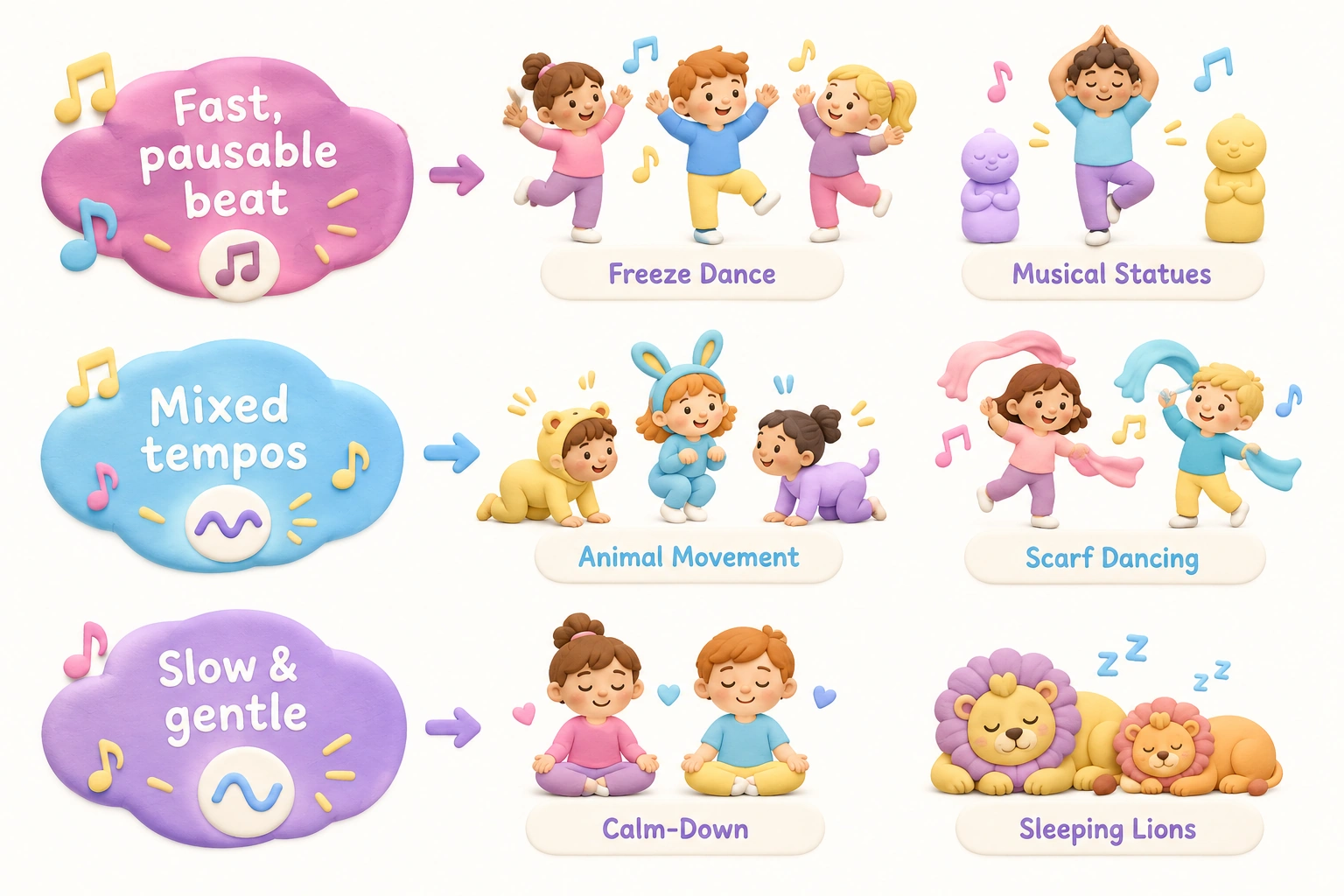
Most party planning guides mention a few song titles but rarely explain how to match music to specific game types. The tempo and structure of the music matters more than the specific song. For freeze dance and musical statues, choose songs with a clear, steady beat that can be paused mid-track for maximum surprise — upbeat pop-style children’s songs work well here. For the Hokey Pokey, use the traditional Hokey Pokey recording, which provides its own instructions. For animal movement games and scarf dancing, mix faster tracks (for energetic animals like frogs and horses) with slower, flowing tracks (for butterflies and elephants). For calm-down activities, switch to slower, quieter instrumental music or gentle lullaby-style tracks. Having a pre-built playlist on a Bluetooth speaker, organized by game phase, removes the need to search for songs mid-party and keeps transitions smooth.
Props and Setup Checklist
One of the practical content gaps in most party game guides is the absence of a simple preparation checklist. Before the party, gather the following items based on which games you plan to run: a Bluetooth speaker with a charged battery and a pre-built playlist; colorful mats, cushions, or carpet squares for musical spots; lightweight scarves or ribbon sticks for scarf dancing; a soft ball or beanbag for hot potato; a pre-wrapped pass the parcel with layers and small treats; a play parachute if available; a bubble solution and wand for the calm-down phase; and small prizes such as stickers or mini bubbles for any game that benefits from a reward moment. None of these items require significant expense, and having them ready before guests arrive prevents the frantic searching that disrupts game flow.
What to Avoid at a 3-Year-Old Party
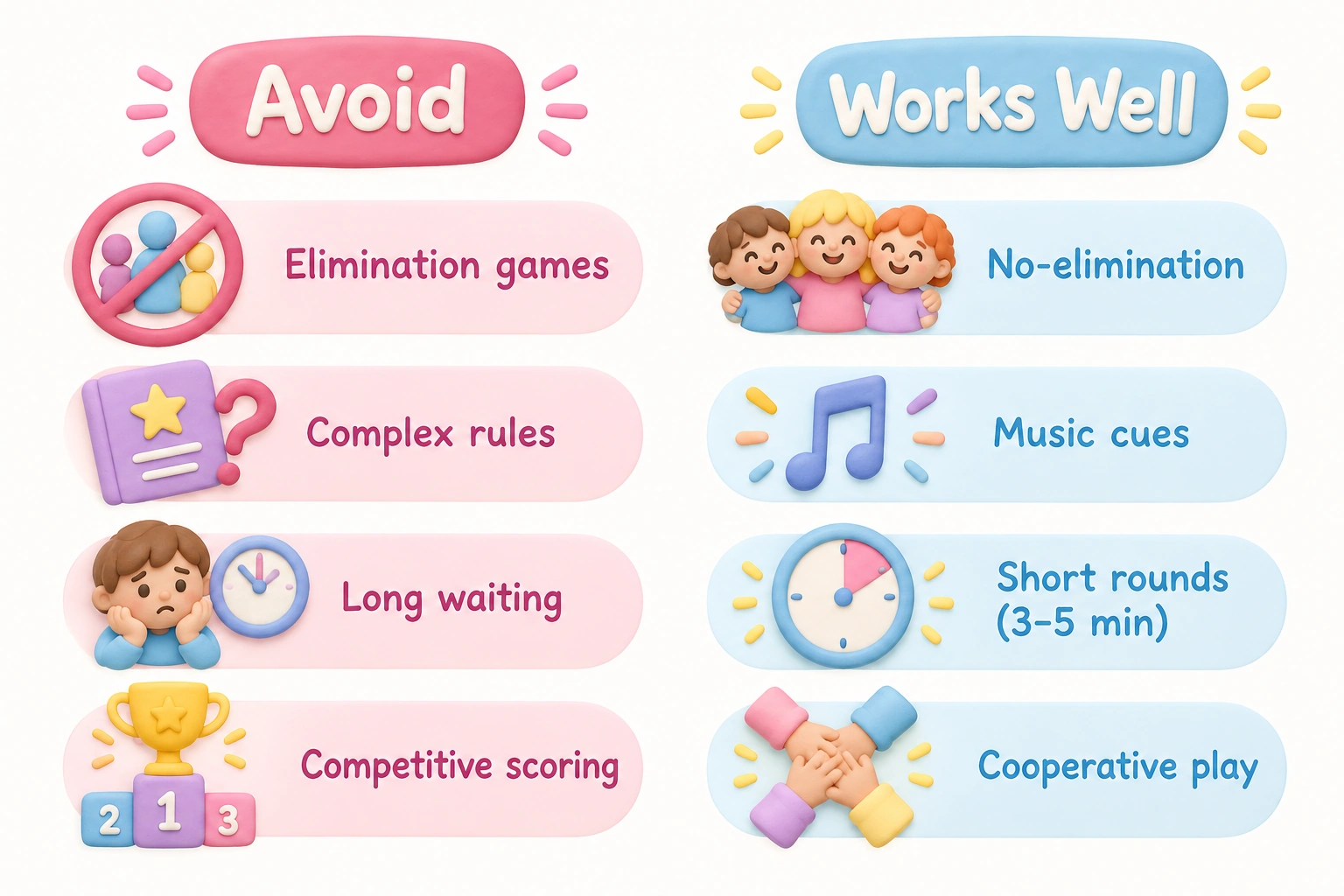
Elimination-based games are the most important thing to avoid with this age group. When a 3-year-old is “out” of a game, they typically do not sit patiently on the sidelines — they become distressed, disruptive, or simply wander away. The no-elimination principle is not just about kindness; it is developmentally appropriate because 3-year-olds do not yet have the emotional regulation skills to manage the disappointment of being excluded. Similarly, avoid games with complex multi-step rules, long waiting periods, or competitive scoring. Games that require reading, counting beyond five, or understanding abstract concepts are not yet accessible to most 3-year-olds. Keep every game simple, physical, musical, and inclusive.
Troubleshooting: When a Game Isn’t Working
Even well-planned games sometimes fall flat with a group of toddlers. If children are losing interest, shorten the round immediately and move to the next game rather than persisting. If a child becomes upset or overwhelmed, have a quiet corner with a calm activity — a bubble station or a basket of simple instruments — where they can decompress without missing the party entirely. If the group energy is too high and children are not responding to instructions, go straight to Sleeping Lions as a reset tool before attempting another active game. Having one or two backup activities in mind — a simple sing-along or a spontaneous dance party with no rules — gives you flexibility when the planned schedule needs adjusting. The goal is a joyful experience, not a perfectly executed program.
Frequently Asked Questions
How long should each game last at a 3-year-old party?
Most games work best in short rounds of three to five minutes for this age group. A toddler attention span typically sustains focused engagement for around this duration before interest begins to drift. It is better to end a game while children are still enjoying it and move on than to extend it until engagement collapses. Plan for six to eight games across a 60–90 minute active period, with smooth transitions between each.
How many children can play these games at once?
Most of the games listed here work with groups of four to twenty children. Circle games such as Duck Duck Goose and pass the parcel work best with groups of six to twelve. Freeze dance, musical statues, and animal movement games scale easily to larger groups. Parachute play typically works best with eight to sixteen children depending on the parachute size.
Do I need a DJ or special equipment?
A Bluetooth speaker and a smartphone playlist are all you need. The most important technical requirement is the ability to pause and resume music quickly and reliably for freeze-style games. Avoid setups where pausing the music requires navigating multiple screens or menus — simplicity and speed matter when you are also managing a group of excited toddlers.
Should prizes be given for winning games?
For non-competitive games, prizes work best when every child receives one — a sticker, a small bubble wand, or a mini stamp — rather than only the “winner.” This approach is consistent with the no-elimination philosophy and prevents the distress that comes when some children receive prizes and others do not. Small prizes also work well as participation rewards at the end of the party’s game segment.
What if some children are shy or reluctant to join in?
Never pressure a reluctant child to participate. Many 3-year-olds need several minutes of observation before they feel comfortable joining a group activity, particularly in a stimulating party environment. Allow shy children to watch from the edge of the group, and invite rather than insist. Games with no defined “wrong” way to participate — such as scarf dancing or bubble chase — are often the easiest entry points for hesitant children.
Can these games work outdoors as well as indoors?
Most of the games listed here adapt easily to both settings. Freeze dance, animal movement games, follow the leader, and parachute play all work well outdoors with more space. Musical spots and pass the parcel work better indoors where the group can be contained more easily. For outdoor parties, a portable Bluetooth speaker with good battery life is essential, and it helps to define the play area clearly so children do not drift too far from the group.
Planning a 3-Year-Old Party That Feels Joyful, Not Stressful
The most successful party games for 3-year-olds share a common quality: they put movement, music, and inclusion at the center, and they keep adult-imposed structure light enough that children feel free rather than managed. Freeze dance and musical statues remain the most reliably effective choices because the when-the-music-stops mechanic is immediately intuitive and endlessly repeatable. Parachute play, animal movement games, and scarf dancing add variety and support different developmental domains. Sleeping Lions and bubble chase give you reliable tools for managing the group’s energy when you need to bring things down before food or cake.
You do not need elaborate decorations, expensive equipment, or a professional entertainer to run a genuinely wonderful 3rd birthday party. A charged speaker, a thoughtful playlist, a handful of simple props, and a willingness to follow the children’s energy rather than fight it will take you a long way. Plan more games than you think you will need, keep each one short, and remember that the goal is not a perfectly executed schedule — it is a room full of 3-year-olds dancing, laughing, and moving together. That is more than enough.
Take a short quiz to find out what your everyday choices say about your parenting style
When your child is curious about something new, what’s your instinct?
Take a short quiz to find out what your everyday choices say about your parenting style
“Can I download this app?” What happens next?
Take a short quiz to find out what your everyday choices say about your parenting style
When it comes to rules at home, which sounds most like you?
Take a short quiz to find out what your everyday choices say about your parenting style
If you could give your child one life skill today, what would you pick?
Take a short quiz to find out what your everyday choices say about your parenting style
Your child gets to choose what to watch. What would your ideal setup look like?
Take a short quiz to find out what your everyday choices say about your parenting style
Pick your parenting superpower ✨