Best Party Games for 2-Year-Olds: Simple Toddler Activities

 Discover a Free Education Video App for Kids
Pastory uses AI to personalize educational video content based on your child’s interests and personality. Safe, engaging, and built for curious young minds. Sign up now to stay updated and enjoy early access with a free trial
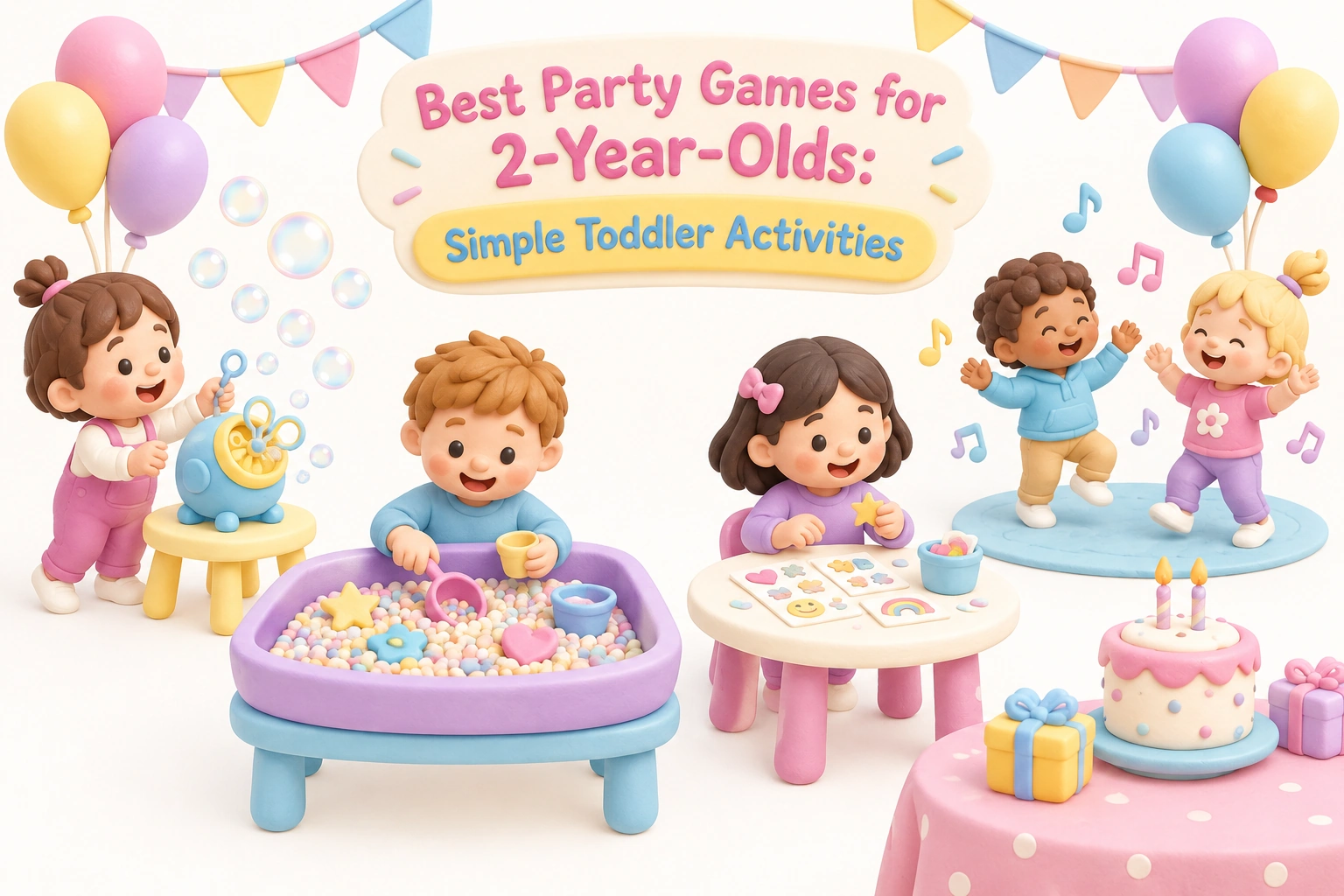
Planning a 2nd birthday party comes with a unique challenge: two-year-olds are enthusiastic, energetic, and wonderfully unpredictable, but they are not yet ready for structured competitive games. The good news is that with the right approach, a toddler party can be genuinely joyful and low-stress for everyone in the room. This guide covers the best party games for 2-year-olds, explains why certain activities work at this developmental stage, and gives you practical setup tips, a sample schedule, and honest advice about what to skip.
Key Takeaways
- Two-year-olds have a toddler attention span of roughly 4–6 minutes per activity, so short, flexible activities work far better than structured games with rules.
- A station-based setup — where children move freely between activity zones — suits this developmental stage better than whole-group games with turns and winners.
- The best party games for 2-year-olds prioritize participation over winning, involve music and movement, sensory play, or simple movement challenges, and require no elimination.
- Certain classic party games — including pass the parcel, musical chairs with eliminations, and piñatas — are genuinely unsuitable for this age group and are worth avoiding entirely.
- A 2nd birthday party works best when kept to 1.5–2 hours, with a calm-down corner available throughout.
Why Structured Games Don’t Work for Most 2-Year-Olds
At age two, children are in a developmental stage characterized by parallel play — playing alongside others rather than cooperatively with them. The concept of winning and losing is not yet meaningful, and turn-taking is still an emerging skill that requires significant adult support. Most two-year-olds cannot follow multi-step instructions, wait patiently for their turn, or understand why they have been “out” of a game. Expecting them to do so reliably leads to frustration, tears, and meltdowns — for the children and sometimes for the adults too.
This does not mean a 2nd birthday party cannot include organized fun. It means the definition of “game” needs to shift. Rule-free activities that invite participation without demanding it, that have no losers, and that can be joined or left at any moment are the sweet spot for this age group. Think of the party less as a series of structured games and more as a curated environment where toddlers can explore, move, and delight in simple experiences together.
What Makes a Party Activity Age-Appropriate for a 2-Year-Old?
Age-appropriate games for two-year-olds share a handful of consistent characteristics. They are short — ideally lasting no more than 5 minutes before naturally transitioning. They are open-ended, meaning there is no single correct way to participate. They support gross motor skills (running, jumping, throwing) or fine motor skills (stacking, sticking, pouring) without requiring precision. They involve sensory exploration, music, movement, or imitation, all of which are deeply engaging at this developmental stage. And critically, they use a no-elimination format so that every child remains included throughout.
A useful rule of thumb is that a child’s comfortable attention span in minutes is roughly double their age — so around 4–6 minutes for a two-year-old. Plan activities accordingly, and always have the next activity ready before the current one winds down.
Best Indoor Party Games for 2-Year-Olds
Freeze Dance
Freeze dance is one of the most reliably successful toddler party games. Play upbeat music and encourage children to dance freely; when the music stops, everyone freezes. At age two, “freezing” is more of a suggestion than a rule, and that is perfectly fine. The joy is in the dancing and the sudden stop, not in perfect compliance. Freeze dance supports body awareness, listening skills, and gross motor development, and it requires no equipment beyond a speaker and a playlist. It works beautifully as an opener because it burns energy quickly and gets even shy children moving.
Bubble Machine Station
Few things captivate toddlers as reliably as bubbles. Setting up a bubble machine in one corner of the party space creates an instant sensory experience that children can engage with at their own pace. Toddlers will chase, pop, and marvel at bubbles for longer than almost any structured activity. If you are hosting indoors, place the bubble machine on a non-slip mat and keep the area clear of furniture, as wet floors can become slippery. Outdoors, a bubble machine station is even simpler to manage. This activity supports hand-eye coordination and sensory exploration with virtually zero setup complexity.
Sensory Bin Exploration
A sensory bin — a shallow container filled with a safe, tactile material such as dried pasta, kinetic sand, water beads (for supervised older toddlers), or shredded paper — is an excellent open-ended play station for a toddler party. Add small scoops, cups, and toy animals to encourage exploration. Sensory play at this age supports cognitive development, fine motor skills, and language as children describe what they feel and find. Set up one or two sensory bins as part of a station-based setup so children can drift in and out freely. Always supervise closely and choose materials appropriate for children who may still mouth objects.
Sticker Station
A sticker station is one of the simplest and most universally loved activities for two-year-olds. Provide large sheets of paper, foam stickers in simple shapes, and let children stick freely. There is no template to follow and no right answer — pure open-ended play. Sticker activities support fine motor skills and creative expression, and they double as a take-home keepsake. This station works particularly well as a calm-down corner activity for children who need a quieter moment during the party.
Musical Bumps
A gentler toddler-friendly version of musical statues, musical bumps involves children dancing while music plays and then sitting down quickly when it stops. Unlike musical chairs, there are no eliminations — everyone stays in the game. The sitting-down element adds a physical comedy that two-year-olds find genuinely funny, and the music and movement combination keeps energy levels high. Keep rounds short and the music varied to maintain interest.
Follow the Leader
Follow the leader works beautifully with toddlers because imitation is one of the primary ways two-year-olds learn. An adult leads a simple sequence — stomping, clapping, spinning, jumping — and children copy. You can weave this through the party space as a mini movement parade. This activity supports gross motor development, body awareness, and the early social skill of paying attention to another person’s actions. Keep the movements simple and exaggerated for maximum engagement.
Pass the Balloon
Pass the balloon is a cooperative, no-pressure alternative to pass the parcel, which is genuinely too complex for most two-year-olds. Children sit in a loose circle and pass a large, lightweight balloon around. There are no rules about speed or direction — the goal is simply to keep the balloon moving. This activity encourages gentle cooperation and turn-taking in its most basic form, without the frustration of waiting for a prize. Use only large balloons and supervise carefully; deflated or burst balloon pieces are a choking hazard for this age group.
Best Outdoor Party Games for 2-Year-Olds
Bubble Chase
Outdoors, a bubble machine or a caregiver blowing bubbles by hand creates an irresistible chase activity. Children run, reach, and pop bubbles with enormous enthusiasm. Bubble chase is essentially unstructured play with a shared focus, which is exactly the right level of organization for a two-year-old. It requires no instructions, no turns, and no winners — just movement, laughter, and sensory delight.
Mini Obstacle Course
A simple toddler obstacle course — a tunnel to crawl through, a low balance beam to walk along, a hoop to step into, and a soft mat to jump onto — gives two-year-olds a physical challenge that feels exciting without being frustrating. Keep each element low to the ground and easy enough that every child can succeed. A play tunnel is particularly popular at this age. The obstacle course supports gross motor skills, spatial awareness, and confidence. Adults should stand at each station to offer encouragement and gentle guidance rather than timing or scoring.
Bean Bag Toss
A bean bag toss with a large, close target — a hoop on the ground, a bucket, or a painted board with wide openings — gives toddlers a satisfying throwing experience. Place the target very close (one to two metres) so that success is frequent. Bean bag toss supports hand-eye coordination and early throwing mechanics without the pressure of competition. Celebrate every attempt, not just the ones that land in the target, to keep the activity positive and inclusive.
Water Play Station
For warm-weather parties, a water table or a simple tub of water with cups, funnels, and small toys is endlessly engaging for two-year-olds. Water play is a classic sensory activity that supports scientific thinking (pouring, filling, emptying) and fine motor development. Ask parents to bring a change of clothes, and set up the water station away from the main party area to contain splashing. This is one of the few activities that can hold a toddler’s attention well beyond the typical 4–6 minute window.
Animal Walk Parade
An animal walk parade is a movement game where an adult calls out an animal and children move like that animal — hopping like frogs, stomping like elephants, slithering like snakes. This activity combines music and movement with language development, as children hear and repeat animal names and sounds. It works well outdoors where there is space to move freely, and it can be extended or shortened easily depending on the group’s energy level. No equipment is needed.
Games to Avoid at a 2-Year-Old Party
Knowing what not to include is just as useful as knowing what works. Several classic party games are genuinely unsuitable for two-year-olds and are worth leaving off the plan entirely.
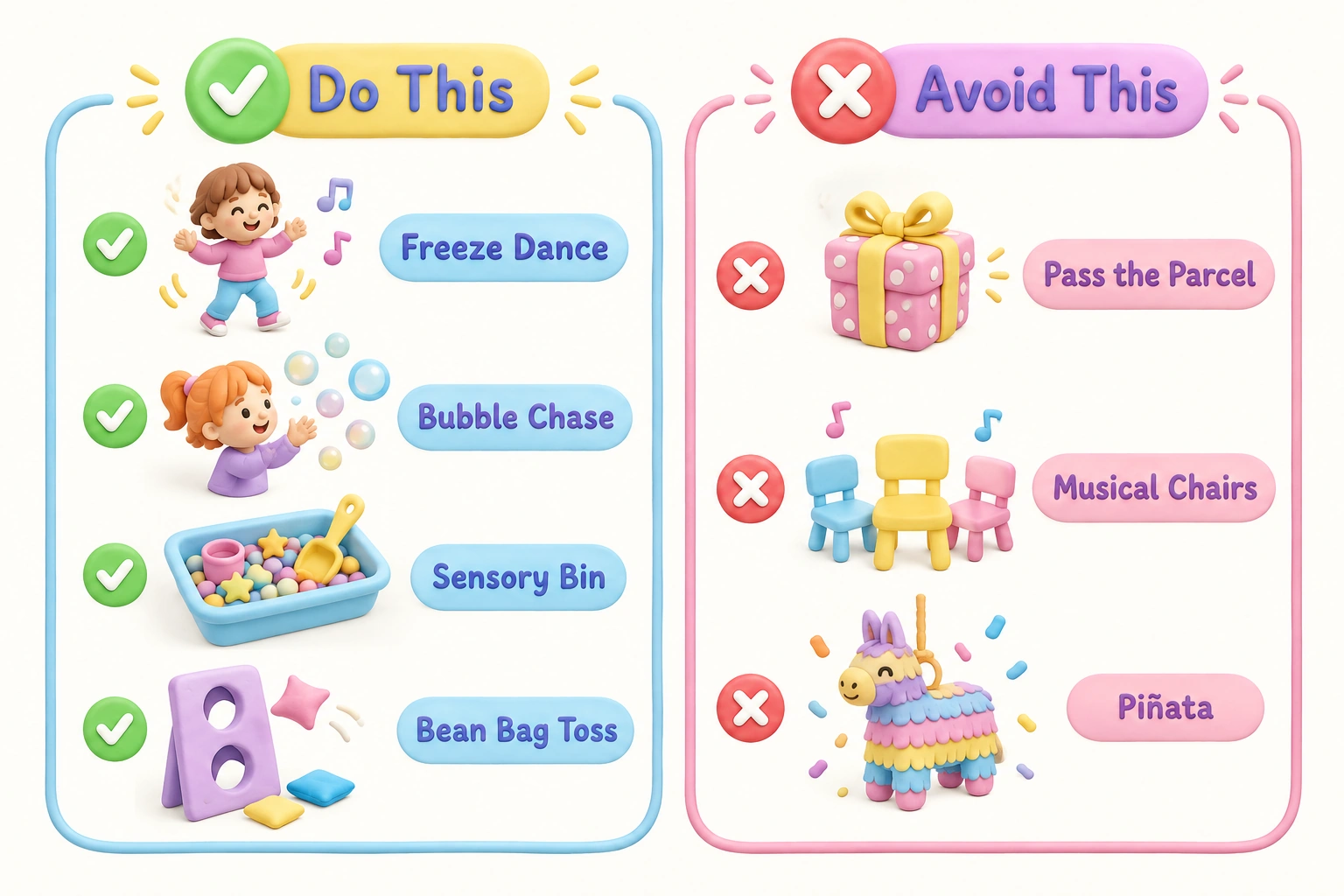
- Pass the parcel: Requires sustained turn-taking, understanding of rules, and the ability to wait — all skills still developing at age two. The child who doesn’t unwrap a layer will almost certainly become distressed.
- Musical chairs with eliminations: The elimination format is confusing and upsetting for toddlers who do not yet understand why they have been removed from the game.
- Piñatas: Most child development guidance suggests avoiding piñatas for children under four. The swinging motion, the crowd rush for sweets, and the competitive scramble are all genuinely risky for toddlers.
- Any game requiring sustained waiting: Two-year-olds cannot reliably wait for their turn in a long queue. Games that require this will generate frustration quickly.
- Complex rule-based games: If a game requires more than one instruction to explain, it is likely too complex for this age group.
Station-Based Setup: A Smarter Party Structure
Rather than running one game at a time for the whole group, a station-based setup allows children to move freely between activity zones at their own pace. This approach respects the toddler attention span, accommodates different temperaments (some children are bold explorers; others need time to warm up), and reduces the pressure on any single activity to hold everyone’s attention simultaneously.
A practical station layout for a 2nd birthday party might include: a sensory bin table, a sticker station, a bubble machine corner, a movement space for freeze dance or follow the leader, and a calm-down corner with soft cushions and board books. Rotate or refresh stations every 20–25 minutes to maintain novelty. Adults stationed at each zone can offer gentle encouragement without directing children’s play.
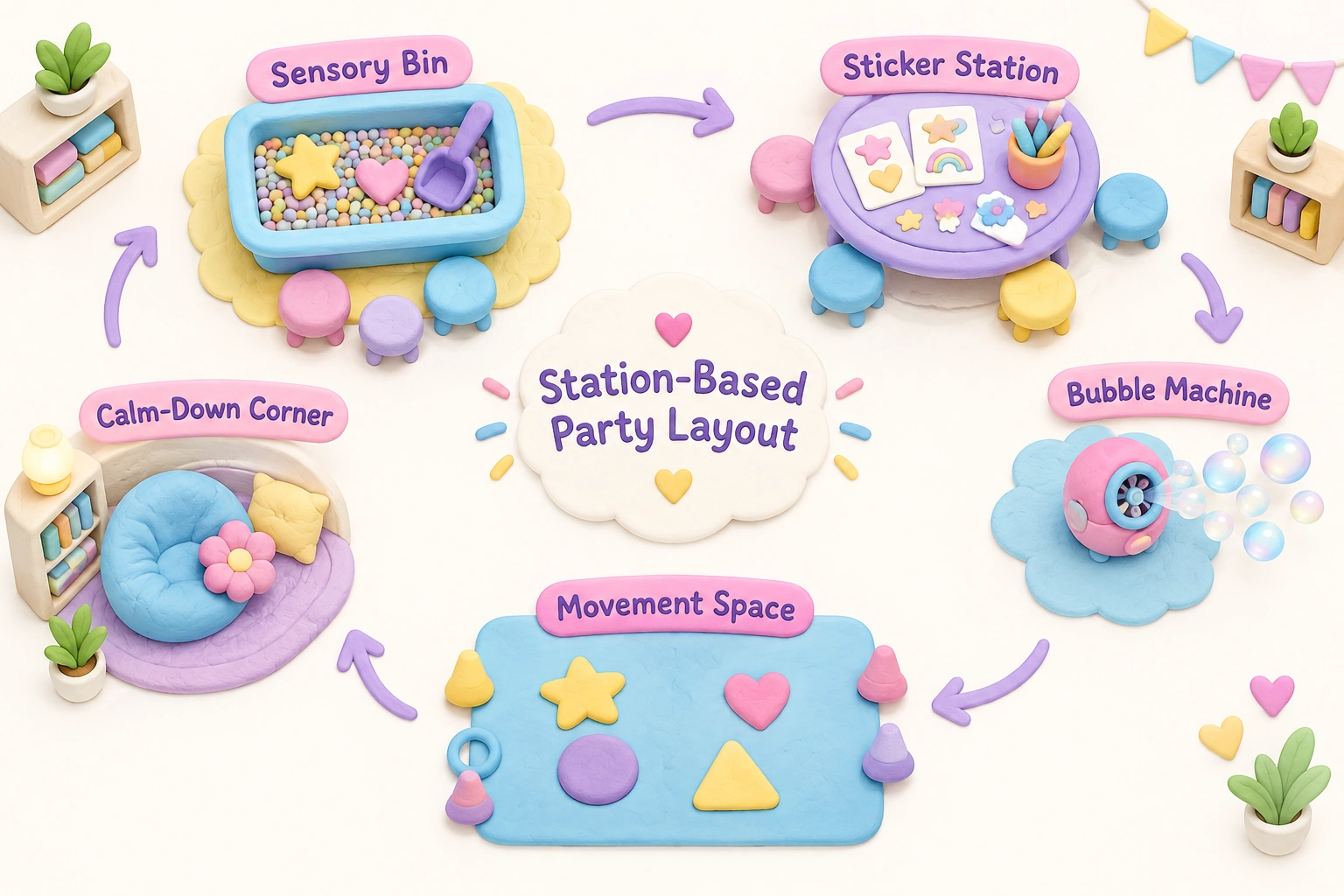
The calm-down corner deserves particular attention. Toddler parties can become overstimulating quickly, especially for children who are tired or temperamentally sensitive. A quiet station with soft toys, simple puzzles, or a picture book gives overwhelmed children a socially acceptable way to regulate without leaving the party. Having this space available from the start — not just when a meltdown occurs — normalizes the need for quieter moments.
Handling Meltdowns Mid-Party
Even the best-planned toddler party will include at least one meltdown. Two-year-olds are in a developmental stage where emotional regulation is genuinely immature; they feel big feelings and have limited tools to manage them. When a child becomes distressed mid-activity, the most effective response is calm redirection rather than insisting they continue. Guide the child gently to the calm-down corner, offer a familiar comfort object if available, and give them time to settle without pressure. Most toddlers recover quickly when they feel safe and unhurried. Communicating this approach to other caregivers before the party starts helps everyone respond consistently.
Tips for Mixed-Age Guest Lists
Many 2nd birthday parties include older siblings aged three to five, which adds a useful layer of complexity. Older children can participate in the same station-based activities but may need slightly more challenge to stay engaged. For the bean bag toss, move the target further back for older children. For the obstacle course, add an extra element or increase the height slightly. For freeze dance, older children can be invited to suggest the next animal walk or dance move, giving them a leadership role that keeps them invested without disrupting the toddler-friendly format. Avoid creating separate parallel games for different age groups if possible — shared activities with adjustable difficulty keep the party cohesive and reduce the risk of younger children feeling excluded.
Sample Party Schedule for a 2-Year-Old’s Birthday
A 2nd birthday party works best when kept to 1.5–2 hours. Longer parties push past the natural energy and attention limits of toddlers and often end in collective exhaustion. The following sample schedule is a starting point; adjust timing based on your child’s routine and the number of guests.
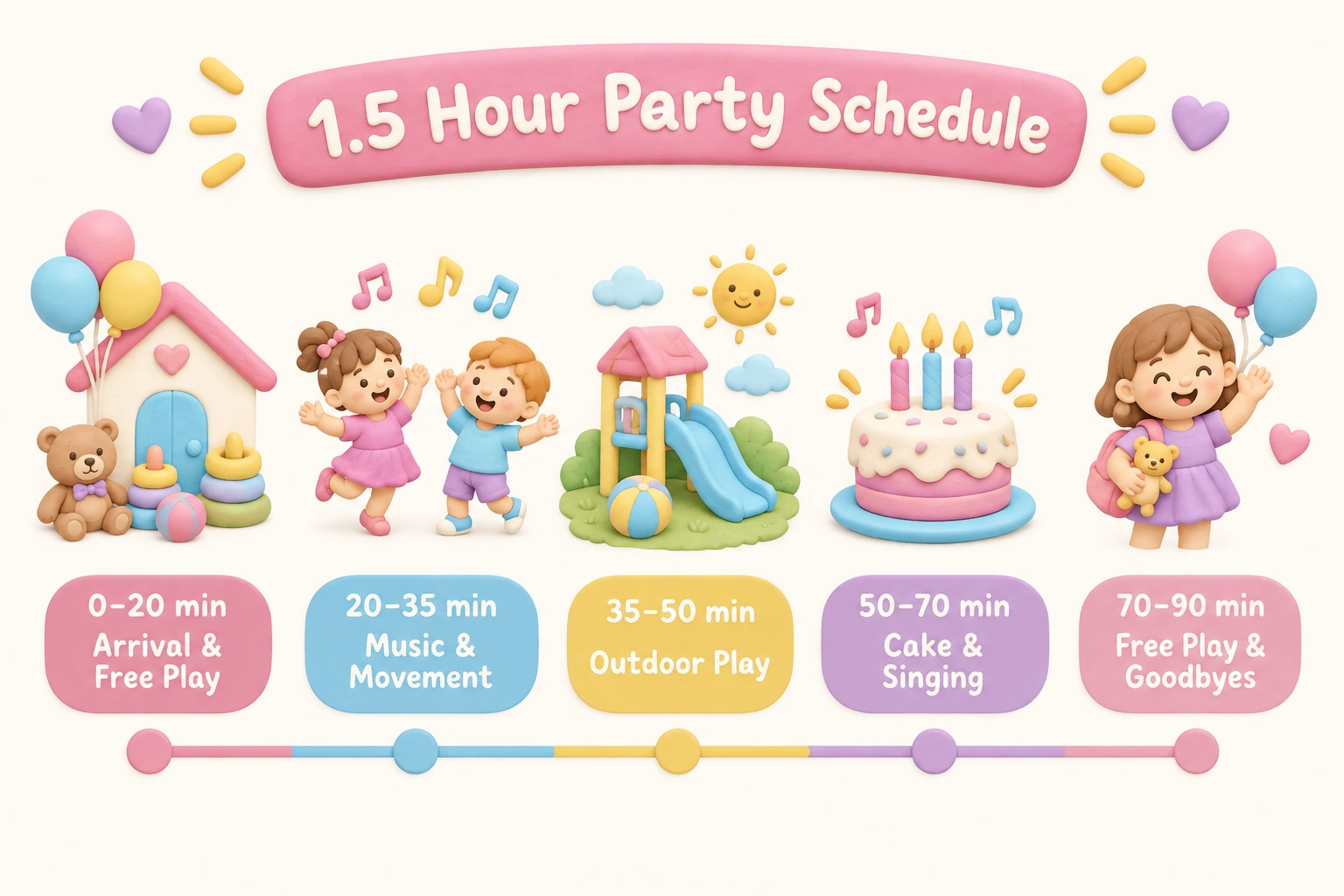
- 0:00–0:20 — Arrival and free station play: Guests arrive and move freely between the sensory bin, sticker station, and bubble machine. This eases children into the environment without pressure.
- 0:20–0:35 — Music and movement: Freeze dance, musical bumps, or an animal walk parade as a whole-group activity with adult leadership.
- 0:35–0:50 — Outdoor play or obstacle course: Move outside if weather allows. Bean bag toss, bubble chase, or water play station.
- 0:50–1:10 — Cake and singing: Keep this moment short and sweet. Two-year-olds are not patient waiters, so serve cake promptly after the song.
- 1:10–1:30 — Free play and goodbyes: Return to stations or allow unstructured play while families begin to leave at their own pace.
Activity Overview: Setup, Effort, and Why It Works
| Activity | Setup Effort | Approx. Engagement Time | Key Developmental Benefit |
|---|---|---|---|
| Freeze dance | Low (speaker + playlist) | 5–8 min | Gross motor skills, body awareness |
| Bubble machine station | Low (machine + solution) | 10–15 min | Sensory exploration, hand-eye coordination |
| Sensory bin | Medium (materials + tray) | 10–20 min | Fine motor skills, cognitive exploration |
| Sticker station | Low (paper + stickers) | 8–12 min | Fine motor skills, creative expression |
| Mini obstacle course | Medium (tunnel, hoops, mats) | 10–15 min | Gross motor skills, spatial awareness |
| Bean bag toss | Low (bags + target) | 5–10 min | Hand-eye coordination, throwing mechanics |
| Water play station | Medium (tub + toys) | 15–25 min | Sensory play, early scientific thinking |
| Animal walk parade | None | 5–8 min | Language development, gross motor skills |
| Pass the balloon | Low (large balloon) | 5–8 min | Early cooperation, turn-taking |
Frequently Asked Questions
Do 2-year-olds actually enjoy party games?
Two-year-olds enjoy movement, music, sensory experiences, and novelty — all of which can be delivered through simple party activities. They do not enjoy waiting, complex rules, or being eliminated from a game. When activities are designed around what toddlers genuinely find engaging rather than what adults expect a party game to look like, children at this age participate enthusiastically.
How long should a 2-year-old birthday party last?
Most child development guidance and experienced party planners suggest 1.5 to 2 hours as the ideal length for a 2nd birthday party. This window fits within a typical toddler’s energy and attention capacity without pushing into nap time or mealtime disruption. Longer parties tend to result in overtired, overwhelmed children regardless of how well the activities are planned.
What if my child won’t participate in any of the activities?
This is entirely normal. Some two-year-olds need 20–30 minutes simply to observe before they feel comfortable joining in. A station-based setup helps because children can watch from the edge of an activity before deciding to engage. Never force participation; a child who watches happily is still having a positive experience. Having a calm-down corner available gives hesitant children a comfortable base from which to venture out at their own pace.
Can I include older children (ages 3–5) in the same games?
Yes, with minor adjustments. Most of the activities listed here work across the 2–5 age range when adults adjust the difficulty slightly for older children — moving targets further away, adding obstacle course elements, or giving older children a leadership role in follow the leader or animal walks. Avoid creating entirely separate games for different age groups, as this can make younger children feel excluded.
Is a bounce house suitable for a 2-year-old party?
Small, toddler-specific bounce houses with low walls and soft surfaces can be appropriate for two-year-olds under close adult supervision. Standard bounce houses designed for older children carry a higher risk of collision injury when mixed age groups use them simultaneously. If you hire a bounce house, check that it is rated for toddler use and ensure an adult is present inside at all times.
What party favors work well for 2-year-olds?
Simple, safe, and developmentally appropriate favors include board books, chunky crayons, playdough pots, bubble wands, or foam sticker sheets. Avoid small parts, balloons sent home uninflated, or anything with a choking hazard. The sticker station artwork children create during the party also makes a lovely, cost-free take-home keepsake.
Making Your 2-Year-Old’s Party Work for Your Family
The most important thing to remember when planning party games for 2-year-olds is that the goal is not a perfectly executed event — it is a warm, low-pressure environment where toddlers can move, explore, and feel celebrated. A station-based setup with four or five simple toddler activities, a bubble machine, some music, and a calm-down corner will almost always outperform an ambitious schedule of structured games. Keep the party short and sweet, plan for meltdowns without panic, and resist the pressure to fill every minute with organized activity.
Two-year-olds are genuinely easy to delight. They do not need elaborate setups or expensive equipment — they need space to move, safe materials to explore, familiar adults nearby, and the freedom to participate on their own terms. When you design the party around those needs rather than around adult expectations of what a party should look like, the result is usually a joyful, memorable celebration for children and caregivers alike.
Take a short quiz to find out what your everyday choices say about your parenting style
When your child is curious about something new, what’s your instinct?
Take a short quiz to find out what your everyday choices say about your parenting style
“Can I download this app?” What happens next?
Take a short quiz to find out what your everyday choices say about your parenting style
When it comes to rules at home, which sounds most like you?
Take a short quiz to find out what your everyday choices say about your parenting style
If you could give your child one life skill today, what would you pick?
Take a short quiz to find out what your everyday choices say about your parenting style
Your child gets to choose what to watch. What would your ideal setup look like?
Take a short quiz to find out what your everyday choices say about your parenting style
Pick your parenting superpower ✨