Best Games for 12-Year-Olds: Digital, Board and Group Picks

 Discover a Free Education Video App for Kids
Pastory uses AI to personalize educational video content based on your child’s interests and personality. Safe, engaging, and built for curious young minds. Sign up now to stay updated and enjoy early access with a free trial
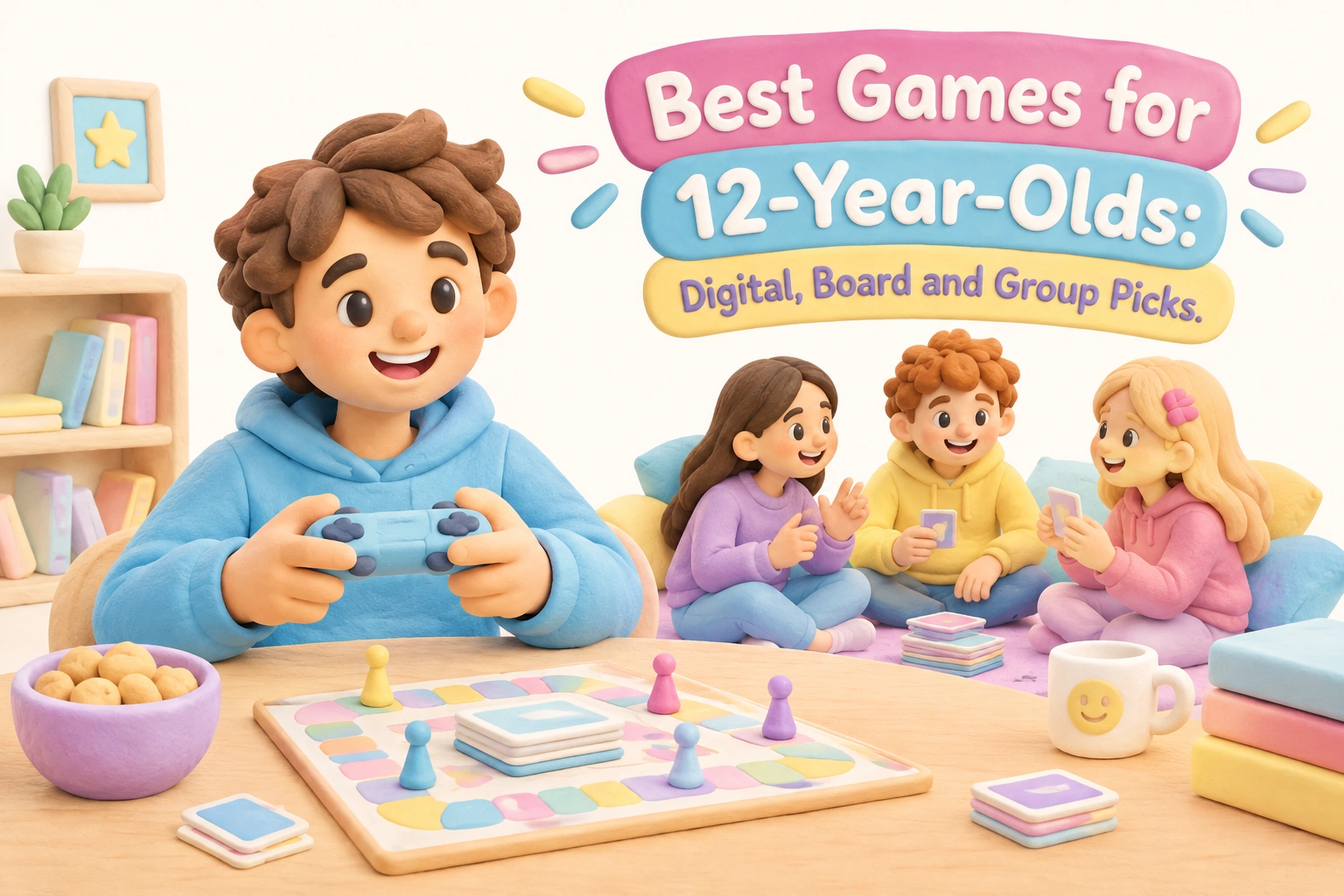
Finding the right games for 12-year-olds means navigating a wide range of formats, skill levels, and content maturity — all while keeping developmental appropriateness and family values in mind. At this tween stage, children are developing stronger abstract reasoning, social awareness, and a growing appetite for challenge and autonomy. The right game, whether digital, tabletop, or group-based, can support strategic thinking, cooperation, and social connection. This guide covers all three categories in one place, with honest guidance on age-appropriateness, parental considerations, and what each type of game actually offers developmentally.
Key Takeaways
- Games for 12-year-olds span digital, board, and group formats — each offering distinct developmental benefits worth considering alongside entertainment value.
- ESRB ratings and Common Sense Media reviews are practical tools for assessing whether a game’s content is age-appropriate for your specific child.
- Cooperative board games and no-elimination party games tend to reduce conflict and support social bonding, making them strong choices for family game night or birthday parties.
- Popular digital titles like Minecraft, Roblox, and Fortnite differ significantly in cost, content, and online safety considerations — understanding these differences helps parents make informed decisions.
- Games with strategic depth, such as Catan or Ticket to Ride, tend to grow with the child and remain engaging well into the mid-teen years, offering good long-term value as a gift for a 12-year-old.
Why Game Choice Matters at Age 12
Twelve-year-olds sit at a meaningful developmental crossroads. Cognitively, they are moving into formal operational thinking — the ability to reason about hypothetical situations, plan ahead, and evaluate consequences. Games that require strategic depth, resource management, or social deduction align well with this emerging capacity. Socially, peer relationships become increasingly central, and games that facilitate cooperation, negotiation, or shared laughter can strengthen those bonds in low-pressure ways.
At the same time, this age group is particularly susceptible to the pull of competitive online environments, in-game purchases, and social pressure around popular titles. Parents who understand what different game formats offer — and what risks they carry — are better placed to guide choices rather than simply restrict them. The goal is not to eliminate screen time but to ensure that the games filling that time are genuinely worthwhile and balanced with screen-free alternatives.
Best Digital Games for 12-Year-Olds
Digital games dominate the leisure landscape for tweens, and three titles consistently top the conversation: Minecraft, Roblox, and Fortnite. Each has a distinct profile in terms of content, cost, and online safety considerations. Beyond these, several other titles offer strong age-appropriate experiences across different platforms.
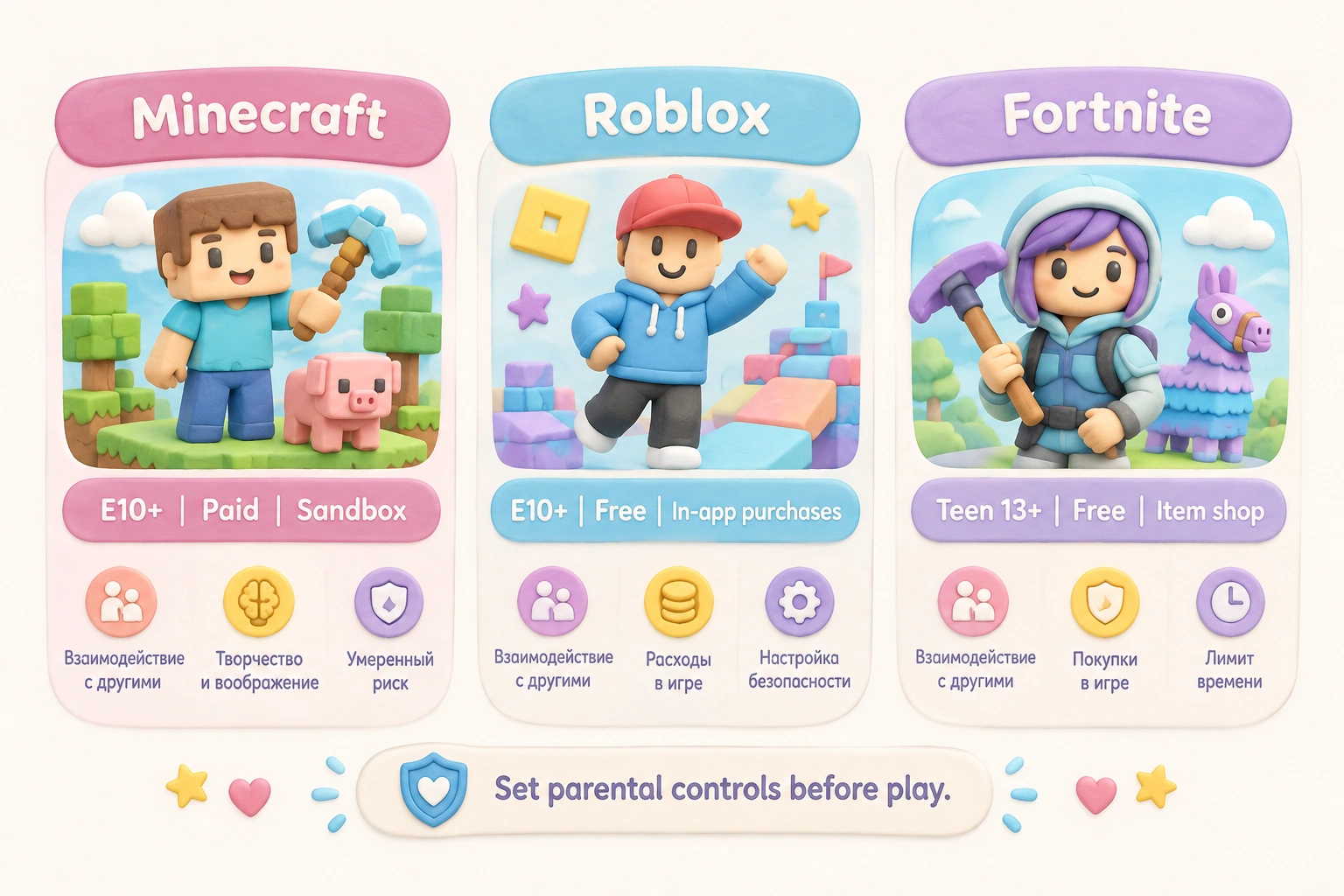
Minecraft, Roblox, and Fortnite: A Parent-Friendly Comparison
| Title | ESRB Rating | Cost Model | Core Experience | Online Safety Notes |
|---|---|---|---|---|
| Minecraft | E10+ | Paid (one-time purchase) | Open-world sandbox; creative mode and survival mode available | Multiplayer servers vary widely; parental controls available |
| Roblox | E10+ | Free platform; in-game purchases (Robux) | User-generated games across many genres | Chat and user content require monitoring; spending limits recommended |
| Fortnite | Teen (13+) | Free to play; cosmetic in-game purchases | Battle royale and creative modes; LEGO Fortnite available | Voice chat with strangers; item shop designed to encourage spending |
Minecraft’s creative mode is particularly well-regarded for encouraging spatial reasoning and open-ended problem-solving. Its survival mode adds resource management and planning elements. Because Minecraft is a paid title with no ongoing monetization pressure, many parents find it a more straightforward choice than free-to-play alternatives. Common Sense Media rates Minecraft as appropriate from around age 8, though multiplayer server content varies significantly and warrants parental oversight.
Roblox functions as a platform rather than a single game, hosting thousands of user-created experiences. This variety is both its strength and its challenge — content quality is inconsistent, and the Robux currency system can lead to significant unplanned spending without clear limits in place. Setting spending limits and reviewing which games within Roblox your child is accessing are practical steps worth taking before allowing independent use.
Fortnite carries a Teen ESRB rating, reflecting its battle royale format and mild violence. Its LEGO Fortnite mode offers a more creative, less combat-focused experience that some parents find more comfortable. The item shop is deliberately designed to create urgency around limited-time cosmetics, which can generate spending pressure. Enabling parental controls and discussing in-game purchases openly with your child before they start playing is strongly recommended.
Other Strong Digital Picks for Tweens
Beyond the Big Three, several video games for tweens offer excellent age-appropriate content with strong replay value. Mario Kart World and Super Mario Party on Nintendo Switch are reliably family-friendly multiplayer titles that work well for mixed-age groups. Animal Crossing: New Horizons rewards patience and creativity without competitive pressure, making it a good fit for children who prefer a calmer digital experience. Portal 2 is a standout choice for tweens who enjoy puzzle-solving — its cooperative mode requires genuine communication and lateral thinking, and it carries an E10+ rating. LEGO games across various franchises consistently offer accessible, humorous gameplay with no meaningful content concerns. For children interested in simulation and strategy, Jurassic World Evolution 2 provides management-style gameplay that encourages planning and critical thinking without combat.
When selecting digital games, checking both the ESRB rating and a Common Sense Media review gives a more complete picture than either source alone. ESRB ratings address content categories, while Common Sense Media assessments consider factors like educational value, consumerism, and online interaction risks — all relevant for a 12-year-old’s gaming environment.
Best Board Games for 12-Year-Olds
Board games offer something digital games rarely replicate: face-to-face social interaction, tactile engagement, and a natural endpoint to play. For parents concerned about screen time, a well-chosen board game can serve as a genuinely compelling screen-free alternative rather than a consolation prize. The best board games for 12-year-olds balance accessible rules with enough strategic depth to remain interesting across multiple sessions.
Gateway Strategy Games
Ticket to Ride is widely considered one of the best gateway games for this age group. Its route-building mechanics are easy to learn within a single session, yet the game rewards forward planning and spatial awareness. A typical game runs 45–75 minutes and works well with two to five players. Ticket to Ride is also one of those titles that grows with the child — a 12-year-old who enjoys it will likely still find it engaging at 15 or 16, making it a strong long-term gift for a 12-year-old.
Catan introduces resource management, negotiation, and probability in an accessible format. It is often described as easy to learn, hard to master — a quality that keeps it on tables for years. Catan works best with three to four players and runs approximately 60–90 minutes. Its trading mechanic makes it inherently social, which suits the peer-focused developmental stage of most 12-year-olds. Azul is a tile-placement game with elegant rules and genuine strategic depth; it plays in around 30–45 minutes and is suitable for two to four players. Its abstract nature makes it accessible regardless of reading level or cultural background.
Cooperative Board Games
Cooperative board games deserve particular attention for families who want to avoid the conflict that competitive games can sometimes generate. In a cooperative game, all players work together against the game itself, which can make the experience more inclusive and less stressful for children who find losing difficult.
Pandemic is the most widely recognized cooperative board game for this age group. Players work as a team to contain disease outbreaks across a global map, requiring communication, role specialization, and collective planning. It plays in 45–60 minutes with two to four players and carries enough strategic complexity to remain challenging across many sessions. Forbidden Island is a shorter, slightly simpler cooperative alternative from the same designer — it plays in around 30 minutes and is an excellent starting point for families new to cooperative play. Both titles model the kind of collaborative problem-solving that developmental research suggests is valuable for children in middle childhood and early adolescence.
Card and Party-Style Board Games
Codenames is a word-association game that works brilliantly as a team game for four or more players. It requires lateral thinking and communication, and it scales well for larger groups — making it equally useful for family game night and birthday gatherings. Exploding Kittens is fast, silly, and easy to teach, with a playtime of around 15 minutes. It works well as a warm-up game or when attention spans are shorter. Taco Cat Goat Cheese Pizza is a reflex-based card game that plays in under 15 minutes and generates reliable laughter across age groups. Telestrations combines drawing and guessing in a format that rewards creativity over artistic skill, making it genuinely inclusive. For children who enjoy deduction, The Chameleon is a social deduction game in which one player secretly tries to blend in while others attempt to identify them — it plays in 15–20 minutes and works well with five to eight players.
Best Group and Party Games for 12-Year-Olds
Group games — whether for a birthday party, a sleepover, or an outdoor gathering — serve a different function from board games or digital play. They prioritize social energy, movement, and shared experience over strategic depth. The best birthday party games for 12-year-olds tend to use a no-elimination format, keeping everyone engaged rather than sidelining players early.
Indoor Group Games
Catch Phrase is a fast-paced word-guessing game that works well for groups of six or more. Its electronic version keeps the pace high and requires no setup beyond batteries. Fishbowl is a free, multi-round party game that combines elements of Taboo, charades, and one-word clues — it scales to any group size and generates increasingly funny moments as the game progresses through rounds. Two Truths and a Lie requires no materials at all and works as an icebreaker or a low-energy wind-down activity; it also encourages children to think about how they present themselves and interpret others, which aligns with the social-cognitive development typical of this age.
Lip Sync Battle and the Cookie Face Challenge (moving a cookie from forehead to mouth using only facial muscles) are high-energy, low-stakes activities that work well for slumber parties. Wink Murder is a classic social deduction game requiring no materials — one player secretly acts as the murderer while others try to identify them before being eliminated. Unlike many elimination games, rounds are short enough that eliminated players rejoin quickly.
Outdoor and Active Group Games
Active games are often underrepresented in roundups aimed at this age group, but 12-year-olds generally still enjoy physical play when it is framed as fun rather than exercise. Balloon Stomp — where players try to pop each other’s balloons while protecting their own — is chaotic, energetic, and requires no skill gap to enjoy. Tug of War and Sack Race work well for larger outdoor birthday parties where teams can be balanced by size rather than age or ability. Team relay races with silly challenges (carrying a ball between knees, walking with a book on the head) keep the energy high while ensuring that athletic ability is not the primary determinant of success.
Matching Games to Your Child’s Personality
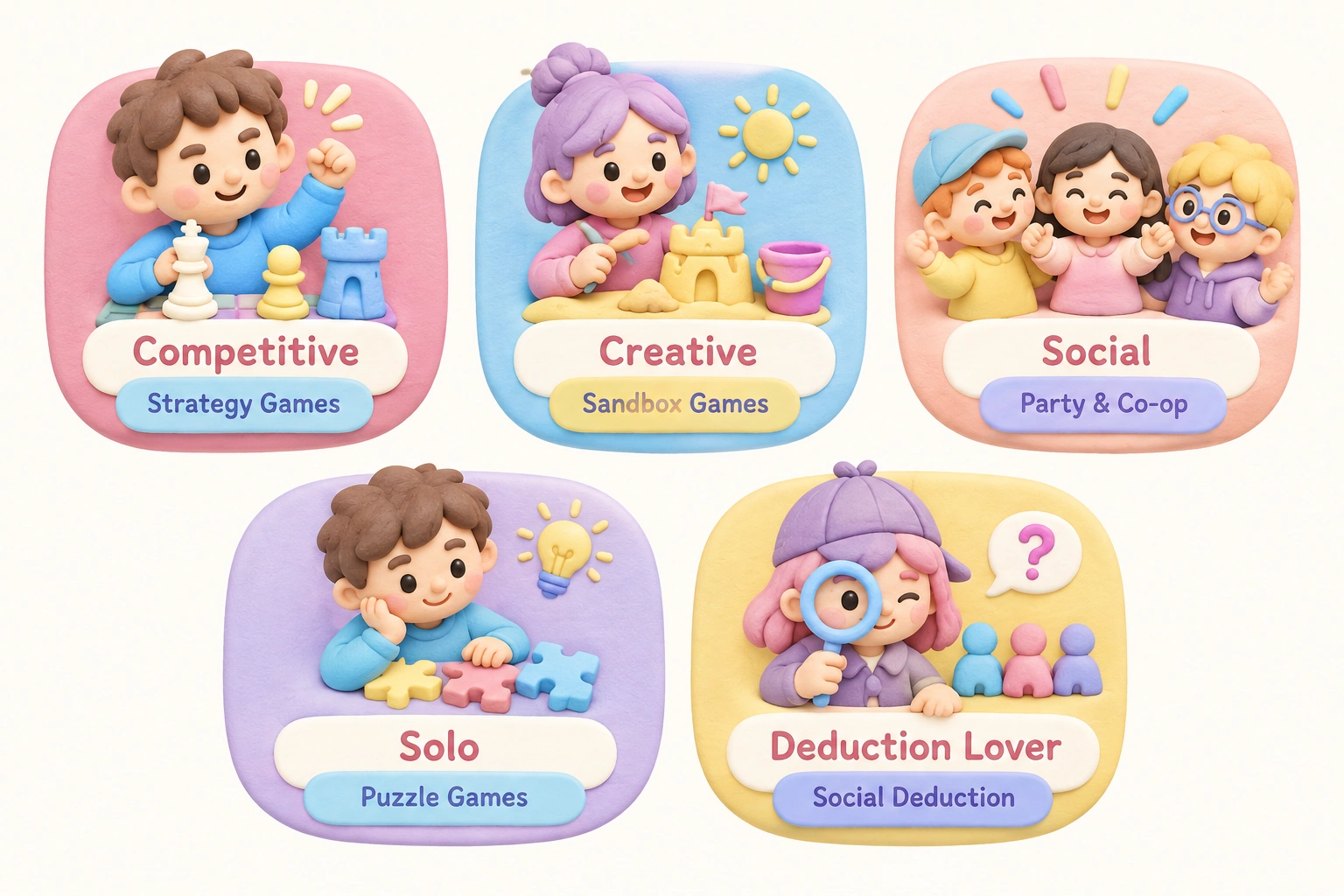
Not every 12-year-old enjoys the same type of game, and matching game format to personality can significantly improve engagement and reduce conflict around game choices.
| Child’s Style | Likely Best Fit | Example Titles |
|---|---|---|
| Competitive and strategic | Strategy board games, competitive digital games | Catan, Ticket to Ride, Mario Kart World |
| Creative and imaginative | Sandbox digital games, open-ended board games | Minecraft (creative mode), Animal Crossing, Azul |
| Social and group-oriented | Party games, cooperative board games, group digital play | Codenames, Pandemic, Catch Phrase, Fishbowl |
| Prefers solo or low-pressure play | Puzzle-based digital games, 2-player board games | Portal 2, Jaipur, Animal Crossing |
| Enjoys deduction and mystery | Social deduction games, mystery board games | The Chameleon, Codenames, Wink Murder |
Personality matching is not a rigid formula — many children enjoy games across multiple categories, and preferences shift as children develop. However, starting with a format that aligns with your child’s natural tendencies tends to produce more positive early experiences, which in turn builds openness to trying new game types over time.
Parental Guidance for Digital Games
Digital games for tweens raise specific considerations that go beyond content ratings. Online multiplayer environments introduce voice chat with strangers, which carries risks that ESRB ratings do not fully capture. Before allowing a 12-year-old to use voice chat in any game, it is worth discussing what appropriate online interaction looks like, what to do if someone says something uncomfortable, and how to use mute and block functions. Many platforms allow parents to disable voice chat entirely through parental controls, which is a reasonable starting point for younger tweens.
In-game purchases represent a separate concern. Free-to-play games like Roblox and Fortnite are specifically designed with monetization mechanics that can feel urgent or socially significant to children — limited-time items, cosmetics that peers are discussing, and currency systems that obscure real-money value. Setting clear spending limits before play begins, and discussing the difference between cosmetic items and gameplay value, helps children develop healthier relationships with in-game economies. Many consoles and platforms allow parents to require approval for any purchase, which removes the ambiguity around accidental or impulsive spending.
Screen time balance remains relevant even when the games themselves are age-appropriate. The American Academy of Pediatrics recommends that parents of children over six focus on ensuring that screen time does not displace sleep, physical activity, homework, or face-to-face social interaction, rather than applying a strict hourly limit. Framing digital game time as one part of a varied leisure diet — alongside board games, outdoor play, and social activities — tends to be more sustainable than blanket restrictions.
Games That Grow With Your Child
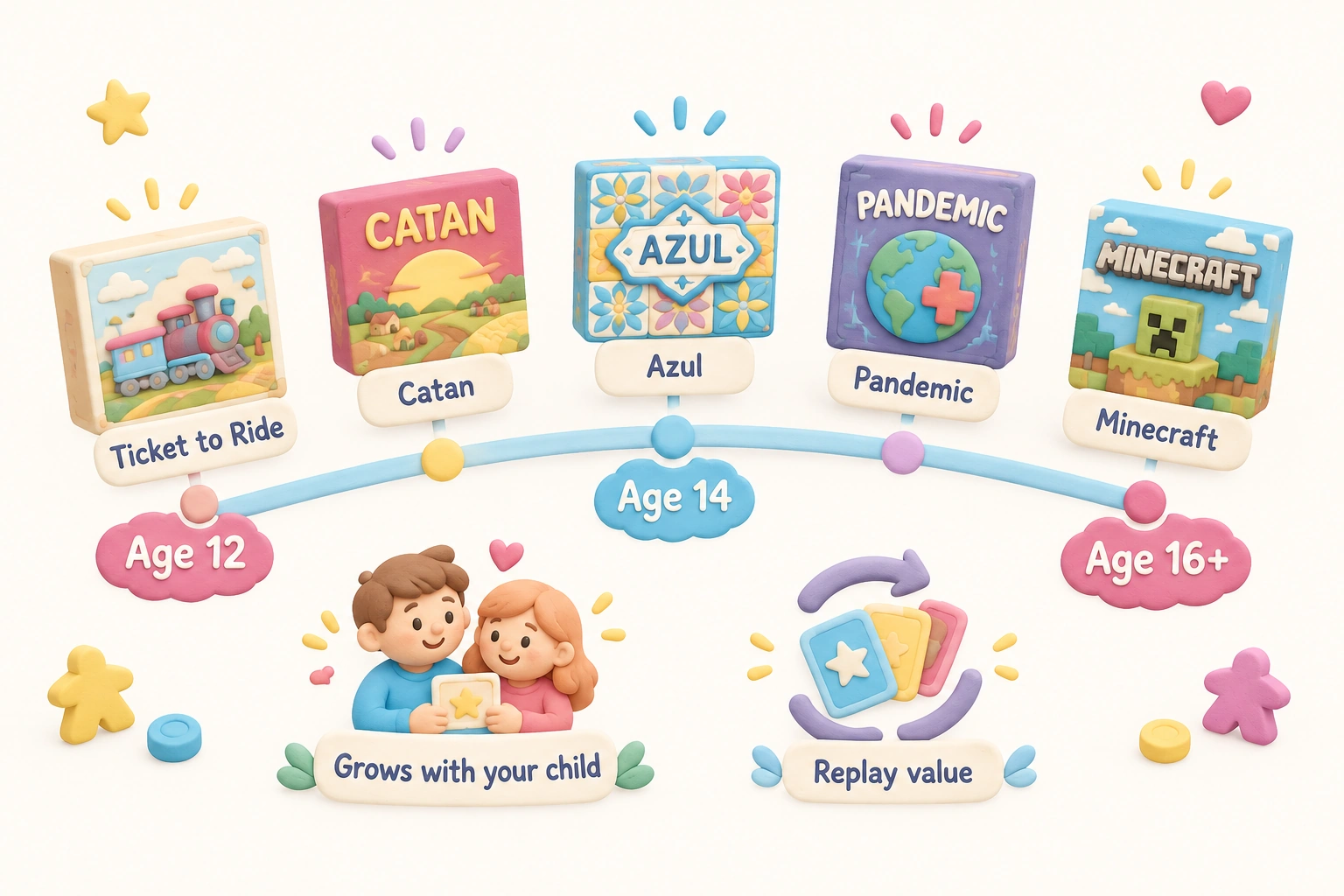
One practical consideration for gift-buyers is longevity. Some games remain genuinely engaging as children develop, while others are quickly outgrown. Titles with meaningful strategic depth tend to age well because the child’s improving reasoning ability reveals new layers of the game over time.
Catan, Ticket to Ride, Azul, and Pandemic are all examples of games that a 12-year-old can enjoy at a surface level and continue to find challenging at 15 or 16 as their strategic thinking matures. In the digital space, Minecraft has demonstrated unusual longevity — children who begin in creative mode often migrate to survival mode and eventually to modding communities as their skills and interests develop. Portal 2’s puzzle design similarly scales with the player’s problem-solving ability rather than becoming trivially easy with repetition. When choosing a gift for a 12-year-old, prioritizing replay value and strategic depth over novelty tends to produce better long-term satisfaction.
Frequently Asked Questions
Are strategy board games too difficult for a 12-year-old?
Most 12-year-olds can engage meaningfully with gateway strategy games like Ticket to Ride or Catan after a single rules explanation. These games are designed to be accessible to new players while offering enough depth to reward repeated play. More complex titles like 7 Wonders or Wingspan may take a few sessions to feel comfortable but are generally within reach for motivated tweens.
Is Fortnite appropriate for a 12-year-old?
Fortnite carries a Teen ESRB rating, which suggests it is designed for players aged 13 and above. Common Sense Media rates it as appropriate from around age 13 as well, citing cartoon violence and online interaction risks. Whether it is appropriate for a specific 12-year-old depends on the child’s maturity, your family’s values around violence in media, and whether parental controls and spending limits are in place. The LEGO Fortnite mode is a notably less combat-focused alternative within the same platform.
What are the best games for a 12-year-old’s birthday party?
For birthday party games, prioritize formats with a no-elimination structure, low setup time, and broad appeal. Codenames, Catch Phrase, Fishbowl, and Taco Cat Goat Cheese Pizza work well indoors. For outdoor parties, team relay races, Balloon Stomp, and Tug of War keep energy high without requiring significant equipment or preparation.
How do I manage in-game purchases for my child?
Most gaming platforms — including PlayStation, Xbox, Nintendo Switch, and mobile app stores — allow parents to require approval for purchases or set spending limits. Enabling these controls before your child begins playing a free-to-play game is the most effective approach. It is also worth having a direct conversation about how in-game currency systems work and why limited-time items are designed to feel urgent.
What is a cooperative board game and why might it suit a 12-year-old?
A cooperative board game is one in which all players work together against the game’s mechanics rather than competing against each other. Pandemic and Forbidden Island are well-known examples. These games can reduce the social friction that competitive games sometimes generate, encourage communication and shared problem-solving, and make the experience more inclusive for children who find losing particularly difficult. They also tend to work well for mixed-age family groups.
Are there good free games for 12-year-olds?
Roblox and Fortnite are both free to access, though both use in-game currency systems that can lead to spending. Several browser-based and mobile games are genuinely free without significant monetization pressure, though content quality varies widely. For screen-free options, many group games like Two Truths and a Lie, Wink Murder, and Fishbowl require no materials or purchase at all.
Choosing the Right Game for Your 12-Year-Old
The most useful frame for choosing games at this age is not a single category but a balanced mix. A 12-year-old who has access to a thoughtfully chosen digital game, a strategy board game for family game night, and a handful of group games for social occasions is well-served across different contexts and developmental needs. Digital games offer immersive engagement and, in the right titles, genuine creative and cognitive challenge. Board games provide face-to-face interaction, strategic thinking practice, and a natural screen-free alternative. Group and party games build social confidence and shared memory in ways that neither digital nor tabletop formats fully replicate.
When making specific choices, ESRB ratings and Common Sense Media reviews are practical starting points for digital titles. For board games, looking for titles described as easy to learn with meaningful strategic depth tends to identify games that will hold a tween’s interest beyond the first session. For group games, the no-elimination format is a reliable indicator of inclusive design. And for any game involving online interaction, having parental controls and spending limits in place before play begins is a straightforward step that significantly reduces the most common risks. The right game for your child ultimately depends on their personality, your family’s values, and the context in which they will be playing — but the options across all three categories are genuinely strong at this age.

Take a short quiz to find out what your everyday choices say about your parenting style
When your child is curious about something new, what’s your instinct?
Take a short quiz to find out what your everyday choices say about your parenting style
“Can I download this app?” What happens next?
Take a short quiz to find out what your everyday choices say about your parenting style
When it comes to rules at home, which sounds most like you?
Take a short quiz to find out what your everyday choices say about your parenting style
If you could give your child one life skill today, what would you pick?
Take a short quiz to find out what your everyday choices say about your parenting style
Your child gets to choose what to watch. What would your ideal setup look like?
Take a short quiz to find out what your everyday choices say about your parenting style
Pick your parenting superpower ✨