Best Games for 9-Year-Olds: Family, Outdoor and Digital Picks

 Discover a Free Education Video App for Kids
Pastory uses AI to personalize educational video content based on your child’s interests and personality. Safe, engaging, and built for curious young minds. Sign up now to stay updated and enjoy early access with a free trial
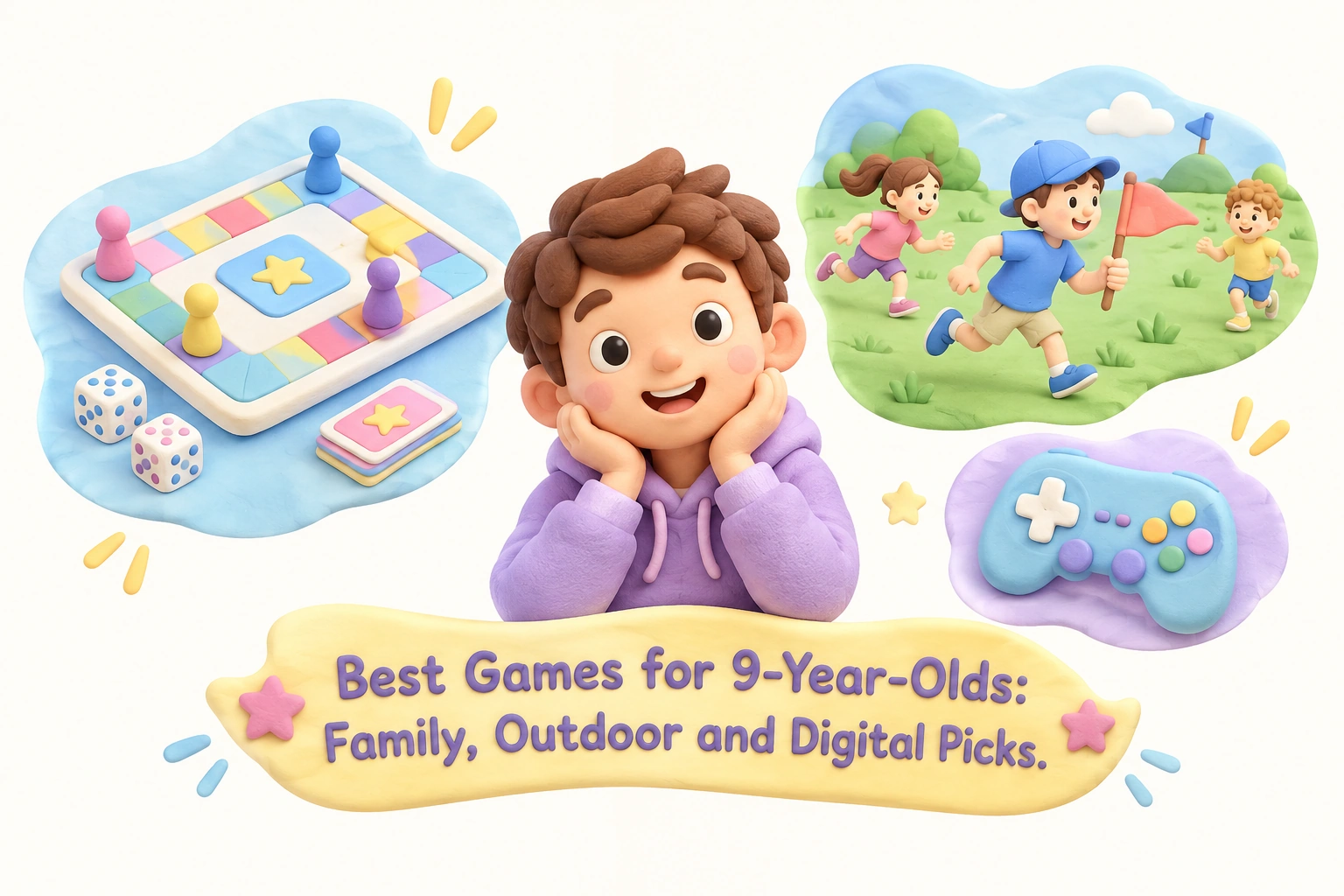
Nine-year-olds sit at a fascinating developmental crossroads: they are capable of genuine strategic thinking, enjoy rule-based competition, and are beginning to care deeply about fairness and social belonging. Choosing the right games at this stage is not simply about keeping children entertained — it is about matching their growing cognitive and social abilities with experiences that feel genuinely challenging and rewarding. This guide covers age-appropriate games across three categories — board and card games, outdoor and backyard games, and digital games — with practical notes on developmental fit, player count, and what parents should watch for.
Key Takeaways
- Nine-year-olds benefit most from games that offer meaningful decisions, not just luck — strategy games for kids and cooperative board games are particularly well matched to this stage.
- Outdoor games for 9-year-olds support physical development, teamwork, and social negotiation, and many excellent options require no equipment at all.
- Digital games can support problem-solving and creativity, but screen time balance, ESRB ratings, and the presence of in-app purchases all deserve careful parental attention.
- Replayability and a manageable learning curve — easy to learn but hard to master — are the most reliable signs of a game that will hold a 9-year-old’s interest over time.
- The best gift ideas for 9-year-olds often combine social play with a genuine cognitive challenge, whether that happens around a table, in the backyard, or on a screen.
What Makes a Game Right for a 9-Year-Old?
Children at age 9 are typically in what developmental psychologists call middle childhood, a period marked by rapid growth in logical reasoning, working memory, and the ability to hold multiple rules in mind simultaneously. They can plan several moves ahead, understand cause-and-effect relationships within a game system, and begin to appreciate the perspective of other players. This means games that were too abstract or too slow at age 6 or 7 can become genuinely engaging now.
When selecting age-appropriate games for this group, four practical criteria are worth applying. First, consider the player count: some games shine with two players, others need four or more to work well, and knowing your typical situation — family game night versus a playdate versus solo play — will narrow the field quickly. Second, look at replayability: a game that offers a different experience each session will hold a 9-year-old’s attention far longer than one that feels solved after a few plays. Third, assess the learning curve: the sweet spot for games for tweens is a ruleset that can be explained in under ten minutes but that reveals deeper layers over repeated sessions. Fourth, consider the developmental domain the game exercises — critical thinking skills, vocabulary, spatial reasoning, physical coordination, or social negotiation — and match that to what your child most enjoys or most needs.
Best Board and Card Games for 9-Year-Olds
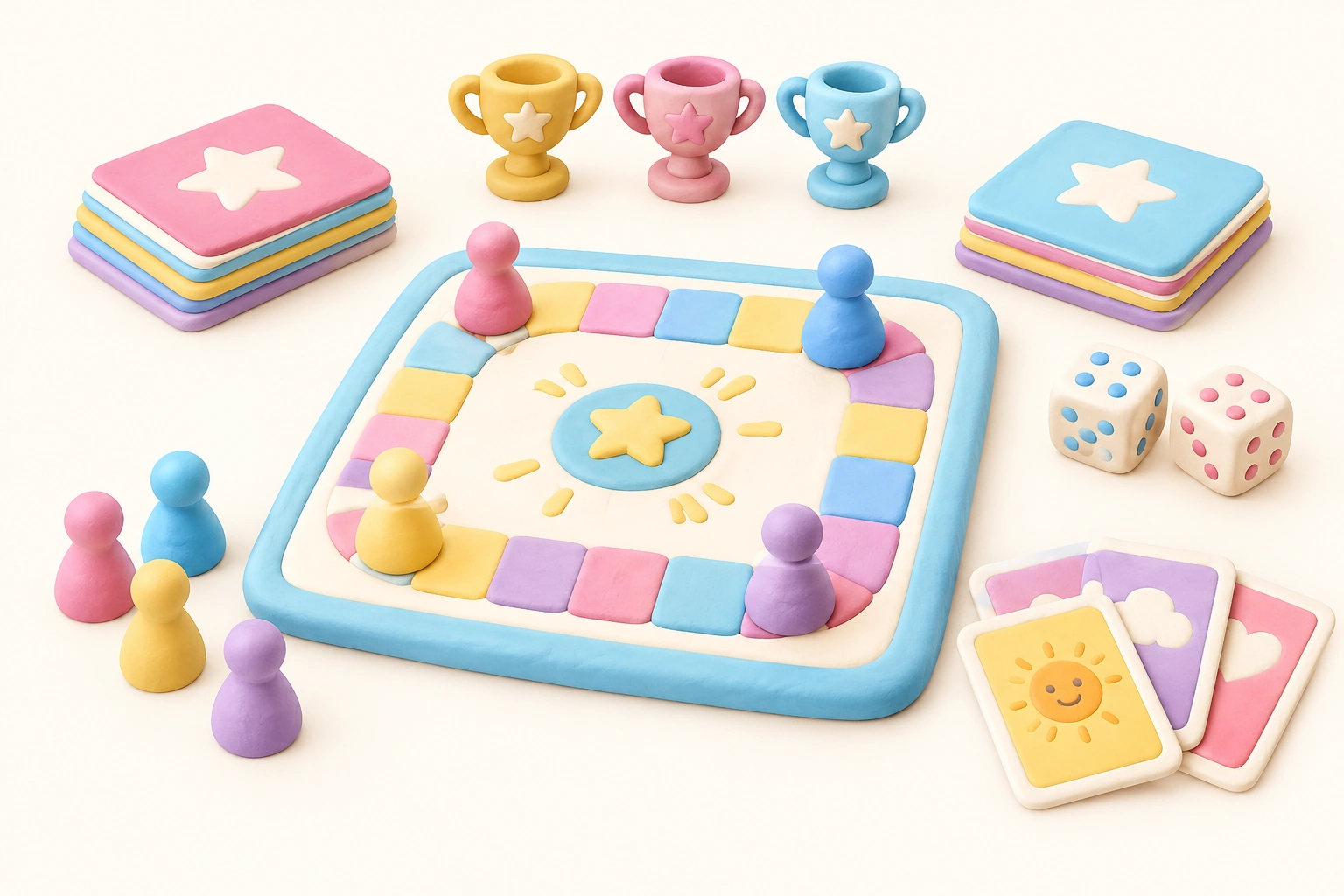
Board and card games are among the most reliable rainy day games for this age group, and the current market offers far more interesting options than the classics many parents grew up with. The picks below are organized by the type of experience they offer rather than by gender, since interest in competition, cooperation, or creativity varies far more by individual child than by any demographic category.
Cooperative Board Games That Build Teamwork
Cooperative board games ask all players to work together against the game itself rather than against each other, which makes them particularly valuable for developing communication and shared decision-making. Forbidden Island is a strong entry point: players must collect treasures and escape a sinking island before it disappears beneath the water. The game plays in about 30 minutes, accommodates two to four players, and scales in difficulty through a simple dial mechanism, making it genuinely replayable. The Crew (the space-mission version) is a cooperative trick-taking card game that introduces mission-based objectives and requires players to communicate under strict constraints — an excellent exercise in planning and restraint for 9-year-olds who are ready for a real challenge. Both titles are widely available and priced under $25, making them practical gift ideas for 9-year-olds on most budgets.
Strategy Games for Kids Who Like to Compete
Ticket to Ride remains one of the most well-designed strategy games for kids in this age range. Players collect colored cards to claim railway routes across a map, balancing their own plans against the risk that opponents will block key connections. The rules take about ten minutes to learn, but the strategic depth — when to claim a route, when to draw more cards, how to read opponents — keeps the game interesting across dozens of sessions. Blokus is a spatial reasoning game in which players place geometric pieces on a grid, each piece touching only the corners of their previous pieces. It plays quickly, works with two to four players, and exercises the kind of visual-spatial thinking that supports mathematical reasoning. Azul, a tile-drafting game about decorating a Portuguese palace, adds an aesthetic dimension alongside its strategic puzzle and is particularly well suited to children who enjoy pattern recognition.
Educational Board Games Worth Playing
Educational board games for this age group work best when the learning is embedded in the gameplay rather than bolted on as a quiz. Bananagrams is a fast-paced word-building game that builds vocabulary and spelling fluency without feeling like a lesson. Qwirkle reinforces pattern recognition and set-building logic through colorful tiles and is accessible enough for younger siblings to join in. Codenames (the standard version, not the junior edition) is appropriate for many 9-year-olds and exercises associative thinking and vocabulary in a team format — it works particularly well for family game night when adults and children play together. For children interested in science or nature, My Little Scythe offers resource management and light engine-building mechanics in a friendly, illustrated setting that rewards planning without overwhelming younger players.
Card Games for Quick Play and Rainy Days
Not every game session needs to last an hour. Taco Cat Goat Cheese Pizza is a reflex-based card game that plays in under 15 minutes, works with two to eight players, and is genuinely funny for children and adults alike. Uno remains a reliable choice for mixed-age groups, though 9-year-olds often enjoy the added complexity of variant rules. Blank Slate asks players to complete a phrase and score points when exactly one other player writes the same word — a game that rewards lateral thinking and is well suited to groups of three to eight. These card games for tweens are compact, inexpensive, and easy to bring to gatherings or holidays.
Best Outdoor Games for 9-Year-Olds
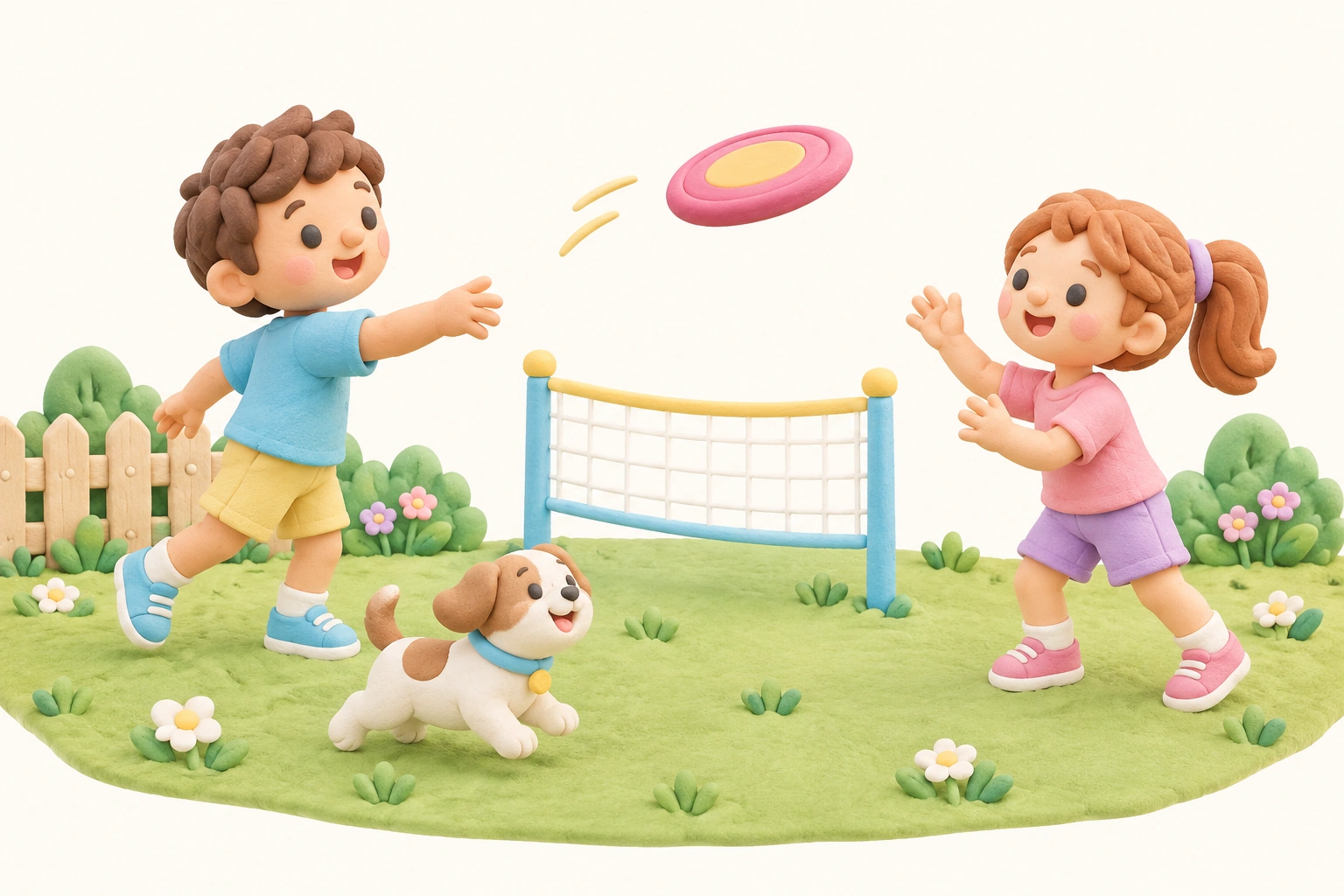
Physical play at age 9 supports gross motor development, cardiovascular fitness, and — crucially — the social negotiation skills that come from organizing and playing games with peers without adult direction. Outdoor games for 9-year-olds range from backyard games requiring equipment to completely free options that need nothing more than a group of children and some open space.
Backyard Games With Equipment
Spikeball is a net-based game played in teams of two, in which players bounce a small ball off a round net and try to prevent the opposing team from returning it. It is fast-paced, highly physical, and develops hand-eye coordination and spatial awareness. The standard set is suitable for ages 9 and up and works on grass, sand, or pavement. Kan Jam is a flying-disc game played in pairs, with players throwing and deflecting a disc toward a goal — it is easy to learn, competitive, and works well for tweens who enjoy outdoor challenges. Bocce Ball and Cornhole (bean bag toss) are lower-intensity backyard games that work across a wide age range, making them good choices for family gatherings where children and adults play together. For water-based summer play, organized water balloon games and relay races add a cooperative or competitive structure to what might otherwise be unstructured splashing.
No Equipment Needed: Free Outdoor Games
Some of the most developmentally rich outdoor games for this age group require no equipment at all. Capture the Flag involves two teams, each defending a flag while trying to capture the other team’s — it demands strategy, communication, speed, and spatial awareness simultaneously. Kick the Can and variations of Tag (including Freeze Tag and Infection Tag) develop cardiovascular fitness and quick decision-making. Four Square, played with a rubber ball and chalk-marked squares, builds hand-eye coordination and turn-taking. Red Light Green Light and Grandmother’s Footsteps are classics that develop impulse control and body awareness. These no equipment needed games are particularly valuable for school holidays, park visits, and situations where bringing gear is impractical. Organizing a backyard scavenger hunt or obstacle course using household items is another low-cost option that encourages creative thinking and physical activity together.
Outdoor Games for Groups and Parties
When a larger group is involved — birthday parties, school events, or neighborhood play — games that scale easily become important. Relay races, tug-of-war, and team-based scavenger hunts all work well with groups of eight or more and can be organized without specialized equipment. Kubb, a Scandinavian lawn game in which players throw wooden batons to knock over blocks, is an underused option that works for mixed ages and group sizes. For party games for kids that combine physical activity with laughter, classic games like Sack Race or a three-legged race remain effective and require minimal preparation.
Best Digital Games for 9-Year-Olds
Digital games occupy a significant portion of many 9-year-olds’ leisure time, and the quality of that experience varies enormously depending on the specific game, the platform, and how parents structure access. The picks below focus on games with clear age ratings, meaningful gameplay, and limited or manageable online risk. Each entry notes whether the game requires an internet connection and flags in-app purchases where relevant, since these are among the most common parent concerns in this category.
Nintendo Switch Games for Kids
The Nintendo Switch remains one of the most family-friendly platforms available, with a strong library of Nintendo Switch games for kids that carry E (Everyone) or E10+ ratings from the ESRB. Mario Kart 8 Deluxe is a racing game that is genuinely accessible to new players while offering enough depth — through item strategy, track memorization, and kart customization — to remain engaging for experienced ones. It supports up to four players locally, making it an excellent family game night option on a screen. Minecraft (available on Switch, PlayStation, Xbox, and PC) is a sandbox building and survival game that supports spatial reasoning, resource management, and creative problem-solving. It does offer optional paid content through its marketplace, so parents should configure account settings accordingly. Animal Crossing: New Horizons is a slow-paced life simulation game that rewards patience, planning, and creativity; it plays offline and has no in-app purchases in its base form. Pokémon Scarlet and Violet introduce open-world exploration and turn-based strategy to the long-running series and are well matched to 9-year-olds who enjoy collecting and planning. Splatoon 3 is a team-based ink-shooting game with an E10+ rating that develops tactical thinking and hand-eye coordination; its online multiplayer mode requires a Nintendo Switch Online subscription.
Games That Support Problem-Solving and Creativity
Super Mario Odyssey is a platforming game that rewards exploration and lateral thinking — many of its puzzles have multiple solutions, encouraging children to experiment rather than follow a single correct path. Kirby and the Forgotten Land is a gentler platformer with a lower difficulty ceiling, making it a good choice for children who are newer to gaming or who find competitive games frustrating. LEGO Star Wars: The Skywalker Saga combines puzzle-solving, exploration, and humor in a format that is highly accessible and has strong replayability across its enormous content library. Luigi’s Mansion 3 is a puzzle-adventure game with cooperative two-player support and a playful tone that works well for siblings or parent-child play sessions.
Mobile and Online Games: What Parents Should Know
Roblox is one of the most popular platforms among children aged 9 to 12, offering thousands of user-created games across genres. Its appeal is genuine — the platform supports creativity, social play, and a wide range of experiences — but parents should be aware that content quality varies significantly between individual games, that in-app purchases (called Robux) are a central part of the platform’s economy, and that chat features require careful privacy settings. Stumble Guys is a free-to-play battle-royale party game available on mobile and PC; it contains in-app purchases and advertising, and its online multiplayer nature means children may interact with strangers. Toca Boca World is a creative play app with no in-app purchases in its paid version and no online multiplayer, making it a lower-risk option for independent digital play. For parents navigating free online games, checking ESRB or equivalent age ratings, disabling or limiting in-app purchases through device settings, and reviewing chat and privacy options before a child plays independently are all practical steps worth taking.
Screen Time Balance: A Practical Framework for Parents
Screen time balance is one of the most common concerns parents raise when discussing digital games, and it is worth addressing directly rather than leaving it as a vague aspiration. The American Academy of Pediatrics and similar organizations generally recommend that screen time for children aged 6 and older be consistent, limited, and balanced with adequate sleep, physical activity, and face-to-face social interaction — though specific hour limits are less emphasized than the quality and context of use. For 9-year-olds, this means that a 45-minute session of a cooperative or creative digital game is a meaningfully different experience from 45 minutes of passive video consumption, even if the clock time is identical.
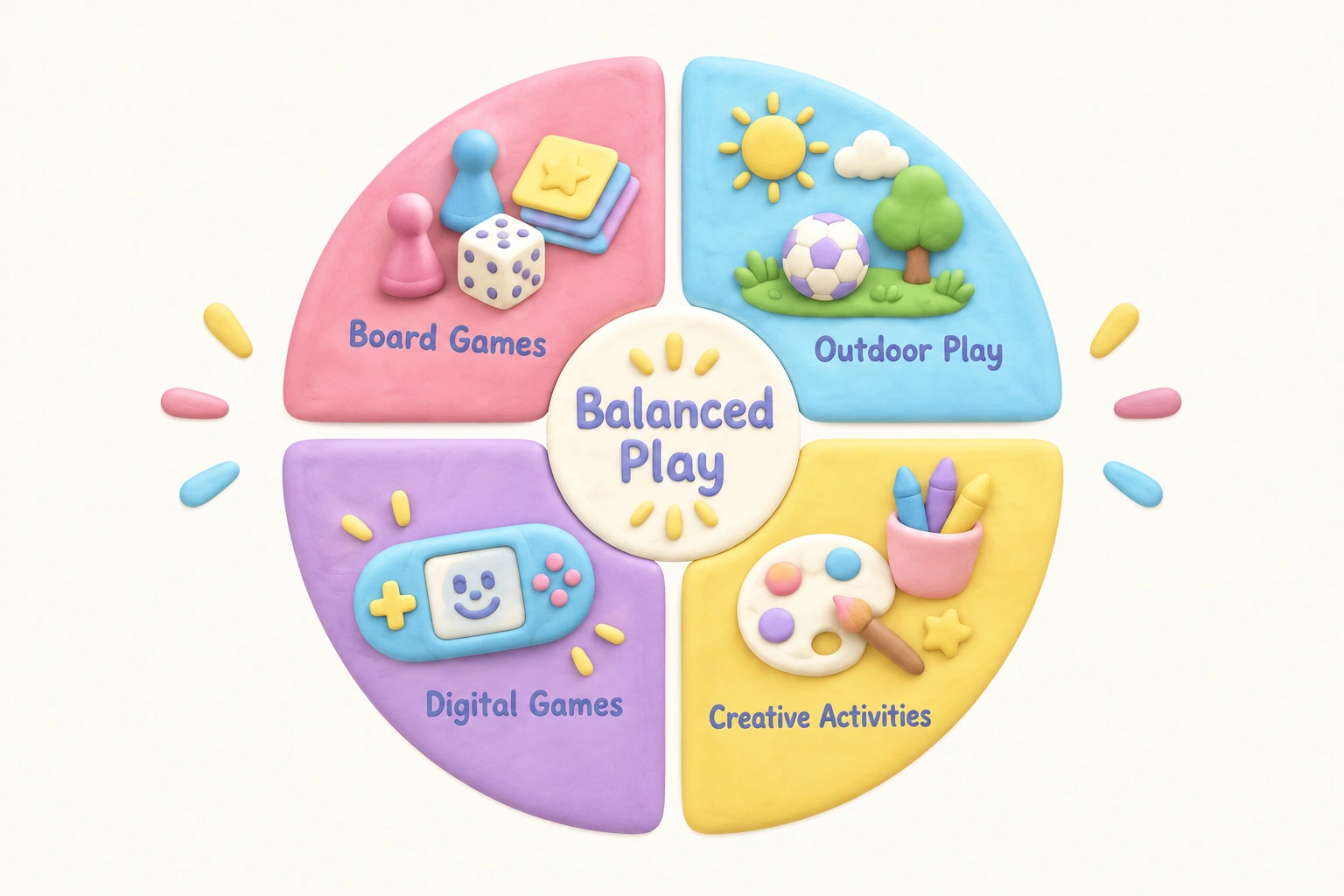
A practical approach is to treat digital games as one category within a broader weekly play diet rather than as a separate problem to be minimized. When children have regular access to board games, outdoor play, and creative activities, digital game sessions tend to feel less like the only available option and more like one enjoyable choice among several. Setting clear session boundaries before play begins — rather than negotiating at the end — reduces conflict and helps children develop the self-regulation skills that will serve them well as they move into adolescence. Co-playing digital games with a child, even occasionally, also gives parents direct insight into the content and social dynamics their child is experiencing online.
Choosing Games by Player Count and Context
| Game | Type | Player Count | Best Context | Developmental Focus |
|---|---|---|---|---|
| Forbidden Island | Cooperative board game | 2–4 | Family game night, rainy days | Teamwork, planning |
| Ticket to Ride | Strategy board game | 2–5 | Family game night | Strategic thinking, spatial reasoning |
| Codenames | Word/team card game | 4–8+ | Parties, family gatherings | Vocabulary, associative thinking |
| Taco Cat Goat Cheese Pizza | Reflex card game | 2–8 | Quick play, parties | Reaction speed, attention |
| Capture the Flag | Outdoor team game | 6+ | Parks, school holidays | Strategy, physical fitness, teamwork |
| Spikeball | Outdoor equipment game | 4 | Backyard, beach | Hand-eye coordination, fitness |
| Mario Kart 8 Deluxe | Digital racing game | 1–4 local | Family screen time, playdates | Hand-eye coordination, friendly competition |
| Minecraft | Digital sandbox game | 1+ (online optional) | Solo or small group play | Creativity, spatial reasoning, resource management |
| Super Mario Odyssey | Digital platformer | 1–2 | Solo or parent-child play | Problem-solving, exploration |
| Bananagrams | Word tile game | 2–8 | Rainy days, family play | Vocabulary, spelling, speed |
Frequently Asked Questions
What types of games are most developmentally appropriate for 9-year-olds?
Games that involve meaningful decisions, clear rules, and some degree of social interaction tend to be the best fit for this age group. Nine-year-olds can handle moderate complexity, enjoy both competition and cooperation, and benefit from games that exercise critical thinking skills, spatial reasoning, or vocabulary. The key is matching the game’s challenge level to the child’s current abilities — too easy leads to boredom, too difficult leads to frustration.
How do I choose between a cooperative and a competitive game?
Consider the child’s temperament and the typical playing group. Children who become upset when they lose, or who play frequently with younger siblings, often respond better to cooperative board games where the group wins or loses together. Children who enjoy rivalry and can handle losing gracefully tend to engage more deeply with competitive strategy games. Many families find it useful to have both types available and alternate based on mood and group composition.
Which digital games work offline and have no in-app purchases?
Animal Crossing: New Horizons plays entirely offline in its single-player mode and has no in-app purchases. Super Mario Odyssey, Kirby and the Forgotten Land, and Luigi’s Mansion 3 are all offline single-player games with no additional purchase requirements beyond the base game. Minecraft has optional paid marketplace content but functions fully offline without it. Toca Boca World (paid version) also plays offline with no in-app purchases.
Are there good games for 9-year-olds that work for just two players?
Yes. Ticket to Ride works well with two players, as does Blokus, Forbidden Island, and Bananagrams. For digital two-player games, Luigi’s Mansion 3 has a cooperative two-player mode, and Mario Kart 8 Deluxe supports local two-player racing. For outdoor two-player options, Kan Jam and Spikeball (in a modified format) both work with two players.
How much screen time is reasonable for a 9-year-old playing video games?
There is no single universally agreed figure, but most pediatric guidance emphasizes consistency, context, and balance over a specific daily hour limit. A useful practical approach is to ensure that digital game time does not regularly displace sleep, physical activity, homework, or face-to-face social time. Setting a predictable daily or weekly limit and discussing it with the child in advance tends to work better than imposing limits reactively at the end of a session.
What should I look for in outdoor games for this age group?
Look for games that involve genuine physical activity, allow for some strategic or social element, and can be adapted for different group sizes. Games that children can organize and referee themselves — without constant adult direction — are particularly valuable at age 9, as they support the development of self-governance and peer negotiation skills. No equipment needed options like Capture the Flag or tag variations are especially practical because they can happen spontaneously wherever children gather.
Finding the Right Game Mix for Your 9-Year-Old
No single game category covers every developmental need or every social context a 9-year-old encounters. A child who spends a rainy afternoon playing a cooperative board game, a summer evening in the backyard with a group of friends, and a weekend hour on a thoughtfully chosen digital game is getting a genuinely varied play diet — one that exercises different cognitive, physical, and social capacities in complementary ways.
When building a game collection or choosing gift ideas for 9-year-olds, prioritizing replayability and a manageable learning curve will serve you better than chasing novelty. The games that get played most in most households are the ones that feel different each time, that work across a range of moods and group sizes, and that offer enough challenge to grow with the child over the coming years. Whether you are starting with a single board game for family game night, a backyard set for summer, or a carefully chosen digital title, the most important factor is that the game creates genuine engagement — moments where a child is thinking, deciding, laughing, or collaborating rather than simply passing time.

Take a short quiz to find out what your everyday choices say about your parenting style
When your child is curious about something new, what’s your instinct?
Take a short quiz to find out what your everyday choices say about your parenting style
“Can I download this app?” What happens next?
Take a short quiz to find out what your everyday choices say about your parenting style
When it comes to rules at home, which sounds most like you?
Take a short quiz to find out what your everyday choices say about your parenting style
If you could give your child one life skill today, what would you pick?
Take a short quiz to find out what your everyday choices say about your parenting style
Your child gets to choose what to watch. What would your ideal setup look like?
Take a short quiz to find out what your everyday choices say about your parenting style
Pick your parenting superpower ✨