Best Games for 11-Year-Olds: Strategy and Creative Play

 Discover a Free Education Video App for Kids
Pastory uses AI to personalize educational video content based on your child’s interests and personality. Safe, engaging, and built for curious young minds. Sign up now to stay updated and enjoy early access with a free trial
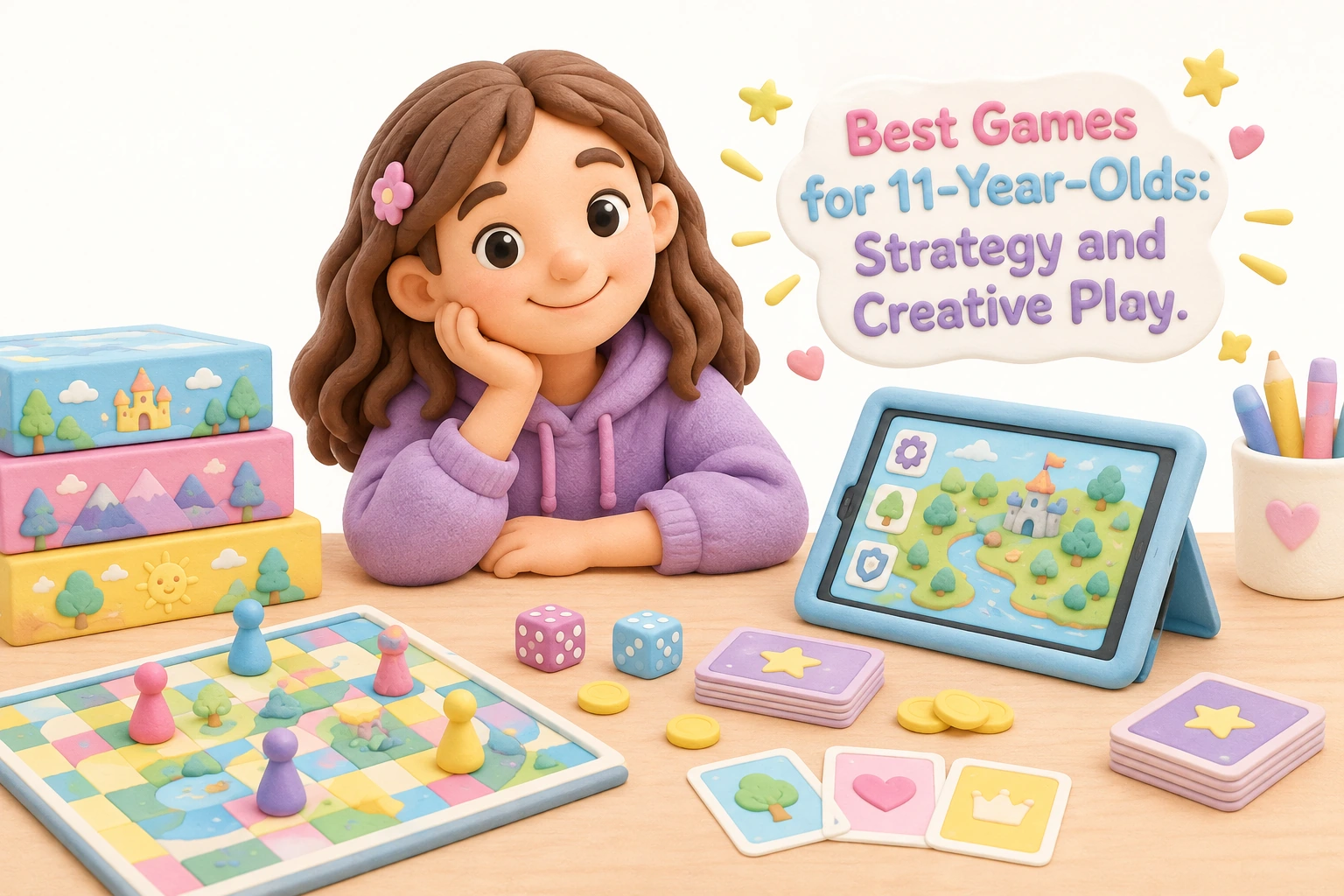
Eleven is a genuinely interesting age for play. Tweens at this stage can handle multi-step rules, think several moves ahead, and engage with themes that would have felt overwhelming just a year or two earlier — yet they still want games that are fun, social, and occasionally a little silly. Finding games that hit that balance takes more than scanning a bestseller list. This guide covers the best games for 11-year-olds across strategy, creative, cooperative, card, and digital categories, explains what each type of game may support developmentally, and helps parents match choices to their child’s personality and attention span.
Key Takeaways
- Eleven-year-olds are developmentally ready for games that involve resource management, negotiation, and multi-step planning — skills that transfer well beyond the game table.
- The best games for this age group tend to run 30–60 minutes, which aligns with a typical tween’s sustained attention span without causing frustration.
- Strategy and creative play are not opposites — many of the strongest games for this age blend both, requiring players to think analytically while making imaginative decisions.
- A mix of screen-free board games and age-appropriate digital games can complement each other when chosen thoughtfully and balanced with other activities.
- Matching a game to a child’s personality type — competitive, creative, cooperative, or solo — increases the chance it will actually get played and enjoyed.
Why Game Complexity Matters at Age 11
Around age 10 to 12, children typically enter a phase of cognitive development characterized by stronger abstract reasoning, improved working memory, and a growing capacity for hypothetical thinking. These shifts mean an 11-year-old can genuinely engage with cause-and-effect planning, weigh trade-offs, and understand that another player’s perspective differs from their own. Games that tap into these emerging abilities — rather than relying purely on luck — tend to hold attention longer and feel more rewarding.
Attention span is a practical consideration that many game guides overlook. Most 11-year-olds can sustain focused engagement for roughly 30 to 45 minutes comfortably; games that run 60 to 90 minutes are manageable when the theme is compelling, but titles requiring two hours or more often lose this age group before the end. When browsing options, checking the estimated play time on the box is as important as checking the age recommendation.
It is also worth noting that 11-year-olds vary considerably. Some are ready for complex engine-building games; others still prefer fast-paced card games with a social element. The sections below are organized by game type and personality fit rather than a single ranked list, so parents can find what suits their specific child.
Strategy Board Games: Building Analytical Thinking
Strategy board games are among the most consistently recommended games for 11-year-olds because they require active decision-making rather than passive luck. The best gateway strategy game for this age is widely considered to be Ticket to Ride (Ages 8+, 2–5 players, 45–75 minutes). Players collect colored train cards and claim railway routes across a map, balancing short-term card collection against long-term route completion. The rules are accessible within one session, yet the decisions — which routes to prioritize, when to block a competitor — involve genuine strategic thinking and pattern recognition.
Once a child is comfortable with Ticket to Ride, Catan (Ages 10+, 3–4 players, 60–90 minutes) is a natural next step. Catan introduces resource management and negotiation skills: players collect and trade resources to build roads, settlements, and cities, and must negotiate with opponents to get what they need. The social dimension — persuading another player to trade, deciding whom to trust — makes Catan particularly valuable for developing communication and decision-making alongside strategic play. It runs longer than ideal for some 11-year-olds, so it works best for children who are already comfortable with board game sessions.
Azul (Ages 8+, 2–4 players, 30–45 minutes) is an excellent choice for children who enjoy visual puzzles. Players draft colored tiles and arrange them on a personal board, scoring points for completed patterns. The game develops spatial reasoning and pattern recognition in a format that feels more like an elegant puzzle than a competition. Its 30–45 minute play time makes it one of the most reliably completable strategy games for this age group.
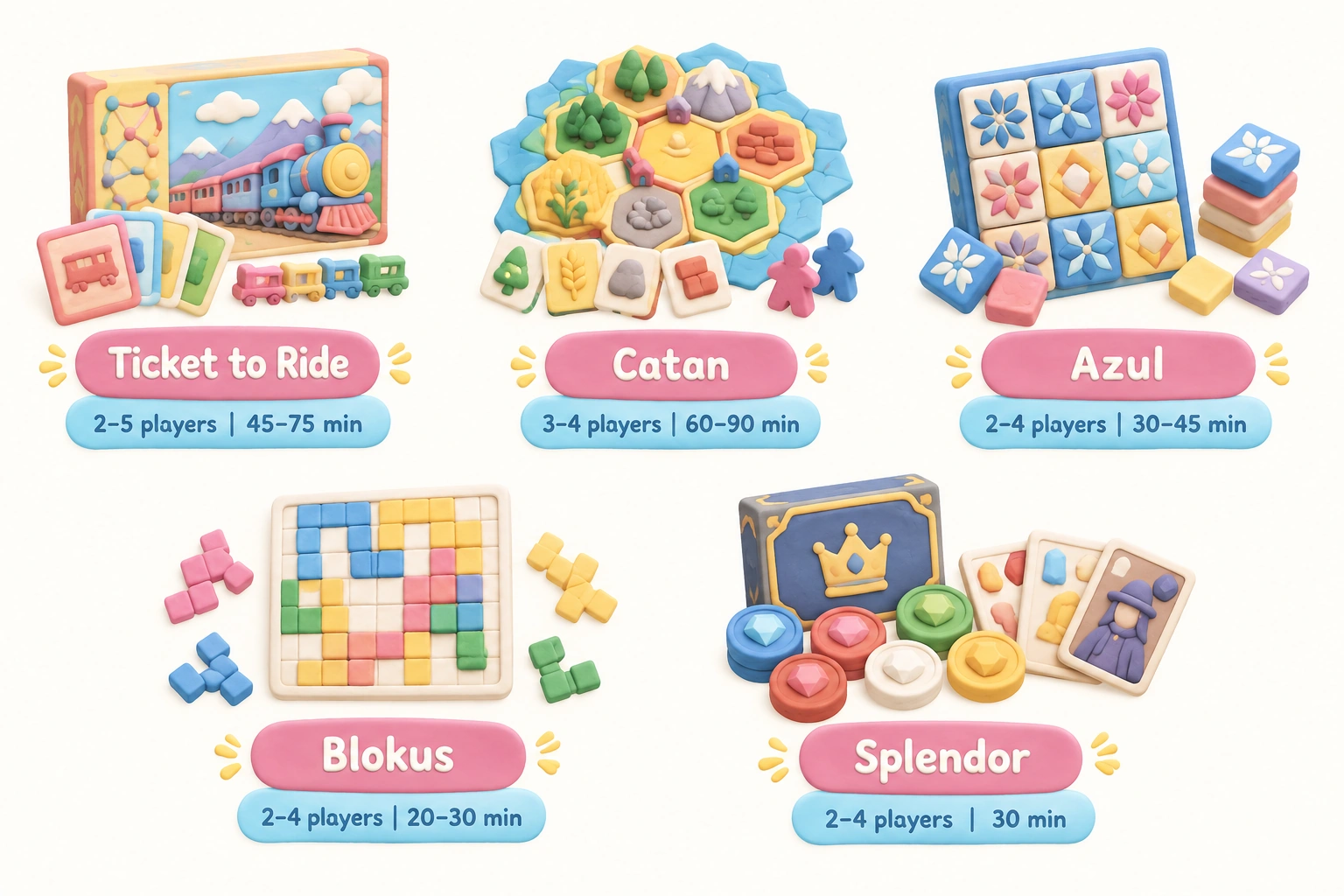
Blokus (Ages 7+, 2–4 players, 20–30 minutes) is a faster spatial reasoning game in which players place geometric pieces on a shared grid, each piece touching only the corners of their own previous pieces. It is quick, visually satisfying, and genuinely challenging — a strong option for family game night when time is limited.
Splendor (Ages 10+, 2–4 players, 30 minutes) introduces card drafting and engine-building in an accessible format. Players collect gem tokens to purchase development cards, which then generate permanent resources for future purchases. The game rewards forward planning and teaches children to think about building systems rather than just reacting to the current state of play.
Creative and Storytelling Games: Imagination Within Structure
Creative games for 11-year-olds work best when they provide enough structure to guide play without scripting every outcome. These games develop creative problem-solving, communication, and the ability to interpret ambiguous information — skills that complement the analytical demands of strategy games.
Codenames (Ages 14+, 4+ players, 15–30 minutes) is frequently played with children as young as 10 or 11 in a family context. One player gives single-word clues to help teammates identify hidden words on a grid, while avoiding words belonging to the opposing team. The game demands lateral thinking, vocabulary, and the ability to anticipate how others will interpret language — a genuinely sophisticated cognitive challenge wrapped in a fast, social format.
Dixit (Ages 8+, 3–6 players, 30 minutes) takes a different approach. Players use beautifully illustrated cards to tell short stories or give clues, and others must identify which card belongs to the storyteller. Dixit rewards imaginative thinking and the ability to calibrate how others perceive meaning — not too obvious, not too obscure. It is particularly well suited to children who enjoy art, storytelling, or lateral thinking over direct competition.
Hues and Cues (Ages 8+, 3–10 players, 30 minutes) asks players to give one- or two-word clues to guide others toward a specific color on a large color grid. It sounds simple but quickly reveals how differently people perceive and describe color — a surprisingly rich exercise in communication and creative problem-solving that works well with mixed-age groups.
For faster, sillier creative play — particularly at sleepovers or with a group — Sushi Go Party! (Ages 8+, 2–8 players, 20 minutes) offers a card-drafting game with a lighthearted theme. Players simultaneously choose cards from a hand and pass the rest, building sets of sushi dishes for points. The simultaneous play keeps everyone engaged and eliminates downtime, which matters for groups of energetic 11-year-olds.
Cooperative Games: Learning to Win and Lose Together
Cooperative play — where all players work toward a shared goal rather than competing against each other — offers a distinct developmental benefit. These games encourage communication, shared decision-making, and the experience of collective success or failure without the social friction that can come with direct competition. For children who find losing difficult, cooperative games can be a gentler entry point into complex gameplay.
Horrified (Ages 10+, 1–5 players, 60 minutes) places players in a classic monster movie setting, working together to defeat iconic creatures before they overrun the town. The game involves meaningful strategic decisions each turn — which monster to prioritize, how to share resources, when to rescue villagers — and scales in difficulty, making it replayable as children grow more skilled. The theme is spooky but not graphic, and the cooperative structure means the group succeeds or fails together.
Gnomes at Night (Ages 6+, 2–4 players, 20 minutes) is a simpler cooperative option that works well when playing with younger siblings or when a shorter session is needed. Players navigate a maze together, but each player sees a different side of the board — meaning they must communicate clearly to coordinate movement. It is a strong introduction to cooperative play for children who have not tried it before.
Cooperative games also provide a natural context for discussing how to handle setbacks. When the whole group loses together, the emotional experience is shared rather than directed at one person — which can make it easier for children to reflect on what went wrong and try again.
Card Games: Fast, Portable, and Surprisingly Deep
Card games for 11-year-olds occupy a useful middle ground: they are portable, quick to set up, and often more strategically interesting than they appear. Many card games also introduce hand management — the skill of deciding which cards to play now versus hold for later — which is a foundational concept in more complex strategy games.
Exploding Kittens (Ages 7+, 2–5 players, 15 minutes) is one of the most popular card games for this age group. Players draw cards until someone draws an Exploding Kitten, using action cards to avoid, redirect, or defuse the explosion. It is fast, funny, and involves more tactical thinking than its silly premise suggests — particularly around when to use defuse cards and how to read opponents’ hands.
Wingspan (Ages 10+, 1–5 players, 40–70 minutes) bridges card games and strategy board games. Players build a collection of bird cards, each with unique abilities, and manage resources to attract birds to different habitats. The game rewards engine-building thinking — understanding how individual cards interact to create powerful combinations — and has exceptional replayability because the bird cards vary significantly between games. Wingspan is particularly well suited to children who enjoy nature, animals, or collecting.
King of Tokyo (Ages 8+, 2–6 players, 30 minutes) uses dice and cards in a fast-paced game where players control giant monsters competing to dominate Tokyo. It involves risk assessment — deciding whether to stay in Tokyo for points while taking damage, or retreat to safety — and introduces the concept of calculated risk in a highly entertaining format.
Video Games for 11-Year-Olds: Digital Strategy and Creative Play
Digital games deserve a place in any honest guide to games for 11-year-olds. The key is selecting age-appropriate titles with clear developmental value and understanding the ESRB rating system. Games rated E (Everyone) are suitable for all ages; E10+ titles are designed for players aged 10 and older and may include mild fantasy violence or suggestive themes; T (Teen) games are intended for ages 13 and up. At 11, E10+ titles are generally appropriate, and some T-rated games may be suitable depending on the child and parental judgment — but it is worth reviewing content descriptors rather than relying on the rating alone.
Minecraft (E10+) remains one of the most developmentally rich digital games available for this age group. In Survival Mode, players gather resources, craft tools, build shelters, and manage threats — a form of turn-based strategy and resource management that mirrors the mechanics of many board games. The creative mode offers an open-ended building environment that supports spatial reasoning and imaginative design. Minecraft’s replayability is essentially unlimited, and it scales naturally as children develop more sophisticated building and survival strategies.
Stardew Valley (E10+) is a farming and community simulation game that involves planning crop rotations, managing time and resources, and building relationships with in-game characters. It rewards long-term thinking and patience, and its gentle pace makes it accessible to children who find faster-paced games overwhelming. The game has no competitive pressure, which suits children who prefer solo or low-stakes play.
Civilization VI (E10+) is a turn-based strategy game in which players guide a civilization from ancient times through the modern era, managing resources, diplomacy, science, and military. It is significantly more complex than most games on this list and is best suited to 11-year-olds who are already comfortable with strategy games and have a longer attention span. The game’s depth means it can grow with a child well into their teenage years.
Into the Breach (E10+) is a compact turn-based strategy game involving small squads of mechs defending cities from alien creatures. Each puzzle-like battle has a clear solution space, and the game rewards careful planning and creative problem-solving over reflexes. It is an excellent choice for children who enjoy chess-like thinking in a digital format.
Animal Crossing: New Horizons (E) offers a creative, low-pressure environment for designing and managing a personal island. While it lacks the competitive or strategic depth of other titles, it supports creative decision-making, resource management, and social interaction through its multiplayer features. It is a strong option for children who prefer creative play over competition.
Matching Games to Your Child’s Personality
One of the most useful frameworks for choosing games for 11-year-olds is matching the game type to the child’s natural play style. A game that suits one child perfectly may sit untouched on the shelf for another.
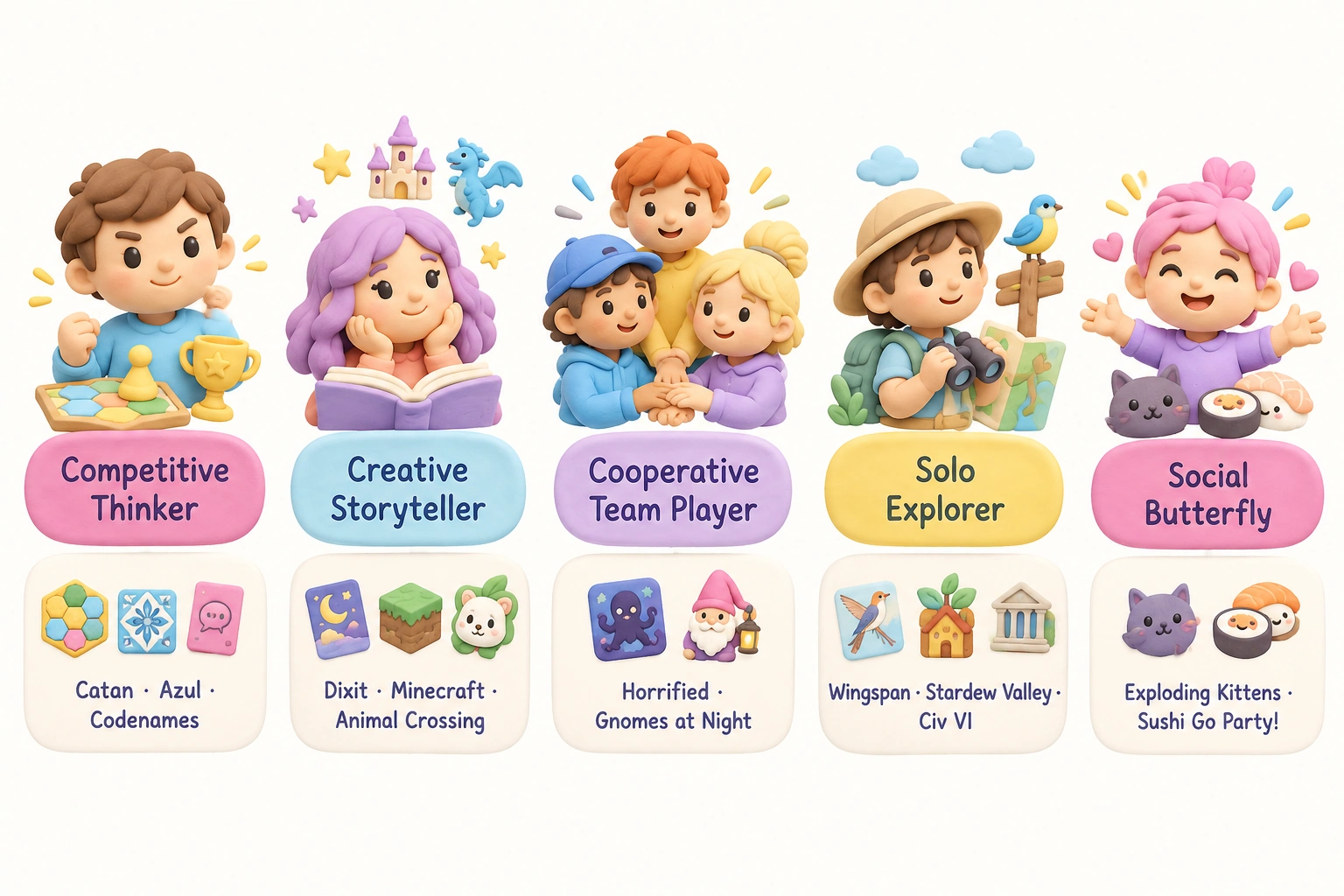
- The competitive thinker — enjoys head-to-head challenges and wants to win through skill. Strong matches: Catan, Azul, Splendor, Codenames, Into the Breach.
- The creative storyteller — prefers imagination, expression, and open-ended play over rigid rules. Strong matches: Dixit, Hues and Cues, Minecraft (Creative Mode), Animal Crossing.
- The cooperative team player — thrives when working with others toward a shared goal. Strong matches: Horrified, Gnomes at Night, Stardew Valley (multiplayer), Minecraft (multiplayer survival).
- The solo explorer — enjoys playing independently or at their own pace. Strong matches: Wingspan (solo mode), Stardew Valley, Civilization VI, Into the Breach.
- The social butterfly — wants fast, funny games that keep a group laughing. Strong matches: Exploding Kittens, Sushi Go Party!, King of Tokyo, Codenames, Hues and Cues.
A Gateway Game Progression Path
If a child is new to strategy games, starting with the most complex title available often leads to frustration rather than engagement. A progression approach — introducing games in order of increasing complexity — tends to build both skill and confidence more effectively.
A practical progression for a child new to strategy board games might begin with Ticket to Ride, which introduces route planning and hand management without overwhelming rules. Once that feels comfortable, Catan adds resource management and negotiation. From Catan, a child ready for more complexity might move to Wingspan, which introduces engine-building and card synergies, or to Splendor for a tighter resource-conversion challenge. Children who enjoy the engine-building concept in Wingspan may eventually be ready for Civilization VI in digital form, which applies similar principles at a much larger scale.
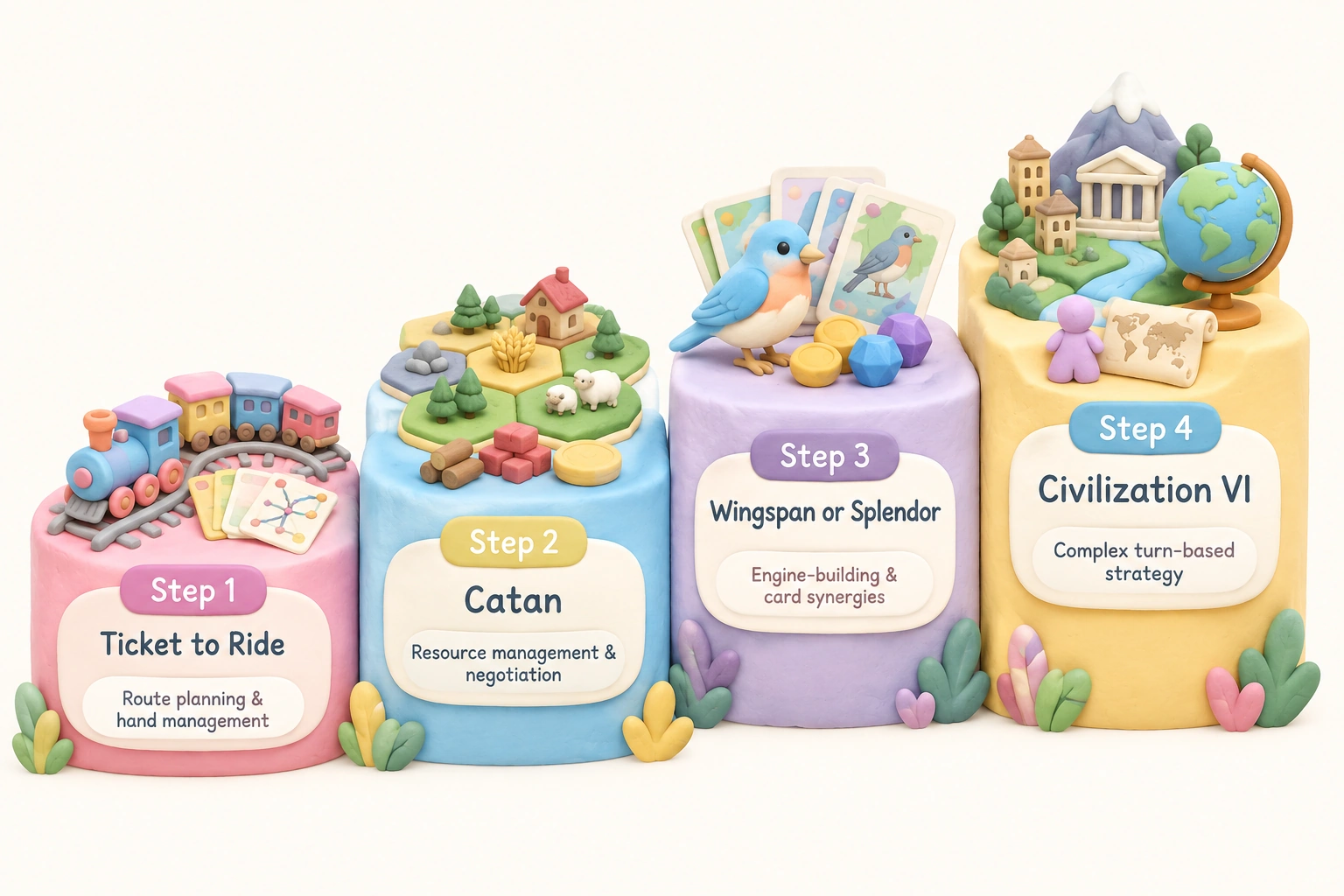
This kind of progression also helps parents identify which game mechanics a child enjoys most — route-building, resource trading, pattern completion, or engine-building — and use that preference to guide future choices.
Balancing Screen-Free and Digital Play
A common question from parents is how to balance screen-free board games with digital games for an 11-year-old. Both formats offer genuine developmental value when chosen thoughtfully, and they are not in direct competition. Board games tend to offer richer face-to-face social interaction, physical components that engage tactile senses, and a natural endpoint when the game concludes. Digital games can offer greater complexity, adaptive difficulty, and the ability to play solo or with remote friends.
The American Academy of Pediatrics recommends that parents of children aged 6 and older prioritize consistent limits on screen time and ensure that digital media does not displace sleep, physical activity, or in-person social interaction. Within those boundaries, age-appropriate digital games with clear strategic or creative value can be a reasonable part of a balanced play diet. Checking ESRB ratings, reviewing content descriptors, and occasionally playing alongside a child are practical steps that help parents make informed decisions about specific titles.
One useful approach is to treat digital and analog games as complementary rather than competing. A child who enjoys Catan may find Civilization VI a natural extension of the same strategic thinking in a digital environment. A child who loves Minecraft’s creative mode may enjoy Blokus or Azul as a screen-free spatial reasoning alternative. Framing choices this way — rather than as screen time versus no screen time — tends to produce more sustainable habits.
Frequently Asked Questions
What is a good game length for an 11-year-old?
Most 11-year-olds sustain focused engagement comfortably for 30 to 45 minutes. Games in the 45–60 minute range are manageable when the theme is engaging. Titles that regularly run 90 minutes or more may lose this age group before the end, particularly on school nights or with children who are newer to strategy games.
Are strategy games actually educational for tweens?
Strategy games may support skills including critical thinking, decision-making, resource management, and negotiation — all of which have broader applications. However, outcomes vary by child, and the benefit depends on how the game is played, how often, and whether an adult is available to discuss strategies and reflect on decisions. Games are not a substitute for formal learning but can complement it meaningfully.
What is the difference between cooperative and competitive games, and which is better for 11-year-olds?
Competitive games involve players working against each other; cooperative games involve all players working toward a shared goal. Neither format is universally better. Competitive games can motivate children who enjoy challenge and direct comparison, while cooperative games suit children who find losing difficult or who thrive in team environments. Many families benefit from having both types available.
How do I know if a video game is appropriate for my 11-year-old?
The ESRB rating system provides a starting point: E (Everyone) and E10+ titles are generally appropriate for this age group. T (Teen) games are intended for ages 13 and up, though some may be suitable depending on the child and the specific content descriptors listed on the packaging or game page. Reviewing those descriptors — rather than relying on the rating alone — gives a more accurate picture of what the game contains.
Can board games help with social skills at this age?
Games that involve negotiation, communication, and shared decision-making — such as Catan, Codenames, or cooperative games like Horrified — may support social skills including turn-taking, perspective-taking, and handling both winning and losing gracefully. These benefits are most likely when an adult is present to model positive behavior and facilitate reflection after the game.
What are good games for a mixed-age group including younger siblings?
Games with simple rules and fast play work best for mixed-age groups. Ticket to Ride, Blokus, Sushi Go Party!, Gnomes at Night, and Hues and Cues are all accessible to children as young as 7 or 8 while remaining genuinely engaging for 11-year-olds. Avoid games with complex rule sets or long play times when younger children are involved.
Choosing Games That Will Still Be Played Next Year
The best games for 11-year-olds are not just the ones that get played once and forgotten — they are the ones with enough depth and replayability to remain interesting as a child grows. Games like Catan, Wingspan, Codenames, and Civilization VI have high replayability because no two games unfold identically. Minecraft and Stardew Valley offer essentially unlimited content. These titles tend to grow with a child rather than being outgrown quickly, which makes them better long-term investments whether chosen as birthday gifts, holiday gifts, or additions to a family game night collection.
When selecting games, it is worth considering not just what an 11-year-old enjoys today but what mechanics and themes are likely to remain engaging at 12 or 13. Games that introduce genuinely complex systems — resource management, engine-building, negotiation, turn-based strategy — tend to reveal new layers of depth as a child’s analytical thinking matures. Starting with a strong gateway strategy game and building from there gives children a foundation that supports increasingly sophisticated play over time, and gives families a shared activity that can evolve alongside the child.

Take a short quiz to find out what your everyday choices say about your parenting style
When your child is curious about something new, what’s your instinct?
Take a short quiz to find out what your everyday choices say about your parenting style
“Can I download this app?” What happens next?
Take a short quiz to find out what your everyday choices say about your parenting style
When it comes to rules at home, which sounds most like you?
Take a short quiz to find out what your everyday choices say about your parenting style
If you could give your child one life skill today, what would you pick?
Take a short quiz to find out what your everyday choices say about your parenting style
Your child gets to choose what to watch. What would your ideal setup look like?
Take a short quiz to find out what your everyday choices say about your parenting style
Pick your parenting superpower ✨