Best Games for 10-Year-Olds: Brain Games and Group Picks

 Discover a Free Education Video App for Kids
Pastory uses AI to personalize educational video content based on your child’s interests and personality. Safe, engaging, and built for curious young minds. Sign up now to stay updated and enjoy early access with a free trial
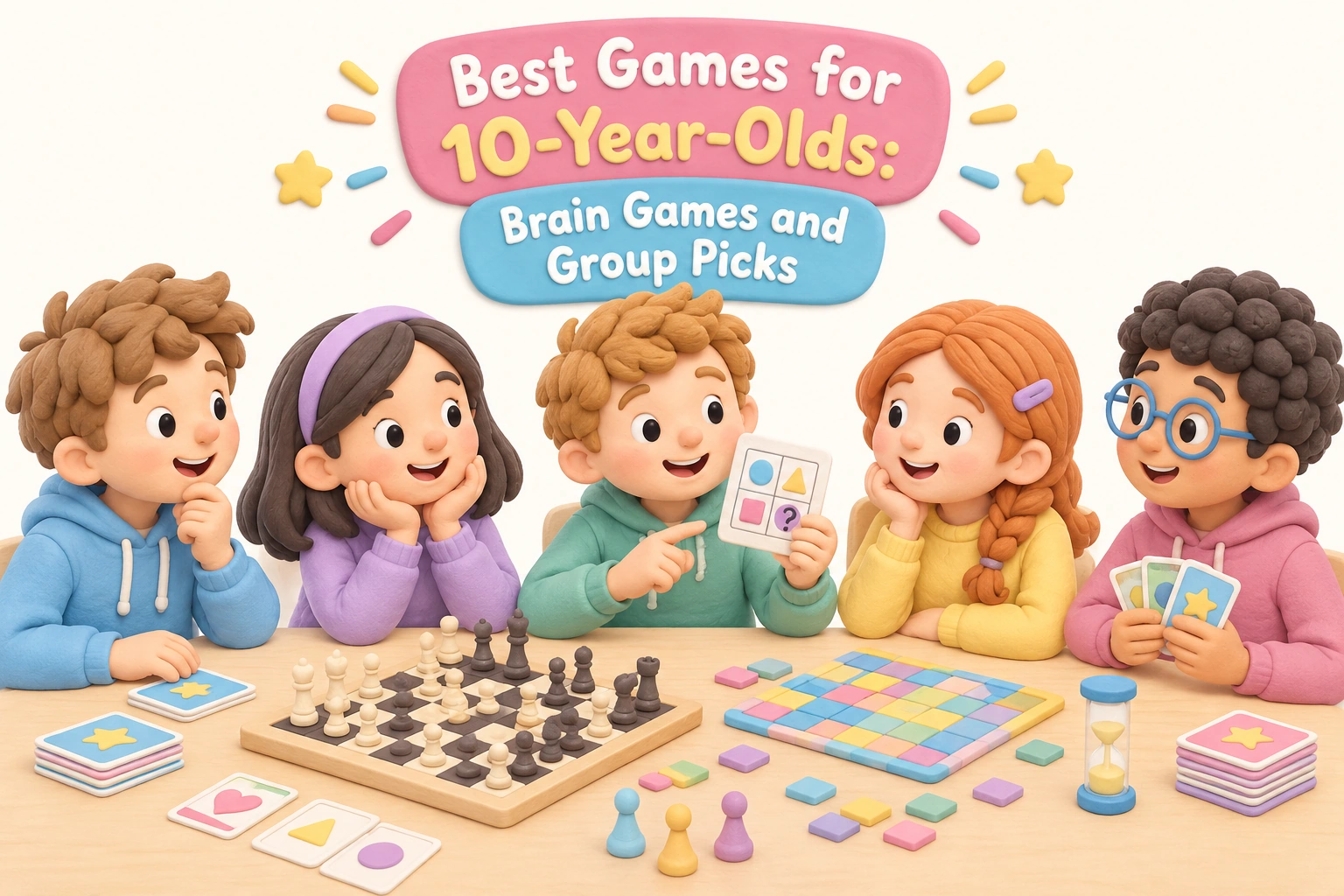
Ten-year-olds occupy a fascinating developmental sweet spot: they have the patience for genuine strategy, the social awareness to enjoy cooperative and competitive group play, and the cognitive capacity to tackle logic puzzles that would have frustrated them just a year or two earlier. Choosing the right games at this stage can support critical thinking skills, spatial reasoning, working memory, and social development — but the sheer range of options makes it hard to know where to start. This guide covers brain games, strategy board games, and group games for 10-year-olds, with practical guidance on matching each type to your child’s personality and your family’s needs.
Key Takeaways
- Brain games for 10-year-olds — including logic puzzles, chess, and deduction games — may support executive function, pattern recognition, and working memory when played regularly.
- Strategy board games offer strong replayability and can double as screen-free activities that the whole family enjoys together on game night.
- Group games for 10-year-olds, both indoor and outdoor, build teamwork, communication, and physical coordination alongside cognitive skills.
- Matching a game to your child’s temperament — competitive vs. cooperative, solo vs. social, quick vs. deep — matters more than any single recommendation.
- Research published in peer-reviewed journals suggests that board games may support visuospatial memory and math skills in school-age children, though outcomes vary by child and context.
What Makes a Game Right for a 10-Year-Old?
At age 10, most children are in the middle childhood stage of development, typically in Grade 5 or Year 6. Cognitively, they are developing stronger logical reasoning, the ability to hold multiple rules in mind simultaneously, and a growing capacity for planning ahead. Socially, they are increasingly motivated by peer relationships and fairness, which makes both cooperative games and competitive games with clear, consistent rules particularly engaging.
A well-chosen game for this age group tends to share a few characteristics. It should be easy to learn enough that a child can grasp the basics within one session, yet offer enough depth to reward repeated play — what game designers call being easy to learn, hard to master. It should match the child’s attention span, which at age 10 can comfortably extend to 30–60 minutes for an engaging activity. And it should be genuinely age-appropriate: not so simple that it feels babyish, and not so complex that it requires adult scaffolding every turn.
Developmental considerations also include the child’s individual temperament. Some 10-year-olds thrive on head-to-head competition; others disengage when they feel they are losing. Cooperative games, where all players work together against the game itself, can be a better fit for children who are sensitive to losing or who prefer collaborative problem-solving. Understanding this distinction before purchasing a game can save considerable frustration.
Brain Games for 10-Year-Olds: Building Cognitive Skills Through Play
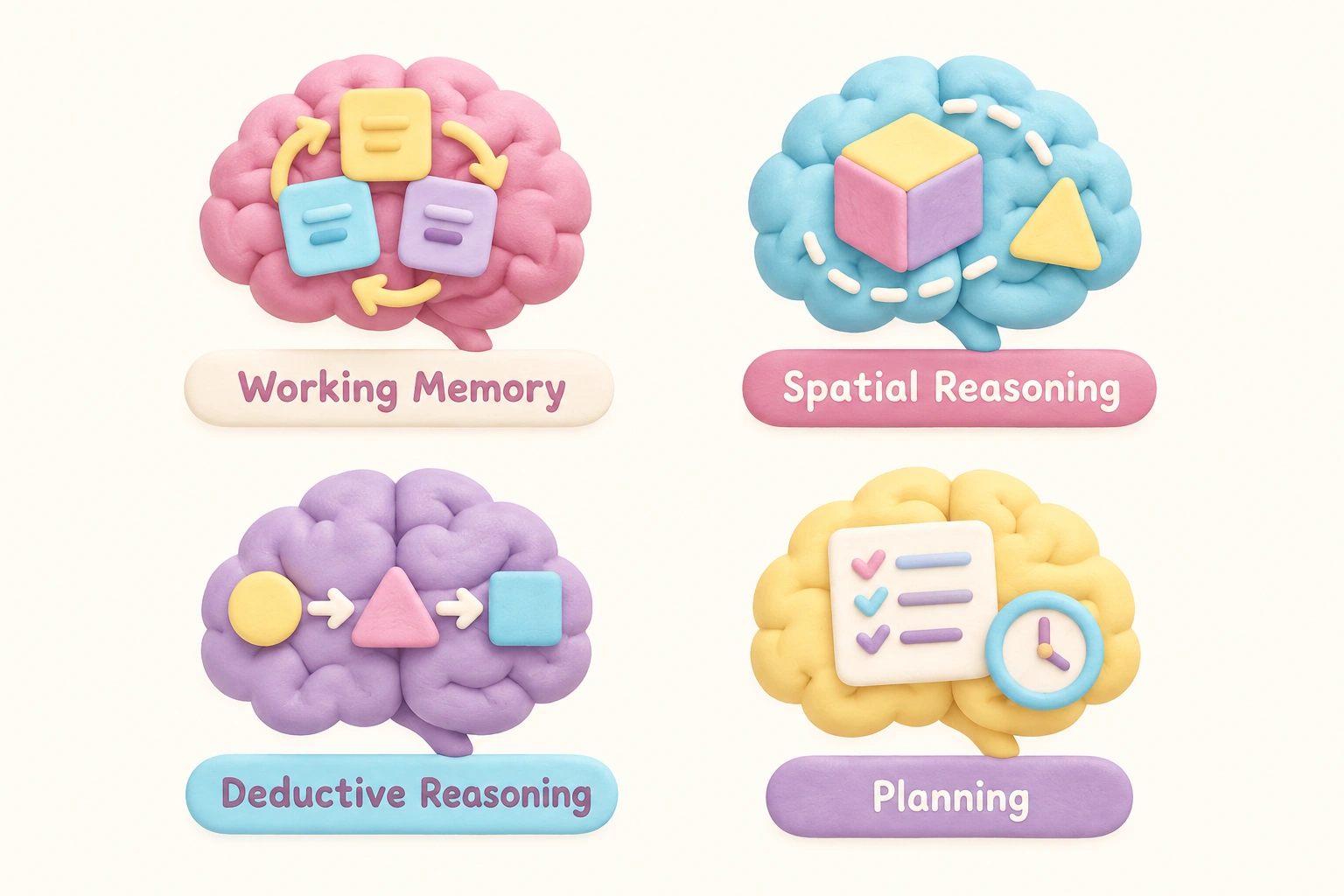
Brain games for 10-year-olds are activities specifically designed to challenge cognitive processes such as working memory, planning, deductive reasoning, and spatial reasoning. Unlike passive entertainment, these games require the child to actively construct strategies, recognize patterns, and adjust their thinking in response to new information.
Chess and Checkers
Chess remains one of the most thoroughly studied strategy games for children. Playing chess requires forward planning, impulse control, and the ability to consider an opponent’s perspective — skills closely linked to executive function development. Checkers offers a gentler entry point with simpler rules, making it a useful gateway strategy game for children who find chess initially overwhelming. Both games are genuinely screen-free activities that can be played with a single inexpensive set for years.
Logic Puzzles and Deduction Games
Logic puzzles for kids — including grid-based deduction puzzles, picture codes, and maze challenges — engage the kind of systematic reasoning that supports mathematical thinking. Games like Code Master (a programming-logic board game) and Blokus (a spatial tile-placement game) translate abstract logical thinking into hands-on play. Blokus in particular is an excellent example of a problem-solving game that develops spatial reasoning: players must fit geometric pieces onto a shared board while blocking opponents, requiring both offensive and defensive thinking simultaneously.
Memory and Pattern Games
Classic concentration-style memory games may seem simple, but research suggests that working memory training through structured play can have meaningful short-term benefits for school-age children. Tangram puzzles — where children recreate shapes using geometric pieces — develop spatial memory and visual attention. These activities are particularly valuable as screen-free alternatives during homework breaks, offering genuine cognitive engagement without the stimulation of a screen.
Sudoku and Number Puzzles
Sudoku is well-suited to 10-year-olds who enjoy math and systematic thinking. Starting with 4×4 or 6×6 grids before progressing to the standard 9×9 format allows children to build confidence gradually. Number puzzles of this type develop pattern recognition and logical elimination — skills that transfer directly to mathematical reasoning in the classroom.
The Science Behind Brain Games
A peer-reviewed study published in a 2024 NIH-indexed journal found that board game play was associated with improvements in visuospatial memory and math skills in school-age children. While the evidence base for specific cognitive transfer effects is still developing, and outcomes vary considerably by child, the general finding that structured game play supports cognitive development is consistent with broader research on play-based learning. Parents should view brain games as one useful tool among many rather than a guaranteed developmental intervention.
Best Strategy Board Games for 10-Year-Olds
Strategy board games occupy a different space from pure brain teasers: they combine cognitive challenge with social interaction, making them ideal for family game night or small group play. The games below are consistently recommended for this age group because of their strong replayability, manageable complexity, and genuine educational value.
| Game | Players | Playtime | Key Skills | Best For |
|---|---|---|---|---|
| Ticket to Ride | 2–5 | 45–75 min | Planning, risk assessment | Families, first strategy game |
| Catan | 3–4 | 60–90 min | Negotiation, resource management | Social, competitive players |
| Forbidden Island | 2–4 | 30–45 min | Teamwork, decision-making | Cooperative play, sensitive losers |
| Azul | 2–4 | 30–45 min | Spatial reasoning, pattern planning | Visual thinkers, shorter sessions |
| Kingdomino | 2–4 | 15–20 min | Spatial reasoning, scoring strategy | Quick games, younger siblings included |
| The Crew: Mission Deep Sea | 2–5 | 20–30 min | Communication, cooperative logic | Cooperative game lovers |
| Cascadia | 1–4 | 30–45 min | Pattern recognition, planning | Nature lovers, solo or group |
Ticket to Ride
Ticket to Ride is widely regarded as one of the best gateway strategy games for families with children around age 10. Players collect colored cards to claim railway routes across a map, working toward secret destination tickets. The rules are straightforward enough to learn in a single session, but the strategic depth — when to claim a route, when to block an opponent, how to balance short and long routes — keeps the game engaging across many plays. Its strong replayability makes it excellent value as a gift for 10-year-olds.
Forbidden Island
Forbidden Island is one of the most accessible cooperative games available for this age group. All players work together to collect four treasures and escape a sinking island before it disappears beneath the water. Because no single player wins or loses alone, Forbidden Island is particularly well-suited to children who find competitive games stressful, or to mixed-age family groups where younger siblings want to participate. The escalating difficulty across multiple game modes also provides a natural progression path.
Azul
Azul is an educational board game built around tile-drafting and pattern completion. Players take turns selecting colored tiles and arranging them on personal boards to score points. The game develops spatial reasoning and forward planning in a visually appealing format that appeals to children who enjoy art and design as much as strategy. Sessions typically run 30–45 minutes, making it practical for weeknight family game nights.
Catan
Catan introduces children to resource management and negotiation — skills that go beyond typical board game mechanics. Players build settlements and cities by trading resources with each other, which means social skills and persuasion are as important as strategic planning. Catan works best with children who enjoy social interaction and can handle the mild frustration of being blocked or out-traded. It is one of the most widely played strategy games for kids in the 10–14 age range.
Group Games for 10-Year-Olds: Indoor and Outdoor Options
Group games for 10-year-olds serve a different developmental purpose than solo brain games or family board games. They build communication, physical coordination, negotiation, and the ability to manage both winning and losing within a social context. At age 10, peer relationships are increasingly central to a child’s sense of identity, making group play particularly valuable.
Indoor Party Games
Indoor party games for this age group work best when they require minimal setup, can accommodate varying group sizes, and keep all participants active rather than waiting for a turn. The following options consistently engage 10-year-olds at birthday parties, classroom events, and rainy-day gatherings.
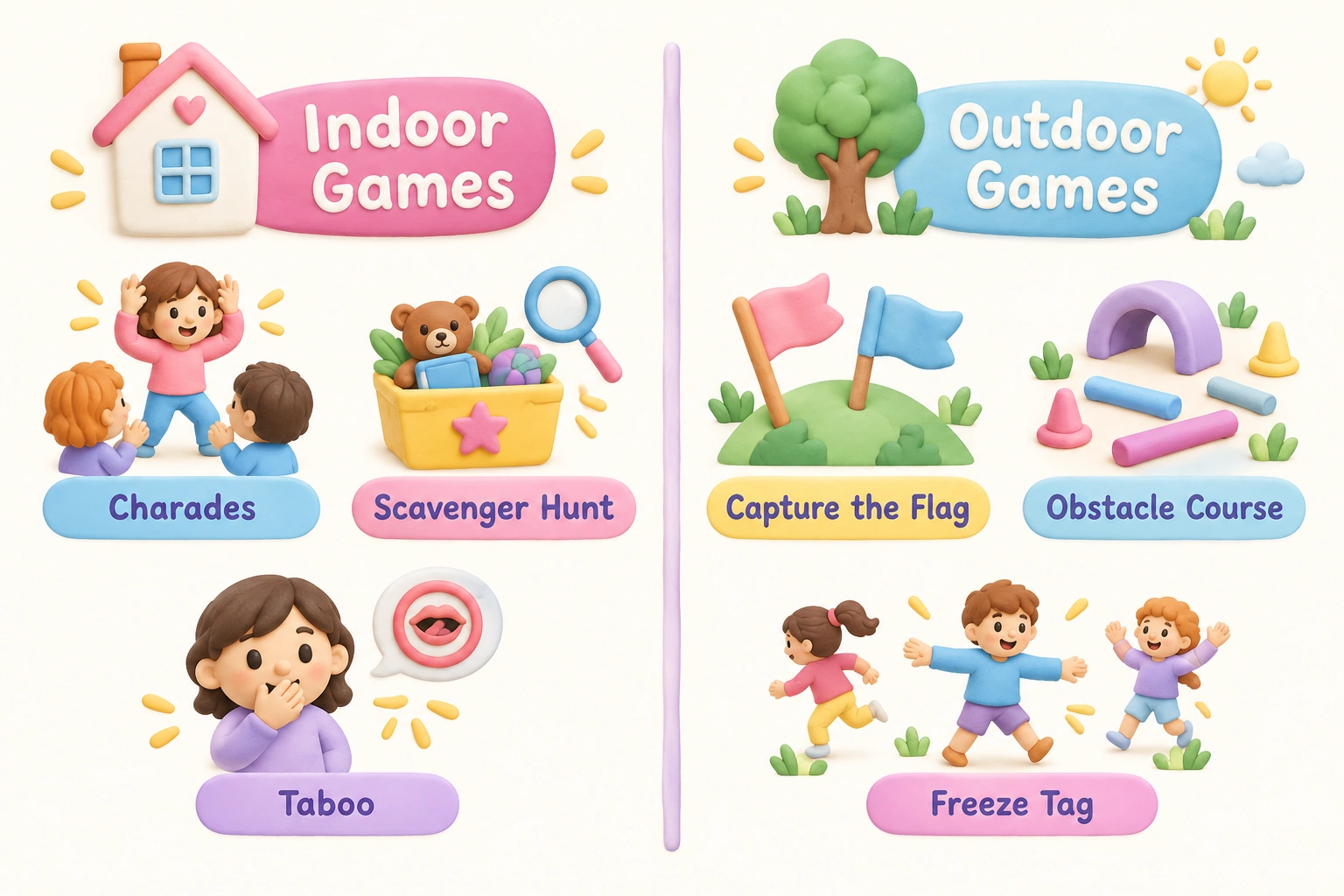
- Charades and Pictionary: Both games develop vocabulary, non-verbal communication, and creative thinking. They scale easily from small groups of four to large parties of twenty or more, and require no equipment beyond paper and pencils for Pictionary.
- Minute-to-Win-It Games: Short, silly physical challenges — stacking cookies on a forehead, moving cotton balls with a spoon — create high energy and laughter without requiring complex rules. These work particularly well as icebreakers at the start of a party.
- Taboo Word Game: Players describe a word to their team without using a list of forbidden related words, developing vocabulary and lateral thinking. The commercial version is appropriate for age 10 and up, and the concept can also be played informally with homemade cards.
- Scavenger Hunt: A well-designed indoor scavenger hunt combines problem-solving, teamwork, and physical movement. Clues can be tailored to the group’s interests and the available space, making this one of the most flexible no-prep group activities for 10-year-olds.
Outdoor Group Games
Outdoor group games for 10-year-olds combine physical activity with social and strategic elements. At this age, children benefit from activities that involve genuine physical challenge alongside rule-based play, supporting both motor development and the ability to manage complex social dynamics.
- Capture the Flag: One of the most enduring outdoor group games for this age, Capture the Flag develops strategic thinking, teamwork, and physical endurance. Teams must balance offense and defense, making it genuinely cognitively engaging as well as physically active.
- Freeze Tag and Freeze Dance: These classic games require quick reactions and spatial awareness. Freeze Tag in particular develops the ability to monitor multiple moving targets simultaneously — a form of distributed attention that is cognitively demanding.
- Obstacle Course: A backyard or park obstacle course can be assembled from everyday materials and adjusted for difficulty. Children at age 10 enjoy both completing courses competitively and designing them for others, the latter being a particularly rich problem-solving activity.
- Egg Toss and Tug of War: These traditional outdoor games require minimal equipment and work well for large mixed groups. They develop physical coordination and, in the case of Tug of War, genuine team strategy around positioning and effort distribution.
No-Prep Verbal Brain Games for Groups
Not every group game requires equipment or preparation. Verbal brain games — including 20 Questions, word association chains, and storytelling rounds — are particularly useful for teachers, parents on car journeys, or caregivers managing groups without access to materials. These activities develop vocabulary, working memory, and creative thinking with zero setup time, making them an underused but highly practical category of screen-free activities for 10-year-olds.
How to Match a Game to Your Child’s Personality
The most developmentally useful game is the one your child will actually want to play repeatedly. Replayability depends not just on game design but on how well the game matches the individual child’s temperament and interests. Consider the following profiles when choosing.
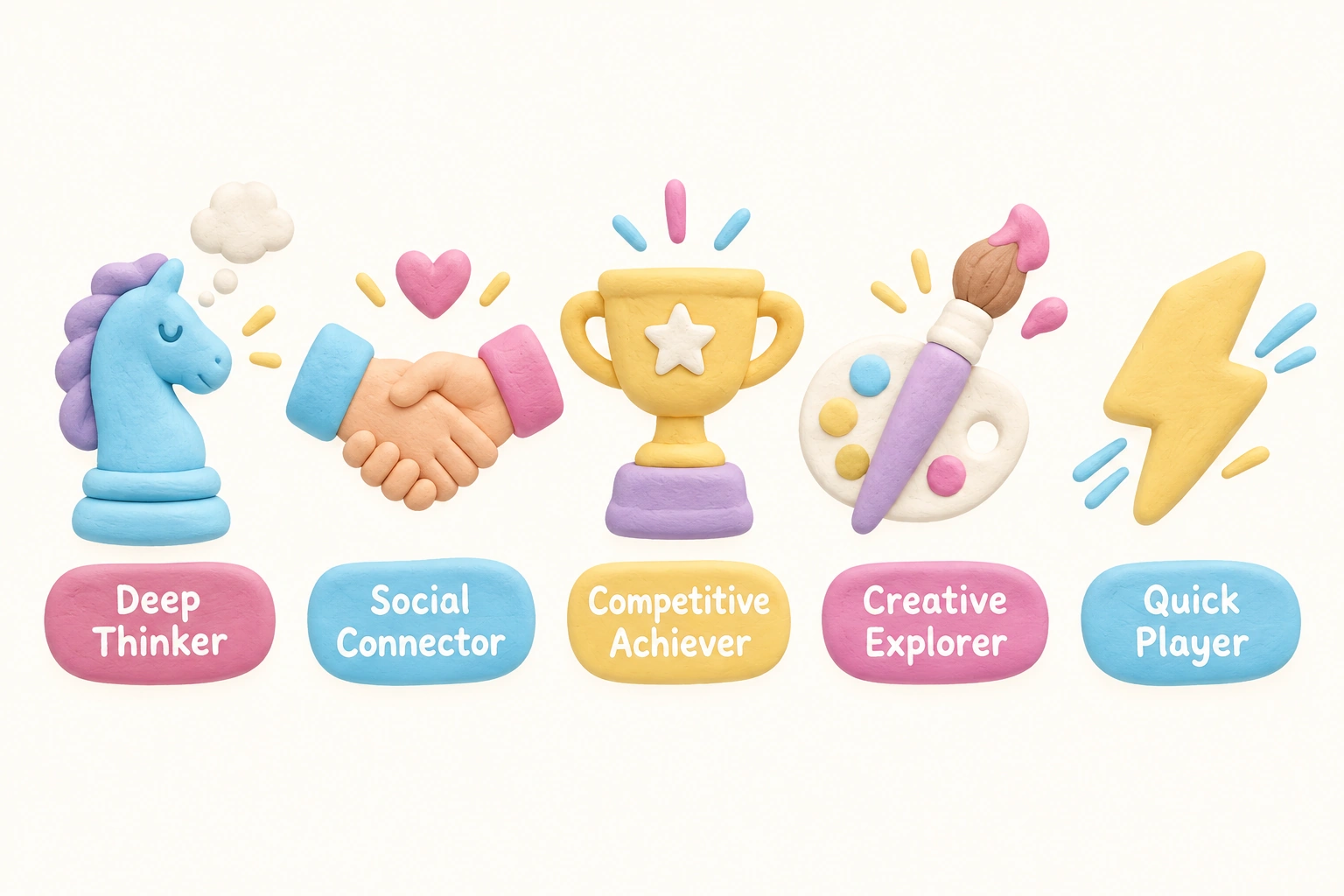
- The deep thinker: Chess, Catan, logic puzzles, and deduction games offer the strategic depth that analytical children find satisfying. These children often prefer games with longer playtimes and more complex rule systems.
- The social connector: Cooperative games like Forbidden Island or The Crew, and group party games like Charades or Scavenger Hunt, suit children who are primarily motivated by social interaction rather than individual achievement.
- The competitive achiever: Ticket to Ride, Blokus, and Capture the Flag provide clear win conditions and competitive structure that motivates children who enjoy measurable outcomes.
- The creative explorer: Open-ended games like Cascadia, Tangram puzzles, or obstacle course design allow children who prefer creative expression to engage with game mechanics on their own terms.
- The short-attention-span player: Kingdomino, Minute-to-Win-It games, and Freeze Tag offer fast rounds and immediate feedback, keeping engagement high for children who disengage during longer games.
Screen-Free vs. Digital Games: A Practical Note for Parents
Many parents searching for games for 10-year-olds are specifically looking for screen-free alternatives to video games and apps. This is a reasonable priority: the American Academy of Pediatrics and equivalent bodies in other countries recommend that screen time for school-age children be balanced with offline activities, physical play, and face-to-face social interaction. Board games, card games, logic puzzles, and outdoor group games all provide genuine cognitive and social engagement without adding to daily screen time.
That said, some digital games do offer meaningful cognitive challenge for 10-year-olds. Games like Minecraft (in creative or survival mode), Portal, and Kerbal Space Program involve genuine problem-solving, spatial reasoning, and systems thinking. The key distinction for parents is between interactive, cognitively demanding digital play and passive or reflexive screen consumption. A child spending 45 minutes designing a complex structure in Minecraft is engaged in a fundamentally different cognitive activity than one scrolling through short videos. If digital games are part of your child’s routine, choosing titles with genuine problem-solving demands and setting clear time boundaries is more developmentally useful than avoiding screens entirely.
Games as Gifts for 10-Year-Olds
Board games and puzzle sets make particularly practical gifts for 10-year-olds because they offer lasting value rather than a single-use experience. When selecting a game as a gift, consider the recipient’s household: a cooperative game like Forbidden Island works well in a family that plays together regularly, while a solo logic puzzle set suits a child who enjoys independent challenges. Games with strong replayability — where the experience changes meaningfully from session to session — tend to remain on shelves and in rotation far longer than games with a fixed narrative or single solution path. Ticket to Ride, Azul, Catan, and Cascadia are all consistently cited as gifts that families return to repeatedly across different age groups.
Frequently Asked Questions
What are the best brain games for 10-year-olds who get bored quickly?
Children with shorter attention spans tend to engage best with games that offer fast feedback and short rounds. Blokus, Kingdomino, and Sudoku puzzles at an appropriate difficulty level all provide cognitive challenge in sessions of 15–20 minutes. Verbal brain games like 20 Questions require no setup and can be stopped at any point, making them particularly flexible.
Are cooperative games better than competitive games for 10-year-olds?
Neither type is universally better. Cooperative games may be more appropriate for children who are sensitive to losing or who are playing with a mixed-age group where skill levels differ significantly. Competitive games can motivate children who are driven by achievement and enjoy clear win conditions. Many families find that having both types available allows them to match the game to the mood and group on any given day.
How many players do you need for group games at a 10-year-old’s birthday party?
Most party games for 10-year-olds work best with groups of 6–20 children. Games like Charades, Capture the Flag, and Scavenger Hunt scale well across this range. For smaller groups of 4–6, strategy board games or deduction games tend to work better than large-group party games, which can feel flat with too few participants.
Can board games genuinely support learning at age 10?
Research suggests that board game play may support visuospatial memory, mathematical reasoning, and planning skills in school-age children, though the strength of these effects varies by game type, frequency of play, and individual child. Board games should be seen as a valuable complement to other learning activities rather than a replacement for structured education. The social and emotional skills developed through game play — turn-taking, managing frustration, strategic communication — are also meaningful developmental outcomes.
What outdoor games work for mixed ages at a family gathering?
Capture the Flag, Tug of War, and obstacle courses can be adapted for mixed ages by adjusting team composition or difficulty. Egg Toss and Freeze Tag also work well across a range of ages and require no specialized equipment. For very mixed groups, assigning older children to team-captain roles can help balance skill levels and keep younger participants engaged.
How do I introduce a 10-year-old to strategy games if they have only played simple games before?
Start with gateway strategy games that have simple rules but genuine strategic depth. Ticket to Ride and Kingdomino are widely recommended as first strategy games for this age group. Forbidden Island works well as a cooperative introduction to strategic thinking without the pressure of direct competition. Once a child is comfortable with these, games like Catan or Blokus offer a natural next step in complexity.
Are logic puzzles appropriate for 10-year-olds as solo activities?
Yes. Logic puzzles, Sudoku, Tangram sets, and maze books are well-suited to independent play at age 10. They provide genuine cognitive challenge without requiring a partner or group, making them useful for quiet time, travel, or situations where screen-free solo activities are needed. Matching the difficulty level to the child’s current ability is important: puzzles that are too easy lose their developmental value quickly, while puzzles that are too difficult can cause frustration and disengagement.
Choosing Games That Grow With Your Child
The best games for 10-year-olds are those that offer enough challenge to remain engaging as the child’s skills develop, enough social flexibility to work across different group sizes and settings, and enough variety to suit different moods and occasions. Brain games like chess, logic puzzles, and deduction games build cognitive skills that transfer to academic learning. Strategy board games like Ticket to Ride and Forbidden Island create shared family experiences with genuine replayability. Group games — from Capture the Flag outdoors to Charades at a birthday party — develop the social and physical skills that are just as important at age 10 as any academic ability.
No single game will suit every child, and the most important factor in any game’s developmental value is whether the child actually wants to play it. Starting with one or two well-chosen options that match your child’s temperament, then expanding the collection as their interests and skills develop, is a more sustainable approach than purchasing a large library at once. If you are unsure where to begin, a cooperative gateway game like Forbidden Island or a spatial strategy game like Azul offers broad appeal and a low risk of sitting unused on a shelf.

Take a short quiz to find out what your everyday choices say about your parenting style
When your child is curious about something new, what’s your instinct?
Take a short quiz to find out what your everyday choices say about your parenting style
“Can I download this app?” What happens next?
Take a short quiz to find out what your everyday choices say about your parenting style
When it comes to rules at home, which sounds most like you?
Take a short quiz to find out what your everyday choices say about your parenting style
If you could give your child one life skill today, what would you pick?
Take a short quiz to find out what your everyday choices say about your parenting style
Your child gets to choose what to watch. What would your ideal setup look like?
Take a short quiz to find out what your everyday choices say about your parenting style
Pick your parenting superpower ✨