Best Games for 8-Year-Olds: Strategy, Creative and Digital Picks

 Discover a Free Education Video App for Kids
Pastory uses AI to personalize educational video content based on your child’s interests and personality. Safe, engaging, and built for curious young minds. Sign up now to stay updated and enjoy early access with a free trial
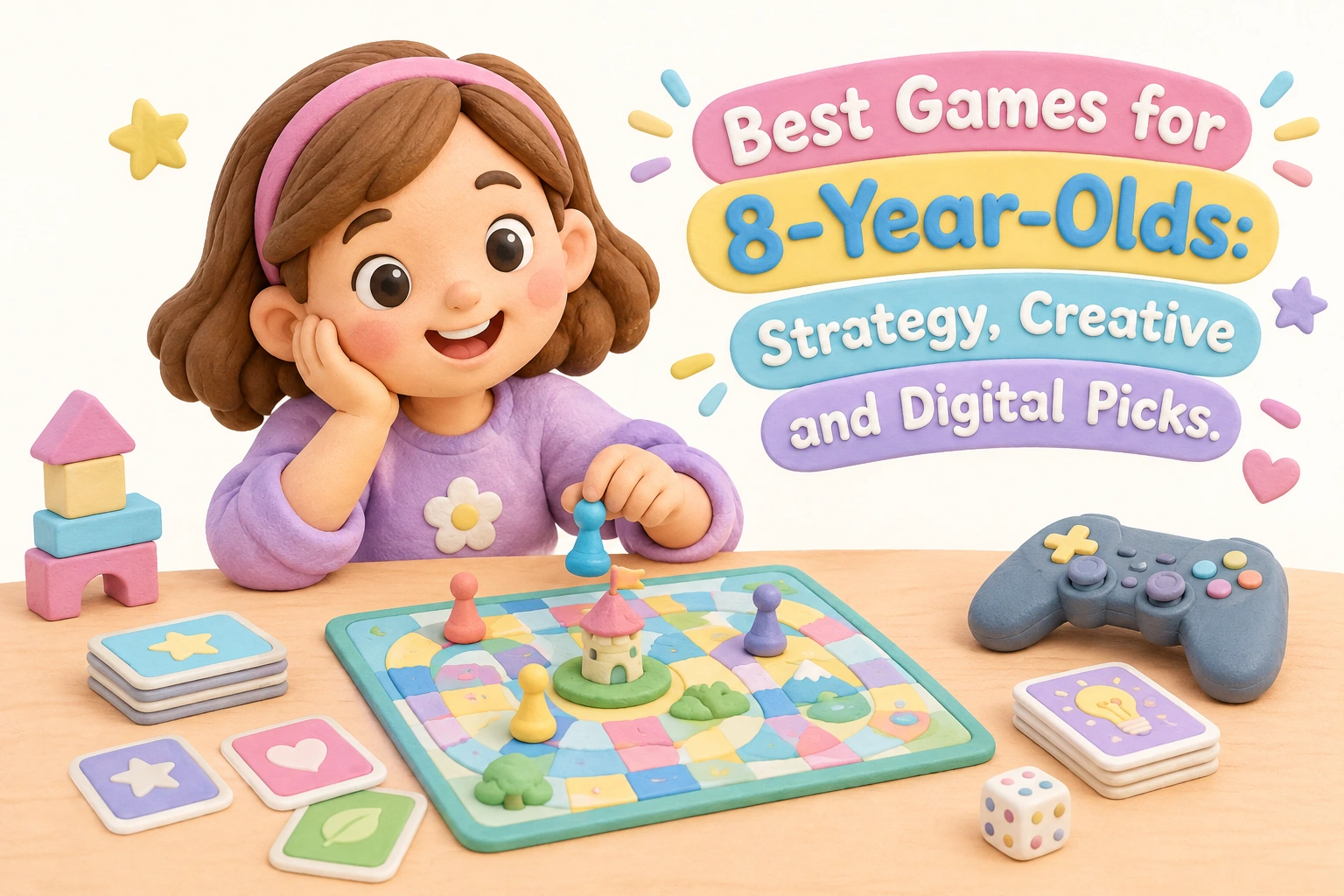
Eight-year-olds sit at a genuinely interesting developmental crossroads: their working memory and logical reasoning are expanding rapidly, they can hold multi-step rules in mind, and they are increasingly motivated by challenge, mastery, and social connection. That makes this age one of the best windows for introducing games that genuinely stretch thinking — whether that means a strategy board game on the kitchen table, a cooperative card game with friends, or a thoughtfully chosen video game on a console. This guide covers the strongest picks across all three formats, explains what each type of game actually develops, and gives parents practical guidance on screen time, ESRB ratings, and how to spot games that are genuinely age-appropriate rather than just marketed that way.
Key Takeaways
- Eight-year-olds are developmentally ready for genuine strategy games, cooperative play, and creative open-ended formats — not just simplified children’s versions of adult games.
- Board games and card games that are easy to learn but offer meaningful decisions may support critical thinking skills, planning, and turn-taking without any screen time.
- Digital games rated E or E10+ by the ESRB can be age-appropriate, but the rating alone does not address online exposure, in-app purchases, or whether a game has a natural stopping point.
- So-called “forever games” — titles like Roblox and Fortnite that have no natural end — require more active parental management than games with clear sessions or story endings.
- A progression ladder from simpler to more complex games helps children build confidence and sustains long-term interest in strategic play.
What Makes a Game Right for an 8-Year-Old?
Age-appropriate games for 8-year-olds share a few consistent qualities. The rules should be learnable in one sitting — ideally under fifteen minutes of explanation — but the decisions within the game should remain genuinely interesting after multiple plays. Developmental psychologists describe this as the “easy to learn, hard to master” quality that sustains engagement without frustrating children who are still building patience and frustration tolerance. At eight, most children can manage games with a player count of two to six, play times of around 30 to 45 minutes, and mechanics that involve planning two or three moves ahead rather than pure luck.
Research published in peer-reviewed journals on board games and cognitive development suggests that games involving planning, counting, and spatial reasoning may support numeracy and executive function skills. These benefits are most consistent when children are actively engaged in decision-making rather than simply rolling dice and moving pieces. That distinction matters when choosing between games: a game that asks a child to weigh options, manage resources, or deduce information is doing more developmental work than one driven entirely by chance.
Social context also shapes game choice. Cooperative play formats — where all players work together against the game itself — are particularly valuable for children who find losing difficult, for siblings with an age gap, or for family game night when the goal is connection rather than competition. Competitive games are equally valid but work best when children have developed enough emotional regulation to handle setbacks gracefully, which varies considerably by individual temperament.
Best Strategy Board Games for 8-Year-Olds
Strategy board games are among the most consistently recommended games for 8-year-olds by educators and child development specialists, and for good reason. They build planning, spatial reasoning, and resource management in a social, screen-free context.
Ticket to Ride (and Ticket to Ride: First Journey)
Ticket to Ride is the most widely cited gateway strategy game for this age group, and the reputation is well-earned. Players collect colored train cards and use them to claim railway routes across a map, trying to complete destination tickets before opponents block their paths. The core mechanic — collect resources, spend resources, plan a route — introduces resource management in an intuitive, visually clear way. The standard version suits most 8-year-olds, while Ticket to Ride: First Journey is a simplified variant with shorter play time and fewer routes, useful for children newer to strategy games or for mixed-age family play. Player count is two to five; play time runs 45 to 75 minutes for the standard edition.
Kingdomino
Kingdomino is an excellent tile-placement game that introduces spatial reasoning and simple scoring strategy in a compact format. Players draft domino-style tiles showing different terrain types and arrange them into a five-by-five kingdom grid, trying to maximize points by connecting matching terrain. The drafting mechanic — choosing a tile also determines your turn order next round — adds a layer of strategic thinking without overwhelming newer players. Play time is around 15 to 20 minutes, making it one of the most practical options for a school-night game. Player count is two to four.
Blokus
Blokus is a spatial reasoning game in which players take turns placing their colored pieces on a grid, with the rule that each new piece must touch a corner — but not a side — of their own previously placed pieces. The result is a game of territorial expansion and blocking that develops visuospatial skills and forward planning in a format that requires no reading. It plays in around 20 to 30 minutes with two to four players and is one of the most accessible strategy games for children who are not yet confident readers.
King of Tokyo
King of Tokyo brings a dice-rolling, push-your-luck mechanic to a monster-battle theme that appeals strongly to 8-year-olds. Players roll dice to gain energy, heal, attack, or score victory points, deciding after each roll which dice to keep and which to reroll — a simple but genuine decision structure. The game is competitive and can be eliminated-player style, so it works best with children who handle losing reasonably well. Play time is 30 minutes; player count is two to six.
Catan Junior
Catan Junior adapts the resource management and trading mechanics of the classic Settlers of Catan into a pirate-themed format designed specifically for younger players. Children collect resources, build ships and hideouts, and trade with the market. It introduces the concept of resource scarcity and negotiation in a friendlier structure than the adult version. Play time is around 30 to 60 minutes with two to four players.
Best Cooperative Games for 8-Year-Olds
Cooperative games are among the most developmentally valuable formats for this age group. Because all players work together against the game itself, cooperative play removes the social sting of direct competition and encourages communication, shared planning, and collective problem-solving — skills that align closely with social-emotional learning goals for middle childhood.
Outfoxed!
Outfoxed! is a cooperative deduction game in which players work together to identify which fox stole a pot pie before the thief escapes. Players roll dice to reveal clues and eliminate suspects using a clever shield-and-reveal mechanism. It is one of the most accessible cooperative games for 8-year-olds, with a play time of around 20 minutes and a player count of two to four. The deduction mechanic — using clues to narrow down possibilities — introduces logical reasoning in a low-pressure, team-based context.
Ghost Fightin’ Treasure Hunters
Ghost Fightin’ Treasure Hunters tasks players with collecting jewels from a haunted house while fighting off ghosts together. The cooperative structure means children who struggle with losing can engage fully without the anxiety of direct competition. It plays in 30 to 45 minutes with one to four players and has enough variability to remain engaging across multiple sessions.
Pandemic (Junior or Standard)
Pandemic is a cooperative strategy game in which players work as a team to stop disease outbreaks spreading across a world map. The standard version is genuinely challenging and suits 8-year-olds who are already comfortable with strategy games; Pandemic Junior offers a simplified version with shorter play time. Both formats develop planning, prioritization, and collaborative decision-making. Player count is two to four; play time is 45 to 60 minutes for the standard edition.
Best Creative and Storytelling Games for 8-Year-Olds
Creative games are an underserved category in most game recommendation lists, yet they address a distinct developmental need: the capacity for imaginative thinking, narrative construction, and perspective-taking. Eight-year-olds are at a stage where storytelling becomes increasingly sophisticated, and games that channel this tendency can support language development, empathy, and creative confidence.
Dixit
Dixit is a storytelling card game in which players use beautifully illustrated, surreal cards to give clues — a word, a phrase, a sound — that are specific enough for some players to identify the right card but vague enough that not everyone can. The mechanic rewards creative thinking and perspective-taking rather than factual knowledge or speed. It plays in 30 minutes with three to six players and is one of the most genuinely creative games available for this age group.
Stuffed Fables
Stuffed Fables is a narrative adventure game in which players take on the roles of stuffed animals protecting a sleeping child. The game is played on the pages of a storybook, with each page spread serving as the game board for that chapter. It combines cooperative play with an ongoing story, making it particularly engaging for children who love books and imaginative play. Sessions run 60 to 90 minutes, so it suits weekend play rather than school nights.
Unstable Unicorns
Unstable Unicorns is a card game in which players build herds of unicorns while using action cards to disrupt opponents. The humor and absurdist theme appeal strongly to 8-year-olds, and the deck-building adjacent mechanics introduce the concept of hand management and strategic card play in a lighthearted format. Play time is 30 to 45 minutes with two to eight players.
Best Quick and Portable Card Games
Not every game needs to be a 60-minute strategic commitment. Quick card games with a play time of 15 to 20 minutes are practical for after school, travel, or when attention spans are shorter. Sushi Go Party is a widely recommended drafting game in which players pass cards around the table, selecting one each round to build the best meal combination — a clean introduction to the drafting mechanic that is genuinely fun for mixed ages. Exploding Kittens offers fast, silly card play that 8-year-olds tend to find hilarious. Five Crowns and Skip-Bo are accessible rummy-style games that develop number recognition and sequencing without feeling educational in a heavy-handed way.
Best Digital Games for 8-Year-Olds
Digital games are a legitimate part of many children’s play lives, and the question for parents is not whether to allow them but how to choose well. The ESRB rating system provides a useful starting point: E-rated games are designed for all ages, while E10+ games contain mild content suitable from age ten. For 8-year-olds, both categories are generally appropriate, but the ESRB rating does not address online multiplayer exposure, in-app purchases, or whether a game has a natural stopping point — all of which matter significantly for this age group.
Nintendo Switch: The Strongest Platform for This Age
The Nintendo Switch remains the most consistently recommended console for 8-year-olds, largely because its first-party library is designed with family-friendly play in mind and its parental controls are among the most comprehensive available. Parents can set daily screen time limits, restrict online play, and receive activity reports through the Nintendo Switch Parental Controls app — a meaningful practical advantage over less structured platforms.
Minecraft is the most widely played digital game among 8-year-olds globally, and its creative mode — in which children build freely without survival pressure — is one of the most genuinely open-ended creative tools available in digital form. Minecraft in creative mode functions more like digital LEGO than a traditional game, supporting spatial reasoning, planning, and imaginative construction. The survival mode adds resource management and problem-solving. Parents should be aware that the Java Edition includes online multiplayer servers with variable content; the Bedrock Edition on Switch offers more manageable parental controls for online play.
Animal Crossing: New Horizons is a cozy life-simulation game in which players develop a deserted island community at their own pace. It has no combat, no time pressure, and no failure state, making it particularly well-suited to children who find competitive or high-stakes games stressful. The game’s real-time calendar means it rewards consistent daily play rather than long sessions, which aligns reasonably well with healthy screen time habits. It is E-rated.
Mario Kart 8 Deluxe is the most accessible competitive racing game for this age group and one of the best options for family game night in digital form. Its assist mode reduces frustration for newer players, and local multiplayer means children can play alongside family members rather than strangers online. It is E-rated.
Kirby and the Forgotten Land and Super Mario Bros. Wonder are both E-rated platformers with gentle difficulty curves, clear level structures, and natural stopping points between stages — an important practical feature for managing screen time. Both titles offer cooperative play options, making them suitable for siblings or parent-child play sessions.
Pokémon Scarlet and Violet introduce role-playing game mechanics — turn-based strategy, team building, and resource management — in a format that 8-year-olds who enjoy collecting and planning tend to find deeply engaging. The games are rated E and offer substantial offline content, though online trading and battling features require parental consideration.
PS5 Options Worth Considering
For families with a PlayStation 5, Astro Bot is a critically acclaimed platformer that is genuinely excellent for 8-year-olds: it is E-rated, has clear level structure, and requires no online connectivity. LEGO Star Wars: The Skywalker Saga combines the familiar LEGO game formula — accessible combat, humor, and collectibles — with a massive amount of content that suits children who enjoy extended exploration. Sackboy: A Big Adventure offers cooperative platforming in a charming handcrafted visual style, making it a strong choice for parent-child play.
The “Forever Game” Problem: Roblox, Fortnite, and Peer Pressure Titles
Many 8-year-olds will ask for access to Roblox or Fortnite because their peers play them. Both are what might be called “forever games” — platforms or live-service titles with no natural ending, no clear session structure, and continuous new content designed to sustain engagement indefinitely. This is not inherently harmful, but it does mean that screen time management requires more active parental involvement than with games that have natural stopping points between levels or chapters.
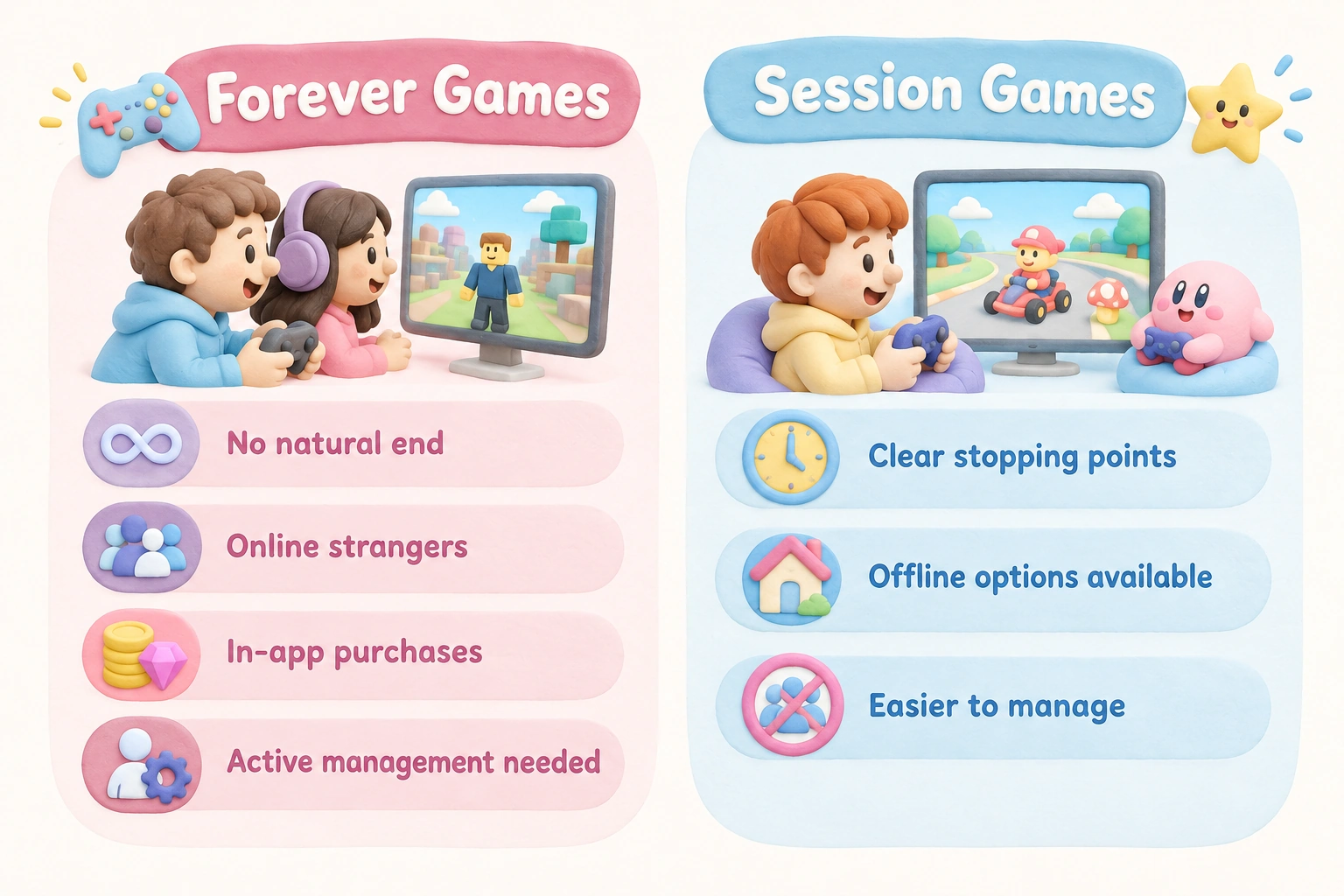
Roblox is a platform rather than a single game, hosting thousands of user-created experiences of highly variable quality and content. Its ESRB rating is E10+, but individual games within the platform are not individually rated, and online chat with strangers is enabled by default. Parents who allow Roblox access should configure parental controls carefully, restrict chat to friends only, and review which specific experiences their child is accessing. In-app purchases using the platform’s currency (Robux) are a consistent financial consideration.
Fortnite is rated T (Teen) by the ESRB, which places it above the recommended range for most 8-year-olds. Its battle royale format involves cartoon-style violence and online play with strangers. Parents who encounter strong peer pressure around Fortnite may find it useful to offer compelling alternatives — Mario Kart 8 Deluxe for competitive multiplayer, Minecraft for creative social play — rather than a flat refusal, which can increase the social appeal of the restricted title.
Screen Time Guidance for 8-Year-Olds
Current guidance from pediatric health organizations generally suggests that school-age children aged six and older benefit from consistent limits on recreational screen time, with an emphasis on content quality and the balance between digital and offline activities. A commonly referenced framework suggests around 30 to 60 minutes of recreational screen time on school days and up to 60 to 120 minutes on weekends, though individual family circumstances vary and these figures are not universal prescriptions. The American Academy of Pediatrics emphasizes that the type of content and the context of use — co-playing with a parent, for example — matter as much as raw duration.
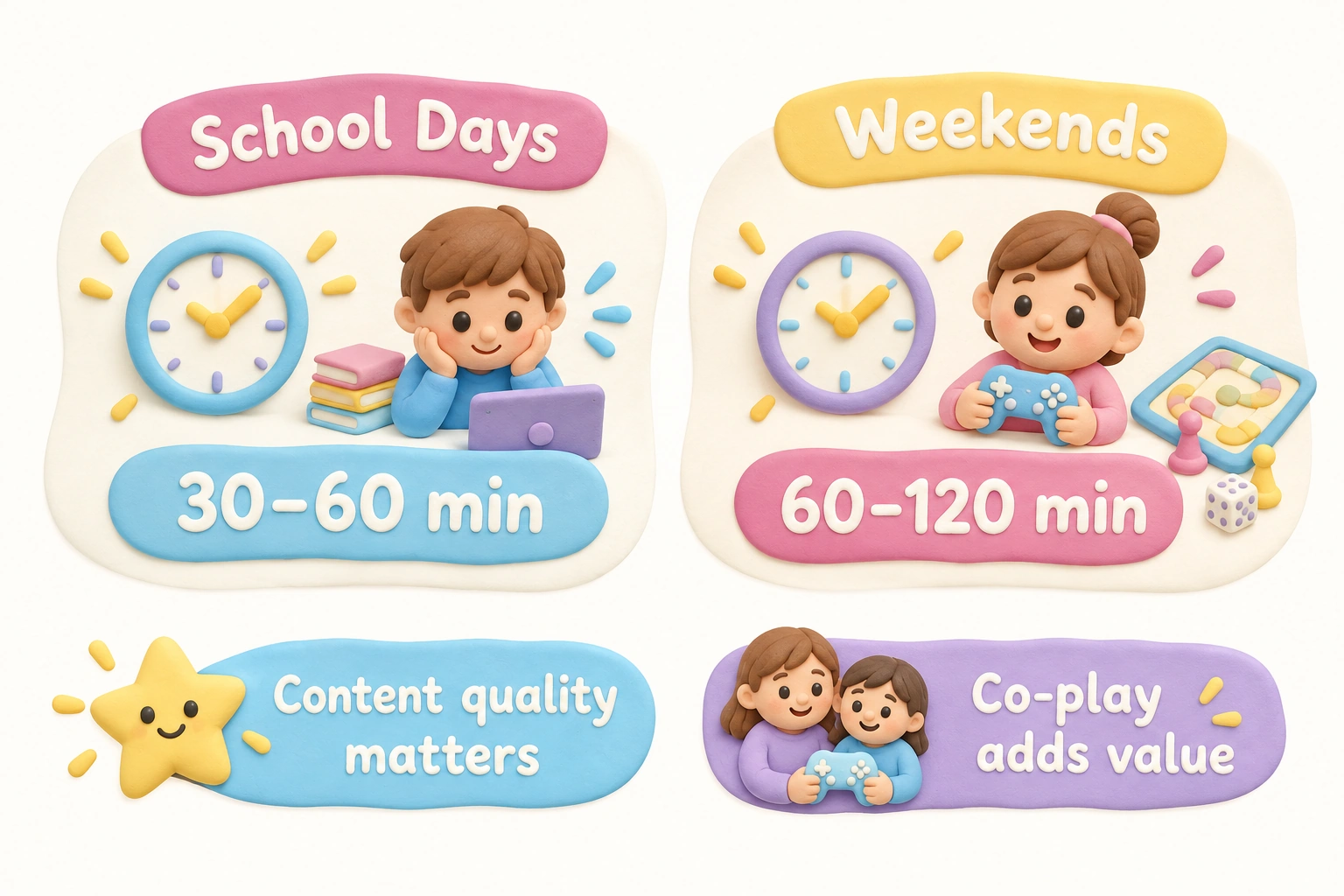
For 8-year-olds specifically, games with clear session structures (a level, a race, a chapter) are easier to manage than open-ended platforms. Setting a timer before a session begins, agreeing on a stopping point in advance, and using console parental controls to enforce limits reduces conflict and helps children develop self-regulation around screen time over time. Offline games — board games, card games, outdoor play — remain important complements to digital play and should not be crowded out by screen time even when digital games are age-appropriate and well-chosen.
A Gateway Game Progression Ladder
One practical gap in most game recommendation lists is a clear progression path — a sense of which games to start with and where to go next as a child’s strategic thinking develops. The following ladder is a useful starting framework, though individual children will move through it at different paces depending on temperament, prior game experience, and interest.
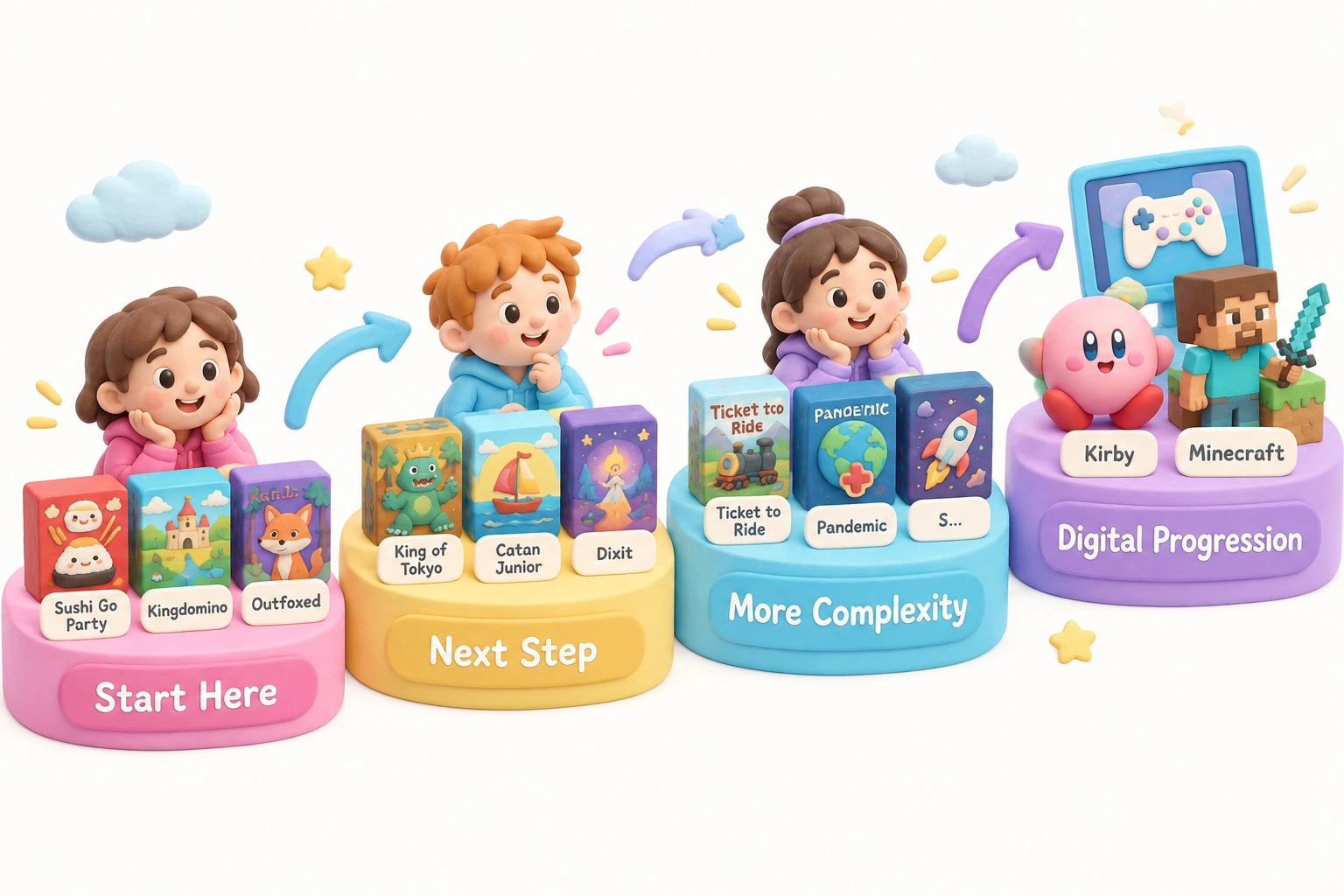
- Start here (new to strategy games): Sushi Go Party, Kingdomino, Outfoxed!, Blokus — all have short play times, simple rules, and genuine decisions.
- Next step (comfortable with basic strategy): King of Tokyo, Catan Junior, Dixit, Ticket to Ride: First Journey — introduce resource management, drafting, or deduction.
- Ready for more complexity: Ticket to Ride (standard), Pandemic, Stuffed Fables — longer play times, more interdependent decisions, richer narrative or strategic depth.
- Digital progression: Kirby and the Forgotten Land → Super Mario Bros. Wonder → Minecraft Creative Mode → Pokémon Scarlet/Violet → Minecraft Survival Mode.
Games for 8-Year-Olds with ADHD or Shorter Attention Spans
Children with ADHD or naturally shorter attention spans benefit most from games with play times under 20 minutes, clear turn structures that keep downtime between turns brief, and cooperative formats that maintain engagement through shared purpose rather than waiting. Outfoxed!, Kingdomino, Sushi Go Party, and Blokus all fit this profile well. In digital formats, games with short, self-contained levels — Kirby and the Forgotten Land, Captain Toad: Treasure Tracker — are more manageable than open-world games where sessions have no natural pause point. Cooperative board games are particularly valuable here because they reduce the emotional load of losing and keep all players actively involved throughout the game.
Frequently Asked Questions
What is the best board game for an 8-year-old who has never played strategy games?
Kingdomino and Sushi Go Party are both excellent starting points. Both have play times under 20 minutes, rules that can be explained in a few minutes, and enough genuine decision-making to hold an 8-year-old’s interest. Ticket to Ride: First Journey is a strong next step once basic strategy concepts feel comfortable.
Are video games good for 8-year-olds?
Age-appropriate video games can support problem-solving, spatial reasoning, and creative thinking, particularly when children are actively engaged in decision-making rather than passively watching. The key factors are content quality, ESRB rating, whether the game exposes children to strangers online, and whether screen time is balanced with offline activities. Co-playing with a parent or sibling adds social and developmental value.
Which digital games work offline and don’t expose children to strangers?
Minecraft in offline or local-only mode, Animal Crossing: New Horizons (without online features enabled), Mario Kart 8 Deluxe in local multiplayer, Kirby and the Forgotten Land, Super Mario Bros. Wonder, Astro Bot, and Captain Toad: Treasure Tracker all offer substantial offline content without requiring online connectivity. Parental controls on Nintendo Switch and PS5 allow parents to disable online features selectively.
My child struggles with losing. What games are best?
Cooperative games are the most practical solution. Outfoxed!, Ghost Fightin’ Treasure Hunters, Pandemic Junior, and Gnomes at Night all pit players against the game rather than each other, removing the direct competition that can make losing feel personal. In digital formats, Animal Crossing: New Horizons and Minecraft creative mode have no failure states at all.
How much screen time is reasonable for an 8-year-old who plays video games?
Pediatric guidance generally supports consistent limits rather than a single universal number, with content quality and context mattering alongside duration. Many families find 30 to 60 minutes on school days and up to 90 minutes on weekends workable, but individual circumstances vary. Using console parental controls to set daily limits removes the negotiation burden from parents and helps children develop self-regulation over time.
What is an ESRB rating and should I rely on it alone?
The ESRB (Entertainment Software Rating Board) rates video games by content: E (Everyone), E10+ (Everyone 10 and older), T (Teen), and M (Mature). The rating is a useful starting point for content appropriateness but does not address online multiplayer exposure, in-app purchases, or whether a game has a natural stopping point. Parents should check all three factors independently, particularly for games that include online play or live-service monetization.
Choosing the Right Game for Your 8-Year-Old
The best games for 8-year-olds are those that match a child’s current developmental stage, temperament, and social context — not simply the titles with the highest ratings or the most peer buzz. A child who finds losing genuinely distressing will get more from cooperative play than from competitive strategy games, regardless of how well-designed those competitive games are. A child who loves building and creating will find more sustained engagement in Minecraft’s creative mode or Dixit than in a resource management game that doesn’t connect to their interests. And a child who is new to strategy games will build more confidence — and more lasting enthusiasm for games — by starting with a 15-minute gateway game than by being thrown into a 90-minute complex strategy title before they are ready.
Screen-free board games and card games remain among the most developmentally rich options available for this age group, offering genuine cognitive challenge, social interaction, and natural session endings without any of the screen time management concerns that digital games introduce. Digital games, chosen carefully with attention to ESRB ratings, online exposure, and parental controls, can complement rather than replace that offline play. The progression ladder approach — starting simple, building complexity gradually, mixing formats — tends to produce children who are genuinely enthusiastic about games across their childhood rather than burning out on a single title or platform. If you are unsure where to start, Kingdomino or Sushi Go Party on the board game side, and Kirby and the Forgotten Land or Animal Crossing: New Horizons on the digital side, are consistently strong first choices for 8-year-olds across a wide range of temperaments and experience levels.

Take a short quiz to find out what your everyday choices say about your parenting style
When your child is curious about something new, what’s your instinct?
Take a short quiz to find out what your everyday choices say about your parenting style
“Can I download this app?” What happens next?
Take a short quiz to find out what your everyday choices say about your parenting style
When it comes to rules at home, which sounds most like you?
Take a short quiz to find out what your everyday choices say about your parenting style
If you could give your child one life skill today, what would you pick?
Take a short quiz to find out what your everyday choices say about your parenting style
Your child gets to choose what to watch. What would your ideal setup look like?
Take a short quiz to find out what your everyday choices say about your parenting style
Pick your parenting superpower ✨