Best Games for 7-Year-Olds: Learning, Board and Digital Picks

 Discover a Free Education Video App for Kids
Pastory uses AI to personalize educational video content based on your child’s interests and personality. Safe, engaging, and built for curious young minds. Sign up now to stay updated and enjoy early access with a free trial
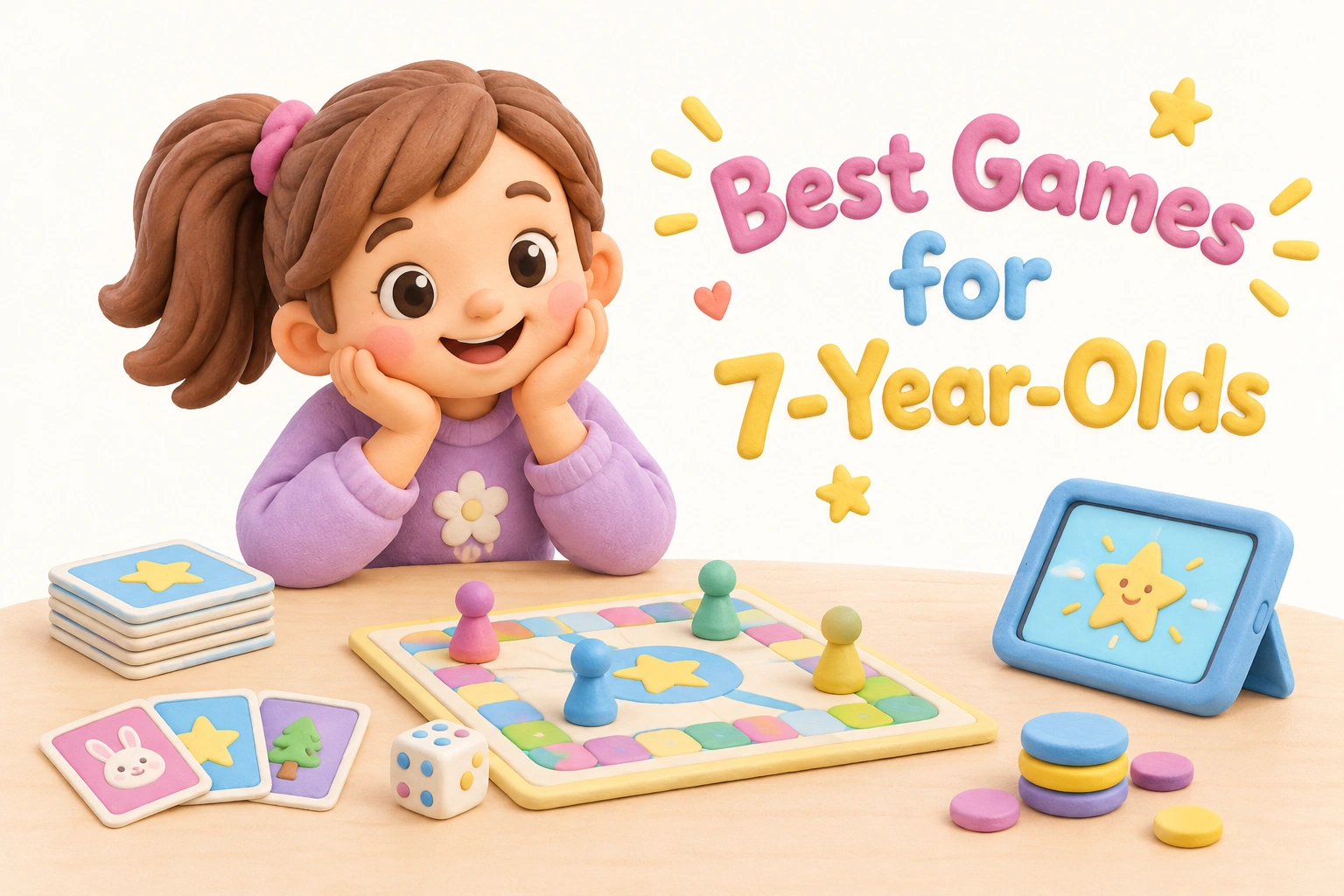
Seven-year-olds sit at a genuinely interesting developmental crossroads: their attention span is expanding, they can follow multi-step rules, and they are beginning to enjoy both competition and cooperative play. Choosing the right games at this stage can support critical thinking, turn-taking, problem-solving skills, and even early math and reading fluency — but the sheer range of options makes it hard to know where to start. This guide covers the best board games, educational games, card games, and digital picks for 7-year-olds, with practical notes on what each type of game actually develops and how to balance screen and screen-free play.
Key Takeaways
- Seven-year-olds benefit most from games that blend a mix of luck and skill, keeping play fair while still rewarding strategic thinking.
- Cooperative games reduce the emotional pressure of winning and losing, which suits children who are still developing resilience around competition.
- Educational board games and apps can support math practice, reading fluency, and logic and deduction when used alongside — not instead of — hands-on play.
- Digital games rated Everyone (E) by the ESRB can offer genuine cognitive development benefits, but screen time should be balanced with screen-free alternatives according to family routines and AAP-informed guidance.
- The best games for 7-year-olds are age-appropriate, have simple rules that children can learn quickly, and offer enough replay value to stay interesting over time.
What Makes a Game Right for a 7-Year-Old?
At age seven, most children are in what developmental psychologists describe as the concrete operational stage — they can think logically about objects and events they can see and manipulate, but abstract reasoning is still developing. This means games with clear, tangible goals and simple rules tend to work well, while games requiring complex multi-layered strategy may frustrate rather than engage. A 7-year-old’s attention span typically supports play sessions of 20 to 45 minutes, so games with a playtime in that range are usually a practical fit.
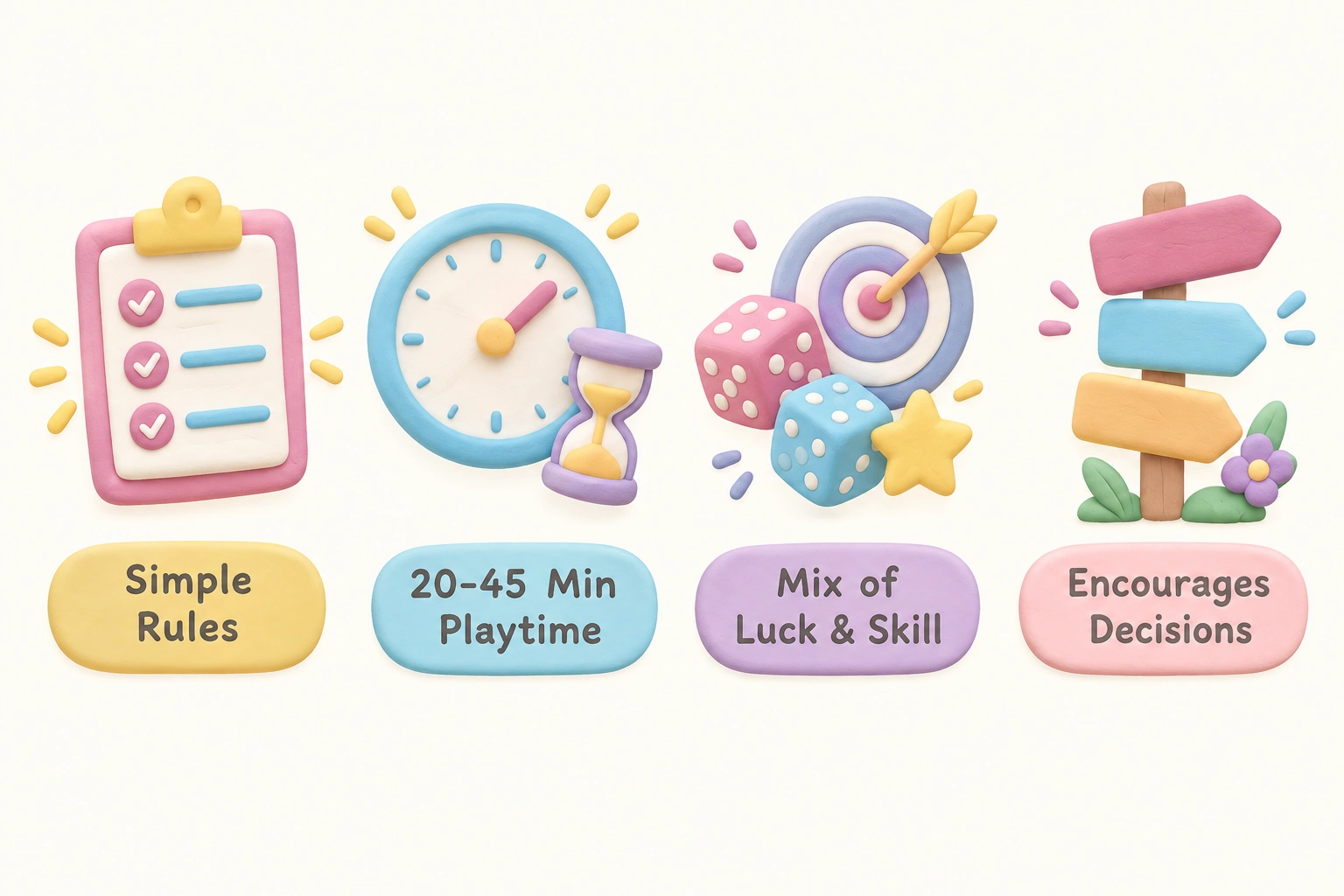
Skill development at this age spans several domains. Cognitively, children are strengthening pattern recognition, spatial awareness, and early logical reasoning. Socially and emotionally, they are learning turn-taking, how to handle losing gracefully, and how to collaborate toward a shared goal. Games that naturally exercise these skills — rather than games marketed as educational without genuine developmental substance — tend to offer the most value. When evaluating any game, it helps to ask: does this require the child to make meaningful decisions, or is it purely luck-based? Does it encourage communication? Can the child play it independently when needed?
Best Board Games for 7-Year-Olds
Board games remain one of the most reliable tools for play-based learning at this age. They are screen-free, encourage face-to-face interaction, and can be revisited repeatedly without losing their appeal. The following picks represent a range of game types, from cooperative to competitive, quick to longer-form.
Ticket to Ride: First Journey
Ticket to Ride: First Journey is the child-friendly version of the popular route-building game. Players collect colored train cards and claim routes across a map, aiming to connect destination cities shown on their tickets. The game introduces resource management and simple strategic thinking in a format that typically takes 15 to 30 minutes. Because the rules are straightforward and the map is visually clear, most 7-year-olds can learn it in a single session. It works well for family game night and is genuinely enjoyable for adults playing alongside children.
Catan Junior
Catan Junior adapts the resource-trading mechanics of the original Settlers of Catan for younger players. Children collect resources, build ships and hideouts, and trade with a central market. The game introduces concepts of resource management and light negotiation without the complexity of the adult version. It supports cognitive flexibility — children must adapt their plans based on what resources are available — and typically plays in around 30 minutes with two to four players.
Forbidden Island
Forbidden Island is a cooperative board game in which all players work together to collect treasures and escape before the island sinks. Because everyone wins or loses as a team, it removes the social pressure of direct competition and is particularly well suited to children who find losing difficult. Cooperative play at this age supports communication skills, shared decision-making, and the understanding that different players can contribute different strengths. Forbidden Island plays in about 30 minutes and scales in difficulty, giving it strong replay value.
Taco vs Burrito
Taco vs Burrito is a card game created by a 7-year-old, which perhaps explains why children at this age tend to love it. Players build increasingly absurd food combinations while using action cards to disrupt opponents. The rules are simple enough to learn in minutes, the play is fast-paced, and the humor keeps engagement high. It is a strong choice for quick play sessions and works well with two to four players.
Outfoxed
Outfoxed is a cooperative deduction game in which players work together to identify which fox stole a pot pie before the culprit escapes. It introduces logic and deduction in an accessible format, requiring children to gather clues and eliminate suspects — a genuine exercise in critical thinking and pattern recognition. The game typically takes 20 minutes and is well suited to independent play once children know the rules.
Connect 4 and Blokus
Classic two-player games like Connect 4 and the tile-laying game Blokus offer strong spatial awareness and strategic thinking practice in a compact format. Connect 4 is particularly useful for developing forward planning — children must think about their own moves while anticipating an opponent’s. Blokus extends this to a four-player format and adds a spatial reasoning challenge as the board fills up. Both games have short playtimes and high replay value, making them practical for everyday use rather than just special occasions.
Best Educational Games for 7-Year-Olds
Educational board games and apps occupy a specific niche: they are designed to reinforce curriculum skills — math, reading, vocabulary, spelling — within a game structure that keeps children motivated. The key distinction worth making is between games that genuinely embed learning into their mechanics and games that simply add a quiz layer on top of otherwise thin gameplay. The former tend to produce more sustained engagement.
Scrabble Junior
Scrabble Junior adapts the classic word game for early readers. One side of the board features pre-printed words that children match letter tiles to, while the reverse side introduces open word-building for more confident readers. The game supports reading fluency, phonics awareness, and vocabulary in a competitive but low-pressure format. It is one of the more effective educational board games for 7-year-olds because the learning is embedded in the core mechanic rather than bolted on.
Zingo and Spot It!
Zingo (particularly Zingo 1-2-3) and Spot It! are fast-paced matching games that develop visual pattern recognition, number recognition, and processing speed. Both games are easy to learn, work with two or more players, and can be completed in under 15 minutes — making them practical for short play sessions before school or as a wind-down activity. Spot It! in particular has multiple play variants, extending its replay value considerably.
Prodigy Math Game
Prodigy Math Game is a digital role-playing game in which children answer math questions to progress through battles and quests. It covers curriculum-aligned math skills from addition and subtraction through to multiplication and early fractions, adapting difficulty based on the child’s responses. The game is free to access at a basic level, though a paid membership unlocks additional content. Parents should be aware that the free version includes prompts to upgrade, which some children find distracting. Used with parental awareness of its structure, Prodigy can support math practice in a format that feels genuinely game-like rather than drill-based.
Khan Academy Kids and BrainPOP Jr.
Khan Academy Kids offers a broad range of curriculum-aligned activities covering reading, math, social-emotional learning, and creative skills. BrainPOP Jr. uses short animated videos paired with quizzes and activities to cover science, social studies, health, and literacy topics. Both platforms are well regarded by educators and are suitable for home use as well as classroom settings. Khan Academy Kids is free; BrainPOP Jr. requires a subscription. Neither platform should replace hands-on learning or caregiver interaction, but both can serve as useful supplements, particularly for children who respond well to structured digital content.
Best Digital and Video Games for 7-Year-Olds
Digital games for 7-year-olds span a wide range of formats, from creative sandbox games to platformers to educational apps. When selecting digital games, the ESRB rating is a useful starting point: games rated Everyone (E) are reviewed for content appropriate for all ages, though parents should still preview games individually. Equally important is whether a game encourages active engagement — decision-making, creativity, problem-solving — rather than passive consumption.
Minecraft
Minecraft appears on nearly every list of recommended games for this age group, and for good reason. In Creative Mode, children build freely using virtual blocks, exercising spatial awareness, planning, and creative expression. In Survival Mode, the game introduces resource management, basic logic, and consequence-based decision-making. Minecraft is rated Everyone 10+ in the US, so parents of younger 7-year-olds may prefer to start with Creative Mode and monitor play. The game supports independent play and can also be a strong co-op multiplayer experience when played with a parent or sibling.
Mario Kart 8 Deluxe (Nintendo Switch)
Mario Kart 8 Deluxe is one of the most accessible racing games available for children. It includes an assist mode that steers the kart automatically, allowing younger or less experienced players to participate without frustration. As children develop confidence, they can reduce the level of assistance and begin developing genuine racing strategy. The game supports local multiplayer, making it a strong choice for family game night in digital form. It is rated Everyone and is compatible with the Nintendo Switch and Nintendo Switch 2 via backward compatibility.
Animal Crossing: New Horizons
Animal Crossing: New Horizons is an open-ended life simulation game in which players develop a deserted island community. The game has no fail state, no time pressure, and no combat, making it particularly well suited to children who find competitive or high-stakes games stressful. It supports creativity, planning, and social interaction (when played with family members online). The real-time calendar system also introduces concepts of time management and seasonal change. It is rated Everyone and plays well in short daily sessions.
Super Mario Bros. Wonder and Super Mario Odyssey
Both Super Mario Bros. Wonder and Super Mario Odyssey are platformer games rated Everyone that offer age-appropriate challenge without overwhelming difficulty. Super Mario Bros. Wonder introduces creative level mechanics that reward curiosity and experimentation. Super Mario Odyssey features a broader open world and more complex puzzles, making it slightly better suited to children at the upper end of the 7-year-old range or those with prior platformer experience. Both games support independent play and have strong replay value through collectibles and hidden areas.
Pokémon: Let’s Go, Pikachu! and Let’s Go, Eevee!
The Pokémon: Let’s Go games offer a gentler entry point into the Pokémon series, with simplified battle mechanics and a cooperative mode that allows a second player to join at any time. The games support reading comprehension (dialogue is text-based), basic strategy, and memory through Pokémon type matching. They are rated Everyone and work well for children who enjoy collecting and nurturing game mechanics.
Games That Grow With the Child
One underserved consideration in most game recommendation lists is scalability — games that increase in difficulty or expand over time, keeping pace with a child’s developing skills. Zombie Kidz Evolution is a notable example: it is a cooperative board game that starts with simple rules and gradually unlocks new content through a legacy-style system, adding complexity as children master earlier mechanics. This structure supports sustained engagement over months rather than weeks and mirrors the kind of scaffolded learning that developmental research suggests is effective for skill-building.
In the digital space, games like Minecraft and Prodigy Math Game similarly scale with the child — Minecraft because its complexity is largely self-directed, and Prodigy because its adaptive algorithm adjusts math difficulty based on performance. When choosing games for a 7-year-old, it is worth asking not just whether the game suits them now, but whether it will still offer meaningful challenge in six months.
Games for Solo Play vs. Group Play
Most game recommendations default to family or group settings, but parents also need options for independent play — times when a child needs to occupy themselves productively without requiring adult facilitation. Games well suited to solo play at age seven include Genius Square (a spatial puzzle game with hundreds of configurations), Prodigy Math Game, and single-player modes in digital games like Minecraft and Animal Crossing. For board games, puzzle-style games with a clear solo challenge — such as Rush Hour Jr. or Gravity Maze — work well because they have a defined goal and a satisfying resolution.
Group play, by contrast, is where cooperative games and family-friendly competitive games shine. Family game night benefits most from games with a playtime under 45 minutes, simple enough rules that everyone can participate without lengthy explanation, and a mix of luck and skill that keeps outcomes unpredictable enough to be exciting. Ticket to Ride: First Journey, Outfoxed, and Taco vs Burrito all fit this profile well.
Screen Time Guidance for 7-Year-Olds
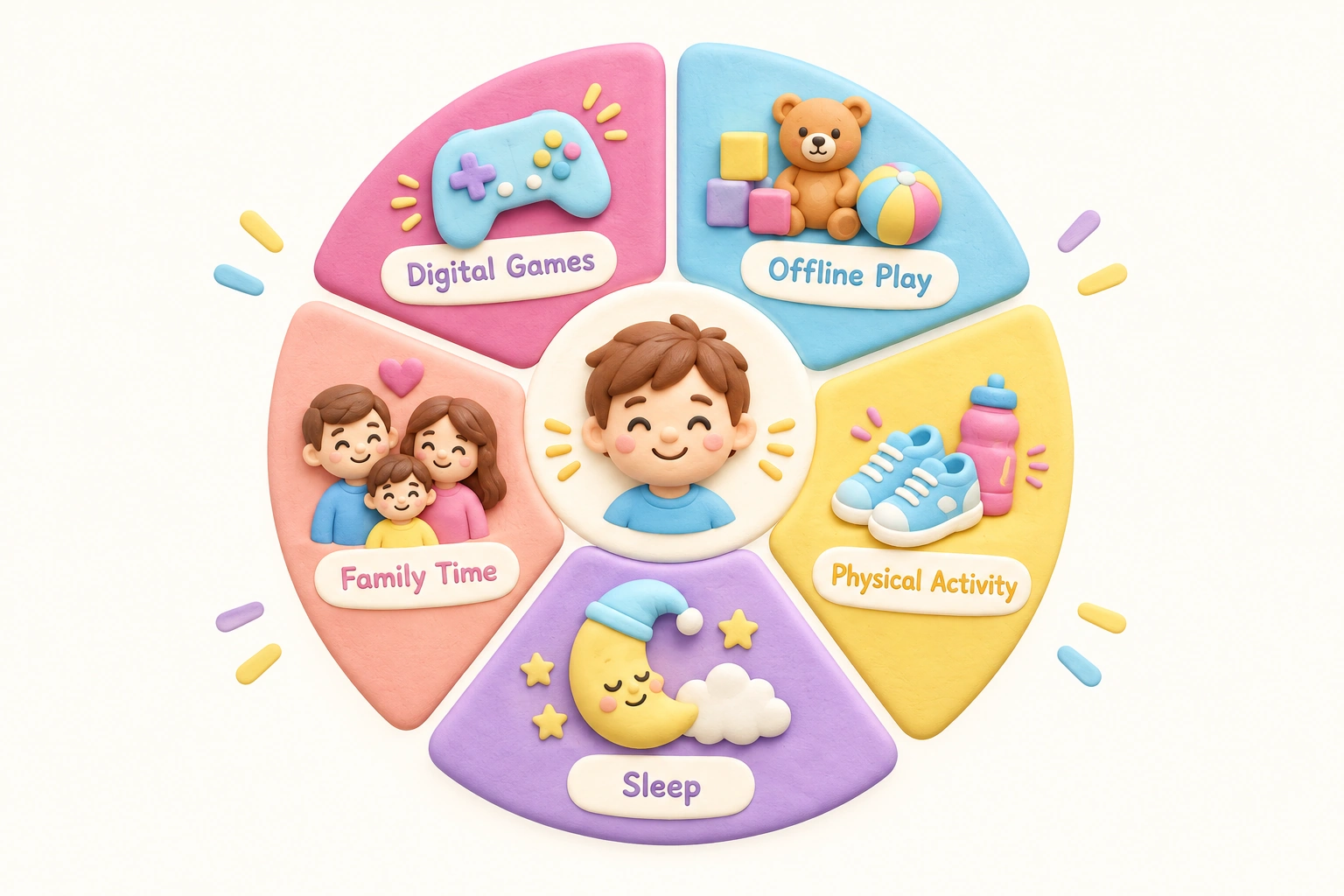
The American Academy of Pediatrics (AAP) recommends that for children aged 6 and older, screen time should be consistent, limited, and balanced with adequate sleep, physical activity, and offline play — rather than capped at a specific daily hour count. For 7-year-olds, this means digital games are most beneficial when they are one part of a varied daily routine rather than the default activity. Parents are encouraged to co-play where possible, particularly with new games, to understand the content and model healthy engagement habits.
When selecting digital games, it is worth distinguishing between games that require active cognitive engagement — decision-making, problem-solving, creative building — and those that rely primarily on passive consumption or rapid reward loops. The former tend to align better with cognitive development goals. It is also worth noting which apps and games function offline, as this can be a practical consideration for travel or areas with limited connectivity. Minecraft, Mario Kart 8 Deluxe, and Animal Crossing all function fully offline once downloaded.
Choosing Games by Budget
Budget is a practical factor that most game recommendation lists overlook. A rough guide for parents:
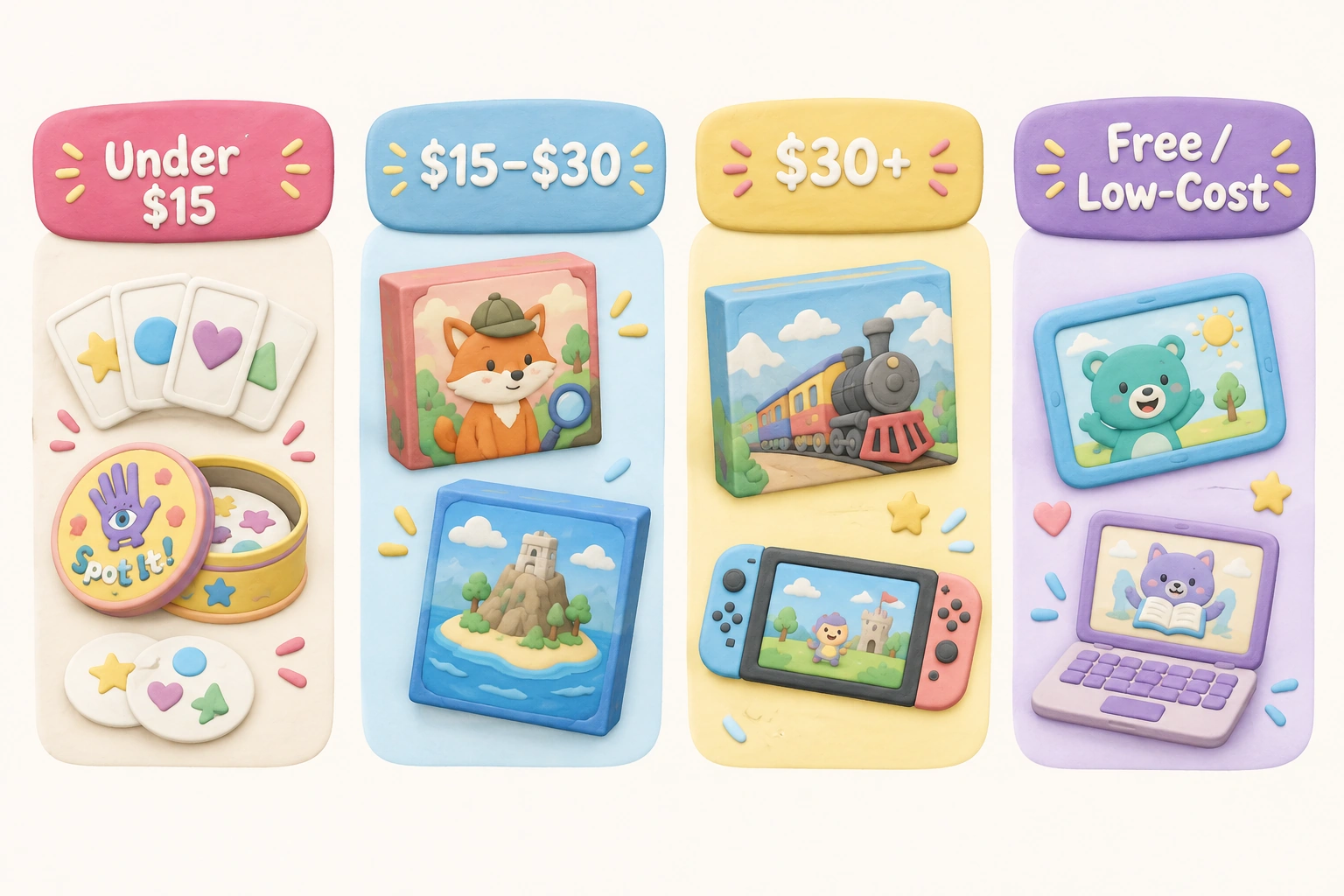
- Under $15: Taco vs Burrito, Spot It!, Zingo, Connect 4, and most card games fall into this range and offer strong value for the price.
- $15–$30: Outfoxed, Forbidden Island, Scrabble Junior, and Catan Junior are typically available in this range and offer more complex gameplay with higher replay value.
- $30 and above: Ticket to Ride: First Journey, Blokus, and Zombie Kidz Evolution sit in this tier. Digital games on Nintendo Switch are generally $40–$60 at launch but often available at reduced prices through sales or second-hand.
- Free or low-cost digital options: Khan Academy Kids and Prodigy Math Game (basic version) are free. ABCmouse and BrainPOP Jr. require subscriptions but offer trial periods.
Frequently Asked Questions
Can 7-year-olds play board games independently?
Many 7-year-olds can play solo puzzle-style games independently once they understand the rules. Cooperative board games typically require at least two players, but solo variants exist for some titles. Digital games like Minecraft and Prodigy are well suited to independent play at this age.
What should I look for in an age-appropriate game for a 7-year-old?
Look for games with simple rules that can be explained in under five minutes, a playtime of 20 to 45 minutes, and mechanics that require some decision-making rather than pure luck. Check the manufacturer’s recommended age range as a starting point, but also consider your child’s individual temperament and experience with games.
Are cooperative games better than competitive games for 7-year-olds?
Neither is universally better. Cooperative games reduce the emotional intensity of winning and losing, which can be helpful for children who are still developing resilience around competition. Competitive games, when played in a supportive environment, can help children practice handling both outcomes. A mix of both types tends to serve most children well.
How much screen time is appropriate for a 7-year-old playing video games?
The AAP does not specify a fixed daily limit for children aged 6 and older, but recommends that screen time be balanced with sleep, physical activity, and offline activities. Many families find that 30 to 60 minutes of digital game time on school days and slightly more on weekends works well, though individual family circumstances vary. Co-playing and discussing game content with your child adds developmental value to the time spent.
Are Nintendo Switch games suitable for 7-year-olds?
Several Nintendo Switch titles are well suited to 7-year-olds, including Mario Kart 8 Deluxe (which has an assist mode), Animal Crossing: New Horizons, Super Mario Bros. Wonder, and Pokémon: Let’s Go. All are rated Everyone by the ESRB. These titles are also compatible with the Nintendo Switch 2 via backward compatibility, so existing game libraries remain usable on the newer hardware.
What is the difference between educational games and regular games for this age?
Educational games are designed to reinforce specific curriculum skills — math, reading, vocabulary, coding — within a game structure. Regular games may develop transferable skills like strategic thinking, turn-taking, and spatial awareness without targeting a specific subject. Both types have developmental value; the most effective approach is to include a mix rather than relying exclusively on either category.
Finding the Right Game for Your 7-Year-Old
The best games for 7-year-olds are not necessarily the most expensive or the most educational-sounding — they are the ones a child will actually want to return to. A game that sits unopened on a shelf provides no developmental benefit, while a game played repeatedly, even a simple card game, builds attention span, social skills, and the habit of sustained engagement. Start with one or two games that match your child’s current interests and temperament, observe how they engage, and expand from there.
For families prioritizing screen-free play, the board and card game options in this guide offer strong developmental value across cognitive, social, and emotional domains. For families comfortable with digital play, the Nintendo Switch titles and educational apps listed here represent some of the most thoughtfully designed options currently available for this age group. The most balanced approach combines both: screen-free games for family game night and cooperative play, and carefully chosen digital games for independent play sessions within a consistent, family-agreed routine.

Take a short quiz to find out what your everyday choices say about your parenting style
When your child is curious about something new, what’s your instinct?
Take a short quiz to find out what your everyday choices say about your parenting style
“Can I download this app?” What happens next?
Take a short quiz to find out what your everyday choices say about your parenting style
When it comes to rules at home, which sounds most like you?
Take a short quiz to find out what your everyday choices say about your parenting style
If you could give your child one life skill today, what would you pick?
Take a short quiz to find out what your everyday choices say about your parenting style
Your child gets to choose what to watch. What would your ideal setup look like?
Take a short quiz to find out what your everyday choices say about your parenting style
Pick your parenting superpower ✨