Best Games for 6-Year-Olds: Board, Active and Digital Picks

 Discover a Free Education Video App for Kids
Pastory uses AI to personalize educational video content based on your child’s interests and personality. Safe, engaging, and built for curious young minds. Sign up now to stay updated and enjoy early access with a free trial
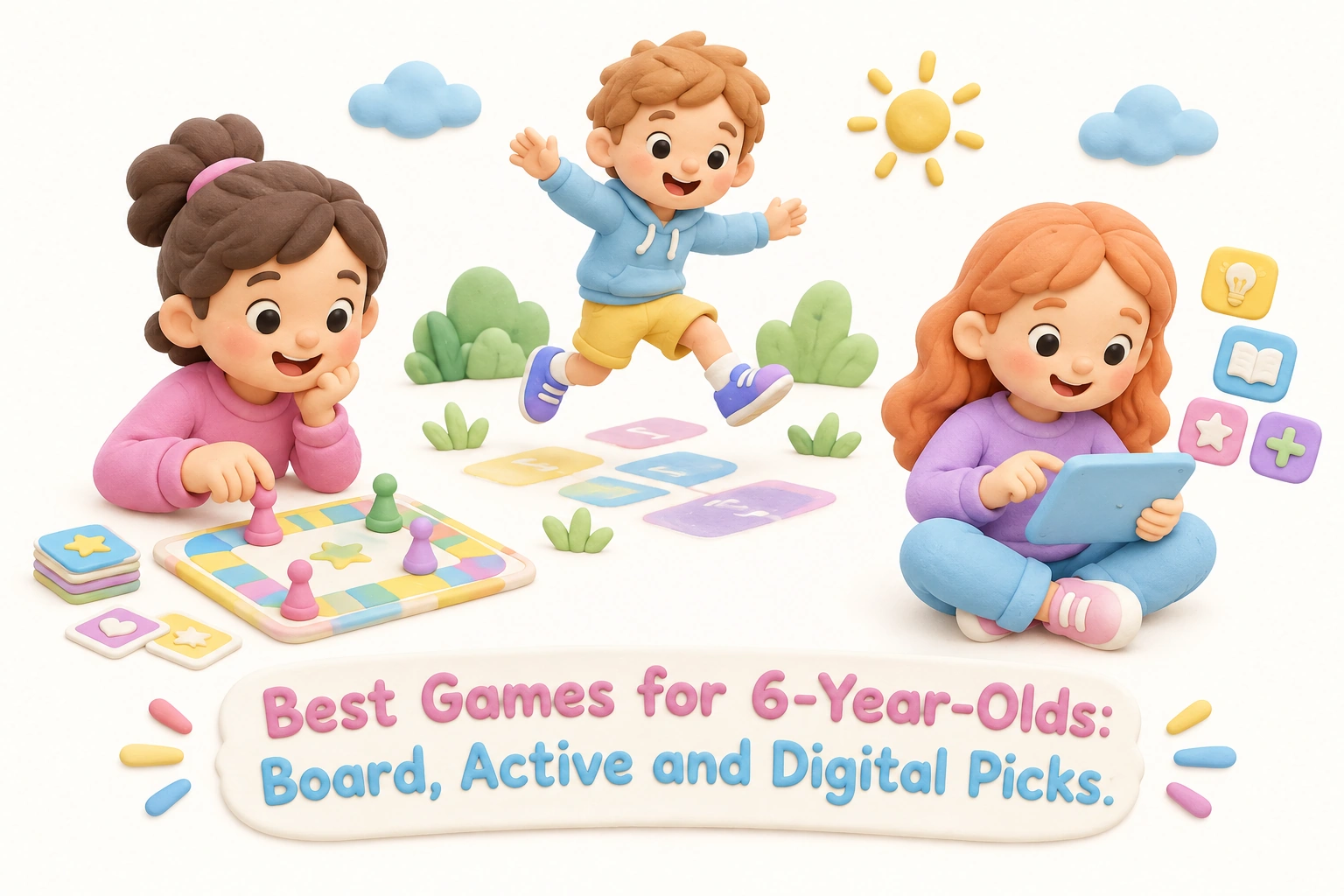
At age six, children are crossing an important developmental threshold: moving from imaginative, free-form play toward rules-based games where strategy, turn-taking, and the experience of winning and losing all become meaningful. Choosing the right games for 6-year-olds means finding activities that match this shift — engaging enough to hold a growing attention span, structured enough to build real skills, and varied enough to support physical, cognitive, and social development all at once. This guide covers board games, active games, and digital options, with honest developmental context for each category so you can make informed choices for your child and family.
Key Takeaways
- Age six marks a shift toward rules-based games; children at this stage can handle more complex mechanics, mild competition, and cooperative play than they could at four or five.
- Board games, active games, and digital games each support different developmental domains — the strongest approach combines all three rather than relying on any single category.
- Cooperative board games for kids are particularly valuable at this age for building good sportsmanship and reducing the frustration that can come with competitive play.
- Active games for kids support gross motor skills, coordination, and energy regulation in ways that seated play cannot replicate.
- Digital games can offer genuine educational value when they are age-appropriate, ad-free, and used within a healthy screen time balance alongside offline activities.
Why Age Six Is a Turning Point for Play
Child development researchers describe the period from roughly five to seven years as a time when children’s thinking becomes noticeably more logical and rule-governed. According to frameworks referenced by organizations such as the American Psychological Association, children in this age band develop stronger working memory, better impulse control, and an emerging capacity for deductive reasoning — all of which make structured games genuinely accessible for the first time. A four-year-old may struggle to hold a game’s rules in mind while also managing the emotional experience of losing; a six-year-old is beginning to develop the executive function needed to do both, though individual variation is wide.
This developmental shift means that games designed for ages six and up are not simply harder versions of toddler toys. They introduce mechanics such as deduction, resource management, spatial reasoning, and multi-step strategy that actively exercise the cognitive skills children are building at this stage. The Child Mind Institute notes that play — including structured game play — supports healthy social and emotional development by giving children a low-stakes environment to practice cooperation, negotiation, and emotional regulation. Understanding this context helps parents choose games that genuinely stretch their child rather than games that are merely entertaining.
Best Board Games for 6-Year-Olds
Board games offer a uniquely rich developmental environment: they require children to follow rules, wait their turn, manage disappointment, and think ahead — all within a social setting that naturally involves caregivers or siblings. The picks below are organized by play style rather than a ranked list, because the best choice depends on your child’s temperament and what skills you most want to support.
Cooperative Board Games for Kids
Cooperative games, where all players work together against the game rather than against each other, are especially well-suited to six-year-olds who are still developing emotional resilience around losing. Hoot Owl Hoot! by Peaceable Kingdom is a widely recommended entry point: players collaborate to guide owls back to their nest before sunrise, with no reading required and a play time of around 15 minutes. Outfoxed! by Gamewright is a step up in complexity — a deduction game in which players gather clues to identify a fox thief before it escapes. Outfoxed! is particularly effective for building deductive reasoning, as children must hold multiple clues in mind and eliminate suspects systematically, a genuine cognitive workout for this age group. Both games support turn-taking and shared decision-making without the emotional friction of direct competition.
Competitive Games with Manageable Complexity
Not all competition is developmentally problematic at age six — in fact, age-appropriate competitive games can help children practice good sportsmanship in a safe context. Rhino Hero by HABA is a stacking card game that builds fine motor skills and spatial reasoning while keeping play time under 20 minutes. Sleeping Queens by Gamewright introduces early numeracy through simple addition and number matching, wrapped in a fantasy theme that appeals to a wide range of children. Dragomino (a junior version of the classic Dominoes-style game Kingdomino) introduces spatial reasoning and tile-matching in a dragon-themed format that six-year-olds find genuinely engaging. For families who enjoy classic games, Connect Four and Guess Who? remain strong choices because their rules are simple enough to learn quickly but offer enough strategic depth to stay interesting.
Junior Versions of Classic Games
Junior versions of classic games are a practical category for this age group. Ticket to Ride: First Journey by Days of Wonder simplifies the beloved train-route game into a format accessible to six-year-olds, with a play time of around 15–30 minutes and mechanics that introduce basic strategy without overwhelming younger players. Monopoly Junior and Scrabble Junior similarly strip back complexity while preserving the core appeal of their parent games. These junior versions are particularly useful for family game night when older siblings or adults are playing, as they allow a six-year-old to participate meaningfully without requiring constant adult assistance.
Quick-Play and Party Options
For birthday party games for 6-year-olds or situations where attention spans are shorter, fast-play games are invaluable. Happy Salmon by North Star Games is a chaotic, high-energy card game that takes under five minutes and requires no reading — ideal for groups. Jenga builds fine motor skills and hand-eye coordination while creating genuine suspense that six-year-olds find thrilling. Qwirkle by MindWare is a tile-matching game that supports pattern recognition and early numeracy without requiring literacy, making it accessible to a wide range of six-year-olds regardless of reading level.
Best Active Games for 6-Year-Olds
Physical play is not simply a break from learning — it is a core developmental need at age six. Gross motor skills, balance, coordination, and body awareness are all actively developing during this period, and active games for kids provide the structured physical challenge that supports this development. The American Academy of Pediatrics recommends at least 60 minutes of moderate to vigorous physical activity daily for school-age children, and active games are one of the most enjoyable ways to meet that target.
Indoor Active Games
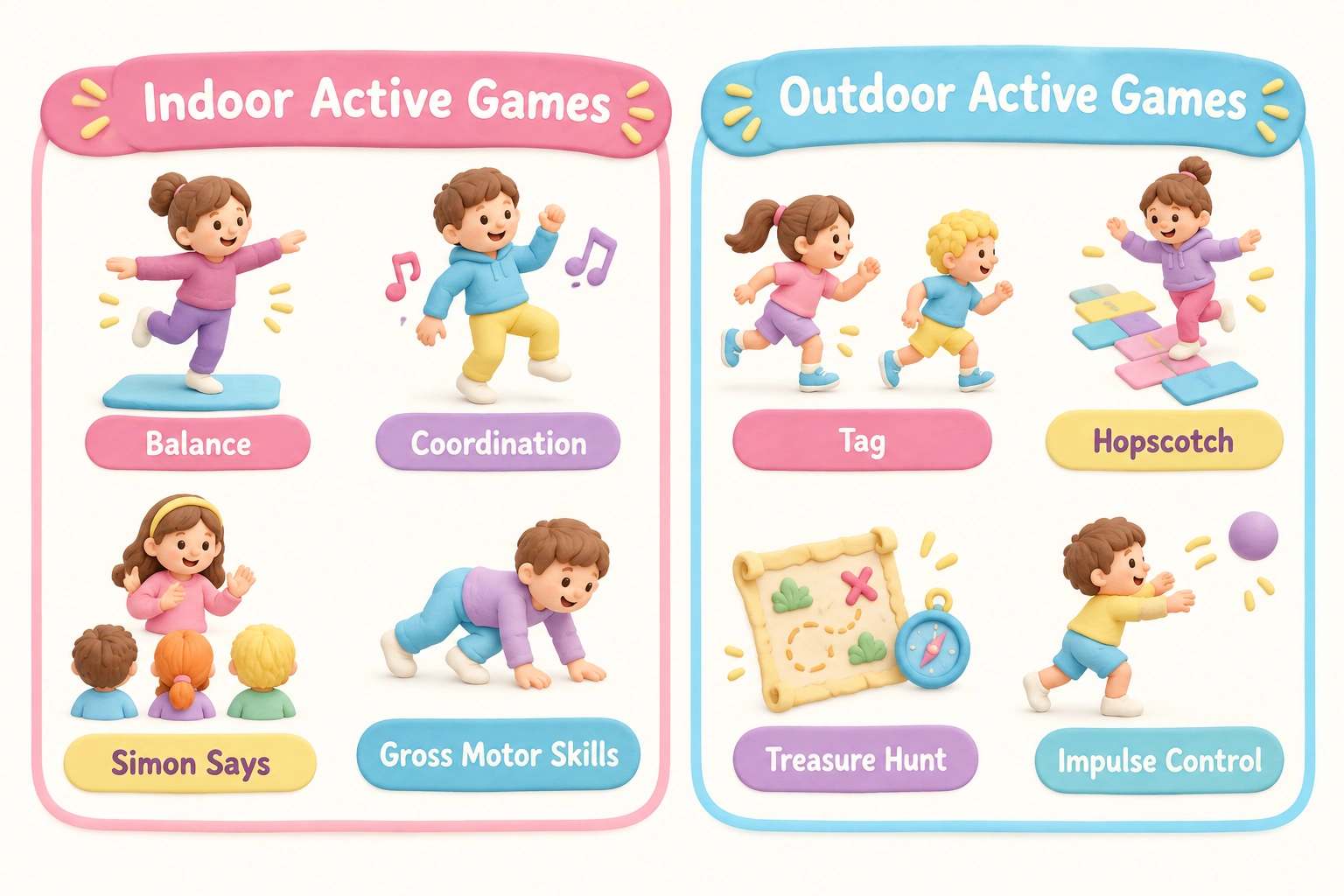
Rainy-day games that keep children moving indoors are a practical necessity for many families. Freeze Dance combines music, movement, and impulse control — children must stop immediately when the music pauses, which exercises the same self-regulation skills that support classroom learning. Simon Says builds listening comprehension and body awareness while keeping energy levels high. Musical Chairs introduces mild competitive pressure in a format that most six-year-olds handle well because rounds are short and the game resets quickly. For a more structured indoor option, setting up a simple obstacle course using cushions, tunnels, and low hurdles develops agility, balance, and spatial awareness while burning energy productively.
Outdoor Active Games
Outdoor play at age six benefits from games that involve running, throwing, catching, and whole-body coordination. Classic games such as Tag, Duck Duck Goose, and Hide and Seek remain developmentally appropriate and socially rich because they require children to read social cues, follow shared rules, and manage the emotional experience of being caught or found. Four Square and Hopscotch develop hand-eye coordination and gross motor skills through repetitive, satisfying movement patterns. For backyard play, beanbag toss, hula hoops, and sack races are accessible options that require minimal equipment and can be adapted for mixed-age groups by adjusting distances or rules. A backyard treasure hunt adds a cognitive layer — children must follow clues and problem-solve — making it one of the most developmentally complete outdoor activities for this age group.
Active Games for Mixed-Age Groups
When siblings of different ages are present, active games need some adaptation to remain fair and engaging for everyone. Handicapping strategies — such as giving younger children a head start in races or allowing them to stand closer in throwing games — preserve the fun without removing the challenge for older children. Team-based games such as tug of war or relay races naturally accommodate mixed ages by distributing physical demands across the group. These adaptations also model an important social lesson: that rules can be adjusted to include everyone, which is a concept six-year-olds are developmentally ready to understand and appreciate.
Best Digital Games for 6-Year-Olds
Digital games occupy a contested space in conversations about child development, and the evidence is genuinely mixed. High-quality, age-appropriate digital games can support literacy, numeracy, problem-solving, and creativity — but the quality of the content, the presence or absence of advertising and in-app purchases, and the overall screen time balance all matter significantly. The guidance below focuses on what to look for and which types of digital games are most likely to offer genuine developmental value.
What to Look for in Digital Games for 6-Year-Olds
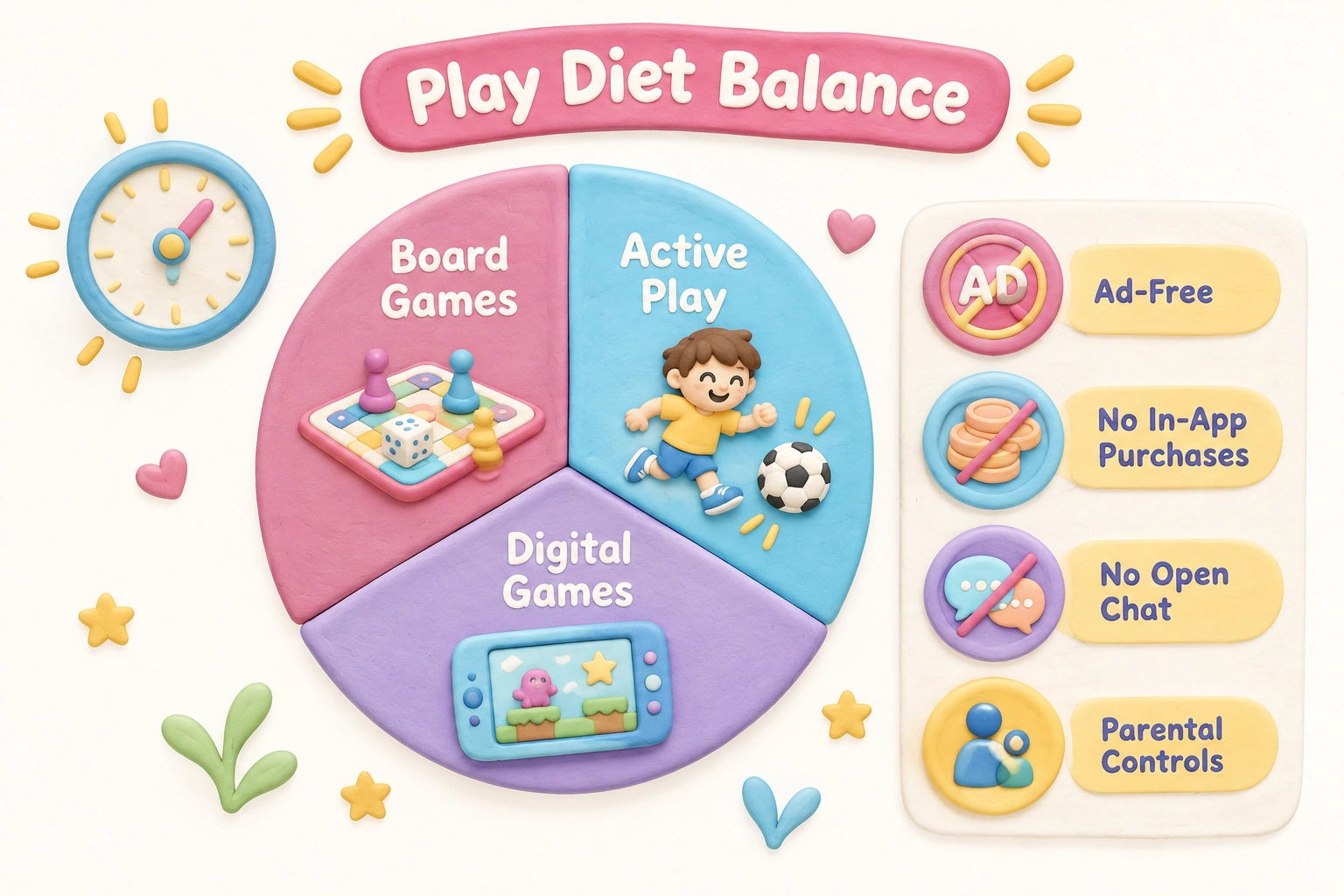
Before downloading any app or game, parents should check for several key features. The game should be genuinely ad-free and carry no in-app purchases that could expose children to commercial pressure or accidental spending. It should have no open chat or social features that connect children with strangers. Age ratings from recognized bodies such as PEGI or ESRB provide a useful starting point, but reading independent reviews from child safety organizations adds an important layer of vetting. Games that offer open-ended play — where children can create, explore, and experiment rather than simply react to prompts — tend to support creativity and executive function more effectively than purely reactive games.
Educational Games for 6-Year-Olds
Khan Academy Kids is a widely respected free app that covers early literacy, numeracy, and social-emotional learning through interactive activities and stories. It is genuinely ad-free, requires no in-app purchases, and is designed with input from child development experts. Prodigy Math uses a role-playing game format to deliver curriculum-aligned math practice, which many children find more motivating than traditional worksheets; parents should note that while the core game is free, it does offer a paid membership tier. PBS Kids games, tied to familiar characters from public television, offer a range of literacy and numeracy activities that are age-appropriate and free from advertising. These educational games for 6-year-olds work best when a parent or caregiver engages alongside the child at least some of the time, asking questions and connecting in-game learning to real-world contexts.
Creative and Open-Ended Digital Play
Toca Life World by Toca Boca is a strong example of open-ended digital play: children create their own stories and scenarios across a range of virtual environments, with no winning or losing and no advertising. The app supports narrative thinking, creativity, and imaginative play in a digital format. Sago Mini World offers a similar approach for slightly younger children but remains appropriate and engaging for many six-year-olds. Minecraft in Creative or Peaceful mode is a powerful creative tool that supports spatial reasoning, planning, and problem-solving — though parents should be aware that the broader Minecraft ecosystem includes online multiplayer features that require careful parental controls for this age group.
Screen Time Balance for 6-Year-Olds
The American Academy of Pediatrics recommends that school-age children’s screen time be consistent, limited, and balanced with adequate sleep, physical activity, and face-to-face interaction. For six-year-olds, this generally means prioritizing content quality over quantity and ensuring that digital game time does not displace physical play, reading, or family interaction. A practical approach is to treat digital games as one category within a broader play diet rather than a default activity. Setting clear, consistent time limits — and following through on them calmly — helps children develop self-regulation around screens, which is itself an important developmental skill. Co-playing digital games with your child, even occasionally, significantly increases their educational value by adding conversation, shared problem-solving, and adult scaffolding to the experience.
Choosing Games That Match Your Child’s Developmental Stage
Not every six-year-old is at the same developmental point. Some children at this age are ready for games with multiple rules, mild strategy, and competitive elements; others still benefit most from cooperative, low-pressure formats. Temperament plays a significant role: a child who becomes easily frustrated by losing may thrive with cooperative board games for kids before gradually introducing competitive formats, while a child who enjoys challenge may be ready for strategy games that are technically aimed at ages seven or eight.
Play time — meaning the actual duration of a game session — is a practical consideration that many parents overlook. A game with a 45-minute play time may be appropriate for a calm, focused six-year-old on a weekend afternoon but completely unsuitable for a tired child after school. Keeping a range of game lengths available — including fast games under 15 minutes and longer games for dedicated family game night sessions — gives you flexibility to match the game to the moment rather than forcing a mismatch that ends in frustration.
Budget is also a realistic factor. Many of the most developmentally valuable games for this age group cost under $20, and several digital options are entirely free. Classic games such as Jenga, Connect Four, and card-based games offer strong developmental value at low cost. For families looking for stretch picks — games that challenge a six-year-old who is developmentally ahead of typical age expectations — titles such as King of Tokyo (played without Power cards initially) or My First Carcassonne offer more complexity while remaining accessible with adult guidance.
Developmental Benefits of Play at Age Six: A Summary
The developmental benefits of play at age six span multiple domains simultaneously. Board games build cognitive skills including memory, deductive reasoning, spatial reasoning, and early numeracy, while also developing social skills such as turn-taking, rule-following, and good sportsmanship. Active games develop gross motor skills, balance, coordination, and physical fitness, while also supporting emotional regulation through the experience of physical challenge and group play. Digital games, when carefully selected, can reinforce literacy and numeracy, support creative thinking, and offer a form of open-ended play that complements rather than replaces physical and social activities.
No single game type covers all developmental domains, which is why a varied play diet — mixing board games, active play, and limited, high-quality digital experiences — is more valuable than any single category alone. The NAEYC emphasizes that play-based learning, including structured game play, is one of the most effective vehicles for developing the cognitive, social, and emotional foundations children need for school success. Parents and caregivers who engage actively in game play — even briefly — amplify these benefits by adding language, modeling problem-solving, and demonstrating how to handle both winning and losing with grace.
Frequently Asked Questions
How long should a board game session be for a 6-year-old?
Most six-year-olds can sustain focused attention for 15–30 minutes in a structured game. Games with a play time in this range are generally the most practical for this age group. Longer games are possible on relaxed weekend afternoons or when the child is particularly engaged, but forcing a long game when a child is tired or restless tends to create negative associations with game play rather than positive ones.
Are video games and apps appropriate for 6-year-olds?
Age-appropriate digital games can offer genuine educational and creative value for six-year-olds when they are carefully selected. Key criteria include: genuinely ad-free content, no in-app purchases, no open chat features, and content that is interactive rather than purely passive. Screen time balance matters — digital games should complement, not replace, physical play and face-to-face interaction. Co-playing with your child increases the developmental value of any digital game significantly.
What skills do games build in 6-year-olds?
Different game types support different skills. Board games tend to build cognitive skills such as memory, deductive reasoning, and early numeracy, alongside social skills including turn-taking and good sportsmanship. Active games develop gross motor skills, coordination, balance, and physical fitness. Digital games, when well-chosen, can support literacy, numeracy, spatial reasoning, and creative thinking. The broadest developmental benefit comes from a mix of all three categories.
What is the difference between cooperative and competitive games for this age?
Cooperative board games for kids have all players working together toward a shared goal, which removes the emotional pressure of direct competition and makes them particularly accessible for children who are still developing resilience around losing. Competitive games introduce the experience of winning and losing directly, which is developmentally valuable but works best when the game is short, the rules are clear, and adults model calm, gracious responses to both outcomes. Many families find it useful to start with cooperative formats and gradually introduce competitive games as a child’s emotional regulation develops.
How can I adapt games for mixed-age siblings?
Most games can be adapted for mixed-age groups with simple adjustments: giving younger children a head start, allowing them to draw extra cards, or pairing them with an older player as a team. Cooperative games naturally accommodate mixed ages because all players contribute to a shared outcome. For active games, adjusting distances, rules, or physical demands keeps the activity fair and enjoyable for everyone without removing the challenge for older children.
What should I look for when choosing a digital game for my 6-year-old?
Prioritize games that are genuinely ad-free and carry no in-app purchases. Check that there are no open social or chat features. Look for content that is interactive and open-ended rather than purely reactive, and verify age ratings from recognized bodies. Reading independent reviews from child safety organizations adds useful context beyond what app store descriptions provide. Parental controls on your device or platform add an important additional layer of safety regardless of the game’s own features.
Finding the Right Game Mix for Your 6-Year-Old
The best games for 6-year-olds are not necessarily the most expensive, the most technologically sophisticated, or the ones with the longest lists of developmental claims on the box. They are the games that match your child’s current developmental stage, hold their attention for an appropriate amount of time, and create opportunities for the kind of engaged, social, and physical play that supports healthy development across multiple domains.
A practical starting point is to have at least one cooperative board game, one competitive board game with a short play time, one or two active games suited to your available space, and one carefully vetted digital option — and to rotate between them based on your child’s mood, energy level, and the time you have available. Family game night does not need to be elaborate to be valuable; even 20 minutes of shared play several times a week builds the habits of attention, cooperation, and joyful engagement that serve children well beyond age six. If you are unsure where to start, cooperative deduction games such as Outfoxed! and active classics such as Freeze Dance or a backyard treasure hunt are low-cost, high-value entry points that most six-year-olds take to quickly and enthusiastically.

Take a short quiz to find out what your everyday choices say about your parenting style
When your child is curious about something new, what’s your instinct?
Take a short quiz to find out what your everyday choices say about your parenting style
“Can I download this app?” What happens next?
Take a short quiz to find out what your everyday choices say about your parenting style
When it comes to rules at home, which sounds most like you?
Take a short quiz to find out what your everyday choices say about your parenting style
If you could give your child one life skill today, what would you pick?
Take a short quiz to find out what your everyday choices say about your parenting style
Your child gets to choose what to watch. What would your ideal setup look like?
Take a short quiz to find out what your everyday choices say about your parenting style
Pick your parenting superpower ✨