Best Learning Games for 4-Year-Olds: Apps, Counting and Creative Play

 Discover a Free Education Video App for Kids
Pastory uses AI to personalize educational video content based on your child’s interests and personality. Safe, engaging, and built for curious young minds. Sign up now to stay updated and enjoy early access with a free trial
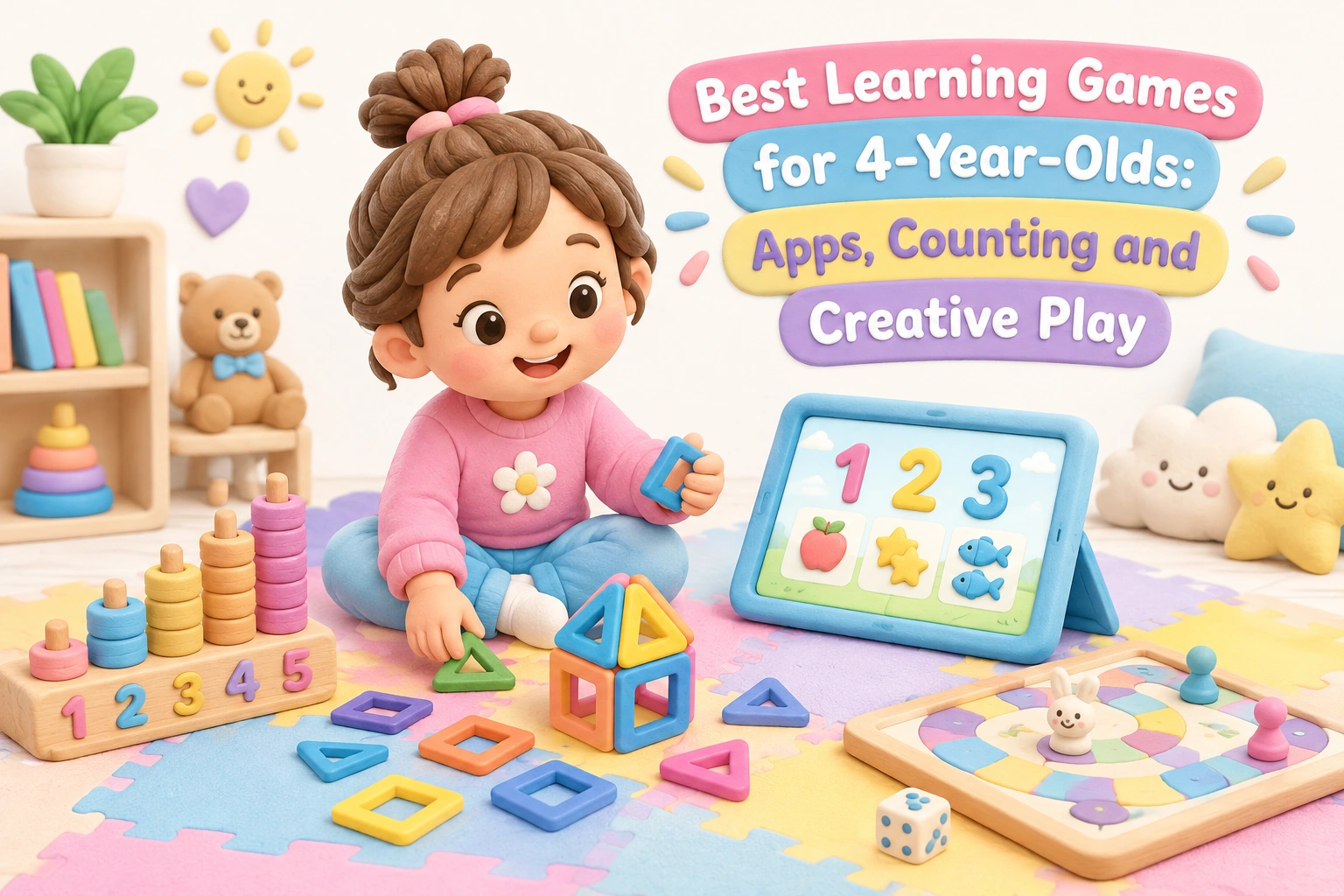
Four-year-olds are at a remarkable developmental crossroads: their curiosity is intense, their language is expanding rapidly, and they are beginning to grasp early math and literacy concepts that will form the foundation of formal schooling. The right learning games at this stage can support cognitive development, build social-emotional skills, and make kindergarten readiness feel like a natural extension of play rather than a chore. This guide covers the most effective categories of educational games for 4-year-olds — including apps, counting activities, board games, and creative play — with practical guidance on how to choose age-appropriate options and balance digital and offline experiences.
Key Takeaways
- Play-based learning is the most developmentally appropriate approach for 4-year-olds; games that feel like play while building real skills are the most effective.
- A balanced mix of digital apps, hands-on counting activities, board games, and creative play covers the widest range of developmental domains.
- The best educational apps for this age group are ad-free, interactive rather than passive, and ideally used alongside a caregiver for short sessions.
- Hands-on counting activities using everyday household objects can be just as effective as commercial products for building early number sense.
- Pretend play and constructive play are strongly linked to social-emotional readiness for school, a dimension that purely academic games often miss.
Why Games Matter for 4-Year-Old Development
At age four, children are not yet developmentally ready for sustained formal instruction, but they are highly capable of learning through structured and unstructured play. Research in early childhood education consistently supports play-based learning as the primary vehicle for cognitive, language, and social growth during the preschool years. Games provide a context in which children can practice skills repeatedly without the pressure of performance, which supports both motivation and retention.
The developmental milestones typical of a 4-year-old include counting objects up to ten, recognizing some letters and numbers, following multi-step instructions, engaging in cooperative play with peers, and using imaginative scenarios in pretend play. Games that are well-matched to these milestones can reinforce emerging skills without frustrating children who are not yet ready for more advanced concepts. It is equally important to recognize that development within the fourth year varies considerably: a child who has just turned four may be working on number recognition from one to five, while a child approaching five may be ready for simple addition and early phonics. Age-appropriate games should flex to meet the child where they are.
From a cognitive development perspective, games also build executive function skills — the ability to follow rules, wait for a turn, hold information in working memory, and shift attention between tasks. These capacities are among the strongest predictors of school readiness and long-term academic success, yet they are rarely the focus of flashcard-style learning tools.
Best Educational Apps for 4-Year-Olds
Digital learning apps can be a valuable part of a 4-year-old’s learning environment when chosen carefully. The most effective apps for this age group are interactive rather than passive, structured around specific learning goals, and free from advertising that can disrupt focus and introduce inappropriate content. The American Academy of Pediatrics recommends that screen time for children aged two to five be limited to one hour per day of high-quality programming, ideally co-viewed with a caregiver who can help the child connect what they see on screen to real-world experiences. This guidance applies equally to educational apps.
Top App Picks and What They Target
Khan Academy Kids is a free, ad-free learning app that covers early literacy, early numeracy, social-emotional skills, and creative activities through an adaptive curriculum. It adjusts to the child’s pace and includes a wide range of interactive activities rather than passive video content, making it one of the most comprehensive free options available for preschool-aged children.
HOMER is a subscription-based app focused primarily on early literacy and phonemic awareness. It uses a personalized learning path based on the child’s interests and reading level, which can help maintain engagement over time. Parents report that HOMER works well for children who are beginning to connect letter sounds to written letters — a key step in early reading development.
Endless Numbers targets number sense and early math concepts through animated, interactive puzzles. Each number from one to one hundred has its own episode introducing the numeral, its quantity, and simple equations. The app is particularly effective for building number recognition and one-to-one correspondence in a visually engaging format.
PBS KIDS Games is a free, ad-free collection of games featuring familiar characters from public television. The games span literacy, math, science, and social skills, and because the characters are already known to many children, engagement tends to be high. The app does not use a personalized learning algorithm, so parents may need to guide children toward activities that match their current developmental level.
Toca Boca apps take a different approach: rather than structured curricula, they offer open-ended digital play environments — a kitchen, a hospital, a hair salon — that support imaginative play, narrative development, and creative thinking. These apps are best understood as digital toys rather than educational programs, but they can complement more structured learning tools effectively.
App Comparison: Key Features at a Glance
| App | Cost | Key Skill Focus | Ad-Free | Interactive vs Passive |
|---|---|---|---|---|
| Khan Academy Kids | Free | Literacy, math, social skills | Yes | Interactive |
| HOMER | Subscription | Early literacy, phonics | Yes | Interactive |
| Endless Numbers | Free/paid tiers | Number sense, math | Yes | Interactive |
| PBS KIDS Games | Free | Literacy, math, science | Yes | Interactive |
| Toca Boca | Free/paid tiers | Imaginative play, creativity | Yes | Open-ended |
| ABCmouse | Subscription | Comprehensive curriculum | Yes | Interactive |
Screen Time Balance and App Use
Even the best ad-free learning apps are most effective when used in short, purposeful sessions rather than extended independent use. For 4-year-olds, sessions of fifteen to twenty minutes tend to align better with typical attention spans than longer periods. Caregiver involvement — asking questions about what the child is doing, connecting app content to real objects or experiences — significantly increases the developmental value of any digital activity. Parents should also ensure that app time does not displace physical play, social interaction, or hands-on activities, all of which contribute to development in ways that screens cannot replicate.
Hands-On Counting Activities for Preschoolers
Hands-on counting activities are among the most effective tools for building early number sense in 4-year-olds, and many of the best require no commercial materials at all. Physical manipulation of objects — touching, moving, and grouping them — supports the development of one-to-one correspondence, the understanding that each object in a set corresponds to exactly one number word. This concept is foundational to all later arithmetic and is best learned through tactile, concrete experience rather than screen-based activities alone.
DIY Counting Games Using Household Items
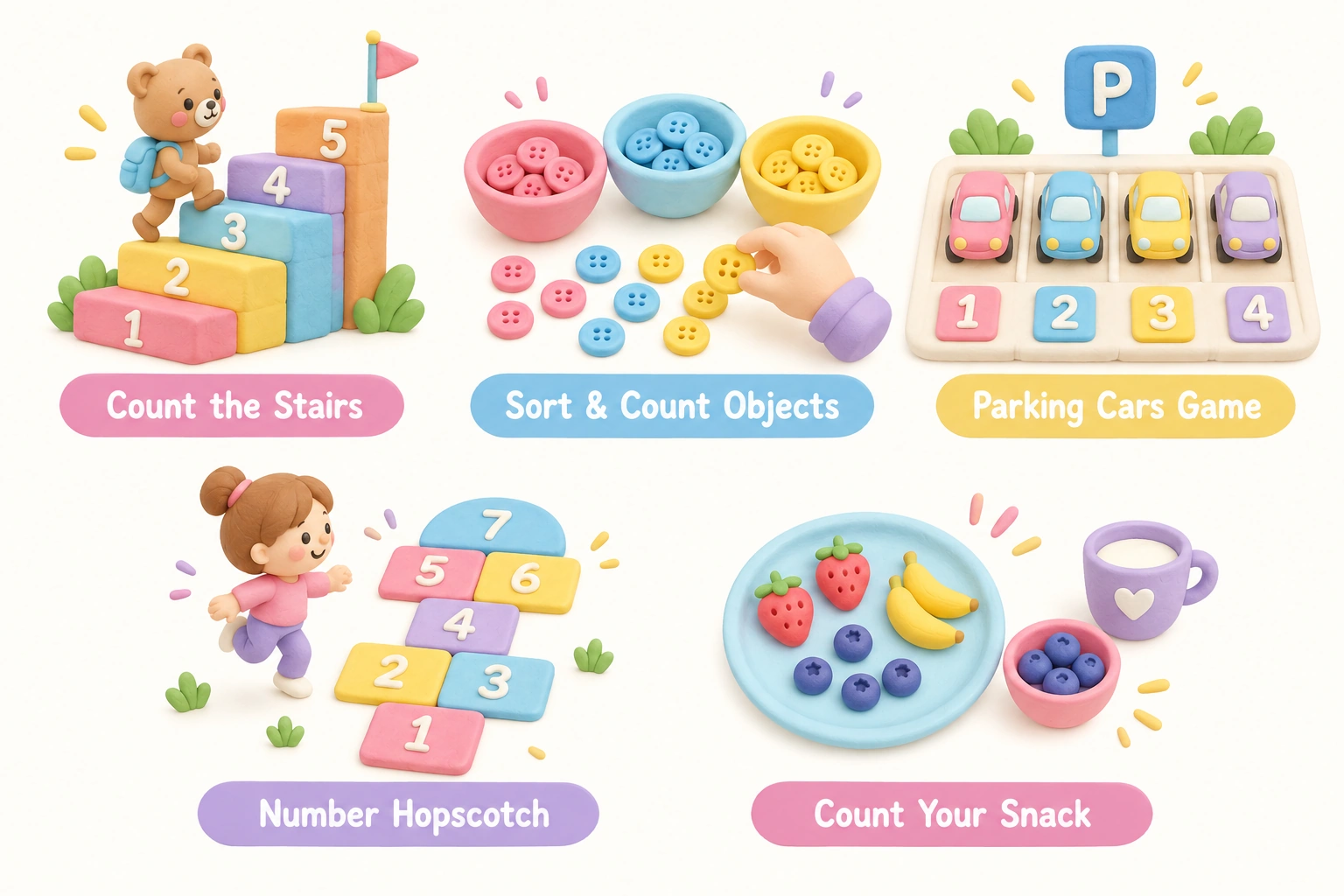
Counting stairs is one of the simplest and most effective zero-material counting activities. As a child climbs or descends, counting each step aloud reinforces rote counting and connects numbers to physical movement. Sorting and counting small household objects — buttons, pasta shapes, dried beans — into groups by color or size introduces both number recognition and early classification skills simultaneously.
The parking cars game is a popular preschool activity that requires only toy cars and numbered parking spaces drawn on paper or cardboard. Children match each car to its numbered space, reinforcing numeral recognition and one-to-one correspondence in a playful context. A similar principle applies to pipe cleaner counters: threading a specific number of beads onto a labeled pipe cleaner gives children a tactile way to connect numerals to quantities.
Hopscotch combines gross motor skills with number recognition and sequencing. Drawing a hopscotch grid with chalk and calling out numbers for children to jump to builds physical coordination alongside early numeracy. For indoor play, a number hopscotch mat or numbered floor tiles achieves the same effect.
Counting with food — grapes, crackers, raisins — is highly motivating for most 4-year-olds and naturally integrates counting into daily routines. Asking a child to count out five crackers for a snack, or to share a pile of grapes equally between two bowls, introduces early division concepts in a completely concrete and meaningful context.
Counting Games That Require No Materials
For parents on the go, several effective counting activities require nothing at all. Counting claps or jumps together, counting steps between two points, or playing a simple game of counting how many red cars pass on a journey all reinforce number skills without any preparation. These informal counting moments, embedded in everyday life, are consistent with how young children learn most naturally — through repeated, low-pressure exposure to concepts in varied real-world contexts.
Board Games for 4-Year-Olds
Board games offer developmental benefits that digital games and solo activities cannot easily replicate: they require turn-taking, rule-following, and often cooperative play with other children or adults. These social dimensions make board games particularly valuable for building the social-emotional skills that underpin kindergarten readiness.
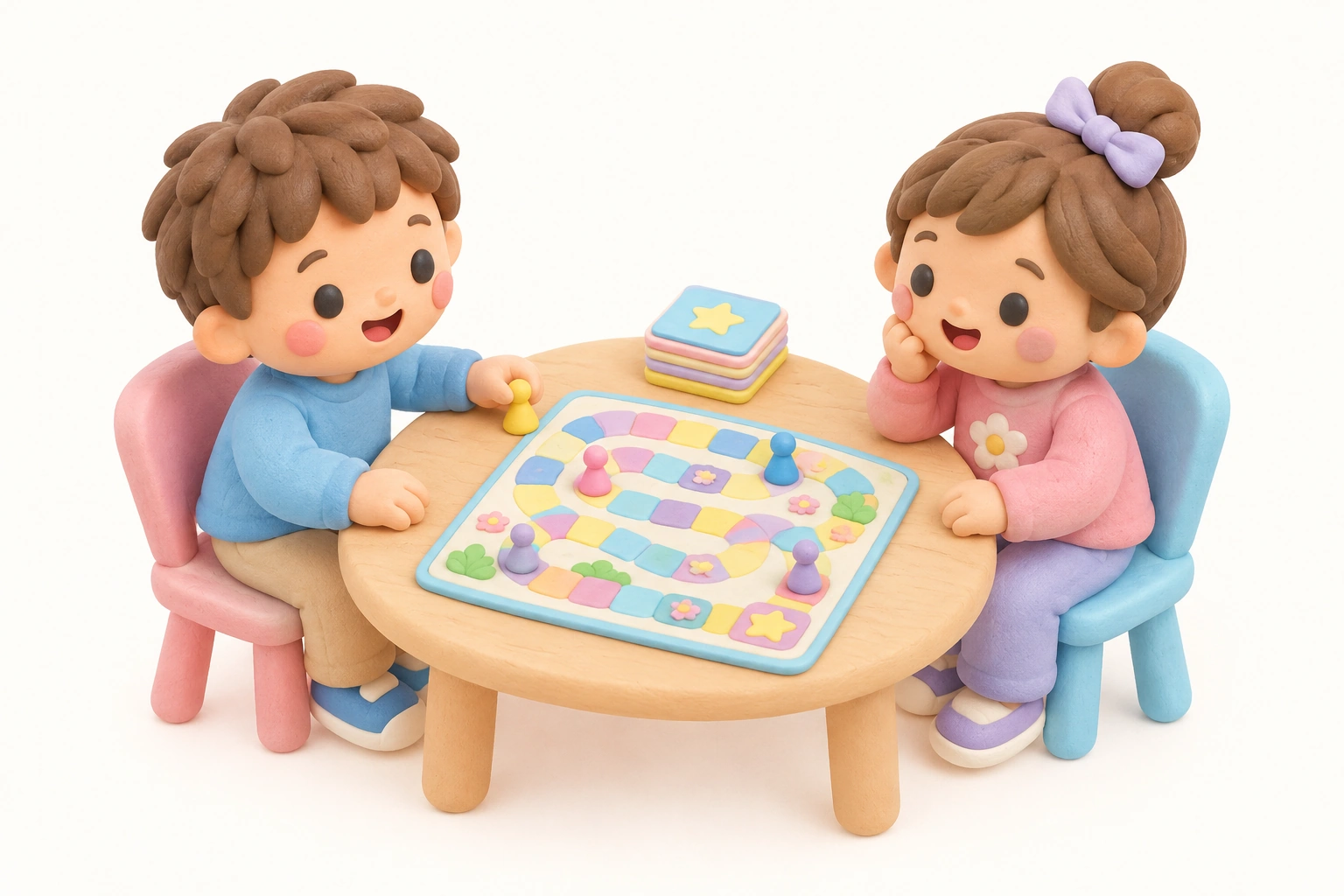
Candy Land is a classic color-matching game that introduces the concept of following a path, taking turns, and accepting outcomes — including losing — with equanimity. While it does not involve strategic thinking, it is an excellent first board game for children who are new to structured play with rules.
The Sneaky Snacky Squirrel Game builds fine motor skills through the use of a squirrel-shaped card that children use to pick up acorns and sort them by color. The game also introduces color recognition and simple strategy in a format that is genuinely engaging for 4-year-olds.
Hoot Owl Hoot! is a cooperative board game in which players work together to help owls fly home before sunrise. Cooperative play at this age supports empathy, communication, and the understanding that working together can achieve goals that individual effort cannot — all important social-emotional skills for school readiness.
Animal Upon Animal is a stacking game that develops fine motor skills, spatial reasoning, and patience. Children take turns balancing wooden animals on top of each other, which requires concentration and careful physical control. The game is simple enough for 4-year-olds but engaging enough to hold attention through multiple rounds.
Memory card games — matching pairs of cards by turning them face up — are among the most effective games for building visual attention, visual scanning, and working memory. These cognitive skills support both early literacy (recognizing letter shapes) and early numeracy (recognizing numerals and quantities).
Creative Play and Imaginative Play for 4-Year-Olds
Pretend play and constructive play are not simply entertainment for 4-year-olds — they are primary mechanisms through which children develop language, narrative thinking, emotional regulation, and social understanding. Research in early childhood development suggests that children who engage in rich imaginative play tend to develop stronger vocabulary, more flexible problem-solving skills, and greater capacity for empathy than those with limited pretend play experience. These outcomes are directly relevant to kindergarten readiness, yet they are rarely the focus of structured educational games.
Pretend Play and Its Developmental Value
Role-playing scenarios — playing doctor, cooking in a toy kitchen, running a pretend shop, or caring for dolls — give 4-year-olds a safe space to explore social roles, practice language in context, and process experiences they have observed in the real world. When children assign roles, negotiate scenarios, and resolve conflicts within pretend play, they are exercising executive function, language development, and social-emotional skills simultaneously. Caregivers can enrich pretend play by participating occasionally, introducing new vocabulary naturally within the scenario, and asking open-ended questions that extend the narrative.
Constructive Play: Building and Creating
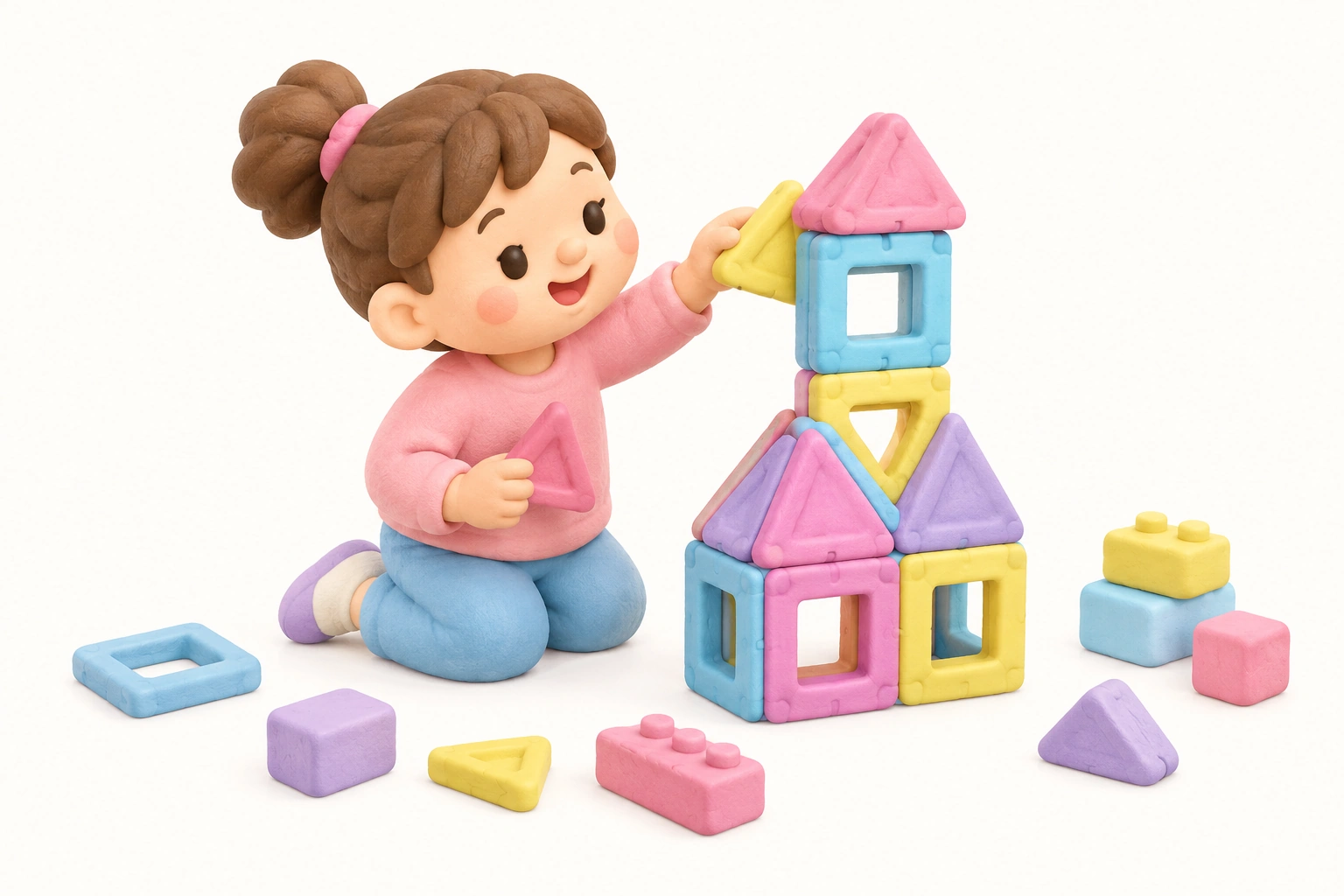
Constructive play — using blocks, magnetic tiles, LEGO Duplo, or similar building materials — supports spatial reasoning, early engineering thinking, and persistence. Open-ended play with building materials allows children to set their own goals, encounter problems, and find solutions without adult direction, which builds self-directed learning habits that are valuable throughout schooling. Magnetic tiles in particular have become popular for preschool-aged children because they are easy to connect and allow rapid construction of complex structures, which maintains engagement even for children with shorter attention spans.
Arts and crafts activities — drawing, painting, cutting, and gluing — develop fine motor skills that are directly relevant to letter writing and number tracing. Providing children with open-ended art materials rather than structured coloring sheets encourages creative decision-making and builds confidence in self-expression. These activities also support letter recognition indirectly, as children who are comfortable with pencils and crayons find the physical act of writing less effortful when formal instruction begins.
Connecting Creative Play to School Readiness
The link between imaginative play and kindergarten readiness is supported by a growing body of early childhood research. Children who have extensive experience with pretend play tend to enter school with stronger narrative language skills, better ability to understand other people’s perspectives, and more developed self-regulation — the capacity to manage emotions and behavior in a structured environment. These social-emotional skills are as important to school success as letter recognition or counting ability, yet they are less easily measured and therefore often underemphasized in discussions of preschool learning games.
Indoor and Outdoor Games for 4-Year-Olds
Physical games — both indoors and outdoors — contribute to gross motor development, body awareness, and the kind of energetic play that supports attention and self-regulation when children return to quieter activities. Simon Says is a classic indoor game that builds listening skills, impulse control, and body awareness simultaneously. Hide and seek develops spatial reasoning and the understanding that objects and people continue to exist even when out of sight — a concept known as object permanence that extends into more abstract thinking.
Scavenger hunts can be designed to incorporate letter recognition, color recognition, or counting, making them a flexible tool for combining physical activity with early academic skills. Outdoor ball games, jumping rope, and simple relay races build gross motor skills and cooperative play in ways that indoor activities cannot fully replicate. Regular physical activity is also associated with better attention and cognitive performance in young children, which means that outdoor play supports learning indirectly as well as directly.
Choosing the Right Learning Games for Your 4-Year-Old
Selecting age-appropriate learning games requires attention to both the child’s current developmental stage and their individual temperament. A child who is highly social will benefit most from cooperative board games and group pretend play, while a child who prefers solitary exploration may engage more deeply with open-ended building materials or a well-chosen educational app. Neither preference is a problem; the goal is to find games that the child finds genuinely engaging, because sustained engagement is what drives learning at this age.
For children with shorter attention spans, games with quick rounds — memory card games, simple dice games, or short app sessions — tend to work better than games with lengthy setup or complex rules. For children with sensory sensitivities, tactile materials such as counting bears, sand trays for letter tracing, or textured building blocks may be more comfortable than standard plastic toys. Parents who have concerns about their child’s development or learning style are encouraged to consult with a pediatrician or early childhood specialist rather than relying solely on commercial games to address specific needs.
When evaluating any learning game, it is worth asking: Does this game require the child to actively think, decide, or create — or does it simply reward passive watching? Does it match where my child is right now, not where I hope they will be? Does it allow for repeated play without becoming frustrating? And does it leave room for my child to experience both success and manageable challenge? Games that meet these criteria tend to support development most effectively, regardless of whether they are digital or physical.
Frequently Asked Questions
How long should a 4-year-old use educational apps each day?
General guidance from pediatric health organizations suggests limiting screen time for children aged two to five to around one hour per day of high-quality content. For educational apps specifically, shorter sessions of fifteen to twenty minutes tend to align better with a 4-year-old’s attention span and are more effective when a caregiver is present to extend learning beyond the screen.
What counting skills should a 4-year-old have?
Most 4-year-olds are developing the ability to count objects up to ten using one-to-one correspondence, recognize numerals from one to five or beyond, and understand that the last number counted represents the total quantity in a set. Development varies considerably within the year, so a child who has just turned four may be working on smaller numbers while one approaching five may be ready for simple addition.
Are video games or apps beneficial for 4-year-olds?
High-quality, interactive, ad-free learning apps can support early literacy, number sense, and problem-solving skills when used in moderation and alongside caregiver involvement. Passive video content or apps driven primarily by entertainment rather than learning goals offer fewer developmental benefits. The key distinction is whether the child is actively thinking and responding, or simply watching.
What board games are genuinely suitable for 4-year-olds?
Games with simple rules, short play times, and low reading requirements work best. Candy Land, The Sneaky Snacky Squirrel Game, Hoot Owl Hoot!, Animal Upon Animal, and basic memory card games are all well-matched to the cognitive and social abilities of most 4-year-olds. Cooperative games are particularly valuable because they build teamwork and communication without the frustration of competitive losing.
How does pretend play support kindergarten readiness?
Pretend play builds narrative language, perspective-taking, emotional regulation, and social problem-solving — all of which are important for functioning in a classroom environment. Children who engage in rich imaginative play tend to enter school with stronger communication skills and greater ability to manage their emotions and behavior, which supports both academic and social success.
Can counting games replace formal math instruction for preschoolers?
Counting games and hands-on math activities are the most developmentally appropriate form of early math learning for 4-year-olds and are not intended to replace formal instruction, which typically begins in kindergarten. These activities build the concrete understanding of number that formal instruction will later build upon. Children who have strong hands-on experience with counting and number concepts tend to find the transition to formal math more manageable.
Building a Balanced Learning Game Routine for Your 4-Year-Old
No single type of learning game covers every developmental domain a 4-year-old needs. The most effective approach combines a variety of game types across the week: a short session with a well-chosen educational app, a hands-on counting activity using everyday objects, a board game that involves turn-taking and social interaction, and generous time for pretend play and constructive play that the child directs themselves. This variety ensures that cognitive development, early literacy, number sense, fine motor skills, and social-emotional skills all receive attention without any one activity dominating the child’s day.
Caregiver involvement remains one of the most consistent predictors of how much children benefit from any learning activity. Playing alongside a child — asking questions, narrating what is happening, introducing new vocabulary, and celebrating effort rather than just correct answers — amplifies the developmental value of even simple games. The goal at age four is not to accelerate academic achievement but to build a genuine love of learning, a sense of competence, and the social and cognitive foundations that will make formal schooling a positive experience. The best learning games for 4-year-olds are ultimately the ones that a child wants to return to again and again — because sustained, joyful engagement is how real learning happens at this age.

Take a short quiz to find out what your everyday choices say about your parenting style
When your child is curious about something new, what’s your instinct?
Take a short quiz to find out what your everyday choices say about your parenting style
“Can I download this app?” What happens next?
Take a short quiz to find out what your everyday choices say about your parenting style
When it comes to rules at home, which sounds most like you?
Take a short quiz to find out what your everyday choices say about your parenting style
If you could give your child one life skill today, what would you pick?
Take a short quiz to find out what your everyday choices say about your parenting style
Your child gets to choose what to watch. What would your ideal setup look like?
Take a short quiz to find out what your everyday choices say about your parenting style
Pick your parenting superpower ✨