Best Learning Games for 3-Year-Olds: Apps, Movement and First Skills

 Discover a Free Education Video App for Kids
Pastory uses AI to personalize educational video content based on your child’s interests and personality. Safe, engaging, and built for curious young minds. Sign up now to stay updated and enjoy early access with a free trial
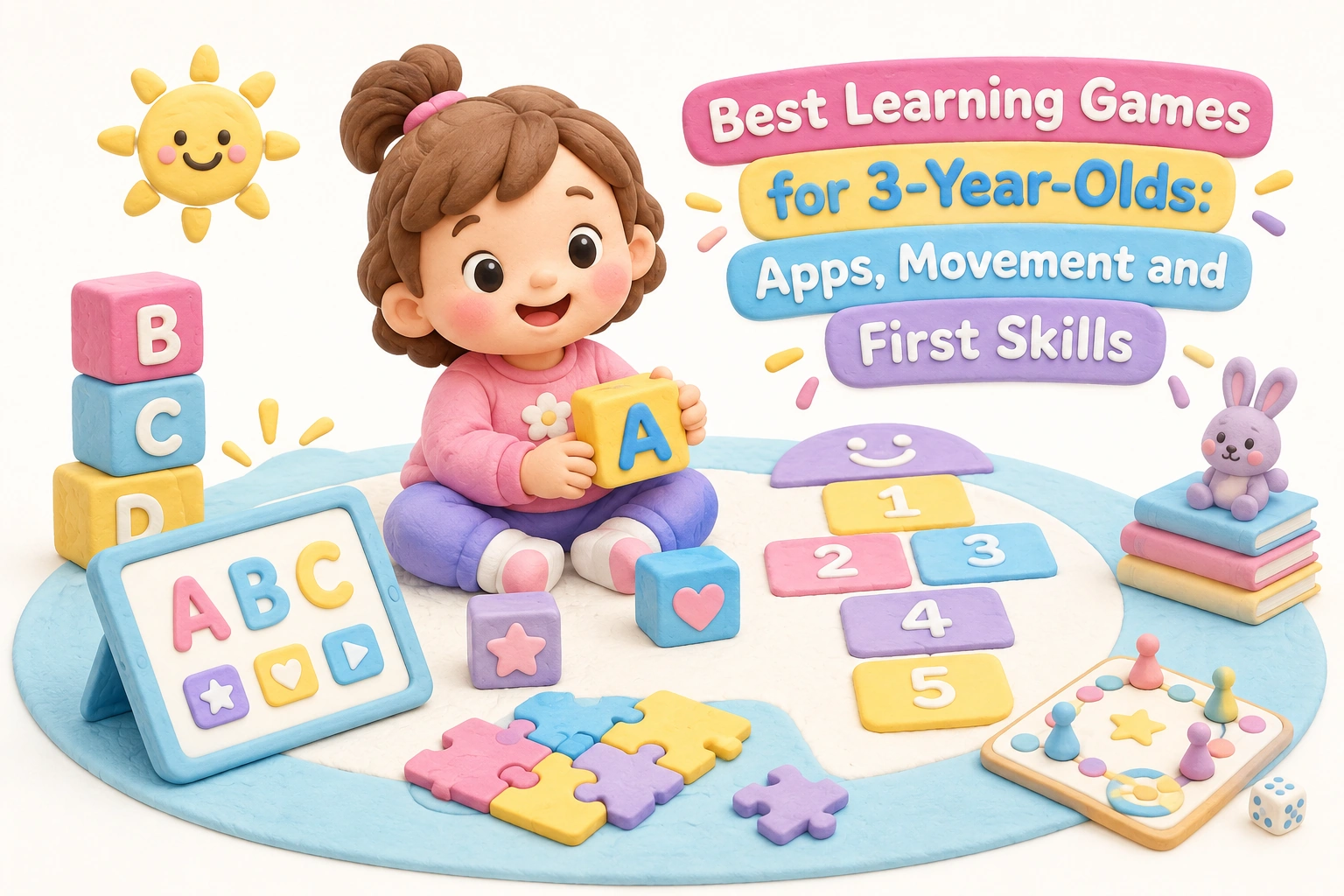
Three-year-olds are at a remarkable developmental crossroads: their brains are rapidly building connections, their language is expanding daily, and they are just beginning to understand that play can involve other people, not just objects in front of them. Choosing the right learning games for 3-year-olds means understanding what skills are actually emerging at this age, which formats genuinely support those skills, and how to balance digital and screen-free experiences in a way that fits your family. This article covers age-appropriate apps, movement games, board games, and DIY activities — with the developmental reasoning behind each category.
Key Takeaways
- At age 3, children are developing letter recognition, early number sense, shape sorting, gross motor skills, and the first stages of cooperative play — games that target these areas offer the most developmental value.
- The most effective learning games for this age combine active engagement, repetition, and a small amount of challenge — neither too easy nor frustrating.
- Ad-free, editorially curated apps can support learning when used with caregiver involvement; passive or unrestricted screen time offers far less developmental benefit.
- Movement games are not separate from academic learning — activities like number hopscotch build counting and gross motor development simultaneously.
- Younger 3-year-olds may benefit most from exploring game materials freely before following rules — a concept sometimes called the “almost game” approach.
What Should a 3-Year-Old Be Learning Through Play?
According to widely referenced developmental milestone frameworks, most 3-year-olds are working on a recognizable cluster of skills. They are beginning to recognize some letters, particularly those in their own name. They can count small groups of objects with one-to-one correspondence — touching each item as they say a number — though they may not yet fully grasp that the last number represents the total. They are sorting objects by color and shape, completing simple puzzles of three to six pieces, and using language in increasingly complex ways. Socially, they are transitioning from parallel play — playing alongside others without truly interacting — toward the early stages of cooperative play, which involves sharing, turn-taking, and simple negotiation.
Gross motor development at this age includes running, jumping, climbing, and beginning to balance on one foot briefly. Fine motor skills are advancing too: 3-year-olds can typically hold a crayon with more control, string large beads, and manipulate puzzle pieces with intention. Games that target any of these domains — whether digital or physical — are most useful when they match the child’s current developmental stage rather than pushing too far ahead or offering no challenge at all.
It is also worth noting that executive function skills — the ability to follow simple rules, wait for a turn, and shift attention — are just beginning to develop at age 3. This is why games with very simple rules, short play sessions, and immediate feedback tend to work better than complex multi-step activities.
Best Apps and Digital Games for 3-Year-Olds
Digital games can support preschool learning when they are interactive rather than passive, editorially curated rather than algorithm-driven, and used with caregiver involvement. The distinction matters: a child watching animated content without responding is receiving far less developmental benefit than a child tapping, sorting, or making choices within a structured app. Research on what is sometimes called the “video deficit effect” suggests that toddlers and young preschoolers learn less efficiently from screens than from real-world interaction — which is why co-viewing and co-play with a caregiver can significantly improve what a child takes away from any digital experience.
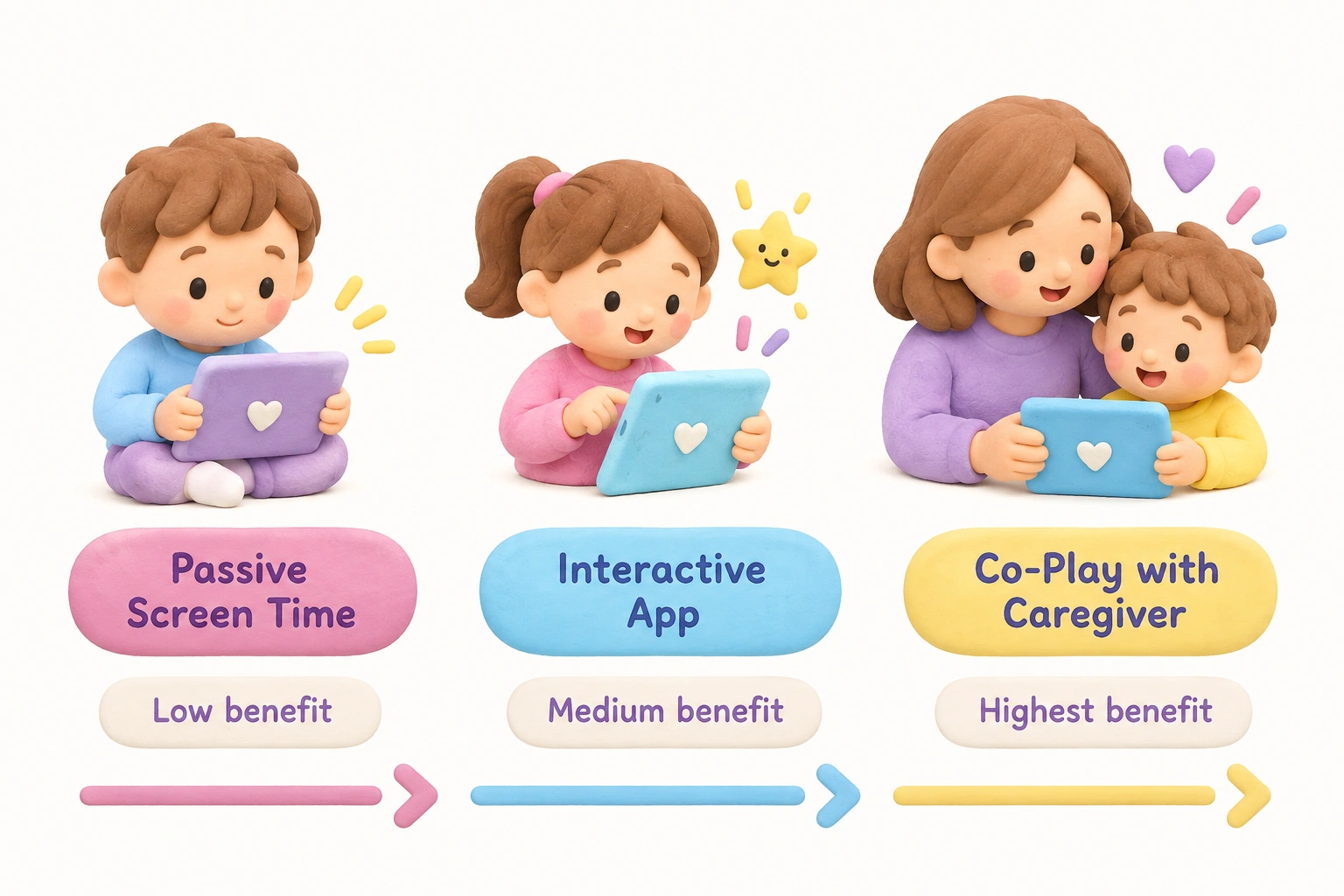
The following apps are frequently cited by educators and developmental specialists as well-suited to 3-year-olds, based on their interactivity, content quality, and age-appropriate pacing. Most are ad-free or offer ad-free versions, which matters for this age group since advertising interruptions disrupt attention and can introduce commercial content that is not developmentally appropriate.
Khan Academy Kids
Khan Academy Kids is a free, ad-free app covering early literacy, letter recognition, phonics, basic math, and social-emotional learning through short interactive activities and animated characters. It is one of the most widely recommended free options for preschool-age children and is available without a subscription. Caregiver involvement — even briefly checking in on what the child is doing — tends to improve how much children retain from sessions.
PBS Kids Games
PBS Kids Games draws on familiar characters such as Daniel Tiger to address social-emotional learning alongside early academic skills. Daniel Tiger episodes and games specifically target emotional regulation, turn-taking, and empathy — areas that are directly relevant to the cooperative play skills 3-year-olds are beginning to develop. The app is free and ad-free.
Sago Mini World
Sago Mini World offers a calm, open-ended digital environment with gentle sensory play elements. Rather than drilling specific academic skills, it supports imaginative and pretend play in a screen-safe format. It is particularly well-suited to younger 3-year-olds who are not yet ready for structured learning tasks but benefit from interactive, low-pressure digital exploration. The app is subscription-based but ad-free.
Endless Alphabet
Endless Alphabet uses animated, interactive letters to build vocabulary and early phonics awareness. Children drag letters into place while hearing letter sounds and watching short animated definitions. The format supports letter recognition and sound discrimination without requiring a child to read. It is a paid app with no in-app advertising.
ABCmouse
ABCmouse offers a structured curriculum covering reading, early math, science, and art across thousands of activities. It is one of the more comprehensive subscription-based options and is designed to support school readiness over time. Because the content library is large, parental guidance in selecting age-appropriate activities within the platform is helpful, particularly for younger 3-year-olds who may find some content too advanced.
Breathe, Think, Do with Sesame
This free Sesame Workshop app focuses on emotional regulation and problem-solving through a Sesame Street character who encounters everyday frustrations. It is particularly useful for building the self-regulation skills that underpin cooperative play and classroom readiness. Sessions are short and well-suited to the attention span of most 3-year-olds.
App Safety and Selection: What to Check Before Downloading
Before downloading any app for a 3-year-old, it is worth checking a few practical factors beyond the content itself. Ad-free status is important: advertising within children’s apps can be disruptive and may expose children to commercial messaging that is not age-appropriate. COPPA compliance (Children’s Online Privacy Protection Act in the United States) indicates that an app has met minimum data privacy standards for children under 13, though standards vary by country. Offline availability matters for families who want to limit data use or manage screen time without relying on an internet connection. Subscription versus one-time purchase affects long-term cost. The table below summarizes these factors for the apps discussed above.
| App | Cost | Ad-Free | Works Offline | Primary Skill Focus |
|---|---|---|---|---|
| Khan Academy Kids | Free | Yes | Partial | Literacy, math, social-emotional |
| PBS Kids Games | Free | Yes | Partial | Social-emotional, early literacy |
| Sago Mini World | Subscription | Yes | Yes | Imaginative play, sensory |
| Endless Alphabet | Paid | Yes | Yes | Vocabulary, phonics, letter recognition |
| ABCmouse | Subscription | Yes | Partial | Full curriculum, school readiness |
| Breathe, Think, Do | Free | Yes | Yes | Emotional regulation, problem-solving |
Screen Time Guidance for 3-Year-Olds
The American Academy of Pediatrics has historically recommended limiting screen time to one hour per day for children aged 2 to 5, with an emphasis on high-quality content. More recent guidance from the AAP has shifted toward a quality-and-context framework rather than a rigid time cap — recognizing that a 20-minute co-viewing session of an educational app with a caregiver is developmentally different from 90 minutes of unsupervised video streaming. The key variables are content quality, caregiver involvement, and whether screen time is displacing sleep, physical activity, or face-to-face interaction.
For 3-year-olds specifically, the most developmentally productive digital experiences tend to be interactive rather than passive, short rather than extended, and followed by real-world application — for example, playing a letter-recognition app and then finding those letters on a cereal box or book cover. Co-viewing and co-play, where a caregiver engages with the content alongside the child, consistently produces better learning outcomes than independent screen use at this age.
Best Board and Tabletop Games for 3-Year-Olds
Board games offer something digital games cannot fully replicate: the physical experience of handling pieces, the social experience of sitting across from another person, and the emotional experience of waiting, losing, and trying again. For 3-year-olds, the best board games have very simple rules, short play times, and enough visual interest to hold attention. Cooperative games — where all players work toward a shared goal rather than competing — are particularly well-suited to this age because they reduce the frustration of losing while still building turn-taking and rule-following skills.
First Orchard by HABA
First Orchard is a cooperative game designed specifically for children as young as 2. Players work together to harvest fruit before a raven reaches the orchard. It builds turn-taking, color recognition, and the early understanding that games have rules and outcomes — without the emotional difficulty of direct competition. It is one of the most recommended first board games for this age group.
Count Your Chickens
Count Your Chickens is another cooperative game in which players move a mother hen around a board, collecting chicks. It directly supports one-to-one correspondence and early counting skills while reinforcing cooperative play. Because no player wins or loses individually, it is well-suited to 3-year-olds who are still developing emotional regulation around competition.
Hi Ho Cherry-O
Hi Ho Cherry-O is a classic game that builds counting and fine motor skills as children pick small plastic cherries from a tree and place them in a bucket. The fine motor component — picking up small pieces — is genuinely useful for this age group. Note that the small pieces require supervision for children who still mouth objects.
Zingo
Zingo is a fast-paced matching game similar to bingo, using picture and word tiles. It supports visual recognition, language development, and the early reading skill of matching printed words to images. The pace is quick enough to hold a 3-year-old’s attention, and the format is simple enough that most children can participate with minimal adult explanation.
The “Almost Game” Approach for Younger 3-Year-Olds
For children at the younger end of the 3-year-old range, following the full rules of even a simple board game may be too demanding. A useful approach is to allow the child to explore the game materials freely — sorting pieces by color, stacking cards, moving tokens around the board — without enforcing rules. This “almost game” play still builds familiarity with game concepts, fine motor skills, and shape and color recognition, while respecting where the child actually is developmentally. Introducing rules gradually, one at a time, tends to work better than presenting the full game at once.
Movement Games That Build First Academic Skills
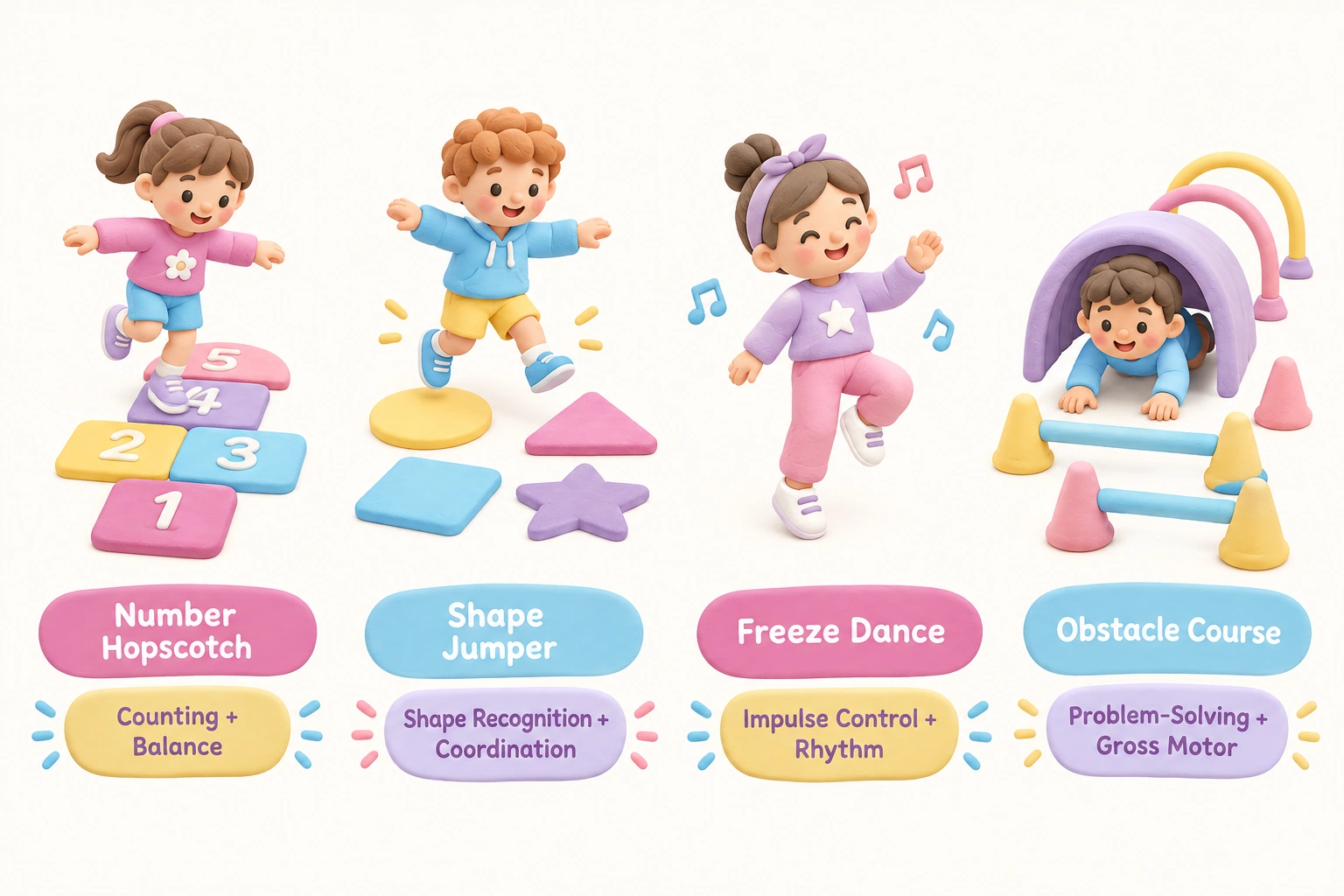
One of the most underused insights in early childhood education is that movement and academic learning are not separate categories for 3-year-olds. Gross motor development and cognitive skill-building can happen simultaneously, and indoor movement games are particularly valuable on days when outdoor play is not possible. The WHO recommends at least 180 minutes of physical activity per day for children aged 3 to 4, spread across the day — making movement games a practical and developmentally important part of any routine.
Number Hopscotch
Number hopscotch uses tape or chalk to create a hopscotch grid with numbers in each square. As children jump from square to square, they practice number recognition and counting while developing gross motor coordination, balance, and spatial awareness. Calling out numbers for the child to jump to adds a listening and comprehension layer. This is one of the clearest examples of a game that builds both gross motor skills and early math skills at the same time.
Shape Jumper
Shape jumper involves taping large shapes — circle, square, triangle, rectangle — onto the floor and calling out shape names for the child to jump to. It builds shape recognition and color sorting (if shapes are different colors) while requiring the whole-body movement that supports gross motor development. It can be played indoors with minimal materials.
Simon Says
Simon Says is one of the most developmentally rich games for 3-year-olds because it simultaneously builds listening comprehension, body awareness, impulse control, and the early executive function skill of following conditional rules. Keeping instructions simple — “Simon says touch your knees,” “Simon says jump twice” — makes it accessible and genuinely fun at this age.
Freeze Dance
Freeze dance — dancing to music and stopping when the music pauses — builds gross motor coordination, rhythm awareness, and impulse control. It functions as an effective brain break between quieter activities and requires no materials beyond a music source. For 3-year-olds, the stopping-on-cue element is a meaningful self-regulation challenge.
Obstacle Courses
Indoor obstacle courses built from cushions, rolled towels, hula hoops, and tape lines on the floor support gross motor development across multiple movement patterns: crawling, jumping, balancing, and stepping. Adding a simple counting or color element — “jump over the blue cushion, crawl through the hoop” — integrates early academic skills into physical play. Obstacle courses also support problem-solving as children figure out how to navigate each section.
Screen-Free Learning Games and DIY Activities
Screen-free learning does not require expensive materials. Many of the most effective preschool learning games for 3-year-olds use everyday household objects and take only a few minutes to set up. These activities support sensory play, fine motor skills, and early academic concepts without any screen time at all.
- Magnetic letters on the fridge: Placing magnetic letters at a child’s eye level and naming them during everyday moments — cooking, tidying — builds letter recognition through repeated, low-pressure exposure.
- Color sorting with household objects: Sorting socks, blocks, or small toys by color into bowls or containers builds color recognition and the early categorization skills that underpin later math and science thinking.
- Playdough letter stamping: Rolling playdough flat and pressing letter stamps or cookie cutters into it combines fine motor skill practice with letter recognition in a sensory play format.
- Memory card matching: Simple matching games with animal or shape pairs build visual memory, concentration, and turn-taking. Homemade versions using index cards with drawn or sticker images work just as well as commercial sets.
- Nature walk bingo: A simple bingo card with pictures of things to spot outdoors — a leaf, a bird, a puddle, a flower — combines gross motor activity, language development, and early observation skills in a screen-free format.
- Snack sorting: Sorting crackers, cereal pieces, or fruit by shape or color before eating them is a low-effort activity that builds categorization skills and one-to-one correspondence in a context children find genuinely motivating.
Supporting the Transition from Parallel Play to Cooperative Play
One developmental shift that is easy to overlook when choosing learning games for 3-year-olds is the transition from parallel play to cooperative play. At age 2, most children play alongside others without truly interacting. By age 3 and 4, children begin to play with others — negotiating roles, sharing materials, and following shared rules. This transition is gradual and uneven; a child may cooperate well in one context and revert to parallel play in another.
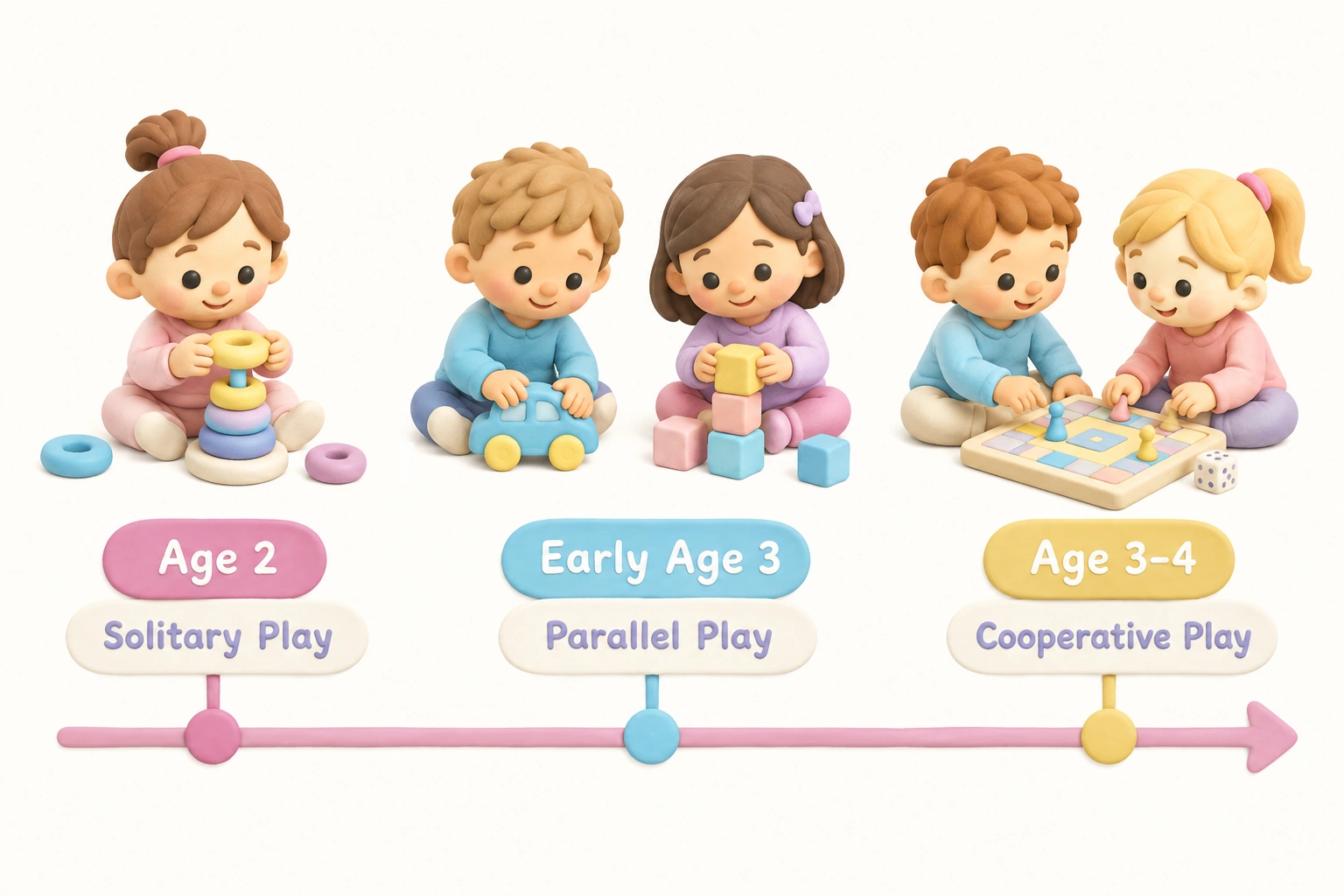
Games that support this transition are those with very simple shared goals, minimal competition, and short enough play times that frustration does not build. Cooperative board games like First Orchard and Count Your Chickens are specifically designed for this purpose. Movement games like Simon Says and freeze dance also support cooperative play because they require children to respond to the same cues at the same time, creating a shared experience without direct competition. When a 3-year-old struggles with turn-taking or sharing during a game, this is developmentally normal — not a sign that the game is wrong for them. Consistent, patient practice with simple cooperative formats is what gradually builds these social-emotional skills.
When to Be Attentive to Developmental Progress
Learning games can be a useful window into a child’s developmental progress. If a 3-year-old consistently shows no interest in any form of play with others, has significant difficulty following even the simplest one-step instructions, or appears to be losing skills they previously had — such as words they used to say or games they used to enjoy — these are worth discussing with a pediatrician or early childhood specialist. This is not a cause for alarm in most cases, but early support, when needed, is most effective when sought early. Learning games are not a diagnostic tool, and a child’s engagement with or disinterest in a particular game does not indicate a developmental problem on its own.
Frequently Asked Questions
What skills should a 3-year-old be developing through play?
At age 3, children are typically working on letter recognition, early counting and number sense, shape and color sorting, fine motor skills such as holding a crayon or manipulating puzzle pieces, gross motor skills including jumping and balancing, and the early stages of cooperative play including turn-taking and following simple rules. Play that targets any of these areas — whether through apps, board games, or movement activities — can support developmental progress.
How much screen time is appropriate for a 3-year-old?
Current guidance from the American Academy of Pediatrics emphasizes content quality and caregiver involvement over rigid time limits, though most guidance suggests keeping recreational screen time to around one hour or less per day for children aged 2 to 5. Interactive, ad-free apps used with a caregiver present are generally considered more beneficial than passive video viewing. Screen time should not replace sleep, physical activity, or face-to-face interaction.
What are the best free learning apps for 3-year-olds?
Khan Academy Kids and PBS Kids Games are two of the most widely recommended free, ad-free options for 3-year-olds. Breathe, Think, Do with Sesame is also free and focuses specifically on emotional regulation. These apps cover a range of first skills including letter recognition, early math, and social-emotional learning without requiring a subscription.
Are cooperative games better than competitive games for 3-year-olds?
For most 3-year-olds, cooperative games — where all players work toward a shared goal — tend to be more developmentally appropriate than competitive games. This is because emotional regulation around winning and losing is still developing at this age, and competitive games can lead to frustration that ends the play session before any learning benefit is gained. Cooperative games like First Orchard and Count Your Chickens build turn-taking and rule-following without the emotional difficulty of direct competition.
Can movement games really help with academic skills?
Yes, and this is one of the most practical insights for parents of 3-year-olds. Activities like number hopscotch build counting and gross motor coordination simultaneously. Shape jumper builds shape recognition while supporting whole-body movement. Simon Says builds listening comprehension and impulse control. Combining physical activity with early academic concepts is not only possible but often more engaging for children this age than seated learning activities.
What if my 3-year-old doesn’t want to follow the rules of a game?
This is developmentally normal, particularly for younger 3-year-olds. The “almost game” approach — allowing a child to explore game materials freely without enforcing rules — is a valid and useful starting point. Introducing one rule at a time, keeping sessions short, and following the child’s lead on when to add more structure tends to work better than insisting on full rule compliance before the child is ready.
Choosing Learning Games That Fit Your 3-Year-Old Right Now
The most effective learning games for 3-year-olds are not necessarily the most elaborate or the most expensive. They are the ones that match where your child actually is developmentally, hold their attention long enough to be useful, and leave room for caregiver involvement — whether that means sitting beside them during an app session, taking turns in a board game, or joining an obstacle course. A mix of digital and screen-free experiences, movement and quiet play, structured games and open-ended exploration, tends to serve this age group better than any single format.
If you are starting out, a free ad-free app like Khan Academy Kids alongside a cooperative board game like First Orchard and a simple movement game like number hopscotch covers the main developmental domains — literacy, math, gross motor, and cooperative play — without significant cost or complexity. As your child’s skills and attention span grow, the range of age-appropriate games available to them will expand naturally. The goal at age 3 is not to accelerate development but to support it — through play that is genuinely enjoyable, appropriately challenging, and rich in the kind of interaction that helps young children learn best.

Take a short quiz to find out what your everyday choices say about your parenting style
When your child is curious about something new, what’s your instinct?
Take a short quiz to find out what your everyday choices say about your parenting style
“Can I download this app?” What happens next?
Take a short quiz to find out what your everyday choices say about your parenting style
When it comes to rules at home, which sounds most like you?
Take a short quiz to find out what your everyday choices say about your parenting style
If you could give your child one life skill today, what would you pick?
Take a short quiz to find out what your everyday choices say about your parenting style
Your child gets to choose what to watch. What would your ideal setup look like?
Take a short quiz to find out what your everyday choices say about your parenting style
Pick your parenting superpower ✨