12 Best Counting Games for Kindergarten: Classroom and Digital Picks

 Discover a Free Education Video App for Kids
Pastory uses AI to personalize educational video content based on your child’s interests and personality. Safe, engaging, and built for curious young minds. Sign up now to stay updated and enjoy early access with a free trial
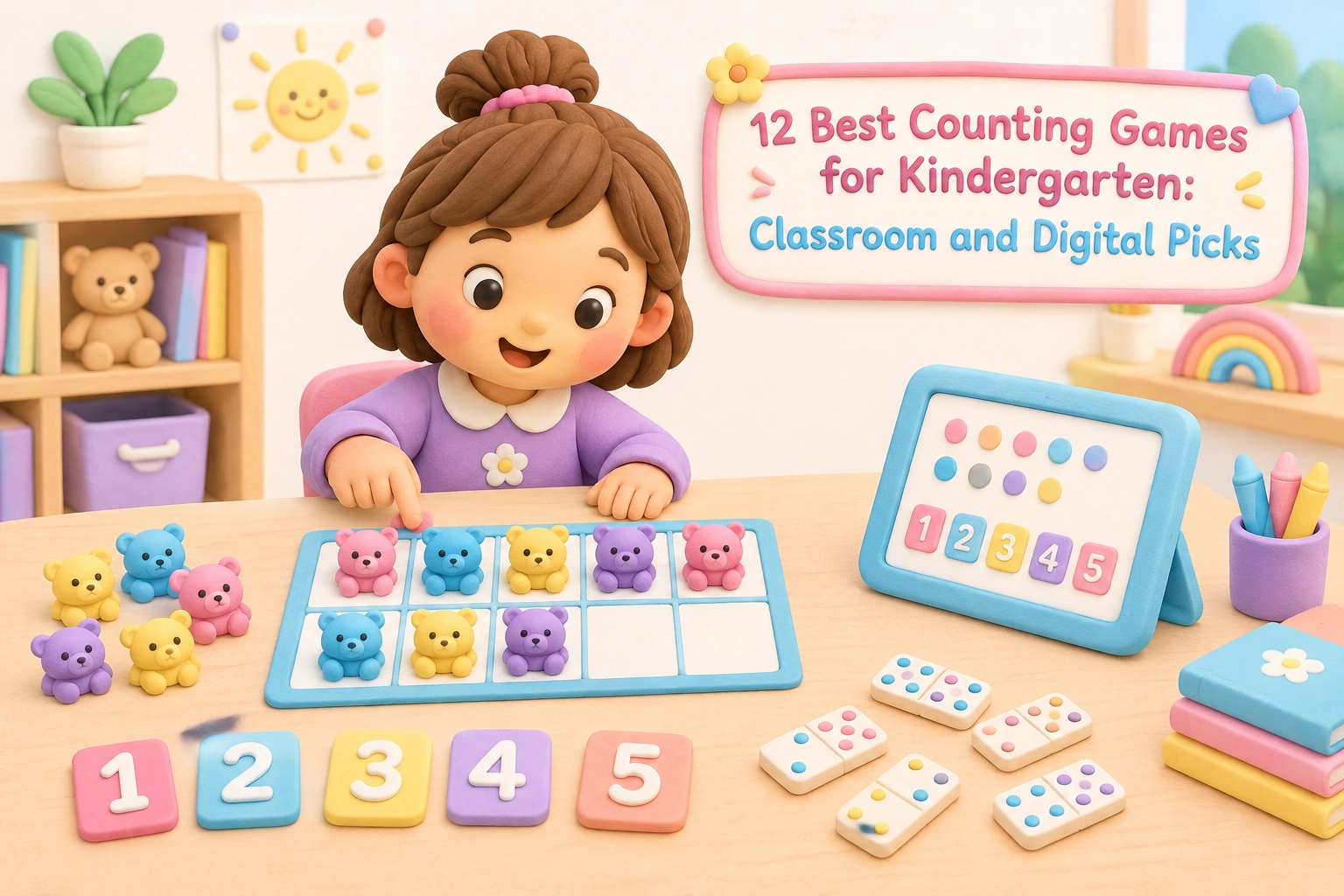
Counting games for kindergarten do more than keep five-year-olds busy — they build the foundational math skills that underpin arithmetic, problem-solving, and even early algebra. This guide covers 12 carefully chosen games, split between hands-on classroom activities and digital tools, with notes on the specific skills each one targets, how to adapt them for different learners, and how to balance screen-based and screen-free play.
Key Takeaways
- Effective counting games for kindergarten target specific skills: one-to-one correspondence, cardinality, subitizing, rote counting, and skip counting — not just reciting numbers aloud.
- Hands-on counting activities using physical manipulatives tend to build deeper conceptual understanding than passive digital exposure alone.
- High-quality digital tools can reinforce classroom learning when used interactively and in short, purposeful sessions rather than as open-ended screen time.
- Mixing physical and digital games helps maintain engagement while keeping total screen time within age-appropriate limits recommended by pediatric health organizations.
- Adapting games for struggling and advanced learners — rather than using a one-size-fits-all approach — produces more consistent developmental progress.
Why Counting Games Matter for Kindergarten Math Development
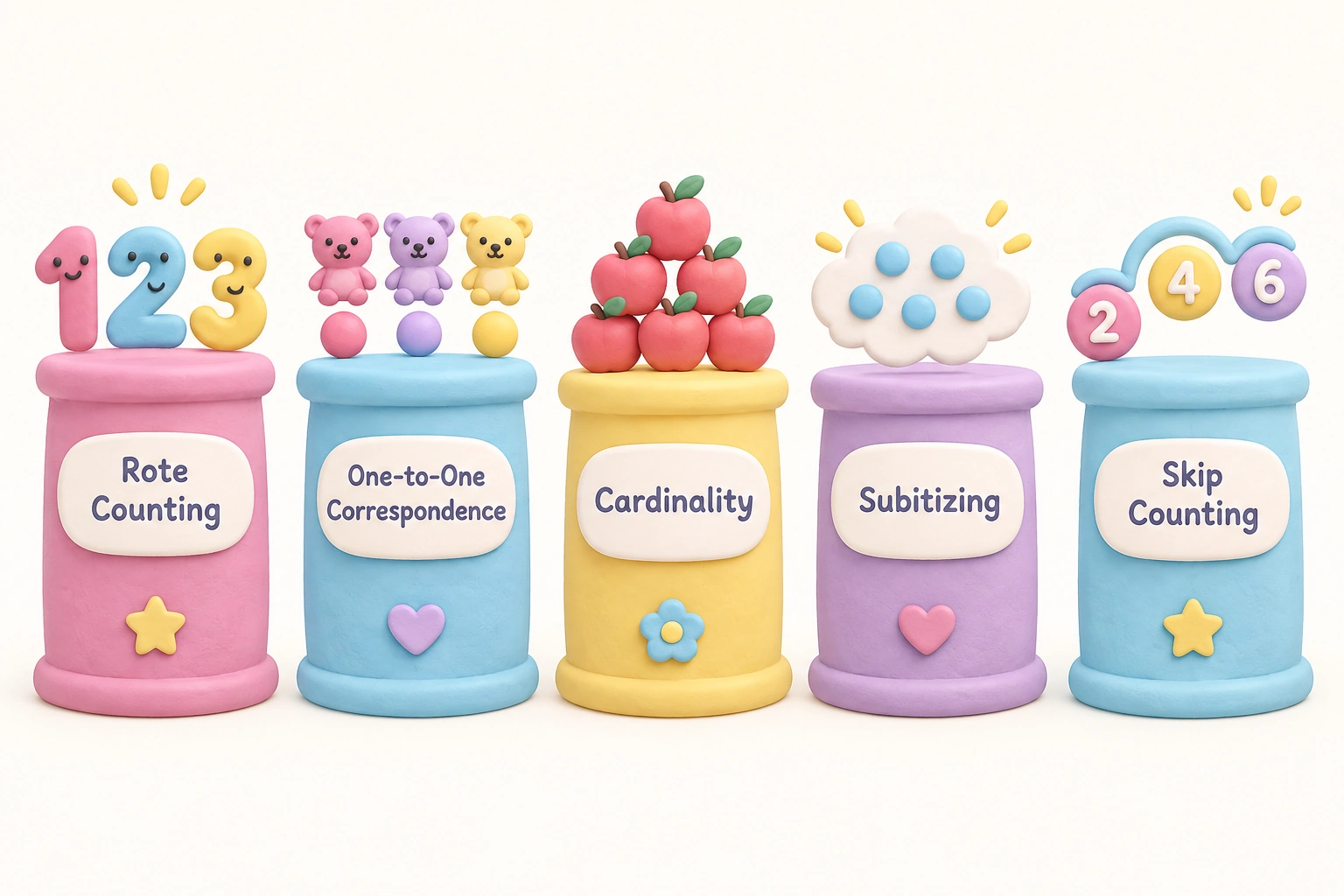
Kindergarten counting is not simply about reciting numbers in order. Developmental research identifies several distinct skills that children must build simultaneously: rote counting (saying numbers in sequence), one-to-one correspondence (matching one number word to one object), cardinality (understanding that the last number counted tells you the total), and subitizing (instantly recognizing small quantities without counting). A child who can count to 20 aloud but cannot tell you how many objects are in a group of five has rote counting without cardinality — a gap that well-designed games can help close.
Game-based learning is particularly well-suited to early math because it creates low-stakes repetition. Children practice counting objects, matching quantities to numerals, and counting forward from a given number many more times during a game than they would in a worksheet exercise — and they do so willingly. Research published in early childhood education journals consistently finds that structured number games, especially those involving a number line or board-game format, are associated with stronger number sense gains compared with drill-based practice alone. Outcomes vary by child, caregiver involvement, and how consistently games are used, but the evidence base for game-based learning in early math is among the stronger ones in the field.
How to Choose the Right Counting Game
Before selecting a game, it helps to identify which specific skill gap you are targeting. The table below summarizes the key selection criteria for both classroom and home use.
| Criterion | What to look for |
|---|---|
| Skill focus | Does the game target the specific skill your child needs — rote counting, cardinality, subitizing, or skip counting? |
| Number range | Is the range appropriate — counting objects within 10, within 20, or counting to 100? |
| Group size | Is it designed for individual, partner, small-group, or whole-class play? |
| Prep time | Does it require significant setup, or can it be used immediately at math centers? |
| Differentiation | Can the range or rules be adjusted for struggling or advanced learners? |
| Screen time | Is it physical, digital, or hybrid? How long is a typical session? |
| Cost | Is it free, low-cost, or subscription-based? |
6 Hands-On Counting Games for the Classroom
Physical, manipulative-based games give children the tactile experience of handling objects, which supports the development of one-to-one correspondence more concretely than screen taps alone. Each game below is mapped to the Common Core kindergarten counting and cardinality standards (K.CC) where relevant, though standards vary by region and curriculum.
1. Counting Bears Sorting and Graphing
Counting bears — small plastic bears in multiple colors — are among the most versatile counting manipulatives in early childhood classrooms. Children sort bears by color into muffin tin cups, count each group, and record totals. This activity directly targets one-to-one correspondence (K.CC.B.4) and cardinality (K.CC.B.5), and the sorting element introduces early data concepts aligned with K.MD.B.3. For struggling learners, limit the set to five bears per color. For advanced students, ask them to compare groups and identify which has more or fewer, extending into early number sense and relative quantity.
2. Ten Frame Bingo
Ten frame bingo combines the familiar bingo format with the visual structure of a ten frame — a two-by-five grid used to represent numbers up to ten. Each player receives a bingo card showing ten frames filled with dots in different arrangements. The caller draws a numeral card and players find the matching ten frame on their board. This game builds subitizing (recognizing quantities without counting individual dots) and number recognition simultaneously. It works well as a whole-class warm-up or in small math centers groups. A free printable version is straightforward to create, making it a low-cost option for classrooms and homeschool families alike.
3. Hopscotch Counting
Outdoor or hallway hopscotch grids numbered 1–10 or 1–20 give children a physical, full-body experience of the number sequence. Children hop forward while counting aloud (rote counting and counting forward from a given number, K.CC.A.1 and K.CC.A.2), and can hop backward to practice counting backward — a skill that supports later subtraction understanding. Variations include skip counting by 2s or 5s using colored chalk squares, which introduces the concept without requiring formal instruction. The gross motor element makes this particularly useful for children who struggle to stay engaged at a table.
4. Count and Clip Cards
Clip cards are printable cards showing a set of objects on one side and three numeral choices along the bottom. Children count the objects and clip a clothespin to the correct numeral. This format targets counting objects within 20, number recognition, and cardinality, while the act of clipping also develops fine motor skills — a meaningful secondary benefit for kindergarteners still building hand strength. Clip cards are easy to differentiate: use cards with quantities 1–5 for children who need more support, and cards with quantities 11–20 or missing-number sequences for those who are ready to extend. Printable sets are widely available at low or no cost.
5. Domino Number Match
Standard dominoes or oversized foam dominoes work well for kindergarten math centers. Children match the dot pattern on each domino half to a numeral card, or sort dominoes by total dot count. The dot arrangements on dominoes are a natural subitizing tool — children who practice with dominoes regularly often develop faster quantity recognition. Domino math also introduces the concept that the same quantity can be represented in different arrangements, which is a foundational insight for later addition. This game requires no prep beyond gathering the dominoes and numeral cards, making it a reliable center-time staple.
6. Counting Collections
Counting collections is a structured classroom routine rather than a packaged game, but it is one of the most research-supported hands-on counting activities available. Each child or pair receives a bag of small objects — buttons, pebbles, snap cubes, or pom-poms — and the task is to count the collection, organize it into groups, and record the total. The open-ended nature means every child works at their own level: one child might count a collection of eight while another organizes a collection of 47 into groups of ten, building early place value understanding. Teachers can use counting collections as a progress tracking tool by observing the strategies children use over time.
6 Digital Counting Games for Kindergarten
Digital tools can reinforce counting skills through interactive, adaptive learning experiences — but the quality of the tool matters enormously. The best digital counting games for kindergarten are interactive (requiring the child to make decisions, drag objects, or respond to prompts) rather than passive (watching animations without engagement). Short, purposeful sessions of 10–15 minutes tend to be more effective than extended open-ended screen time. The American Academy of Pediatrics recommends that screen time for children aged 2–5 be limited and that caregivers co-view or co-play where possible; for children aged 6 and older, consistent limits on time and content type remain advisable.
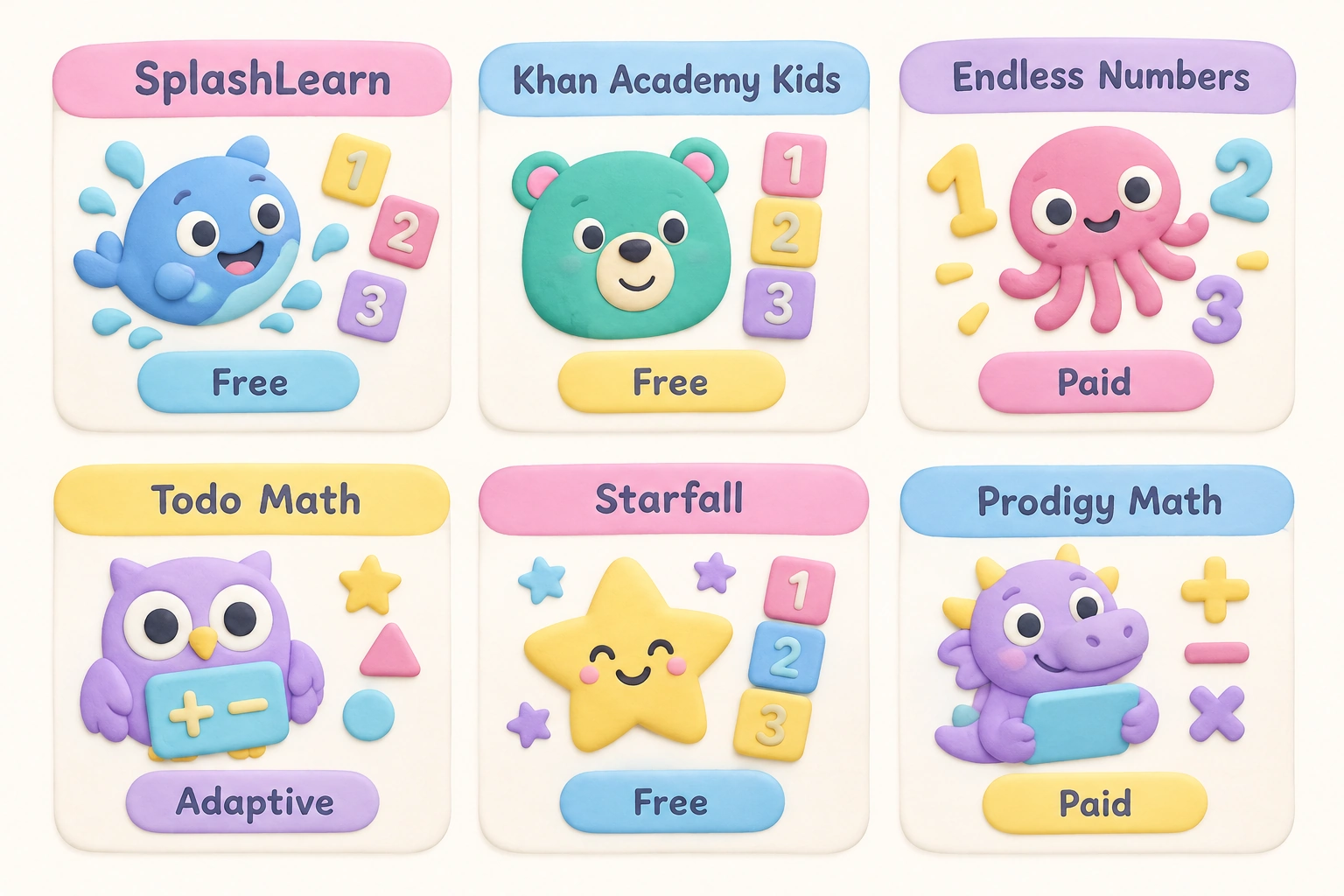
| App / Platform | Best for | Skill focus | Platform | Free tier? | Adaptive learning? |
|---|---|---|---|---|---|
| SplashLearn | Classroom and home use | Counting objects, number recognition, skip counting | iOS, Android, web | Yes (limited) | Yes |
| Khan Academy Kids | Home use, homeschool | Counting 1–10, one-to-one correspondence, number sense | iOS, Android | Fully free | Partial |
| Endless Numbers | Number recognition, subitizing | Number recognition, quantity association | iOS, Android | Limited (paid) | No |
| Todo Math | Math centers, differentiation | Counting, cardinality, skip counting | iOS, Android | Yes (limited) | Yes |
| Starfall | Free browser-based use | Rote counting, number recognition | Web, iOS | Yes (substantial) | No |
| Prodigy Math | Older kindergarteners, early Grade 1 | Number sense, counting on, early operations | Web, iOS, Android | Yes (limited) | Yes |
7. SplashLearn
SplashLearn offers a structured sequence of counting games for kindergarten that aligns with Common Core standards, including activities targeting counting objects within 20, ten frame recognition, and skip counting by 2s, 5s, and 10s. The platform uses adaptive learning to adjust difficulty based on a child’s responses, which means a child who masters counting to 10 quickly will be moved toward counting to 20 without waiting for the rest of a class. Teachers can access progress tracking dashboards, making SplashLearn a practical tool for math centers as well as home practice. The free tier provides access to a meaningful subset of activities; a paid subscription unlocks the full library.
8. Khan Academy Kids
Khan Academy Kids is fully free and covers early counting skills through a mix of interactive stories, games, and guided exercises. The counting activities focus on one-to-one correspondence, counting objects within 10, and basic number recognition — skills that align with the early kindergarten curriculum. The app does not use aggressive engagement mechanics such as streaks or reward loops, which makes it a lower-risk choice for families concerned about screen time habits. Caregiver involvement is encouraged through a parent dashboard that shows completed activities, though the adaptive learning component is less sophisticated than some paid alternatives.
9. Endless Numbers
Endless Numbers by Originator focuses specifically on number recognition and quantity association rather than sequential counting. Each number is introduced through an animated character and a set of objects that children drag into place, reinforcing the connection between a numeral and its quantity. The app is particularly effective for building subitizing skills and for children who are visual or kinesthetic learners. The base app covers numbers 1–5 free of charge; additional number packs require a one-time purchase. Endless Numbers does not include adaptive learning or progress tracking, so it works best as a supplementary tool rather than a primary counting curriculum.
10. Todo Math
Todo Math is designed with classroom differentiation in mind, offering over 2,000 activities across multiple skill levels. For kindergarten counting, the relevant modules cover counting forward from a given number, counting backward, cardinality, and introductory skip counting. The app’s multi-player mode allows two children to work together on the same device, which introduces a collaborative element that purely solo digital games lack. Teachers using Todo Math in math centers can assign specific activity sets to individual students, making it one of the more flexible digital tools for mixed-ability kindergarten classrooms. A free trial is available; full access requires a subscription.
11. Starfall
Starfall’s math section offers browser-based counting games that require no download or account, making it one of the most accessible free options for classrooms with Chromebooks or shared devices. The counting activities are straightforward: children count objects on screen, match numerals to quantities, and practice rote counting sequences. The interface is simple and low-stimulation compared with many app-based tools, which can be an advantage for children who are easily distracted by complex animations. Starfall does not offer adaptive learning or progress tracking, so it is best used as a warm-up or independent practice tool rather than a primary assessment resource.
12. Prodigy Math
Prodigy Math uses a role-playing game format in which children answer math questions to progress through an adventure. For kindergarteners at the upper end of the skill range, Prodigy covers counting on from a given number, number recognition, and early addition — skills that bridge kindergarten and Grade 1 expectations. The game-based learning format is highly engaging, and the free tier provides access to the core gameplay. Parents and teachers should be aware that Prodigy’s in-game economy includes optional paid memberships that unlock cosmetic items; the math content itself remains accessible without payment. Progress tracking is available through a teacher or parent dashboard.
Balancing Digital and Physical Counting Games
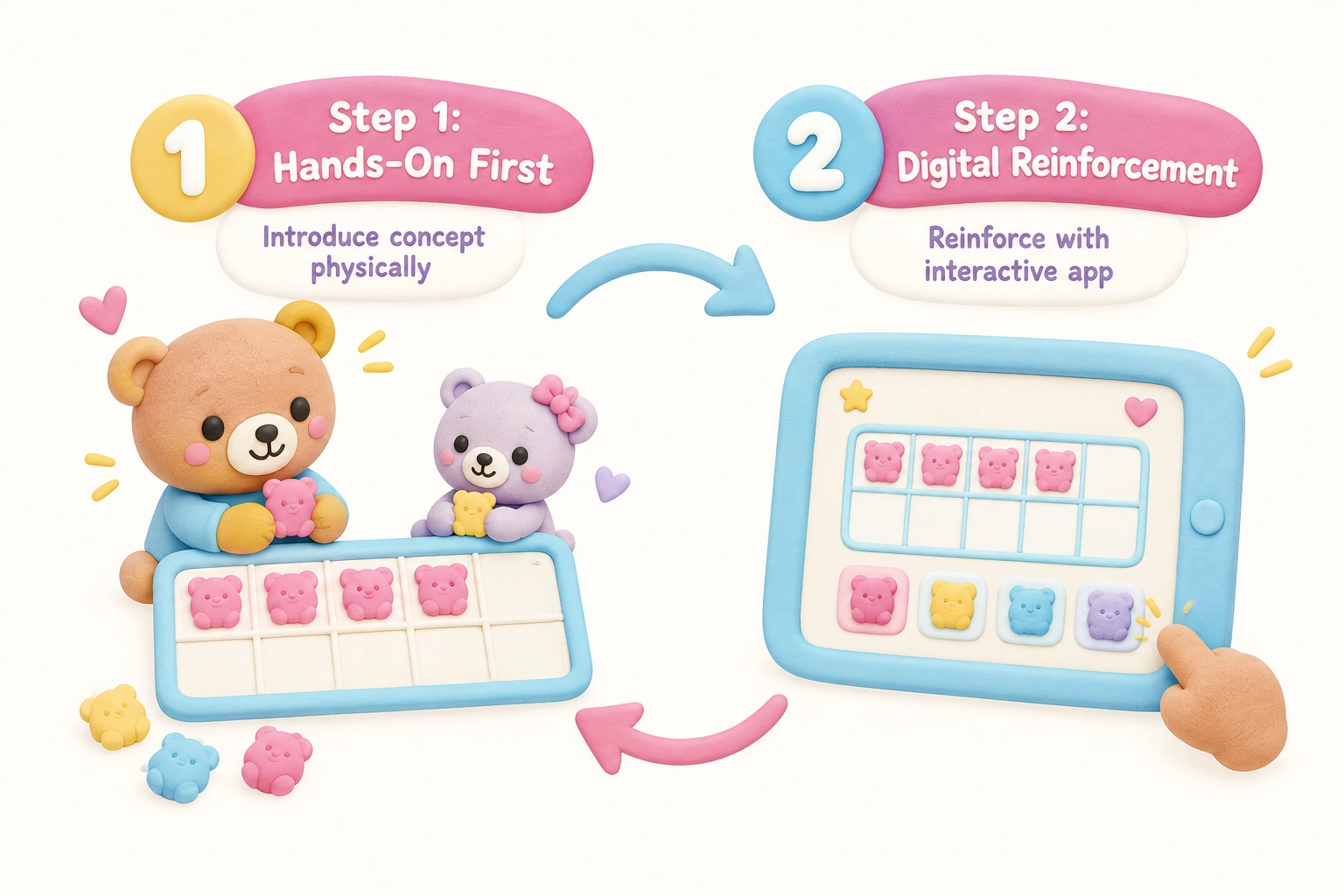
One gap in most counting game resource lists is practical guidance on how to blend digital and physical approaches without over-relying on screens. A useful framework is to treat digital counting games as reinforcement tools rather than primary instruction. Introduce a new counting concept — say, skip counting by 5s — through a physical activity such as hopscotch or counting bears first, then use a digital game to provide additional repetition once the concept has been introduced concretely. This sequence aligns with how early childhood educators typically structure math centers: hands-on exploration first, followed by practice in varied formats.
For home use, a reasonable approach is to alternate sessions: one day of physical counting activities (clip cards, domino math, counting collections) followed by one day of a digital game. This keeps total screen time manageable while maintaining the variety that sustains kindergarten-age engagement. If a child is using a digital counting game independently, check in periodically to ask what they counted or what number came next — brief conversational involvement from a caregiver meaningfully increases the learning value of digital tools.
Adapting Counting Games for Different Learners
Differentiation is one of the most underserved topics in counting game guides. Most lists present games as fixed activities, but nearly every game on this list can be adjusted for children who need more support or more challenge.
- For children who are still developing one-to-one correspondence: Reduce the number range to 1–5, use large physical objects that are easy to touch and move, and slow down the counting pace. Counting bears in muffin tins and clip cards with small quantities work well at this level.
- For children who have mastered counting to 10: Extend the range to counting objects within 20, introduce ten frames with numbers 11–20, or begin skip counting by 2s using hopscotch or a number line.
- For children who are ready for more challenge: Introduce counting collections with larger quantities, ask children to organize objects into groups of ten, or use Prodigy Math to bridge toward early addition and counting on strategies.
- For children with fine motor challenges: Prioritize digital drag-and-drop games or large-format physical games (oversized dominoes, floor hopscotch) over activities requiring precise pincer grip such as clip cards.
Frequently Asked Questions
What is the difference between rote counting and rational counting?
Rote counting means reciting numbers in sequence — “one, two, three, four, five” — without necessarily connecting each number to an object. Rational counting (sometimes called meaningful counting) means applying that sequence accurately to a set of objects, assigning one number word to each object and stopping at the correct total. Many kindergarteners can rote count to 20 before they can reliably count a set of 12 objects. Games that require children to physically touch or move objects as they count — such as counting bears or counting collections — specifically target rational counting rather than rote recitation.
How often should kindergarteners practice counting games?
Short, frequent practice tends to be more effective than occasional long sessions. Ten to fifteen minutes of counting game practice four or five days per week is a reasonable target for most kindergarteners. In classroom settings, math centers typically run for 15–20 minutes and rotate every few days to maintain novelty. At home, even five minutes of a counting game during a natural transition — before dinner or after school — can contribute meaningfully to skill development over time.
At what age should children be able to count to 20?
Most kindergarteners (typically ages 5–6) are working toward counting to 20 by ones and counting to 100 by tens, which aligns with Common Core standard K.CC.A.1. However, developmental timelines vary considerably. Some children arrive at kindergarten already counting confidently to 30 or beyond, while others are still consolidating counting to 10. Games that allow children to work at their own pace — such as counting collections or adaptive digital tools — are better suited to mixed-ability groups than activities with a fixed number range.
Are free digital counting games as effective as paid ones?
Free tools such as Khan Academy Kids and Starfall offer genuinely useful counting practice and are appropriate for many kindergarteners. Paid or subscription-based platforms such as SplashLearn and Todo Math tend to offer more sophisticated adaptive learning, broader activity libraries, and more detailed progress tracking — features that are particularly valuable for teachers managing a whole class. For home use, free tools are often sufficient, especially when combined with physical counting activities. The quality of caregiver involvement during digital game sessions matters more than whether the app is free or paid.
Can counting games help children who are struggling with number sense?
Game-based learning can be a supportive tool for children who find formal math instruction difficult, because games reduce performance anxiety and increase the number of low-stakes practice opportunities. However, counting games are not a substitute for targeted instructional support if a child has significant difficulties with number sense or mathematical learning. If a child consistently struggles to count a small set of objects accurately after regular practice, consulting with the classroom teacher or a learning specialist is advisable.
What does subitizing mean and why does it matter?
Subitizing is the ability to instantly recognize the quantity of a small group of objects without counting them one by one. Most people can subitize quantities up to about four or five. This skill matters because it speeds up number recognition and supports later addition strategies — a child who can instantly see that a domino shows three dots and two dots can begin to understand that three and two make five without counting from one. Ten frame games, domino math, and apps like Endless Numbers all provide subitizing practice in an engaging format.
Choosing the Right Mix of Counting Games for Your Kindergartener
The most effective approach to kindergarten counting is not choosing between physical and digital games — it is using both deliberately. Hands-on counting activities with counting manipulatives, ten frames, and clip cards build the concrete understanding that makes digital practice meaningful. Digital tools then provide additional repetition, adaptive challenge, and progress tracking that would be difficult to replicate with physical materials alone. Neither approach fully replaces the other, and neither replaces the value of a caregiver or teacher who asks questions, notices errors, and adjusts the difficulty in real time.
When selecting games, prioritize skill fit over novelty. A simple domino matching game that a child plays correctly and enthusiastically three times a week will build more durable number sense than a sophisticated app used passively for twenty minutes once. Start with the specific skill your child needs — whether that is one-to-one correspondence, cardinality, subitizing, or skip counting — and choose one or two games that target that skill directly. Add variety gradually as skills develop, and revisit earlier games periodically to consolidate what has been learned. With consistent, purposeful practice, counting games can make a genuine contribution to the foundational math skills kindergarteners will rely on for years to come.

Take a short quiz to find out what your everyday choices say about your parenting style
When your child is curious about something new, what’s your instinct?
Take a short quiz to find out what your everyday choices say about your parenting style
“Can I download this app?” What happens next?
Take a short quiz to find out what your everyday choices say about your parenting style
When it comes to rules at home, which sounds most like you?
Take a short quiz to find out what your everyday choices say about your parenting style
If you could give your child one life skill today, what would you pick?
Take a short quiz to find out what your everyday choices say about your parenting style
Your child gets to choose what to watch. What would your ideal setup look like?
Take a short quiz to find out what your everyday choices say about your parenting style
Pick your parenting superpower ✨