Best Preschool Math Games: Learn Numbers Through Play

 Discover a Free Education Video App for Kids
Pastory uses AI to personalize educational video content based on your child’s interests and personality. Safe, engaging, and built for curious young minds. Sign up now to stay updated and enjoy early access with a free trial
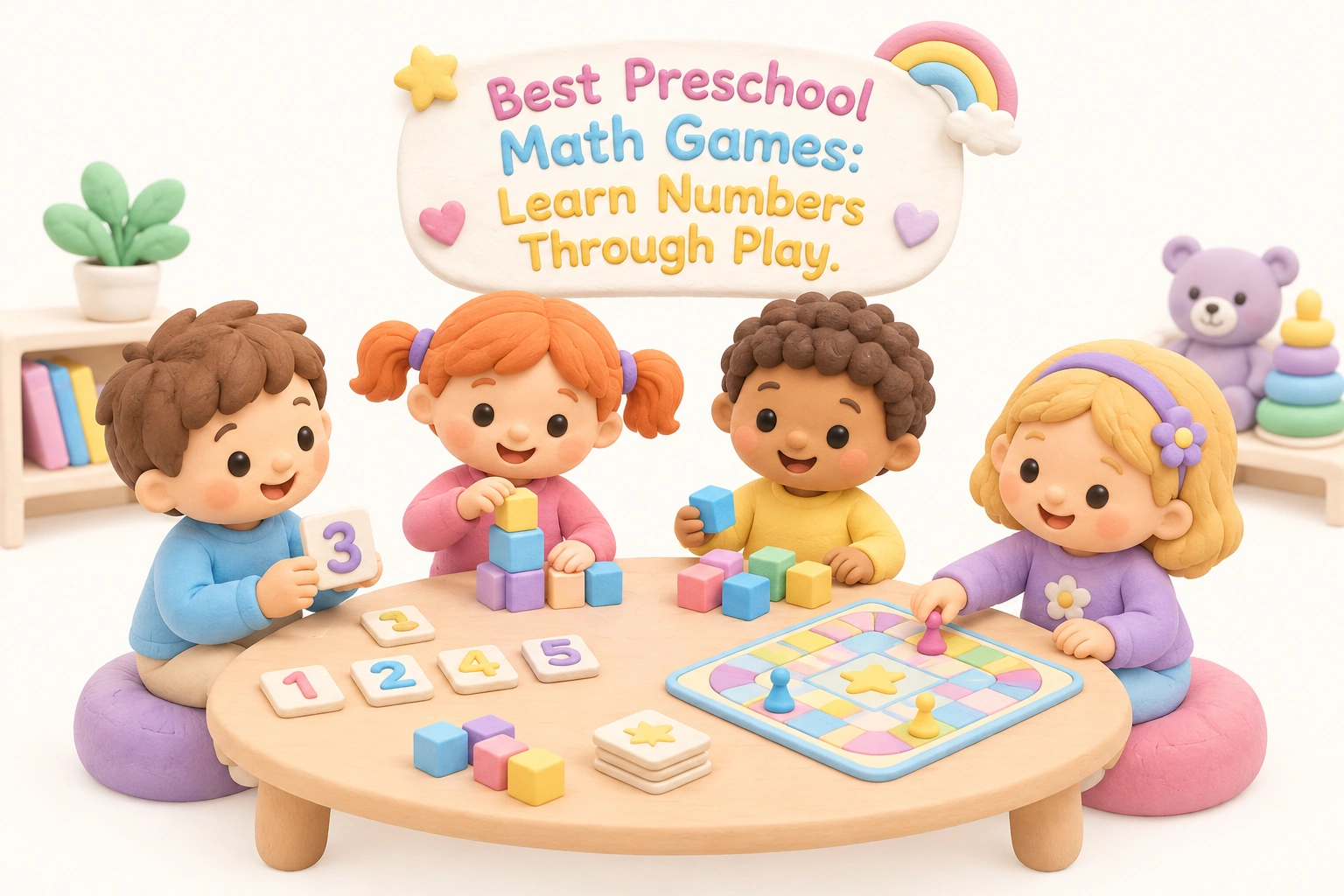
Young children are natural mathematicians long before they ever sit at a desk. They sort toys by color, count steps on the stairs, and compare who has more crackers at snack time. The most effective preschool math games work with this instinct, turning everyday play into structured opportunities to build number recognition, counting skills, and early math concepts that form the foundation for formal schooling. This guide explains which skills matter most at each age, what the research says about play-based learning, and how to choose games that genuinely support your child’s development.
Key Takeaways
- Play-based learning is one of the most effective ways for children aged 3–5 to develop early math skills, including number sense, counting, and one-to-one correspondence.
- Different game types — board games, sensory activities, outdoor games, and printable activities — each support overlapping skills and can be matched to a child’s age and stage.
- Concepts like subitizing and cardinality are rarely explained to parents but are central to preschool math development and easy to practice through simple games.
- Guided play, where an adult frames the activity but the child leads the exploration, tends to produce stronger learning outcomes than either free play or direct instruction alone.
- Connecting math games to kindergarten readiness standards helps parents and educators choose activities with lasting developmental value.
Why Play-Based Math Works: What the Research Shows
Research consistently supports the idea that young children learn mathematical concepts more effectively through play than through worksheets or rote instruction. A peer-reviewed study published in a leading developmental journal found that the amount of time preschool-aged children spent in play-based activities was a meaningful predictor of their later math performance. The National Association for the Education of Young Children (NAEYC) similarly emphasizes that hands-on math activities embedded in play allow children to construct understanding rather than simply memorize procedures.
Guided play — a specific approach where an adult sets up a mathematically rich environment and asks open-ended questions while the child directs the exploration — appears to be particularly effective. Research cited by Edutopia drawing on University of Cambridge studies found that guided play produced stronger learning gains than either free play or direct instruction alone for early numeracy skills. This matters practically: it means a parent sitting alongside a child playing a number path board game, asking “how many spaces do you think you’ll land on?”, is doing something developmentally meaningful, not just passing time.
The key insight for families is that the quality of the interaction around a game matters as much as the game itself. Math vocabulary — words like “more”, “fewer”, “before”, “after”, “equal” — absorbed during play becomes the conceptual scaffolding children use when formal math instruction begins.
Pre-K Math Milestones: What to Expect by Age
Understanding what skills are developmentally appropriate helps parents choose games that challenge without frustrating. The following milestones are broadly consistent with Head Start Early Learning Outcomes Framework guidance and widely cited developmental research, though individual children vary considerably.
| Age | Key Math Skills Emerging | Well-Matched Game Types |
|---|---|---|
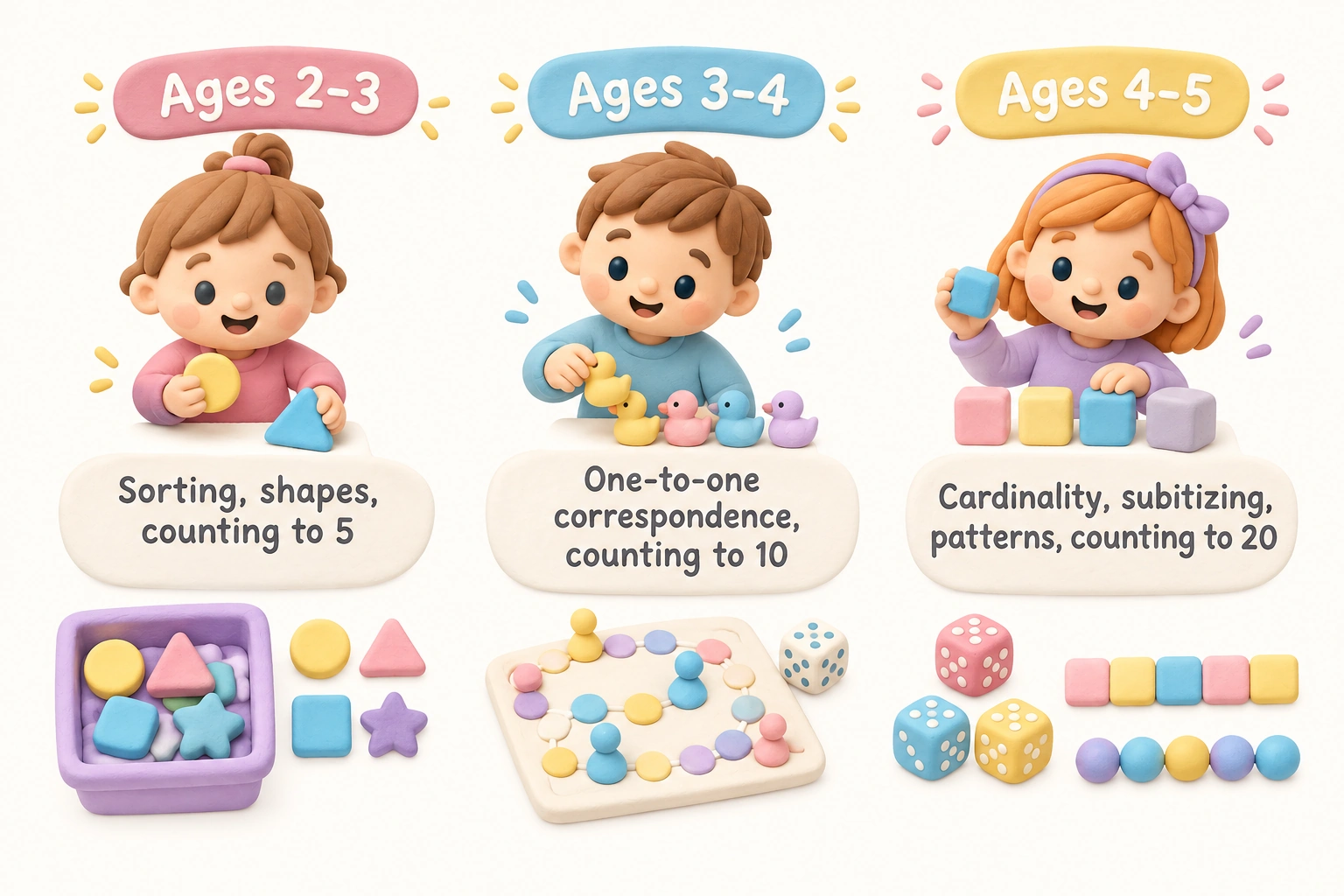
| 2–3 years | Rote counting to 5–10, sorting by one attribute (color or size), recognizing basic shapes | Sensory bins, simple sorting games, shape puzzles |
| 3–4 years | One-to-one correspondence, counting objects to 10, comparing “more” and “fewer”, naming shapes | Counting board games, number matching cards, play dough mats |
| 4–5 years | Counting to 20, cardinality, subitizing small sets, identifying simple patterns, early ordinal numbers | Dice games, ten frame activities, number path games, outdoor counting challenges |
These milestones are starting points, not strict benchmarks. A child who is not yet meeting a milestone at a given age may simply need more exposure to playful, low-pressure activities rather than formal intervention. The section on warning signs later in this article addresses when it may be worth consulting an educator or specialist.
Understanding Subitizing and Cardinality: Two Skills Parents Often Miss
Two concepts appear frequently in early childhood math research but are rarely explained on parent-facing resources. Understanding them helps you choose games more intentionally.
Subitizing is the ability to recognize a small quantity instantly, without counting. When a child looks at three dots on a die and says “three” without counting each dot, they are subitizing. This skill typically develops for quantities up to four or five and is a building block for number sense and later arithmetic. Dice games, dot card flash activities, and domino matching all support subitizing naturally.
Cardinality is the understanding that the last number counted in a sequence represents the total quantity of the set. Many young children can recite numbers in order but do not yet grasp that when they count five blocks and say “five”, that final word means “five altogether”. Games that involve counting a group of objects and then asking “so how many are there?” directly reinforce cardinality. Simple board games where children count tokens and then confirm the total are particularly useful here.
Both subitizing and cardinality are foundational to kindergarten readiness. Children who enter kindergarten with a solid grasp of these concepts tend to find early addition and subtraction more intuitive.
What Makes a Preschool Math Game Genuinely Educational?
Not every game marketed as educational actually builds meaningful math skills. Before choosing a game, it helps to apply a short set of criteria drawn from early childhood education research.
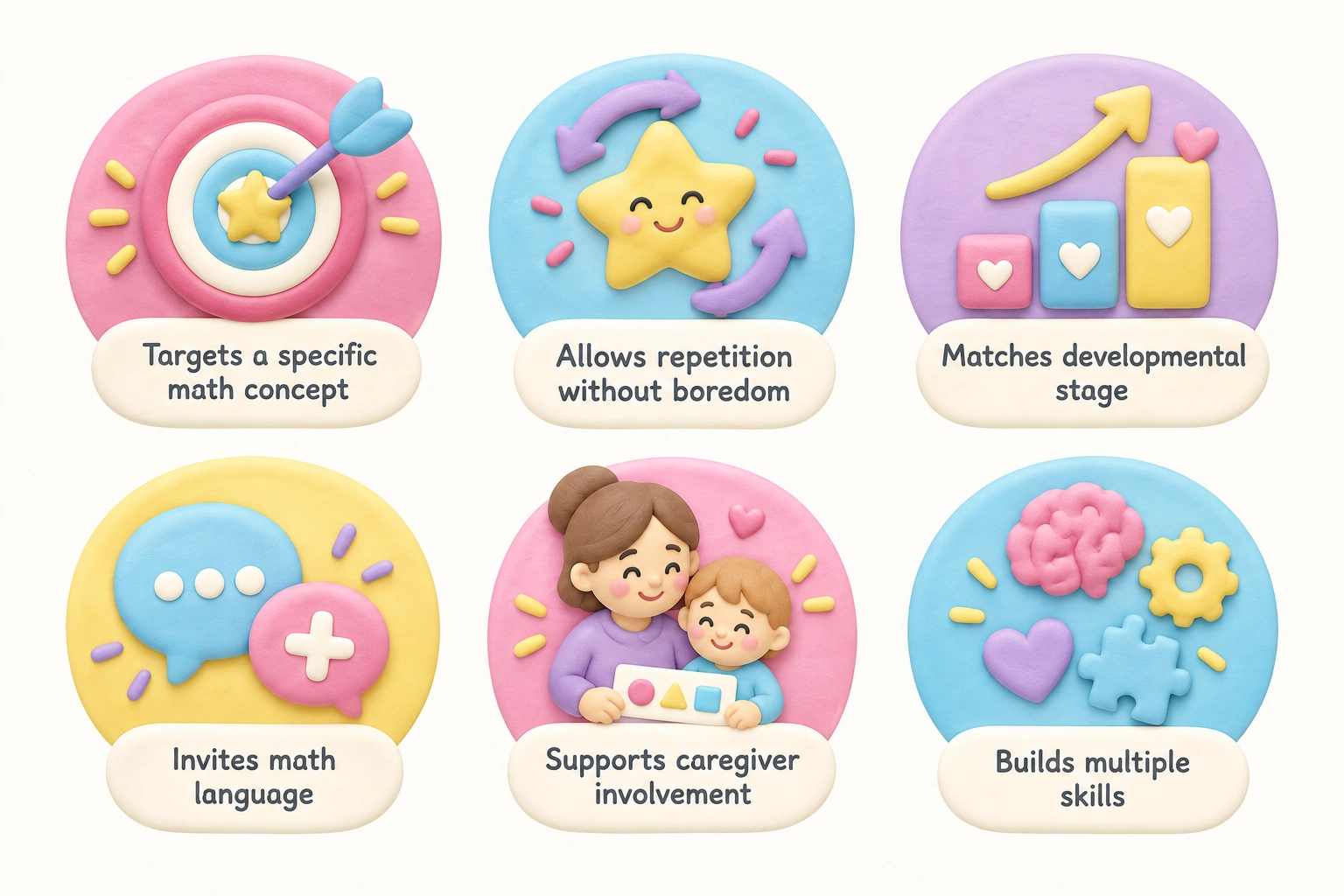
- Targets a specific math concept: The game should clearly practice counting, number recognition, sorting, patterns, or another defined skill — not just involve numbers incidentally.
- Allows repetition without boredom: Young children learn through repetition. A good math game remains engaging across multiple sessions because the outcome varies (dice rolls, card draws) even when the skill practiced stays the same.
- Matches the child’s developmental stage: A game that is too easy produces no learning; one that is too hard produces frustration. Look for games that sit just above the child’s current comfortable level.
- Invites math language: Games that naturally prompt children to say number words, compare quantities, or describe positions (first, second, last) build math vocabulary alongside procedural skills.
- Supports caregiver involvement: The best preschool math games are designed to be played with an adult or older child, not as solo activities. Co-play is where guided play and math conversation happen.
- Builds more than one skill: The strongest activities develop counting alongside fine motor skills, social turn-taking, or problem-solving simultaneously, making them more efficient uses of play time.
Hands-On Math Activities and Sensory Games
Hands-on math activities are among the most developmentally appropriate tools for preschool-aged children because they engage multiple senses and allow children to physically manipulate quantities. Math manipulatives — objects children can touch, move, and count — make abstract number concepts concrete and accessible.
Play dough number mats are a versatile example. A child rolls small balls of dough and places them on a printed mat showing a numeral and a corresponding dot pattern. This single activity builds number recognition, one-to-one correspondence, fine motor skills, and subitizing simultaneously. Mats can be made at home or downloaded as free printable math games from educational websites.
Sensory counting bins involve hiding small objects (pebbles, buttons, or toy animals) in a tray of rice or sand. Children dig, find, and count objects, then sort them by size or color. The sensory element sustains engagement longer than a paper activity, and the sorting component introduces early pattern and classification thinking.
Number tracing in shaving cream or sand combines tactile sensory play with number recognition and early writing readiness. A child traces a numeral with their finger while saying the number aloud, reinforcing the connection between the symbol and the spoken word.
These activities are particularly well-suited to children aged 2–4 and can be adapted upward by increasing the number range or adding a comparison element (“find more than three”, “sort into groups of two”).
Board Games and Card Games for Preschool Math
Structured board games and card games introduce preschoolers to rule-following, turn-taking, and mathematical thinking within a social context. Several commercially available games are well-regarded by early childhood educators for their genuine alignment with pre-k math milestones.
Number path board games — where players roll a die and move a token along a numbered track — are strongly supported by NAEYC research. Moving a token while counting spaces reinforces one-to-one correspondence, number sequence, and ordinal understanding (“I’m on space four, you’re on space seven — who is further ahead?”). The linear number path also builds an intuitive mental number line, which supports later arithmetic.
Zingo Number is a bingo-style game that builds number recognition and number matching for children aged 4 and up. Players match tiles showing numerals and dot quantities to their boards, reinforcing the connection between written numbers and quantities.
Count Your Chickens is a cooperative board game, meaning all players work together rather than competing. Cooperative formats reduce the emotional stakes of losing and encourage children to count, problem-solve, and communicate about quantities together. This makes it particularly useful for children who find competitive games frustrating.
Simple card games such as number memory (matching numeral cards to dot cards) or a preschool-adapted Go Fish using number pairs build number recognition and counting and comparison skills with minimal equipment. A standard deck of cards with face cards removed works well for children aged 4–5.
Outdoor and Movement-Based Math Games
Outdoor math games connect physical movement to number learning, which can be especially effective for children who learn best through their bodies. Movement-based activities also support gross motor development alongside school readiness skills.
Chalk number jump involves writing numerals 1–10 on a pavement or driveway and calling out a number for the child to jump to. This builds number recognition and number sequence in a high-energy format. Variations include jumping to the number that is “one more” or “one less” than the one called, introducing early addition and subtraction concepts.
Number scavenger hunts ask children to find a specific quantity of natural objects — three sticks, five leaves, two stones — and bring them back to a collection point. Counting and comparison happen naturally as children check whether they have the right amount.
Number path floor games use masking tape or chalk to create a large number line on the floor. Children hop along the path while counting aloud, or roll a large foam die and move the corresponding number of spaces. NAEYC highlights number path games specifically as a research-supported format for building number sense in young children.
Outdoor games are particularly useful for children who find sitting still for tabletop activities difficult. They also extend naturally into everyday contexts — counting steps, comparing the heights of plants, or measuring distances with footsteps.
Free Printable Math Games and Ten Frame Activities
Free printable math games offer a low-cost, flexible option for home and classroom use. When well-designed, printables can target specific skills precisely and be adapted to a child’s current level by adjusting the number range.
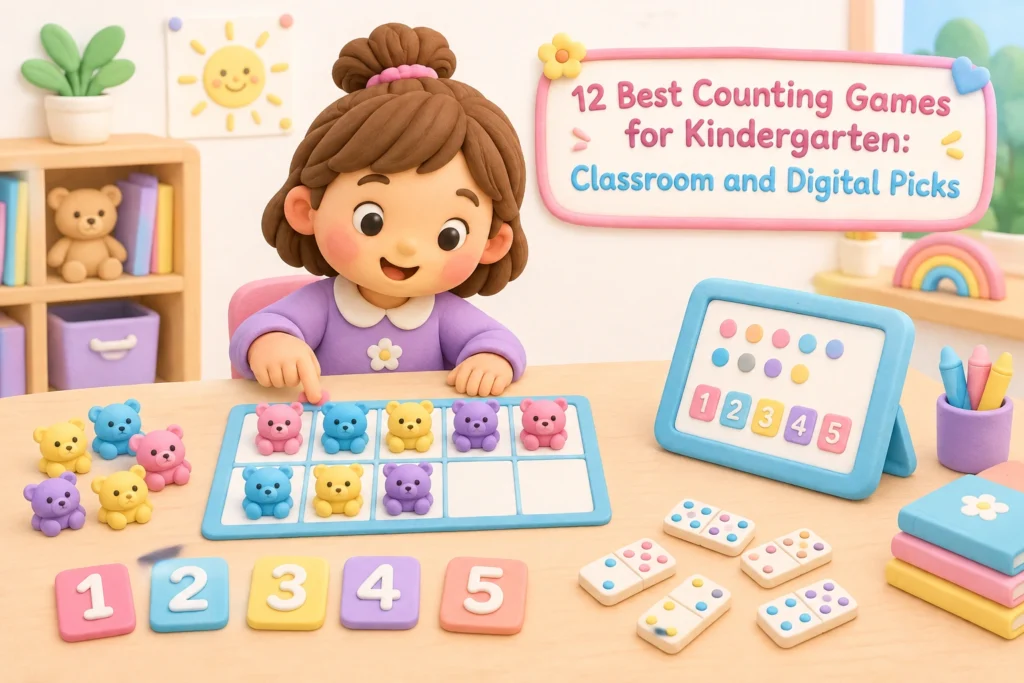
Ten frames are grids of ten boxes arranged in two rows of five. Children place counters, stickers, or drawn dots in the boxes to represent numbers, building a visual understanding of quantities up to ten and the relationship between numbers and the benchmark of five. Ten frame activities directly support subitizing and number sense and are widely used in kindergarten classrooms, making them an excellent bridge activity for children approaching school age.
Number bingo printables can be tailored to practice numeral recognition, dot-to-numeral matching, or even simple addition. The game format keeps engagement high across multiple rounds.
Number puzzles — where children match a numeral piece to a corresponding quantity piece — build number recognition and counting in a self-correcting format, meaning children can check their own work without adult intervention.
Many reputable educational websites offer free printable math games aligned to pre-k math milestones and Head Start standards. When selecting printables, look for those that include both the numeral and a visual quantity representation (dots, pictures, or ten frames) rather than numerals alone, as the visual connection is what builds genuine number sense rather than symbol memorization.
Digital and Online Math Games: Benefits and Realistic Limits
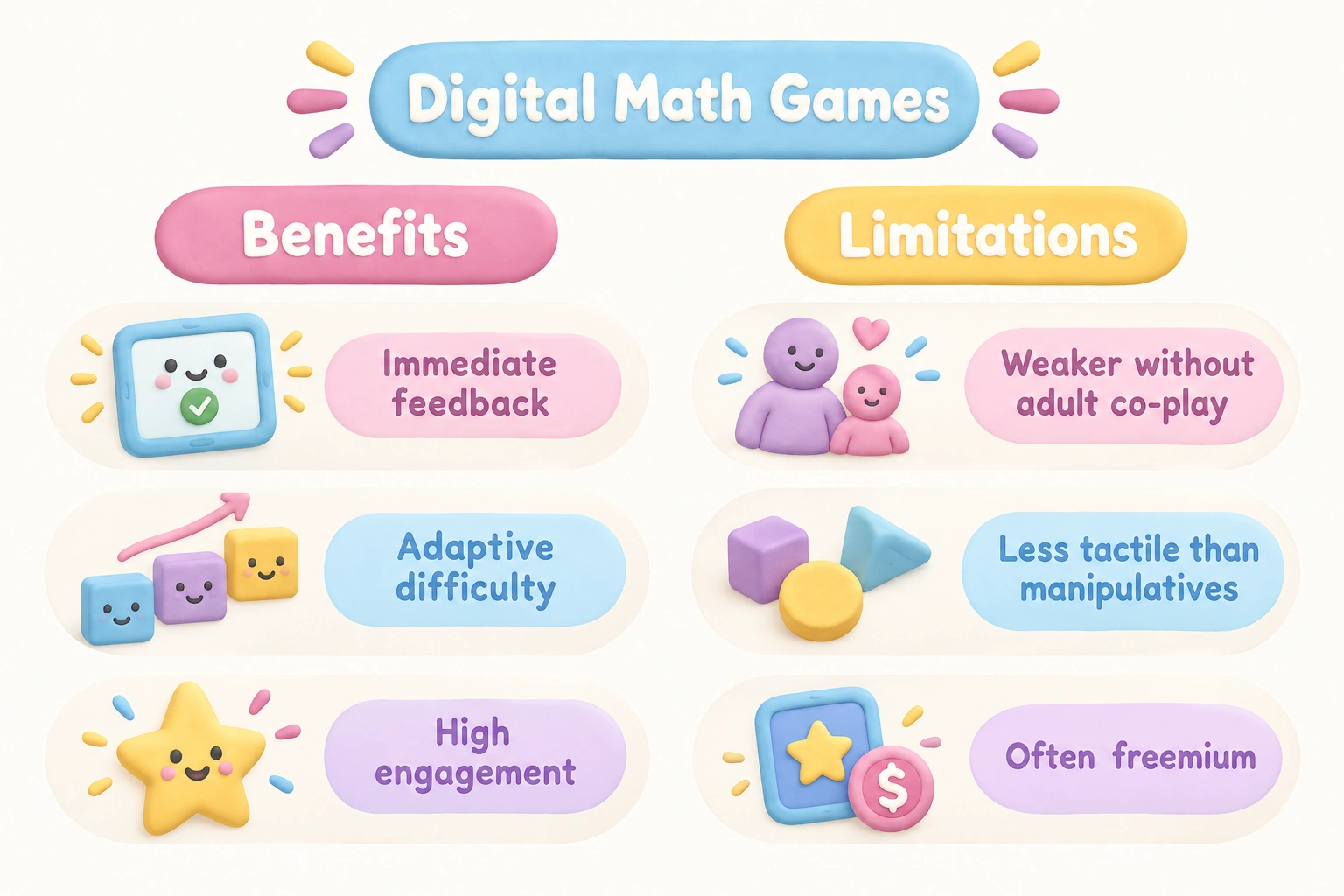
Online and app-based math games for preschoolers have grown significantly in quality and availability. Platforms such as SplashLearn, Starfall, and PBS Kids offer interactive play experiences that can reinforce counting skills, number recognition, and sorting and patterns in an engaging digital format.
The genuine benefits of well-designed digital math games include immediate feedback (the game responds instantly when a child places the correct number), adaptive difficulty (some platforms adjust the challenge level based on the child’s responses), and high visual engagement that can sustain attention for short sessions. For children who are already comfortable with touchscreen devices, digital games can extend math practice into moments when physical materials are not available.
However, several important limitations apply. The American Academy of Pediatrics (AAP) recommends that screen time for children aged 2–5 be limited and, where possible, involve co-viewing or co-play with a caregiver. Digital math games used independently, without adult interaction, tend to produce weaker learning outcomes than the same time spent in guided play with physical materials. The interactive engagement of a touchscreen game is not equivalent to the hands-on manipulation of physical math manipulatives, which engage fine motor systems and spatial reasoning more fully.
Parents should also be aware that many platforms described as free operate on a freemium model, offering limited content without a subscription. Genuinely free options include PBS Kids math games and Starfall, which provide substantive content without requiring payment. When evaluating any digital platform, look for content that is editorially curated by educators rather than purely algorithm-driven, and check whether the platform’s difficulty progression is based on developmental research or primarily on engagement metrics.
Digital math games are best treated as one component of a varied math play diet rather than a primary learning tool. A short session on a counting app followed by a hands-on activity with the same concept tends to produce better retention than either approach alone.
Everyday Math: Games Hidden in Daily Routines
Some of the most effective preschool math activities require no materials at all. Embedding counting and comparison into daily routines builds number sense continuously and helps children understand that math is part of real life, not just a school subject.
Cooking and baking offer natural opportunities for measuring, counting, and comparing quantities. Setting the table involves one-to-one correspondence (one plate per person). Bath time can involve comparing which container holds more water. Shopping trips provide authentic contexts for counting items, comparing prices in simple terms, and identifying numbers on signs and labels.
The key to making these moments mathematically productive is using precise math vocabulary. Rather than saying “put some pasta in the pot”, saying “can you count out ten pieces of pasta?” turns a routine action into a counting activity. Asking “do we have enough forks for everyone?” introduces one-to-one correspondence and early problem-solving in a meaningful context.
Tips for Parents: How to Extend and Scaffold Math Play
Guided play works best when adults know how to support without taking over. The following strategies, drawn from early childhood education research, can help parents get more developmental value from any math game.
- Ask open-ended questions: “How did you know there were four?” or “What do you think will happen if we add one more?” encourages children to articulate their thinking rather than just produce an answer.
- Use math vocabulary consistently: Words like “equal”, “more than”, “fewer than”, “first”, “last”, and “in between” build the conceptual language children need for formal math.
- Adjust difficulty gradually: If a game is too easy, increase the number range or add a comparison step. If it is too hard, reduce the range or remove one rule. Small adjustments keep the child in the productive learning zone.
- Follow the child’s interest: A child who loves dinosaurs will engage more deeply with a counting game using dinosaur figures than with abstract counters. Theming games around a child’s current interest sustains motivation.
- Step back when the child is absorbed: Guided play does not mean constant adult direction. When a child is deeply engaged and working through a problem independently, observation is often more valuable than intervention.
When to Seek Additional Support
Most variation in early math development is within the typical range and responds well to increased playful exposure. However, there are some signs that may warrant a conversation with a preschool teacher, pediatrician, or early childhood specialist.
If a child approaching age five consistently struggles to count reliably to five, shows no interest in or awareness of quantities, cannot sort objects by a single attribute such as color or size, or becomes significantly distressed by any math-related activity, it may be worth seeking a professional perspective. These observations are not diagnostic, and many children who show early difficulty with numeracy develop strong math skills with appropriate support. Early identification of any underlying difficulty — whether related to attention, processing, or specific learning differences — allows for timely, targeted help that can make a meaningful difference to school readiness.
Frequently Asked Questions
What math should a 3-year-old know?
Most 3-year-olds are developing the ability to count to five or ten by rote, recognize basic shapes, sort objects by one attribute such as color, and begin to understand “more” and “fewer”. One-to-one correspondence — understanding that each object gets one count — is typically emerging at this age. These skills vary considerably between children, and playful exposure matters more than formal instruction at this stage.
How do you teach numbers to preschoolers through play?
The most effective approach is guided play: set up a mathematically rich activity (a counting game, a sorting bin, a number path), play alongside the child, and use math vocabulary naturally during the activity. Asking questions like “how many do you have?” or “which pile has more?” builds number sense without formal teaching. Everyday routines — counting steps, measuring ingredients, setting the table — are equally valuable.
Are online math games good for preschoolers?
Well-designed digital math games can reinforce number recognition and counting skills, particularly when used in short sessions with caregiver involvement. They work best as a supplement to hands-on math activities rather than a replacement. Look for platforms with editorially curated content and clear developmental alignment. Be aware that many platforms are freemium; genuinely free options include PBS Kids and Starfall.
What is one-to-one correspondence and why does it matter?
One-to-one correspondence is the understanding that each object in a group gets exactly one count — that counting involves matching a number word to each individual item without skipping or double-counting. It is a foundational early math skill that underpins accurate counting, cardinality, and later arithmetic. Simple games involving counting physical objects, moving tokens on a board, or placing one item in each box of a ten frame all build this skill.
What is the difference between subitizing and counting?
Counting involves assigning a number word to each object in sequence. Subitizing is the instant recognition of a small quantity without counting — seeing three dots and knowing immediately it is three. Subitizing develops naturally for quantities up to about four or five and is supported by dice games, dot card activities, and domino matching. Both skills contribute to strong number sense.
How can I connect preschool math games to kindergarten readiness?
Focus on games that build the skills most commonly assessed at kindergarten entry: counting reliably to 20, recognizing numerals 1–10, comparing quantities, identifying basic shapes, and understanding simple patterns. Number path board games, ten frame activities, and sorting games directly target these skills. Using precise math vocabulary during play also prepares children for the language of formal math instruction.
How much time should preschoolers spend on math games each day?
There is no single recommended daily duration, but short, frequent sessions tend to be more effective than long infrequent ones for young children. Even 10–15 minutes of focused math play per day, embedded in routines or structured as a brief game, can build meaningful skills over time. The quality of engagement and the presence of a supportive adult matter more than total minutes.
Choosing Math Games That Grow With Your Child
The best preschool math games are not necessarily the most elaborate or expensive. A number path drawn in chalk, a handful of buttons for sorting, or a simple card matching game can deliver genuine developmental value when played with intention and conversation. What matters most is that the activity targets a real math concept, sits at the right level of challenge for your child’s current stage, and involves an adult who uses math language and asks questions that prompt thinking.
As children move through the preschool years toward kindergarten readiness, the games that serve them best will shift — from sensory counting activities at age two or three, toward ten frame games, dice activities, and number path challenges at four and five. Tracking which concepts your child finds easy and which require more support helps you select activities that keep learning moving forward without creating frustration.
Play-based learning is not a shortcut or a substitute for eventual formal instruction. It is the developmentally appropriate foundation on which formal math understanding is built. Children who enter kindergarten with strong number sense, solid counting skills, and a positive relationship with mathematical thinking — built through games, routines, and playful exploration — are well-positioned for the more structured learning that follows. If you are uncertain whether your child’s math development is on track, a conversation with their preschool teacher or pediatrician is always a reasonable next step.

Take a short quiz to find out what your everyday choices say about your parenting style
When your child is curious about something new, what’s your instinct?
Take a short quiz to find out what your everyday choices say about your parenting style
“Can I download this app?” What happens next?
Take a short quiz to find out what your everyday choices say about your parenting style
When it comes to rules at home, which sounds most like you?
Take a short quiz to find out what your everyday choices say about your parenting style
If you could give your child one life skill today, what would you pick?
Take a short quiz to find out what your everyday choices say about your parenting style
Your child gets to choose what to watch. What would your ideal setup look like?
Take a short quiz to find out what your everyday choices say about your parenting style
Pick your parenting superpower ✨