Best Kindergarten Math Games: Early Addition and Number Skills

 Discover a Free Education Video App for Kids
Pastory uses AI to personalize educational video content based on your child’s interests and personality. Safe, engaging, and built for curious young minds. Sign up now to stay updated and enjoy early access with a free trial
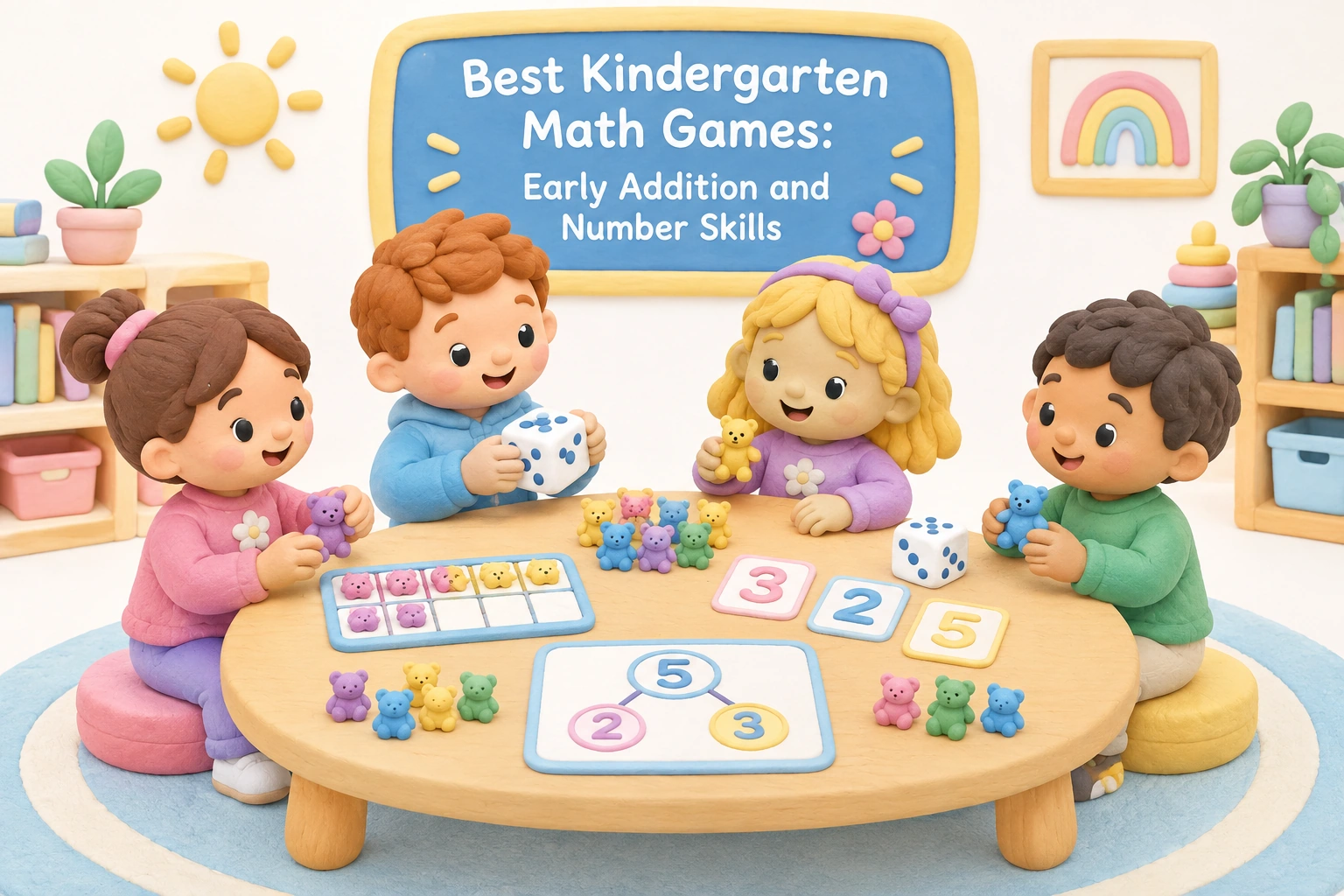
Kindergarten is a critical window for building the mathematical foundations children will rely on throughout their schooling. Games are one of the most developmentally appropriate ways to support this learning, because they create low-pressure repetition, encourage counting on, and make abstract concepts like number bonds and part-part-whole relationships feel concrete and playful. This article covers the most effective types of kindergarten math games for early addition and number skills, explains the developmental reasoning behind each category, and helps parents and educators choose the right games for their child’s current stage.
Key Takeaways
- Hands-on math games that use dice, cards, and math manipulatives are among the most effective tools for building number sense and early addition skills in kindergarteners.
- Games work best when they are matched to a child’s current developmental stage — starting with subitizing and one-to-one correspondence before moving to addition within 5 and then addition within 10.
- Free printable kindergarten math games and no-prep dice games offer accessible, low-cost options for both classroom math centers and home use.
- Digital math games can supplement hands-on learning but work best when used alongside physical play rather than as a replacement for it.
- The same game can often be adapted for beginners and more advanced learners by changing the number range or materials used.
Why Games Are Developmentally Appropriate for Kindergarten Math
Young children learn most effectively through play, and kindergarten math games leverage this natural learning mode. When a child rolls dice and counts the dots, they are practicing subitizing — the ability to instantly recognize a quantity without counting each item individually. Subitizing is a foundational skill that underpins later addition fact fluency, and games provide the repeated, low-stakes exposure that helps it develop. Research in early childhood education consistently supports play-based learning as a meaningful vehicle for building mathematical understanding, particularly for children aged five to seven.
Games also support one-to-one correspondence, the understanding that each object in a set corresponds to exactly one number word. This concept, along with cardinality — knowing that the last number counted represents the total quantity — forms the bedrock of number sense. Board games that involve moving a token one space per count, or card games where children match numerals to dot quantities, naturally reinforce both skills without requiring formal instruction.
From a motivational standpoint, games reduce math anxiety by removing the pressure of right-or-wrong performance. A child who is hesitant about numbers in a worksheet context will often engage enthusiastically with the same content in a game format. This is particularly relevant for kindergarteners, whose confidence in mathematics is still forming and can be significantly shaped by early experiences.
The Developmental Progression: Which Skills Come First
Not all kindergarten math skills are equally foundational, and introducing games in a thoughtful sequence helps children build understanding rather than memorize procedures. A useful progression moves from concrete recognition to relational thinking to early computation.
The sequence typically begins with number recognition and subitizing — can the child identify how many dots are on a card without counting? From there, children develop counting on, the ability to start from a given number and count forward rather than always starting from one. Counting on is a significant cognitive step and is directly linked to early addition skills. Once counting on is secure, children are ready to explore addition within 5, then addition within 10, and eventually the concept of making 10 — understanding which pairs of numbers combine to reach ten, sometimes called the “friends of ten.”
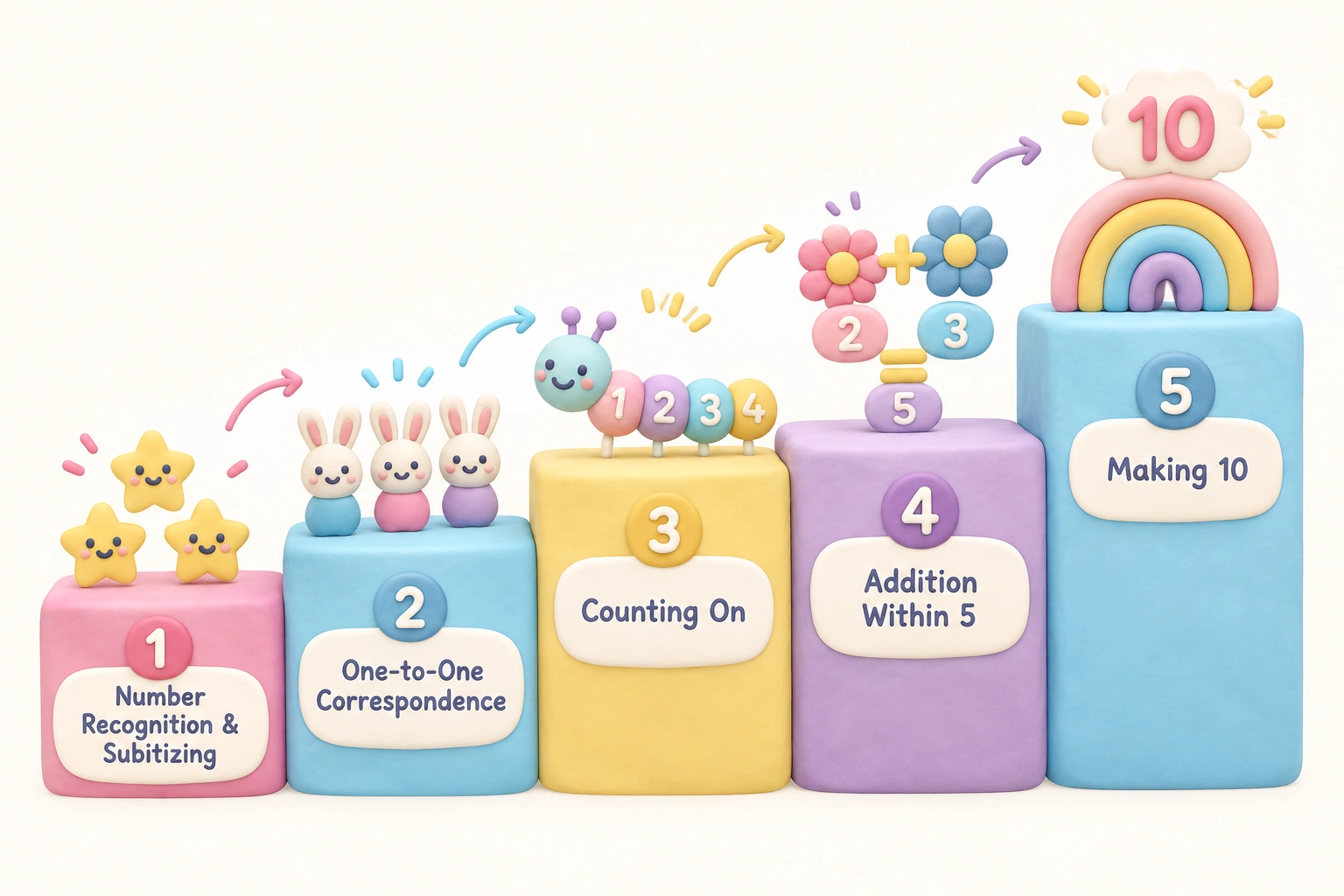
Games that are introduced too early in this sequence can frustrate children, while games introduced at the right moment feel achievable and engaging. Parents and teachers can use this progression as a rough guide: if a child struggles with a game, it may be worth stepping back to a more foundational activity rather than repeating the same game at the same level.
Hands-On Math Games: Dice, Cards, and Manipulatives
Hands-on math activities remain the most developmentally grounded approach for kindergarten-aged children. The Concrete–Pictorial–Abstract (CPA) learning progression, widely used in mathematics education, suggests that children should first work with physical objects before moving to pictures and then to abstract symbols like numerals and equations. Games that use math manipulatives — such as counting bears, unifix cubes, or snap cubes — sit firmly in the concrete stage and are appropriate for most kindergarteners.
Dice Games
Dice games are among the most versatile and accessible kindergarten math games available. A simple Roll and Add game requires only two dice and a recording sheet: children roll both dice, count or subitize the dots, and write or say the total. This single activity builds subitizing, counting on, and early addition skills simultaneously. A Roll and Cover variation adds a game board where children cover the corresponding number with a counter, introducing an element of strategy and reinforcing number recognition. These games are genuinely no-prep math games — a pair of standard dice and a printed grid are all that is needed.
For differentiation, beginners can use one die and count all dots from one, while more advanced learners can use two dice and practice counting on from the larger number. Using number dice (showing numerals rather than dots) shifts the focus from subitizing to numeral recognition and mental math, making the same game format useful across a wider developmental range.
Card Games
A standard deck of playing cards, with face cards removed, provides an inexpensive and flexible resource for kindergarten math games. Addition War is a widely used classroom and home game: each player flips two cards and adds them together, and the player with the higher sum wins all four cards. This game targets addition within 10 and naturally encourages children to use counting on rather than counting all. Number War, a simpler version using one card per player, builds number comparison skills and is appropriate for children who are still developing number recognition.
Memory Match games using ten-frame cards — cards that show quantities arranged in a structured five-by-two grid — support subitizing and help children visualize part-part-whole relationships. Ten frames are a particularly powerful tool because they make the structure of numbers visible: a child can see at a glance that seven is five and two more, which directly supports the concept of making 10.
Board Games
Several commercially available board games align well with kindergarten math skills. Sum Swamp, for example, requires players to add or subtract numbers shown on dice to move through a swamp-themed board, making it a natural fit for addition within 10. Hi Ho Cherry-O builds early counting and one-to-one correspondence. Shut the Box, a traditional game involving dice and numbered tiles, introduces addition facts in a tactile, engaging format. These games are worth considering for family game nights because they involve caregivers alongside children, which research suggests enhances learning outcomes compared to independent play alone.
Free Printable Kindergarten Math Games
Free printable kindergarten math games offer a practical solution for teachers building math centers and for parents who want structured activities without significant cost. Printable games typically require minimal materials beyond the printed sheet, a pair of dice, and some counters — making them genuinely low-prep activities suitable for busy classrooms and homes alike.
Common printable formats include Roll and Cover boards (where children roll a die and cover the matching number on a grid), number bond mats (where children use counters to show how a number can be split into two parts), and ten-frame fill games (where children roll a die and fill in a ten-frame, building toward making 10). These formats directly target the Common Core State Standards for kindergarten mathematics, particularly K.OA.A.1 (representing addition and subtraction) and K.OA.A.5 (fluently adding and subtracting within 5).
When selecting free printable games, it is worth checking that the skill label matches the child’s current developmental stage. A printable that looks engaging but targets addition within 20 may be frustrating for a child who is still consolidating addition within 5. Many teacher-resource websites organize printables by skill and standard, which makes it easier to find an appropriate match.
Online Kindergarten Math Games: Benefits and Realistic Limits
Digital platforms such as SplashLearn, ABCmouse, IXL, and Education.com offer online kindergarten math games that cover number recognition, counting, addition within 5, addition within 10, and number bonds. Apps like Endless Numbers and Todo Math provide structured, game-like environments designed specifically for early learners. These platforms can provide useful practice, particularly for children who are motivated by digital interaction or who benefit from immediate visual feedback.
However, online math games are most effective as a supplement to hands-on learning rather than a primary instructional tool. The CPA progression described earlier suggests that kindergarteners benefit most from working with physical objects before engaging with pictorial or abstract representations on a screen. A child who has not yet developed solid one-to-one correspondence through physical counting activities may find digital number games confusing or may engage with them in a surface-level way — tapping answers without building genuine understanding.
Screen time guidance from organizations such as the American Academy of Pediatrics recommends that digital media use for children aged five and older be purposeful, limited in duration, and ideally accompanied by caregiver involvement. For kindergarten math specifically, this means that a short session on a math app works best when a parent or teacher briefly discusses what the child did, asks questions about the numbers involved, or connects the digital activity to a physical one. Co-engagement transforms passive screen time into an interactive learning experience.
Parents choosing digital math games should look for platforms that adapt to the child’s current level, provide clear feedback without simply revealing answers, and avoid excessive rewards or animations that distract from the mathematical content. A game that celebrates every tap with a lengthy animation may reduce the actual time spent on mathematical thinking.
Kindergarten Math Games for the Classroom: Math Centers and Small Groups
In classroom settings, kindergarten math games are most commonly used in math centers — independent or small-group stations where children rotate through different activities while the teacher works with a guided math group. Games used in math centers need to be self-explanatory enough for children to manage with minimal adult support, durable enough for repeated use, and targeted enough to reinforce a specific skill.
Effective math center games for kindergarten include Roll and Cover boards, number bingo (where children cover numbers called out or shown on a card), number puzzles that require children to sequence numerals or match quantities to numerals, and partner addition games using dice or cards. Number bingo is particularly useful because it can be adapted to target number recognition, addition facts, or even skip counting by changing the numbers on the boards and the calling method.
For teachers working with mixed-ability groups, differentiation within the same game format is practical and important. In a Roll and Add game, beginners might use one die and count all dots, intermediate learners might use two dice and count on, and more advanced learners might use two dice and record a number sentence. This approach means the teacher can introduce one game to the whole class and then adjust materials for different groups without preparing entirely separate activities.
Small group instruction offers the additional benefit of allowing the teacher to observe and prompt mathematical thinking in real time — asking “how did you know that was six?” or “what would happen if you added one more?” These questions support the development of math fact fluency and number sense more deeply than independent practice alone.
Standards Alignment: Matching Games to Kindergarten Math Goals
For teachers and homeschooling parents who want to ensure their game choices align with curriculum expectations, the following table maps common kindergarten math game types to relevant Common Core State Standards. This mapping is intended as a practical reference, not a rigid prescription — many games address multiple standards simultaneously.
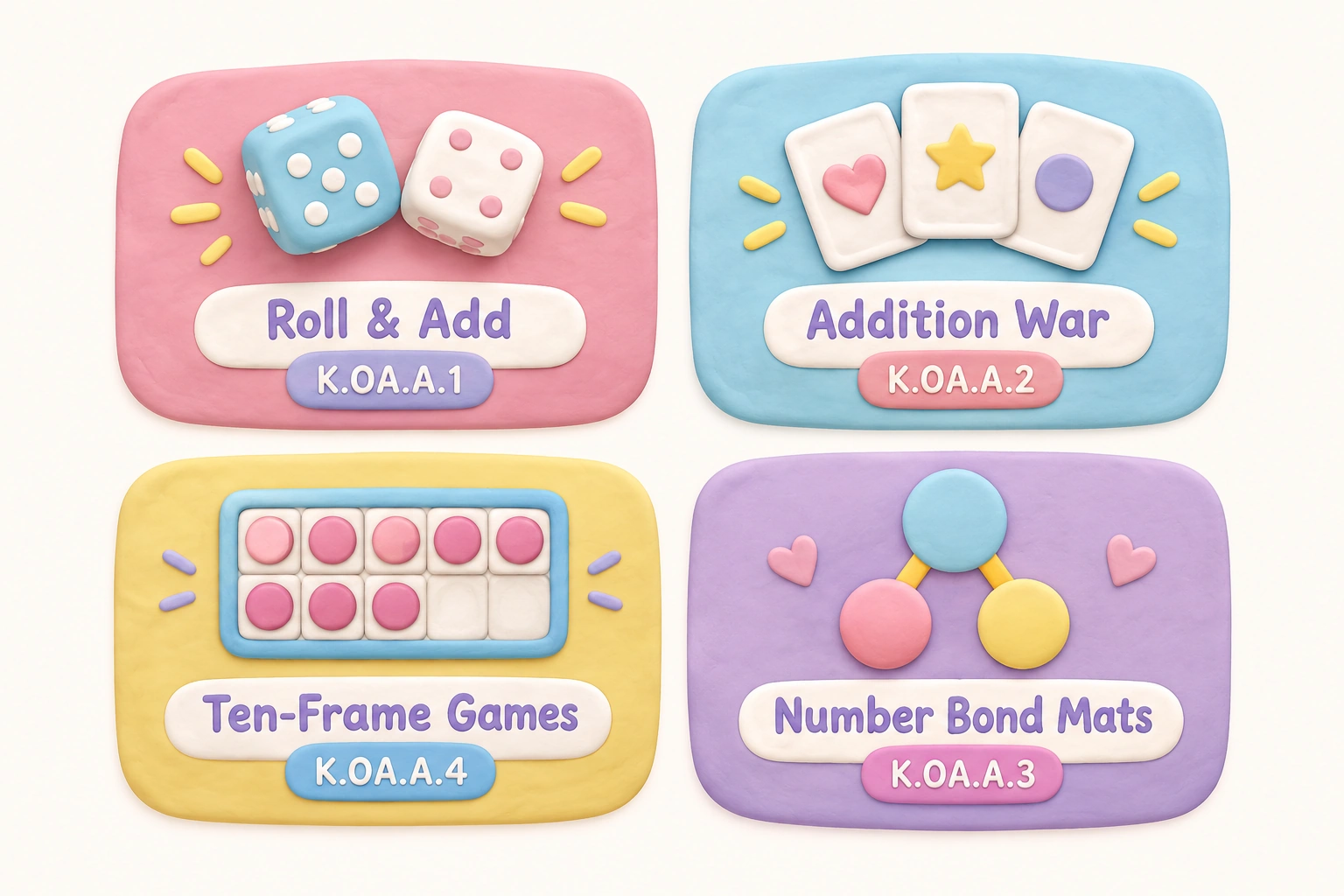
| Game Type | Primary Skill | CCSS Standard |
|---|---|---|
| Subitizing card games (dot cards, ten-frame cards) | Instantly recognizing quantities; number sense | K.CC.B.4, K.CC.B.5 |
| Roll and Cover (one die) | Number recognition; counting to 6 | K.CC.A.3, K.CC.B.4 |
| Roll and Add (two dice) | Addition within 10; counting on | K.OA.A.1, K.OA.A.2 |
| Number bond mats with counters | Part-part-whole relationships; addition within 5 | K.OA.A.3, K.OA.A.5 |
| Ten-frame fill games | Making 10; addition fact fluency | K.OA.A.4, K.OA.A.5 |
| Addition War (card game) | Addition within 10; comparing sums | K.OA.A.2, K.CC.C.6 |
| Number bingo | Number recognition; cardinality | K.CC.A.3, K.CC.B.5 |
| Number line hopscotch | Counting on; number sequencing | K.CC.A.1, K.CC.A.2 |
Movement-Based Math Games
Movement-based kindergarten math games are an underused but highly effective category, particularly for children who find it difficult to sit still for extended periods. Number Line Hopscotch, where children hop along a numbered grid drawn on the floor or pavement, builds number sequencing and counting on in a physically engaging way. A teacher or parent calls out a starting number and an amount to add, and the child hops forward the corresponding number of spaces — making the abstract concept of addition within 10 visible and physical.
Math Twister, adapted from the classic game, can use number mats instead of colored circles, asking children to place hands or feet on specific numbers or sums. Musical Chairs with a math twist — where children must answer a number question to claim a chair — adds a competitive element that many kindergarteners find highly motivating. These movement games are particularly valuable for classroom use because they break up sedentary learning time while maintaining mathematical focus.
Addressing Math Anxiety Through Games
Math anxiety — a feeling of tension or apprehension specifically related to mathematical tasks — can begin to emerge as early as kindergarten, particularly in children who have experienced repeated difficulty or negative feedback around numbers. Games offer a meaningful protective factor because they reframe mathematical activity as enjoyable rather than evaluative. When a child is playing a dice game with a caregiver, the social and playful context reduces the emotional stakes of making an error.
Parents who notice that their child becomes distressed or avoidant around number activities may find that introducing games in a relaxed, non-competitive format — where the goal is participation rather than winning — helps rebuild positive associations with mathematics. Choosing games that are slightly below the child’s current challenge level initially, so that success is frequent, can help restore confidence before gradually increasing difficulty. If math anxiety appears persistent or significantly affects a child’s willingness to engage with learning, consulting with the child’s teacher or a learning specialist is advisable.
Balancing Digital and Hands-On Math Games: Practical Guidance
A common question from parents is how to balance online math games with physical, hands-on activities. A practical approach is to treat digital games as practice tools and hands-on games as the primary learning environment. For most kindergarteners, a session of ten to fifteen minutes on a math app, followed by a short physical game using the same skill, provides both the engagement of digital interaction and the concrete grounding that supports genuine understanding.
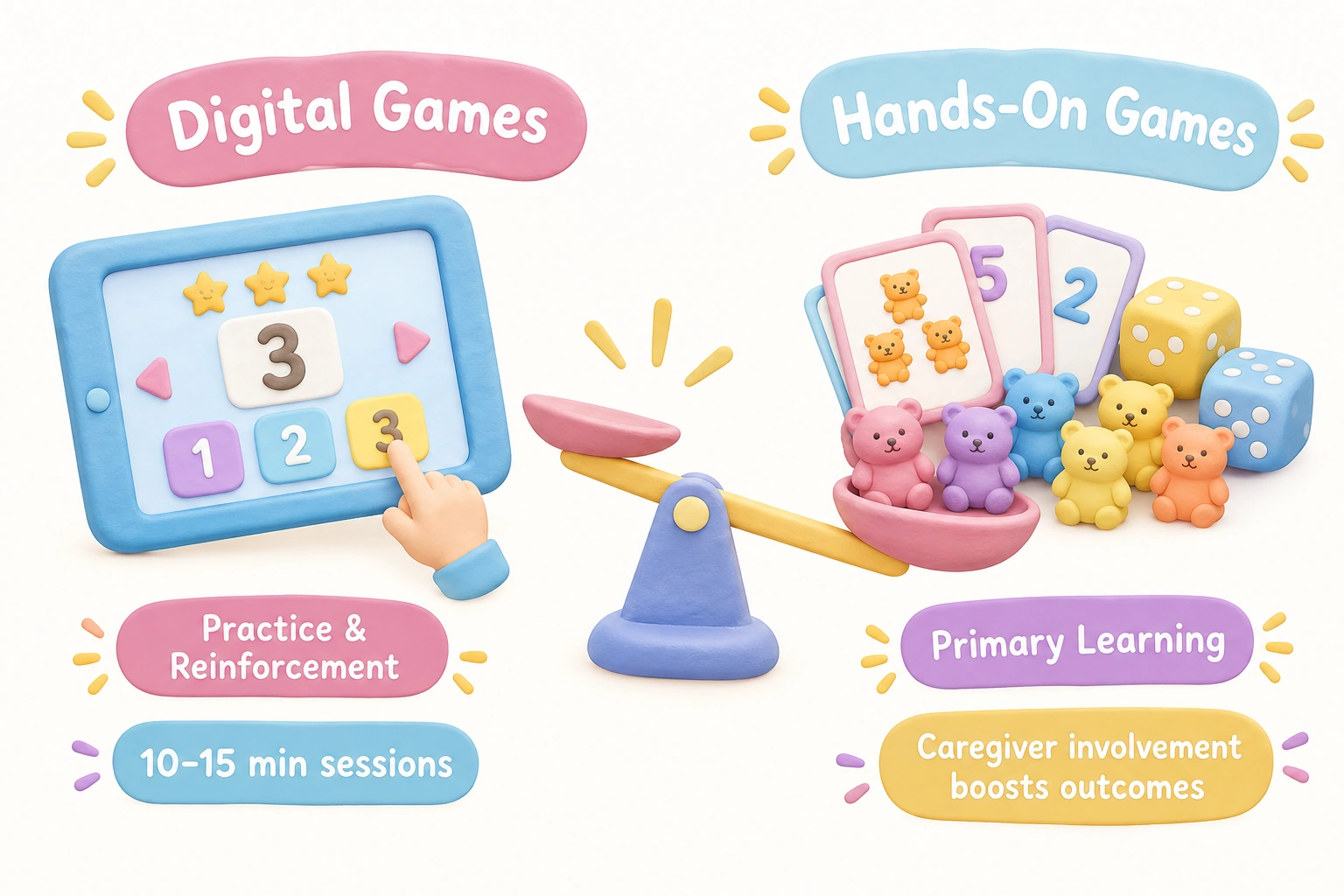
For example, a child who has been practicing addition within 5 on a tablet app might then play a quick Roll and Add game with a parent using one die and a small pile of counters. The physical game reinforces the same skill with tangible objects, helping to consolidate what was practiced digitally. This kind of intentional pairing — digital then physical, or physical then digital — is more developmentally sound than extended independent screen time on a single platform.
Budget is also a practical consideration. Many of the most effective kindergarten math games cost very little: a pair of dice, a deck of cards, and free printable game boards cover a wide range of skills. Commercially available board games like Sum Swamp or Shut the Box are worth purchasing if the family will use them regularly, but they are not necessary for strong early math development. Free printable kindergarten math games from reputable teacher-resource sites can provide months of varied practice at no cost.
Frequently Asked Questions
What math skills should kindergarten games focus on?
Kindergarten math games are most valuable when they target number sense, number recognition, subitizing, one-to-one correspondence, cardinality, and early addition skills — specifically addition within 5 and addition within 10. Games that build part-part-whole relationships and the concept of making 10 are particularly important because these skills directly support later addition fact fluency and mental math strategies.
How do I know if a game is at the right level for my child?
A well-matched game should feel achievable but slightly challenging — the child should be able to play with some success but still need to think. If a child completes a game without any hesitation or counting, it may be time to increase the number range or add a second die. If a child becomes frustrated or disengaged quickly, stepping back to a simpler format or a smaller number range is usually more productive than persisting with the same game.
Are online math games effective for kindergarteners?
Online kindergarten math games can support practice and engagement, particularly when they adapt to the child’s level and provide clear feedback. However, they are most effective as a supplement to hands-on math activities rather than a primary learning tool. Caregiver involvement during or after digital game sessions — asking questions and connecting the activity to physical objects — significantly improves the learning value of screen-based math games.
How long should a kindergarten math game session last?
For most kindergarteners, game sessions of ten to twenty minutes are appropriate. Shorter sessions with high engagement are more valuable than longer sessions where attention has drifted. In classroom math centers, games typically run for fifteen to twenty minutes per rotation. At home, a brief game before or after another activity — rather than a dedicated long session — often works well for maintaining enthusiasm.
Can games really improve math fact fluency?
Games can meaningfully support the development of math fact fluency, particularly when they provide repeated, low-pressure exposure to the same number combinations. Addition War, Roll and Add, and ten-frame games all create the kind of repeated practice that helps addition facts become more automatic over time. However, fluency develops gradually and varies by child — games support the process but do not guarantee a specific timeline for any individual child.
What if my child doesn’t enjoy competitive games?
Many effective kindergarten math games can be played cooperatively or non-competitively. Roll and Cover, ten-frame fill games, and number bond mats work equally well as solo or collaborative activities. For children who find competition stressful, framing the game as “let’s see how many we can get together” rather than “who wins” removes the evaluative pressure while preserving the mathematical practice.
Choosing the Right Kindergarten Math Games for Your Child or Classroom
The most effective kindergarten math games are those that match the child’s current developmental stage, use concrete materials where possible, and create enough repetition to build genuine fluency without becoming tedious. No single game or platform covers every skill, and a varied mix — dice games, card games, printable activities, movement games, and occasional digital practice — provides the broadest developmental support.
For parents, the most important factor is engagement: a game that a child wants to play repeatedly will build more mathematical understanding than a technically perfect activity that the child avoids. Starting with simple, high-success games and gradually increasing challenge as confidence grows is a reliable approach. For teachers, aligning game choices to current instructional goals and using the same game format across different skill levels reduces preparation time while maintaining differentiation.
If you are unsure where to start, a pair of dice and a simple Roll and Add recording sheet is one of the most versatile and developmentally sound kindergarten math games available — free, flexible, and directly aligned with the early addition skills that kindergarteners need to develop. From there, adding ten-frame card games and a cooperative board game or two creates a well-rounded home or classroom math game collection that can grow with the child throughout the kindergarten year.

Take a short quiz to find out what your everyday choices say about your parenting style
When your child is curious about something new, what’s your instinct?
Take a short quiz to find out what your everyday choices say about your parenting style
“Can I download this app?” What happens next?
Take a short quiz to find out what your everyday choices say about your parenting style
When it comes to rules at home, which sounds most like you?
Take a short quiz to find out what your everyday choices say about your parenting style
If you could give your child one life skill today, what would you pick?
Take a short quiz to find out what your everyday choices say about your parenting style
Your child gets to choose what to watch. What would your ideal setup look like?
Take a short quiz to find out what your everyday choices say about your parenting style
Pick your parenting superpower ✨