
Vocabulary Games for Kids: 25 Fun Ideas for Home, Classroom, and Online Play

 Discover a Free Education Video App for Kids
Pastory uses AI to personalize educational video content based on your child’s interests and personality. Safe, engaging, and built for curious young minds. Sign up now to stay updated and enjoy early access with a free trial
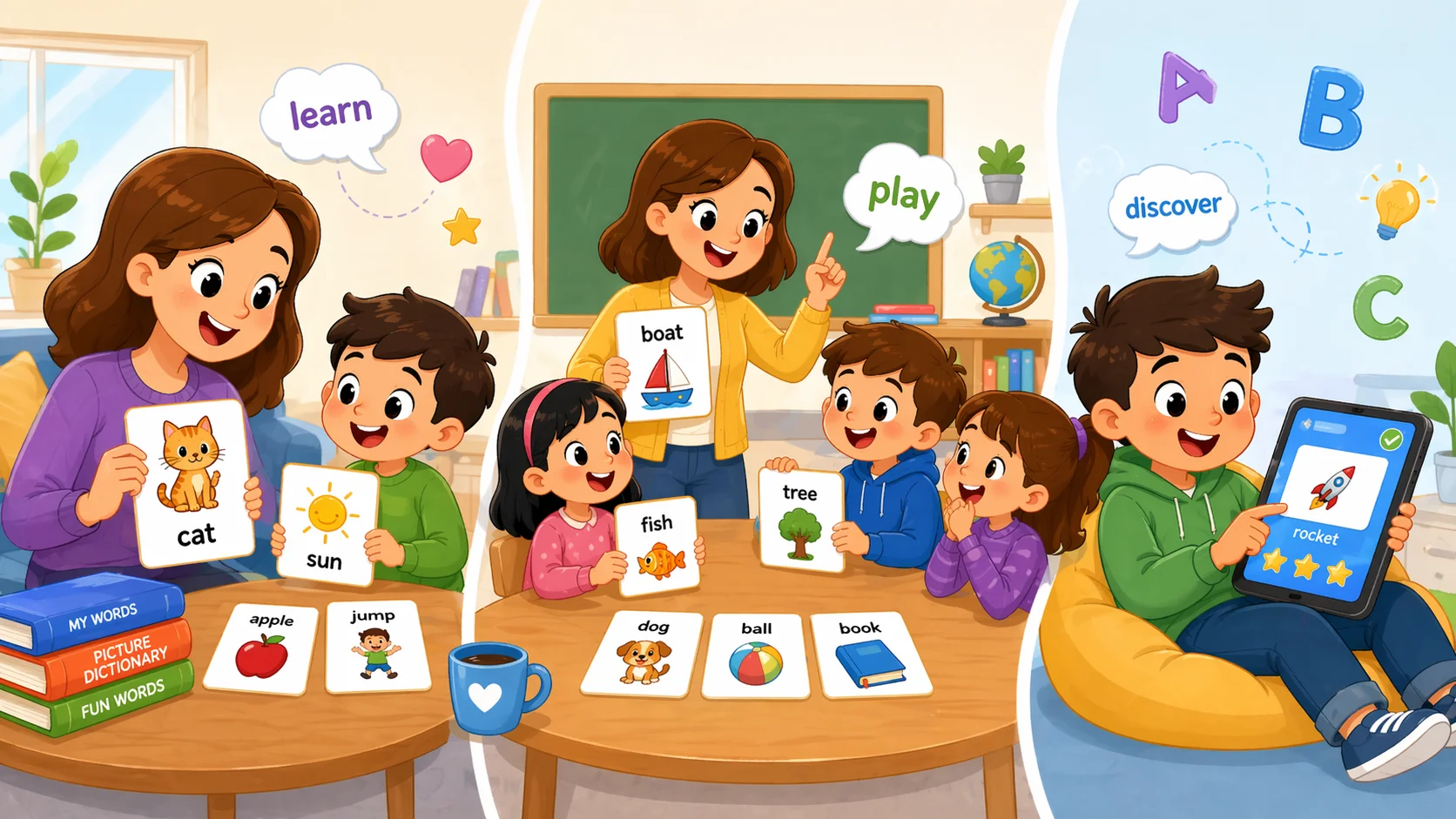
Building a strong vocabulary is a cornerstone of literacy and academic success. Playing vocabulary games gives children repeated, low-pressure opportunities to encounter and use new vocabulary. This guide covers 25 practical vocabulary activities for home, classroom, and online learning. Whether you are supporting an English language learner or strengthening a native speaker’s literacy skills, these strategies make vocabulary practice interactive and enjoyable.
The National Reading Panel highlights that repeated exposure to vocabulary, especially in rich and varied contexts, supports language learning. Games help parents and teachers build this repetition into playful, meaningful practice. From classic board games and search puzzles to digital tools, these activities help children build English skills while staying engaged.
Vocabulary Games for Home
Vocabulary practice at home works best when activities are simple, short, and easy to repeat. These activities are designed for parents who want 10–15-minute practice sessions that fit into a busy family schedule and require no special training.
Vocabulary Games for Classroom
Teachers can use these games for whole-class instruction, small-group centers, or quick warm-ups. They encourage collaboration, peer interaction, and meaningful use of English.
Play Fun Vocabulary Games Online
This section covers online games and mobile-friendly activities. They are ideal for independent practice because visuals and audio cues can support word recognition and meaning.
Vocabulary Games by School Stage
Age-appropriate grouping helps children stay challenged without feeling overwhelmed. This section groups activities from preschool through upper elementary so they match children’s developmental needs.
12 Vocabulary Games for Home
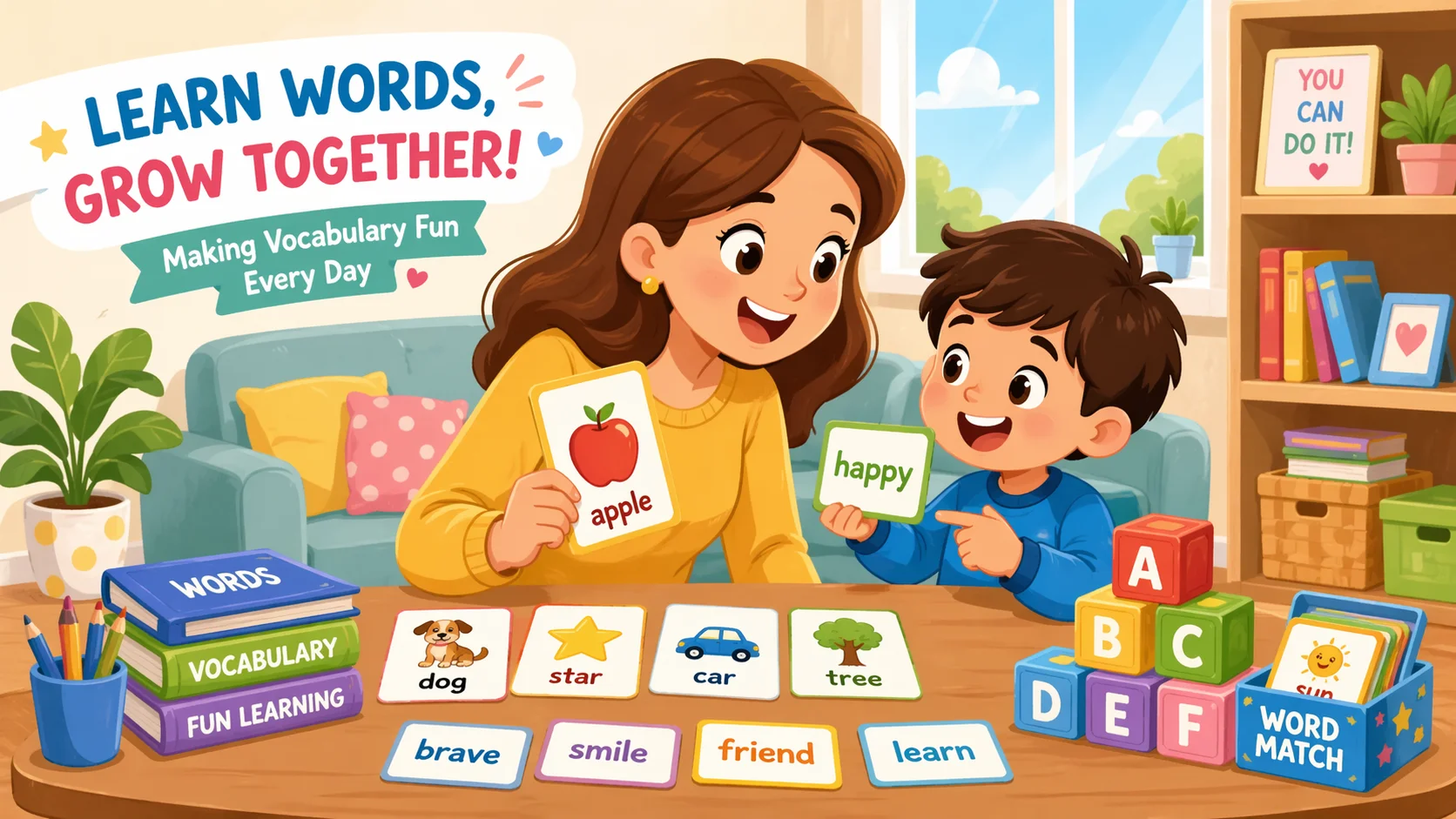
Home can be one of the most important places for a child’s vocabulary development. These 12 activities require minimal materials and make English practice a natural part of daily life and family interaction.
1. SplashLearn Online Vocabulary Games
SplashLearn offers a structured digital environment for word recognition, phonics practice, and vocabulary growth.
- Best for: Independent practice and curriculum alignment.
- Age: 3–11 years.
- Materials: Tablet or Computer.
- How to Play: Children move through a personalized learning path and complete interactive games focused on spelling, noun identification, and sentence building.
- Skills: Phonemic awareness, word recognition, and context clues.
- Easy Variation: Focus specifically on sight words for younger children.
- Parent Tip: Set a 10-minute daily goal to build a consistent habit without screen fatigue.
2. Vocabulary Bingo
Vocabulary Bingo is a classic, engaging way to review vocabulary from a recent book or lesson.
- Best for: Reviewing a specific set of new vocabulary.
- Age: 5+ years.
- Materials: Bingo cards (printable or hand-drawn), markers.
- How to Play: Instead of saying the answer aloud, the caller gives a synonym or definition. The child must find the matching item on their board.
- Skills: Listening comprehension and semantic meaning.
- Easy Variation: Use picture clues for younger children who are still building literacy skills.
- Parent Tip: Use small snacks like raisins or cereal as markers to increase engagement.
3. Word Search
A word search puzzle helps children notice spelling patterns and practise visual scanning.
- Best for: Visual learners and quiet time.
- Age: 6+ years.
- Materials: Worksheet or online games.
- How to Play: Children scan a letter grid to find the hidden words listed below it.
- Skills: Pattern recognition and spelling accuracy.
- Easy Variation: Highlight the first letter of each hidden entry to assist beginners.
- Parent Tip: Add one “bonus word” that is not on the list to encourage closer attention.
4. Crossword
Crossword puzzles challenge children to recall a word based on a clue, definition, or synonym.
- Best for: Strengthening the link between a term and its definition.
- Age: 7+ years.
- Materials: Crossword worksheet.
- How to Play: The child fills in the grid by solving clues for specific English vocabulary words.
- Skills: Critical thinking and recall.
- Easy Variation: Provide a word bank so the child can choose from a limited list.
- Parent Tip: Start with picture clues for primary games to build confidence.
5. Vocabulary Scramble
In this game, the letters are mixed up, and the child has to put them in the correct order.
- Best for: Spelling mastery.
- Age: 6+ years.
- Materials: Magnetic letters or paper scraps.
- How to Play: Present a scrambled example like “E-L-P-P-A” for apple. The child must arrange the characters to form the correct entry.
- Skills: Orthographic mapping and word recognition.
- Easy Variation: Group the scrambled items by category, such as “Animals” or “Fruit.”
- Parent Tip: Use terms the child recently encountered in their favorite cartoons or books.
6. I Spy
I Spy is a versatile, low-prep way to build descriptive language on the go.
- Best for: Early years and on-the-go learning.
- Age: 3+ years.
- Materials: None.
- How to Play: “I spy with my little eye something that is [Adjective] and starts with [Letter].”
- Skills: Descriptive language, adjectives, and initial sounds.
- Easy Variation: Use only colors or shapes for very young children.
- Parent Tip: Move from simple objects to more specific descriptions to build vocabulary.
7. Headbanz
This yes/no guessing game helps children identify a hidden answer through questions.
- Best for: Speaking practice and categorization.
- Age: 5+ years.
- Materials: Headbands and cards with pictures or words.
- How to Play: One player wears a card on their head without looking at it. They ask questions (“Am I a noun?”, “Do I have fur?”) to guess the identity.
- Skills: Categorization and question formation.
- Easy Variation: Allow the other players to give one-word clues.
- Parent Tip: Focus on one topic at a time, such as “Community Helpers” or “Ocean Life.”
8. Word Pyramid
Word Pyramid helps children build associations between a central theme and related words.
- Best for: Semantic connections and fast recall.
- Age: 8+ years.
- Materials: Paper and pen.
- How to Play: Start with a broad category at the base, such as “Nature,” then move upward with more specific words, such as “Forest,” “Pine,” and “Needle.”
- Skills: Classification and vocabulary building.
- Easy Variation: Use a PowerPoint game format with clickable layers.
- Parent Tip: Encourage the use of synonyms to reach the top of the pyramid.
9. Rolling Words
This activity combines the feel of a board game with different vocabulary tasks.
- Best for: Varied practice of a single item.
- Age: 6+ years.
- Materials: Dice and a list of new vocabulary.
- How to Play: Roll a die to choose the task: 1 = define it, 2 = use it in a sentence, 3 = draw it, 4 = find a synonym, 5 = spell it, 6 = act it out.
- Skills: Multi-modal learning.
- Easy Variation: Use only three actions for younger children.
- Parent Tip: Keep a “Word of the Week” list on the fridge for this activity.
10. What Is It?
In this guessing game, children identify a noun from a series of increasingly specific clues.
- Best for: Understanding meaning through characteristics.
- Age: 5+ years.
- Materials: None.
- How to Play: Describe an object: “I am round. I am red. You can eat me.” The child guesses “apple.”
- Skills: Inference and attribute identification.
- Easy Variation: Use physical objects hidden in a “mystery bag.”
- Parent Tip: Let the child be the describer to practice their speaking skills.
11. Vocabulary Dice Chart
This version works well with a worksheet or chart so children can record their answers and track progress over time.
| Dice Roll | Task for the Vocabulary Word | Skill Developed |
| 1 | Give a Definition | Meaning Comprehension |
| 2 | Name a Synonym | Semantic Depth |
| 3 | Use in a Sentence | Contextual Usage |
| 4 | Draw a Picture | Visual Memory |
| 5 | Identify Part of Speech | Grammar Awareness |
| 6 | Spell It Aloud | Spelling Accuracy |
12. Basketball Vocabulary
This movement-based activity works well for children who focus better when they can move.
- Best for: Active children and breaking up sedentary study time.
- Age: 5–12 years.
- Materials: Small hoop and ball (or trash can and paper ball).
- How to Play: The child earns a shot by correctly defining a new vocabulary term or using it in a sentence.
- Skills: Recall and motivation.
- Easy Variation: The child gets two shots if they can name an antonym.
- Parent Tip: Use this as a short movement break during homework time.
13 Vocabulary Games for Classroom
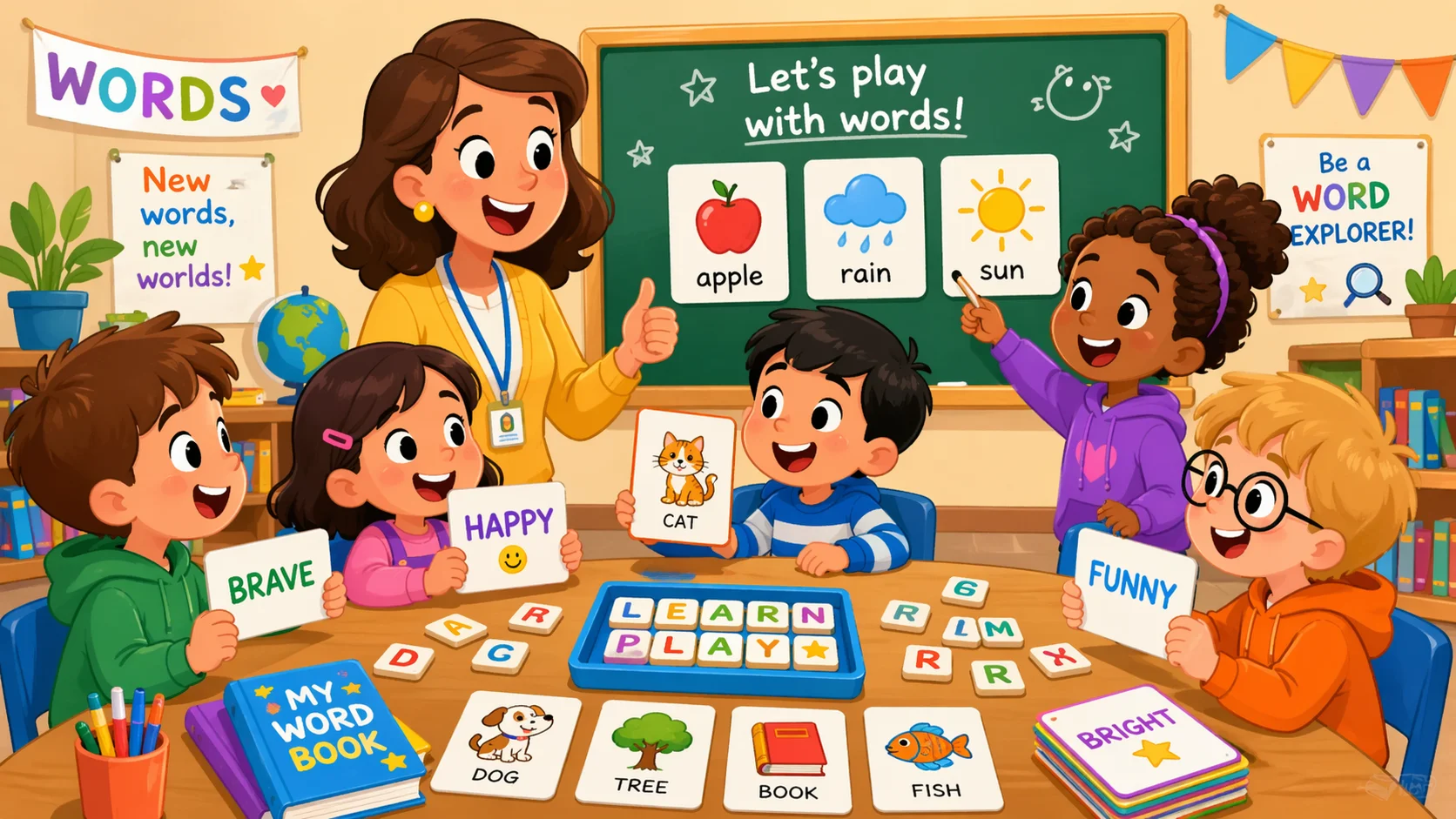
Classroom games can support collaboration, social learning, and meaningful vocabulary practice. Vygotsky’s work on the Zone of Proximal Development highlights the value of support, scaffolding, and social interaction in learning. These vocabulary games are designed for group work, centers, and whole-class activities.
13. Synonym Matching
This activity helps English learners understand that several words can have similar meanings.
- Group Size: Pairs or Small Groups.
- Prep Time: 5 minutes.
- Materials: Index cards or a worksheet.
- How to Run: Students match “happy” with “joyful” or “big” with “enormous.”
- Skill Focus: Expanding language beyond basic descriptors.
- Teacher Tip: Challenge advanced students to rank synonyms by intensity, such as cold → chilly → freezing.
14. Word Detective
Word Detective encourages students to use context clues to identify a missing word.
- Group Size: Individual or Pairs.
- Prep Time: 10 minutes.
- Materials: Short reading passages with gaps.
- How to Run: Provide a sentence with a missing word and three clues about its meaning. Students must “solve” the mystery.
- Skill Focus: Contextual learning and inference.
- Teacher Tip: Use commonly confused words (their/there/they’re) to sharpen accuracy.
15. Checkers Vocabulary
Turn a standard board game into a vocabulary-building tool for pairs.
- Group Size: Pairs.
- Prep Time: 2 minutes.
- Materials: Checkers set and a list.
- How to Run: To move a piece, a player must use one of the current unit’s vocabulary words correctly in a sentence.
- Skill Focus: Usage and sentence construction.
- Teacher Tip: Tape vocabulary words directly onto the checkerboard for a more hands-on experience.
16. Pictionary
Pictionary uses drawing and visual recall to reinforce meaning without relying on translation.
- Group Size: Two Teams.
- Prep Time: 0 minutes.
- Materials: Whiteboard or paper.
- How to Run: One student draws a vocabulary word while their team tries to guess it within 60 seconds.
- Skill Focus: Visual-spatial learning and word recognition.
- Teacher Tip: Works best for concrete nouns and action verbs.
17. Go Fish Vocabulary
This adaptation of the classic card game focuses on definitions instead of numbers.
- Group Size: 3–5 students.
- Prep Time: 15 minutes (once).
- Materials: Custom deck with terms and definitions.
- How to Run: Instead of asking for “a 7,” a student asks, “Do you have the word that means a large, gray animal with a trunk?”
- Skill Focus: Listening and retrieval practice.
- Teacher Tip: Laminate the materials for year-long use in literacy centers.
18. Memory Cards
Memory or concentration games work well for small-group rotations.
- Group Size: 2–4 students.
- Prep Time: 5 minutes.
- Materials: Pairs of cards (Term/Picture or Term/Definition).
- How to Run: Students place the cards face down. Students turn over two cards; if they match a word with its definition, they keep the pair.
- Skill Focus: Visual memory and word recognition.
- Teacher Tip: Include a “Wild Card” that allows a student to steal a pair if they can use it in a complex sentence.
19. Vocabulary Charades
This game gets the whole class moving while reinforcing word meaning.
- Group Size: Whole Class.
- Prep Time: 0 minutes.
- Materials: Slips in a hat.
- How to Run: A student acts out a vocabulary word without speaking while the class tries to guess it.
- Skill Focus: Non-verbal communication and understanding.
- Teacher Tip: This is especially helpful for English language learners because they can show understanding without producing complex sentences.
20. Word Association
Word Association helps students build semantic connections through quick verbal chains.
- Group Size: Whole Class (Circle).
- Prep Time: 0 minutes.
- Materials: None.
- How to Run: The teacher says a word, such as “ocean,” and the next student says a related word, such as “water.”
- Skill Focus: Fast recall and categorization.
- Teacher Tip: Introduce “Taboo” terms that students cannot say to increase the difficulty.
21. Vocabulary Hangman
This is a more classroom-friendly version of the classic letter-guessing game.
- Group Size: Whole Class.
- Prep Time: 1 minute.
- Materials: Whiteboard.
- How to Run: Use a “snowman” or “space rocket” instead of the traditional figure.Provide a definition as a clue before they start guessing.
- Skill Focus: Spelling and word recognition.
- Teacher Tip: Let the student who guesses the word provide the next definition for the class.
22. Word Sorting Game
Word Sorting helps students categorize English vocabulary by meaning, topic, or grammatical feature.
- Group Size: Pairs.
- Prep Time: 5 minutes.
- Materials: Printed items and sorting mats.
- How to Run: Students sort words into categories such as “parts of speech” (noun, verb, adjective) or “topic.”
- Skill Focus: Structural analysis and vocabulary building.
- Teacher Tip: Use a “Mystery Category” where students must figure out the sorting rule used by their partner.
23. Sentence Monkey
Sentence Builder focuses on word use and grammar.
- Group Size: Small Groups.
- Prep Time: 10 minutes.
- Materials: Cards and punctuation marks.
- How to Run: Students race to build a grammatically correct sentence using at least two target vocabulary words.
- Skill Focus: Syntax and sentence use.
- Teacher Tip: Award extra points for using transition terms or complex clauses.
24. Word Search Puzzles Online
Online puzzle games can provide instant feedback and reduce printing.
- Group Size: Individual.
- Prep Time: 0 minutes.
- Materials: Classroom laptops or tablets.
- How to Run: Students complete a word search based on the weekly theme or subject.
- Skill Focus: Digital literacy and spelling.
- Teacher Tip: Use this as a “fast finisher” task to keep students engaged during transitions.
25. Crossword Puzzles Online
Digital crossword puzzles work well for review and independent practice.
- Group Size: Individual or Pairs.
- Prep Time: 0 minutes.
- Materials: Digital devices.
- How to Run: Students solve an interactive puzzle with audio clues or image support.
- Skill Focus: Clue-based recall and English learning.
- Teacher Tip: Use a live leaderboard to encourage friendly classroom competition.
Play Fun Vocabulary Games Online
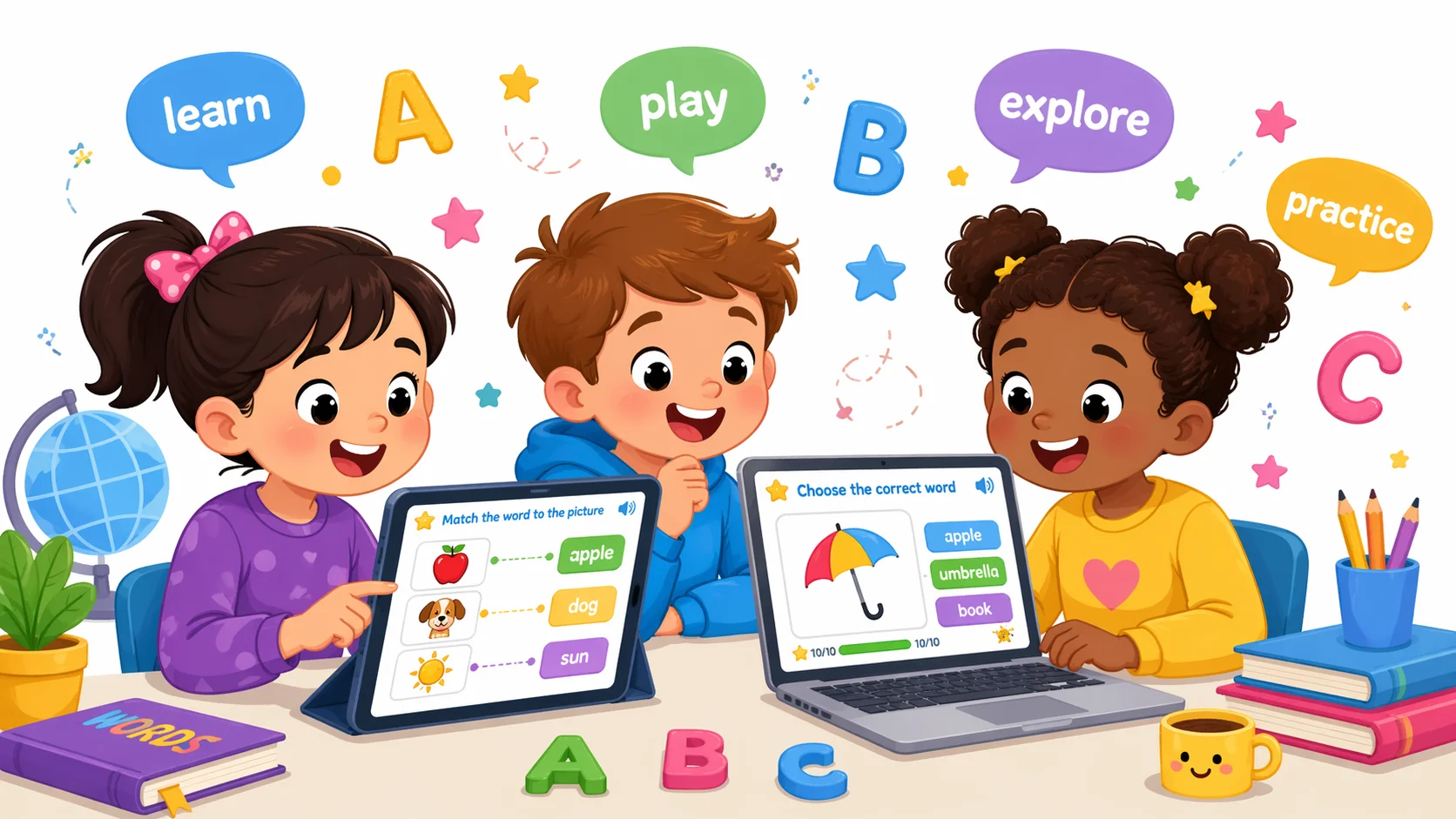
Digital tools can make English vocabulary practice more engaging through visuals, audio, and interactive tasks. Online games can be especially helpful for English language learners because they can hear pronunciation while seeing words in context.
Interactive Online Games
Many digital tools use gamification to increase motivation and engagement. These platforms often include:
- Drag-and-drop mechanics for matching games.
- Sound-supported tasks to help with word recognition.
- Adaptive difficulty that adjusts to the child’s progress.
Word Search Puzzles Online
Digital word search tools allow teachers and parents to create custom puzzles for specific vocabulary goals. They are easy to access and reduce the need to print a worksheet for every session.
Crossword Puzzles Online
Online crosswords work well for independent practice. Many online games include a “hint” button that provides a synonym or the first letter, helping to prevent frustration in younger learners who are still developing their literacy skills.
Mobile Vocabulary Games
Mobile games allow children to practise English in short bursts during commutes or waiting times. These short “micro-learning” sessions can support long-term recall because they fit naturally into the day.
Printable Board Games and Cards
Many websites offer downloadable games and worksheets. This bridges digital tools and hands-on play, creating a flexible hybrid approach.
Vocabulary Games by School Stage
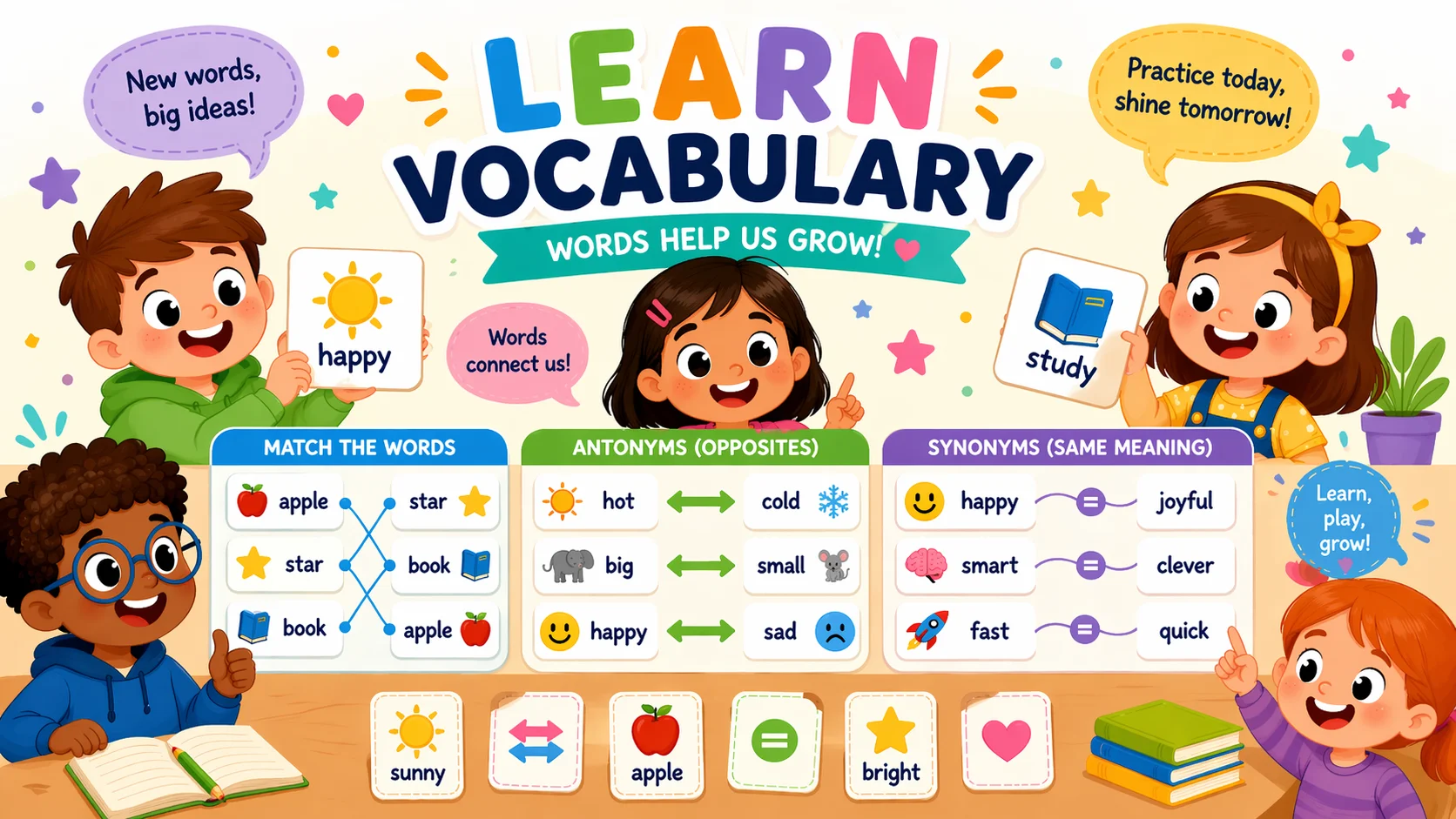
Adapting vocabulary practice to children’s developmental stages helps maintain interest and confidence.
Preschool Vocabulary Games
For children ages 3–5, focus on visuals, movement, and oral clues.
- Activities: I Spy, Vocabulary Charades, and simple matching games.
- Focus: Noun identification, colors, and basic action verbs.
Early Elementary Vocabulary Games
For children ages 5–7, begin introducing basic spelling and simple sentence practice.
- Activities: Vocabulary Bingo, Word Search, and Word Scramble.
- Focus: Sight words, family members, and common school objects.
Upper Elementary Vocabulary Games
For children ages 7–11, emphasize synonyms, antonyms, and context clues.
- Activities: Crossword puzzles, Headbanz, and Word Detective.
- Focus: Descriptive language, adverbs, and academic language.
Middle School Vocabulary Games
For children ages 11 and up, focus on nuanced meanings, idioms, and subject-specific vocabulary.
- Activities: Word Association, Sentence Builder, and strategy-based board games.
- Focus: Greek/Latin roots and subject-specific terminology.
Benefits of Using Games to Teach Vocabulary
Integrating engaging English vocabulary activities into a child’s routine can support memory, motivation, participation, and language use.
Build Word Depth and Recall
Research on retrieval practice shows that actively recalling information can support long-term retention more effectively than passive review alone. Games prompt children to recall vocabulary from memory, which strengthens retention over time.
Improve Spelling and Sentence Use
Activities such as crosswords and word searches require students to pay close attention to letter patterns and spelling. Over time, this can improve spelling accuracy, word recognition, and confidence in written tasks.
Grow Focus and Participation
The social and goal-oriented nature of classroom games can increase motivation and engagement, which may help students stay focused. This can be especially helpful for students who struggle to stay engaged during traditional instruction.
Support Speaking and Writing
Vocabulary games often ask students to explain their thinking or use a word in a sentence. This creates a bridge to more formal speaking and writing tasks and helps children move from recognizing words to using them actively.
Core Concepts and Vocabulary Skills
To build vocabulary effectively, choose games that target specific language skills.
Synonyms and Antonyms
Understanding synonyms helps students choose more precise words in speaking and writing. Matching games and crosswords are useful for building this range.
Verbs, Nouns, Collocations
Learning words in isolation is less useful than learning how they work together in common phrases and collocations. Sentence games and charades help children see how verbs, nouns, and adjectives work together in natural language.
Context Clues and Word Meaning
The ability to infer word meaning from surrounding text is a vital reading skill. Word Detective and clue-based games build this “detective” mindset and support reading comprehension.
Categories, Connections, Associations
Grouping words by theme, such as “weather,” helps children organize information. Word Sorting and Word Association are useful tools for building these semantic connections.
How to Integrate Games into Curriculum
Thoughtful integration ensures that classroom games are not just “time-fillers” but purposeful learning tools that support curriculum goals.
For Classroom Teachers
- Warm-up: Use Word Association to activate prior knowledge at the beginning of a lesson.
- Stations: Include a digital station with online games for small-group rotations.
- Fast finishers: Provide a printable word search or crossword to keep early finishers engaged.
For Parents and Homeschoolers
- Daily 10: Spend 10 minutes each day on a vocabulary game.
- Word of the Day: Use the Vocabulary Dice Chart for one target word.
- Family Game Night: Add a Headbanz-style guessing game or Pictionary to your evening routine.
Weekly Rotation Plan
- Monday: Introduce target words with visuals and child-friendly definitions.
- Tuesday: Use matching games to reinforce meaning.
- Wednesday: Play a speaking game, such as Charades.
- Thursday: Focus on a writing task, such as Sentence Builder.
- Friday: Run a review challenge with Vocabulary Bingo.
Conclusion
Vocabulary building does not have to mean tedious memorization. With the right games, you can make vocabulary practice a rewarding part of a child’s learning routine.
Best Picks by Age
- Preschool: I Spy and Charades.
- Early elementary: Bingo and Word Search.
- Upper elementary: Crosswords and Word Detective.
Best Picks by Goal
- Speaking: Headbanz-style Guessing Game and Word Association.
- Spelling: Word Scramble and Classroom-Friendly Hangman.
- Review: Checkers Vocabulary, Memory Cards.
Best Picks by Setup Time
- No-Prep: I Spy, Word Association, Charades.
- 5-Minute Prep: Bingo, Word Sorting.
- Digital: SplashLearn and Online Crosswords.
Frequently Asked Questions
What Are the Best Vocabulary Games for Elementary Students?
Some of the best vocabulary games for elementary students include Vocabulary Bingo for group review, Pictionary for visual learners, Synonym Matching for word depth, and interactive online games such as SplashLearn. These formats balance engagement, fun, and academic practice.
Which Vocabulary Games Need No Preparation?
Several vocabulary games require no preparation, including I Spy, Word Association, Vocabulary Charades, and What Is It? These are ideal for short “bridge moments,” such as waiting for a bus or transitioning between classroom activities.
How Often Should Kids Play Vocabulary Games?
Research on spaced repetition and retrieval practice suggests that short, frequent sessions can be more effective than long, infrequent ones. Aim for 10–15 minutes of vocabulary-building activities 3–4 times per week to support retrieval practice and long-term recall.
Which Vocabulary Games Work at Home and in the Classroom?
Flexible formats such as Bingo, Crosswords, Memory Cards, and digital tools work well in both settings. These games provide consistent English practice across environments and support a child’s literacy development and confidence.
What Are the Best Vocabulary Games for ESL Kids?
The best games for ESL are simple, visual, and repetitive enough to help children learn English without feeling overwhelmed. For ESL kids and children learning English as a second language, matching games, picture bingo, charades, and word recognition games work especially well. These activities support interactive learning because children hear, see, and use new vocabulary in context instead of memorizing isolated lists.
What Word Games for Kids Make Learning Fun at Home?
The best vocabulary activities for kids are short, playful, and easy to repeat. Memory games, I Spy, Vocabulary Bingo, and simple guessing games give children a fun way to learn new vocabulary through interactive play. These fun games can also make learning fun during everyday routines, supporting a child’s learning journey and helping build a lasting love for learning.

Take a short quiz to find out what your everyday choices say about your parenting style
When your child is curious about something new, what’s your instinct?
Take a short quiz to find out what your everyday choices say about your parenting style
“Can I download this app?” What happens next?
Take a short quiz to find out what your everyday choices say about your parenting style
When it comes to rules at home, which sounds most like you?
Take a short quiz to find out what your everyday choices say about your parenting style
If you could give your child one life skill today, what would you pick?
Take a short quiz to find out what your everyday choices say about your parenting style
Your child gets to choose what to watch. What would your ideal setup look like?
Take a short quiz to find out what your everyday choices say about your parenting style
Pick your parenting superpower ✨



