Short Math Poems Collection for Students Across Grade Levels

 Discover a Free Education Video App for Kids
Pastory uses AI to personalize educational video content based on your child’s interests and personality. Safe, engaging, and built for curious young minds. Sign up now to stay updated and enjoy early access with a free trial
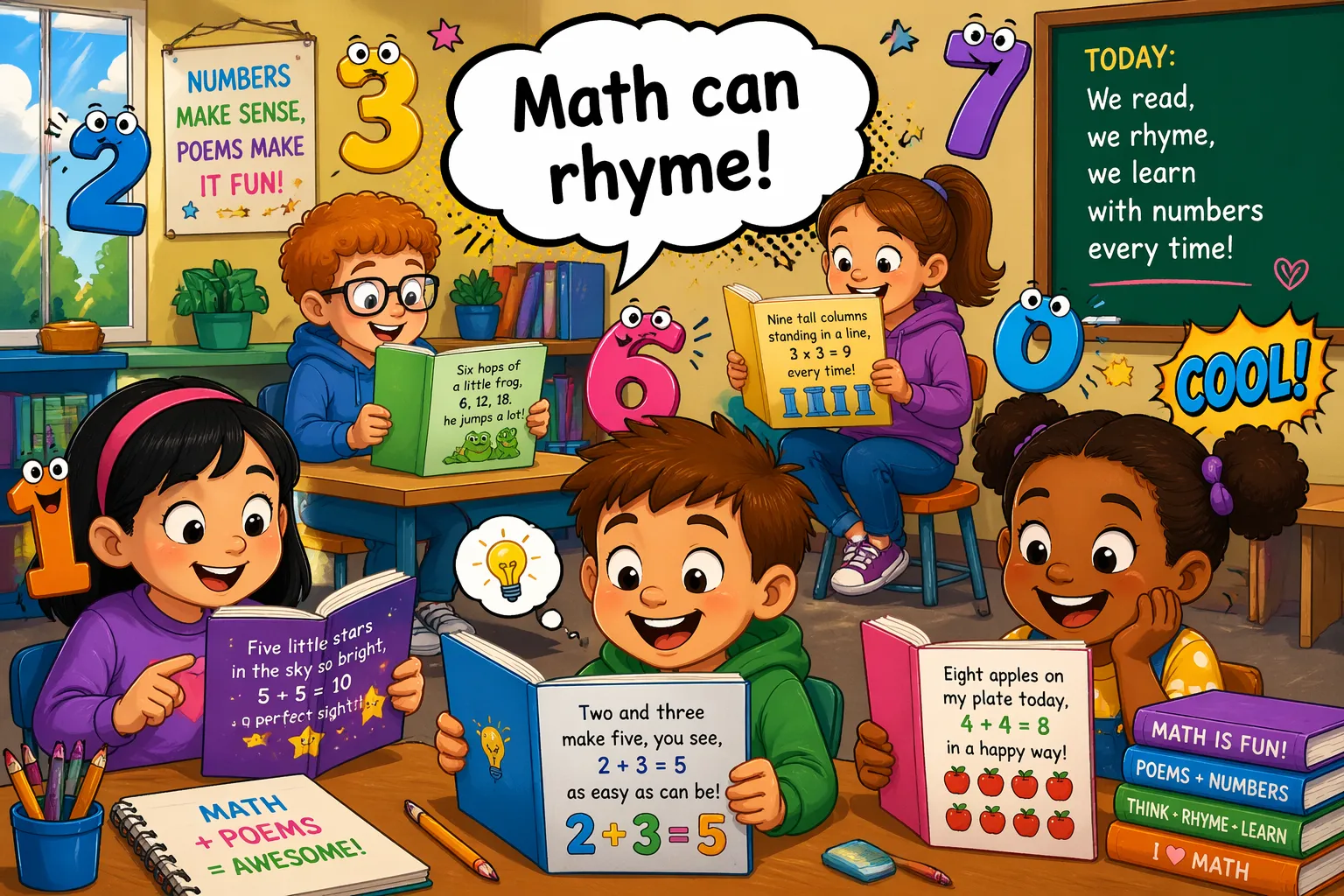
Math and poetry might seem like opposites — one built on logic, the other on language — but short math poems bring these two worlds together in surprisingly powerful ways. This collection gathers rhythm-based verses for young learners and abstract, concept-driven poems for older students, organized by grade level and theme to make discovery easy for teachers, parents, and students alike.
Short Math Poems for Elementary School Level
Simple, playful short math poems help young learners connect numbers, shapes, and basic math concepts to imagination and humor. At the elementary level, rhythm and repetition are powerful teaching tools — research in cognitive science consistently links rhyme-based learning to stronger memory formation in children ages 4–10.
Most of the poems are protected by copyright. The full versions are available at sciencepoems.net and poetrysoup.com.
Silly Spider by Mr. R
“Silly Spider” uses a spider-themed storytelling format to teach early number sequences and counting patterns. Mr. R’s poem uses bouncy rhythm to make skip counting feel like play rather than drill work. Elementary teachers often use it as a warm-up activity before introducing multiplication patterns.
Baloney Belly Billy by Shel Silverstein
This humorous character-based poem uses exaggerated, larger-than-life descriptions to build number familiarity and engagement. Shel Silverstein’s gift for comedy makes math feel approachable — children who resist number practice often respond enthusiastically to his absurdist style. The piece appears in A Light in the Attic and can be explored through your school or local library collection.
Eleven Toes by Mr. R
“Eleven Toes” takes a quirky approach to counting by introducing an unexpected number concept through an unusual character. Mr. R — a classroom teacher turned children’s poet — writes specifically to support numeracy development in early learners.
Eighteen Flavors by Shel Silverstein
This playful enumeration poem lists imaginary ice cream flavors in a way that naturally reinforces counting and number association. Students follow along with the growing list, building both listening skills and an intuitive sense of quantity. Silverstein’s work is widely available through libraries and is a staple in many early elementary classrooms.
Math by Ettie Christian-Bowling
This short reflective poem links everyday life situations — sharing snacks, counting steps — directly to simple arithmetic ideas. Ettie Christian-Bowling’s verse is accessible for beginning readers and works well as a discussion starter about where math shows up in daily routines.
Band-Aids by Shel Silverstein
“Band-Aids” uses repetition and object counting in a way that mirrors subtraction thinking — items get added and removed in a playful sequence. This poem is particularly effective for introducing the concept of “taking away” without formal math language. It is collected in Where the Sidewalk Ends, one of the most widely used poetry books in elementary classrooms.
Math’s a Challenge by Shreya Katyal
This motivational short poem frames math problem-solving as a game-like challenge rather than a source of anxiety. Katyal’s verse is especially useful for students who feel intimidated by numbers, offering a confidence-building perspective through rhythmic language.
Marvelous Math by Rebecca Kai Dotlich
“Marvelous Math” is a celebratory poem that highlights the excitement of numbers, patterns, and mathematical discovery. Rebecca Kai Dotlich is an award-winning children’s poet whose work is frequently cited by elementary literacy educators for its strong phonemic structure. The piece appears in the anthology A Kick in the Head: An Everyday Guide to Poetic Form.
Shapes by Shel Silverstein
This piece introduces geometric shapes — circles, squares, triangles — through rhythmic naming and imaginative visuals. It is one of the most commonly used math poems in kindergarten and first-grade classrooms for introducing early geometry vocabulary. Silverstein’s broad catalog is available through major library systems worldwide.
Paragliding and Gravity Maths by Ianthechimp
This creative verse connects motion, gravity, and simple numeric comparisons in a compact, accessible format. It offers a gentle introduction to the idea that math describes the physical world — a concept that supports cross-subject learning in science and mathematics.
Maths Poem by Andrew N.
This compact verse blends basic arithmetic ideas — addition, subtraction, and counting — with everyday observations designed for beginners. Andrew N.’s poem works well as a classroom reading activity or as a model for students writing their own short math poems.
Short Math Poems for Middle School and High School Level
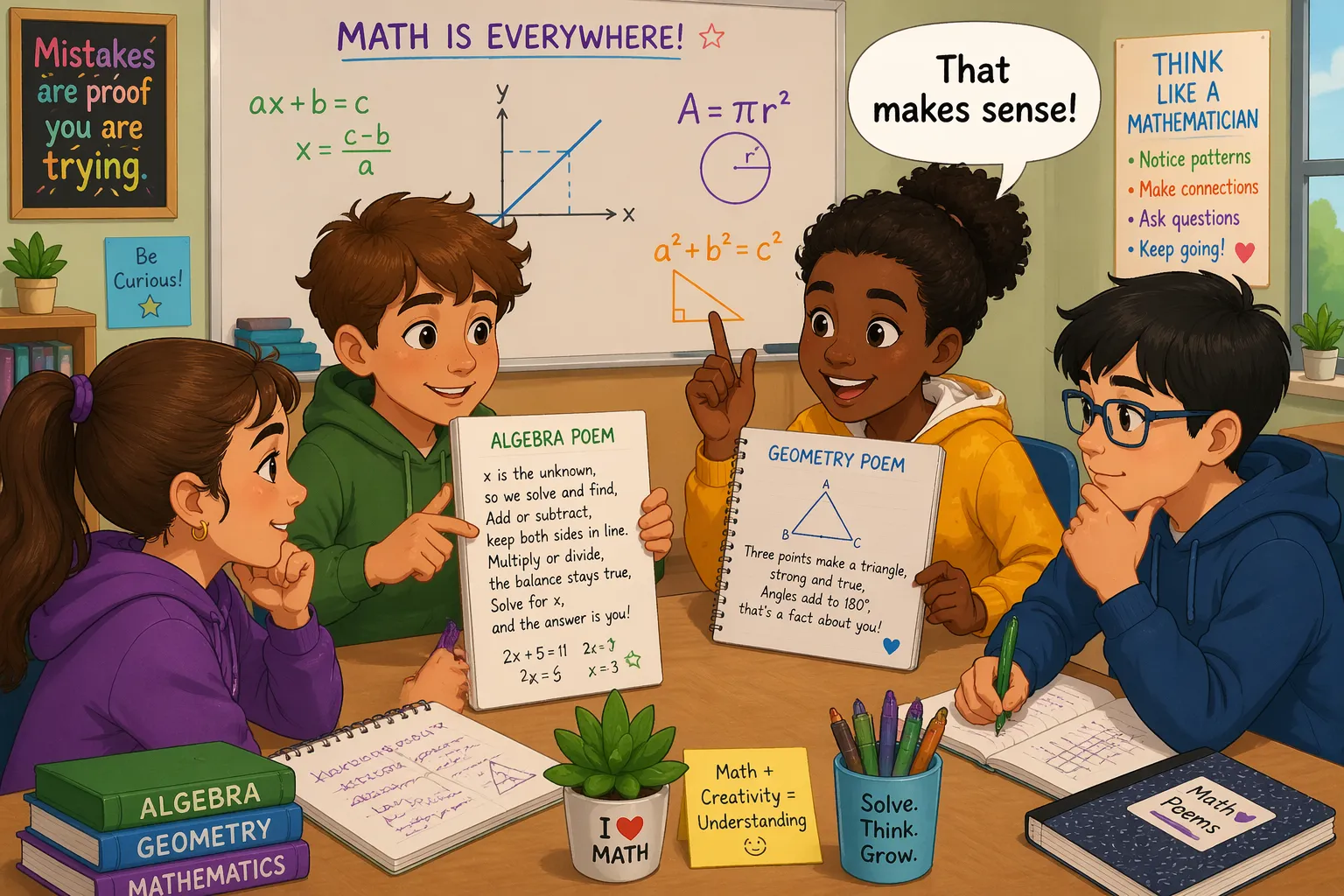
At the middle and high school level, short math poems shift from playful counting verses to analytical, concept-driven poetry exploring equations, abstract thinking, and mathematical philosophy. These pieces treat mathematics as a lens for understanding the world — blending precision with imagery in ways that reward careful reading.
Philip Larkin’s Koan by Paisley Rekdal
This poem offers a poetic reflection on paradox and mathematical logic in a compact, thought-provoking form. Rekdal’s work appears in academic poetry collections and engages students interested in the boundaries between language and formal reasoning.
Mathematics Considered as Vice by Anthony Hecht
Anthony Hecht explores obsession with mathematical thinking through rich metaphorical language in this mid-length poem. It is well-suited to high school students studying both mathematics and literary analysis, offering a rare intersection of the two disciplines.
Science of Numbers: Or Poetry as Pure Mathematics by William Virgil Davis
Davis blends mathematical structure with poetic form and symbolic reasoning, treating the two disciplines as parallel systems of meaning. This piece works well in cross-subject classroom discussions about logic, language, and the beauty of pattern.
Blue Terrance by Terrance Hayes
“Blue Terrance” uses numeric rhythm and structured repetition to explore identity and abstraction. Terrance Hayes is a MacArthur Fellow and widely studied contemporary poet whose work appears on many high school Advanced Placement reading lists.
Untold Witch by Keith Waldrop
This poem incorporates symbolic logic and hidden numerical patterns within a poetic narrative structure. Waldrop’s experimental style challenges high school readers to look for mathematical order beneath the surface of language.
Animals by Joshua Corey
Corey connects natural patterns — growth cycles, population — with mathematical interpretation in a condensed verse form. The poem supports discussions about mathematical modeling in biology and environmental science.
Center for Atmospheric Research by Bin Ramke
This poem integrates scientific data thinking with poetic measurement and structure, blurring the line between observation and calculation. It is a strong choice for science-focused classrooms exploring the relationship between quantitative reasoning and language.
At End of Life, Secret by Reginald Dwayne Betts
Betts reflects on finite quantities and existential counting themes in this emotionally resonant poem. Reginald Dwayne Betts is a widely recognized poet and legal scholar whose work appears in major literary publications including The New Yorker.
Origin of Order by Pattiann Rogers
“Origin of Order” explores mathematical structure behind natural systems — symmetry, sequence, and pattern — in elegant, closely observed verse. Rogers is frequently anthologized in collections linking science and poetry, making this piece ideal for interdisciplinary units.
After Midnight by Ray DiPalma
DiPalma uses timing and numerical sequencing to build abstract poetic rhythm, creating a poem that reads almost like a score or algorithm. It is well-suited to advanced students interested in experimental forms.
Drake Equation by Richard Kenney
Kenney references probabilistic reasoning and cosmic-scale calculations — the famous Drake Equation used to estimate intelligent life in the universe — as poetic structure. This poem pairs naturally with astronomy units and discussions of mathematical probability.
Mathematics by Jane Hirshfield
Jane Hirshfield is a widely published and award-winning poet whose work appears in the Best American Poetry series. “Mathematics” offers a contemplative piece connecting logic, language, and numerical structure in precise, luminous lines.
Mathematical by Jessica Nelson North
This piece explores the identity of mathematics as a language through compressed poetic lines. North’s work uses brevity to mirror the economy of mathematical notation itself.
Lullaby for Mathematician by Robert Bernard Hass
This poem blends calm, measured rhythm with symbolic mathematical thinking — a gentle meditation on the inner life of a mathematician. It works well in high school classrooms as a discussion prompt about the human side of abstract disciplines.
Introduction to Methods of Mathematical Physics by Lisa Rosenberg
Rosenberg’s structured poem references formal mathematical systems and physics modeling, making it an excellent companion for students taking calculus or physics alongside literature.
Morning Song by Sawako Nakayasu
“Morning Song” uses timing and sequence imagery to mirror mathematical progression, with a spare, minimalist style characteristic of Nakayasu’s broader body of work.
At Forty by Lynn Pedersen
This reflective poem uses the structure of numerical age and life-stage measurement to explore time, identity, and growth — concepts that resonate with older high school students.
Pajama Quotient by Linda Gregerson
Gregerson’s playful use of division and ratio concepts in an everyday domestic context makes abstract operations feel immediate and relatable.
Before I Was Gazan by Naomi Shihab Nye
Naomi Shihab Nye is one of the most widely taught poets in American middle and high school classrooms. This piece explores identity and numerical time progression in a deeply reflective tone, suitable for discussions that connect mathematics to human experience.
My Dog Practices Geometry by Cathryn Essinger
Essinger connects spatial reasoning and geometry through the behavior of a dog navigating space — an accessible, witty entry point into geometric thinking for middle schoolers. The poem appears in Essinger’s collection A Desk in the Elephant House.
Found Fragment on Ambition by David Tomas Martinez
Martinez uses fragmented numeric symbolism to represent goals and progression, creating a piece well-suited to discussions about measurement, scale, and aspiration.
Bible Belted: Math by Quraysh Ali Lansana
This poem integrates cultural rhythm with structured numeric expression, offering a perspective on how mathematical thinking appears across communities and traditions.
Calculations by Brenda Cárdenas
“Calculations” focuses on arithmetic reflection and symbolic computation — treating the act of counting and measuring as deeply human gestures.
Robert Duncan by Robin Blaser
Blaser’s poetic tribute incorporates abstract numerical and structural references within a poem about artistic and intellectual identity. It is best suited to advanced high school students with an interest in poetics.
Equation by Hyam Plutzik
This condensed poem explores symbolic equality and balance — the fundamental idea of the mathematical equation — through spare, precise language.
Geometry by Rita Dove
Rita Dove, a former U.S. Poet Laureate, explores spatial relationships and form-based reasoning in “Geometry.” The piece is widely anthologized and frequently used in high school literature and mathematics crossover lessons. It is available through many academic poetry databases and Dove’s published collections.
Short Math Poems by Theme: Numbers, Shapes, Equations, Gravity, Patterns
Organizing short math poems by conceptual theme allows teachers and students to find the right piece for a specific lesson quickly. The selections below group poems around core math topics for easy classroom and curriculum use.
Shapes and Geometry:
- Shapes by Shel Silverstein — geometric form recognition through playful language
- Geometry by Rita Dove — spatial relationships and structure in concise poetic expression
- My Dog Practices Geometry by Cathryn Essinger — movement and shape recognition through everyday observation
- Solid Figures by Author Unknown — introduces 3D geometry concepts through short descriptive verse
Equations and Calculation:
- Equation by Hyam Plutzik — balance and equality through symbolic mathematical language
- Drake Equation by Richard Kenney — probability and cosmic estimation as poetic structure
- Calculations by Brenda Cárdenas — arithmetic thinking and step-by-step numerical reflection
- Pajama Quotient by Linda Gregerson — playful interpretation of division and ratio in everyday life
Patterns, Gravity, and Order:
- Paragliding and Gravity Maths by Ianthechimp — gravity, motion, and numeric reasoning in compact form
- Origin of Order by Pattiann Rogers — structured systems and natural mathematical patterns
- Science of Numbers: Or Poetry as Pure Mathematics by William Virgil Davis — poetic structure merged with formal numeric logic
Usage Ideas for Short Math Poems
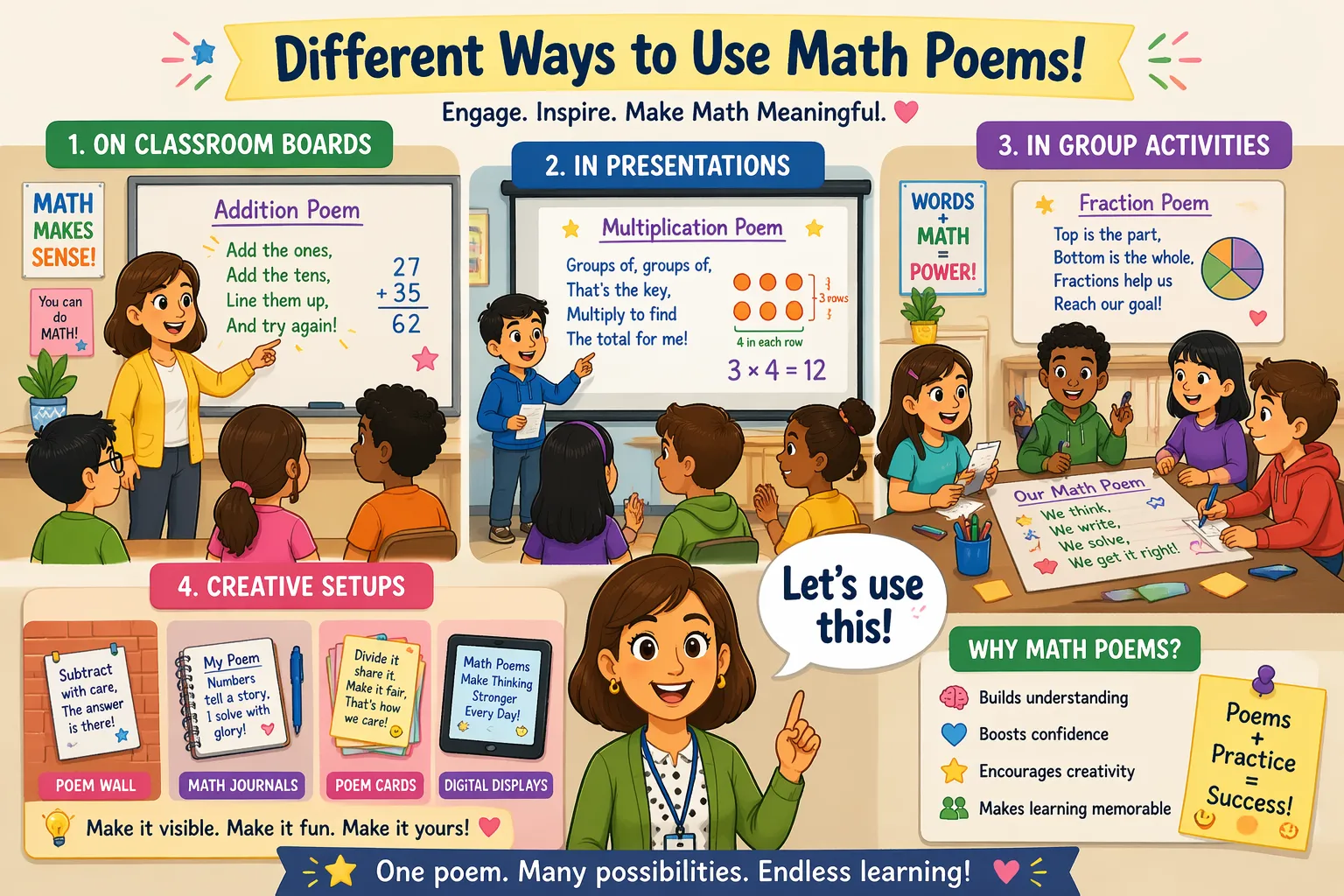
Short math poems are practical classroom and home-learning tools — not just decorative additions to a lesson plan. Used intentionally, they strengthen retention, motivation, and cross-subject thinking in students from kindergarten through high school.
Classroom Reading Activities With Short Math Poems
Teachers can open a math lesson by reading a short poem aloud, then asking students to identify the math concepts it references. This activates prior knowledge and frames the lesson within a creative, low-pressure context. Poems like “Marvelous Math” by Rebecca Kai Dotlich or “Geometry” by Rita Dove work well as entry points into geometry and number pattern units.
Creative Writing Exercises Based on Math Concepts
Students can write their own short math poetry using numbers, shapes, equations, or real-life math situations as inspiration. A simple structure — asking students to describe a geometric shape, a favorite number, or a math operation in four rhyming lines — produces surprisingly engaged writing even from reluctant learners. This exercise supports both mathematical vocabulary development and language arts standards simultaneously.
Memorization Support Through Rhythm and Rhyme
The rhythmic structure in math poems helps students retain formulas, sequences, and patterns more reliably than silent reading alone. Research in educational psychology suggests that information presented in rhyme is processed more deeply and recalled more accurately — a principle teachers can apply directly to teaching multiplication tables, geometric definitions, or the order of operations.
Visual Math Representation Using Poetry
Poems can be paired with diagrams, drawings, or manipulatives to create multimodal learning experiences. For example, after reading “Shapes” by Shel Silverstein, students can draw the shapes described, labeling them with vocabulary from both the poem and their math curriculum. This pairing strengthens the connection between verbal and visual mathematical understanding.
Cross-Subject Learning With Math and Language Arts
Integrating math poems into literature studies gives students a reason to engage with both subjects more deeply. A piece like “Geometry” by Rita Dove can anchor a lesson that covers both poetic form in English class and coordinate geometry in math class — reducing the feeling that subjects are isolated from each other and improving overall engagement.
Engagement Growth Through Short Math Poems Activities
Short math poems serve as a bridge between abstract mathematical thinking and the natural human love of story and rhythm. At the elementary level, playful counting poems like those by Shel Silverstein and Mr. R build number familiarity before formal instruction begins. At the middle and high school level, concept-driven poetry by poets like Rita Dove, Jane Hirshfield, and Terrance Hayes show students that mathematics is not just a school subject — it is a way of seeing the world.
When teachers and parents incorporate short math poems into regular routines — whether as a daily warm-up, a creative writing prompt, or a cross-subject reading activity — students develop stronger mathematical vocabulary, greater willingness to engage with abstract ideas, and a more positive emotional relationship with math overall. Poetry does not replace direct instruction in arithmetic, geometry, or algebra. It complements it by giving numbers a voice.
Frequently Asked Questions
What Are Short Math Poems Used For?
Short math poems support early math exposure, memory formation, and engagement through rhythm, storytelling, and numeric patterns. Teachers use them to introduce new concepts, reinforce vocabulary, and reduce math anxiety by approaching numbers through a familiar, enjoyable format.
How Do Short Math Poems Help Students Learn Math Skills?
Math poems reinforce counting, arithmetic, geometry, and abstract thinking through repetition and poetic structure. The rhythmic patterns in verse help students internalize sequences and formulas more reliably than text-only instruction, particularly for learners who respond well to auditory or language-based approaches.
Which Grade Levels Benefit From Short Math Poems?
Short math poems are suitable for learners from preschool through high school, with complexity increasing by level. Simple counting rhymes work best for elementary students ages 4–10, while abstract, concept-driven poems by contemporary poets are better suited to middle and high school students exploring algebra, geometry, and mathematical philosophy.
Can Students Write Their Own Short Math Poems?
Students at any grade level can create original poems using numbers, shapes, equations, and real-life math situations as their material. Even a simple four-line rhyme about addition or a shape can deepen a student’s engagement with mathematical vocabulary and reinforce the concepts covered in class.
Where Can You Find Short Math Poems Online?
Short math poems are available through several reliable sources:
- poetrysoup.com — a large community poetry platform with member-submitted math poems
- sciencepoems.net — classroom-focused poems by Mr. R covering numbers and patterns
- Published poetry collections by Shel Silverstein, Rita Dove, Rebecca Kai Dotlich, and Jane Hirshfield, available through library systems and major booksellers
- Academic poetry databases such as the Poetry Foundation at poetryfoundation.org for high school-level selections
Take a short quiz to find out what your everyday choices say about your parenting style
When your child is curious about something new, what’s your instinct?
Take a short quiz to find out what your everyday choices say about your parenting style
“Can I download this app?” What happens next?
Take a short quiz to find out what your everyday choices say about your parenting style
When it comes to rules at home, which sounds most like you?
Take a short quiz to find out what your everyday choices say about your parenting style
If you could give your child one life skill today, what would you pick?
Take a short quiz to find out what your everyday choices say about your parenting style
Your child gets to choose what to watch. What would your ideal setup look like?
Take a short quiz to find out what your everyday choices say about your parenting style
Pick your parenting superpower ✨