
How to Improve Handwriting for Kids – Effective Strategies for Parents

 Discover a Free Education Video App for Kids
Pastory uses AI to personalize educational video content based on your child’s interests and personality. Safe, engaging, and built for curious young minds. Sign up now to stay updated and enjoy early access with a free trial
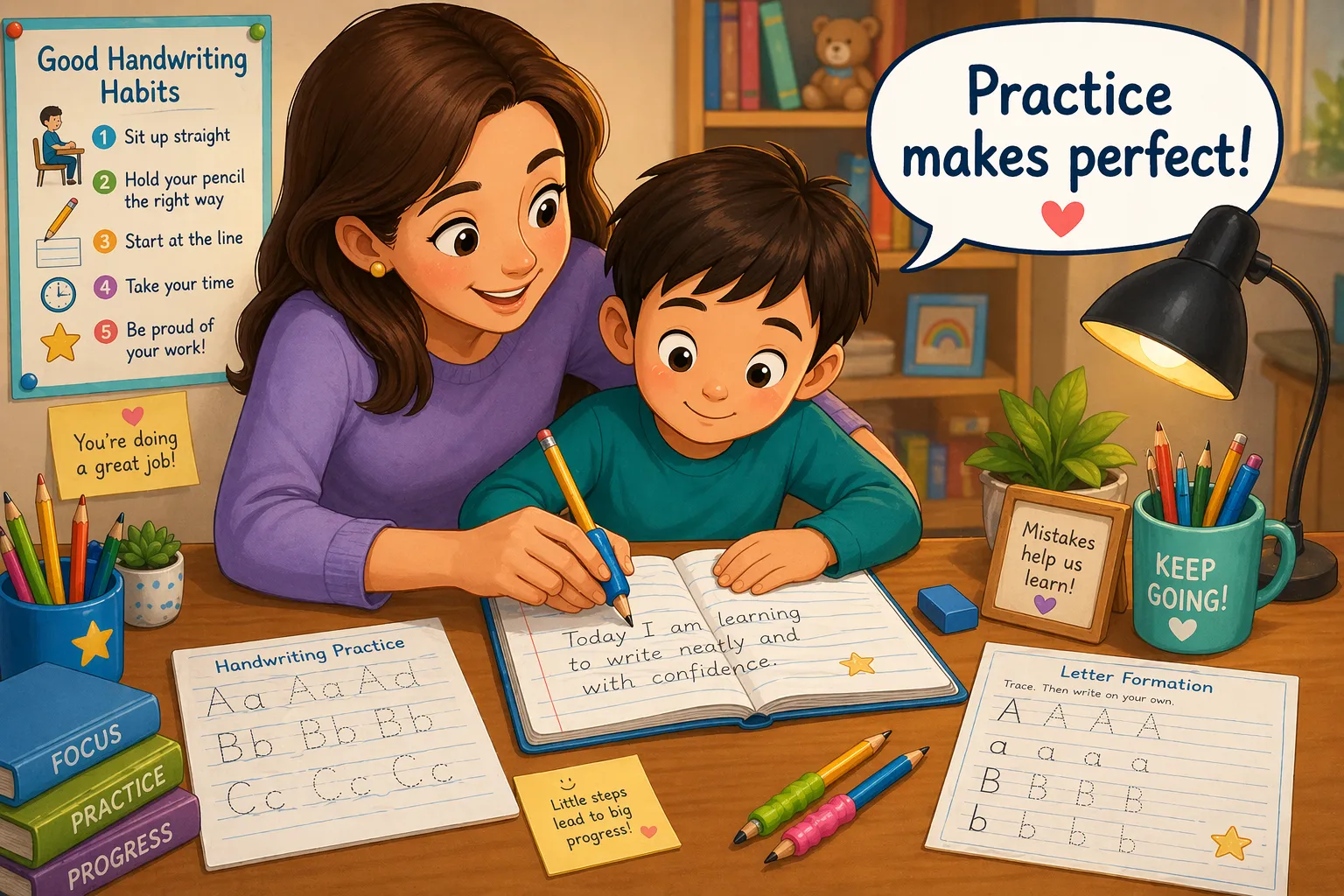
This guide covers proven, practical methods to help children from early elementary to middle school develop legible, neat handwriting. Whether your child is struggling with messy handwriting or just needs a little extra support, you’ll find strategies covering motor skills, posture, tools, motivation, and teacher collaboration — all grounded in child development research.
Analyze Your Child’s Handwriting Before Starting
Before jumping into handwriting practice, it helps to take a step back and look closely at what’s actually going wrong. Identifying specific issues — whether it’s letter formation, spacing, pencil grip, pressure, or writing speed — allows parents to target their efforts instead of drilling randomly. A focused approach saves time and reduces frustration for both child and parent.
Compare Handwriting With Peers
One of the simplest ways to understand where your child stands is to look at handwriting samples from classmates. With the teacher’s help, collect a few anonymous writing samples — not to shame or compare, but to use as a practical benchmark for legibility and letter size. Seeing that other children the same age write more slowly or with similar spacing issues can actually be reassuring and informative.
Ask Others to Read Your Child’s Writing
Try a short, low-pressure exercise: ask a sibling, grandparent, or family friend to read a paragraph your child has written without any help. Note which letters, words, or sections cause confusion or need explanation. This real-world readability test gives you immediate, honest feedback that a parent’s familiar eye might miss.
Consult Teachers for Observations
Teachers observe handwriting in a way parents rarely get to — under time pressure, across subjects, over weeks. When speaking with your child’s teacher, ask specific questions:
- Does my child rush through writing tasks or avoid them altogether?
- Has my child complained of hand pain or fatigue during longer writing sessions?
- How does handwriting quality affect their grades or assignment completion?
- Does my child struggle more with copying from the board than writing from memory?
These answers will help shape a targeted improvement plan at home.
Observe Posture and Paper Position
Correct seated posture is often overlooked but directly affects handwriting quality. Your child should sit with feet flat on the floor, back straight, and the non-dominant hand holding the paper steady. Paper should be tilted approximately 20–30 degrees to the right for right-handed children and the opposite direction for left-handed children. Poor posture or an awkward paper angle forces the wrist and shoulder into uncomfortable positions, which leads to inconsistent letter formation over time.
Key Traits of Neat Handwriting for Kids
Good handwriting isn’t about perfect, beautiful script — it’s about legibility and consistency. For school-age children, neat handwriting generally means consistent letter size, uniform spacing, proper alignment on the baseline, and readable letter shapes. When all four elements work together, writing becomes easier to produce and easier to read.
Consistent Letter Size and Shape
Children learning to write need to understand that letters have different height zones. Tall letters like b, d, and h should reach the top line, mid-size letters like a, c, and e stay in the middle zone, and descending letters like g, j, and p extend below the baseline. Using three-line paper — or highlighting these zones with different colors — helps children internalize these boundaries through visual and tactile cues.
Even Spacing Between Words and Letters
Spacing is one of the most common handwriting challenges for young children. A helpful trick is the “spaghetti and meatballs” rule: letters within a word sit close together like strands of spaghetti, while the space between words should be roughly as wide as one meatball — or one finger placed sideways. This concrete, silly image tends to stick with kids far better than abstract verbal reminders.
Proper Alignment on the Line
The “sky, grass, dirt” concept gives children a visual vocabulary for letter placement. Sky refers to tall letters that rise above the midline, grass is where most lowercase letters live, and dirt is where descending letters dip below the baseline. Using highlighters in three colors on lined paper brings this concept to life and helps children develop automatic alignment habits.
Appropriate Writing Speed
Writing too slowly leads to fatigue and lost ideas; writing too fast creates illegibility. The goal is a relaxed, automatic pace where the child can maintain letter shape without conscious effort. Research published through occupational therapy frameworks suggests that speed should only be increased once accuracy is firmly established — rushing improvement tends to reinforce poor habits rather than fix them.
Tools and Materials to Improve Handwriting for Kids
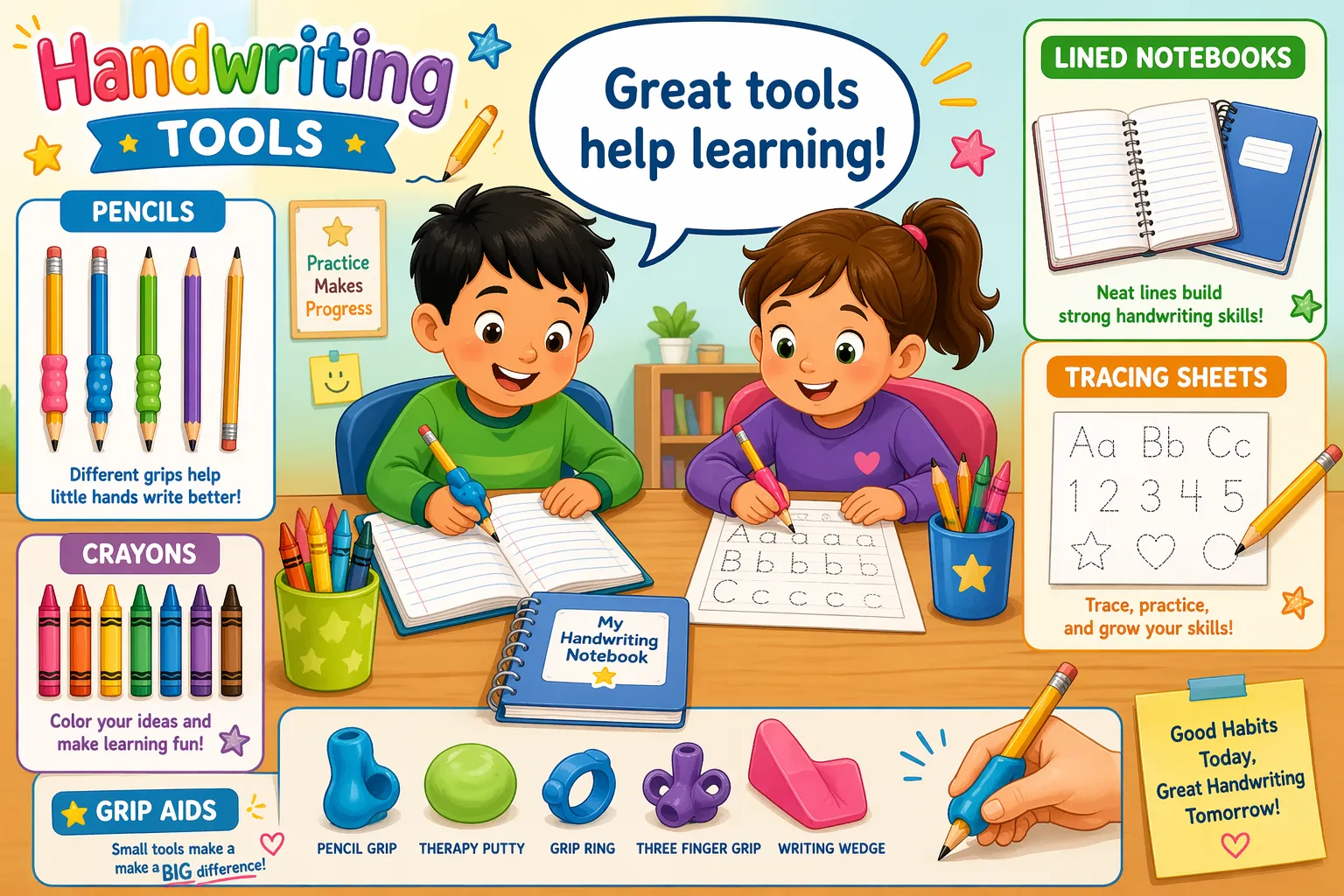
The right physical tools can make a significant difference in handwriting practice, particularly for children who are struggling with grip, pressure, or letter formation. Most of these tools are low-cost and easy to set up at home, making them practical options for parents without access to formal handwriting instruction or occupational therapy.
Select the Right Paper and Pen
Start younger children on raised-line paper, which provides a tactile cue for staying on the baseline. As children grow, transition to narrow-ruled or college-lined paper, which encourages smaller, more controlled writing. For the writing tool itself, look for a triangular barrel pencil or pen with a soft grip and, for older children, quick-drying ink to prevent smudging — especially important for left-handed writers.
Use Pencil Grips to Correct Grip Problems
An improper pencil grip is one of the leading causes of poor handwriting and hand fatigue. Common grip correctors include:
- The Pencil Grip (universal design for most children)
- Stetro grip (guides specific finger placement)
- DIY rubber band wrap (loop around the last two fingers to discourage over-gripping)
Test different grips for comfort before committing to one, and check that your child’s knuckles are not white or tense during writing.
Make a Slant Board at Home
A slant board reduces wrist extension and naturally improves letter formation, particularly for left-handed children. You don’t need to buy one — a 3-inch binder placed on the desk, or a large clipboard with a thick book underneath, works just as well. Even a 20-degree incline can reduce strain and improve the consistency of letter shapes within a single practice session.
Create Raised Lines for Tactile Feedback
Children who consistently write letters that float above or below the baseline often benefit from tactile feedback. Use Wikki Stix, glue lines, or puffy paint to create raised boundaries on lined paper. Feeling the baseline under the pencil helps children self-correct without constant verbal reminders from parents or teachers.
Introduce a Spacing Tool
A simple craft stick, a rubber finger spacer, or even a child’s own index finger can serve as a spacing tool between words. For home practice, printable spacing guides with dotted center lines are widely available and help children visually confirm correct spacing before and after each word.
Motor Skills and Physical Exercises for Better Handwriting
Handwriting is a physical skill that depends on fine motor control, hand strength, and shoulder stability — not just knowledge of letter forms. Many children with messy handwriting are not being careless; they simply haven’t developed the underlying muscle control that fluent writing requires. Building these skills through play and non-writing activities is often more effective than drilling letters alone.
Build Fine Motor Skills Through Play
Fine motor development supports handwriting skills at every age. Effective play-based activities include:
- Threading beads or lacing cards
- Squeezing putty, clay, or therapy dough
- Using tweezers to pick up small objects like pompoms
- Cutting with child-safe scissors along curved lines
- Building with small Lego bricks or magnetic tiles
These activities strengthen the intrinsic hand muscles used to hold a pencil and guide it across the page.
Draw and Play Games Before Writing
Before formal handwriting practice, warm up with drawing-based activities that build hand control. Mazes, connect-the-dots, tracing shapes, and dot-to-dot pictures all develop the same fine motor pathways used in letter formation. Physical games like Operation, Jenga, or threading activities also sharpen the hand-eye coordination that makes neat handwriting possible.
Manage Pencil Pressure
Too much pressure on the pencil is a common issue that causes hand fatigue, torn paper, and inconsistent letter weight. Teach children the difference between “heavy pencil” (pressing hard, deep grooves on the paper) and “light pencil” (barely touching the surface). Using a golf pencil or a short broken crayon naturally encourages lighter pressure because children can’t grip it tightly enough to over-press.
Build Writing Speed Gradually
Speed should develop as a byproduct of accuracy and motor memory — not the other way around. Start with slow, deliberate tracing of individual letters. Once a child can produce a letter correctly and consistently, introduce short timed exercises: one minute writing the same letter repeatedly, focusing on maintaining shape at a moderate pace. Increase speed only after the letter form is automatic and relaxed.
Fun Daily Handwriting Practice Strategies
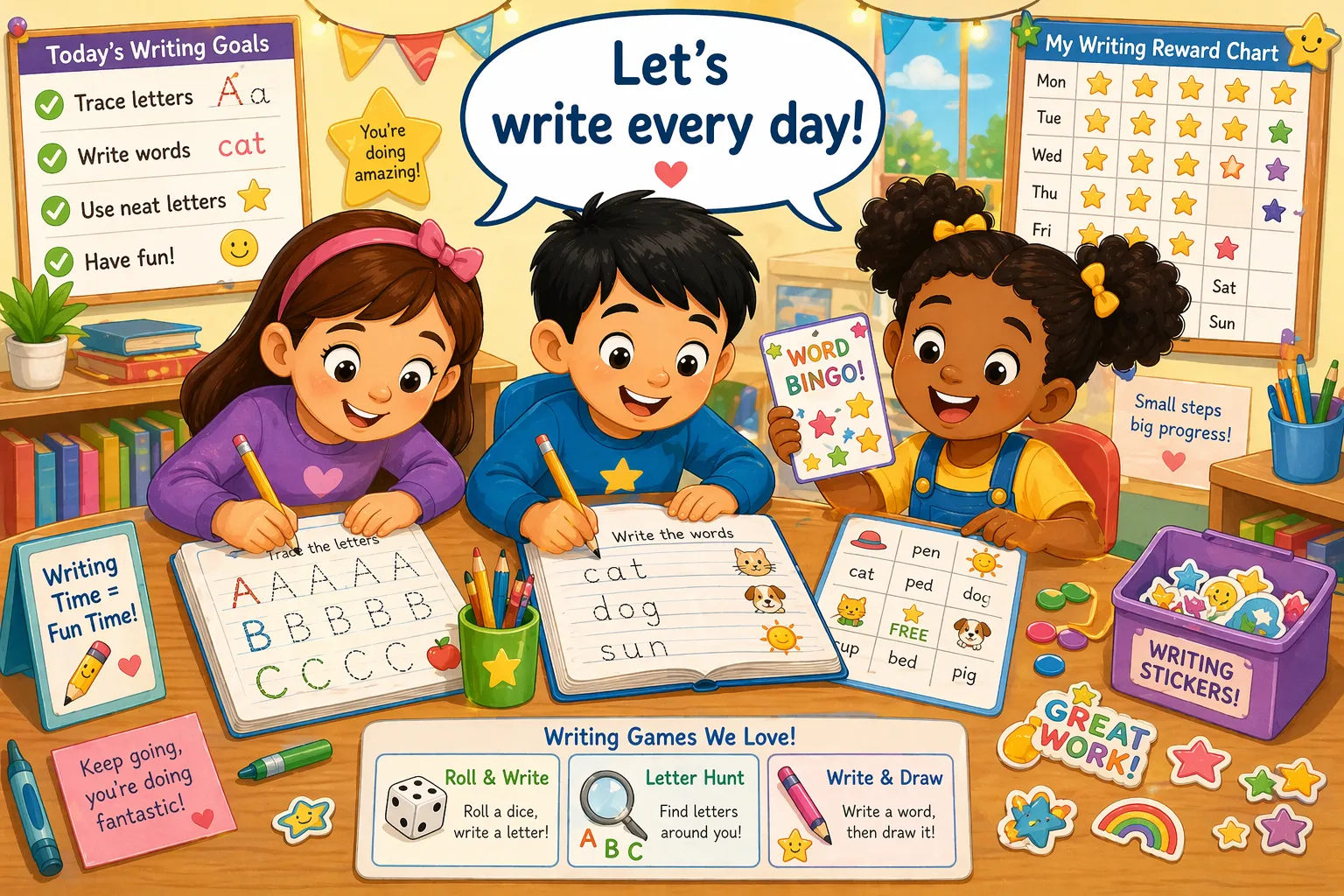
Consistent handwriting practice doesn’t need to feel like homework. Short, frequent sessions — five to ten minutes a day — are more effective than occasional long drills, and keeping the atmosphere positive prevents the resistance and avoidance that often develop when children feel pressured to perform.
Use Multisensory Methods to Learn the Alphabet
Writing letters in shaving cream, a sand tray, or a rice bin engages tactile memory alongside visual and motor learning. Start with large air-writing movements using the whole arm, then move to chalk on vertical surfaces like a chalkboard or sliding door, and finally to pencil on paper. This progression from large to small movements supports handwriting without tears — a well-known educational approach that emphasizes sensory engagement before pencil work.
Make the Writing Environment Enjoyable
A low-pressure, inviting writing environment reduces resistance significantly. Some ideas that work well:
- Let children use colorful pens only during handwriting practice (making it feel special)
- Write letters to pen pals, grandparents, or cousins
- Create the family grocery list together
- Write jokes, comic strip captions, or birthday card messages
When handwriting serves a real purpose, children are far more motivated to write neatly.
Use Hand-Over-Hand Guided Practice
For younger children or those who are resistant to independent practice, hand-over-hand guidance is a useful starting point. The parent gently places their hand over the child’s and guides the pencil through letter strokes. Over several sessions, gradually reduce pressure until the child is leading independently. This technique works especially well for cursive letter connections or particularly tricky letter formations.
Addressing Specific Age Groups and Challenges
How to Help Elementary School Kids (Ages 5–10)
Young children in elementary school benefit most from short, playful sessions focused on grip and letter formation. Keep practice to five to ten minutes daily, use wide-ruled paper, and praise effort consistently rather than comparing results to a standard. Drawing, coloring, and cutting activities count as handwriting support at this age, because they directly build the fine motor skills that pencil work requires.
Middle School Handwriting Improvement (Ages 11–14)
Older children need a different approach. Transition to narrow-ruled or college-lined paper, which naturally encourages smaller and more controlled letters. If print handwriting is consistently messy, introducing cursive writing can help — cursive enforces a natural rhythm and reduces the letter reversals common in rushed print. At this age, the goal is functional legibility and reasonable speed, not perfection.
Identify Underlying Issues
Some children struggle with handwriting despite consistent effort and good instruction. Red flags that warrant a professional evaluation include:
- Complaints of hand pain or cramping during short writing tasks
- Letter reversals (b/d, p/q) that persist after age 8
- Extreme avoidance of any writing activity
- Writing that becomes completely illegible under mild time pressure
These patterns may suggest dysgraphia, developmental coordination disorder, or vision-related difficulties. An occupational therapist or pediatrician can assess whether a child needs targeted support beyond standard handwriting practice.
Final Checklist for Handwriting Success
Use this checklist to confirm you’ve covered the key areas before, during, and after working on handwriting improvement with your child:
- ✅ Have you identified specific issues (grip, spacing, letter formation, pressure)?
- ✅ Have you consulted your child’s teacher for classroom observations?
- ✅ Is your child sitting with correct posture and paper position?
- ✅ Are you using the right paper and writing tools for your child’s age?
- ✅ Is pencil grip correct, or is a grip aid in use?
- ✅ Are fine motor activities included in daily play?
- ✅ Is practice kept short (5–10 minutes) and positive?
- ✅ Are you tracking progress with before-and-after samples?
- ✅ Has improvement been celebrated, even in small steps?
- ✅ Have you ruled out underlying issues with a teacher or health professional?
Frequently Asked Questions
What Causes Poor Handwriting in Kids?
Poor handwriting is most commonly linked to weak fine motor skills, an incorrect pencil grip, low muscle tone, insufficient handwriting instruction, or simply rushing. In some cases, it may indicate an underlying condition such as dysgraphia, developmental coordination disorder, or ADHD. A professional evaluation is worthwhile if handwriting challenges persist despite consistent, targeted practice.
Can a 13-Year-Old Improve Their Handwriting?
Yes — handwriting improvement is possible at any age. For teenagers, the focus should be on functional legibility rather than perfect letter forms. Narrow-ruled paper, a proper pencil grip, and ten minutes of daily handwriting practice typically produce noticeable results within two to four weeks. Cursive writing often helps teens slow down and write more consistently.
What Age Should You Start Handwriting Practice?
Pre-writing skills like drawing, tracing, and scribbling begin naturally around age three to four and directly support later letter formation. Formal handwriting instruction — learning correct lowercase letters and print — generally begins at age five to six in kindergarten. That said, improvement is possible at any age with the right tools and consistent practice.
How Long Does It Take to See Improvement?
With ten minutes of daily practice, most children show noticeable improvement within two to four weeks. Significant, lasting improvement typically takes two to three months of consistent effort. The quality of practice matters more than the length — focused, calm sessions outperform long, pressured drills every time.
Does Cursive Help Kids With Messy Print Handwriting?
Cursive handwriting often helps children who struggle with messy print, particularly because it reduces common letter reversals like b/d and enforces natural word spacing through connected strokes. It also tends to slow down children who rush. Most handwriting specialists recommend introducing cursive after print is at least readable, typically around age eight.

Take a short quiz to find out what your everyday choices say about your parenting style
When your child is curious about something new, what’s your instinct?
Take a short quiz to find out what your everyday choices say about your parenting style
“Can I download this app?” What happens next?
Take a short quiz to find out what your everyday choices say about your parenting style
When it comes to rules at home, which sounds most like you?
Take a short quiz to find out what your everyday choices say about your parenting style
If you could give your child one life skill today, what would you pick?
Take a short quiz to find out what your everyday choices say about your parenting style
Your child gets to choose what to watch. What would your ideal setup look like?
Take a short quiz to find out what your everyday choices say about your parenting style
Pick your parenting superpower ✨



