50 Funny Limericks for Kids With Authors: Classic and Modern Examples

 Discover a Free Education Video App for Kids
Pastory uses AI to personalize educational video content based on your child’s interests and personality. Safe, engaging, and built for curious young minds. Sign up now to stay updated and enjoy early access with a free trial
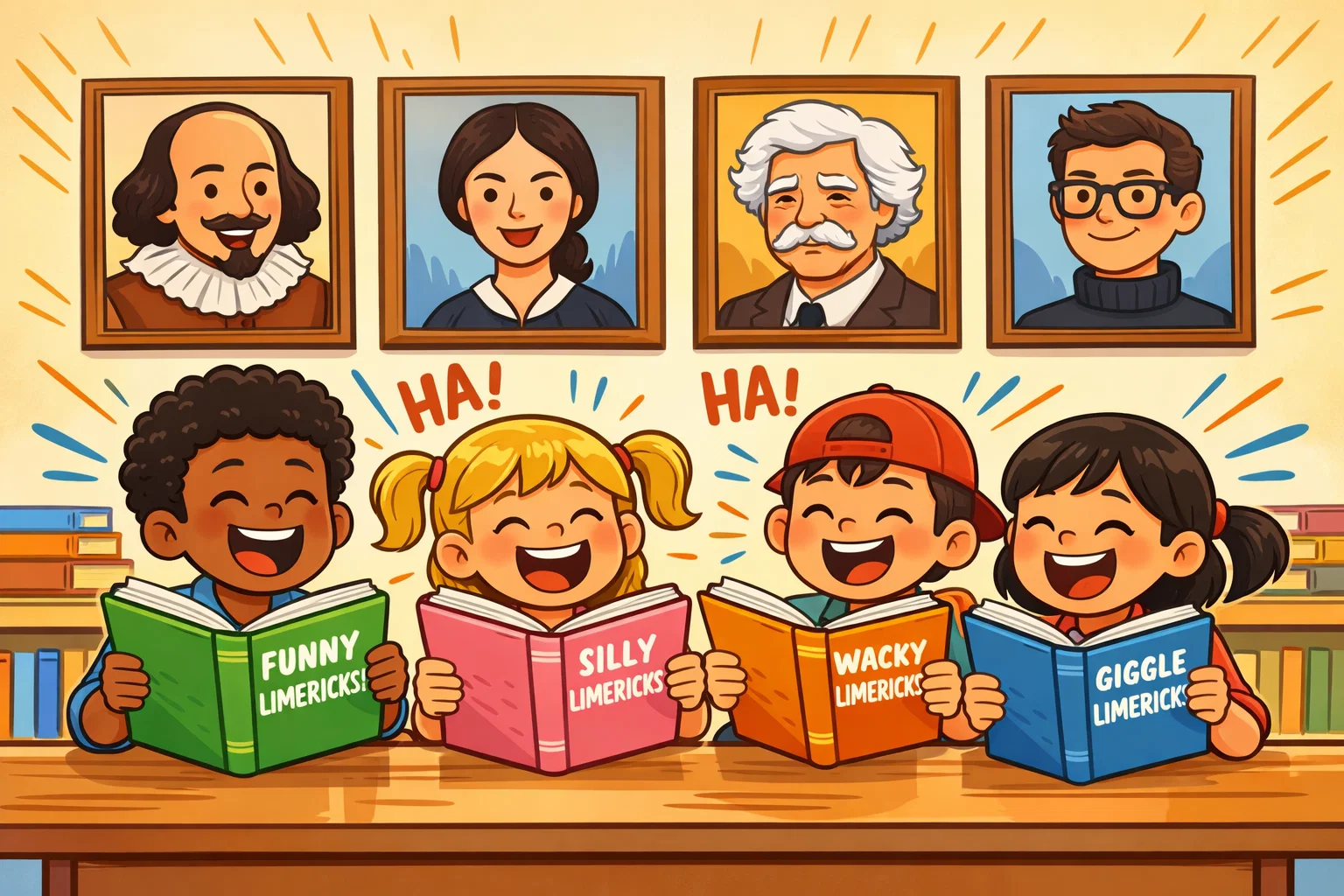
Limericks are one of the most accessible and delightful ways to introduce children to poetry. These five-line poems combine a bouncy rhythm with a humorous ending that quickly captures a child’s imagination. This guide brings together 50 kid-friendly limericks, from Edward Lear classics to anonymous favorites and playful modern-style verses. Whether you are a teacher planning a poetry lesson or a parent looking for a quick bedtime laugh, these examples offer a strong mix of fun and learning.
What Makes the Limerick Form Special
The limerick is a five-line verse form with a long history, but it became especially popular in English through writers such as Edward Lear in the 19th century. Unlike formal sonnets or complex free verse, the limerick is designed specifically to entertain through nonsense and humour. Working with rhyme, repetition, and stress patterns can help children notice sounds, syllables, and rhythm more clearly.
Limerick Rhyme Pattern
A standard limerick follows a strict AABBA rhyme scheme. This means the first line, second line, and fifth line all rhyme with each other (the “A” rhymes). The third and fourth lines are shorter and share their own separate rhyme (the “B” rhyme). This rhyming structure creates a predictable yet satisfying sound that makes the poem easy for young readers to memorize.
Limerick Rhythm and Syllable Count
The rhythm of a limerick is often described as “anapestic,” which gives it a galloping, musical quality. In a standard limerick, lines one, two, and five usually carry three stresses, while lines three and four usually carry two. This bouncy rhythm ensures the verse moves quickly toward the final line, making it a favorite for read-aloud sessions in the classroom.
Humor, Twist, and Read-Aloud Flow
Every great limerick example relies on a “twist” or a funny revelation in the last line. Most limericks build toward a comic surprise, whether through absurdity, wordplay, or sheer silliness. Because they are often funny and rely on silly imagery, they encourage kids to experiment with tone and expression, which are vital components of reading fluency.
Famous Limerick Poets and Traditions
While the exact origin of the name may link back to the city of Limerick in Ireland, the form was truly popularized by the British poet Edward Lear. In his 1846 publication, A Book of Nonsense, Lear used the single stanza format to create well-known characters and unusual situations. Other writers associated with memorable limericks include Oliver Wendell Holmes Sr. and Leigh Mercer.
50 Best Fun Limerick Examples for Kids With Authors
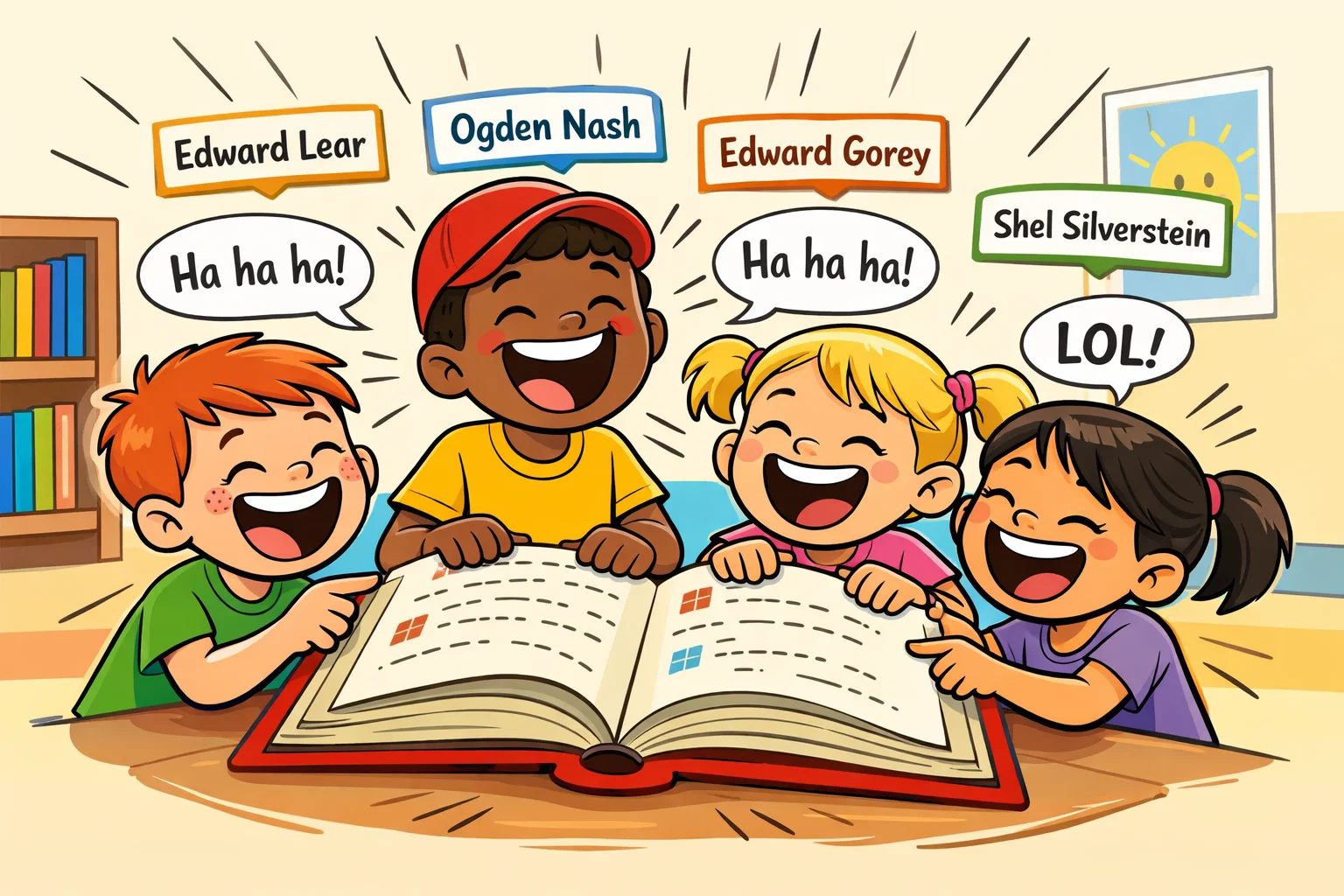
1–10: Edward Lear Classics
Edward Lear is the best-known classic limerick writer for children. His work from the mid-1800s defined the Victorian style of nonsense poetry.
- The Old Man with a Beard – Edward Lear
There was an Old Man with a beard,
Who said, “It is just as I feared! —
Two Owls and a Hen,
Four Larks and a Wren,
Have all built their nests in my beard!”
The visual of a creature-filled beard is absurdly silly and easy to draw.
- The Old Person of Rheims – Edward Lear
There was an Old Person of Rheims,
Who was troubled with horrible dreams;
So, to keep him awake,
They fed him with cake,
Which amused that Old Person of Rheims.
It uses an unusual place name and an absurd image to create humor.
- The Old Man of the Nile – Edward Lear
There was an Old Man of the Nile,
Who sharpened his nails with a file;
Had he used a sharp knife,
It had cost him his life,
But he died of a very large smile.
The final line provides a happy, comic twist.
- The Lady of Ryde – Edward Lear
There was a Young Lady of Ryde,
Whose shoe-strings were seldom untied;
She purchased some clogs,
And some small spotted dogs,
And frequently walked about Ryde.
It sparks the imagination by suggesting someone can walk on water.
- The Old Man in a Tree – Edward Lear
There was an Old Man in a tree,
Who was horribly bored by a Bee;
When they said, “Does it buzz?”
He replied, “Yes, it does!
It’s a regular brute of a Bee!”
The rhyme between “tree” and “bee” is simple and effective for early readers.
- The Young Lady of Norway – Edward Lear
There was a Young Lady of Norway,
Who casually sat in a doorway;
When the door squeezed her flat,
She exclaimed, “What of that?”
This courageous Young Lady of Norway.
It features a funny physical comedy element.
- The Old Man of the West – Edward Lear
There was an Old Man of the West,
Who wore a pale plum-colored vest;
When they said, “Does it fit?”
He replied, “Not a bit!”
That uneasy Old Man of the West.
The last word emphasizes a relatable feeling of wearing uncomfortable clothes.
- The Person of Gretna – Edward Lear
There was a Young Person of Gretna,
Who rushed down the crater of Etna;
When they said, “Is it hot?”
He replied, “No, it’s not!”
That mendacious Young Person of Gretna.
It uses a name of a place (Etna) to create a high-stakes, silly scenario.
- The Old Man of the Coast – Edward Lear
There was an Old Man of the Coast,
Who placidly sat on a post;
But when it was cold,
He relinquished his hold,
And called for some hot buttered toast.
The rhythm makes it very easy to read aloud during a lesson.
- The Lady in Blue – Edward Lear
There was a young lady in blue,
Who said. “Is it you? Is it you?”
When they said, “Yes, it is.”
she replied only, “Whizz!”
That ungracious lady in blue.
Its nonsense logic is playful and surprising.
11–20: Famous Traditional and Anonymous Limericks
Many popularized limericks are anonymous and have been passed down through generations. These well-known limericks have circulated widely in print and oral tradition.
- The Lady from Niger – Anonymous
There was a young lady of Niger,
Who smiled as she rode on a tiger;
They returned from the ride,
With the lady inside,
And the smile on the face of the tiger.
This is a famous traditional limerick, but for a child-focused article I would either omit it or clearly label it as dark humor.
- The Man from Peru – Anonymous
There was a young man from Peru,
Who dreamed he was eating his shoe;
He woke in the night,
With a terrible fright,
To find it was perfectly true!
The silly imagery of eating a shoe is a classic “gross-out” joke.
- The Pelican – Dixon Lanier Merritt
A wonderful bird is the pelican,
His bill will hold more than his belican;
He can take in his beak,
Enough food for a week,
But I don’t see how the helican.
The clever wordplay on “pelican” and “can” is a great vocabulary lesson.
- The Tutor – Carolyn Wells
A tutor who tooted the flute,
Tried to tutor two tooters to toot;
Said the two to the tutor,
“Is it harder to toot, or
To tutor two tooters to toot?”
It acts as a tongue-twister, improving oral fluency.
- The Flea and the Fly – Anonymous
A flea and a fly in a flue,
Were imprisoned, so what could they do?
Said the fly, “Let us flee!”
Said the flea, “Let us fly!”
So they flew through a flaw in the flue.
The rhyme and wordplay teach homophones in a funny way.
- The Man of Quebec – Rudyard Kipling
There was a small boy of Quebec,
Who was buried in snow to his neck;
When they said, “Are you friz?”
He replied, “Yes, I is —
But we don’t call this cold in Quebec!”
It uses a regional dialect to add humour.
- The Bee – Anonymous
A collegiate young person named Bee,
Was stung in the eye by a flea;
Said she, “Don’t you see,
It’s a bug on a bee,
And it’s really quite painful to me!”
It highlights a silly irony.
- The Old Man of Nantucket – Anonymous
There once was a man from Nantucket,
Who kept all his cash in a bucket;
But his daughter, named Nan,
Ran away with a man,
And as for the bucket, Nan tuck it.
The last line uses a clever pun on the place name.
- The Mouse – Anonymous
There was a small mouse with a hat,
Who sat on a very large mat;
He saw a big cat,
And that was just that,
Now the mouse is as flat as the mat.
It follows a simple aabba rhyme scheme that even toddlers can follow.
- The Star – Anonymous
There once was a glowing bright star,
Who wondered just where they all are;
He fell from the sky,
Without saying goodbye,
And landed right inside a jar.
It uses a theme of outer space and adventure.
21–30: Animal Limericks Kids Love
Animals are a natural fit for limericks because they invite vivid images, simple rhymes, and playful personification.
- The Bear – Anonymous
A hungry old giant named Bear,
Could never find something to wear;
He put on a rug,
And gave it a tug,
But he still had a bottom quite bare!
“Bare” and “Bear” provide a great second rhyme lesson.
- The Frog – Anonymous
There once was a green little frog,
Who lived in a swamp on a log;
He jumped for a fly,
But hit his own eye,
And fell back down into the bog.
It creates a clear visual image that children can picture quickly.
- The Whale – Anonymous
A very magnificent whale,
Had a very magnificent tail;
He gave it a flip,
And sank a big ship,
Then went to the store for a sale.
The rhyme between whale, tail, and sale gives the ending a silly twist.
- The Shark – Anonymous
A shark with a toothache, they say,
Swam into the shallow blue bay;
He met a kind trout,
Who pulled the tooth out,
And they both went together to play.
It uses a “kindness” theme within a funny context.
- The Kangaroo – Anonymous
A bouncy young kangaroo,
Had nothing at all for to do;
He jumped on a spring,
And started to sing,
“I’m coming to visit with you!”
The rhythm matches the “jumping” motion of the animal.
- The Snake – Anonymous
A colorful snake from the zoo,
Decided to try something new;
He tied a big knot,
In all that he got,
And couldn’t tell what he should do.
It turns the snake’s long body into a simple visual joke.
- The Duck – Anonymous
There once was a very small duck,
Who had an amazing run of luck;
He found a gold coin
By a puddle of muck,
And bought himself a bright yellow truck.
A duck buying a truck is the kind of absurd image kids remember.
- The Cat – Anonymous
A fluffy and fat tabby cat,
Decided to sleep in a hat;
The owner came by,
With a wink in his eye,
And said, “Well, imagine all that!”
It’s a relatable story for anyone with a pet.
- The Hippo – Anonymous
A hippo who wanted to fly,
Said, “I’ll give it a really good try!”
He flapped his big ears,
To the sound of some cheers,
But he never got into the sky.
It encourages imagination while remaining humorous.
- The Giraffe – Anonymous
A clumsy and tallish giraffe,
Gave everyone cause for a laugh;
He tripped on his neck,
And made such a wreck,
He broke his new trophy in half.
It uses physical comedy to entertain.
31–40: School, Family, and Everyday Life Limericks
- The Teacher – Anonymous
Our teacher is really quite cool,
The smartest in the whole of the school;
But one day she tripped,
And her coffee was spilled,
Right into the fish-pond and pool.
Kids love seeing teachers in silly accidents.
- The Homework – Anonymous
My homework was soggy and wet,
The worst that I’ve ever had yet;
The dog took a bite,
In the middle of the night,
A story you’ll never forget!
It plays on the “dog ate my homework” trope.
- The Sister – Anonymous
My sister is lovely and sweet,
And keeps her room tidy and neat;
But when she starts singing,
My ears start a-ringing,
And I have to escape to the street!
It captures sibling dynamics with humour.
- The Chef – Anonymous
A chef made a giant apple pie,
That reached all the way to the sky;
We ate for a week,
Until we could speak,
No more of that pie, oh my, oh my!
Hyperbole is a great poetic device for kids.
- The Skater – Anonymous
A boy on a skateboard was fast,
He wanted to be the first past;
He hit a small stone,
And let out a groan,
As he came in the very, very last.
The final line provides a realistic, funny outcome.
- The Dentist – Anonymous
I went to the dentist today,
To keep all the cavities away;
He looked in my mouth,
From north to the south,
And said, “Everything is okay!”
It provides reassurance about common childhood experiences.
- The Umbrella – Anonymous
A girl with a giant umbrella,
Was looking for a handsome young fella;
The wind gave a blow,
And wouldn’t you know,
She flew off to see Cinderella.
It mixes nonsense with fairy tale references.
- The Bedtime – Anonymous
When bedtime is finally here,
I pretend that I cannot quite hear;
I hide in my bed,
With a sheet o’er my head,
Until all the lights disappear.
It mimics a common bedtime “tactic.”
- The Soup – Anonymous
I ate such a big bowl of soup,
It made me feel quite in a loop;
I slurped and I swallowed,
And more of it followed,
Until I was part of the group.
Onomatopoeia like “slurped” is fun to read.
- The Clock – Anonymous
There was an old clock on the wall,
That didn’t like ticking at all;
It stopped at half-nine,
And said, “I’ll be fine,”
Then started to dance in the hall.
Personifying objects is a staple of nonsense poetry.
41–50: Nature, Adventure, and Silly Surprise Limericks
- The Moon – Anonymous
The moon is a circle of cheese,
That floats on a very light breeze;
The stars took a bite,
In the middle of night,
And made the moon cough and then sneeze.
It uses imagination to explain the phases of the moon.
- The Rocket – Anonymous
A rocket went up to the sun,
Because it was looking for fun;
It got way too hot,
Like a tea in a pot,
And burned up before it began.
The first line sets up a high-stakes adventure.
- The Tree – Anonymous
A whispering willow was sad,
Because its new haircut was bad;
The wind trimmed the leaves,
In the summer-time breeze,
And made the old willow quite glad.
It personifies nature in a humorous way.
- The Mountain – Anonymous
A mountain was tickled by clouds,
Far away from the noise of the crowds;
He let out a sneeze,
That shook all the trees,
And made all the birds cry out loud.
The idea of a sneezing mountain is silly and grand.
- The Rain – Anonymous
The rain came down purple and blue,
A color that nobody knew;
It tasted like grape,
In every small shape,
And stained all the grass and my shoe.
Sensory details make this limerick poem pop.
- The Ocean – Anonymous
The ocean was wavy and green,
The prettiest thing ever seen;
But a fish with a tuba,
And goggles for scuba,
Was somehow both noisy and keen.
A fish with a tuba is a classic nonsense image.
- The Snowman – Anonymous
A snowman was wearing a tie,
And a hat that was slightly awry;
When the sun came out bright,
He vanished from sight,
Without even saying goodbye.
It’s a timeless story about winter.
- The Wind – Anonymous
The wind is a mischievous sprite,
Who whistles in the middle of the night;
He steals all the hats,
And frightens the cats,
Then hides far away out of sight.
It explains the wind through a comic character.
- The Island – Anonymous
On an island of candy and cake,
There’s a chocolate-milk-colored lake;
You can swim in the sweet,
And have plenty to eat,
As long as you don’t get a stomachache!
It taps into a child’s love for sweets.
- The End – Anonymous
A poem must come to an end,
My very dear, wonderful friend;
With a skip and a hop,
We’ll come to a stop,
And see what the next day will send!
It provides a satisfying conclusion to the verse collection.
Why These Limericks Work for Kids
When choosing poetry for children, it helps to focus on pieces that are rhythmic, memorable, and easy to enjoy aloud. The limerick format is particularly effective because it aligns with how children process language – through pattern recognition and emotional engagement.
Safe Humor and Clean Word Choice
For a child-focused collection, choose limericks that rely on absurdity, surprise, and wordplay rather than cruelty, innuendo, or embarrassment. According to child development experts, silly humor (benign incongruity) helps children build confidence in their own understanding of the world. By recognizing what is “wrong” or “impossible” in a poem, they reinforce what is “right” in reality.
Short Form Kids Can Memorize
With only five lines, a limerick is the perfect length for a child’s working memory. Research in literacy shows that memorizing short, rhythmic texts improves “prosody” – the patterns of stress and intonation in language. This makes limericks especially useful for children who may struggle with longer poems or stories.
Author Credit Builds Trust and Search Relevance
Citing authors like Edward Lear or Oliver Wendell Holmes provides literary context. This transforms a simple list of “funny poems” into a credible educational resource. Knowing that some of these poems date back to the Victorian era can help children see how long playful verse has been part of literary culture.
How to Write Fun Limericks for Kids
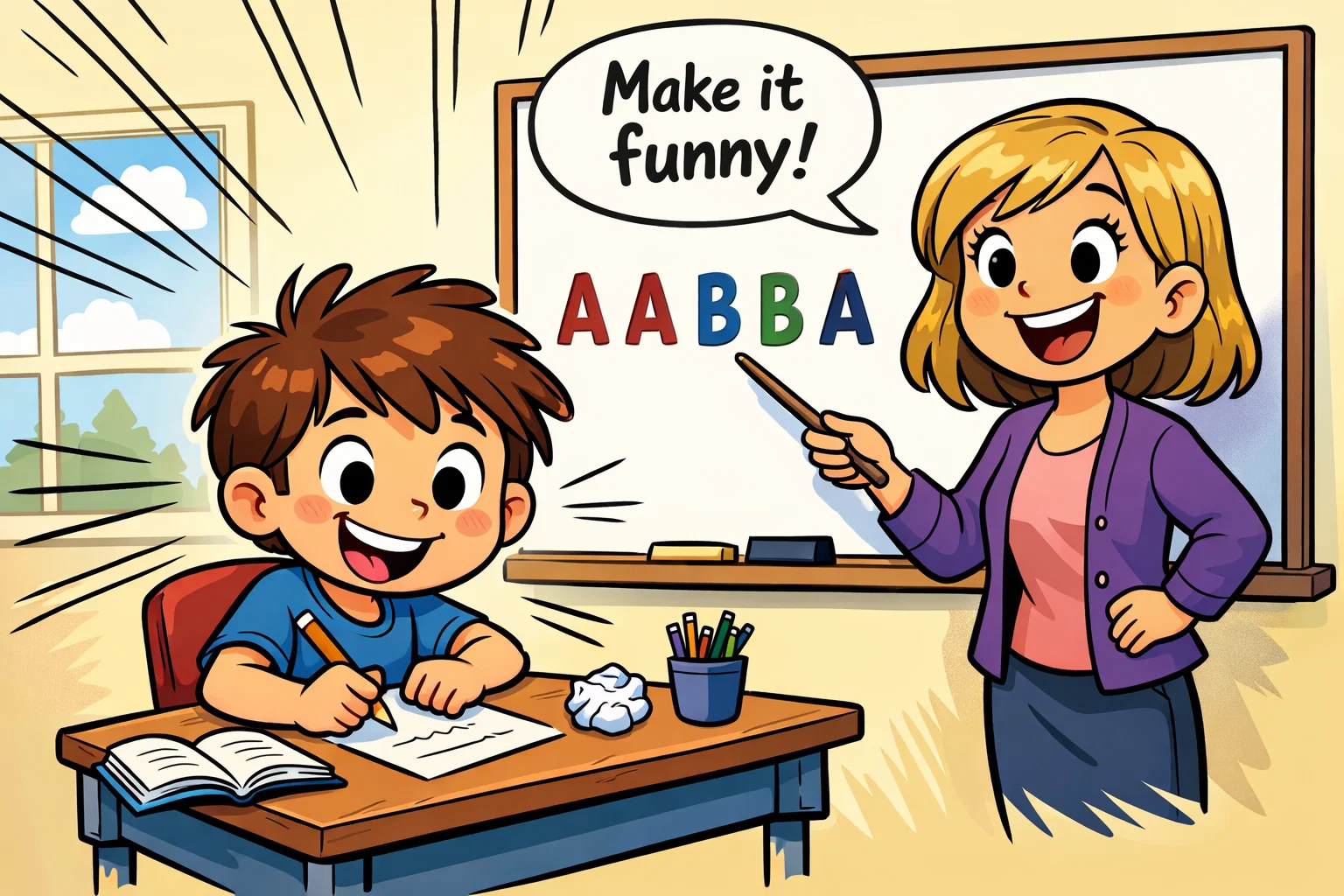
Writing a limerick is a fantastic classroom or home activity that boosts creativity. Follow these steps to help a child craft their own single stanza masterpiece.
Pick Character, Place, or Silly Situation
Start with the first line. A classic limerick usually begins with “There was a…” followed by a creature, a person, or the name of a place.
- Example Topics: A dancing dog, a boy from Mars, or a teacher who forgot their shoes.
Build AABBA Rhyme Pattern
Focus on the rhyme scheme.
- Choose a word for the end of line 1 (e.g., “Cat”).
- Find two more words that rhyme with “Cat” for lines 2 and 5 (e.g., “Hat”, “Sat”).
- Choose a different rhyme for lines 3 and 4 (e.g., “Blue”, “Shoe”).
Keep Lines 3 and 4 Short
Explain to the child that lines three and four should be shorter than the rest. This creates the “gallop” rhythm. If lines one, two, and five have 8–9 syllables, lines three and four should only have 5–6.
End With Clever Punch Line
The final line is the most important. It should provide a twist or a funny conclusion.
- Formula: The hero tries something (Lines 1-2), something goes wrong (Lines 3-4), and the result is funny (Line 5).
Read Aloud and Fix Rhythm
The best way to test a limerick is to read it aloud. If you stumble over the words, there are probably too many syllables. Clap along to the beat: da-DUM da-da-DUM da-da-DUM. If it doesn’t “bounce,” try removing a word.
Limerick Activities for Kids
Activity 1: Clap Rhythm and Mark Rhymes
Read a famous limerick aloud and have children clap on the stressed beats. Afterward, use colored pencils to circle the “A” rhymes in one color and the “B” rhymes in another. This reinforces the rhyming structure visually.
Activity 2: Finish Missing Last Line
Provide a limerick with the last line removed.
There once was a boy named Lee,
Who climbed up a very tall tree;
He reached for a pear,
But it wasn’t quite there…
(Child fills in: And he fell on his head, you see!)
Activity 3: Write New Limerick From Prompt
Use these inspiration prompts to start a poem:
- “There once was a frog in a bog…”
- “A silly young girl from the moon…”
- “A teacher who loved to eat cake…”
Free Printable Limerick Worksheet
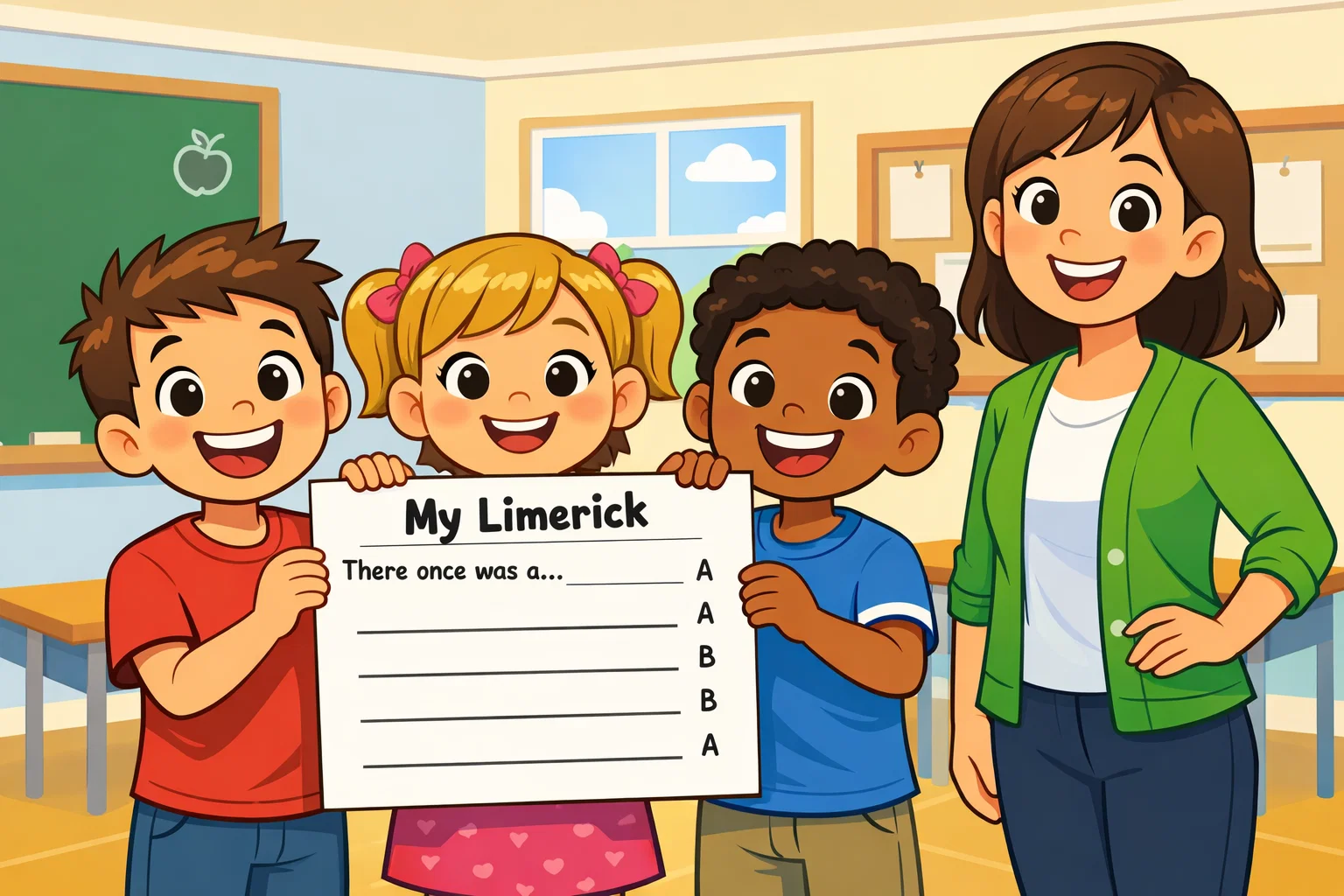
Fill-in-Lines Template
| Line | Rhyme | Your Words |
| Line 1 (Long) | A | There once was a _________ from _________ |
| Line 2 (Long) | A | Who ____________________________________ |
| Line 3 (Short) | B | He/She __________________________________ |
| Line 4 (Short) | B | And _____________________________________ |
| Line 5 (Long) | A | ________________________________________ |
Rhyme Word Bank
- Group 1: Dog, Log, Fog, Frog, Jog
- Group 2: Bee, Tree, See, Knee, Free
- Group 3: Moon, Spoon, Noon, Soon, Tune
- Group 4: Bear, Chair, Hair, Fair, There
Author Match Exercise
Match the poet to their description:
- Edward Lear – A) British poet who helped to popularise limericks in 1846.
- Anonymous – B) A term used when we don’t know the poet’s name.
- Oliver Wendell Holmes – C) A famous American writer who enjoyed comic verse.
Classroom and Home Use Ideas
- Morning Work: Start the day with a “Limerick of the Day” to get kids laughing.
- Poetry Slam: Have kids perform their limericks with funny voices.
- Art Connection: Ask children to illustrate the unusual characters in their poems.
Future of Limericks for Kids
In a digital age, the limerick remains relevant because its short form suits quick reading, performance, and classroom use. It serves as a precursor to more complex literary analysis.
Limericks in Classroom Literacy Practice
Teachers increasingly use limerick poems to teach rhythm and syllable counting. Because the form is so rigid, it provides a “safety net” for students who feel overwhelmed by the lack of rules in free-verse poetry.
Limericks in Digital Learning
Digital writing tools can also use limerick templates to teach rhyme, typing, and pattern recognition. The “AABBA” pattern is essentially a linguistic algorithm that helps children understand structured thinking.
Limericks in Family Reading Time
Limericks are the “dad jokes” of poetry. They provide a quick way for families to bond over a short story without the commitment of a full book. They encourage imagination and shared humour, which strengthens emotional intelligence.
More Poetry Fun for Kids
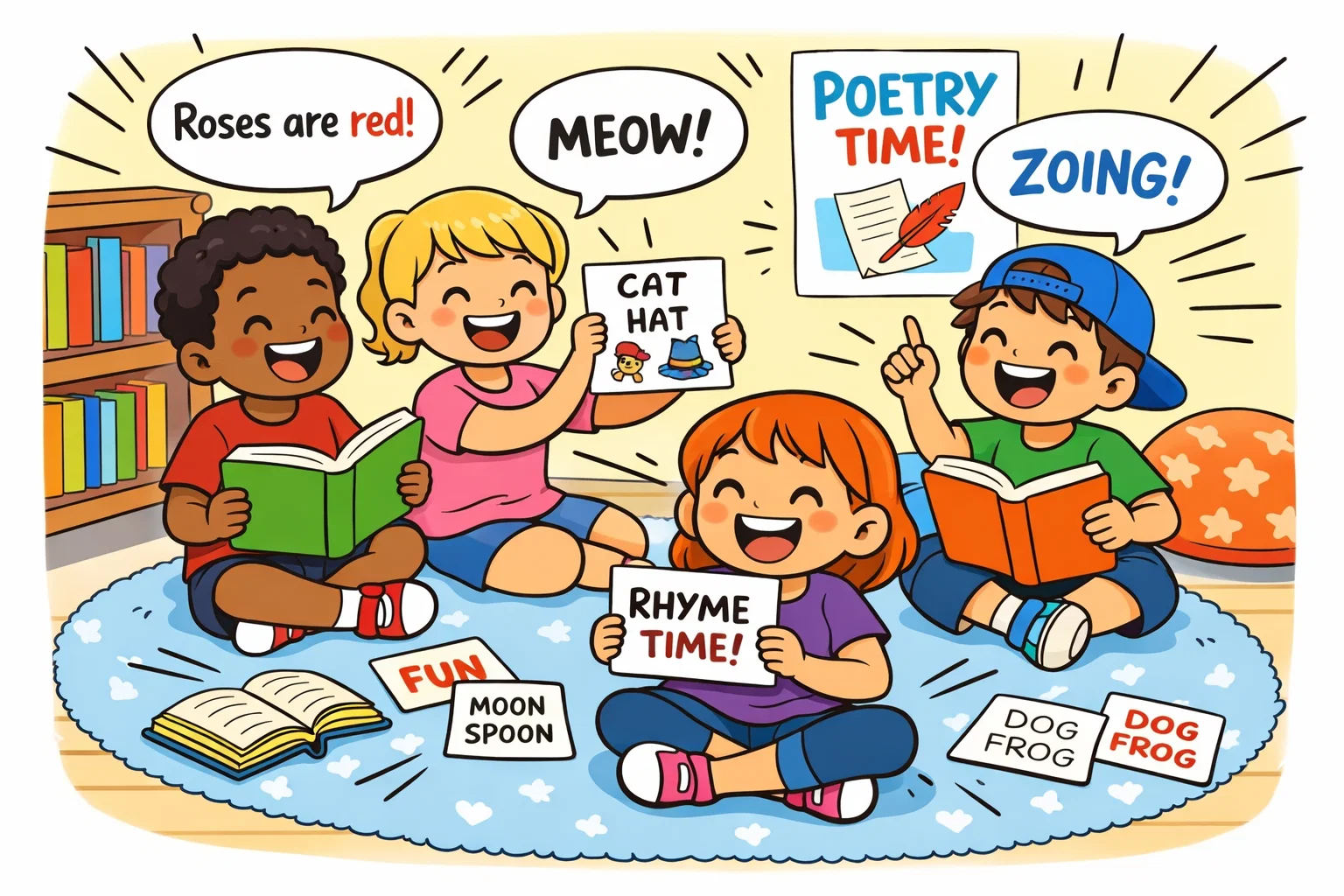
Haiku Examples for Kids
While a limerick is comic and bouncy, a haiku is a three-line poem often taught through a 5-7-5 syllable pattern in English. It is a quieter, more observant form of poetic expression.
Poetry Games and Activities
Try “Poetry Scavenger Hunt,” where kids find objects in the house that rhyme, then try to fit them into a single stanza.
Rhyming Words for Kids
Building a strong “Rhyme Bank” is the first step toward becoming a poet. Practice with word families like “-at,” “-ing,” and “-op.”
Short Funny Poems for Kids
If your child enjoys limericks, they will also love nonsense poems by Lewis Carroll or the comic verses of Shel Silverstein.
Final Takeaways
Best Way to Use This List
Start with a few Edward Lear classics to show what a traditional limerick sounds like. Once the child recognizes the bouncy rhythm, move to the animal and school sections to show how the form can be used for any topic.
Best Next Step After Reading
Pick your favorite example from the 50 provided, grab a piece of paper, and draw a picture of the scene. Then, try to change just one word in the final line to see how it changes the joke!
Frequently Asked Questions
Which Limerick Is Most Famous?
The most famous limerick is arguably Edward Lear’s “The Old Man with a Beard,” published in 1846. It perfectly illustrates the aabba rhyme scheme and the silly spirit of the genre. Another contender is “The Lady from Niger,” which has been a staple of British and Irish schoolbooks for decades.
Which Authors Wrote the Best Limericks for Kids?
Edward Lear is the key name here, because he helped popularize the limerick in the 19th century. Many child-friendly limericks are also traditional or anonymous, which is why clear labeling matters in a collection like this.
How Many Lines Are in Limerick?
A limerick poem strictly contains five lines. Lines one, two, and five are longer and rhyme with each other. Lines three and four are shorter and share a separate rhyme. This specific five-line structure is what gives the poem its iconic, funny “snap.”
How Can Kids Write Their Own Limerick?
Kids can write their own limerick by following a 3-step lesson:
Pick a funny subject, such as a cat in a hat. Follow the AABBA rhyme scheme by rhyming lines 1, 2, and 5. Make lines three and four shorter to keep the rhythm moving. Always end with a twist!
Take a short quiz to find out what your everyday choices say about your parenting style
When your child is curious about something new, what’s your instinct?
Take a short quiz to find out what your everyday choices say about your parenting style
“Can I download this app?” What happens next?
Take a short quiz to find out what your everyday choices say about your parenting style
When it comes to rules at home, which sounds most like you?
Take a short quiz to find out what your everyday choices say about your parenting style
If you could give your child one life skill today, what would you pick?
Take a short quiz to find out what your everyday choices say about your parenting style
Your child gets to choose what to watch. What would your ideal setup look like?
Take a short quiz to find out what your everyday choices say about your parenting style
Pick your parenting superpower ✨