50 Rhyming Words for Kindergarteners to Learn and Enjoy

 Discover a Free Education Video App for Kids
Pastory uses AI to personalize educational video content based on your child’s interests and personality. Safe, engaging, and built for curious young minds. Sign up now to stay updated and enjoy early access with a free trial
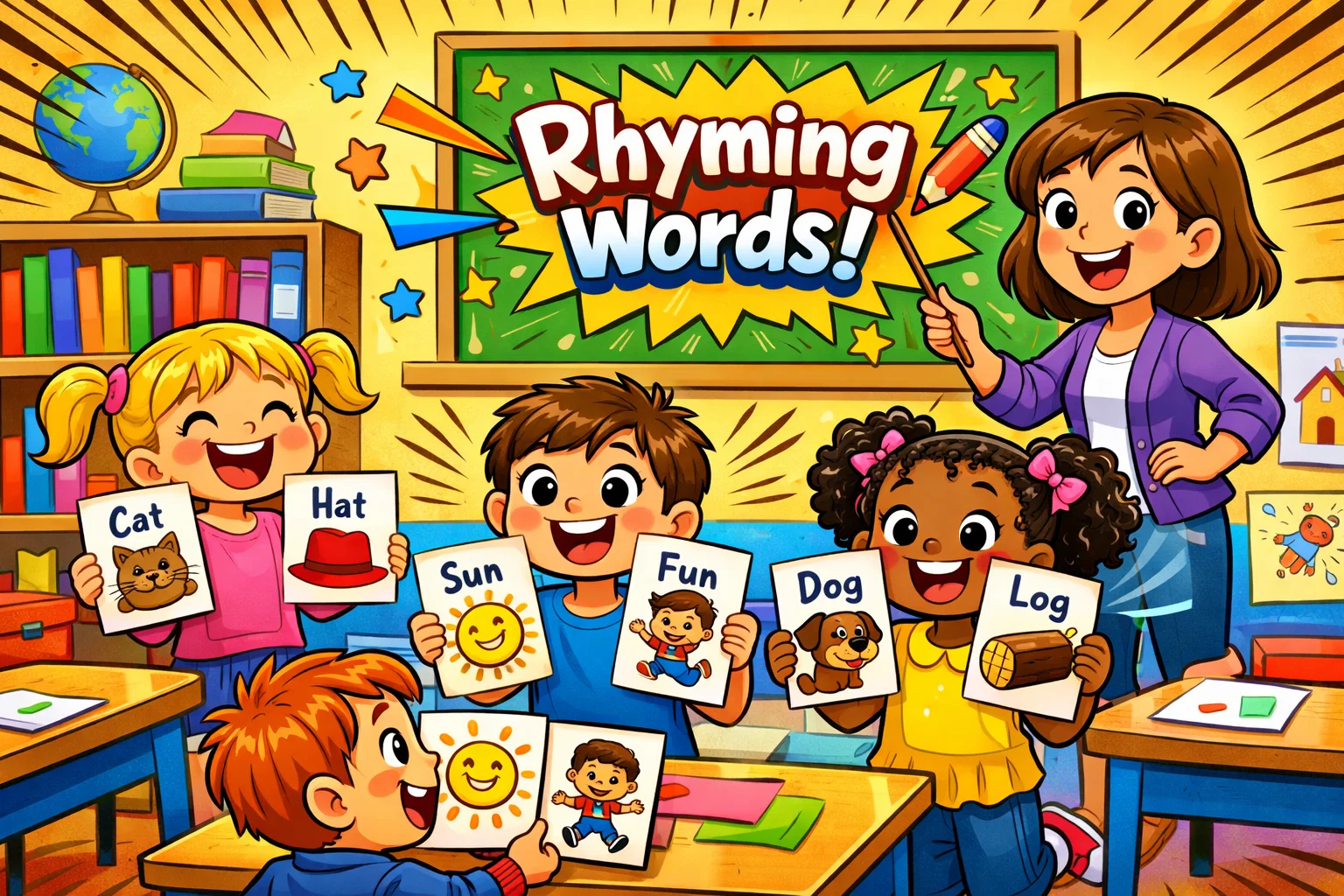
Helping kindergarteners recognize sound patterns is a foundational step in early literacy development. In this guide, you will find a list of 50 rhyming words, practical activities, and effective strategies for teaching them at home or in the classroom. By focusing on phonemic awareness, parents and teachers can help children move from listening for sounds to reading with confidence. You will also learn how to expand a child’s vocabulary, strengthen listening skills, and turn learning new words into a joyful daily habit through interactive games and songs.
Research suggests that phonological awareness is a strong indicator of later reading success. A structured approach to sound patterns helps young children begin decoding words more easily. This article offers a practical toolkit for anyone who wants to make early literacy instruction engaging and effective for young learners.
What Are Rhyming Words?
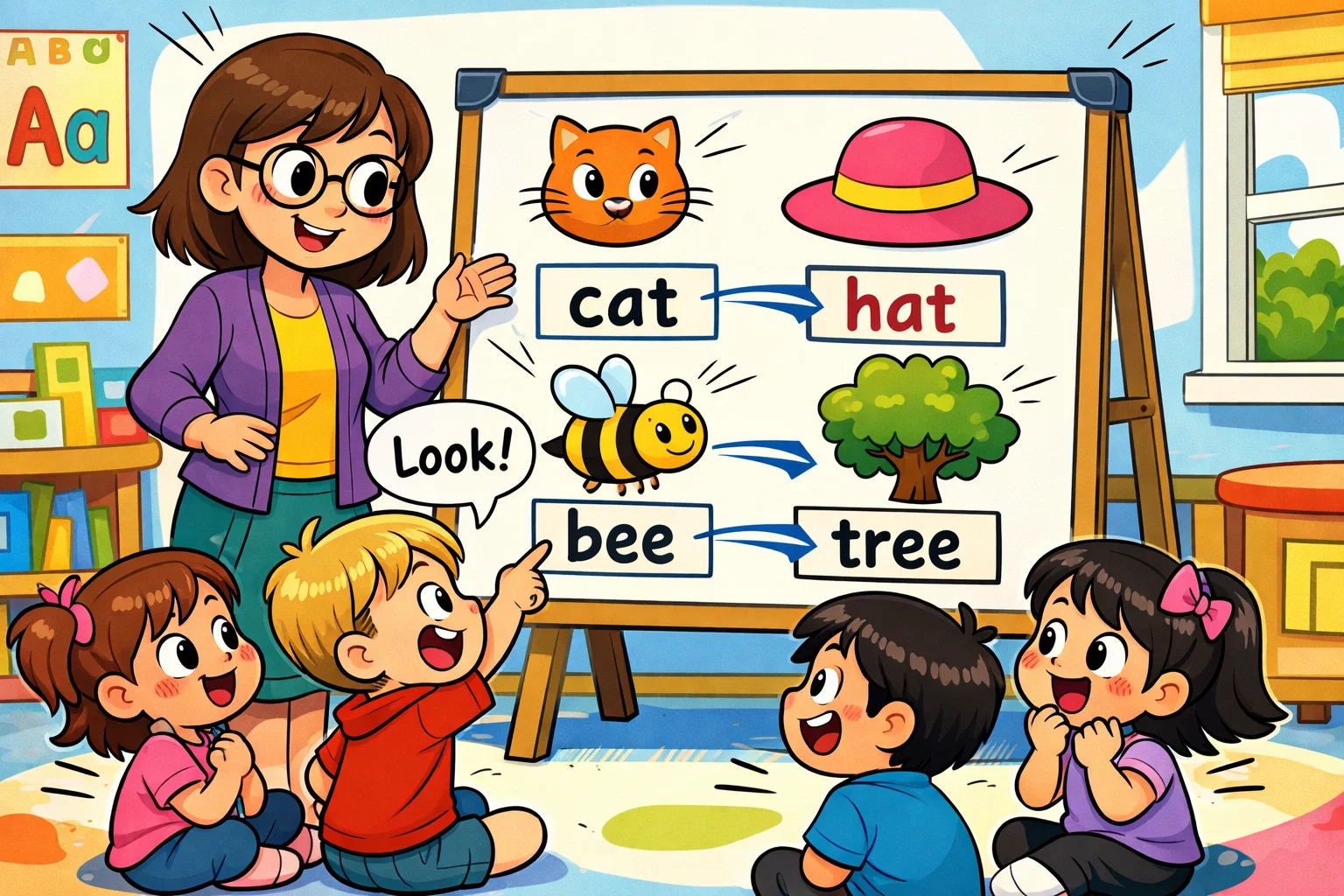
Rhyming words are words that share the same ending sound, even if their beginning sounds are different. For kindergarteners, understanding rhyme means noticing that words like cat and hat go together because they sound the same at the end. When children hear and practice rhymes, they begin to notice sound patterns in English, which is an important precursor to decoding new words during reading instruction.
In early literacy instruction, many simple rhyming words belong to the same word family. Recognizing these families can help a child read or spell similar words based on patterns they already know. This kind of pattern recognition is an important part of early literacy.
Ending Sounds Kids Can Hear Fast
Children naturally respond to sound patterns that are clear and repetitive. Simple rhyming pairs such as sun and fun or log and dog are easiest for young children to hear because their ending sounds are clear and consistent. Many young children can recognize rhyming patterns before they can identify individual letters, which makes spoken-word activities a strong starting point for early literacy practice.
Difference Between Rhyming and Non-Rhyming Words
A rhyming pair shares the same ending sounds, while a non-rhyming pair does not. For example, pig and wig match because they share the “-ig” sound, but pig and pen do not, even though they start with the same letter. Teaching this contrast helps children focus on the ending sound in each word, which supports early literacy development. It is helpful to explain that the beginning of the word changes while the ending sound stays the same.
Easy First Examples for Kindergarten
The best examples for kindergarten are one-syllable words that represent familiar objects or ideas. Starting with words connected to animals, toys, or food makes the concept concrete and relatable.
- Animals: Cat/Rat, Bee/Tree, Frog/Log
- Home: Bed/Red, Cup/Up, Chair/Bear
- Action: Hop/Stop, Run/Sun, Play/Day
50 Rhyming Words for Kindergarten Kids
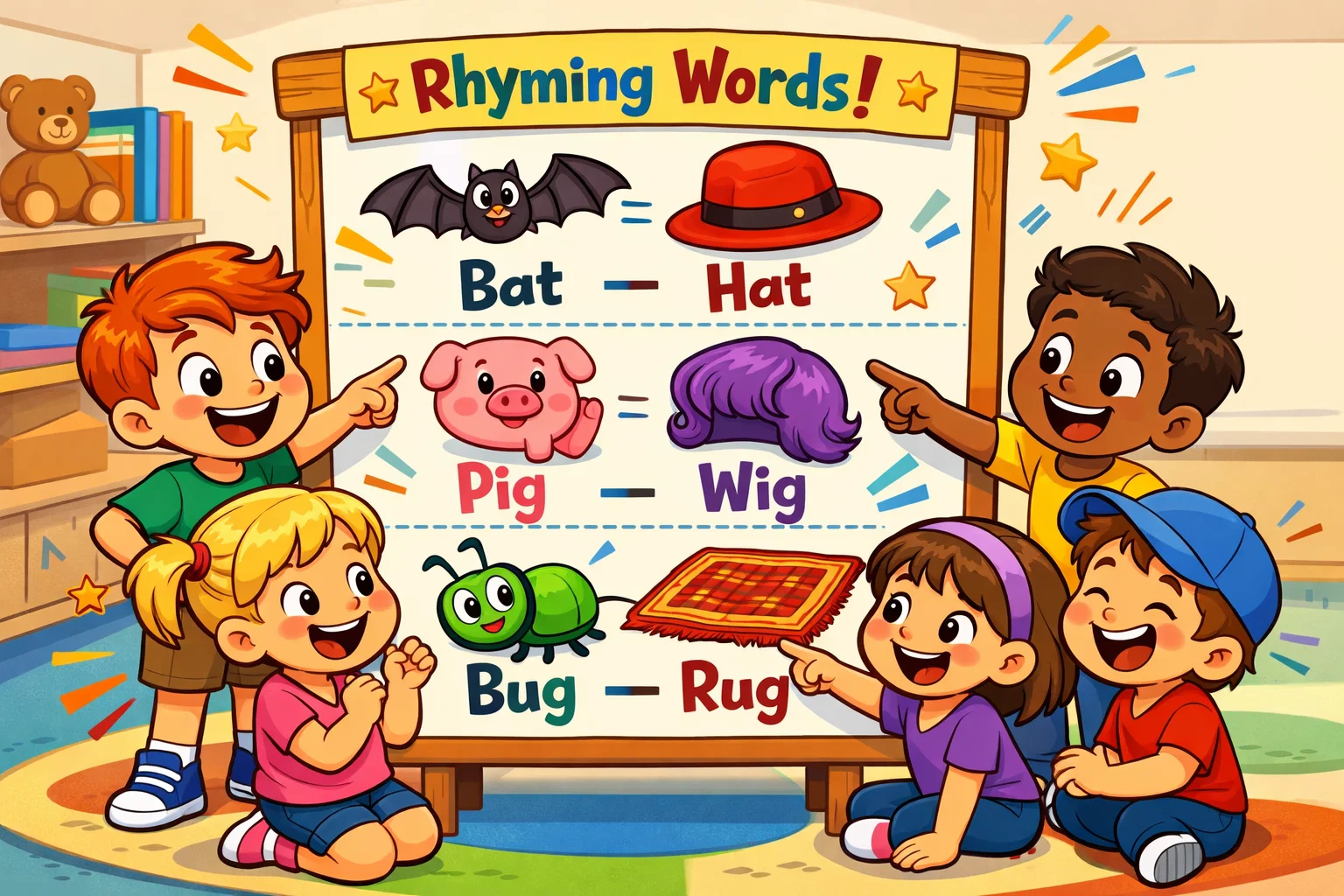
Organizing rhyming words by word family is one of the most effective ways to make learning systematic. This list of 50 words works well for kindergarteners because the words are short, easy to sound out, and common in early reading materials.
| Word Family | List of Examples | Example Sentence |
| -at | Cat, Bat, Hat, Mat, Rat | The cat wore a hat. |
| -an | Can, Fan, Man, Pan, Van | The man had a fan. |
| -ap | Cap, Map, Nap, Tap, Clap | I wear a cap before I take a nap. |
| -ag | Bag, Tag, Wag, Rag, Flag | The bag has a tag. |
| -et | Pet, Net, Jet, Wet, Get | My pet got wet. |
| -en | Hen, Pen, Ten, Den, Men | Ten men held a pen. |
| -ig | Pig, Wig, Dig, Big, Fig | The big pig wore a wig. |
| -in | Pin, Fin, Tin, Win, Bin | Put the pin in the tin. |
| -op | Hop, Mop, Top, Pop, Stop | Stop and hop to the top. |
| -ug | Bug, Hug, Mug, Rug, Tug | The bug is on the rug. |
-at and -an Word Families
These are often the first families taught because they are very common in early reader books. Kindergarteners quickly learn that changing the first sound in “cat” creates “bat” or “rat”, which helps them read several related words more easily.
- Practice: “Which of these match with cat? (Bat, Mat, Hat).”
-ap and -ag Word Families
These groups help with tactile learning. You can “clap” for clap or “wag” like a dog for wag. Incorporating movement makes the rhyming activities more engaging for high-energy kindergarten kids.
- Tip: These word families work especially well in movement-based rhyming games.
-et and -en Word Families
The short “e” sound can be tricky for some learners, so use these examples to help kindergarten students distinguish subtle differences between vowel sounds.
- Practice: “The hen is in the den with a pen.”
-ig and -in Word Families
Short “i” sounds are very distinct and easy to vocalize. Words like pig and wig work well on rhyming worksheets because they are easy to illustrate with simple drawings.
-op and -ug Word Families
Ending the list with the -ug family also makes it easy to create playful phrases like “Give the bug a hug on the rug.” These words are often the most fun for children to say aloud.
Why Rhyming Words Matter for Kindergarten Kids
Developing rhyme awareness is more than just a fun activity; it is an important early literacy milestone that helps bridge the gap between speaking and reading. Research consistently shows that phonological awareness is one of the strongest predictors of early reading success. When kindergarten kids engage with these patterns, they are training their brains to map sounds to symbols efficiently.
Early Reading Skills
These patterns help children identify word families, which are groups with a common ending. When a child knows how to read “map,” they can quickly deduce how to read “cap” or “tap.” This pattern recognition reduces the effort required during early reading, allowing children to focus more on meaning rather than only sounding out words. As their fluency increases, so does their enjoyment of literature.
Listening and Speaking Skills
Practicing these sounds improves auditory discrimination – the ability to hear subtle differences between sounds in words. By singing rhyming songs, children practice the rhythm and intonation of speech. Exposure to rhythmic language, songs, and rhyming poems can support a child’s expressive language and speaking confidence. It also helps with pronunciation and articulation.
Memory, Vocabulary, and Confidence
Rhythm and repetition can make new words easier for children to remember. Using a rhyming game to introduce new words allows kids to expand their vocabulary without feeling overwhelmed. As they successfully match the rhyming pairs, their self-esteem grows, fostering a positive association with literacy. This confidence can also carry over into other learning activities.
Does Your Child Know How to Rhyme?
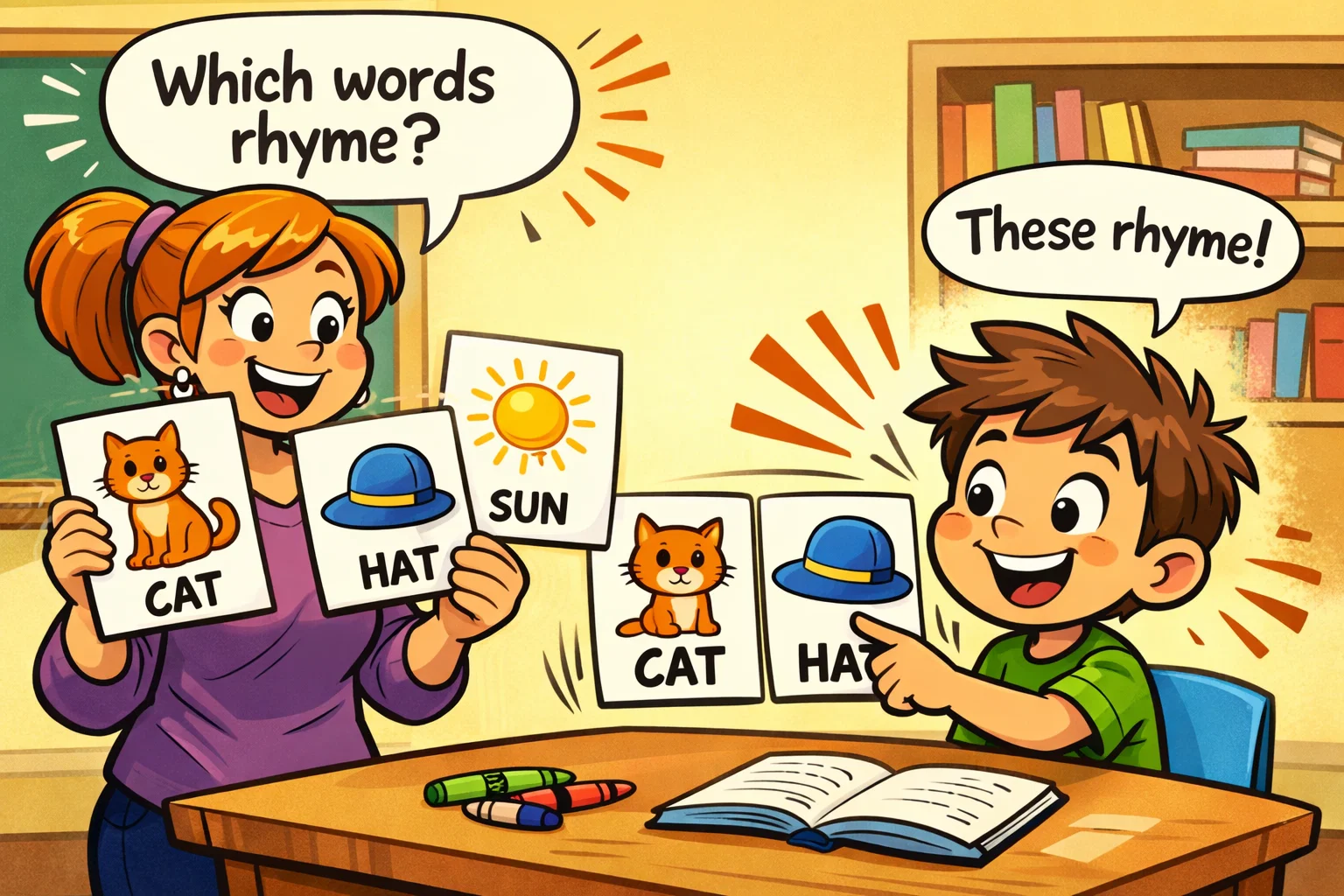
Before diving into a full list, it is helpful to assess a child’s current ability level. Every child develops at a different pace, but most kindergarteners show specific signs of “readiness” between the ages of 4 and 6. Identifying where a child stands allows for a more personalized educational experience.
Signs of Early Rhyme Awareness
A child with emerging skills will often:
- Notice when two terms in a story or song sound the same.
- Laugh at “silly” combinations (e.g., “The cat sat on the bat”).
- Spontaneously produce a simple rhyming term when prompted.
- Anticipate the final part of a familiar nursery verse or chant.
- Fill in the missing word when you pause during a familiar story.
Quick Home or Classroom Check
To gauge progress, try these three fun activities to assess rhyme awareness:
- The Odd One Out: Say three terms (e.g., hop, mop, sun). Ask the child to find the one that doesn’t fit the pattern.
- Finish the Line: Read a poem aloud and pause before the last word to see whether the child can fill in a rhyming word.
- Search Challenge: Give the child a target word like “fan” and see whether they can think of a rhyming word within 10 seconds.
What to Do if Rhyming Feels Hard
If a child struggles to produce rhyming words, simplify the task by using pictures or props. Physical objects, such as a plastic pig and a wig, provide a visual anchor for the sounds in spoken words. Using these patterns in everyday conversations (e.g., “Time to put the cat on the mat!”) also provides low-pressure exposure to the concept. Repetition and patience are key during this developmental stage.
Three Stages of Rhyme Learning
Teach rhyming concepts effectively by breaking them down into developmental stages. Many literacy specialists recommend moving from listening to identifying rhymes and then to producing them.
1. Sensitivity to Rhymes: Noticing Matching Ending Sounds
In the first stage, children simply notice that certain words sound the same at the end. They might point out a match while you are reading rhyming books together. At this stage, the goal is exposure through songs, chants, and read-alouds. At this stage, the child is mostly listening and beginning to build an internal library of sound patterns.
2. Recognition of Rhymes: Finding Matches in Lists and Pictures
During the second stage, children can identify a rhyming pair when presented with options. They can participate in a rhyming match activity or use a worksheet that asks them to connect the correct images. They are not yet creating their own rhymes, but they can recognize when a pair of rhyming words is correct. This is where matching rhyming games become highly effective.
3. Production of Rhymes: Saying New Word Pairs and Sets
The final stage is production, where the child can independently say rhyming words and, in some cases, write them as well. If you say “cake,” they might respond with “snake” or “bake.” This stage shows that they can hear and use rhyme patterns independently and creatively. They are now active participants in the language-building process.
Tips for Explaining Rhyming Words
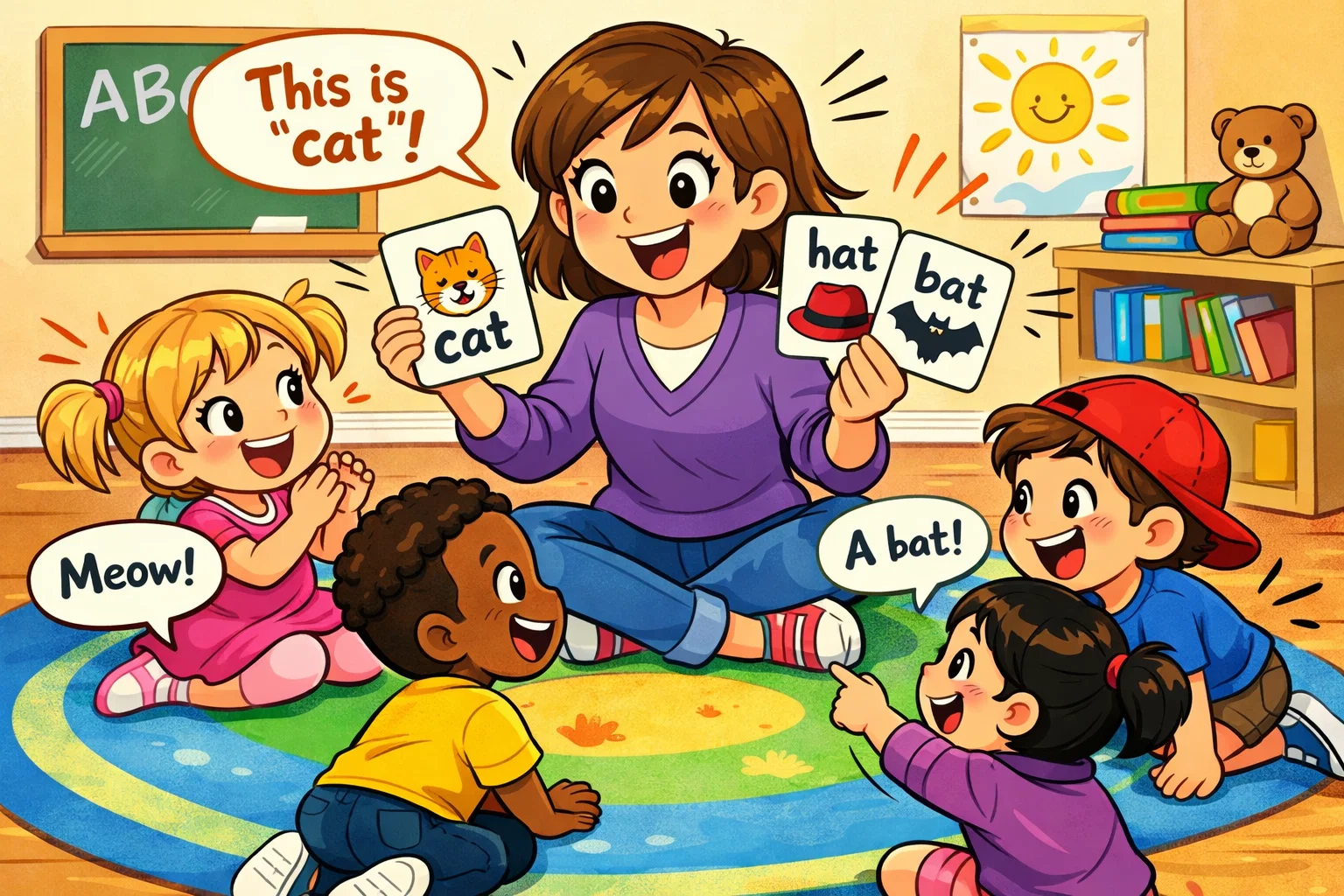
When you introduce these concepts, your explanation should be direct and sensory-based. Avoid overly technical definitions and focus on what the child can hear and feel.
Offer Simple Explanation
Explain that these are “sound friends” that have the same ending. You might say, “Listen to the end of the word – cat and hat. They both say -at at the end!” Using a hand gesture, like a “tail” flick for the ending sound, helps kids visualize the structure of the word.
Compare Rhyming and Non-Rhyming Words
Contrast is a powerful teaching tool. Say a matching pair like bug/rug followed by a non-matching pair like bug/sit. Ask the child which pair “sounds like a song.” This helps children distinguish between words that sound similar and words that truly rhyme. You can also use “nonsense” pairs to show that the sound is what matters most.
Give Kids Options to Pick Rhymes
Instead of asking, “What rhymes with dog?” offer a choice. “Does log rhyme with dog, or does bus rhyme with dog?” This multiple-choice approach builds confidence and reinforces rhyming recognition without the pressure of total recall. It gives the child an early sense of success.
Give Kids Turns to Create Rhymes
Once a child is comfortable, make rhyming a turn-taking game. Say, “I have a pan – can you think of a word that rhymes with pan?” Encourage children to use silly or nonsense words too; if the ending sound matches, it still counts as successful rhyme practice. This encourages creativity and linguistic experimentation.
Rhyming Words with Pictures
Visuals are especially helpful for kindergarteners who are still developing early reading skills. Pictures and visual cues allow a child to practice rhyme without being limited by their current reading level. This levels the playing field for all students.
Picture Cards for Object Rhymes
Create a set of picture cards with rhyming pairs, such as a bee and a tree. Place the cards face down and have children flip them over to find the matching rhyme. This reinforces rhyme recognition through visual association. This is a classic “concentration” style game.
Picture Prompts for Animal and Action Rhymes
Use images of animals, everyday objects, and simple actions to make the lessons more dynamic. This variety helps kids stay engaged and see that language patterns apply to everything around them, not just objects on a worksheet. You can even use photos of the children themselves doing these actions.
How to Pair Pictures with Word Families
Organize your worksheets by placing a “word family house” (for example, -at) at the top. Have children glue pictures that belong in the “-at” house. This activity builds pattern recognition and helps reinforce rhyming skills in a structured, visual way. It also aids in fine motor skill development through cutting and pasting.
How to Use This List to Teach Rhyming Words
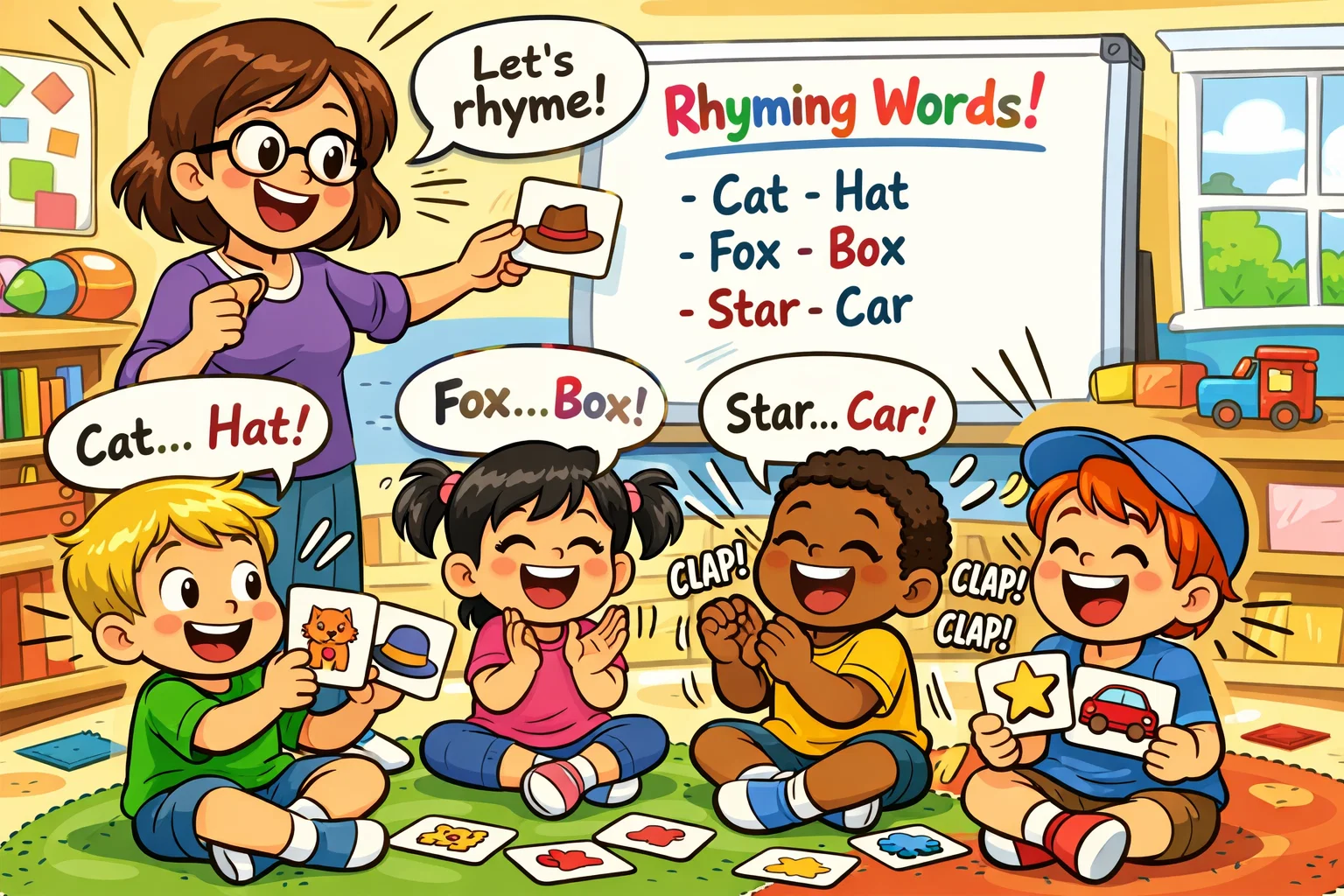
Having a rhyming words list is only the first step. To help children retain what they learn, integrate these words into fun activities throughout the day. Consistency and variety are the keys to retention.
Read, Repeat, and Clap Ending Sounds
When you say a pair, have the child repeat it and clap when they hear the end. For example: “Cat (clap), Hat (clap).” This kinesthetic approach helps kindergarteners feel the rhythm and pulse of the language. It turns a verbal lesson into a physical experience.
Sort Words by Sound Families
Use your list to create sorting bins or “word buckets.” Label one bin “-ig” and another “-op.” Write simple rhyming words on slips of paper and ask the child to “mail” each slip to the correct word-family bin. This helps with categorization and logical thinking.
Use Pictures, Motions, and Real Objects
Don’t just read; act them out. If the word is hop, have the child hop to a real object or picture that rhymes with it, such as a mop. Engaging multiple senses can help the concept of rhyme stick over time. You can also hide objects around the room that rhyme and have a scavenger hunt.
Use List for 5-Minute Daily Practice
Consistency is better than intensity. Spend 5 minutes each day reviewing 5 items from the list of 50. Frequent, short bursts of practice are more effective for kindergarten kids than long, infrequent lessons. You can do this during breakfast, in the car, or before bed.
Fun Activities and Games for Teaching Rhyming Words
Play is the primary “work” of childhood. Use these interactive games to make learning the highlight of the day. Games lower the pressure and make children more willing to experiment with new sounds.
Rhyming Word Match-Up
Lay out a variety of cards with rhyming pairs. Have the child place matching rhyming pairs side by side. This simple rhyming match game is a staple in kindergarten classrooms because it is highly effective.
Rhyming Treasure Hunt
Give the child a clue that rhymes with an object in the room: “Find something that rhymes with bear.” The child then runs to touch a chair. This game for kids combines physical activity with cognitive processing, making it perfect for active learners.
Rhyming Bingo
Create bingo cards with pictures instead of numbers. The caller says a word that rhymes with one of the pictures (for example, “bat” for a picture of a cat). This is a fantastic rhyming game for groups of kindergarten students to play together.
Rhyme Fishing
Attach paperclips to cardstock “fish” featuring rhyming words for kids. Use a magnet on a string to “fish” for a pair of rhyming items. This develops hand-eye coordination alongside literacy skills.
Rhyming Word Hopscotch
Draw a hopscotch grid with simple rhyming words in the squares. As the child jumps on a square, they must call out a new word that rhymes with the one in that square. This is great for outdoor play.
Memory Game with Rhyming Pairs
Place cards face down on a table. The goal is to find two words that sound alike. This encourages the child to remember both the rhyming words and their locations, which supports short-term memory and phonological awareness.
Rhyming Stories and Story Starters
Start a sentence: “I saw a fox sitting in a…” and let the child finish it with “box!” This helps kids to find matches in context and encourages them to think about how stories are constructed.
Rhyming Songs and Poems
Sing rhyming songs like “Down by the Bay” or “The Ants Go Marching.” The repetition and melody make these patterns helpful for long-term memory. Music is a powerful tool for language acquisition.
Rhyme and Draw
Give the child a pair like sun/run. Ask them to draw a picture of a sun with legs that is running. This creative task shows whether the child understands the rhyme and gives them another playful way to work with language.
Short Rhyming Poem to Spark Imagination
Reading rhyming books and poems aloud exposes children to the “flow” of English. Here is a short, original poem designed to be fun and easy to memorize.
Poem Using Simple Kindergarten Rhymes
The big brown pig,
Wore a purple wig.
He sat on a rug,
And gave a bug a hug.
He saw a red hen,
Holding a blue pen.
They jumped in a van,
And waved to a funny man!
How to Read Poem with Expression and Repetition
When reading, emphasize the ending of each line with a bit of extra volume or a different tone. Pause slightly before the rhyming word to let the child predict the sound. Read each line twice so the children can hear the rhyme and join in on the second pass.
Follow-Up Questions, Drawing, and Acting
After reading, ask, “Which words sounded the same?” Encourage the child to draw the pig in a wig. Acting out the hug for the bug helps reinforce rhyming through social interaction and play-acting.
More Learning with Rhymes
Once a child is comfortable with this list of 50, you can build on those skills with more complex books, games, and activities. The journey of literacy is ongoing.
- Rhyming Books: Look for classic titles by Dr. Seuss, Julia Donaldson, or Shel Silverstein. These authors are masters of playful rhyme and sound patterns.
- Online Games: Use age-appropriate educational apps that offer matching rhyming puzzles and sound-sorting challenges.
- Word Family Trees: Create a large poster where the “trunk” is a sound like “-at” and the “leaves” are matches like cat, hat, and bat. Add new leaves as the child discovers more words.
Quick Summary and Conclusion
Main Takeaways for Parents
Start with simple rhyming terms and focus on spoken words first. Use these patterns in everyday conversations – like at the grocery store or during bath time – and keep the practice light and fun. Remember, this early exposure helps children build the foundation for a lifetime of successful reading and writing.
Main Takeaways for Teachers
Organize your classroom lessons around word families to help with pattern recognition. Use a balanced mix of worksheets, interactive games, songs, and read-aloud activities to support children through different kinds of learning experiences in your kindergarten classroom.
Next Step After 50 Rhyming Words
Once these 50 words are familiar, move on to new word families, simple decodable readers, and longer rhyming poems. The ultimate goal is to keep the child curious and excited to play with words, turning them into lifelong lovers of language.
FAQs
Do Kindergarten Kids Usually Know How to Rhyme?
Most children begin to develop these skills between ages 4 and 5. While some children enter kindergarten with strong rhyme awareness, others need more practice and playful exposure to develop it. There is a wide range of normal development.
At What Age Do Children Begin to Rhyme?
Children often start noticing these sounds as toddlers (age 2–3) through nursery songs and bedtime stories. By around age 5, many children can match rhyming pairs and produce simple rhyming words with only a little prompting.
How Do You Introduce Rhymes to Children?
The best way to teach rhyming words is to start with music and nursery rhymes. Transition to reading rhyming books and eventually use a rhyming match game to check for understanding and retention. Keep it playful!
Why Are Rhyming Words Important in Early Childhood?
They help children develop phonemic awareness, which is the ability to hear and manipulate sounds in words. This is one of the most important early literacy skills for learning to read successfully and fluently.
How Many Rhyming Words Should Kindergarten Kids Practice at Once?
To avoid overwhelm, focus on small bites: 4–6 items or 2–3 pairs per session. Short, frequent rhyme activities are often the most effective way to help children stay motivated and make steady progress. Over-practicing can lead to frustration, so always end on a high note!

Take a short quiz to find out what your everyday choices say about your parenting style
When your child is curious about something new, what’s your instinct?
Take a short quiz to find out what your everyday choices say about your parenting style
“Can I download this app?” What happens next?
Take a short quiz to find out what your everyday choices say about your parenting style
When it comes to rules at home, which sounds most like you?
Take a short quiz to find out what your everyday choices say about your parenting style
If you could give your child one life skill today, what would you pick?
Take a short quiz to find out what your everyday choices say about your parenting style
Your child gets to choose what to watch. What would your ideal setup look like?
Take a short quiz to find out what your everyday choices say about your parenting style
Pick your parenting superpower ✨