Egg Drop Challenge for Kids at Home

 Discover a Free Education Video App for Kids
Pastory uses AI to personalize educational video content based on your child’s interests and personality. Safe, engaging, and built for curious young minds. Sign up now to stay updated and enjoy early access with a free trial
The egg drop challenge is a classic hands-on STEM challenge that transforms a kitchen floor or a backyard into a high-stakes engineering lab. It is the perfect home-based activity because it requires almost no specialized equipment – just a raw egg, some recyclables, and a healthy dose of imagination. Whether you are looking to entertain a young child or challenge a tech-savvy teenager, this experiment scales beautifully to meet any skill level while teaching the fundamentals of physics and structural integrity.
Beyond the thrill of the “splat” (or the triumph of a clean landing), this science activity serves as a powerful STEM challenge. It forces children to grapple with real-world problems: How do I absorb the impact? How can I prevent an egg from cracking when dropped from a height? By participating in this egg drop experiment, kids aren’t just playing; they are practicing the engineering design process – planning, building, testing, and iterating – to keep their delicate cargo safe.
Egg Drop Challenge Overview
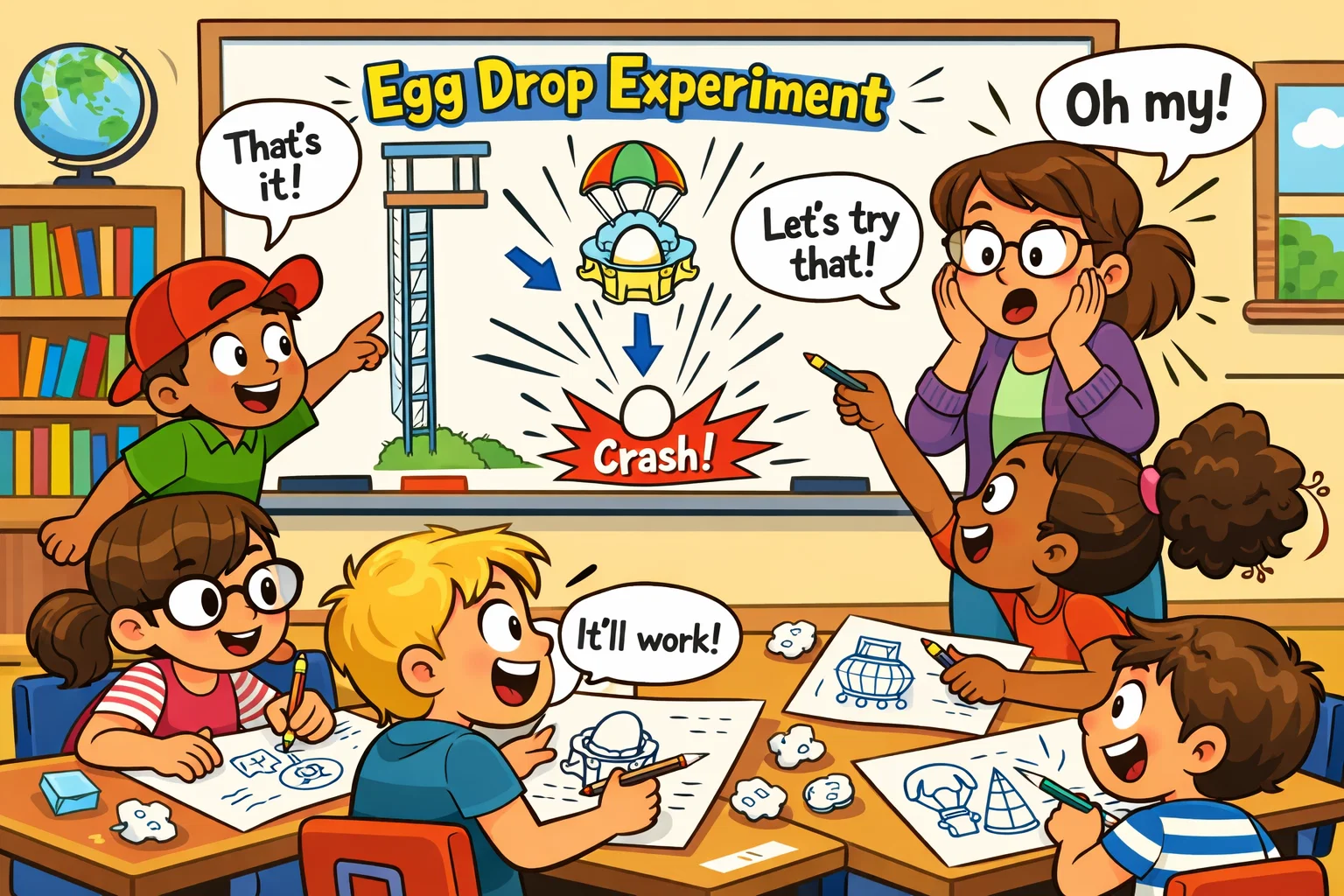
At its core, the classic egg drop is a problem-solving task. The objective is deceptively simple: protect the egg from breaking when it hits the ground after being dropped. However, the execution requires a deep dive into creative thinking and a basic understanding of how forces work.
Challenge Concept
The idea is to create a container or a protective structure that will surround the egg and shield it from the energy of impact. When the actual egg falls, gravity pulls the mass toward the earth, increasing its velocity. Without protection, the sudden stop against a hard surface transfers all that energy into the fragile exterior, causing the shell to crack and the egg to break. The challenge asks students to protect the egg as effectively as possible by using different materials to either slow the descent or cushion the landing.
STEM Learning Goals
The egg drop project is a cornerstone of STEM and STEAM education. The primary goals include:
- Physics: Understanding gravity, acceleration, and air resistance (drag).
- Engineering: Designing a contraption within specific constraints like weight and size.
- Math: Measuring drop heights and comparing the success of different design geometries.
Skills Kids Practice
While the focus is on the raw egg, the real growth happens in the child’s mind. Participants develop creative thinking and problem-solving skills as they realize their first idea might not work. They learn to build their design, observe how the egg falls, and ask, ‘How could you improve your design?’. This resilience – the ability to fail and try again – is perhaps the most valuable takeaway from any challenge lesson. By iterating on a failed parachute or a weak cushion, children learn that engineering is a process, not a one-time event.
Egg Drop Challenge Setup at Home
Setting up this activity at home is easy, but a little preparation goes a long way in managing the potentially messy reality of a failed experiment.
Space Preparation Indoors
If you are running the experiment inside, choose a spot with a hard, easy-to-clean floor, like tile or linoleum.
- Drop Points: Use a sturdy chair, a stepladder, or the top of a staircase.
- Splash Zone: Lay down a plastic bag, a tarp, or a sandwich bag to catch any potential mess. You can even place the egg inside a small Ziploc bag before putting it in the container to contain the fluids if the shell cracks. This “double-bagging” technique is highly recommended for indoor sessions.
Outdoor Setup Options
Outdoors is the preferred “lab” for most families. Dropping the egg from a height like a second-story balcony or a porch adds excitement.
- Landing Surfaces: Grass is more forgiving and may prevent an egg from breaking even with a mediocre design. For a true STEM challenge, aim for the sidewalk or driveway to ensure the contraption is doing all the work.
- Wind Conditions: If using a parachute, check the wind. A light breeze can carry a lightweight egg drop design onto a roof or into a tree!
Safety Rules for Kids
Safety is paramount. Ensure an adult handles the egg drop itself if the height involves a ladder or a balcony.
- Supervision: Always supervise the use of hot glue or sharp scissors.
- Clear the Area: Ensure no pets or siblings are standing in the “landing zone” to avoid a literal “splat” situation.
- Hygiene: Since you are handling a raw egg, ensure everyone washes their hands thoroughly after the experiment to avoid any risk of salmonella.
Challenge Materials
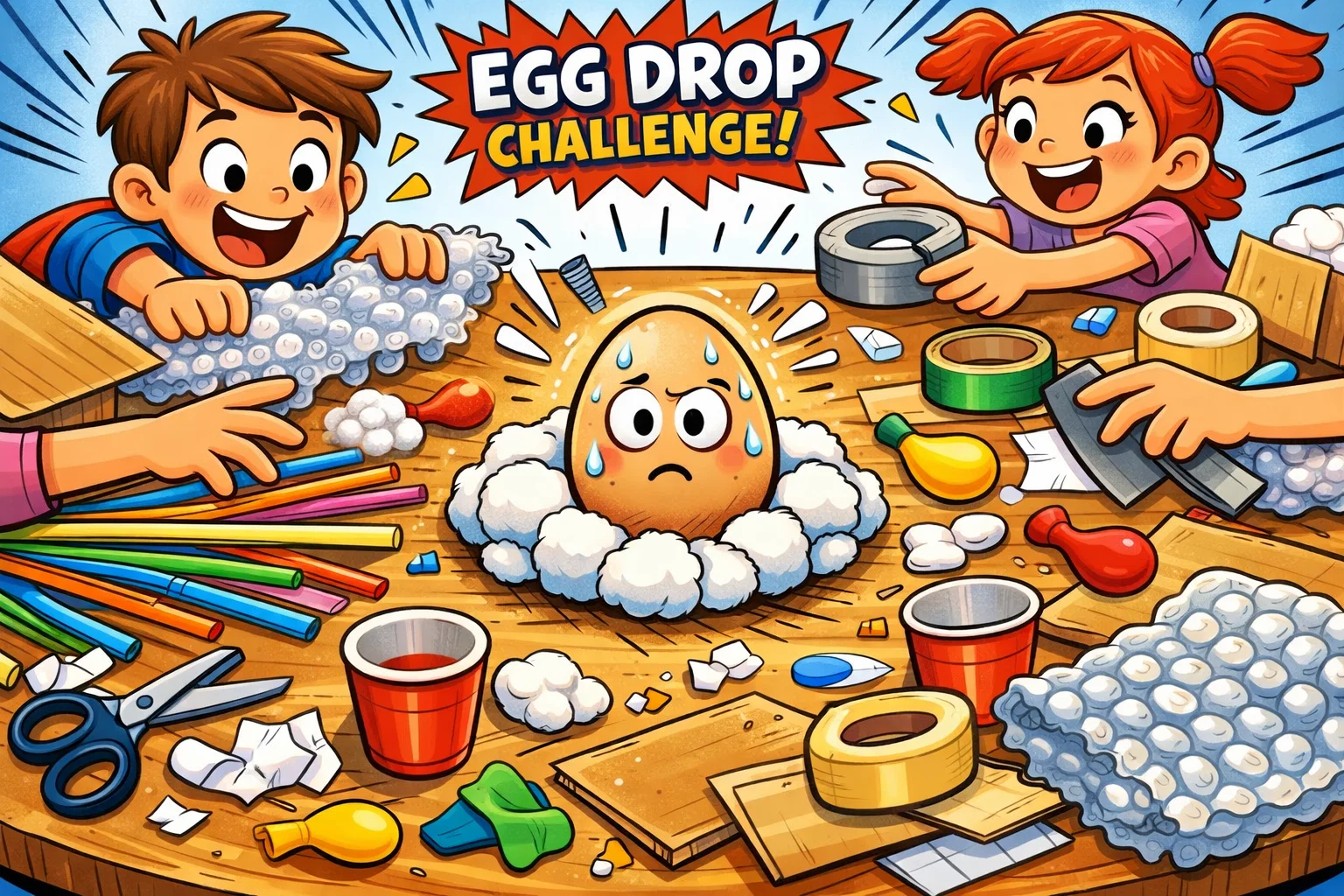
The beauty of the challenge is that you can use almost anything found in your recycling bin. Here is a breakdown of what you might need.
| Category | Material Examples | Purpose |
| Cushioning | Cotton balls, bubble wrap, oobleck, shredded paper | Absorb the impact and soften the blow. |
| Structure | Straws, cardboard boxes, popsicle sticks, toilet paper rolls | Create a rigid frame to surround the egg. |
| Suspension | Rubber bands, pantyhose, string | Keep the egg inside from hitting the walls of the container. |
| Drag | Plastic bag, lightweight fabric, paper | Make a parachute to slow the fall. |
| Fasteners | Tape, rubber bands, glue | Hold the different materials together. |
Common Household Materials
Look for straws and tape first, as these are the most versatile. Cardboard box scraps can be used to build “crumple zones” similar to those in modern cars. Popsicle sticks are great for creating a sturdy outer cage for the fragile contents.
Cushioning Materials
To prevent an egg from shattering, you need materials that can compress. Cotton balls are a classic choice, but don’t overlook a pool noodle cut into rings or a thick layer of bubble wrap. These materials store the energy of the fall and release it slowly, shielding the payload.
Structural Materials
The contraption needs a skeleton. Use toilet paper rolls as pillars or straw trusses to distribute the weight. The goal is to ensure the egg stays centered using these supports and immobile within the device.
Materials to Avoid
Avoid using heavy stones or metallic objects that increase the mass significantly. A heavier contraption hits the ground with more force. Also, stay away from glass or brittle plastics that could shatter and create a safety hazard upon impact.
Egg Drop Design Ideas
There are several egg drop ideas that have proven successful over the decades. Encourage your students to design something unique, but give them these “classic” archetypes to spark their imagination.
Parachute Design
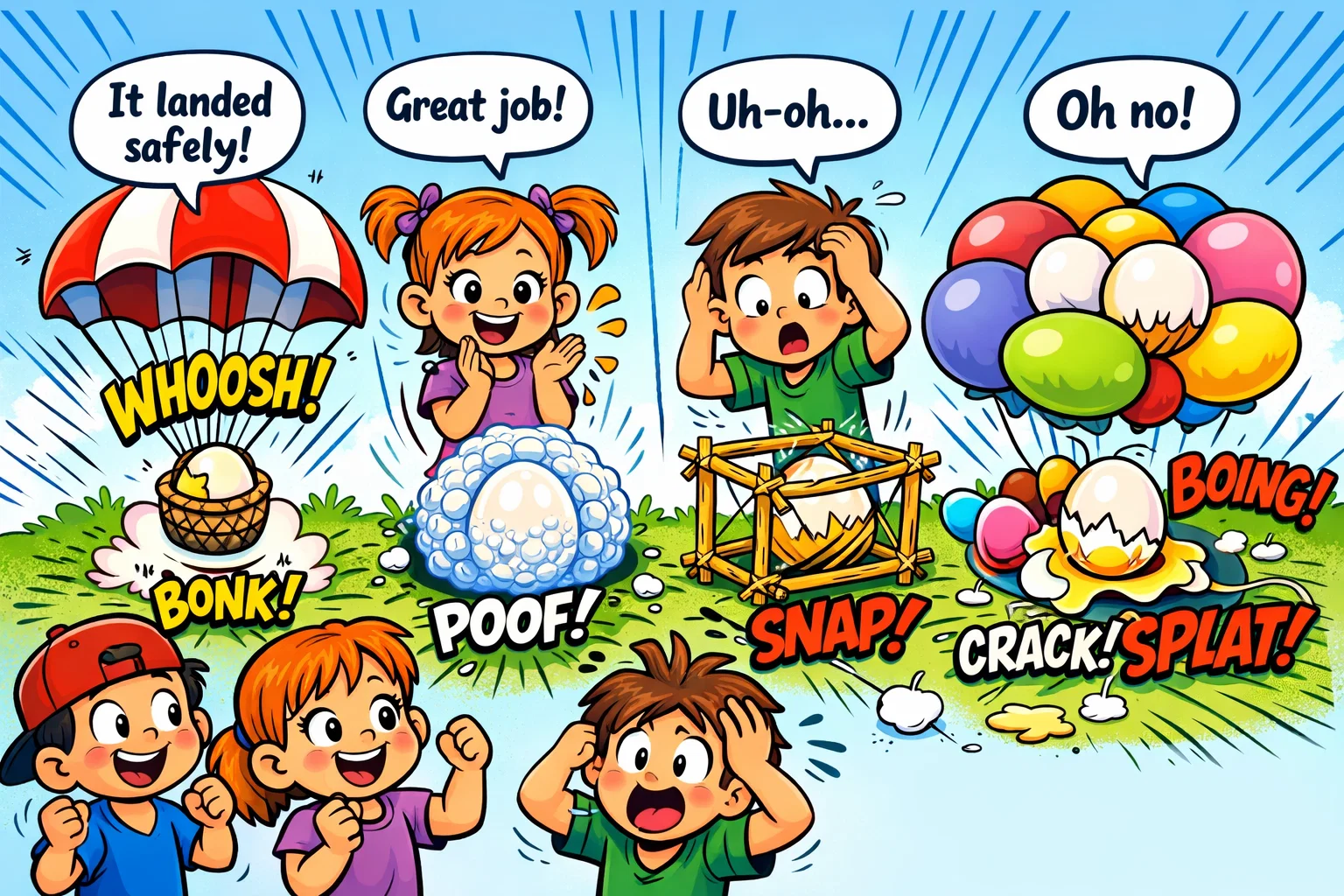
The parachute approach focuses on air resistance. By attaching a plastic bag or light fabric to the container for the egg, you increase drag. This slows the velocity so that when the egg falls, it hits the ground with much less force. Make a parachute by cutting a large square of plastic and attaching strings to the four corners of the structure.
Cup and String Design
In this egg drop design, the payload is suspended in the middle of a cardboard box or large cup using string or rubber bands. This “hammock” effect ensures that when the outer shell hits the ground, the inner object continues to move slightly within its suspension, spreading out the force of impact.
Bubble Wrap Encasement
This is the “brute force” method of protection. Wrap the egg in several layers of bubble wrap and tape it securely. The air-filled pockets act as tiny shock absorbers. This is often one of the most reliable designs for beginners because it is very difficult to mess up the padding.
Straw Structure
Using straws and tape, kids can build a geodesic dome or a truss system. The straw frame is designed to bend or break upon impact, sacrificing its structural integrity to keep the fragile item from cracking. This mimics the way a car’s bumper works during a collision.
Balloon Cushion Design
Surround the fragile item with several inflated balloons. This turns the contraption into a bouncy ball. If the landing is controlled, the shell is less likely to crack; if it bounces too high and flips, it might lead to a mess.
Foam or Sponge Container
A sponge egg drop involves hollowing out a thick sponge or using a pool noodle to place the egg inside. Sponges are excellent at energy absorption because they are filled with air pockets that compress. This is one of the most reliable egg drop designs because it provides 360-degree protection.
Paper Mache Shell
For an artistic twist, you can create a rigid outer shell. While hard, it can be heavy. The trick here is to surround the egg with a soft cushion inside the hard shell. This creates a two-stage protection system.
Cardboard Tube Construction
Using toilet paper rolls or paper towel tubes allows you to create a “crumple zone.” If you place the egg inside the center of a long tube and pad the ends, the ends of the tube will crush and absorb the impact before the force reaches the center.
Steps
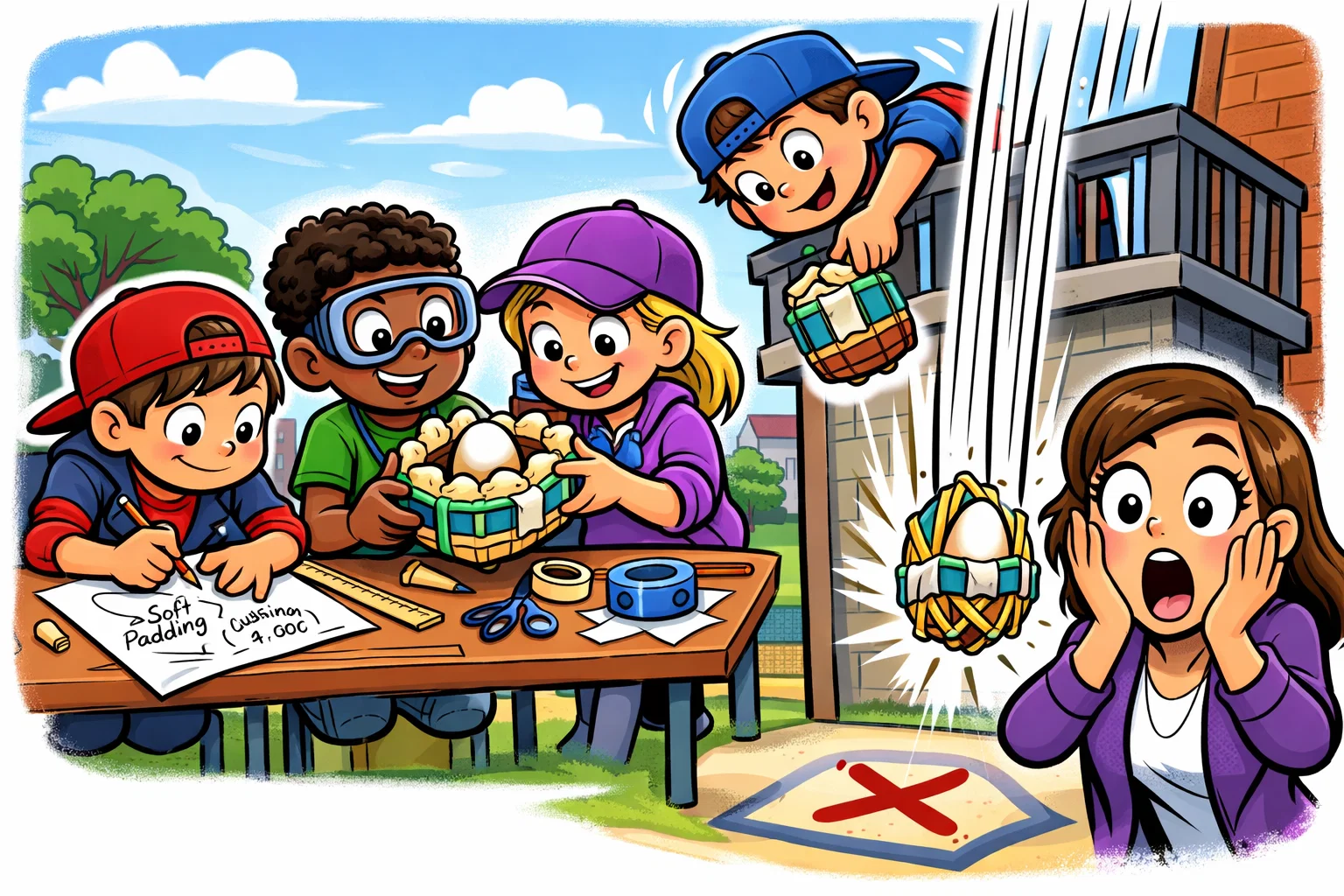
Follow these steps to ensure a structured and educational experience for your young engineers.
Design Phase
Ask students to sketch their ideas on a printable worksheet. This encourages them to think before they build. Ask them: “How will you prevent an egg from cracking when dropped?” Have them label the different materials they plan to use.
Build Phase
Give students about 30–45 minutes to build their design. Remind them to put the egg in a place where it can be checked easily. They should tape it securely but leave a “hatch” or an opening so they can inspect the contents after the fall.
Test Phase
Take the completed designs to the drop zone. Attempt to drop an egg without breaking it from the first height (e.g., 3 feet). If successful, move to a higher level. Record the results on an activity sheet.
Revise and Retest Phase
This is where the real learning happens. If the raw egg breaks, ask, “Could you improve your design?” Did the parachute fail to open? Did the cotton balls shift? Let them refine their contraption and try again with a fresh shell.
Rules
To make it a fair egg drop challenge, establish some ground rules.
Height Rules
Start at a standard height (e.g., 5 feet) and increase it by 2 feet for every successful landing. This creates an exciting and engaging competitive atmosphere.
Weight Limits
To increase difficulty for older kids, set a maximum weight. This prevents them from just using an entire roll of bubble wrap and forces more creative thinking. Use a kitchen scale to challenge students to stay under 100 grams.
Material Limits
Limit the number of straws or the amount of tape. For example, “You only get 10 cotton balls and 2 feet of tape.” This forces them to be more strategic about where they place the egg.
Egg Drop Challenge Variations
Egg Drop Challenge for Younger Kids
For the little ones, use a hard-boiled version or place the egg inside a jar of oobleck. Oobleck is a non-Newtonian fluid that stays liquid until impact, at which point it turns solid. It’s a great way to introduce science activities to preschoolers without the high risk of a “splat.”
Egg Drop Challenge for Older Kids
Challenge them to create a design that allows the payload to be “reloaded” quickly. Alternatively, require that the egg must remain visible in the design at all times, preventing them from just hiding it inside a giant box of cotton balls.
Group Challenge Version
Divide the family into teams. Give each team a “budget” of materials and see who can build the most efficient contraption. You can even assign roles: Lead Architect, Materials Manager, and Quality Control Officer.
Science Explained
Why do these fragile objects break? It’s all about physics and the laws of motion.
Gravity and Falling Objects
Gravity is a constant force pulling the raw egg toward the center of the Earth. As it falls, it accelerates at approximately 9.8 m/s². The longer it falls, the faster it goes, and the more kinetic energy it gains.
Impact Forces
The “splat” happens because of a sudden change in momentum. When the device hits the ground, its velocity goes from high to zero in a fraction of a second. This generates a large impact force. According to Newton’s Second Law, the force is equal to the rate of change of momentum.
Energy Absorption
To prevent an egg from breaking, we must increase the time it takes for the object to stop. Cushion materials like cotton balls or a sponge egg drop design compress, which extends the impact time. By spreading the force over a longer period, the peak pressure on the shell is reduced. This is the same reason why jumping onto a mattress is safer than jumping onto concrete.
Questions to Spark Critical Thinking
Engaging the mind is just as important as the physical build. Use these prompts:
Prediction Questions
- “What do you think will happen to the yolk if we don’t use a parachute?”
- “Which of these different materials will absorb the impact best?”
- “Do you think bouncing will help or hurt the internal stability?”
Reflection Questions
- “What part of your protective structure worked the best?”
- “Why did the straw frame fail but the bubble wrap succeed?”
- “Was the contraption too heavy?”
Improvement Questions
- “How would you change your container that will protect the item if we dropped it from 20 feet?”
- “If you had no tape, how would you hold the cotton balls in place?”
Egg Drop Challenge Extensions
Keep the learning going with these “next level” ideas:
Material Comparison Experiment
Try the same design but swap one material. For instance, build two identical boxes – one filled with bubble wrap and one with oobleck. See which one is more effective for the cargo.
Shape Experiment
Does a round container for the egg work better than a square one? Does the shape of the parachute (circle vs. square) change the speed at which the egg falls?
Altitude Variation Test
Track how high you can go. Can the same egg drop design survive a drop from a chair, a ladder, and a roof? Create a graph showing the “Survival Rate vs. Height.”
Common Egg Drop Mistakes
Even the best young engineers run into trouble. Watch out for these:
Overpacking Designs
Making the contraption too heavy is a common pitfall. A heavy box hits much harder than a light one. The goal is to be “light and fluffy,” not “dense and heavy.”
Weak Tape Connections
If the straws and tape come apart mid-air, the fragile payload has no protection. Always tape it securely to ensure the structure holds its shape upon impact.
Ignoring Internal Positioning
If the item is loose around the egg’s cradle, it will rattle. This internal collision can be just as deadly as the external one. Ensure the raw egg is snug but not squeezed.
Egg Drop Ideas That Failed
It’s important to share the “failures” to encourage a growth mindset.
Heavy Designs
In one example, a student built a solid “brick” of popsicle sticks and glue. It was so heavy that when it dropped from a height, it hit the ground like a hammer, causing the fragile contents to shatter instantly.
Rigid Designs
A design that is too stiff will transfer all the shock directly to the center. Without a cushion or a “crumple zone,” the shell has no chance. Think of a car with no shocks – every bump is felt by the passengers!
Egg Drop Designs That Worked
The best egg drop design usually combines two or three different methods of protection.
Balanced Cushion Designs
A combination of a soft interior (like cotton balls or bubble wrap) and a semi-rigid exterior (like a cardboard box) is incredibly effective. The exterior takes the initial hit, and the interior absorbs the remaining vibrations.
Lightweight Suspension Designs
One of the most awesome egg protectors we’ve seen used pantyhose to suspend the contents in the middle of a wire frame. The elasticity of the fabric acted like a bungee cord, preventing the shell from ever touching the hard outer walls.
More STEM Activities for Kids at Home
If your kids loved the egg drop challenge, they might enjoy these too:
Egg Science Experiments
- The Naked Egg: Soak the item in vinegar to dissolve the shell.
- The Silver Egg: Hold a soot-covered shell underwater to see it turn silver.
- Strength Test: See how many books you can stack on top of four half-shells.
Kitchen Science Projects
- Baking Soda Volcanoes: The classic acid-base reaction.
- Homemade Slime: Exploring non-Newtonian fluids.
- Crystal Growing: Using sugar or salt to see molecular structures.
Engineering Challenges for Kids
- Bridge Building: Using only straws and tape to hold a heavy weight.
- Spaghetti Towers: How high can you build with dried pasta and marshmallows?
- Paper Airplane Lab: Testing different wing shapes for distance and lift.
Frequently Asked Questions
Best age for this challenge?
Children as young as 5 can enjoy a simplified version, while students up to 18 can engage with the complex physics and engineering constraints. It is a lifelong favorite for a reason!
Egg alternatives for practice runs?
Use a plastic Easter version filled with coins or a golf ball to mimic the weight of the real thing before doing the final test. This saves on the mess and the groceries.
Mess-free egg drop ideas?
Seal the raw egg in a high-quality sandwich bag before placing it in the contraption. If it breaks, the yolk stays in the bag, making cleanup a breeze!

Take a short quiz to find out what your everyday choices say about your parenting style
When your child is curious about something new, what’s your instinct?
Take a short quiz to find out what your everyday choices say about your parenting style
“Can I download this app?” What happens next?
Take a short quiz to find out what your everyday choices say about your parenting style
When it comes to rules at home, which sounds most like you?
Take a short quiz to find out what your everyday choices say about your parenting style
If you could give your child one life skill today, what would you pick?
Take a short quiz to find out what your everyday choices say about your parenting style
Your child gets to choose what to watch. What would your ideal setup look like?
Take a short quiz to find out what your everyday choices say about your parenting style
Pick your parenting superpower ✨