Heart Rate Experiment for Kids: Exercise Recovery

 Discover a Free Education Video App for Kids
Pastory uses AI to personalize educational video content based on your child’s interests and personality. Safe, engaging, and built for curious young minds. Sign up now to stay updated and enjoy early access with a free trial

Have you ever wondered why your chest feels like a drum after sprinting across the playground? That rhythmic thumping is your heart working overtime to fuel your limbs. Understanding how physical activity affects the human body isn’t just for doctors – it’s a fascinating way for kids to explore their own biology.
This pulse rate experiment is a classic STEM activity designed for children aged 8 to 14. It transforms a simple afternoon of jumping jacks into a rigorous science experiment where kids can investigate how their circulatory system adapts to stress and how quickly the internal pump returns to its resting rate. By the end of this project, your young scientist will know how to measure pulse, analyze data like a pro, and understand why recovery time is a secret window into their overall fitness.
Heart Rate Experiment Overview
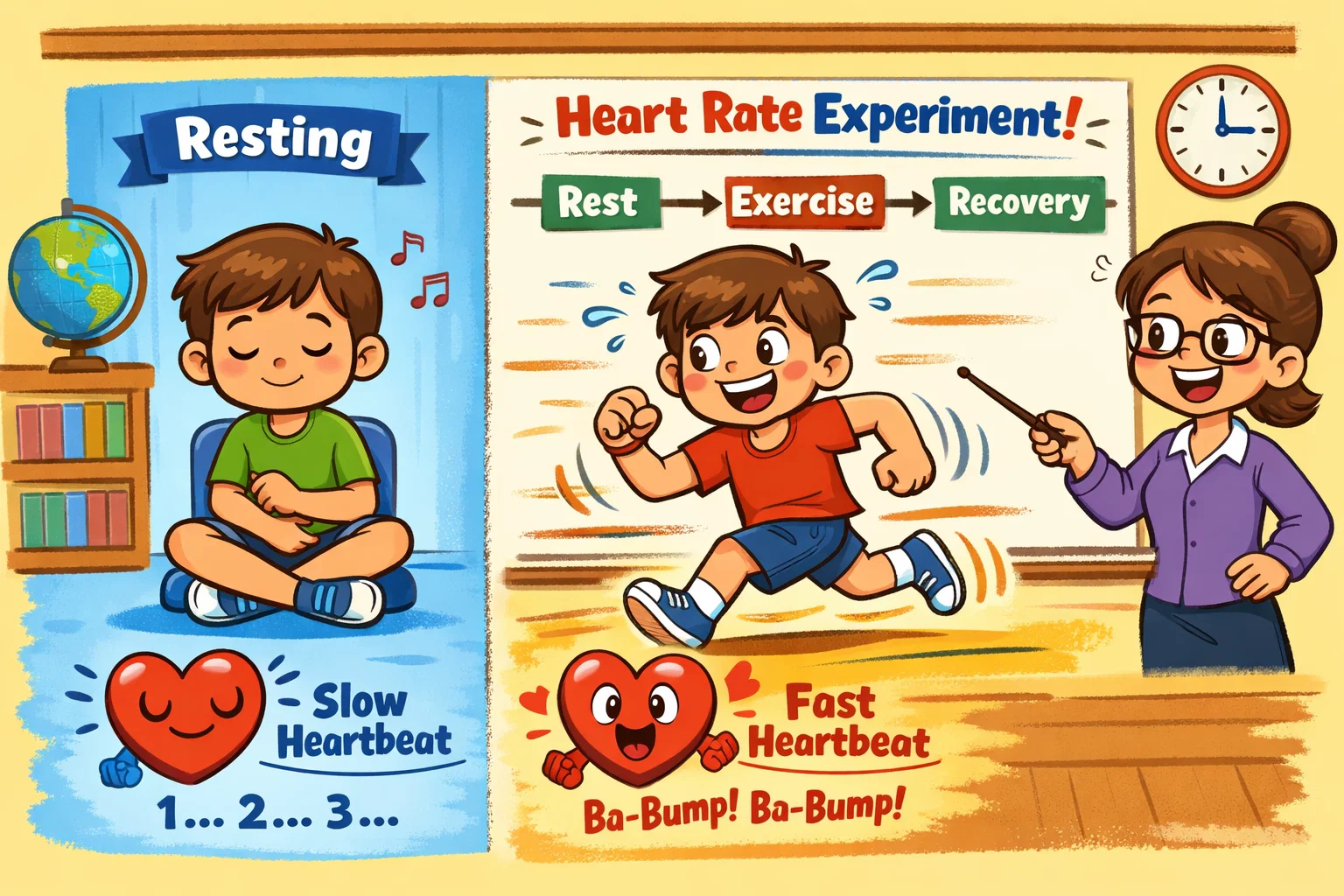
At its core, this project demonstrates the physiology of the human body in motion. When we move, our muscles demand more oxygen and a way to remove carbon dioxide. The heart responds by beating faster to circulate blood throughout the body.
Experiment goal and key idea
The primary objective is to measure three distinct phases of activity: the resting rate, the frequency immediately after exercise, and the recovery time. The key idea is to see how long it takes for the pulse to return to its resting rate. This “cool down” period is a vital indicator of how efficiently the cardiovascular system returns to a resting state after a burst of vigorous activity.
Age range and learning level
- Ages 5–7: Focus on the “feel.” Can they feel their heartbeat? Is it fast or slow?
- Ages 8–12: The sweet spot. Kids can find the pulse at the wrist (radial artery) or neck (carotid artery) and calculate the number of beats per minute.
- Ages 13+: Advanced students can collect data over multiple trials, investigate the effect of exercise intensity, and use physiology concepts like anaerobic vs. aerobic thresholds.
Real-life connection to fitness
In the world of professional sports, an athlete uses cardiovascular data to track their health. A fast recovery time – the time it takes for the pulse rate to decrease – usually indicates a higher level of fitness. By doing this science project, kids see that their bodies aren’t static; they are adaptive systems that become stronger with regular exercise.
Heart Rate Science Project Setup
Before you start jumping, you need a plan. Following the scientific method ensures your results are reliable and not just a lucky guess.
Scientific question
A good science experiment starts with a question. For this project, you might ask: “How does one minute of vigorous jumping jacks affect the time it takes for my pulse to return to its normal resting rate?”
Hypothesis and prediction
Ask your child to make a prediction. A common hypothesis might be: “If I exercise more intensely, then my recovery period will be longer because my heart works harder to deliver oxygen to the muscles.”
Variables to change and keep same
To keep the test “fair,” you must manage your variables:
- Independent Variable: The type or duration of physical activity.
- Dependent Variable: The rate in beats per minute and the recovery time.
- Controlled Variables: Use the same person for each trial, the same rest period before starting, and the same temperature in the room.
Supplies and Equipment List

You don’t need a high-tech lab to measure pulse. Most of these items are already in your junk drawer!
Basic materials
- Stopwatch or Timer: To track the one-minute intervals.
- Notebook and Pencil: To collect data.
- Chair: For a true resting rate measurement.
- Graph paper: To analyze and graph the change over time.
Optional digital tools
If you have a fitness tracker or a smartwatch, these can provide a very accurate reading. However, learning to find the radial pulse (wrist) or carotid pulse (neck) manually is a valuable life skill.
Safe exercise options
| Exercise | Intensity | Safety Note |
| Jumping Jacks | Moderate | Ensure plenty of overhead space. |
| Running in Place | High | Wear sneakers to prevent slipping. |
| Walking | Low | Great for a “control” group trial. |
| Step-ups | Moderate | Use a sturdy, low step or stool. |
Step-by-Step Heart Rate Experiment Instructions
Ready to get the pulse climbing? Follow these steps carefully to ensure your science experiment yields great data.
1. Measuring resting heart rate
Before any movement, the body must be at rest. Have the participant sit quietly for five minutes. Use two fingers (not the thumb, as it has its own pulse) to find the pulse on the wrist (radial) or neck (carotid). Count the number of beats for one minute. This is your resting rate.
2. Exercise phase execution
Start the stopwatch and perform your chosen physical activity (like jumping jacks) for exactly two minutes. Ensure the movement is vigorous enough to make breathing a bit harder, but stay within a safe limit. Consistency is key here – if you do a second trial, you must jump with the same energy!
3. Recording heart rate after exercise
Immediately after exercise, stop and measure the pulse for 60 seconds. This will likely be your highest beats per minute (BPM). Record this value in your table. This peak shows the maximum effort of the myocardium during the task.
4. Tracking recovery time
This is the most important part of the science project. While sitting down, measure the pulse every minute.
- Minute 1: Record BPM.
- Minute 2: Record BPM.
- Continue until the pulse rate is the same as the initial resting rate. The total minutes passed is your recovery time.
Exercise Recovery Time Explanation
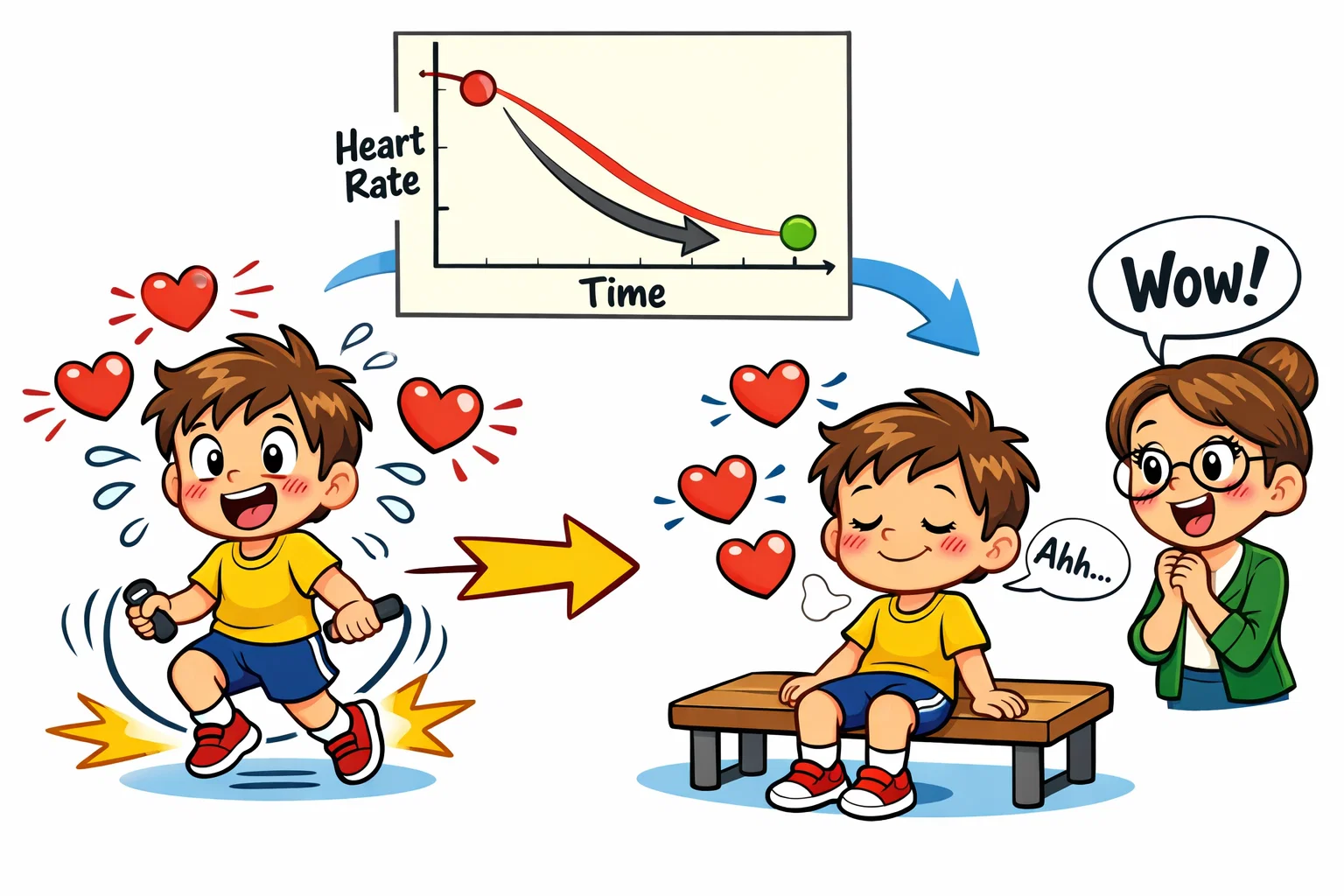
So, what exactly is happening inside the human body? Recovery is the window where the parasympathetic nervous system helps slow the heart rate.
Meaning of recovery time
Recovery time is essentially how long your circulatory system takes to recover from the increased oxygen demand incurred during physical activity. Your internal pump moves quickly during the experiment to move oxygen to the muscle tissues and remove carbon dioxide. Once you stop, the demand drops, and the rhythm slows down.
Why recovery speed differs
Factors like body composition, age, and how often you exercise regularly play a role. An athlete usually has a circulatory system that is more “efficient” – it can pump blood in larger volumes per beat, meaning it doesn’t have to beat as fast and can return to normal much quicker.
Data Collection and Results Analysis
Recording results in a table
Organizing your notes is the difference between a “messy activity” and a “science project.”
| Phase | Time (Minutes) | Pulse (BPM) |
| Rest | 0 | 72 |
| Immediately After Exercise | 0 | 145 |
| Recovery 1 | 1 | 110 |
| Recovery 2 | 2 | 90 |
| Recovery 3 | 3 | 75 |
| Full Recovery | 4 | 72 |
Graphing heart rate changes
Create a graph with the X-axis as “Time” and the Y-axis as “Beats Per Minute.” You will likely see a steep curve that starts high and then gradually levels off as it approaches the resting rate.
Identifying patterns
When you analyze your graph, look for the “slope.” A steeper drop in the first minute suggests a very healthy cardiovascular response. If the line stays flat for a long time, it may indicate that the body is working harder to regain its balance.
Scientific Method in Action
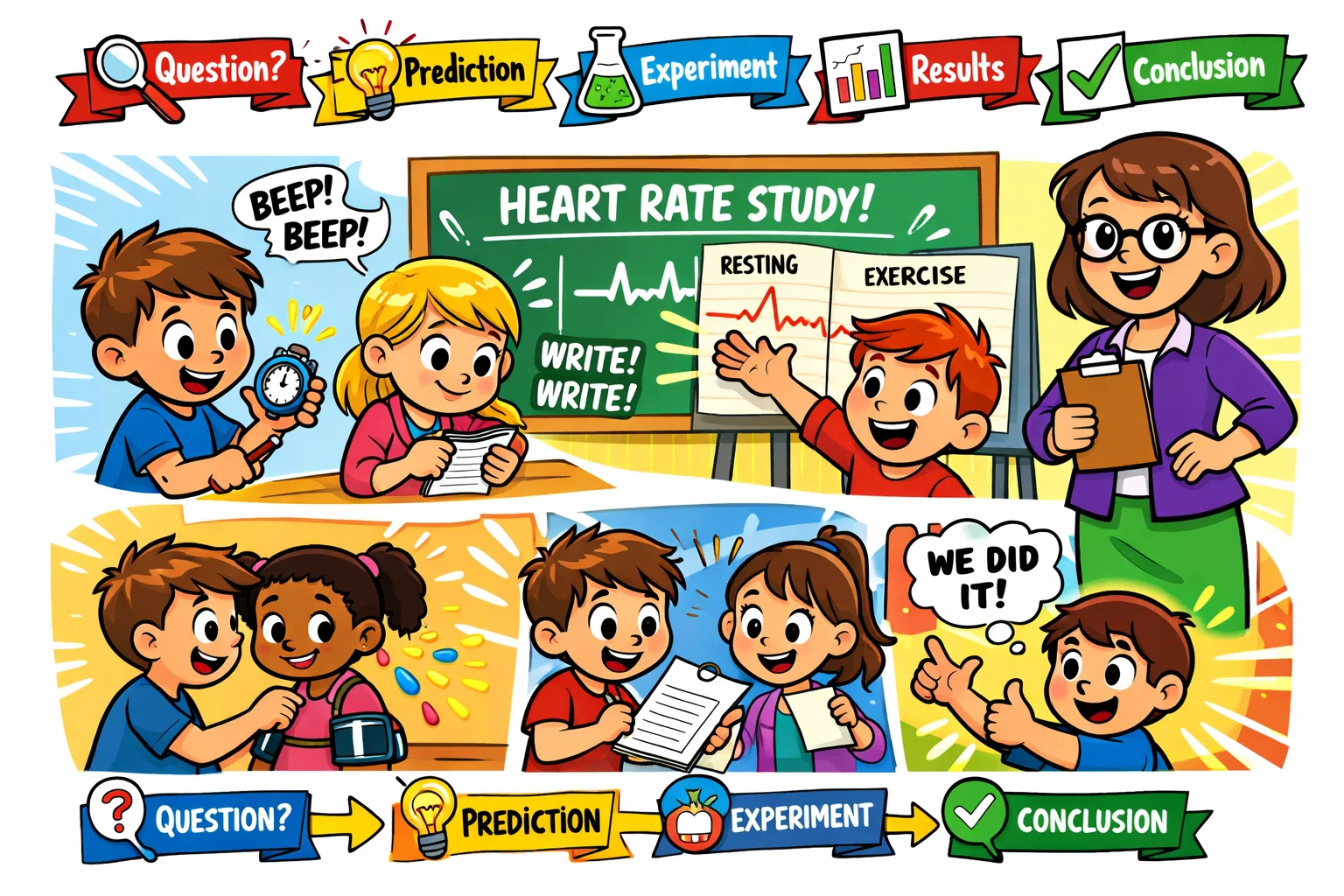
This isn’t just about fitness; it’s about logic.
- Observation: My chest thumps fast when I run.
- Hypothesis: I think it will take 5 minutes to slow down.
- Experiment: Measure, exercise, measure again.
- Analysis: It actually took 4 minutes.
- Conclusion: My hypothesis was close, but my recovery time was faster than expected!
Repeating trials for accuracy is crucial. One measurement can be an outlier caused by a sudden noise or a deep breath. Doing the experiment three times and taking the average ensures your data is trustworthy and reflects your true physiology.
Learning Outcomes for Kids
- Science skills development: Kids learn to calculate rates, collect data, and use tools like a stopwatch.
- Health awareness: It connects the “feeling” of being tired to the actual physiology of how the internal pump works.
- Critical thinking practice: They begin to ask “Why?” Why did my friend recover faster? Why does my pulse feel stronger in my neck than my wrist?
Common Misconceptions About Heart Rate
Faster heart rate equals unhealthy
Actually, a high rate during exercise is a sign of a healthy human heart responding to demand. A sedentary body may struggle to speed up or slow down efficiently, which can be a concern.
Recovery time same for everyone
Every human body is unique. Factors like body composition, hydration, and even how much rest you got the night before can change over time how your system responds.
One measurement proves the result
In a lab setting, one data point is never enough. You need to collect data multiple times to ensure the pulse reflects a pattern, not just a one-off event.
Safety and Supervision Guidelines
- Adult supervision needs: An adult should always be present to monitor for overexertion.
- Warm-up: Start with light stretching to prepare the muscles and blood vessels for increased flow.
- When to stop: If a child feels dizzy, nauseous, or has chest pain, stop the experiment immediately. The goal is a fun exercise, not exhaustion.
More Science Experiments for Kids
If your child enjoyed tracking their pulse, consider these follow-up STEM activities:
- Lung Capacity Test: Use a balloon to see how much air your lungs hold after different types of physical activity.
- The “Squeezing” Muscle: Use a tennis ball to demonstrate how hard the myocardium has to squeeze to pump blood through the whole body.
- Hydration Investigation: See if drinking water affects the resting rate over the course of an hour.
Teacher and Parent Guidance
Lesson planning tips: In a classroom, have students work in pairs. One is the “Athlete” and the other is the “Scientist” (the timer). Then, swap roles. This keeps everyone engaged and ensures the pulse rate is measured accurately.
Differentiation: For younger kids, skip the beats per minute math. Just have them feel the “thump-thump” to keep it simple. For older kids, introduce the concept of blood pressure or variability.
Frequently Asked Questions
How long does recovery time usually last?
For most healthy children, the time for the internal rhythm to return to its resting rate takes between 2 to 7 minutes. Athletes may see a return to normal in under 2 minutes.
What is the best exercise for this experiment?
Jumping jacks or a 3-minute “step test” are the gold standards. They are aerobic, easy to standardize, and quickly involve every major muscle.
How often should the experiment be repeated?
To get the most accurate data, try repeating the process three times with 10-minute rest periods in between. This allows the circulatory system to fully reset before the next trial.

Take a short quiz to find out what your everyday choices say about your parenting style
When your child is curious about something new, what’s your instinct?
Take a short quiz to find out what your everyday choices say about your parenting style
“Can I download this app?” What happens next?
Take a short quiz to find out what your everyday choices say about your parenting style
When it comes to rules at home, which sounds most like you?
Take a short quiz to find out what your everyday choices say about your parenting style
If you could give your child one life skill today, what would you pick?
Take a short quiz to find out what your everyday choices say about your parenting style
Your child gets to choose what to watch. What would your ideal setup look like?
Take a short quiz to find out what your everyday choices say about your parenting style
Pick your parenting superpower ✨