Barometer Experiment for Kids Using a Balloon and a Jar

 Discover a Free Education Video App for Kids
Pastory uses AI to personalize educational video content based on your child’s interests and personality. Safe, engaging, and built for curious young minds. Sign up now to stay updated and enjoy early access with a free trial
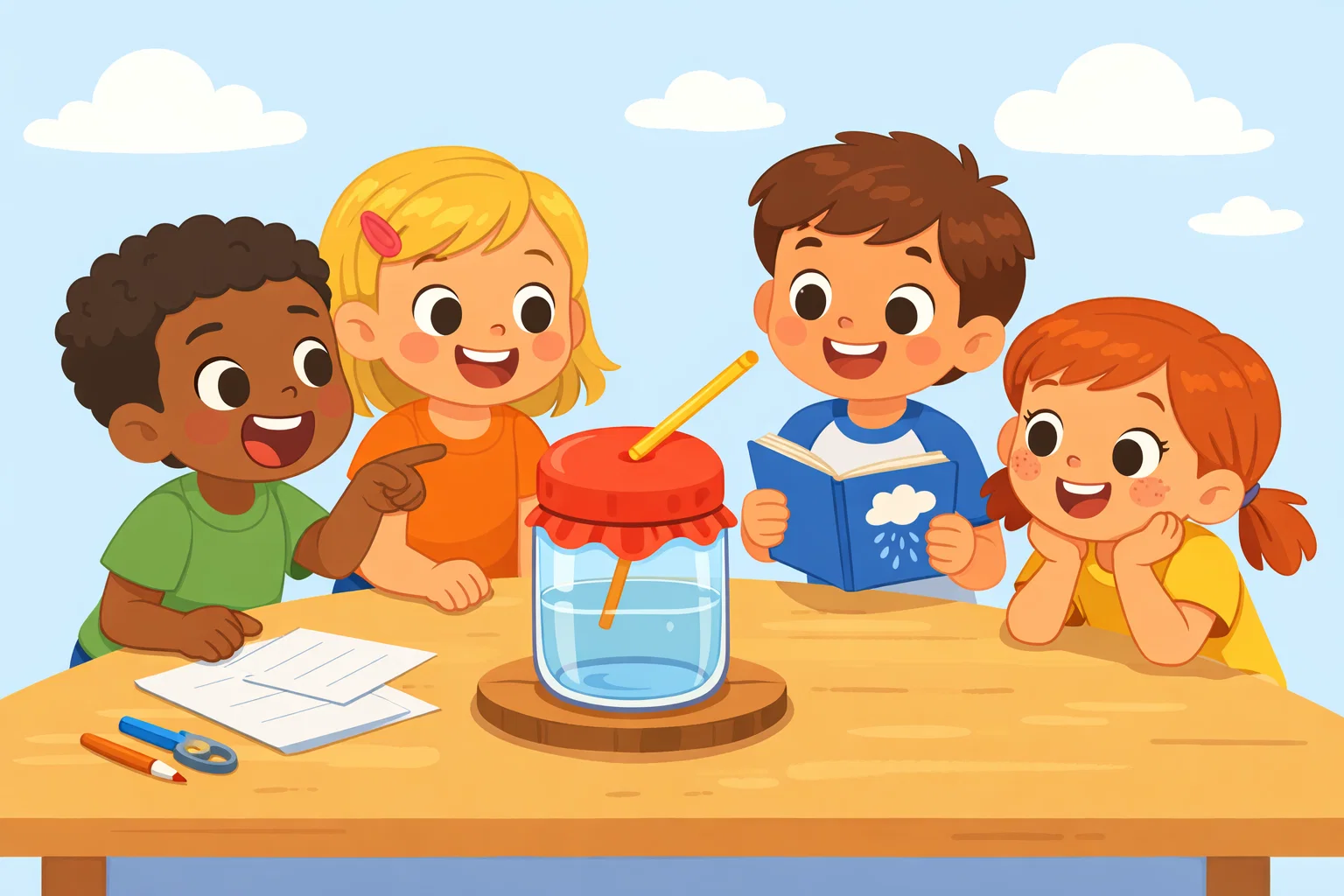
Have you ever wondered how meteorologists know a storm is coming before the first raindrop even falls? It may feel like magic, but it’s actually pure weather science. By learning how to make a barometer at home, you can give your children a front-row seat to the invisible forces that shape our atmosphere. This classic DIY barometer uses simple household items – a balloon and a jar – to turn the abstract concept of atmospheric pressure into something visible and dynamic.
This experiment is a staple in early childhood development and STEM education because it transforms a “hidden” scientific principle into a tactile experience. It’s a fantastic way to spark curiosity, encourage daily observation, and help children understand the “why” behind the daily forecast. Whether you are preparing for a science fair or looking for a rainy-day activity, this homemade barometer provides a perfect blend of play and profound learning.
Balloon Jar Barometer Science Experiment
The balloon barometer is one of the most accessible science experiments for young learners. It mimics the function of professional instruments used by scientists for centuries, yet it is simple enough to build on a kitchen table. This project allows kids to act as their own mini-meteorologist, tracking weather changes right from their bedroom window.
What Balloon Jar Barometer Shows
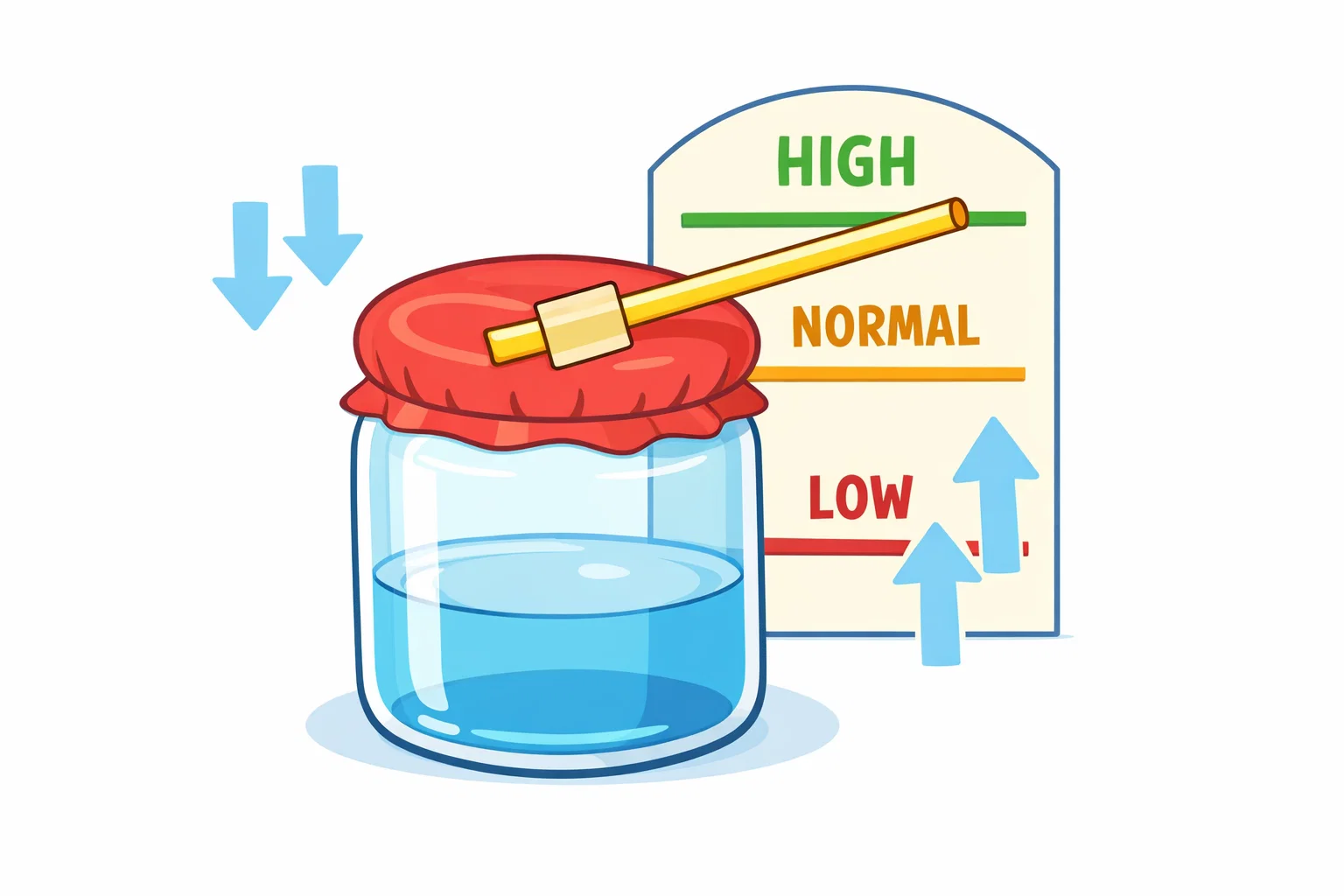
In this experiment, the stretched balloon rubber acts as a sensitive membrane. When you seal the air inside the jar, you create a relatively controlled environment. The pointer (usually a drinking straw) will move up or down based on the weight of the air outside. Children will see the tip of the straw shift its position as the external air pressure fluctuates, providing a visual representation of how the “weight” of the sky changes.
Why Experiment Works for Kids Learning Weather
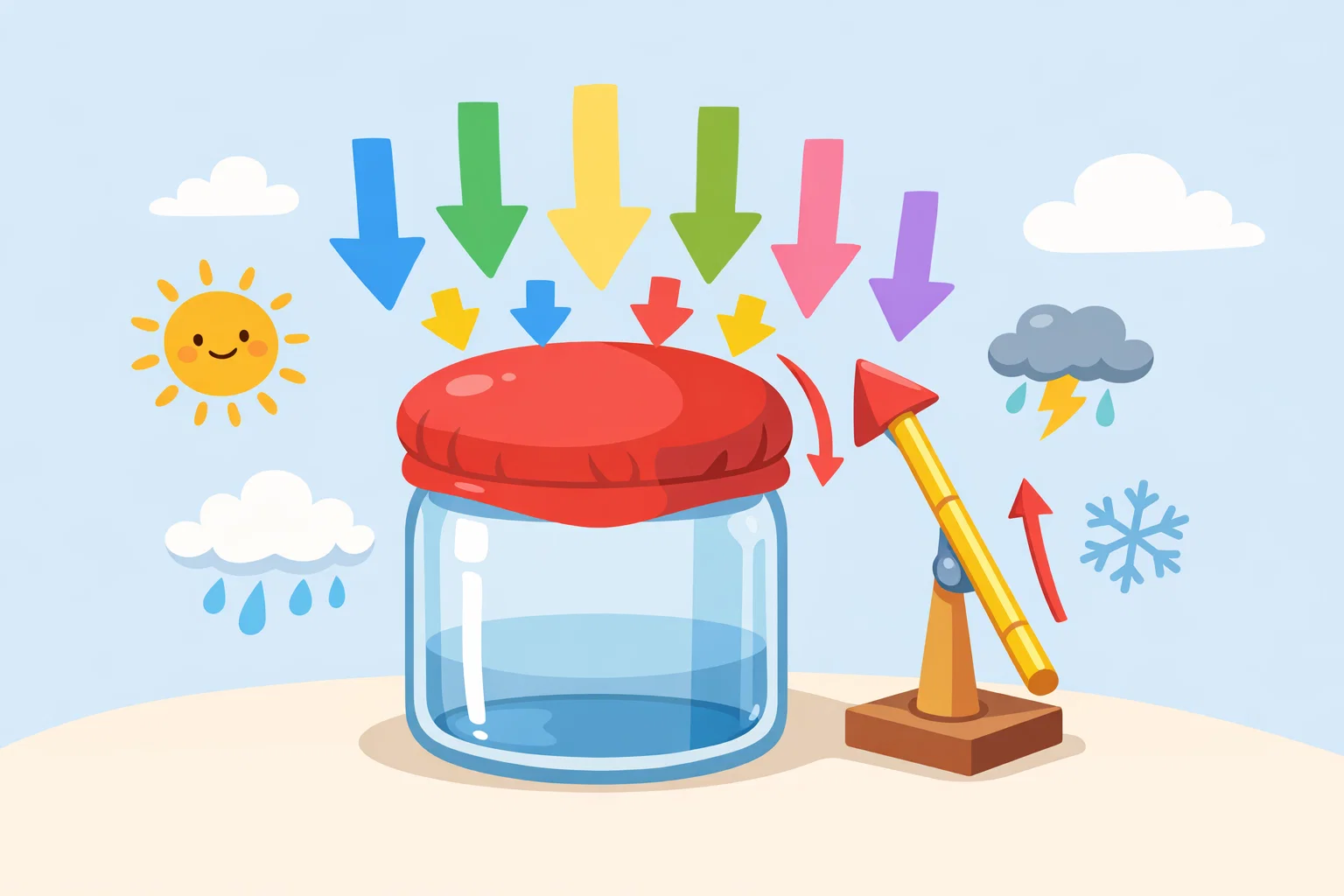
Abstract concepts like “pressure” are often difficult for children to grasp because they cannot see the layer of air pushing down on them. This weather science experiment works because it provides a clear mechanical reaction. When the air pressure outside the jar increases, the balloon fits tighter and sinks; when it decreases, the relatively higher pressure inside the jar pushes back. This “push and pull” makes the invisible visible.
Real-Life Weather Connections
In the real world, a barometer measures air pressure to help scientists predict the weather. High pressure usually brings fair weather and blue skies, while low pressure usually means clouds and rainy weather are on the way. By using their DIY barometer to track air pressure, kids can see these patterns happen in real-time, often noticing the pressure changes hours before the clouds actually arrive.
Materials for Balloon Jar Barometer
You don’t need a laboratory to explore weather science. Most of these items are likely sitting in your pantry or craft drawer right now.
Household Supplies Needed
- Glass or plastic jar: A medium-sized jam jar or a sturdy plastic container works well.
- Balloon: A standard 12-inch latex balloon.
- Rubber Band: To secure the balloon tightly over the jar.
- Drinking Straw: A straight, lightweight straw to act as the pointer.
- Tape or Glue: To attach the straw to the center of the balloon.
- Paper or Card: To create a scale for recording pressure changes.
Optional Tools for Better Results
| Tool | Purpose |
| Ruler | To measure exactly how many millimeters the straw moves. |
| Marker | To draw a “High” and “Low” indicator on your scale. |
| Food Coloring | Does not affect the science, but makes it look professional! |
Safe Material Choices for Children
For preschool-aged children, using a thick plastic jar instead of glass is a safer “unbreakable” option. Always ensure an adult handles the balloon and stretch phase, as uninflated balloons can be a choking hazard.
Balloon Jar Barometer Instructions

Ready to build a simple barometer? Follow these steps to ensure your device is sensitive enough to catch those subtle atmospheric pressure shifts.
Preparing Jar and Balloon Surface
First, cut the neck off the balloon. You want the round part of the balloon to be wide enough to stretch over the top of the jar. Pull the balloon across the opening so it is as flat and tight as a drumhead. Use a rubber band to secure it firmly around the rim. It must be airtight so that no air inside the jar can escape.
Attaching Straw Pointer
Take your drinking straw and place one end at the center of the balloon. Tape it down securely. The end of the straw should hang off the side of the jar – this will be your pointer. As the center of the balloon moves up or down, the tip of the straw will move in the opposite direction.
Creating Pressure Measurement Scale
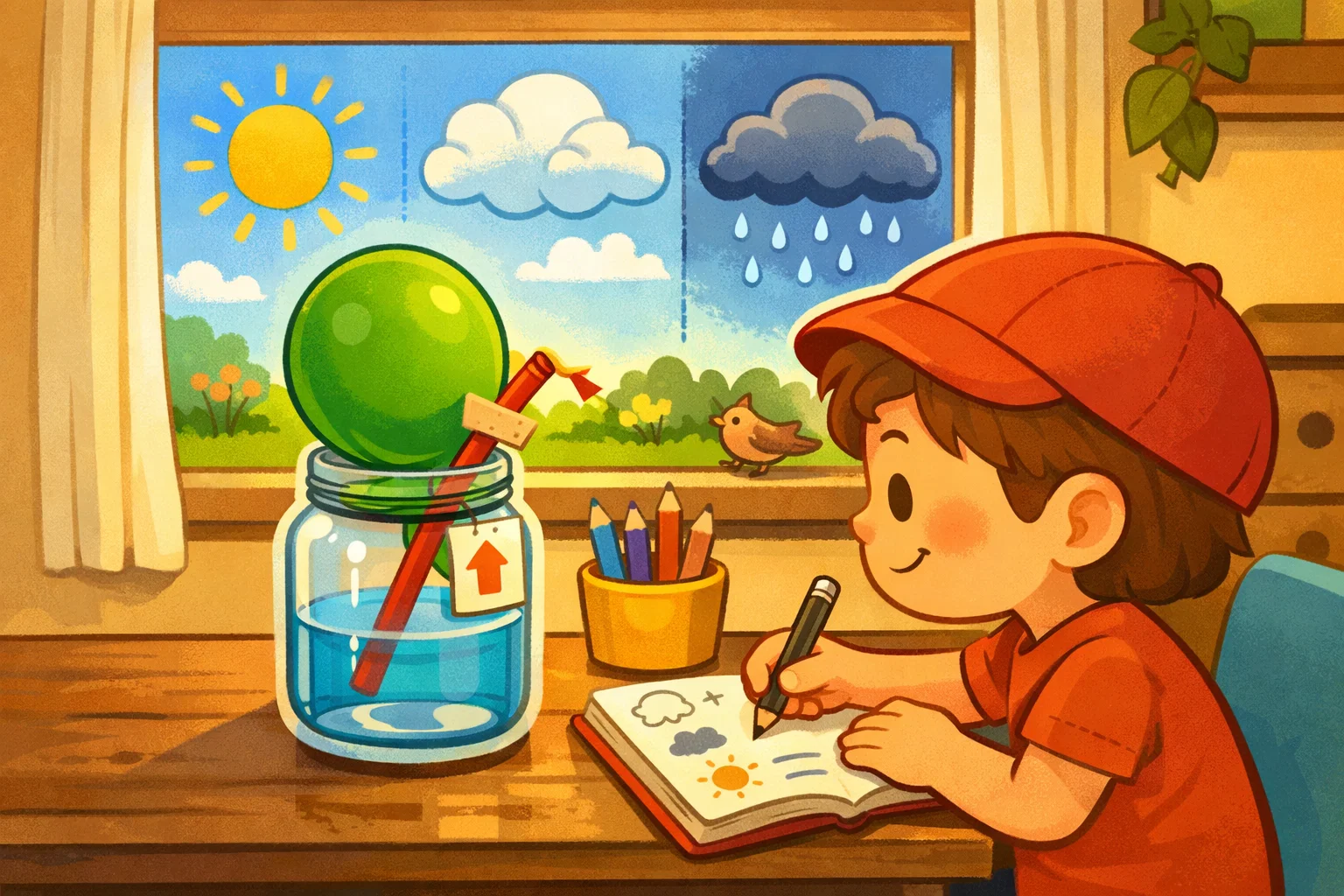
Place a piece of card or paper behind the tip of the straw. Mark the straw’s current position as “neutral.” You can draw a sun at the top and a rain cloud at the bottom to help kids predict weather changes visually.
Final Setup Check
- Is the balloon tightly over the jar?
- Is the straw pointing straight?
- Is the jar away from direct sunlight? (Heat can make the air inside the jar expand, giving a false reading!)
How Balloon Jar Barometer Works
To explain the science behind this, we have to look at the “tug-of-war” between the air inside and the air outside.
Air Pressure Changes Explained for Kids
Imagine the air around us is made of billions of tiny, invisible bouncy balls pressing on everything. These balls are always pushing on us – this is air pressure. Even though we don’t feel it, the air around us has weight!
High Pressure vs Low Pressure Effects
- High Pressure: The air outside is “heavy” and pushes on the balloon. This makes the balloon surface dip inward, which causes the pointer to tilt upward. High pressure usually means clear, sunny days.
- Low Pressure: The air outside is “lighter.” Now, the pressure inside the jar is stronger than the air outside. This makes the balloon bulge upward, causing the straw attached to the balloon to point downward. This often signals bad weather.
Why Balloon Reacts to Weather
The stretched balloon is a flexible bridge. Because you sealed the jar, the air inside stays the same. When the external air pressure changes, the balloon moves to try and balance that difference. It’s a physical reaction to the weight of the atmosphere!
Using Homemade Barometer to Observe Weather
Daily Weather Tracking Ideas
Encourage your child to check the barometer every morning and evening. They can mark the piece of card with the date. Over a week, they will see a “graph” of the atmosphere’s behavior.
Comparing Barometer Readings to Forecasts
Open a weather app or watch the news. Does the meteorologist say pressure is low? Check your homemade barometer! Does your pointer agree? This builds trust in the scientific method.
Indoor vs Outdoor Placement Tips
Keep your barometer indoors in a spot with a stable temperature. If the air inside the jar cools or heats up too much, the air will shrink or expand, which can distort the readings. Avoid windowsills or heaters!
Ages Suitable for Balloon Jar Barometer
Preschool and Early Elementary Use
For the little ones, focus on the “up and down.” Use the sun and cloud icons. It’s a great sensory activity to see how the jar pushes and pulls the balloon.
Elementary and Middle School Learning
Older kids can get into math. Have them measure the movement in centimeters. They can research Evangelista Torricelli, the Italian scientist who invented the first mercury barometer in 1643.
Adult Supervision Recommendations
Adults should help with cutting the balloon and ensuring the rubber band is tight enough to prevent the balloon from snapping off.
Science Concepts Covered in Experiment
This project is a triple-threat for educational value:
- Atmospheric Pressure Basics: Understanding that air has mass and exerts force.
- Weather Prediction Fundamentals: Learning the correlation between pressure and sky conditions.
- Scientific Observation Skills: Training the eye to notice small changes over time.
Classroom Extension Ideas
Weather Journals for Kids
Have students create a “Log Book.” They can record the barometer level, the temperature, and whether it is sunny or cloudy.
Comparing Different Barometer Designs
Try using a large jar versus a smaller bottle setup. Does the size of the air inside change how fast it reacts?
STEM Project Ideas
This is a classic for science fair projects. Students can pose the question: “Can a homemade barometer accurately predict the weather as well as a digital one?”
Different Types of Barometers
| Type | How it Works | Kids’ Safety |
| Balloon Jar | Uses a flexible membrane and air volume. | ⭐⭐⭐⭐⭐ (Very Safe) |
| Mercury | Uses a heavy liquid metal; invented by Torricelli. | ❌ (Dangerous) |
| Aneroid | Uses a small metal box that expands/contracts. | ⭐⭐⭐ (Internal mechanism not visible) |
| Digital | Uses electronic sensors. | ⭐⭐⭐ (No “moving parts” to learn from) |
Why Balloon Jar Version Best for Kids
It is visual, tactile, and completely non-toxic. It allows children to see the mechanics of weather science without needing expensive sensors.
Safety Tips for Balloon Jar Experiment
- Balloon Handling: Keep uninflated or broken balloons away from children under 3.
- Glass Jar: If a jar breaks, an adult must clean it up immediately. Consider using a heavy-duty plastic container instead of a glass jar for younger kids.
- Storage: Keep the barometer in a place where it won’t be knocked over, as the straw is delicate.
Related Weather Science Experiments for Kids
- Cloud in a Jar: Use hairspray and ice to show how warm air expands and then condenses into clouds.
- Homemade Thermometer: Use rubbing alcohol and a straw to see how liquids react to heat.
- Rain Gauge: Use a plastic bottle to measure actual rainfall during a storm.
Make Balloon Jar Barometer Science Project
Science Fair Presentation Ideas
Create a “Before and After” poster. Show what the barometer indicates during a storm versus a sunny day. Use photos of your straw to the center setup.
Hypothesis Examples for Kids
- “If the atmospheric pressure drops, then the pointer will move down, and it will rain.”
- “The barometer will react faster if the air inside the jar cools.”
Recording Results and Conclusions
A good science project always ends with a conclusion. Did your diy barometer work? Most kids find that while it isn’t as precise as a professional tool, it is remarkably accurate at showing pressure changes!
Frequently Asked Questions About Balloon Jar Barometer
Why Straw Moves Without Touching?
It moves because the air around us is literally pushing on the balloon. When the higher pressure of the atmosphere presses down, it acts like an invisible hand.
How Long Barometer Takes to Respond?
You might not see movement in five minutes. Weather changes usually happen over several hours. Check it once in the morning and once before bed!
Can Experiment Be Reused?
Yes! As long as the balloon stretched tightly over the jar remains airtight, your barometer works for weeks. If the balloon loses its stretch, simply replace it with a new one.
Take a short quiz to find out what your everyday choices say about your parenting style
When your child is curious about something new, what’s your instinct?
Take a short quiz to find out what your everyday choices say about your parenting style
“Can I download this app?” What happens next?
Take a short quiz to find out what your everyday choices say about your parenting style
When it comes to rules at home, which sounds most like you?
Take a short quiz to find out what your everyday choices say about your parenting style
If you could give your child one life skill today, what would you pick?
Take a short quiz to find out what your everyday choices say about your parenting style
Your child gets to choose what to watch. What would your ideal setup look like?
Take a short quiz to find out what your everyday choices say about your parenting style
Pick your parenting superpower ✨