Volcano Model Experiment for Kids: Eruption Science Activity

 Discover a Free Education Video App for Kids
Pastory uses AI to personalize educational video content based on your child’s interests and personality. Safe, engaging, and built for curious young minds. Sign up now to stay updated and enjoy early access with a free trial

Igniting a child’s curiosity about the natural world often starts with a single, spectacular moment. The volcano science experiment is a classic for a reason: it combines the thrill of a “messy” activity with the profound wonder of geological forces. By creating a model volcano, children transition from passive observers to active scientists, engaging in STEM learning that bridges the gap between a textbook diagram and a real-world reaction. Whether you are an educator in a classroom or a parent at home, this activity provides a multisensory experience that sticks in a child’s memory far longer than a standard lecture.
Building a volcano at home is more than just a fun science experiment; it is a gateway to understanding how volcanoes form and how our planet stays in a constant state of change. This hands-on experiment encourages children to ask “why” and “how,” fostering critical thinking skills as they watch their volcano erupt. By using simple household items, you can demonstrate the power of gas pressure and chemical changes, making complex earth science concepts accessible and incredibly fun science activity.
How to Make Volcano Model Erupt
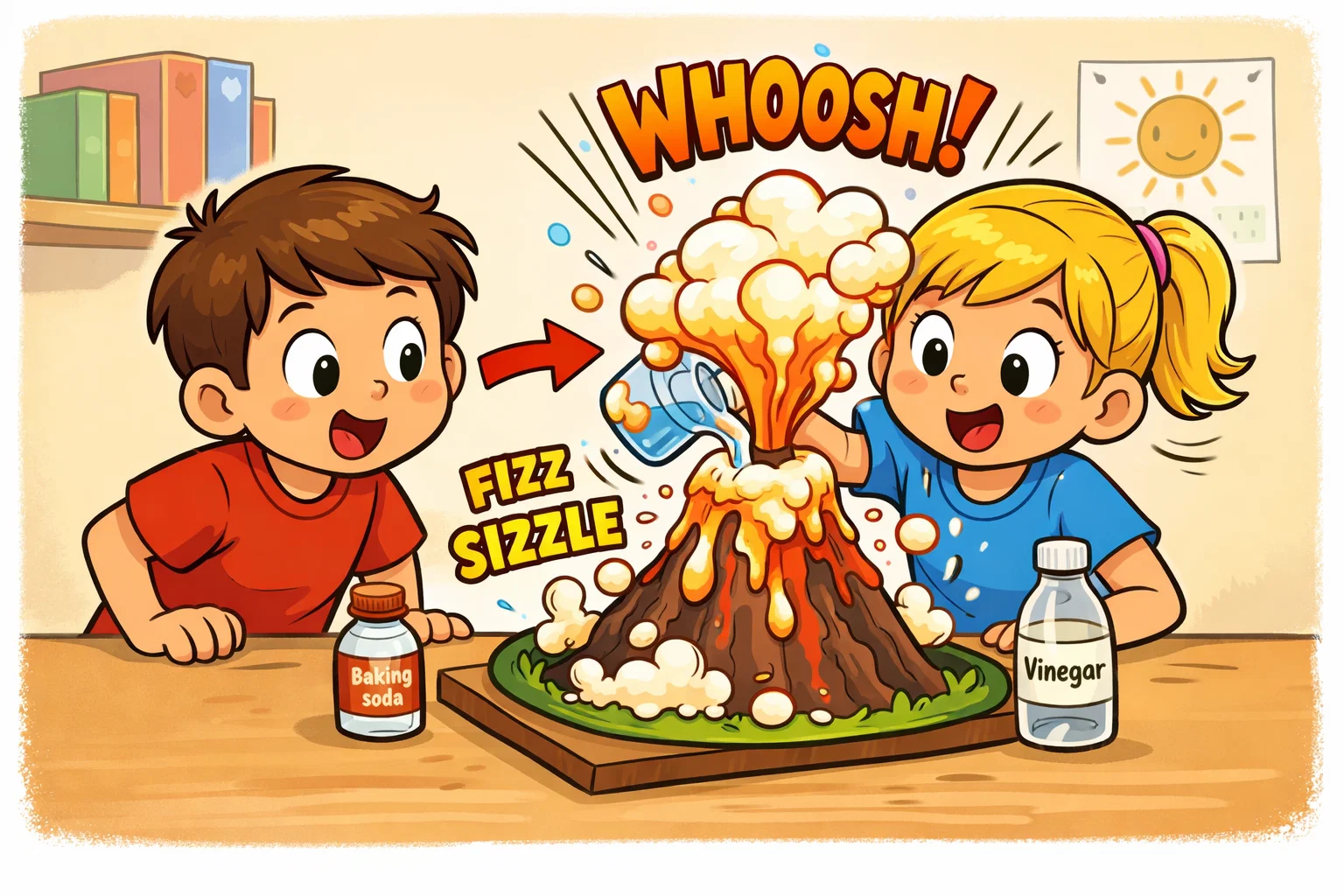
The primary goal of this activity is to simulate a volcanic eruption using a safe, controlled chemical reaction. In nature, a volcano is an opening in the Earth’s crust through which lava, ash, and gases escape. Our model volcano uses the interaction between baking soda and vinegar to mimic the pressure buildup that leads to a real-life flow of lava.
When you make your own volcano, kids will observe a rapid eruption of colorful bubbles and foam. They will see how the liquid mixture expands and escapes the “crater,” much like how magma (underground) becomes lava once it reaches the earth’s surface. This visual representation helps children visualize the geological processes occurring beneath the Earth’s surface.
Materials for Volcano Model
To make a volcano that looks as good as it erupts, you’ll need to build a sturdy mountain structure. Choosing the right material ensures your volcano model can withstand multiple eruptions.
| Material | Purpose |
| Plastic Bottle (small) | Acts as the central “magma chamber” or chimney. |
| Cardboard or Plywood | Provides a stable surface for the volcano base. |
| Playdough, Clay, or Paper Mâché | Used to sculpt the sides of the mountain. |
| Brown and Green Paint | To give the model volcano a realistic look. |
| Tape or Hot Glue | To secure the bottle to the base. |
Using a plastic bottle as the core is essential because it holds the liquid without leaking, allowing the foam to flow over the sides of your sculpted mountain.
Materials for Eruption Reaction

The “magic” happens when you combine specific household items to create a soda volcano. You don’t need a lab to be a scientist; you just need these basics:
- Baking soda (bicarbonate of soda): This serves as the solid base for the chemical reaction.
- Vinegar: The acidic liquid that triggers the eruption.
- Dish soap: Adding a few drops creates more bubbles and a thicker, slower-moving lava.
- Food coloring: Usually red or orange, to make the mixture look like molten rock.
- Warm water: Helps dissolve the powder for a smoother flow.
Setting Up the Volcano Base
Preparation is key to a successful science experiment. First, find a flat surface—ideally outdoors or on a tray that can catch the liquid.
- Secure the Bottle: Glue the bottom of your plastic bottle to the center of your cardboard base.
- Build the Mountain: Shape your clay or dough around the bottle, sloping it downward to the base. Ensure you leave the “mouth” of the bottle open at the top.
- Decorate: Once the material has dried, paint it to look like a real geological feature. Adding small plastic trees or rocks can enhance the model.
- The Containment Zone: Place the entire volcano model inside a large baking pan or a plastic bin to catch the “lava” and prevent a mess.
Volcano Eruption Steps
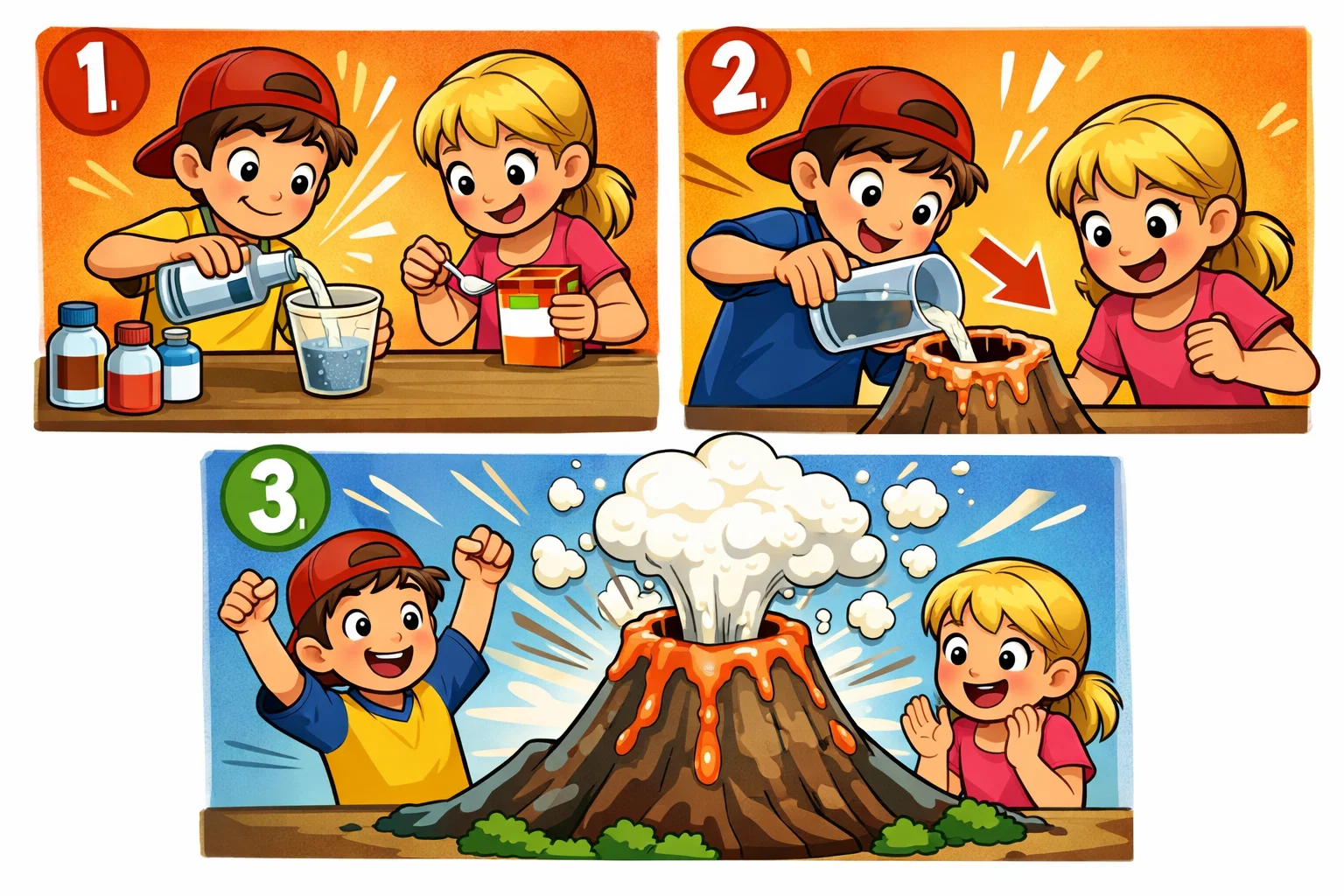
Now it’s time to find out how to make the mountain erupt! Follow these steps for a perfect volcanic display:
- The Base Mixture: Pour about 2–3 tablespoons of baking soda into the bottle.
- The Secret Ingredient: Add a squirt of dish soap and several drops of red food coloring.
- The Dilution: Add about half a cup of warm water to the bottle and gently swirl the mixture.
- The Eruption: Quickly pour in about half a cup of vinegar.
- Observe: Stand back and watch the volcano erupt as the mixture foams up and spills over the rim!
Cleanup After Experiment
Responsible science includes a tidy workspace. Since we used baking soda and vinegar, the “lava” is non-toxic and biodegradable.
- Rinse: Use plenty of water to rinse the model volcano if you plan to use it again.
- Dispose: The cardboard base may become soggy after repeated eruptions; if so, recycle it and save the plastic bottle for your next experiment.
- Wipe: Clean the surrounding surface with a damp cloth. The vinegar smell will dissipate quickly, or you can use a bit of lemon juice to neutralize it.
Volcano Model Science Explanation
While it looks like magic, the erupting volcano is a perfect example of basic volcanic processes in action. This activity bridges the gap between play and the curriculum, teaching kids about the laws of nature.
Chemical Reaction Behind Eruption
The “lava” is the result of a chemical reaction between an acid (vinegar) and a base (baking soda). When these two meet, they produce new substances. Specifically, the bicarbonate of soda reacts with the acetic acid in the vinegar to produce carbon dioxide gas.
Why Volcano Foams and Overflows
As the reaction occurs, it creates millions of tiny carbon dioxide bubbles. Because the gas takes up much more space than the original liquid and powder, it builds up pressure inside the bottle. Since the gas has nowhere else to go, it pushes the soapy mixture up and out of the bottle’s neck, creating the overflow we call an eruption.
How Real Volcanoes Compare
In nature, volcanoes on Earth erupt because of intense pressure from gases and ash trapped in magma. While our model uses a chemical trigger, real geological events are driven by heat and tectonic movement in the earth’s crust. When the pressure becomes too great, the magma is forced through the surface, in a simplified way, similar to our baking soda foam.
Volcano Types for Kids
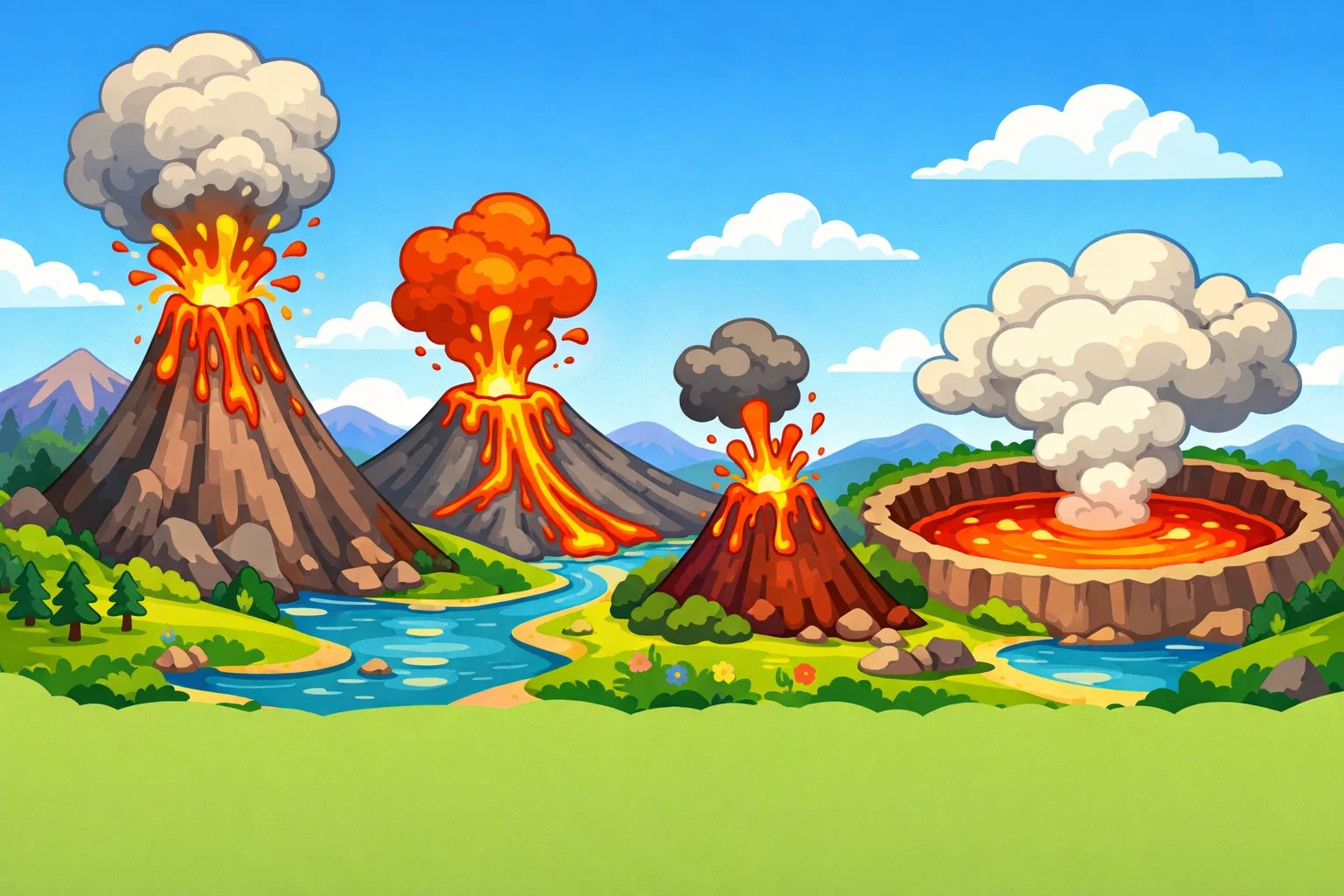
Not all volcanoes look the same! Exploring different types helps kids understand the variety of geological formations on our planet.
Stratovolcanoes
These are the “classic” tall, cone-shaped mountains like Mt. Fuji or Mount St. Helens. They are known for their explosive eruptions because their magma is thick, trapping gases until the pressure becomes immense.
Shield Volcanoes
Imagine a warrior’s shield lying flat on the ground. These are broad and wide. The lava here is thin and runny, so it flows long distances, creating a gentle slope. Hawaii’s Mauna Loa is a famous example.
Cinder Cone Volcanoes
These are the simplest types. They are small and built from blobs of congealed lava ejected from a single vent. As the lava is blown into the air, it breaks into small fragments called cinders that fall around the vent to form a circular cone.
So-called supervolcanoes
These are the giants. A supervolcano eruption is rare—occurring perhaps every 100,000 years—but it is powerful enough to change the global climate. Yellowstone is one of the most well-known volcanic centers of this type.
Step-by-Step Volcano Project Variations
You can adapt the volcano experiment to suit different needs, whether it’s for a toddler or a competitive classroom setting.
Simple Volcano Experiment for Preschool
For the littlest scientists, skip the elaborate mountain construction. Simply use a small cup or a mound of sand at the beach. Focus on the sensory experience—the sound of the “fizz” and the feel of the bubbles.
School Science Fair Volcano Model
To impress judges, use more permanent material like plaster of Paris. Create a detailed “Earth’s Layers” diagram to accompany the model volcano. Collect data on how changing the amount of baking soda affects the height of the eruption.
Color-Changing Volcano Experiment
Pour different food colors into separate sections of the powder before adding the vinegar. As the eruption begins, the colors will swirl together, creating a “rainbow lava” effect that is visually stunning for kids and adults alike.
Ice or Lava Flow Volcano Version
For a “cool” twist, freeze the vinegar into ice cubes with food coloring. Place them on a “mountain” of baking soda. As the ice melts, the reaction happens slowly, showing a sustained lava flow rather than a sudden burst.
Learning Goals for Volcano Experiment
Educators often observe that hands-on STEM activities significantly improve retention. Here is what your little scientist is actually learning:
Science Skills Developed
- Observation: Noticing changes in state (solid or liquid to gas).
- Prediction: Guessing what happens when more vinegar is added.
- Measurement: Counting the spoonfuls of powder used.
STEM Concepts for Kids
This activity introduces the basics of chemistry (reactants and products) and geology (tectonics and pressure). It demonstrates that science is a process of trial and error.
Age-Appropriate Learning Outcomes
| Age Group | Focus | Outcome |
| Preschool | Sensory Play | Identifying colors and the “fizzing” sound. |
| Elementary | Cause and Effect | Understanding that baking soda + vinegar = gas. |
| Middle School | Geological Systems | Comparing the model to the Earth’s crust and mantle. |
Volcano Experiment Safety Tips
Safety is the foundation of any good instruction. While these ingredients are safe, supervision is always required.
Safe Ingredient Handling
- Eyes: Vinegar is an acid and can sting. Have kids wear safety goggles to feel like a real scientist.
- Ingestion: Remind children that while these are household items, the mixture is not for drinking!
Indoor and Outdoor Setup Advice
If you are indoors, use a deep tray or the kitchen sink. Outdoors is always better for a larger erupting volcano, as you don’t have to worry about the liquid splashing on the carpet.
Common Mistakes to Avoid
- Too Much Water: This dilutes the reaction and makes it less “explosive.”
- Narrow Opening: If the bottle neck is too wide, the foam won’t shoot up; if it’s too narrow, it might clog.
- Old Ingredients: Ensure your baking soda is fresh for the best bubble production.
Extra Volcano Experiments for Kids
Once the first eruption is over, the fun doesn’t have to stop. Encourage further science fun with these extensions.
Multiple Eruptions Experiment
Try varying the ratios. What happens if you use 5 tablespoons of baking soda but only a tiny bit of vinegar? Record which mixture creates the tallest eruption.
Mapping Lava Flow Activity
Place small obstacles (like toy trees or houses) around the base of the mountain. Watch your volcano erupt and see which paths the lava flows take. This helps kids understand how volcanic activity affects the environment.
Recording Volcano Results
Give your child a “Science Journal.” Have them draw the volcano before, during, and after the experiment. This builds the habit of documenting evidence, a key skill for any future scientist.
Volcano Model Questions Kids Ask
Children are natural-born skeptics and curious thinkers. Here are some quick answers to common questions:
Why Volcanoes Erupt
Think of a shaken bottle of soda. The gas wants to get out! Inside the Earth, heat creates gas and melted rock (magma). When the pressure gets too high, it pops through the earth’s surface.
How Lava Forms
Deep under our feet, it is so hot that even rocks melt! This melted rock is called magma. When it finds a hole in the earth’s crust and comes out, we call it lava.
Where Volcanoes Exist
Most volcanoes on Earth are found in the “Ring of Fire” around the Pacific Ocean. Many also exist deep underwater where the earth’s crust is pulling apart!
Teaching Volcano Science at Home or School
Whether you are a parent or an educator, this activity is a powerhouse for learning.
Classroom Volcano Demonstration
For a large group, use a gallon-sized container to create a “Mega-Volcano.” Have students take turns adding the powder and the liquid to foster a sense of teamwork.
Homeschool Science Lesson Integration
Pair the experiment with a geography lesson. Look at maps of the world and mark where famous volcanoes are located. Discuss how volcanic ash makes soil very fertile for farming.
Printable Volcano Worksheets
Use a simple diagram of a volcano and have kids label the “Crater,” “Vent,” “Magma Chamber,” and “Lava Flow.” This reinforces the vocabulary learned during the activity.
More Science Activities for Kids
If your kids loved the vinegar volcano, they will likely enjoy these other STEM projects:
Easy Chemistry Experiments
- Slime Making: Explore polymers and non-Newtonian fluids.
- Elephant Toothpaste: A more intense version of the foam reaction using yeast and peroxide (requires adult supervision).
Earth Science Projects
- Rock Polishing: Learn about different types of stones and minerals.
- Earthquake Shake Table: Build a small structure and see if it can survive a “quake.”
Outdoor Science Experiments
- Mentos and Soda: A high-pressure gas release experiment that is definitely for outdoors only!
- Solar Ovens: Use the sun’s energy to melt a marshmallow, teaching about renewable energy.
“The important thing is to never stop questioning. Curiosity has its own reason for existing.” — Albert Einstein
Building a volcano model is a rite of passage for many young learners. It represents the perfect intersection of art, science, and play. By providing the material and the space to explore, you are helping your child understand the complex, beautiful, and sometimes explosive nature of our planet.

Take a short quiz to find out what your everyday choices say about your parenting style
When your child is curious about something new, what’s your instinct?
Take a short quiz to find out what your everyday choices say about your parenting style
“Can I download this app?” What happens next?
Take a short quiz to find out what your everyday choices say about your parenting style
When it comes to rules at home, which sounds most like you?
Take a short quiz to find out what your everyday choices say about your parenting style
If you could give your child one life skill today, what would you pick?
Take a short quiz to find out what your everyday choices say about your parenting style
Your child gets to choose what to watch. What would your ideal setup look like?
Take a short quiz to find out what your everyday choices say about your parenting style
Pick your parenting superpower ✨