Hands-On Weather Science Experiments: Exploring Weather and Climate Through Engaging Activities for Kids

 Discover a Free Education Video App for Kids
Pastory uses AI to personalize educational video content based on your child’s interests and personality. Safe, engaging, and built for curious young minds. Sign up now to stay updated and enjoy early access with a free trial
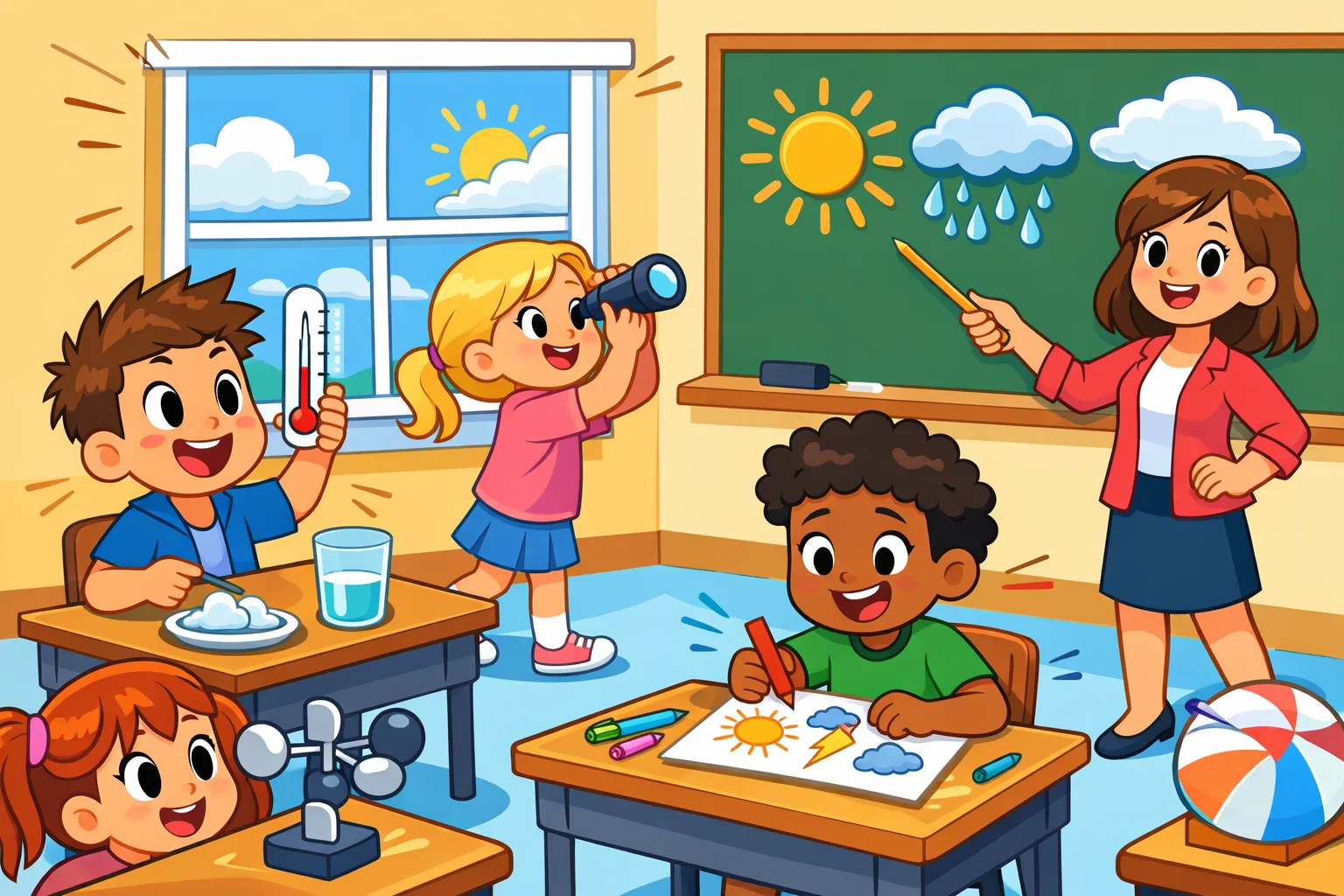
Ever wondered why you can have a sudden thunderstorm on a sunny afternoon, but you still know exactly when to pull your winter coats out of storage each year? Understanding the wonders of nature starts with a simple idea: weather describes what is happening right now, while climate represents long-term patterns of what happens over years or decades. For young learners, these concepts can feel abstract until they get their hands dirty – or at least their hands on a thermometer.
This guide is designed to help parents and educators lead hands-on science projects that bridge the gap between daily observations and long-term data. By engaging in a science experiment that tracks atmospheric patterns, children don’t just memorize definitions; they become little observers of the sky. Through hands-on activities, students learn to make predictions, collect data, and draw conclusions about the environment. Let’s explore the world of meteorology and discover how to build a mini observation point in your own backyard!
Hands-On Weather And Climate Experiments For Kids
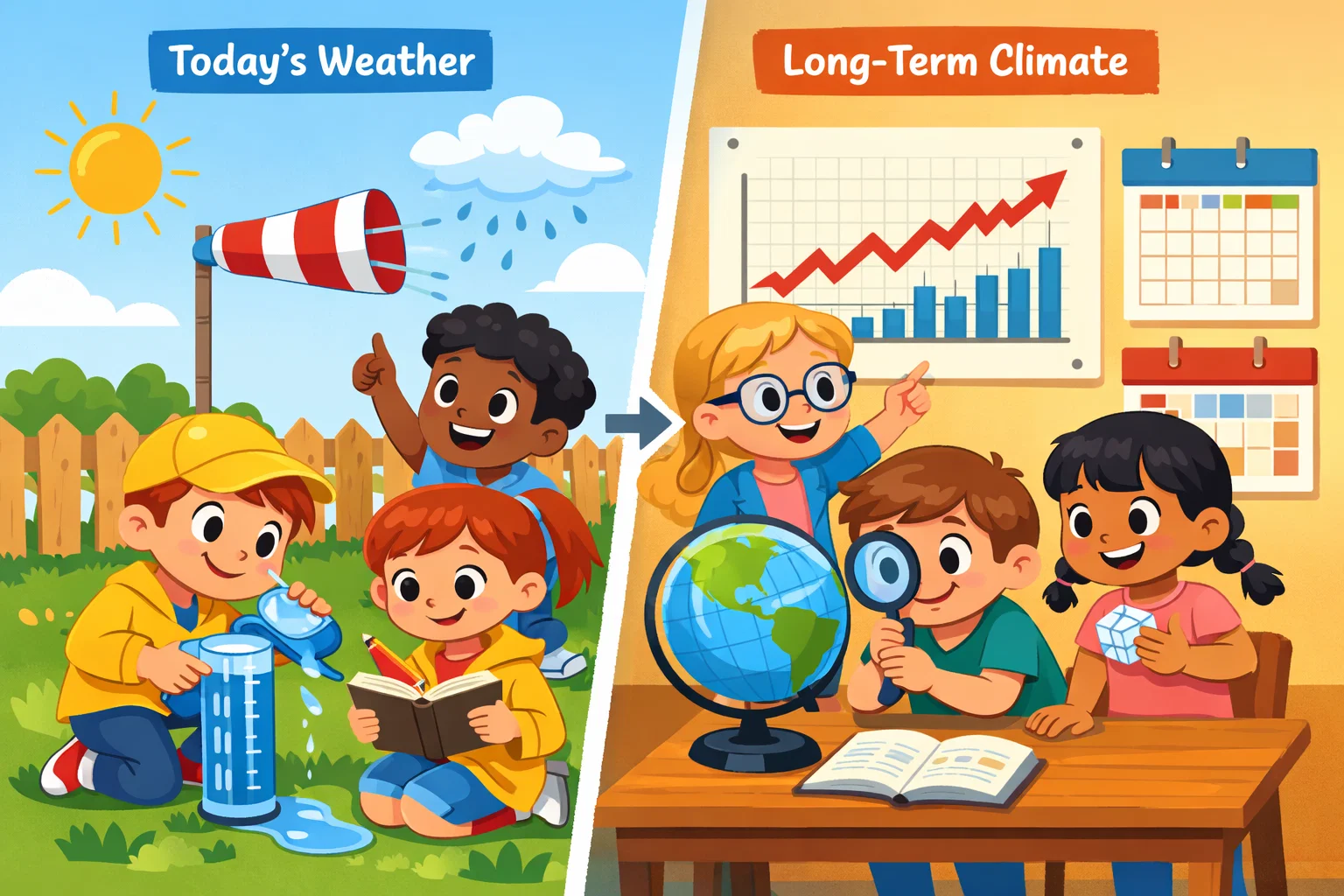
The difference between weather and climate is often summarized by the saying, “Climate is what you expect; weather is what you get.” To help elementary students grasp this, practical activities are essential. When kids conduct the experiment themselves, they move from passive reading to actively understanding environmental changes through physical interaction.
Practical tests allow younger students to see the high variability of daily conditions – how air pressure drops before a storm or how water vapor in the air feels on a humid day. Meanwhile, older students can look at the same data through a wider lens to see the average temperature trends that define a region. This hands-on way of learning transforms a nonfiction text into a living laboratory where students understand the “why” behind the local forecast.
General Weather Experiments
To learn about daily conditions, start with the basics. Simple science activities focus on the immediate environment. For example, you can simulate a tornado in a bottle to discuss vortices or create a “cloud in a jar” to see how water vapor behaves when it cools.
Other engaging activities include:
- Shadow Tracking: Measuring how shadows move to understand the sun’s position.
- Cloud Identification: Using a visual chart to identify different cloud types associated with cumulus versus stratus formations.
- Wind Direction: Using a simple wind vane to see which way the breeze is blowing.
Climate Observation Activities
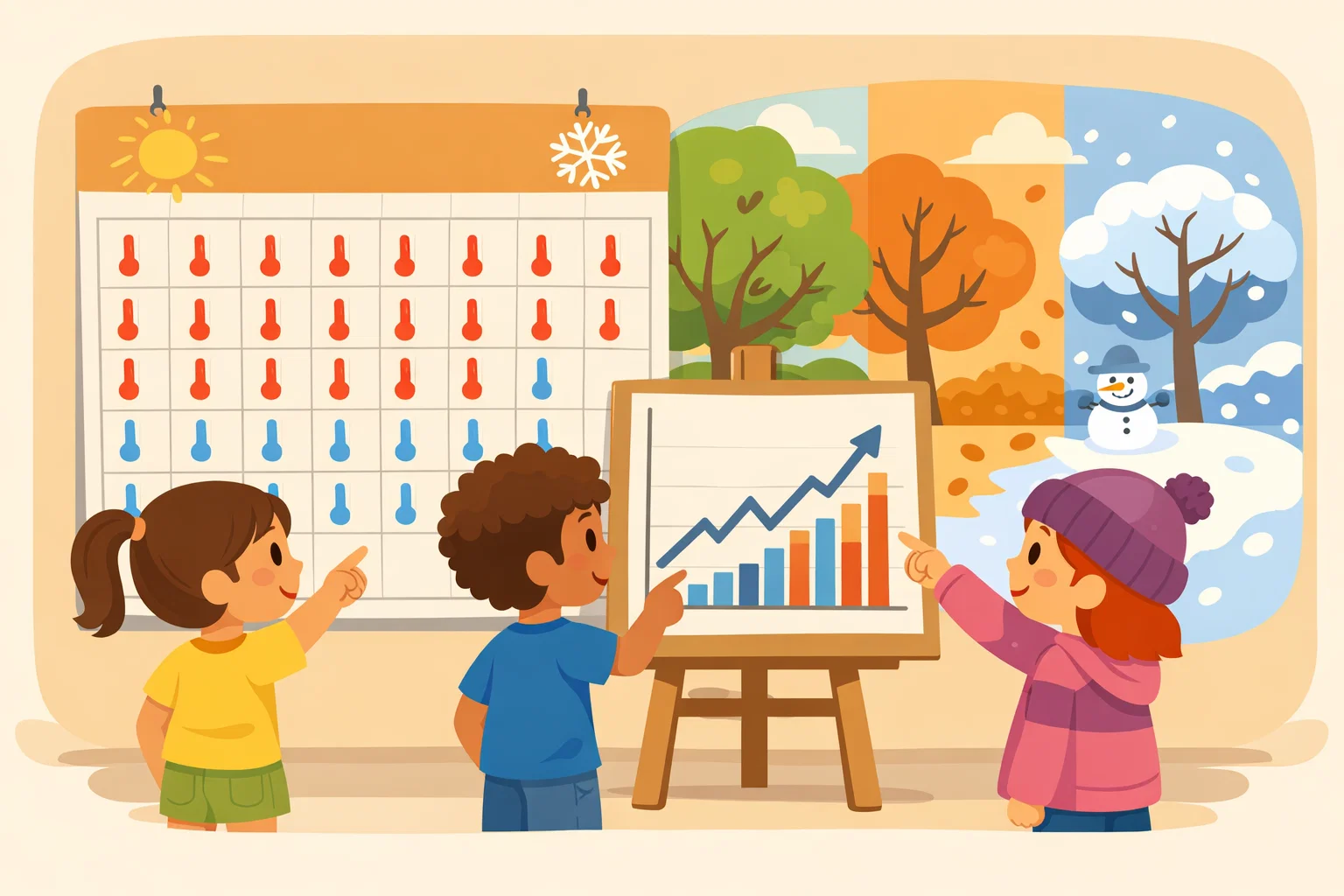
Unlike a one-day science experiment, climate activities require patience. These educational activities for kids involve observation and tracking tasks that last for weeks or months. For instance, students collect data on when the first leaves fall or when the first frost appears. Over time, this recorded data reveals the local climate’s characteristics.
A great greenhouse experiment can demonstrate the greenhouse effect by placing one thermometer inside a glass jar and another outside in the sun. This helps kids understand how certain gases trap heat in our atmosphere, influencing global phenomena over long periods.
Comparing Weather And Climate Through Data
The best way to explore the distinction is through direct comparison. If a child records a very hot day in April, they might think their local environment is always hot. However, by looking at the average temperature for April over the last 30 years (available from long-term weather records), they can see that their hot day was an “outlier.”
| Feature | Daily Conditions | Climate |
| Timeframe | Minutes to days | Years, decades, or centuries |
| Focus | Short-term changes | Long-term averages |
| Example | A sudden thunderstorm | A tropical rainforest having consistently high rainfall |
| Tools | Barometer, Rain gauge | Historical atmospheric patterns |
Weather Data Tracking Activities
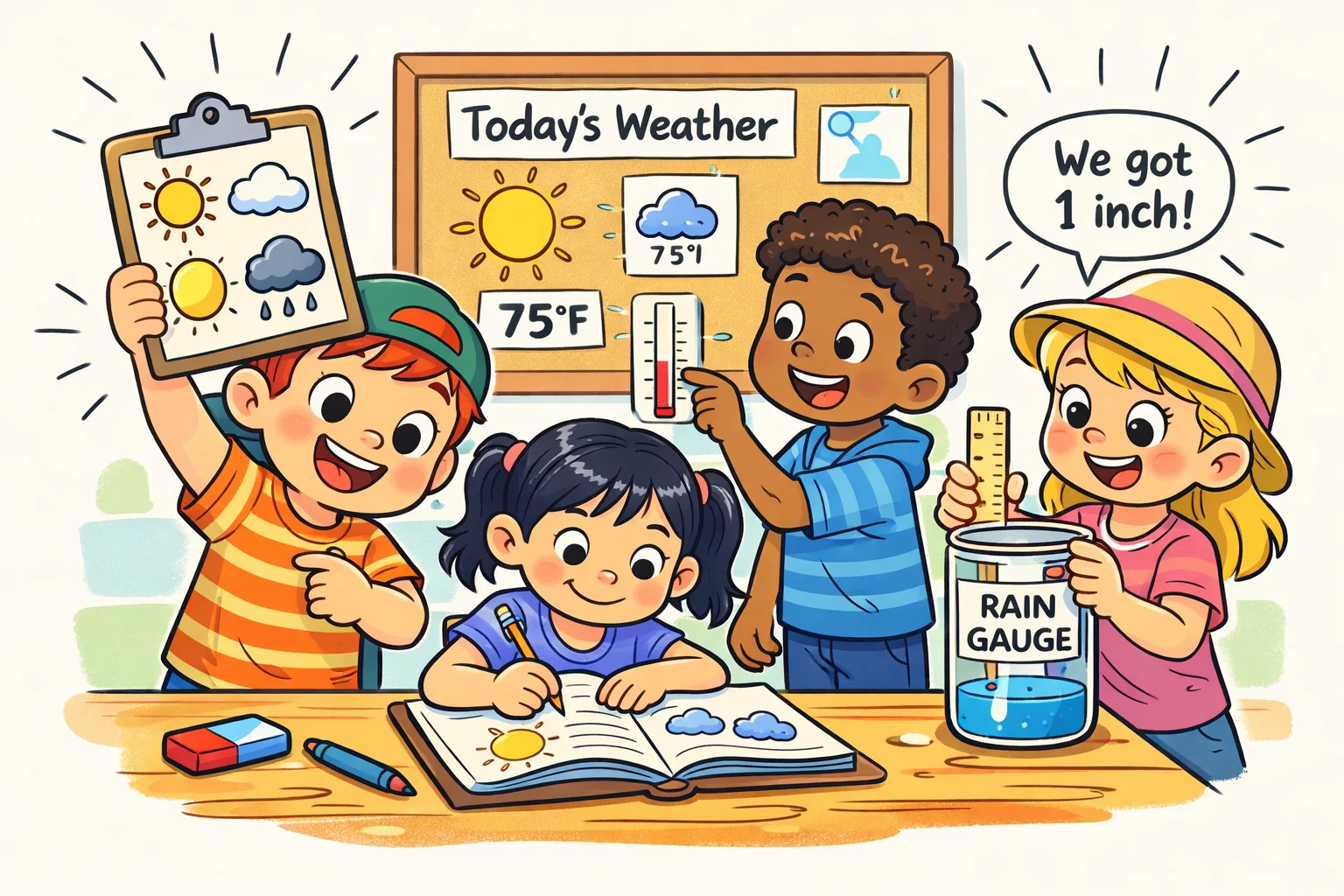
Building thinking skills starts with structured tracking. When students work to record information daily, they develop a habit of precision. This approach builds early data literacy, teaching kids that science isn’t just about dramatic experiments – it’s about careful observation of the sky above.
Daily Weather Log Setup
Every budding scientist needs a logbook. You can create a printable chart or use a dedicated notebook. A good daily log should include:
- Date and Time: Consistency is key!
- Sky Conditions: Sunny, overcast, or “partly” something?
- Precipitation: Was there light rain or a heavy downpour?
- Wind Speed: Is it a light breeze or a gale?
Measuring Temperature And Rainfall
Using scientific instruments is the highlight for most kids of all ages.
- Thermometer: Teach kids how to read the scale. Have them use thermometers to record the heat in the shade versus the sun.
- Rain Gauge: After a storm, check the rain gauge to see how many millimeters fell. This makes the concept of “an inch of rain” much more tangible.
Graphing Daily Observations
Don’t let the numbers sit in a book! Explore the skies by turning those numbers into art. Elementary students can use colored markers to create a “nature calendar,” using blue for rain, yellow for sun, and grey for clouds. This provides a visual record of how the week progressed.
Climate Data Collection Projects
To understand meteorology on a deeper level, we must look at the “long game.” Climate projects help students understand that one snowy day does not define long-term climate trends, just as one rainy day doesn’t mean you live in a swamp.
Monthly Temperature Averages
At the end of each month, have the students work together to add up all the daily readings and divide by the number of days. This average temperature is a much more stable number than the daily highs and lows. It teaches them how temperature data can be smoothed out to show a trend.
Seasonal Pattern Tracking
Every season brings different conditions. By tracking the water cycle – specifically evaporation and how clouds condense – across spring, summer, fall, and winter, kids can see how Earth’s tilt influences seasonal changes in their local area.
Long-Term Weather Records
For a truly fun and educational challenge, compare your current findings to records from years or decades ago. Many libraries have nonfiction archives or digital records from the National Weather Service that show what the environment was like when the child’s grandparents were young.
Experiments Comparing Weather And Climate
Short-Term Weather Experiment
Activity: For one week, predict the outdoor conditions each morning and then record what actually happens by 4:00 PM.
- The Goal: To see how quickly atmospheric changes occur.
- Observation: Kids will likely see that the forecast isn’t always 100% accurate, demonstrating the “chaos” of short-term environmental events.
Long-Term Climate Experiment
The Experiment: Use a greenhouse (or a simple plastic wrap over a seed tray) to simulate a specific zone.
- The Goal: Observe how the warm air trapped inside creates a consistent “climate” for the plants, regardless of whether the room outside is slightly cooler or warmer that day.
Data Comparison Activity
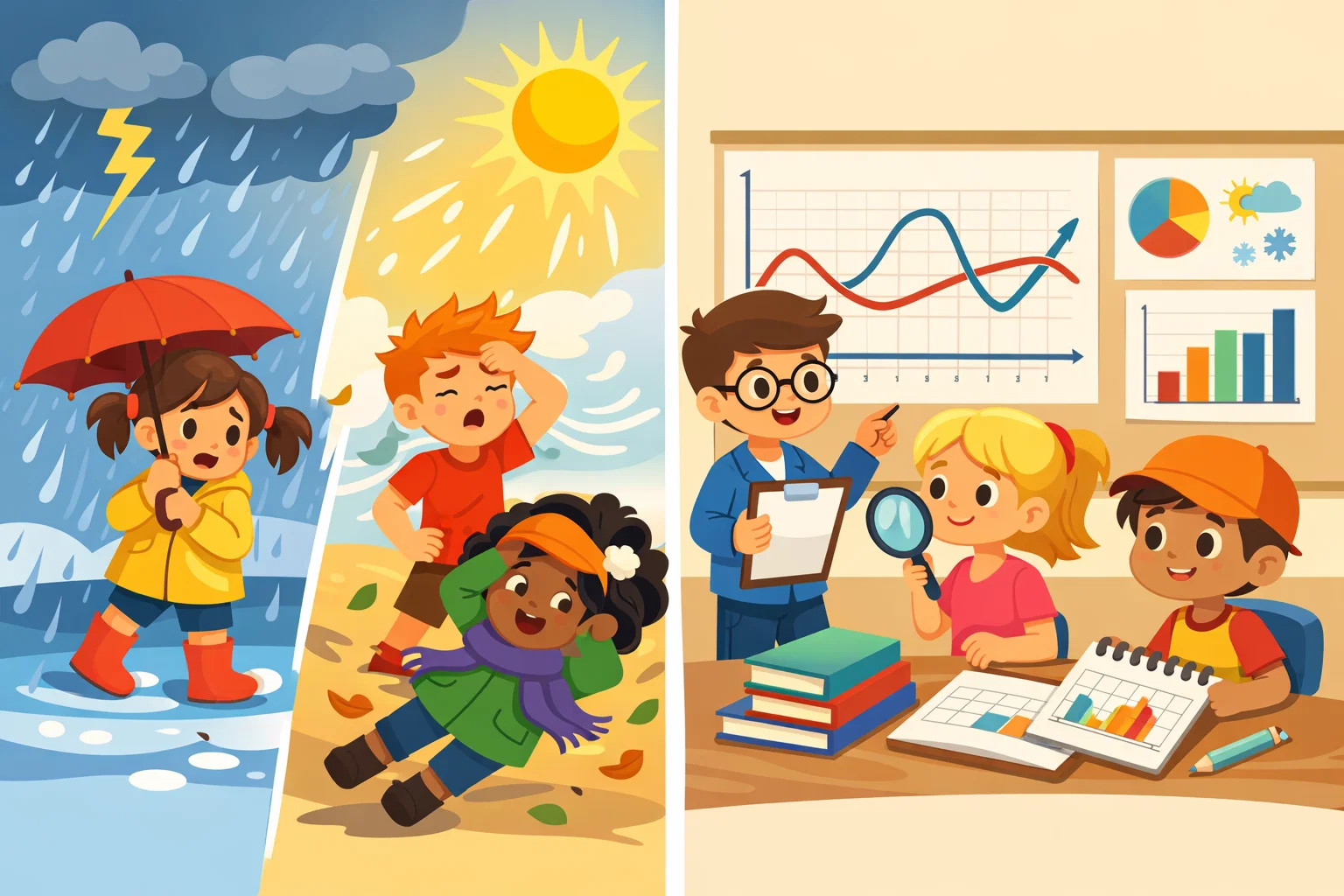
Create a “Daily vs. Long-term” poster. On one side, list the “Wildest Events” of the month (the highest wind, the biggest thunderstorm). On the other side, list the “Climate Normals” for your city. This experiment provides a clear visual of how extreme events sit within a stable system.
Weather Measurement Tools For Kids
You don’t need expensive equipment to learn about the atmosphere. In fact, building your own tools is a fantastic hands-on way to learn how they work.
DIY Thermometer And Rain Gauge
- DIY Rain Gauge: Cut the top off a plastic soda bottle, turn it upside down to act as a funnel, and mark the side with a ruler.
- DIY Thermometer: While a traditional thermometer is hard to make, you can create a “liquid sensor” using a bottle, water, rubbing alcohol, and a straw to show how liquids expand when they get warm.
Wind And Cloud Observation Tools
A wind vane is a classic simple science project. Using a straw, a paper plate, and a bit of cardboard, kids can see which direction the wind is blowing. For clouds, a “cloud window” (a cardboard frame with different cloud types drawn on the edges) helps young learners identify what they see in the sky.
Home Weather Station Setup
Combine all your tools into one observation point. Pick a spot in the yard that is:
- Away from tall trees (for accurate rain collection).
- In a place that gets both sun and shade.
- Safe from pets who might think the wind vane is a toy!
Graphing And Visualizing Weather And Climate Data
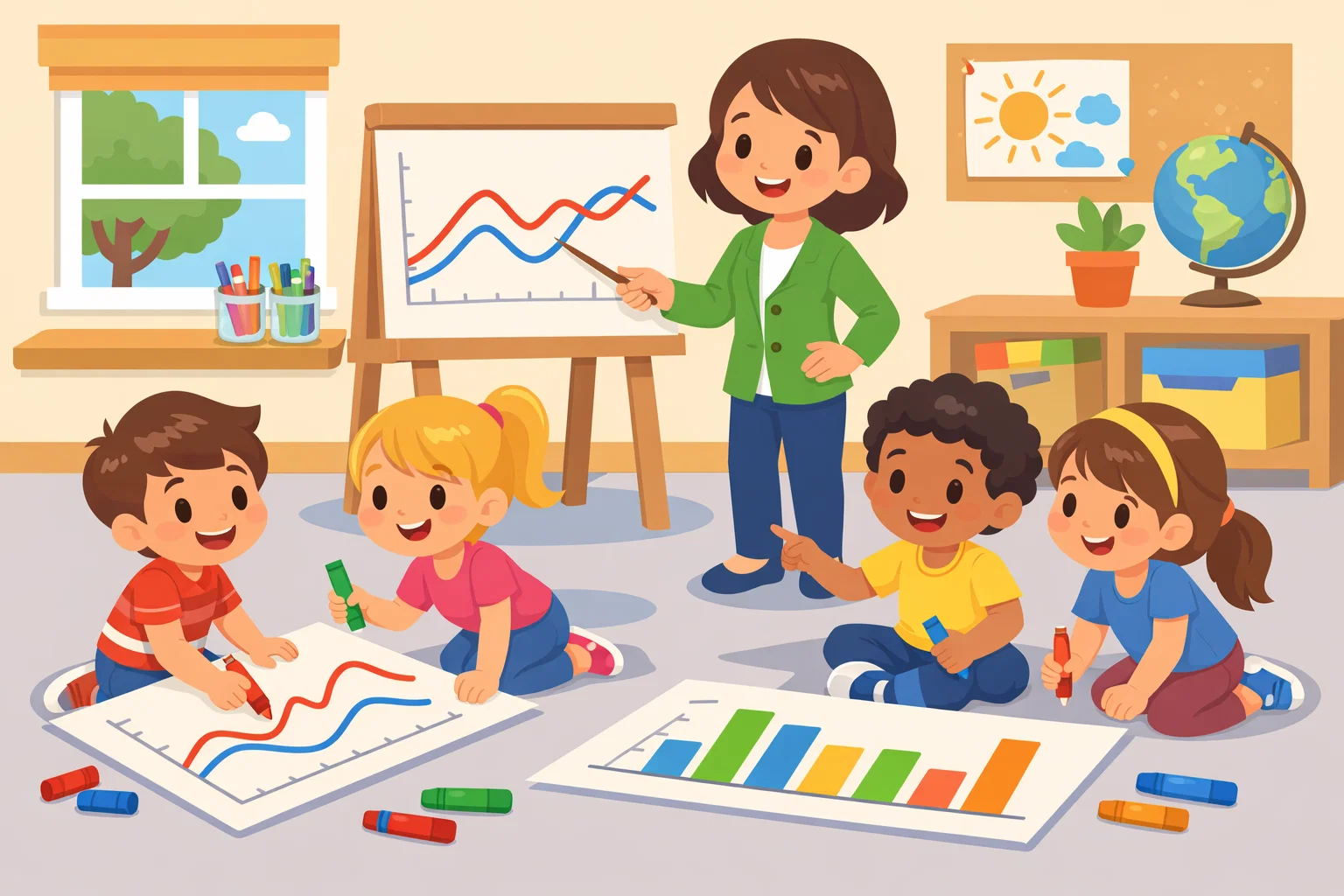
Data visualization is where science meets art. It helps students understand complex information at a glance.
Line Graphs For Temperature
Line graphs are perfect for showing how temperature data rises and falls. Use the horizontal axis (X) for the days of the month and the vertical axis (Y) for the degrees. When the line zig-zags, it represents the “volatile” nature of our surroundings.
Bar Charts For Rainfall
Bar charts are excellent for measuring moisture. Each bar represents a day or a week. This makes it easy to see which week was the “wettest” and helps kids visualize the water cycle in action as they see the droplet counts add up.
Comparing Graphs Over Time
Place a graph of this January next to a graph of last January. Are they similar? This is the beginning of understanding atmospheric trends. If they are very different, discuss why!
Classroom And Home Experiment Ideas
Elementary Classroom Activities
Teachers can turn tracking into a simple classroom morning routine. Assign a “Sky Observer of the Week” to check the barometer and the anemometer. This encourages students to work as a team to maintain a continuous record of their surroundings.
Family-Based Weather Projects
At home, monitoring the environment can be a great bonding activity. Check the local forecast together before school and discuss what kind of gear (umbrellas or sunhats) will be needed. It’s a practical way to apply hands-on science.
Group Data Collection Projects
If you have friends in different cities, start a group environmental data project. Compare the average temperature in a desert city versus a coastal city. This helps kids see how geography affects the world across the country.
Safety And Accuracy Tips For Experiments
Safe Outdoor Observation
Always prioritize safety! Never conduct the experiment during a thunderstorm or when there is lightning. Ensure that younger students are supervised when using tools or venturing into the yard during heavy storms.
Consistent Measurement Practices
For the best results, students collect data at the same time every day (e.g., 8:00 AM). Scientific accuracy depends on consistency. If you measure the temperature at noon one day and midnight the next, your results will appear inconsistent than they actually are!
Recording Errors And Adjustments
Sometimes, a rain gauge tips over, or someone forgets to check the thermometer. That’s okay! Teach kids that “missing data” is a real part of science. Just leave a note in the log explaining what happened.
Educational Value Of Weather And Climate Experiments
Scientific Thinking Skills
These science experiments teach kids to ask “Why?” They learn to form a hypothesis (e.g., “I think it will be colder tomorrow because the air pressure is dropping”) and then test it.
Math And Data Literacy
From calculating the average temperature to measuring rainfall in millimeters, these projects are a “stealth” way to practice math. Students learn about fractions, decimals, and percentages without even realizing they are doing “schoolwork.”
Environmental Awareness
By observing the world around them, children become more in tune with nature. They begin to notice how the greenhouse effect or changes in the water cycle might impact the plants and animals in their own local area.
Additional Weather and Climate Experiment Resources
Books and Activity Guides
Look for nonfiction books like The Magic School Bus Inside a Hurricane or National Geographic Kids guides to the sky. These provide great scientific vocabulary and context for your tests.
Online Data Sources
The National Weather Service and NOAA websites are goldmines for historical data. You can find records to compare with your own observation station findings.
Extension Experiment Ideas
Want to go further? Try a water cycle in a baggie or build a solar oven to see how the sun’s energy can be harnessed. The wonders of the natural world are endless!
“Climate is what we expect, what we see is what we get.” — Adaptation of Mark Twain
These activities give children the tools to not just watch the sky, but to understand the complex, beautiful systems that govern our planet.
Frequently Asked Questions About the Wonders of Weather
How do children begin to learn about weather and its changes?
To learn about weather, kids should start by looking out the window! Understanding the world of weather begins with simple observations of the sky. By using weather instruments like a thermometer or a rain gauge, kids learn how to move from subjective feelings (“it feels cold”) to objective earth science data. This process helps them move beyond simple weather concepts and start understanding weather as a complex system.
What are the most common types of weather kids should know?
There are many different types of weather that students will encounter. The primary types of weather include sunny, cloudy, rainy, snowy, and windy conditions. As they become more advanced, they can explore more intense weather phenomena, such as thunderstorms, hailstorms, or even fog. Learning the correct weather vocabulary for these events is a great way to improve their scientific communication skills.
Why is it important to track weather patterns over time?
When students track weather patterns, they begin to see the “why” behind the local weather. By using a log to observe and track daily changes, they can see how weather patterns shift with the seasons. This is the foundation of meteorology. Seeing how clouds condense before a storm or how wind direction changes helps them understand how one weather-related event leads to another.
Can kids practice weather forecasting at home?
Yes! While a professional meteorologist uses supercomputers, children can try their hand at weather forecasting by observing different weather indicators. For example, a falling barometer often signals a coming storm. Engaging in weather activities for kids that involve making daily predictions helps them see how atmospheric data is used to create a forecast.
How does different weather affect our daily lives?
It is fascinating for children to see how weather affects everything from the clothes we wear to the food we grow. By exploring the wonders of weather through hands-on projects, students realize that these conditions aren’t just numbers on a screen – they are a vital part of our planet’s earth science cycle.

Take a short quiz to find out what your everyday choices say about your parenting style
When your child is curious about something new, what’s your instinct?
Take a short quiz to find out what your everyday choices say about your parenting style
“Can I download this app?” What happens next?
Take a short quiz to find out what your everyday choices say about your parenting style
When it comes to rules at home, which sounds most like you?
Take a short quiz to find out what your everyday choices say about your parenting style
If you could give your child one life skill today, what would you pick?
Take a short quiz to find out what your everyday choices say about your parenting style
Your child gets to choose what to watch. What would your ideal setup look like?
Take a short quiz to find out what your everyday choices say about your parenting style
Pick your parenting superpower ✨