
Mold Growth Experiment for Kids on Bread

 Discover a Free Education Video App for Kids
Pastory uses AI to personalize educational video content based on your child’s interests and personality. Safe, engaging, and built for curious young minds. Sign up now to stay updated and enjoy early access with a free trial
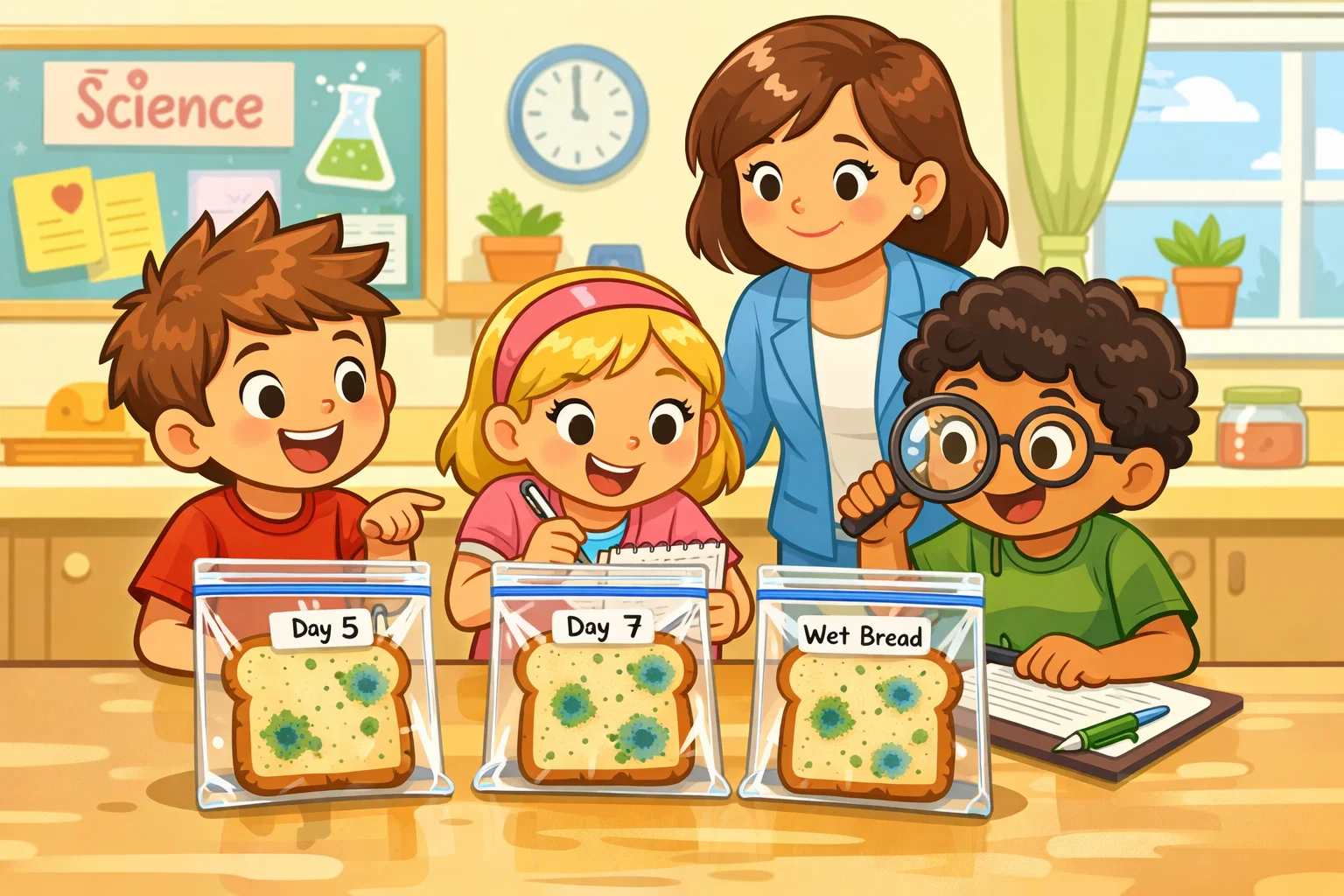
If you are looking for a hands-on way to introduce children to the invisible world of microbiology, this activity is a classic for a reason. It is a simple, visual, and highly engaging science activity that transforms your kitchen into a laboratory. By using a common slice of bread, kids can observe stages of fungal growth that are usually too small to see, providing a tangible lesson on how fungus interacts with our environment.
This science experiment is particularly effective because it uses organic materials found in every pantry. It helps teach children about the importance of hygiene and food safety while fostering a sense of curiosity. Whether you are a parent looking for a homeschool project or a teacher prepping for a science fair, this guide provides everything you need to grow mold safely and educationally.
Mold Growth Experiment Overview
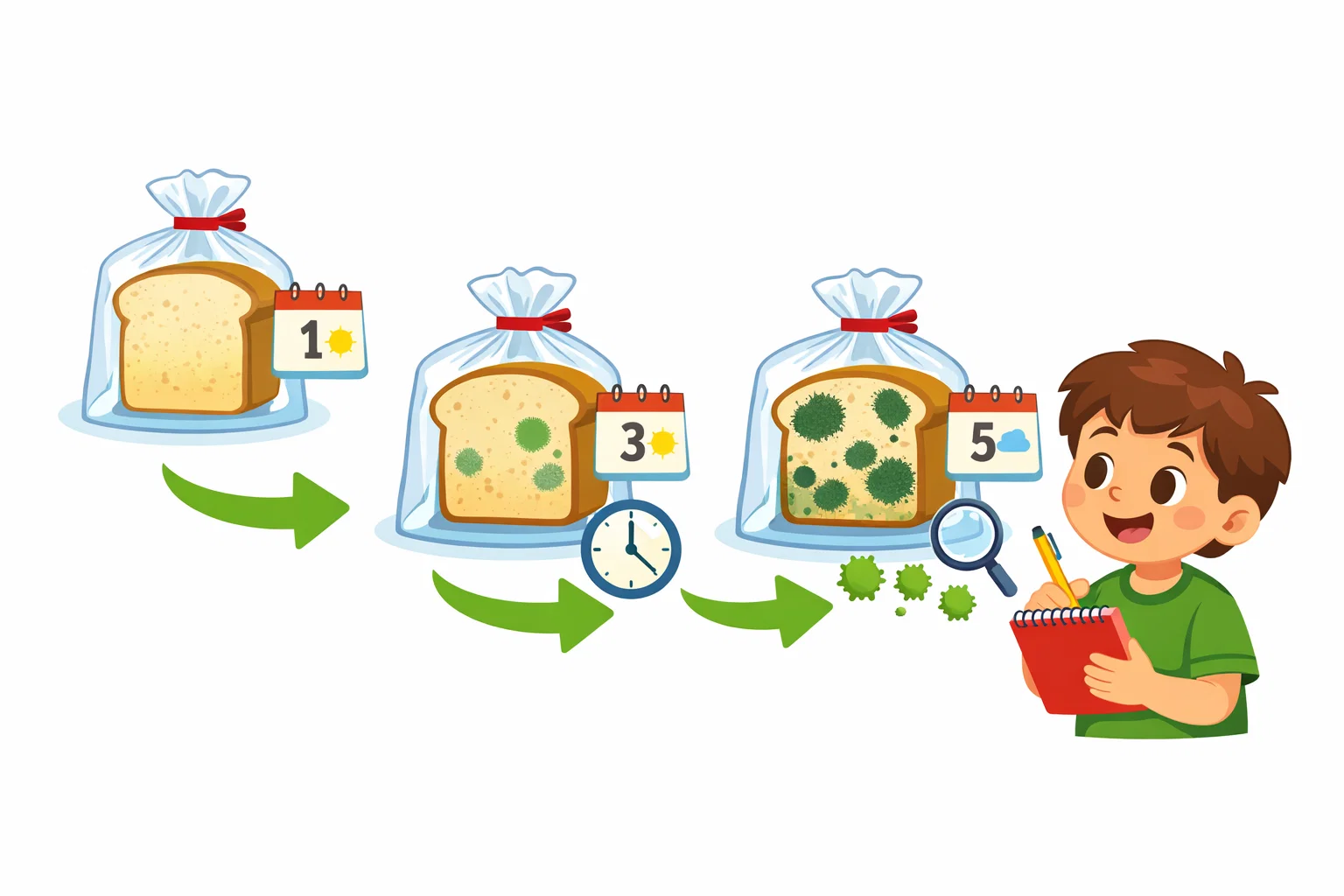
The bread science experiment is a foundational science project that explores how environmental factors – like moisture, temperature, and light – influence the rate at which mold will grow. Because mold is a microscopic fungus, it serves as a perfect bridge to discuss biology without needing a microscope.
Beyond the “gross-out” factor that many kids love, the science behind this project is rooted in decomposition. In nature, mold helps break down dead things, recycling nutrients back into the environment. In our homes, however, we usually want to prevent mold from ruining our snacks. This observation allows kids to see both sides of that biological process.
Experiment Goal Explanation
The primary goal is for children to observe the transition of a piece of bread from a fresh food item to a host for fungal growth. Over the course of about 10 days, students will track:
- The initial appearance of mold spots caused by spores.
- The development of common mold colonies.
- How different variables, such as moisture level, speed up or slow down mold growth.
Why Bread Works For Mold Growth
A slice of bread is essentially an ideal environment for mold spores. The porous texture has a high surface area that can trap spores that float in the air. Furthermore, most baked goods contain sugar and starches, which provide the energy source the fungus needs to thrive.
While many commercial products contain a preservative (like calcium propionate) to prevent mold for a period of time, they cannot stop it forever. The structure of the starch holds onto dampness once added, creating the perfect humid microclimate inside a plastic bag.
Age Groups Suitable For This Experiment
| Age Group | Focus Area | Complexity Level |
| Preschool | Sensory & Color | Simple observation: “Look, it turned green!” |
| Elementary | Variables & Recording | Comparing damp vs. dry samples in a notebook. |
| Middle School | Microbiology & Data | Estimating the area of visible mold growth in square centimeters. |
Learning Outcomes From Mold Growth Experiment
By conducting a mouldy bread experiment, children move from passive observers to active scientists. They aren’t just looking at moldy food; they are analyzing the conditions that make mold grow.
Science Skills Developed
- Observation: Noticing the difference between early white mold growth and blue-green patches.
- Comparison: Evaluating how a dry sample differs from a wet one.
- Prediction: Formulating a hypothesis about which mold color or growth pattern will appear first.
- Recording: Using a clear container or bag to document daily changes.
STEM Connections For Kids
This science activity introduces the concept of microbiology. Children learn that a germ or a spore is a biological entity with specific needs. It also touches on chemistry, as they see how a preservative might inhibit fungal growth compared to “clean label” or homemade options.
Real Life Connections
This is perhaps the most practical part of the bread experiment. It reinforces why we wash our hands before eating and why we store bread in specific ways. If children see how fast the microorganism spreads on surfaces touched by dirty hands versus clean hands, they are much more likely to remember their hygiene habits!
Supplies Needed For Mold Growth Experiment
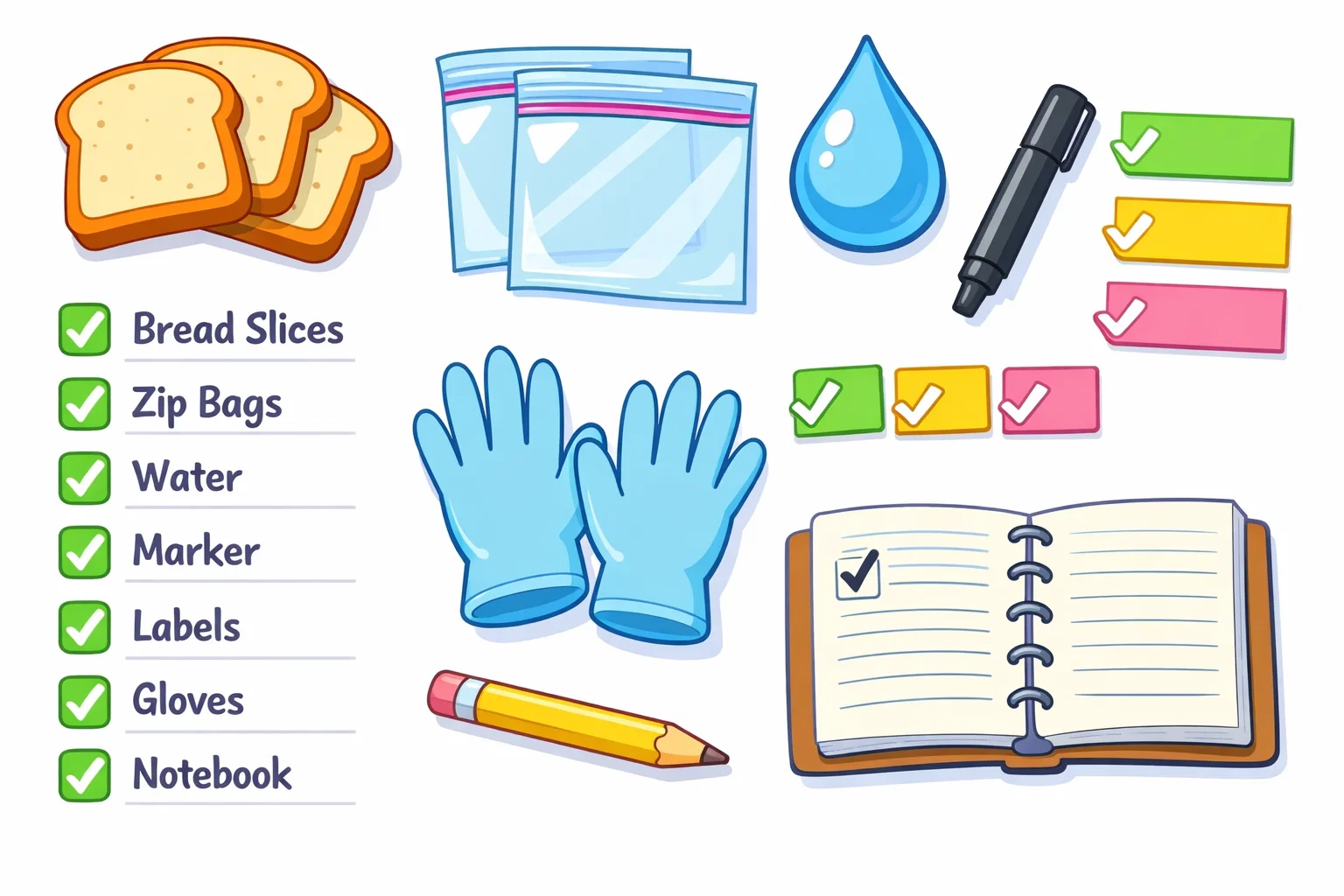
You don’t need a high-tech lab for this science project. Most of these items are likely in your kitchen right now.
Basic Materials List
- 3-4 bread slices (the same brand is best for a fair test).
- Sealable plastic bags (zip-top plastic bags work best).
- Water (a spray bottle is helpful).
- Permanent marker for labeling.
- Masking tape.
Optional Materials For Variations
- Magnifying glass: To see the slime and hyphae (root-like structures) up close.
- Gloves: For handling the moldy samples at the end of the study.
- Thermometer: To track the temperature of different storage locations.
- Camera: To take time-lapse photos of the growth on bread.
Safe Material Choices
Safety is paramount when dealing with living things like fungi. Always use heavy-duty, sealable plastic bags. Using a clear container that can be taped shut is also a great option. The goal is to ensure that once the fungus starts to flourish, it stays contained so that mold spores do not enter the household air.
Mold Growth Experiment Setup Steps
Follow these steps to ensure your mouldy bread experiment yields best results.
Step One: Bag Labeling
Before you even touch the food, label your plastic bags. You should have at least two:
- Control: “Dry Sample – No Water”
- Variable: “Damp Sample – 3 Sprays of Water”
Add the date so you can track how many days the experiment will take.
Step Two: Moisture Application
Take one slice of bread and lightly mist it with water. You want it to be damp, not soaking wet. If there is too much water, the organic matter might just turn into a soggy mess rather than allowing mold to grow properly.
Step Three: Control Sample Setup
Control is vital for any science experiment. Place a dry piece of bread into the labeled bag. This shows you what happens when the environmental conditions (moisture) are absent. It helps prove that it is the water that affects mold growth.
Step Four: Storage And Observation
Seal the bags tightly. You might even want to tape the seals for extra security. Place them in a clear container and store them in a consistent place, such as a kitchen cupboard. Keep the bags closed for the entire duration of the study.
Mold Growth Observation Process
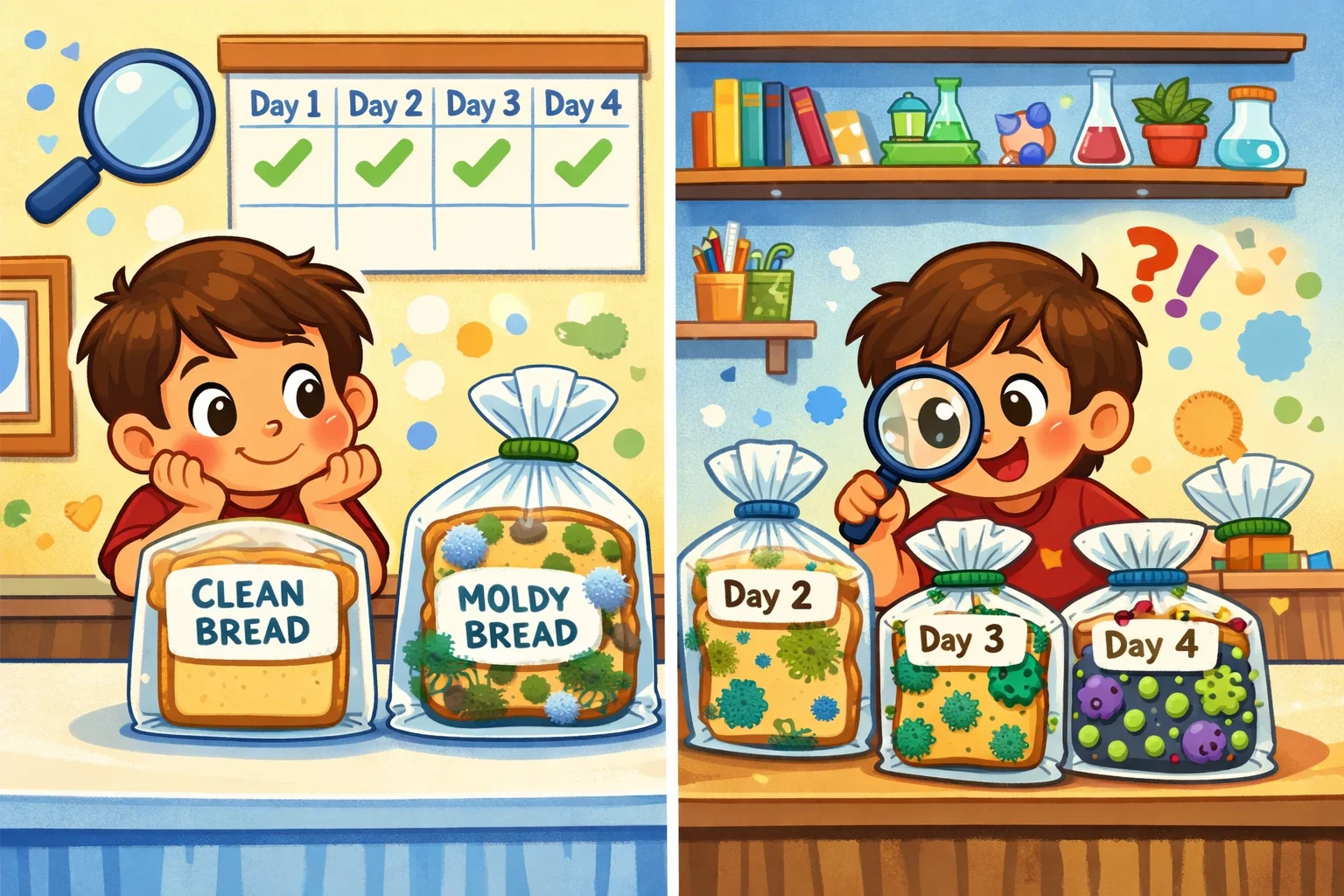
Once the experiment is set up, the real fun – the waiting game – begins.
Daily Changes To Watch
During the first few days, you might see nothing. However, by day 4 or 5, look for:
- White mold: This often looks like soft, fuzzy lint.
- Color changes: You may see blue-green, black, or even yellow spots.
- Texture: The food may appear to “shrink” as the fungus breaks down the organic material.
How Long Mold Growth Takes
The experiment will take roughly 10 days for significant mold growth to occur. Factors like the temperature of your home and whether the sample contains a preservative will influence the speed.
Recording Results With Kids
Encourage your child to maintain a “Discovery Journal.”
- Draw: Sketch the amount of mold seen each day.
- Measure: Use a ruler to measure the diameter of the largest moldy spot.
- Describe: Use words like “fuzzy,” “spotted,” or “slimy.”
Mold Growth Experiment Results Explanation
When the 10 days are up, it’s time to analyze the findings.
Why Mold Appears Faster On Wet Bread
Mold requires moisture to activate its metabolism. In the dry bag, the tiny spores remain dormant. In the damp bag, the water allows the spores to “wake up” and begin growing hyphae, which are the thread-like structures that digest the starches.
Differences Between Bread Types
If you tested different kinds of samples, you might notice that sourdough or organic versions get moldy much faster than highly processed options. This is usually because industrial loaves have more preservatives designed to prevent mold from growing.
Why Control Sample Matters
“A control is the baseline of your experiment. Without the dry sample, we couldn’t be 100% sure that it was the water making the difference.” — Science Education Principle
Mold Safety Guidelines For Kids
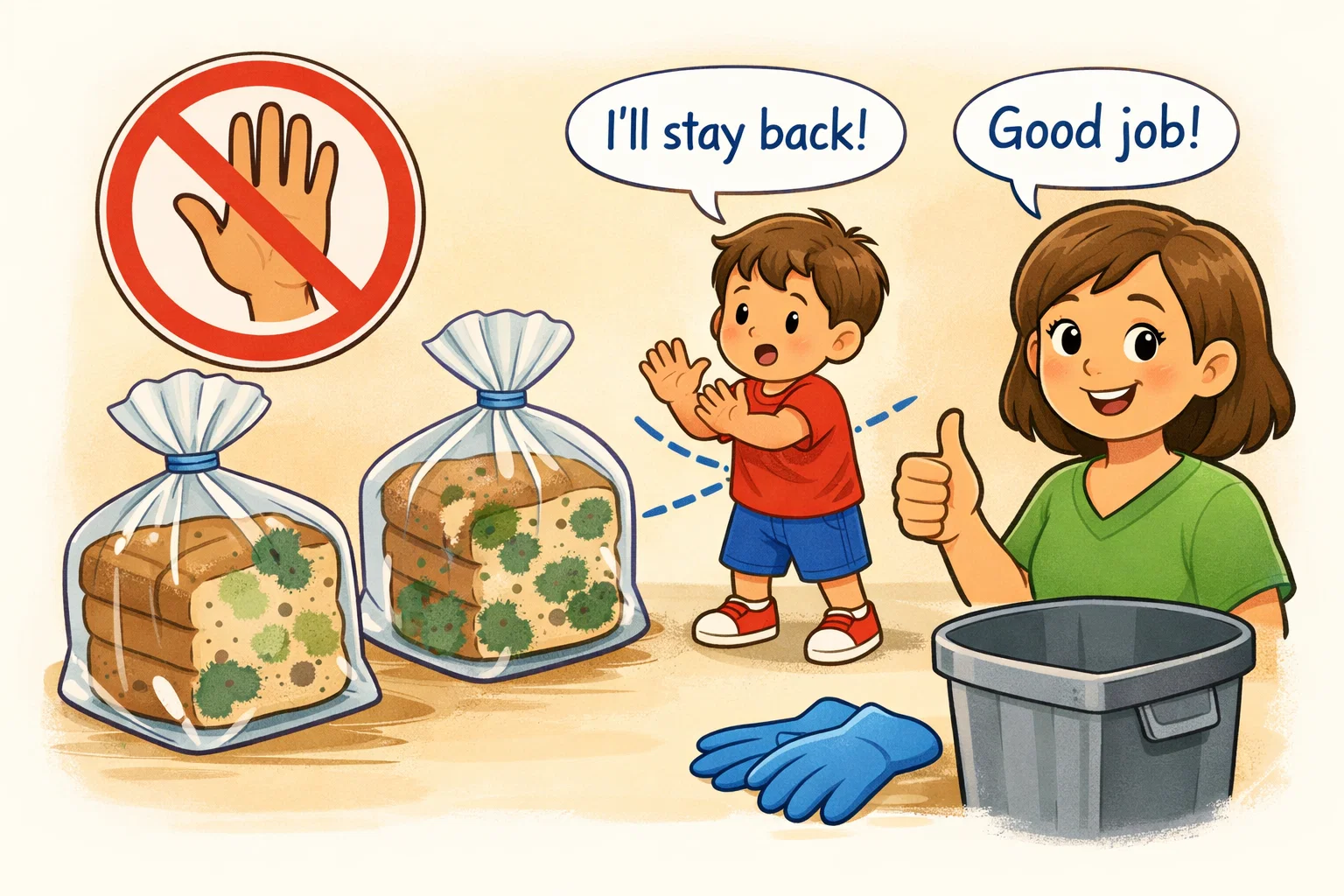
While mold helps the planet by recycling waste, it can be harmful to humans if inhaled or ingested, especially for those with allergies.
Handling Mold Safely
The most important rule: Never open the bags. Once the moldy sample is inside and the process has started, the seal stays shut. This prevents mold spores from floating into your kitchen and causing potential irritation.
Adult Supervision Rules
Adults should handle the initial setup and the final disposal. If a bag appears to be leaking or has a hole, an adult should double-bag it immediately. Wash your hands thoroughly after handling the sealed bags, even if you didn’t touch the contents directly.
Disposal Instructions
When the project is finished, do not open the bags to look closer. Place the entire sealed bag into a larger trash bag, tie it tightly, and take it to the outdoor bin. This ensures the fungal growth is safely contained.
Mold Facts For Kids
To add more science behind the fun, share these facts with your young scientists:
- What is it? It is a kind of fungus, not a plant. It doesn’t make its own food from sunlight; It feeds on the organic material it grows on.
- Ancient Medicine: Some types of mold, like Penicillium, are used to make penicillin, a life-saving medicine!
- Spore Power: There are thousands of different kinds of fungi, and their spores are everywhere – right now, they are probably floating in the air around you!
Comparison Table: Common Fungi Found on Food
| Type of Fungus | Scientific Name (approx) | Appearance | Common Habitat |
| Black Fungus | Rhizopus stolonifer | Fuzzy black spots | Baked goods, Fruit |
| Blue-Green | Penicillium | Dusty blue or green | Bread, citrus, cheese |
| White or grey growth | Aspergillus (early stage) | Fluffy white/grey | Grains, Starchy food |
Mold Growth Experiment Variations
Once you’ve mastered the basic bread experiment, try these variations to keep the homeschool curriculum fresh.
Bread Type Comparison Test
Does gluten-free dough get moldy faster than wheat? Use three different kinds of slices and keep all other variables (water, light, temp) the same. You might be surprised by which one becomes moldy first!
Temperature Impact Experiment
Does warmth make food spoil faster?
- Place one bag in the refrigerator.
- Place one bag in a dark cupboard.
- Place one bag in a warmer location (away from direct heat).
- Predict: Will the cold prevent mold?
Light Versus Dark Storage Test
Does the fungus grow better in the dark? Some microorganisms are sensitive to UV light. Test if a slice kept in a dark drawer grows different types of mold than one kept on a sunny windowsill.
Mold Growth Science Fair Project Ideas
If your child is entering a science fair, they need a structured approach to their bread science experiment.
Experiment Question Examples
- “How does the brand of loaf affect the amount of mold that grows in one week?”
- “Does the amount of sugar in the recipe help mold grow faster?”
- “Which bread ingredient slows mold growth the most at stopping mold from growing?”
Hypothesis Writing For Kids
A hypothesis is an educated guess. You can use this template:
“If I add more sugar to the slice of bread, then the mold will grow faster because the fungus uses sugar for energy.”
Display Board Suggestions
- Photos: Take a photo every day of the 10 days to show the progression.
- The Bags: Do not tape the actual moldy bread to the board. Use clear, high-quality photos instead for safety.
- Graphs: Create a bar graph showing the “Days Until First Spotting” for different types.
Related Science Experiments For Kids
If your kids enjoyed the mouldy bread experiment, they might love these other simple science projects:
- Yeast Balloons: Use sugar and warm water to see how yeast (another kind of fungus) releases gas to inflate a balloon.
- Apple Spoilage: Test how different coatings (lemon juice, salt, wax) prevent mold or browning on apple slices.
- Bacteria Hand-Wash Test: Use agar plates or food slices to see the difference between “unwashed hands,” “hand sanitizer,” and “soap and water.”
This science activity is a wonderful way to spark a lifelong interest in the natural world. By observing the microorganism, children learn that even the things we can’t see have a massive impact on our environment.
Frequently Asked Questions About Mold Growth Experiment
How long does mold take to grow on bread?
In most household conditions, visible mold may appear within 3 to 5 days, but it usually takes 10 days to see significant mold growth covering a large portion of the piece of bread.
Mold growth experiment safety concerns?
As long as the plastic bags remain sealed and are disposed of properly, the experiment is very safe. The main risk is for individuals with severe allergies, who should avoid being the primary “observer” if the bags aren’t perfectly airtight.
What is the best bread type for a mold experiment?
For the best results, use a “natural” or bakery-style loaf that does not list “calcium propionate” in the ingredients. These lack the preservative needed to fight fungal growth, meaning you will grow mold faster.

Take a short quiz to find out what your everyday choices say about your parenting style
When your child is curious about something new, what’s your instinct?
Take a short quiz to find out what your everyday choices say about your parenting style
“Can I download this app?” What happens next?
Take a short quiz to find out what your everyday choices say about your parenting style
When it comes to rules at home, which sounds most like you?
Take a short quiz to find out what your everyday choices say about your parenting style
If you could give your child one life skill today, what would you pick?
Take a short quiz to find out what your everyday choices say about your parenting style
Your child gets to choose what to watch. What would your ideal setup look like?
Take a short quiz to find out what your everyday choices say about your parenting style
Pick your parenting superpower ✨



