Build Popsicle Stick Catapult: Simple Science Experiment Project for Kids

 Discover a Free Education Video App for Kids
Pastory uses AI to personalize educational video content based on your child’s interests and personality. Safe, engaging, and built for curious young minds. Sign up now to stay updated and enjoy early access with a free trial
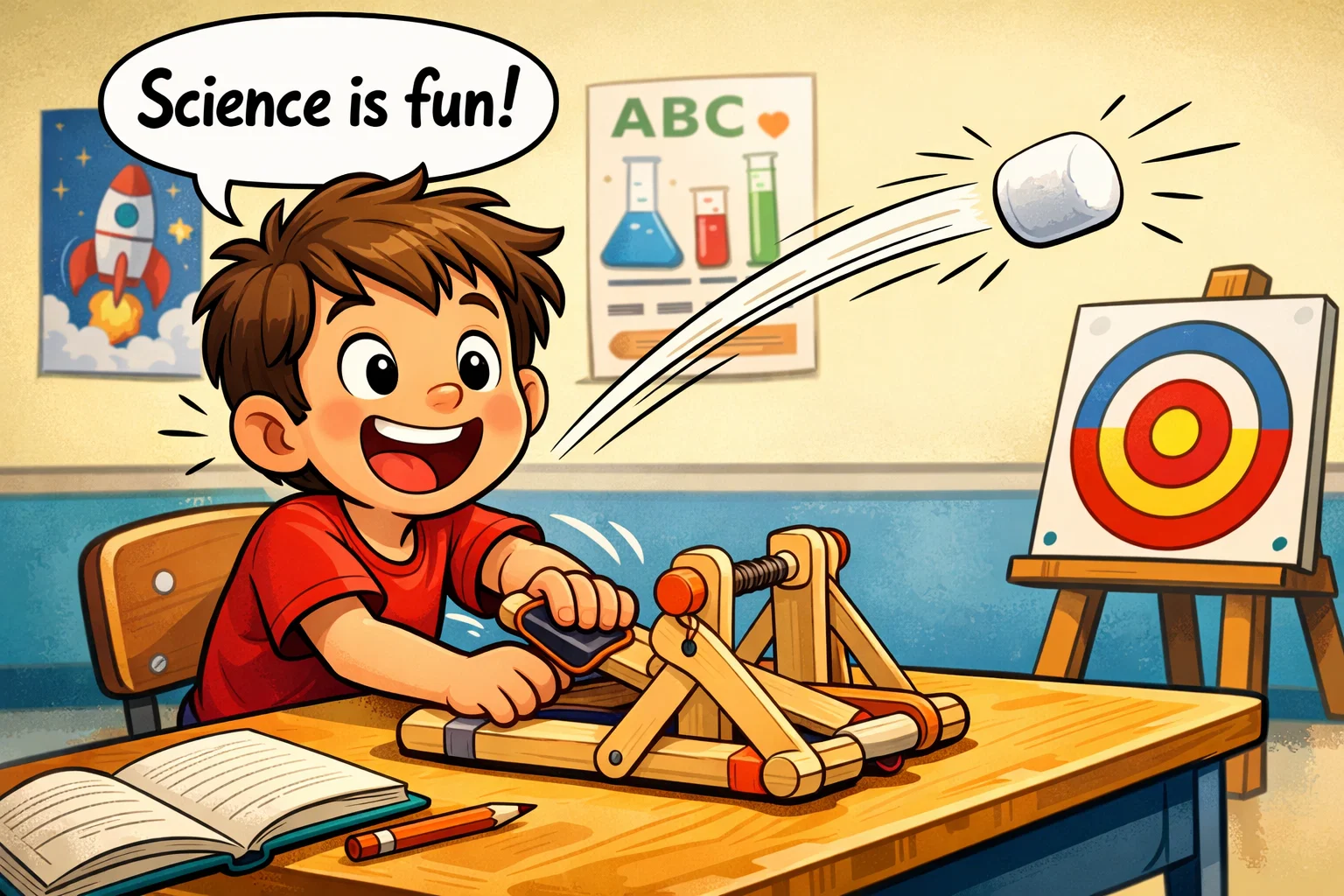
Engaging in hands-on activities is a powerful way for kids to connect with the physical world. A catapult project offers more than just the excitement of watching a marshmallow fly across the room. It provides:
- A tangible way to explore complex engineering and physics principles.
- A great stem activity for a rainy afternoon or a structured classroom project.
- An ideal starting point for building with basic household items like popsicle sticks and rubber bands.
- A method for young learners to see how a simple machine transforms effort into motion, fostering curiosity.
Science Behind How Catapult Works
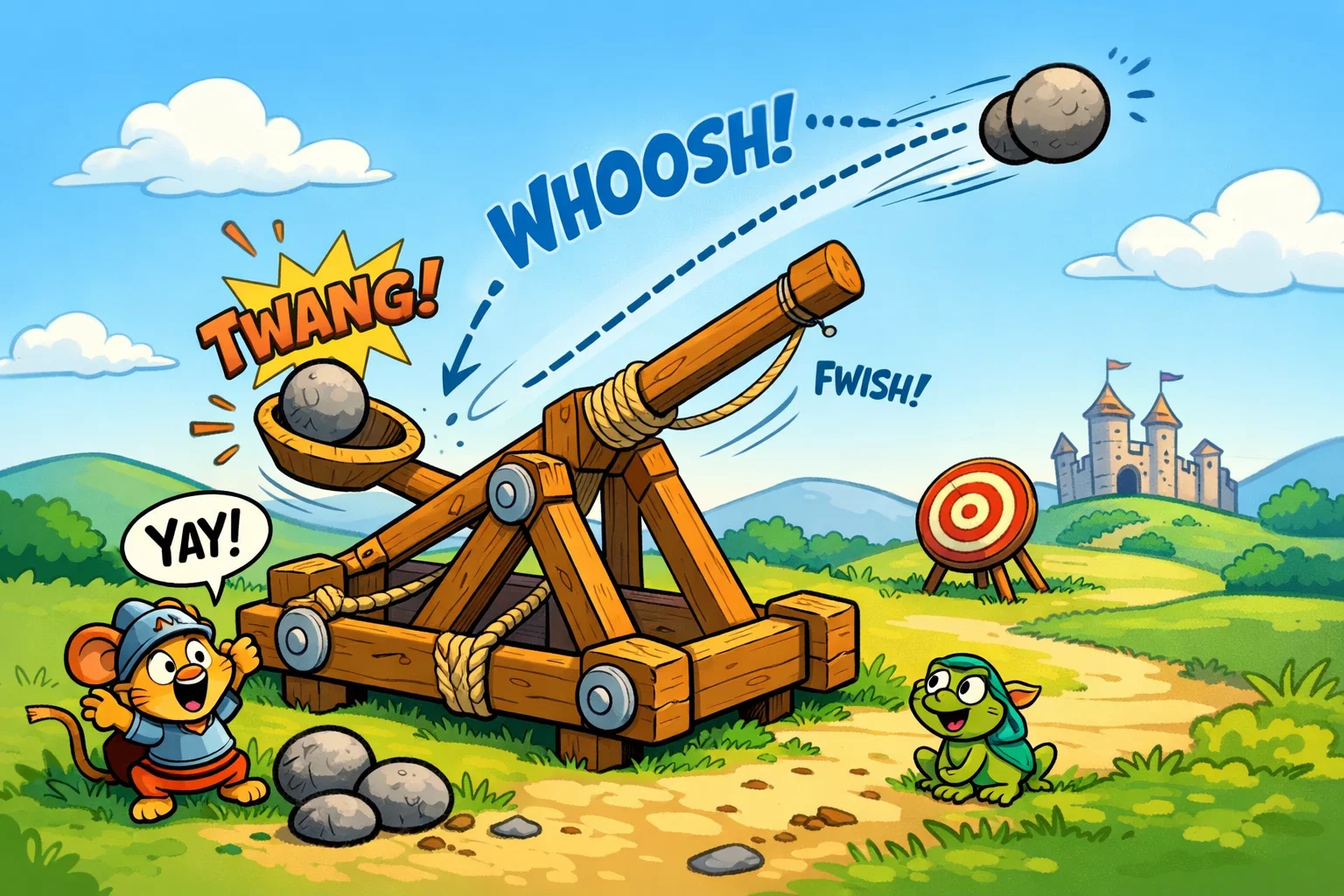
The operation of a catapult is an archetypal demonstration of the law of conservation of energy and Sir Isaac Newton’s three laws of motion. In childhood education, the catapult serves as a tangible model for complex physics concepts that would otherwise remain abstract. Students learn that a catapult works by storing energy and then releasing it rapidly to hurl a projectile.
Energy Transformation: Potential to Kinetic
Catapult engineering involves the utilization of stored energy to launch an object without explosives. In a stick catapult, this process includes several key scientific steps:
- Storing Elastic Potential Energy: When you push the arm back, you are doing work on the system.
- Energy Storage Locations: This energy is held in the tension of the rubber bands or the structural flexion of the craft sticks.
- Mathematical Representation: The stored potential energy in a spring-like system is defined by the formula PE_elastic = 0.5 * k * x^2, where k is the spring constant of the rubber band and x is the displacement.
- Rapid Conversion: Upon the release of the catapult arm, this potential energy is rapidly converted into kinetic energy, the energy of motion.
Newton’s Laws of Motion in Action
The launch sequence provides a physical manifestation of Newton’s Laws, codified in 1687. These laws help kids learn cause-and-effect relationships:
- First Law (Inertia): The projectile remains in the bucket until the moving arm acts upon it.
- Second Law (F=ma): The acceleration of the projectile depends on the force applied by the rubber band and the mass of the object.
- Third Law (Action-Reaction): As the arm pushes the marshmallow, the marshmallow exerts an equal force back on the arm, often seen as a “kick” in the catapult base.
Role of Rubber Band Tension and Elasticity
The rubber band is the engine of your popsicle stick catapult. By wrapping a rubber band around the sticks, you create the tension necessary for the launch. The more you stretch the elastic, the more potential energy is stored. However, it is important to observe “rubber band creep.” Over multiple trials, elastics may stretch out and lose their effectiveness, leading to a gradual decrease in how far the projectile travels.
Physics of Fulcrum and Lever Arms
A catapult is essentially a lever, a type of simple machine. The fulcrum is the pivot point—in this case, the stack of sticks—that allows the lever arm to rotate. Positioning the fulcrum is a key part of the experiment. Moving the sticks and stack closer to the launch bucket changes the mechanical advantage, which can significantly alter the trajectory.
Impact of Launch Angle on Projectile Distance
The understanding of projectile motion has evolved significantly since antiquity. Early theories relied on the concept of “impetus,” but Galileo Galilei later discovered that projectile motion is composed of two independent components: horizontal motion and vertical motion. Modern educators emphasize that teaching this concept is challenging because it requires students to dismantle intuitive but incorrect worldviews.
Research published in the Journal of Physics: Conference Series suggests that hands-on modeling helps students overcome these misconceptions by allowing them to experience the independence of horizontal and vertical vectors. This inductive approach is essential because children often do not accept theoretical concepts that they cannot experience directly in the classroom.
Defining Trajectory and Projectile Path
The trajectory is the curved path an object follows through the air. When you release the arm, the projectile enters a parabolic arc. This path is governed by the initial velocity and the angle at which it leaves the catapult.
Optimal Degrees to Shoot Far
The launch angle is the primary variable in your science experiment. To make the projectile go as far as possible, you need to find the “sweet spot.”
| Launch Angle Category | Trajectory Outcome | Mechanical Implication |
| Low Angles (< 30 degrees) | Shallow, broad arc | High horizontal velocity but hits the ground quickly. |
| Optimal Angle (45 degrees) | Maximum horizontal range | Balances vertical flight time with horizontal speed. |
| High Angles (> 60 degrees) | Steep, narrow arc | High altitude but low horizontal range; falls near the launch site. |
Comparing High Arcs vs. Flat Tows
A high arc is useful for clearing obstacles, much like ancient trebuchets clearing castle walls. However, for distance, a flat tow often lacks the air time needed to travel far. Students can explore this by adjusting the height of their fulcrum stack.
Gravity and Air Resistance Factors
Once the projectile is in the air, gravity pulls it toward the earth at approximately 9.8 m/s^2. Air resistance also plays a role, especially with light objects like pom-poms or foil balls. A heavier, denser projectile might overcome air resistance better than a cotton ball.
Instructions to Make a Catapult with Popsicle Sticks
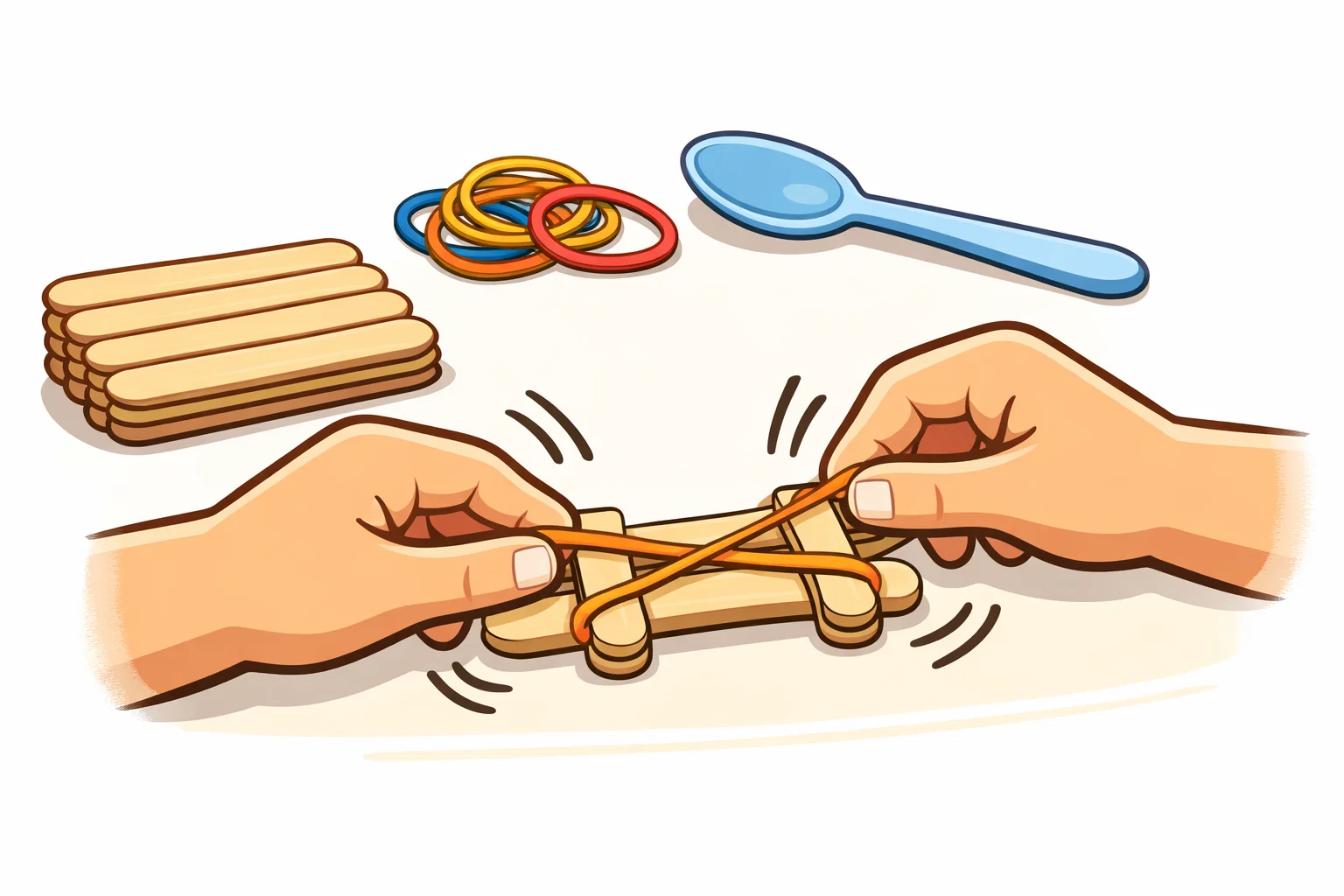
Building a simple catapult is a fun and easy way to explore engineering. This popsicle stick catapult project is a staple in stem learning due to its cost-effectiveness and clear illustration of mechanics.
Essential Craft Stick and Material List
To build a catapult, gather the following supplies:
- 10 Jumbo popsicle sticks (or craft sticks)
- 4-5 Strong rubber bands
- 1 Plastic spoon or a plastic bottle cap
- Projectiles (marshmallows, foil balls, or pom-poms)
- Adhesive (hot glue or sticky dots)
Building Base Stack with Rubber Band Fasteners
- Take 8 popsicle sticks and stack them together.
- Secure the sticks at both ends with a rubber band around the stack. This serves as your fulcrum.
- Take the remaining 2 sticks and zip-tie or rubber band them together at just one end.
Attaching Lever Arm and Projectile Holder
- Open the two sticks slightly and slide the large fulcrum stack between them.
- Secure the fulcrum to the lever arms with a last rubber band in a cross pattern to keep it from sliding.
- Glue a plastic spoon or bottle cap to the top of the upper stick to create the bucket.
Troubleshooting Common Design Flaws
If your catapult isn’t launching well, check the stability. If the base is not secured, energy is wasted as the device “hops.” Use tape to anchor it to the table. Also, ensure the release of the arm is rapid; a hesitant release saps kinetic energy.
Advanced Craft Stick Catapult Designs for STEM
Once you master the basic model, older kids can experiment with different designs to increase power or accuracy.
Plastic Spoon and Popsicle Stick Assembly
Using a plastic spoon instead of a cap effectively extends the lever arm. A longer arm can lead to a longer trajectory because the projectile travels a longer distance along the arc before release, gaining more speed.
Building Large Scale Pool Noodle Models
For outdoor play, try scaling up. Using pool noodles as the frame and bungee cords for tension creates a massive catapult capable of hurling larger objects, which is a great way to see the same physics on a bigger scale.
Lego Bricks and Technical Gear Challenges
Integrating Lego Technic pieces allows students to build complex ballistas or trebuchets with adjustable angles and trigger mechanisms. This encourages the engineering design process: build, test, and iterate.
Simple Machine Principles in Construction
Catapults are excellent tools for identifying simple machines. The lever arm (the stick), the fulcrum (the stack), and the inclined plane (the angle of the bucket) all work together to achieve the launch.
Guided Catapult Science Experiment Variations
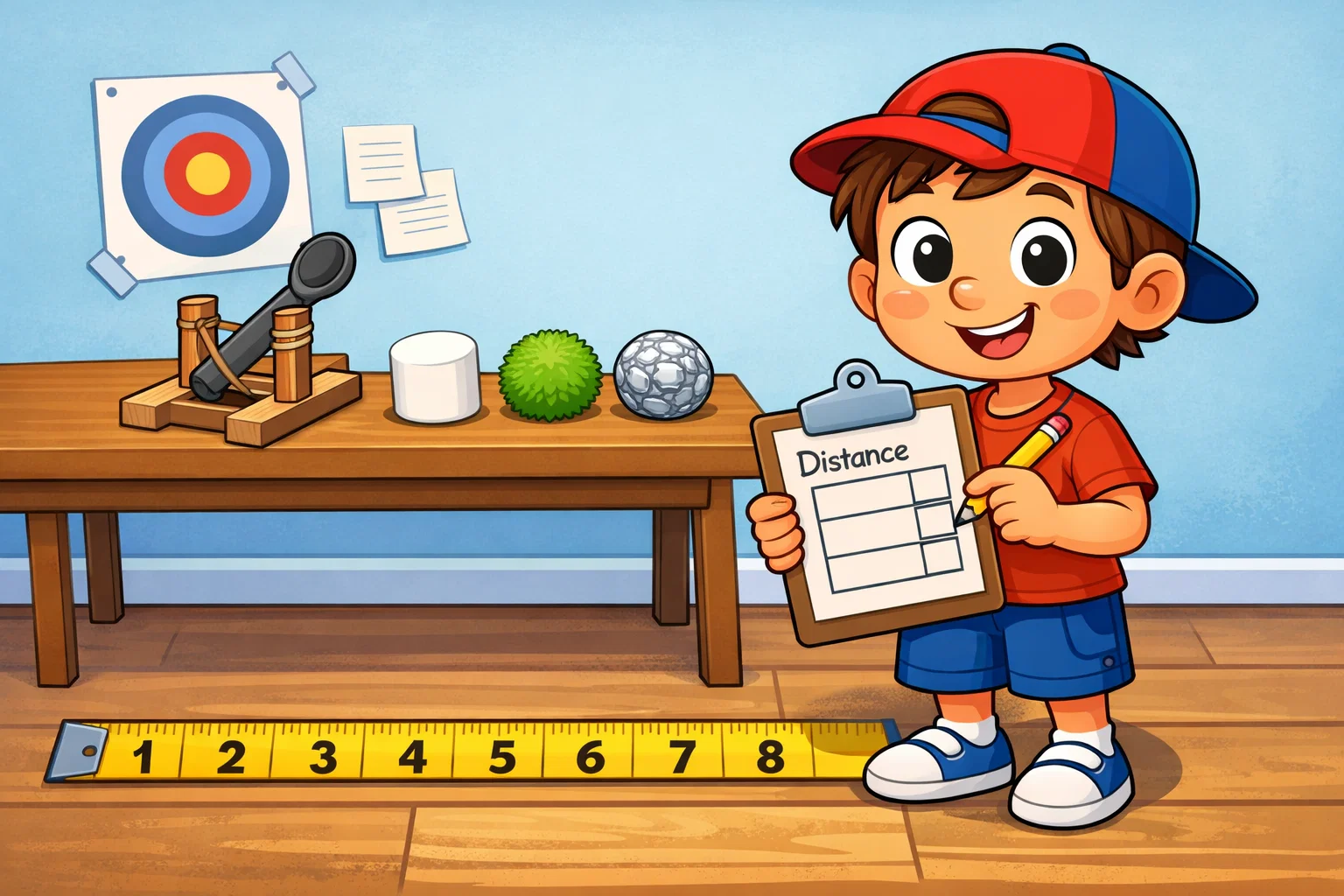
To turn this into a true science experiment, encourage your kids to change only one variable at a time and record the results.
Experiment 1: Launch Distance vs. Launch Angle
Adjust the position of the fulcrum. Sliding it closer to the bucket increases the launch angle. Use a protractor to measure the angle and a tape measure to see how far the projectile lands.
Experiment 2: Projectile Weight and Velocity
Compare how a marshmallow travels compared to aluminum foil balls or pencil erasers. Scientific observations show that heavier objects require more tension to reach the same distance, reflecting Newton’s Second Law.
Experiment 3: Tension Variations and Elastic Force
Add more rubber bands to the lever arm. Does more tension always mean more distance? Students may find that there is a limit where the sticks might snap or the release becomes too difficult.
Experiment 4: Testing Aerodynamics of Different Objects
Try different designs for projectiles. Does a crumpled foil ball go further than a smooth one? This helps kids learn about air resistance and surface area.
Creative Catapult Project Activities and Games
Fun experimenting is the best way to keep kids engaged. Turning the experiment into a game increases the number of trials they are willing to perform.
Target Practice with Shooting Hoops
Set up a small “basketball” hoop using a plastic cup. This requires students to master both power and launch angles to land the projectile in the target.
Fun Catapult Bowling Challenge
Stack lightweight cups in a pyramid and use the catapult to knock them down. This activity focuses on accuracy and the force of impact.
Seasonal Variations: Snowball Catapult Fight
During winter, a snowball catapult using small, packed snowballs (or white pom-poms indoors) adds a thematic layer to the science.
Competitive Distance Trials for Groups
Organize a “Launch-Off.” Groups can compete to see whose design reaches the furthest corner of the room, motivating them to optimize their rubber band tension and fulcrum placement.
Frequently Asked Questions (FAQ)
Which Angle Provides Greatest Range in Vacuum?
In a theoretical vacuum without air resistance, a 45-degree angle is the mathematical ideal for maximum range. In the real world, factors like the height of the launcher might shift this slightly.
Why Does Lightweight Projectile Travel Less Distance?
A very light object, like a cotton ball, is easily slowed down by air resistance. It lacks the mass to maintain its momentum compared to a slightly heavier marshmallow.
How Does Lever Arm Length Affect Velocity?
A longer lever arm moves through a larger arc in the same amount of time, meaning the end of the arm (and the projectile) is moving faster at the moment of release.
What Safety Gear Is Needed for Outdoor Launches?
According to standard safety protocols, safety glasses with side shields (ANSI/ISEA Z87.1) should be worn whenever stored energy is involved to protect against snapping rubber bands or flying projectiles.
Can Recoil Force Affect Accuracy of Aim?
Yes. As per Newton’s Third Law, the catapult pushes back against its base during a launch. If the base is not heavy or anchored, this recoil can cause the device to shift, altering the aim for the next shot.
Take a short quiz to find out what your everyday choices say about your parenting style
When your child is curious about something new, what’s your instinct?
Take a short quiz to find out what your everyday choices say about your parenting style
“Can I download this app?” What happens next?
Take a short quiz to find out what your everyday choices say about your parenting style
When it comes to rules at home, which sounds most like you?
Take a short quiz to find out what your everyday choices say about your parenting style
If you could give your child one life skill today, what would you pick?
Take a short quiz to find out what your everyday choices say about your parenting style
Your child gets to choose what to watch. What would your ideal setup look like?
Take a short quiz to find out what your everyday choices say about your parenting style
Pick your parenting superpower ✨