Capillary Action Experiments for Kids

 Discover a Free Education Video App for Kids
Pastory uses AI to personalize educational video content based on your child’s interests and personality. Safe, engaging, and built for curious young minds. Sign up now to stay updated and enjoy early access with a free trial
If you have ever watched water climb up a straw or seen a paper towel pull up a spill, you have witnessed one of the most fascinating physical phenomena in nature. For parents and educators, these moments are not just simple cleanup tasks; they are perfect opportunities to spark a child’s interest in science. Engaging in a capillary action experiment allows children to visualize how liquid moves in ways that seem to defy the pull of gravity.
Children are naturally curious about the world around them. Using a hands-on activity to explain complex concepts is far more effective than reading from a textbook. When children see colors “walking” between cups or flowers changing shades overnight, the abstract becomes tangible. These experiments are low-cost, high-impact tools that foster critical thinking and observation skills from a very young age.
Top Capillary Action Experiment Ideas
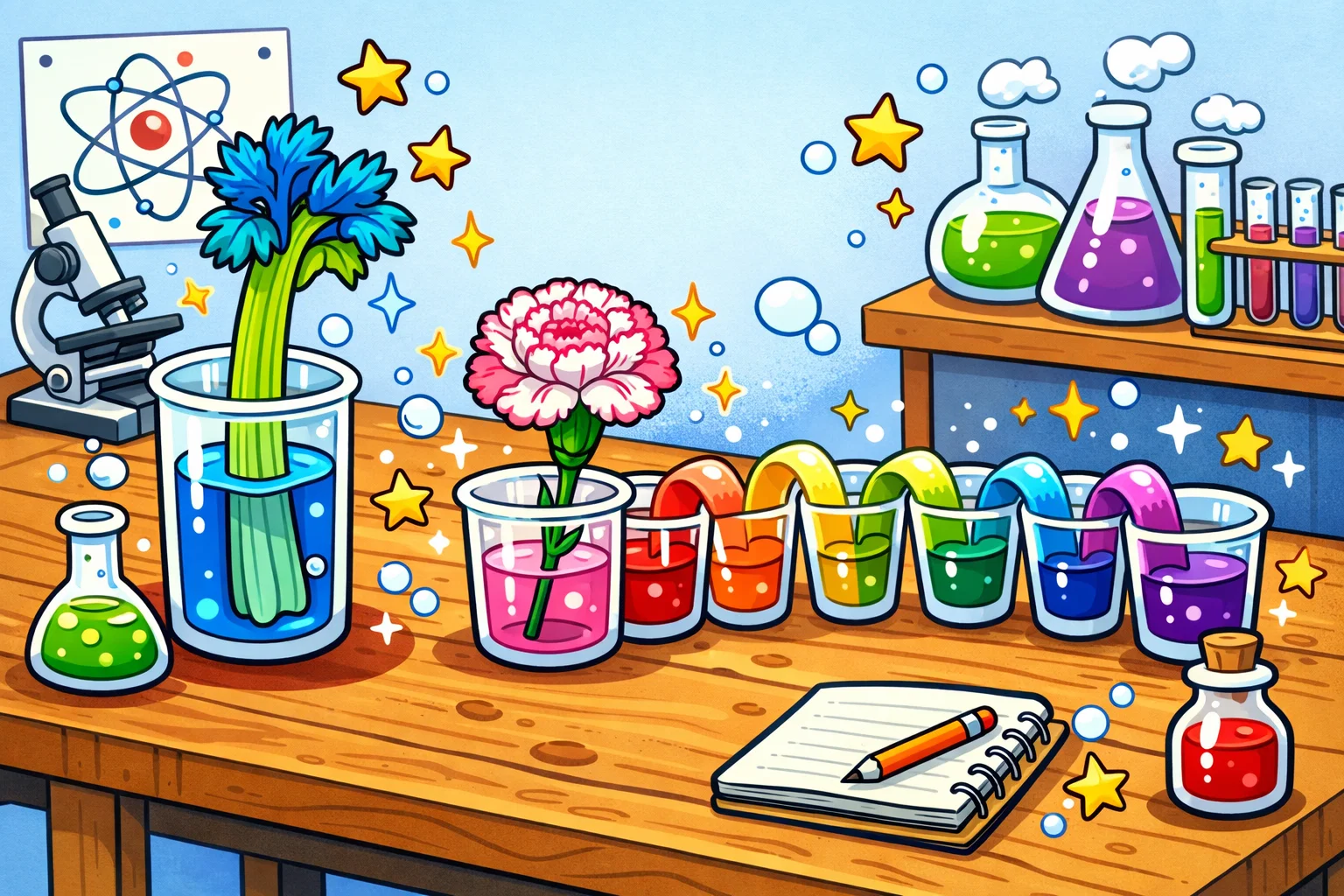
There are several ways to demonstrate this process using common household items. Each activity offers a unique visual result that highlights how water interacts with different materials.
Walking Water Rainbow Challenge
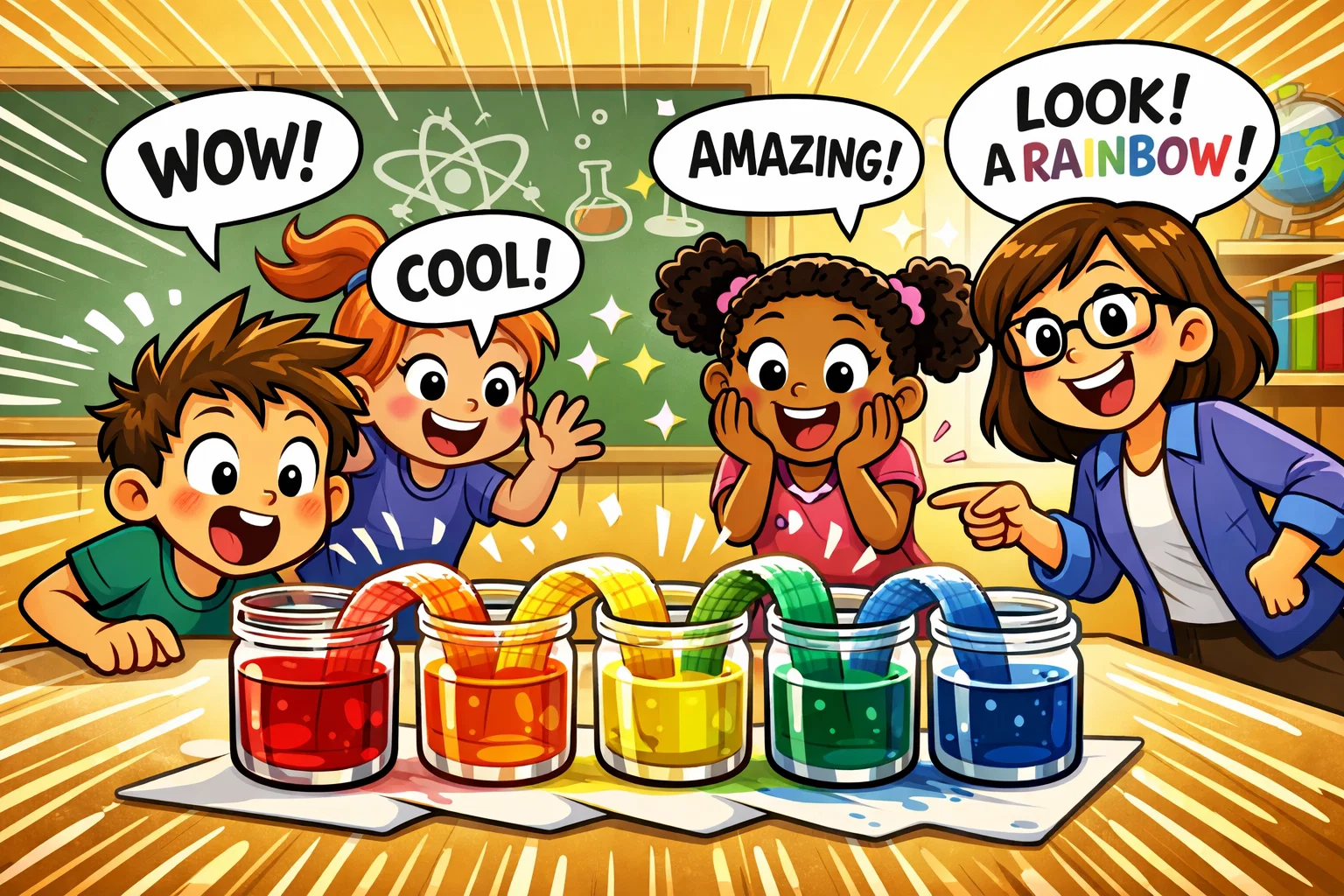
This classic setup uses jars of water colored with food coloring and folded bridges of paper towel. By placing an empty jar between two full ones, fluid travels up the towel, over the edge, and into the empty container. Over time, the colors mix to create a full rainbow, demonstrating both the movement of molecules and the principles of color theory.
Color Changing Flowers Activity
Using white carnations or stalks of celery, it is possible to show how a plant drinks. When the stem is placed in a cup of water mixed with food coloring, the liquid travels through the internal structures of the stem all the way to the petals or leaves. This clearly illustrates that the action isn’t just a kitchen trick; it is a vital biological function.
Celery Stalk Water Absorption
Similar to the flower activity, celery is excellent for this because the xylem (veins) are very large. After a few hours in colored liquid, cutting the stalk reveals dyed dots. This helps children visualize that water doesn’t just coat the outside; it moves through specific channels inside the plant.
Coffee Filter Chromatography Craft
By using markers to draw a circle on a coffee filter and then dipping the center into water, the liquid spreads outward. As the moisture moves through the fibers of the filter, it carries the ink with it. Because different ink molecules move at different speeds, the colors separate, creating a tie-dye effect that reveals the hidden components of a single marker color.
Growing Rainbow Paper Towel Test
On a strip of paper towel, drawing small rectangles of different colors at both ends and dipping them into water allows the colors to stretch toward the middle. This activity is particularly good for measuring the speed of the liquid as it moves through the porous material.
Self-Assembling Toothpick Stars
Snapping five toothpicks in half (without breaking them fully) and arranging them in a circle so the broken centers meet creates a unique effect. When a small amount of water is dropped into the center, the wood fibers absorb the liquid. As the molecules expand, the toothpicks straighten out, causing them to push against each other and form a perfect star shape.
Visualizing Leaf Veins Science
Placing a fresh, light-colored leaf in a strong solution of food coloring emphasizes the intricate network of “pipelines” in nature. This shows how even the smallest leaves rely on these forces to stay hydrated.
Capillary Action Science Basics
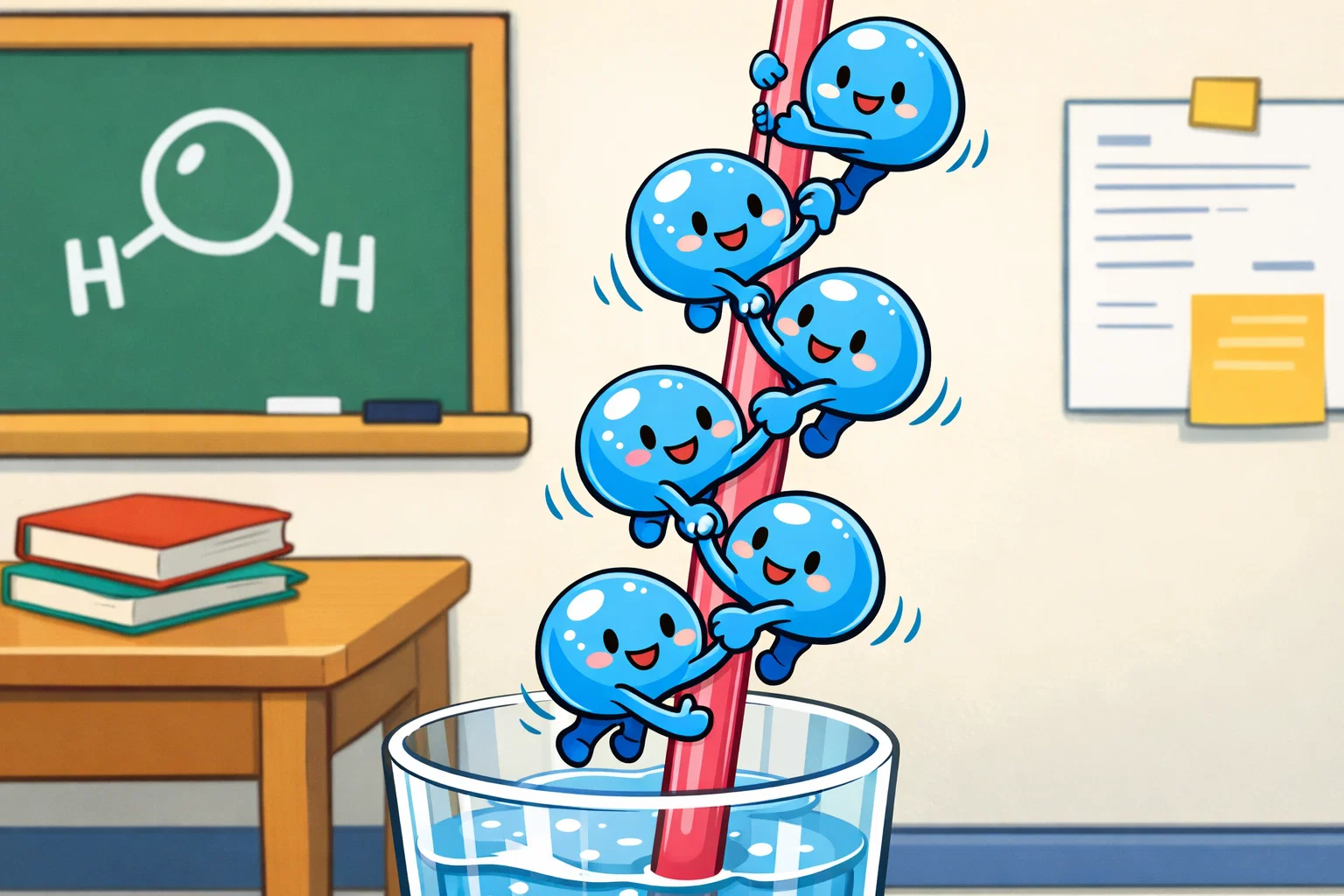
To guide students through these activities, a firm grasp of the underlying physics is essential. The movement observed is the result of specific interactions between water and solid surfaces.
Definition of Capillary Action
In simple terms, this is the spontaneous movement of a liquid through narrow spaces. It occurs when the forces pulling the fluid forward are stronger than the forces holding it back. It is the reason why a sponge can soak up a puddle and why trees can move water from deep roots to high leaves.
Mechanisms of Cohesion and Adhesion
At the molecular level, two main forces are at work. Cohesion is the attraction between like molecules—in this case, liquid molecules sticking to each other. Adhesion is the attraction between different molecules, such as water sticking to the cellulose in a paper towel. When the adhesive force (the attraction to the container) is stronger than the cohesive force (the liquid’s desire to stay together), the liquid begins to climb.
Science Behind Liquid Movement
While it might look like the water is defying gravity, it is actually following the path of least resistance through tiny channels. As the molecules at the front edge stick to a surface and move forward, they pull the trailing molecules along with them. This creates a continuous chain of molecules that “walks” along the medium.
Capillary Action in Nature
Beyond the kitchen table, this process is essential for life on Earth. Plants use a tissue called xylem, which consists of tiny tubes that act like capillaries. While large trees eventually need a suction force called transpiration (evaporation from leaves) to move liquid hundreds of feet, the initial pull starts with the same principles seen in a paper towel experiment.
Research indicates that engaging in these types of hands-on activities is crucial for long-term academic success. Recent studies on active learning strategies in STEM show that students who participate in experiential learning are significantly more likely to retain information and persist in scientific fields. This is further supported by the National Science Teaching Association (NSTA), which advocates for a “sensemaking” approach. Instead of just memorizing definitions, students should be encouraged to figure out the “why” behind the phenomena they observe.
Step-by-Step STEM Activity Instructions
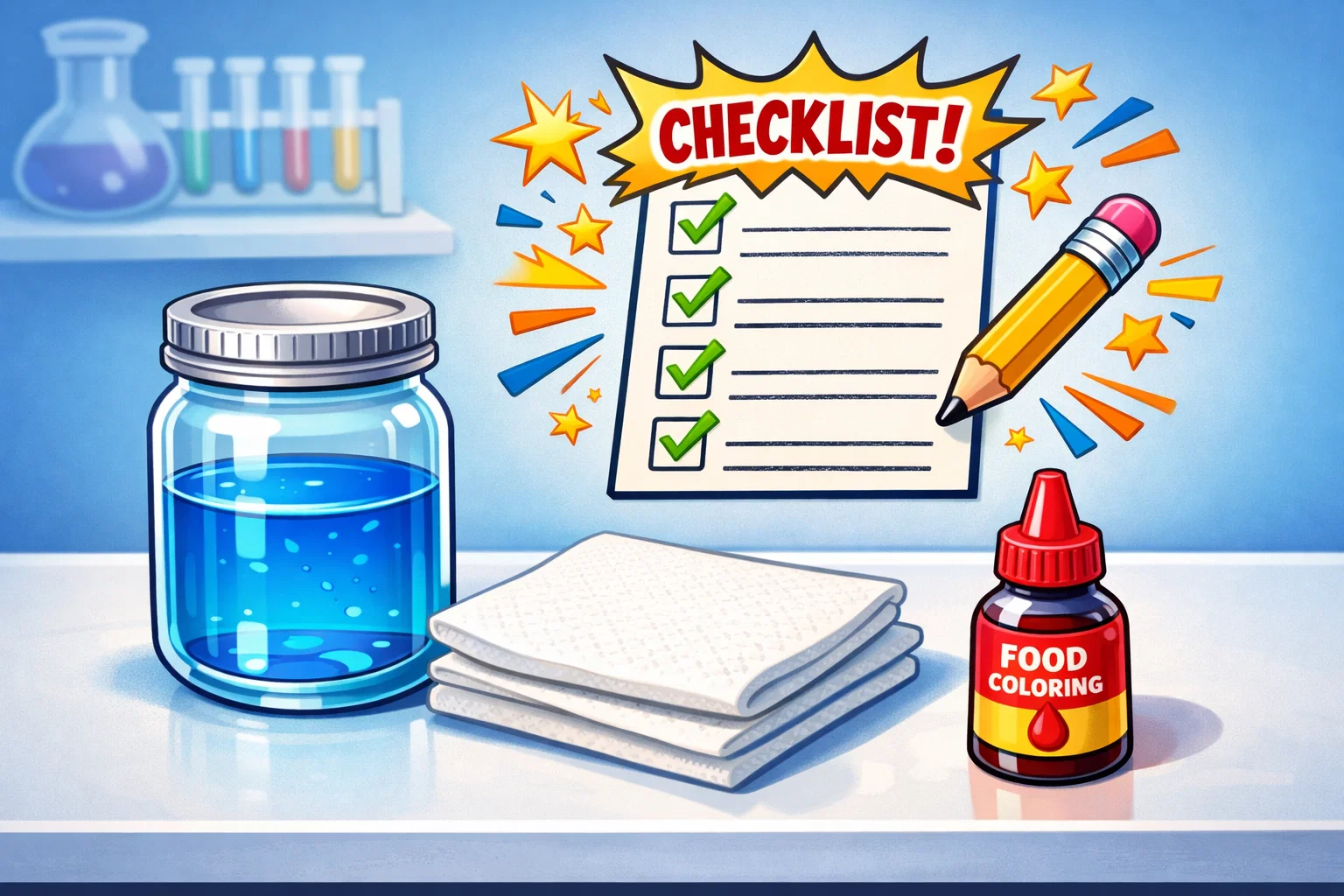
To ensure the experiment is a success, the following practical guidelines should be followed.
Essential Science Supplies List
| Material | Purpose |
| Clear Jars or Cups | To observe the liquid movement clearly |
| Paper Towel | High-quality brands with high porosity work best |
| Food Coloring | Provides the visual contrast needed to see the “walk” |
| Water | The primary liquid medium |
| Scissors/Knife | For cutting celery or flowers (adult use only) |
Prep Work for Home Experiments
A flat surface should be cleared before starting. Using a tray to catch spills is helpful, as food coloring can stain. Liquid levels should be kept high; the less distance the moisture must climb against gravity, the faster the results will appear.
Safety Guidelines for Young Scientists
While these activities are generally safe, children always require supervision when using food coloring. If a child has sensitivities to dyes, natural alternatives like beet juice can be used. Any cutting of stems must be performed by an adult to prevent injury and to ensure the plant’s xylem isn’t crushed, which would stall the experiment.
Step-by-Step Procedure for Success
- Fill outer jars 3/4 full with water and add 10-20 drops of food coloring.
- Fold the paper towel into a narrow “V” shape to create a dense path for the liquid.
- Place one end of the towel in the colored water and the other in an empty jar.
- Observe the initial wicking. If the fluid stops moving, check for air gaps or evaporation stalls.
Advanced Capillary Action Projects
For older children, more complex variables can be introduced to deepen the inquiry.
Growing Dinosaur Water Expansion
Many “grow-your-own” toys use porous materials that absorb water through capillary action. By measuring the weight and size of the toy over several days, students can calculate the rate of absorption and the total volume of liquid held within the material.
Magic Color Appearance Drawing Book
A “magic” book can be created by drawing on a paper towel with washable markers and hiding the drawing behind another layer of paper. When the bottom edge is dipped in water, the liquid travels up and reveals the hidden colors, demonstrating how moisture moves through multiple layers of a medium simultaneously.
Vertical Liquid Transport Observation
Using different types of materials—like cotton string, newspaper, and sponges—helps identify which can pull water the highest. This introduces Jurin’s Law, which states that the height of the liquid rise is inversely proportional to the width of the tube or pore.
Plant Hydration Simulation
A “self-watering” system for a small potted plant can be designed using a cotton wick. Placing one end in a reservoir of water and the other in the soil demonstrates how the principles of adhesion and cohesion solve practical problems in gardening and agriculture.
Educational Benefits of Play-Based Science
Incorporating these activities into a learning routine offers more than just entertainment; it builds a foundation for long-term education.
Development of Observation Skills
Experiments require children to slow down and look closely. Noticing tiny changes in color and height trains the brain to pay attention to detail—a skill that is vital in all academic disciplines.
Benefits for Preschool and Kindergarten Learners
At this age, the primary goal is “wonder.” Seeing colors mix and water move provides a sensory experience that builds positive associations with science. According to research on early childhood science education, children exposed to scientific inquiry early in life develop stronger problem-solving skills and a more robust vocabulary.
Encouraging Inquiry-Based Exploration
Instead of providing all the answers, asking open-ended questions is more effective: “What might happen if a thicker towel is used?” or “Why did the blue liquid move faster than the red?” This encourages children to form and test hypotheses, which is the heart of the scientific method.
FAQ
Why does water move upwards against gravity?
Water moves upward because the attraction between liquid molecules and the fibers of the paper (adhesion) is stronger than the downward pull of gravity. As the first molecules move up, they pull the rest of the fluid along with them through internal molecular bonds (cohesion).
Which materials show best results in capillary experiments?
Porous materials with tiny, interconnected spaces work best. High-quality paper towels, cotton fabric, and natural wood are excellent choices. Materials like plastic or metal lack the necessary “channels” or chemical attraction to water to allow for this movement.
How long does it take to see walking water effect?
Liquid usually begins to climb the towel almost immediately. However, for the colors to fully mix and fill an empty jar, it typically takes between 2 to 4 hours. Leaving the experiment overnight often yields the most dramatic results.
Does water temperature affect speed of absorption?
Generally, warmer water moves faster. Heat increases the kinetic energy of the molecules, reducing the viscosity of the liquid and allowing it to flow more easily through the narrow spaces of the medium.
Can other liquids besides water demonstrate this process?
Most fluids can demonstrate this, but the height and speed vary based on surface tension and viscosity. For example, rubbing alcohol or oil move differently than water because their molecular structures and attraction to surfaces differ.
Take a short quiz to find out what your everyday choices say about your parenting style
When your child is curious about something new, what’s your instinct?
Take a short quiz to find out what your everyday choices say about your parenting style
“Can I download this app?” What happens next?
Take a short quiz to find out what your everyday choices say about your parenting style
When it comes to rules at home, which sounds most like you?
Take a short quiz to find out what your everyday choices say about your parenting style
If you could give your child one life skill today, what would you pick?
Take a short quiz to find out what your everyday choices say about your parenting style
Your child gets to choose what to watch. What would your ideal setup look like?
Take a short quiz to find out what your everyday choices say about your parenting style
Pick your parenting superpower ✨