Soap Experiments for Kids: Surface Tension Guide

 Discover a Free Education Video App for Kids
Pastory uses AI to personalize educational video content based on your child’s interests and personality. Safe, engaging, and built for curious young minds. Sign up now to stay updated and enjoy early access with a free trial
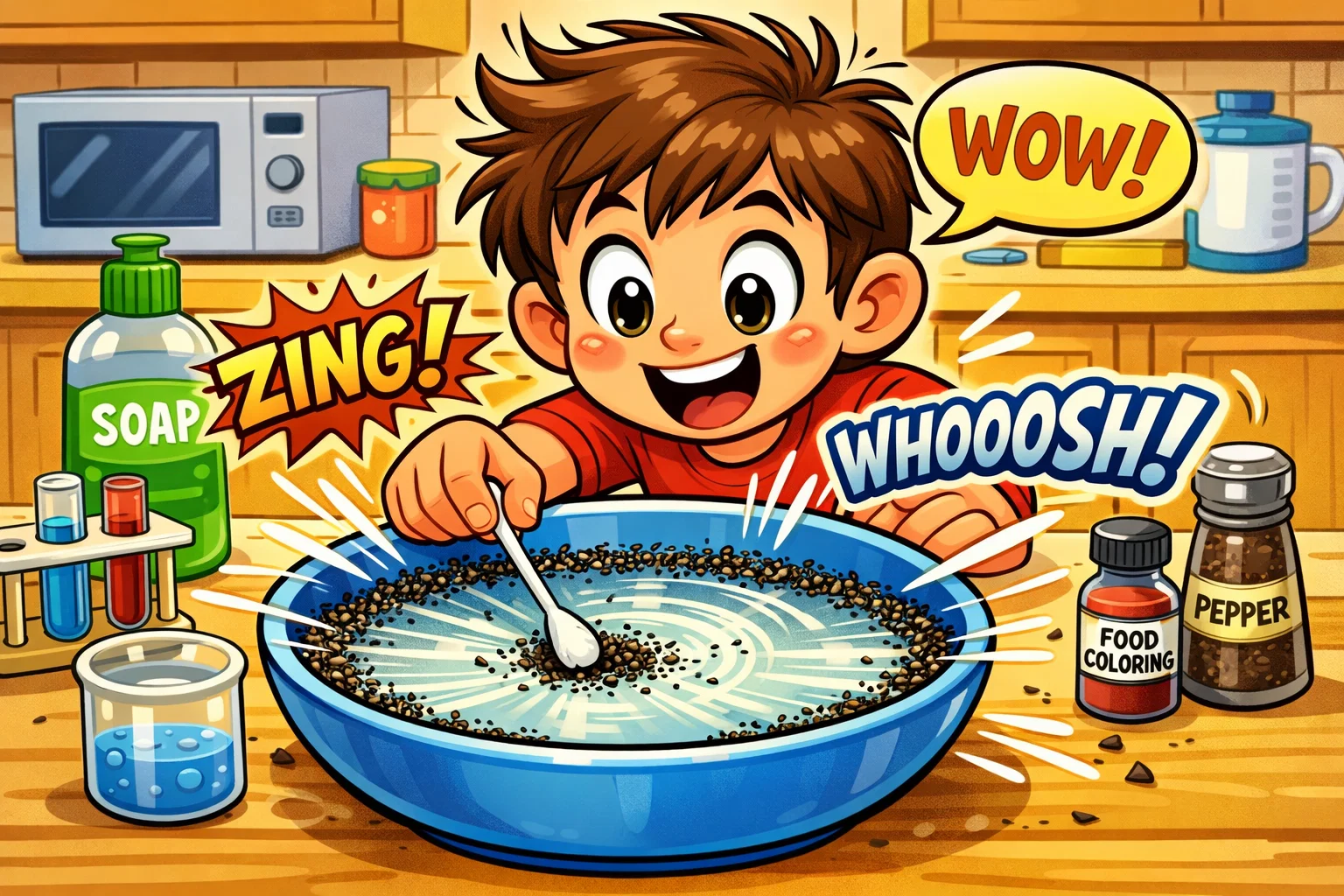
Exploring science at home is a powerful way to foster curiosity in young minds. One of the most fascinating phenomena to observe is surface tension, a property that makes water behave in unexpected ways.
By using simple household items like soap, you can transform your kitchen into a laboratory, allowing children to witness the hidden forces of physics in action.
Surface Tension Science Basics
To guide your children through these activities, it is helpful to first grasp the underlying principles. This liquid isn’t just a simple substance; it possesses a unique internal strength that influences how it interacts with everything it touches.
Definition of Surface Tension in Water
Surface tension is the property of a liquid outside that allows it to resist an external force, behaving as if it were an elastic membrane. This phenomenon originates from the cohesive forces between fluid molecules.
In a bulk liquid, molecules experience attractive forces from neighbors in all directions, resulting in a net force of zero. However, molecules at the interface—specifically the air-water boundary—lack neighbors on the superior side. This creates an imbalance where the net inward pull toward the bulk liquid generates a state of tension.
Role of Hydrogen Bonds
In the aqueous base, the primary driver of this cohesive force is hydrogen bonding. Molecules are polar, characterized by a significant electronegativity difference between the oxygen atom and the two hydrogen atoms. This results in a dipole moment where the oxygen possesses a partial negative charge and the hydrogens possess partial positive charges.
The attraction between the oxygen of one molecule and the hydrogen of another creates a robust tetrahedral network. At the surface, these units are pulled laterally and downward, creating a “skin” with a measurable energy density.
The thermodynamic definition of surface tension (gamma) is the work (W) required to increase the surface area (A) of a liquid by a unit amount at a constant temperature and pressure:
- gamma = dW / dA
In the International System of Units (SI), surface tension is expressed in Newtons per meter (N/m). For pure water at 20 degrees Celsius, the value is approximately 0.0727 N/m.
How Soap Molecules Disrupt Surface Tension
The introduction of soap or detergent introduces surface-active agents, or surfactants, into the system. Surfactant molecules are amphiphilic, meaning they contain both a hydrophilic (polar) head and a hydrophobic (non-polar) tail.
When added to the fluid, these molecules migrate to the surface to achieve a lower energy state. The behavior of these molecules includes:
- The hydrophilic heads remaining in the water.
- The hydrophobic tails protruding into the air.
- The disruption of the hydrogen bonding network of the aqueous medium at the surface.
This mechanism is supported by research into interfacial dynamics. According to a study published in the Journal of Chemical Education, the presence of surfactants significantly lowers the work required to expand a surface because the hydrophobic tails create a buffer that interrupts the strong attraction between water molecules.
By interspersing themselves between liquid molecules, surfactants weaken the net inward pull, typically reducing the surface tension to approximately one-third of its original value (down to about 25 mN/m). This reduction allows the fluid to “wet” surfaces more effectively and facilitates the formation of bubbles by providing the elasticity needed for the substance to stretch into a thin film.
Real World Examples of Surface Tension
You can see surface tension in action every time you look at a dewdrop on a leaf or a water strider skittering across a pond. These insects are so light that the “skin” of the liquid supports their weight without breaking. In technology, surface tension governs how ink flows in printers and how medical diagnostic tools move tiny droplets of blood through specialized sensors.
Necessary Equipment and Materials
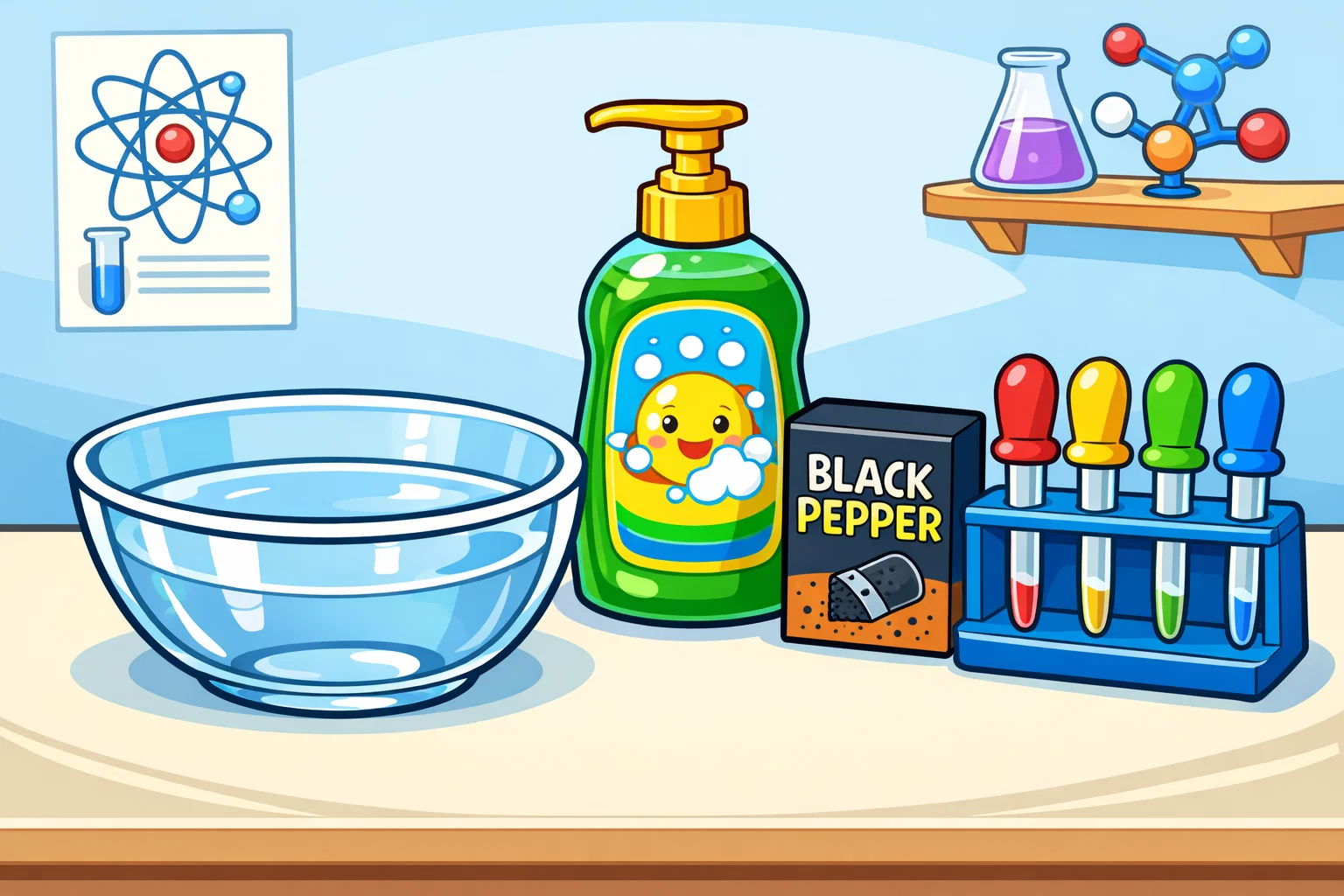
Before beginning your soap experiment, ensure you have the correct tools to avoid frustration and ensure safety.
Essential Laboratory Apparatus
- Large, shallow bowls or plates (preferably white to see colors clearly)
- Graduated cylinders or measuring cups
- Eye droppers or pipettes
- Stopwatches for timed observations
- Magnifying glasses
Recommended Household Chemicals
The choice of soap is critical. While many brands exist, Dawn Ultra is often cited as the gold standard due to its high concentration of surfactants. It contains approximately 10-15% sodium alkyl sulfate (SDS) by mass. Other useful additives include:
- Distilled water (to avoid the interference of mineral ions)
- Glycerin or corn syrup (to strengthen bubble films)
- Liquid food coloring
- Whole milk (the fat content is essential for the “fireworks” effect)
Safety and Technical Notes for Parents
While household detergents are generally safe, they are not without hazards. According to Safety Data Sheets (SDS), many concentrated soaps are classified as GHS Category 2B Eye Irritants. To ensure a safe learning environment, educators and parents should follow the “RAMP” protocol (Recognize, Assess, Minimize, Prepare), which is a standard safety framework recommended by the American Chemical Society for educational environments:
- Recognize: Identify potential hazards like slippery floors or eye irritants.
- Assess: Determine the risks associated with the age of the children involved.
- Minimize: Use splash-proof safety goggles if working with high concentrations.
- Prepare: Establish a hand hygiene routine where children wash hands for 20 seconds after the experiment.
Preparation of Experimental Workspace
Select a flat, stable surface that is easy to wipe down. Covering the area with a plastic tablecloth or tray is highly recommended. Ensure you have plenty of distilled liquid on hand, as tap water often contains calcium and magnesium ions that react with soap to form insoluble scum, which can “kill” the surfactant reaction.
Easy Surface Tension Experiments with Soap
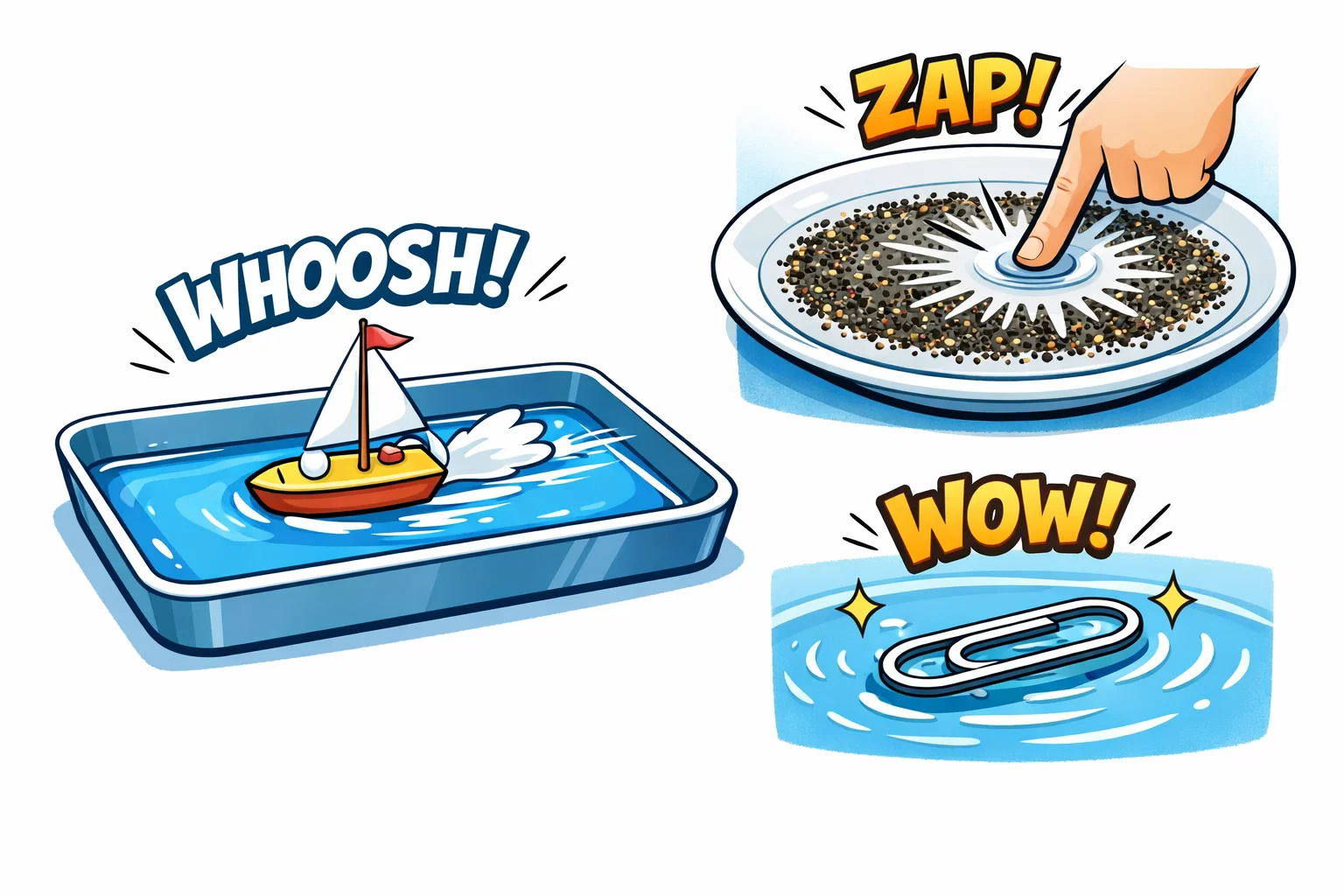
These activities are perfect for beginners and provide immediate visual feedback.
Magic Pepper and Soap Experiment
Fill a plate with water and sprinkle black pepper on top. The pepper floats due to surface tension. When you touch a drop of soap to the center, the pepper rapidly retreats to the edges. This occurs because the soap breaks the surface tension in the center, and the remaining force at the edges pulls the pepper away—a process known as the Marangoni Effect.
Soap Powered Boat Project
Cut a small boat shape out of a plastic milk carton or cardstock with a notch in the back. Place it in a tub of water. Put a single drop of soap in the notch. The boat will zoom forward as the soap reduces the tension behind it, allowing the higher tension in front to pull the vessel through the fluid.
Magic Milk Fireworks Activity
Pour whole milk into a shallow dish and add drops of food coloring. Dip a cotton swab in soap and touch the milk. The colors will swirl and dance. This happens because the soap is “chasing” the fat molecules in the milk while simultaneously lowering the surface tension, causing a rapid spreading of the pigments.
Suddenly Sinking Paper Clips Experiment
Carefully balance a dry paper clip on the surface of water using a fork. It will float. Add a drop of soap nearby, and the clip will instantly sink as the “skin” supporting it disappears.
Geometric Bubble Shapes
Use pipe cleaners to create 3D frames (cubes or pyramids). Dip them into a strong soap solution (see the table below). You will see the film stretch into complex geometric shapes that minimize their outside area.
Floating Card Challenge
Fill a glass to the brim with water and place a playing card on top. Carefully flip it over. The surface tension and air pressure work together to keep the card in place, preventing the liquid from spilling.
Step by Step Experimental Procedure
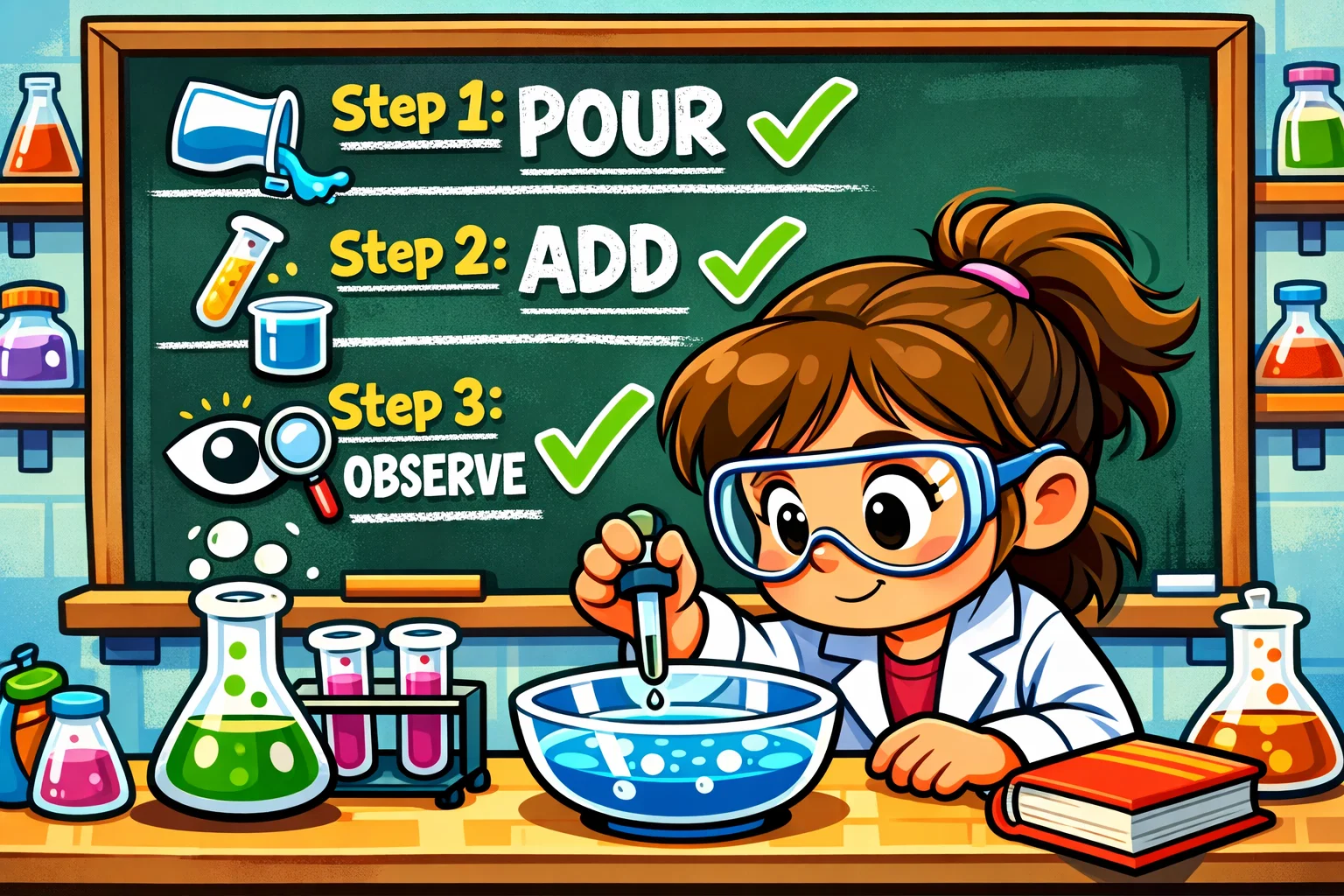
To maximize the educational value, treat these activities as a formal scientific investigation.
Scientific Method Implementation
- Observation: Ask why things float.
- Hypothesis: Predict what happens when soap is added.
- Experimentation: Follow the steps precisely.
- Analysis: Record what actually happened.
- Conclusion: Determine if the hypothesis was correct.
Raw Materials Checklist
| Item | Purpose |
| Distilled Water | Pure solvent for predictable results |
| Dawn Ultra | High-concentration surfactant |
| Corn Syrup | Viscosity modifier for bubble stability |
| Shallow Basin | Maximizes outside area for observation |
Required Steps for Success
- Step 1: Clean all containers thoroughly. Even a trace of grease can break the tension prematurely.
- Step 2: Pour the liquid slowly to avoid creating premature bubbles.
- Step 3: Introduce the soap only when the water is perfectly still.
- Step 4: Use small increments; often a single molecule-thick layer is all that is needed.
Observation and Data Collection
Encourage children to use a notebook. Measure the distance a soap boat travels or time how long a bubble lasts. Use the magnifying glass to look at the “color bands” in soap films, which indicate the thickness of the liquid.
Troubleshooting Common Results
If the experiment fails, it is usually due to “water hardness.” Calcium (Ca2+) and magnesium (Mg2+) in tap water react with soap to form a solid precipitate:
- 2 C17H35COO- + Ca2+ -> (C17H35COO)2Ca (s)
This reaction effectively “kills” the surfactant. Switching to distilled liquid usually solves this issue immediately.
Advanced Surface Tension Activities
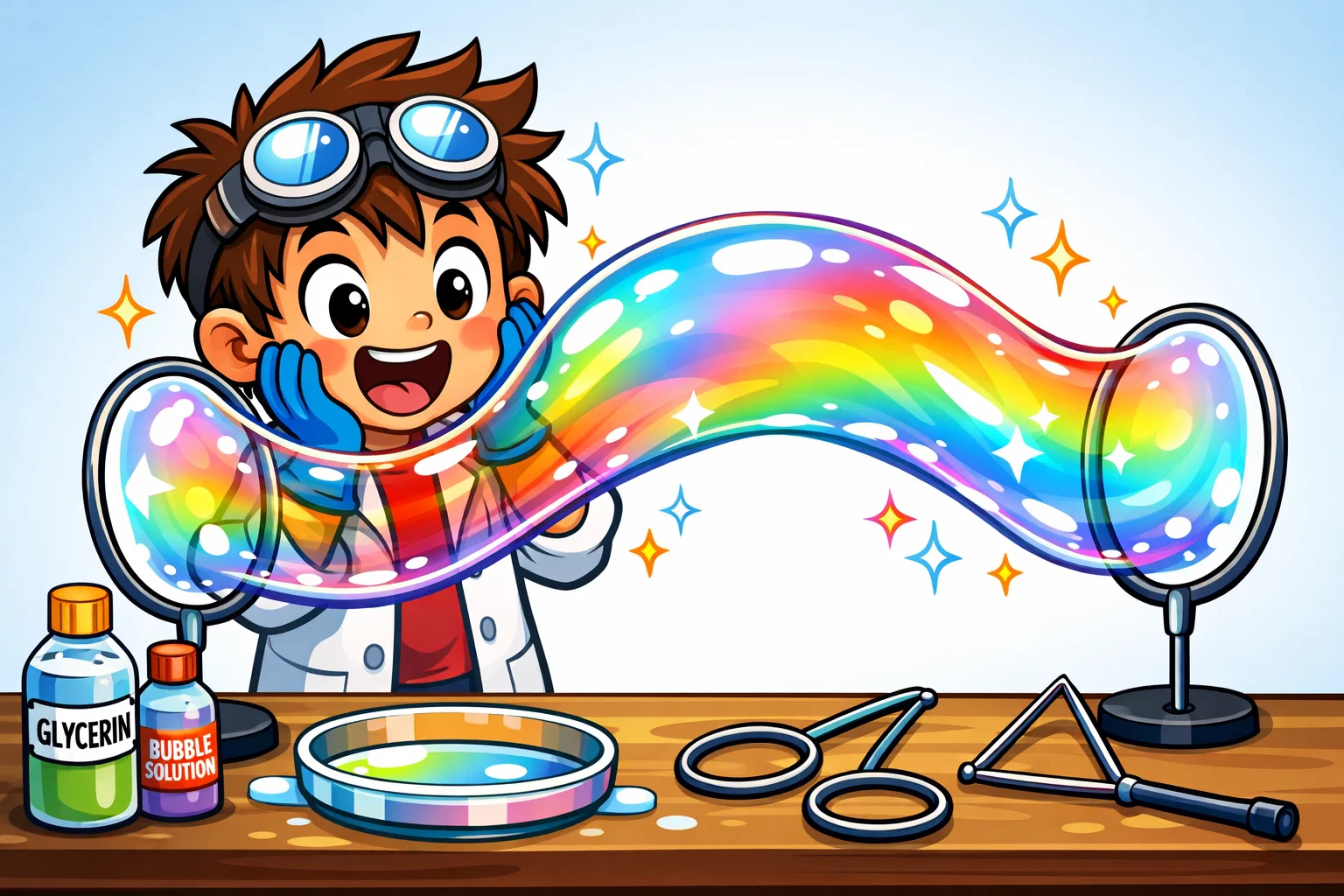
For older children, these projects involve more precise measurements and complex physics.
Water Drops on Penny Calculation
How many drops can fit on a penny? Due to surface tension, the water will form a large dome. Have students predict the number, then compare it to the number of drops they can fit once the penny has been rubbed with a tiny bit of soap.
Hydrophobic Cocoa Experiment
Dip a spoonful of dry cocoa powder into the water. It will come out dry because the surface tension of the fluid is too high to “wet” the hydrophobic cocoa. Then, add a drop of soap to the liquid and try again—the cocoa will instantly become wet and dissolve.
Floating Paperclip Precision Test
Use a series of different liquids (salty water, sugar water, soapy water) and measure how much weight a floating paperclip can support in each before sinking. This teaches how solutes affect molecular cohesion.
Leidenfrost Effect Exploration
Under strict supervision, observe how water droplets dance on a very hot pan. While primarily a heat phenomenon, the surface tension of the droplet keeps it in a perfect sphere as it floats on a cushion of its own vapor.
Bubble Snakes Construction
Cut the bottom off a plastic bottle and cover it with a sock. Dip the sock into a soap and corn syrup solution and blow through the top. This creates a “snake” made of thousands of tiny, high-tension bubbles.
Recommended Solution Ratios
| Experiment Type | Soap : Water Ratio | Additives | Target Group |
| Basic Bubbles | 1 : 4 | None | 3-6 years |
| Super Bubbles | 1 : 6 | 1 tbsp Glycerin | 7-12 years |
| Unpoppable | 1 tbsp : 1 cup | 1 tbsp Corn Syrup | 7-12 years |
| Giant Bubbles | 1/3 cup : 2 cups | 1/4 cup Corn Syrup | 10-15 years |
FAQ
Why does soap make water lose its strength?
Soap molecules are surfactants that wedge themselves between water molecules. This disrupts the hydrogen bonds that hold the liquid together, weakening the “skin” or surface tension.
Can you perform these experiments with cold water?
Yes, but surface tension is actually higher in cold water. In warmer liquid, molecules move faster and are slightly less cohesive, which might change the speed of your results.
Which type of soap works best for surface tension projects?
Dish soaps like Dawn Ultra are preferred because they contain a high concentration of surfactants and are designed to break down fats and surface bonds quickly.
Why do water striders sink when soap is added to pond water?
Water striders rely on the high surface tension of pure water to stay afloat. When soap is added, the tension drops so low that the liquid can no longer support the insect’s weight, causing it to fall through the outside.
Is it possible to restore surface tension after adding detergent?
In a small container, it is very difficult because the surfactant molecules are already distributed. You would generally need to empty the vessel, wash it thoroughly to remove all soap residue, and refill it with fresh water.
Take a short quiz to find out what your everyday choices say about your parenting style
When your child is curious about something new, what’s your instinct?
Take a short quiz to find out what your everyday choices say about your parenting style
“Can I download this app?” What happens next?
Take a short quiz to find out what your everyday choices say about your parenting style
When it comes to rules at home, which sounds most like you?
Take a short quiz to find out what your everyday choices say about your parenting style
If you could give your child one life skill today, what would you pick?
Take a short quiz to find out what your everyday choices say about your parenting style
Your child gets to choose what to watch. What would your ideal setup look like?
Take a short quiz to find out what your everyday choices say about your parenting style
Pick your parenting superpower ✨