20+ Leadership Games and Activities for Kids: Skills & Ideas

 Discover a Free Education Video App for Kids
Pastory uses AI to personalize educational video content based on your child’s interests and personality. Safe, engaging, and built for curious young minds. Sign up now to stay updated and enjoy early access with a free trial
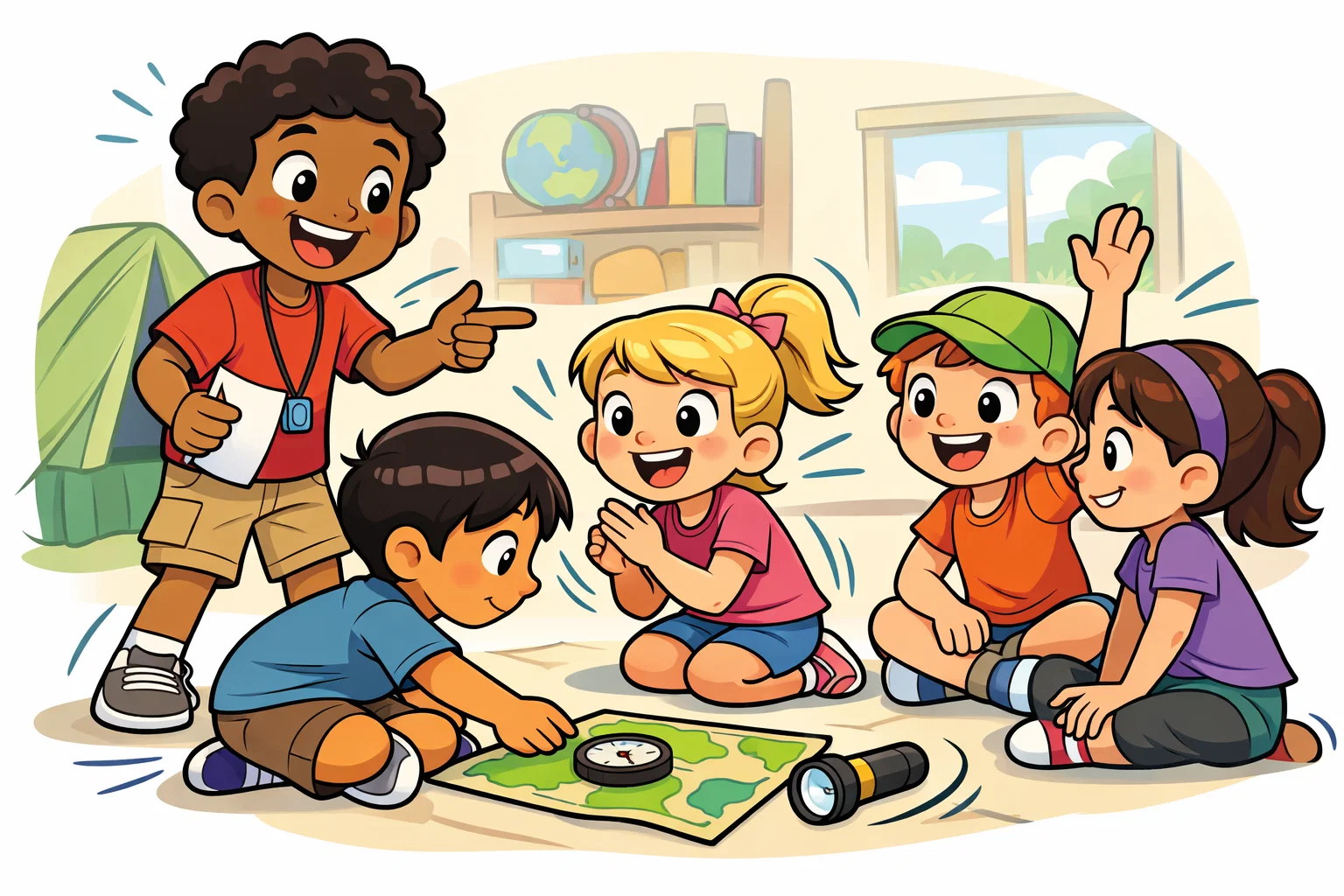
Leadership games and activities for kids do more than prepare children for the future — they build confidence, communication, empathy, and the ability to make decisions alongside others. Whether you are a parent, teacher, or youth group leader, structured activities give children a safe space to practice guiding, listening, and working as a team.
This article covers 20+ leadership games and activities organized across indoor, outdoor, classroom, and youth group settings, along with the core skills children develop and practical tips for running each activity effectively.
Key Takeaways
- This article covers 20+ leadership games and activities for kids across five key settings.
- Activities span indoor, outdoor, classroom, and youth group formats to suit different environments.
- Kids practice skills including delegation, motivation, creativity, feedback, and reflection.
- Team-building challenges like the Human Knot and Marshmallow Challenge develop cooperation and decision-making.
- Practical tips and a FAQ section help parents and leaders run each activity with confidence.
Leadership Games and Activities for Kids
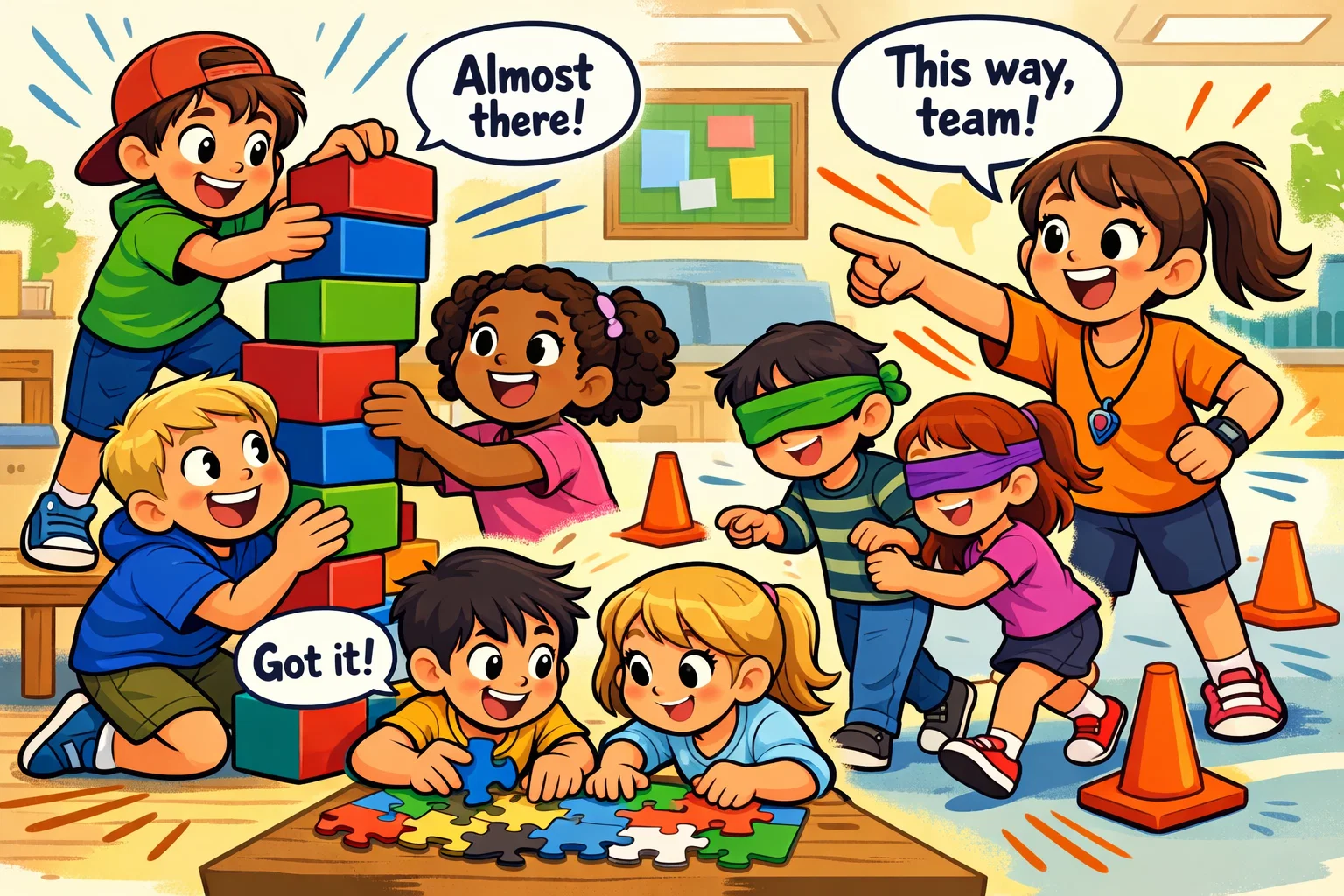
Hands-on leadership games and activities are an effective way to engage young minds because they transform abstract concepts into tangible experiences. Instead of lecturing about specific leadership traits, these exercises allow kids to improve through direct experience, trial, and error. These fun and engaging tasks are perfect for indoor or outdoor settings and can be adapted to fit different leadership styles, ensuring that both creative thinkers and natural organizers find their place.
By placing one student or a player from each team in a position of responsibility, you allow them to practice leadership in a low-stakes environment. These leadership training activities focus on collaboration skills and the ability to work together towards a common goal. It is important to remember that these moments of guidance often happen organically; when a group works through a challenge, the person who steps up to offer a suggestion is exercising the very leadership behaviors we aim to cultivate.
Human Knot Leadership Game
The human knot is a classic leadership development exercise that requires zero materials and can be done almost anywhere. To start, divide students into small groups (ideally 6 to 10 people). Have them stand in a circle and reach out to grab the hands of two different people across from them. This creates a tangled mess of arms that seems impossible to resolve at first glance.
The group is given one objective: untangle the human knot without letting go of each other’s hands. This exercise forces children to work together and communicate effectively. Often, a capable figure emerges to coordinate the movements, such as telling someone when to duck or step over a linked arm. It builds problem-solving skills as the group works to figure out the spatial logic of the knot. Success in this game relies heavily on patience and the ability of the person in charge to listen to feedback from the rest of the circle.
Minefield Leadership Challenge
In this leadership challenge, the outdoor area or a large room is scattered with “mines”—which can be any soft objects like balls, cones, or even crumpled paper. Students are divided into pairs, where one person wears a blindfold and the other acts as the navigator.
The navigator must use their communication skills to move their partner through the minefield using only verbal cues. This game encourages teamwork and places a heavy emphasis on active listening and trust. Leaders need to be able to give precise, calm instructions, while the blindfolded partner learns to rely entirely on their team member. Safety is paramount here; the instructor should ensure that students moving around the room do so at a slow pace to prevent collisions. This exercise highlights the weight of responsibility that comes with guiding others.
Storytelling Charades Activity
This activity blends creativity with public speaking and non-verbal expression. One student is given a prompt or a social scenario—perhaps a historical event or a conflict-resolution scene—and must act it out without speaking, while the rest of the group works to guess the story. This builds empathy and creative thinking, as the person in charge must think creatively about how to convey a message without the easiest tool at their disposal: their voice.
It highlights different leadership behaviors—specifically how to influence a group’s understanding through gestures and facial expressions. When the group finally “gets it,” the student gains a boost in confidence, realizing they can drive a collective understanding. This is an excellent way to help students who might be more introverted to express their ideas in a dynamic, high-energy format.
Scavenger Hunt Leadership Game
To organize a scavenger hunt, divide participants into teams and provide a list of tasks or items to find. Each group is given a designated leader for specific segments of the hunt to ensure that everyone gets a chance to lead. This encourages delegation and strategic planning.
| Phase of Hunt | Core Skill Focus | Why it Matters |
| Initial Planning | Creative thinking | Setting a strategy before acting. |
| Task Allocation | Delegation | Recognizing that one person can’t do it all. |
| The Search | Motivation | Keeping the team’s spirits high during the hunt. |
| Completion | Reflection | Analyzing what went well and what didn’t. |
Organizers must delegate tasks to ensure the team finishes on time, helping students learn that effective oversight is about managing resources and time, not just giving orders. This game is highly adaptable and can be held in an outdoor area or throughout a school building.
Lead the Blindfolded Game
This activity is similar to the Minefield challenge but focuses more on collective movement and coordination. A player from each team guides a line of blindfolded followers (who hold onto the shoulders of the person in front of them) through a simple obstacle course. This requires the person at the front to move around the room or field to check for safety while maintaining a clear, calm voice.
The person at the front must make decisions about the best path to take, considering the speed and comfort of the entire line. It reinforces the idea that effective leadership is about the safety and success of the entire group, not just the speed of the individual at the front. It is a powerful lesson in active listening for the followers and clarity of command for the head of the line.
Team Building Leadership Activities
Team activities focus on how a group works as a single unit rather than a collection of individuals. These leadership development activities emphasize that a leader is only as effective as the people they support.
Tower Building Challenge
Divide students into groups of four. Using materials like newspaper and tape, they must build the tallest freestanding tower. This activity is designed to boost collaboration and requires kids to make decisions together. Who will hold the base? Who will design the top?
As the clock ticks, students learn to manage stress and listen to different opinions. It’s a perfect scenario for leadership roles to rotate naturally. If the structure begins to lean, the team must think creatively to stabilize it, often requiring one person to step back and look at the “big picture” while others handle the construction.
Marshmallow and Toothpick Challenge
A variation of tower building, this task requires high levels of precision and delicate problem-solving. Because the materials are fragile, leaders need to maintain a positive atmosphere even when the tower falls. This teaches leadership behaviors like resilience and staying calm under pressure.
When the marshmallows begin to squish or the toothpicks snap, the group is given a chance to practice patience. The person overseeing the project must encourage the team to try again, fostering a “growth mindset” rather than a fear of failure. It is through these small frustrations that natural leadership is truly tested.
Build as Team Activity
In this task, the group is given a complex Lego set or a jigsaw puzzle without the final picture provided. They must work together toward a common objective by describing what they see and how pieces might fit.
It highlights different leadership styles—some kids will take charge of sorting pieces by color, while others will lead the physical assembly. This teaches kids that leadership strategies can involve being a specialist or a generalist. The goal is to finish the project as a cohesive unit, proving that collaboration skills are the backbone of any successful venture.
Hidden Structures Game
One student sees a “structure” (a specific arrangement of blocks or shapes) hidden behind a screen. They must then communicate clearly by describing the structure to their team, who must replicate it perfectly.
This emphasizes active listening and the guide’s ability to communicate effectively. If the description is vague, the structure will be wrong. This immediate feedback loop helps students think about the clarity of their words. It shows that leaders need to be able to translate a vision into actionable steps that others can follow accurately.
Classroom Leadership Activities
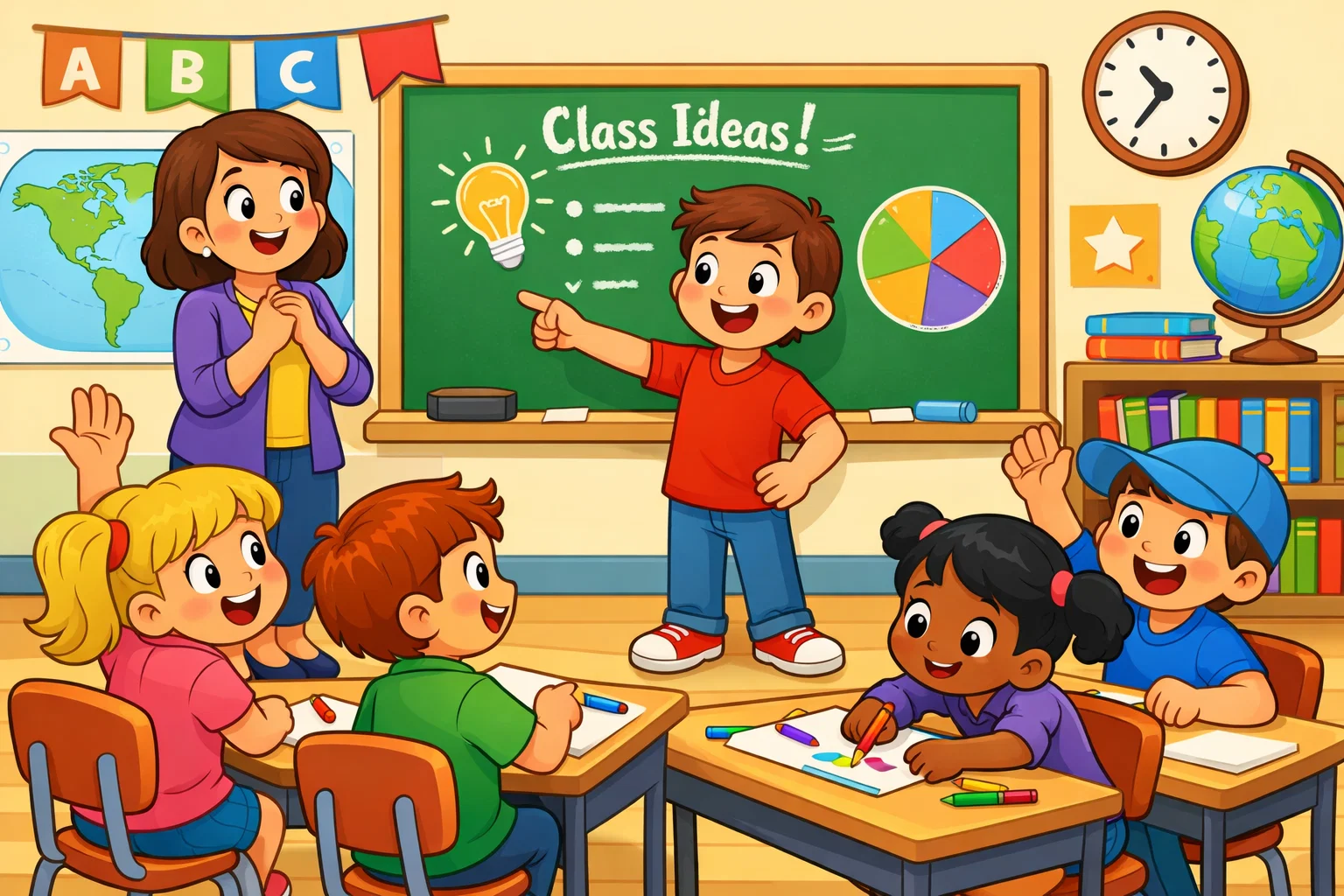
The classroom is a primary environment for developing leadership in children. Beyond games, educators can offer leadership opportunities within the daily curriculum.
Class Meetings Leadership Format
Instead of the teacher leading every discussion, ask students to chair the weekly class meeting. They can take turns setting the agenda, facilitating the conversation, and calling on peers who wish to speak.
This helps students feel a sense of ownership over their environment. When a student manages a meeting, they learn the importance of active listening and ensuring that every team member has a chance to contribute. It transforms the classroom from a top-down hierarchy into a collaborative community.
Peer Mentoring Activities
Assign students from older grades to work with younger ones on reading or math. This leadership role model dynamic builds accountability. When a student is a mentor, they naturally adopt good leadership traits to set a positive example.
They learn that their behavior influences others, which is a key component of leadership for kids. Mentoring also improves the mentor’s own understanding of the subject matter, as they must teach kids the concepts they have already mastered.
Public Speaking Leadership Tasks
Short “Show and Tell” or “Minute Speeches” build confidence and the ability to influence an audience. You might ask students to speak on a topic they are passionate about, such as a hobby or a community issue.
This helps them develop leadership skills related to persuasion and clarity. Being able to stand in front of a group and present an idea is a foundational skill that will serve them in every future leadership role. The goal is to turn “nervous energy” into “enthusiastic influence.”
Role-Playing Scenarios
Using role-play, students think through how to handle a playground dispute or a group project disagreement. This leadership strategy exercise helps them practice leadership in social contexts, emphasizing empathy and conflict resolution.
By acting out both sides of an argument, students learn to see perspectives other than their own. This is essential for effective leadership, as a true head must understand the needs and frustrations of those they guide.
Leadership Activities for Youth Groups
Youth groups, scouts, and camps provide more freedom for outdoor and physical leadership games and activities that might be too large for a standard classroom.
Leadership Race Activity
This is a relay where each station requires a different skill—some physical, some logical, and some creative. A new head is assigned at each station. This ensures different leadership qualities are celebrated; a child who isn’t fast at running might be the one who solves the logic puzzle that lets the team move forward.
It teaches kids that every team member has a “time to shine” and that a good head knows when to step back and let someone else’s expertise take over.
Goal Pyramid Exercise
Students work on a common goal, such as planning a community service project. They start at the base with individual tasks and move up to the pyramid tip (the final outcome).
Managers must delegate tasks to ensure every “brick” of the pyramid is stable. This exercise helps kids to improve their organizational skills. They learn to visualize the steps required to reach a massive objective, breaking it down into manageable pieces for everyone involved.
Get Off the Couch Challenge
This involves active problem-solving tasks that require physical movement, such as “The Floor is Lava.” These team activities require high levels of coordination and motivation.
When the “lava” is rising, someone must step up to organize the path to safety. This challenge demands quick decision-making and the ability to keep the group focused during high-energy moments. It’s about more than just moving; it’s about moving together towards a common goal.
Round Tables Discussion Activity
Students in small groups discuss a specific issue, such as how to improve their local park. A moderator ensures everyone has a chance to speak, practicing active listening and group facilitation. This mimics real-world leadership workshops and helps kids realize that their ideas can lead to actual change.
Indoor Leadership Activities
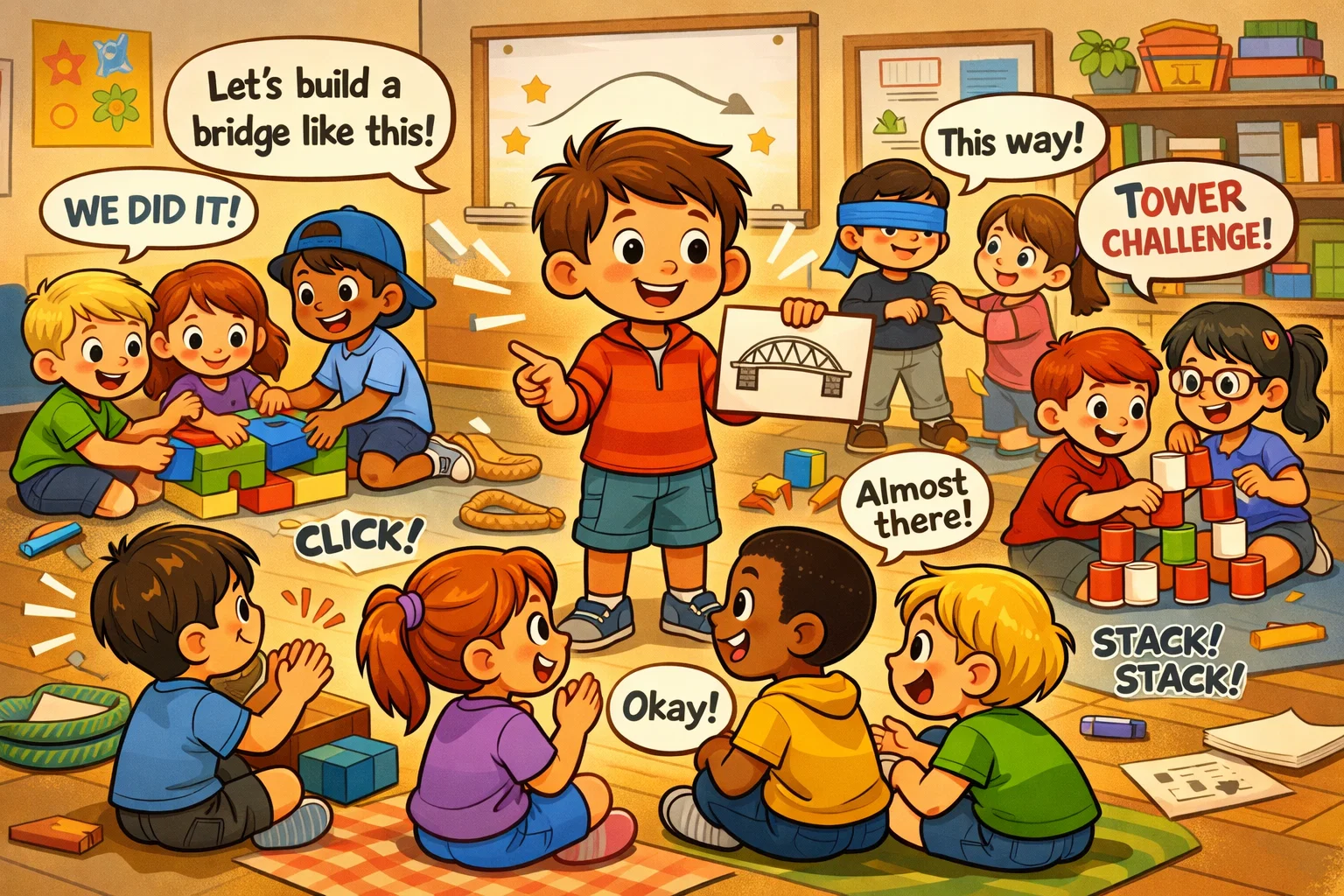
Bingo Leadership Game
Create bingo cards with leadership traits like “Honesty,” “Bravery,” or “Reliability.” Kids must find peers who have demonstrated these traits recently. It’s a great way to build confidence and recognize the value of others. This game shifts the focus from “being the boss” to recognizing the good leadership qualities that exist in everyone around them.
Team Noughts and Crosses
Two teams compete in a giant version of the game. Before each move, the team member must consult their group. The head makes the final call, teaching them how to make decisions after hearing feedback. It highlights the balance between group consensus and final accountability.
Silence Leadership Game
The group is given a task—like lining up by height or birthdate—but they cannot speak. This forces students to find non-verbal leadership strategies and rely on visual communication skills. It’s a powerful lesson in how much we communicate through body language and eye contact.
Outdoor Leadership Activities
Obstacle Course Leadership Game
Designing and running an obstacle course allows kids to get a chance to manage safety, timing, and encouragement. One student acts as the “Safety Officer,” while another acts as the “Timer.” This shows that leadership roles are varied and all essential for a successful event.
Train Tracks Team Activity
Using wooden planks or “skis,” two teams must move in unison to reach a finish line. The person at the front calls out the rhythm (“Left! Right!”). This game encourages teamwork and synchronized movement. If the rhythm is lost, the “train” stops. It’s a vivid illustration of how a leader’s voice provides the structure for the group’s success.
Tug-of-War Leadership Exercise
Tug-of-war is often seen as a test of brawn, but it is actually about timing. A coordinator stands to the side to organize the “pulls.” This teaches motivation and effective leadership through vocal encouragement and strategic timing.
Benefits of Leadership Activities for Kids
The long-term advantages of these programs are vast:
- Communication Skills Development: Kids learn that being a head is 10% speaking and 90% active listening.
- Confidence and Responsibility: Taking on leadership roles helps kids realize their actions have value.
- Problem-Solving: Structured challenges teach creative thinking and resilience.
- Teamwork and Empathy: Working together towards a common goal helps kids understand and respect different perspectives.
Leadership Skills Kids Practice Through Activities
Delegation and Trust
Learning to delegate tasks is one of the hardest leadership skills to master. Activities like the human knot show kids that they must trust their peers to untangle the mess. You cannot move everyone’s arms yourself; you have to guide them and trust they will follow through.
Motivation and Positivity
Leaders need to be able to keep morale high. Even when a hula hoop falls or a tower collapses, a good head uses positive reinforcement to keep the team from giving up.
Creativity and Flexibility
Plans rarely go perfectly. Leadership activities require kids to think creatively to solve unexpected hurdles. This adaptability is what separates a rigid manager from an inspiring guide.
Feedback and Reflection
After every game, a brief reflection helps students learn what worked and what didn’t. This is a vital part of leadership workshops, turning every failure into a learning opportunity.
Tips for Running Leadership Activities
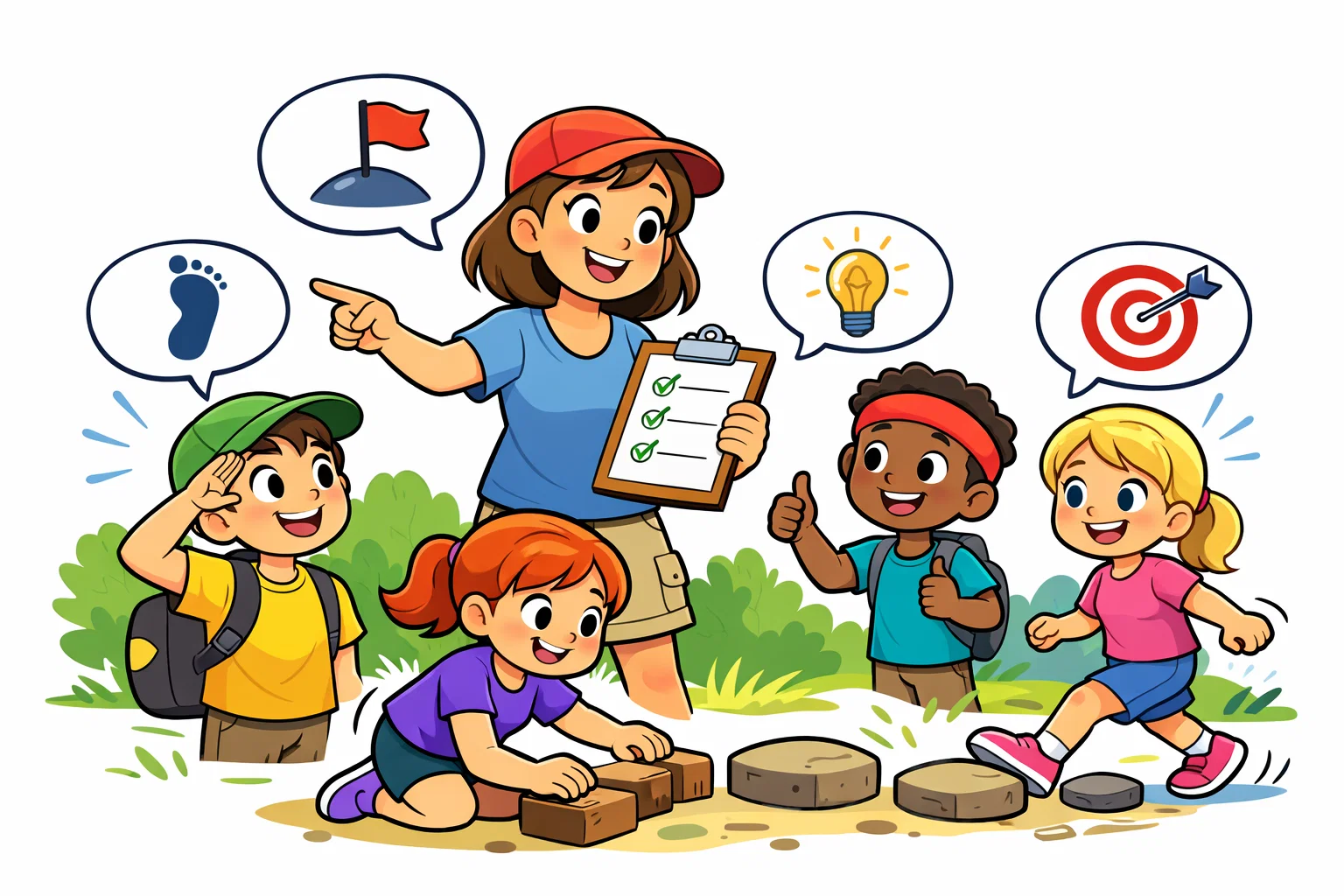
- Choose Age-Appropriate Tasks: Younger kids need shorter, more physical games, while older students think better with complex logic puzzles.
- Incorporate Inclusive Leadership: Ensure that leadership opportunities are not just given to the most vocal kids.
- Rotate Roles: Every child should have the chance to be the leader and a team member.
- Reflect: Always ask students questions like, “How did it feel to be in charge?” or “What did your team do to help you?”
Leadership Activities FAQs
What is the best age for leadership activities?
While leadership for kids can start as young as 3 or 4 with simple sharing games, formal leadership development activities are most effective starting around age 7.
What is the ideal group size?
For most leadership games, small groups of 5 to 8 are ideal. This ensures every team member has a voice.
How can leadership activities help shy kids?
They provide a safe space to practice. Starting with students in pairs and moving to small groups helps them build confidence gradually.
How much time is needed?
Most games and activities for kids take 15 to 30 minutes, but the reflection period afterward is just as important.

Take a short quiz to find out what your everyday choices say about your parenting style
When your child is curious about something new, what’s your instinct?
Take a short quiz to find out what your everyday choices say about your parenting style
“Can I download this app?” What happens next?
Take a short quiz to find out what your everyday choices say about your parenting style
When it comes to rules at home, which sounds most like you?
Take a short quiz to find out what your everyday choices say about your parenting style
If you could give your child one life skill today, what would you pick?
Take a short quiz to find out what your everyday choices say about your parenting style
Your child gets to choose what to watch. What would your ideal setup look like?
Take a short quiz to find out what your everyday choices say about your parenting style
Pick your parenting superpower ✨