Cambridge Early Years Activities

 Discover a Free Education Video App for Kids
Pastory uses AI to personalize educational video content based on your child’s interests and personality. Safe, engaging, and built for curious young minds. Sign up now to stay updated and enjoy early access with a free trial

The early years are the most crucial time in a child’s learning and development, laying a strong foundation for all future success. The Cambridge Early Years programme recognises this by placing purposeful, engaging activities within a rich, play-based pedagogical framework. This isn’t just about keeping young children busy; it’s a strategically designed approach where every activity directly supports specific curriculum goals and developmental milestones, guiding the whole child toward holistic development.
For schools, parents, and early learning centres, understanding this link is vital. Structured play-and-explore sessions and expertly curated learning opportunities are the main vehicles through which children learn and develop the essential knowledge and skills—from early literacy and mathematics to robust social and emotional development. By ensuring activities are purposeful and aligned with the framework, we nurture each child’s natural curiosity, help children explore their surroundings and foster a joyful, lifelong love of learning.
Cambridge Early Years Overview
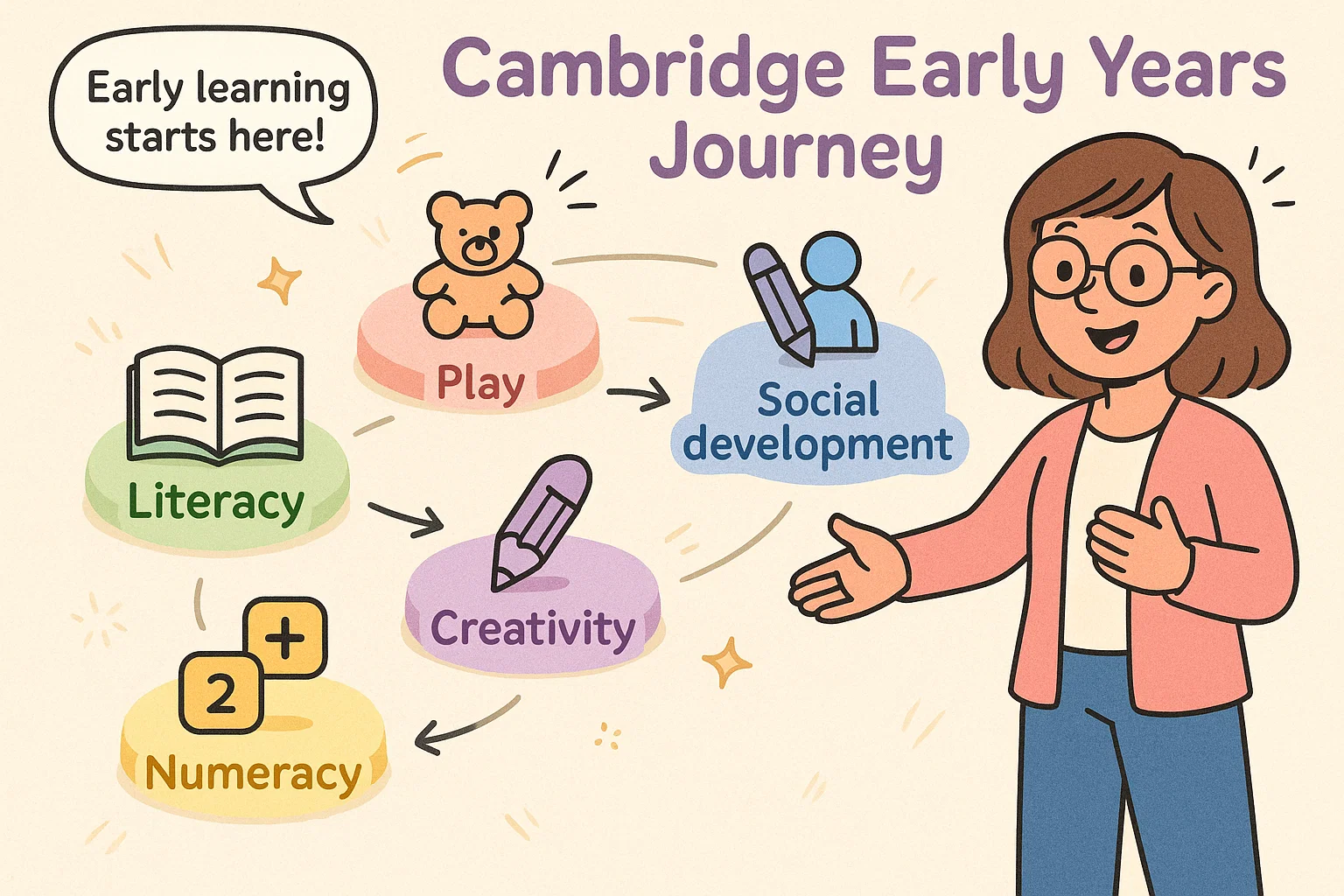
The Cambridge Early Years programme provides an internationally recognised guide for the teaching and learning of young children aged 3 to 6. It’s designed to be a flexible and culturally sensitive foundation stage, preparing learners for their transition into Cambridge Primary and beyond. The programme’s core is rooted in the belief that children develop best when they are active participants in their learning.
Its focus is on building a strong foundation across key developmental areas rather than rote memorisation alone. It aims to develop a child’s confidence, communication, and thinking skills, ensuring they become curious, independent, and resilient lifelong learners. This phase is integral to the entire Early Years programme pathway, setting the stage for future academic achievement within the school setting.
Cambridge Early Years Framework
The Cambridge Early Years Framework is the backbone of this educational approach. It provides a flexible yet clear structure for early years education globally. Its design is deliberately comprehensive, ensuring the holistic development of the child’s personality, intellect, and physical wellbeing. The framework is not prescriptive but rather a guide to pedagogy for the early years practitioner and educator.
Curriculum Focus Areas
The Cambridge Early Years curriculum organises learning and development into six major areas. Activities are the practical way to engage children and reinforce these areas:
| Focus Area | Core Developmental Goals | Activity Examples |
| Communication and Language | Expressive and receptive language, communication skills, storytelling, phonics awareness. | Circle time discussions, role-play using expressive language, repeating rhymes. |
| Personal, Social and Emotional Development | Self-regulation, social and emotional development, forming relationships, building confidence, interacting with others. | Sharing games, collaborative block building, identifying facial expressions. |
| Physical Development | Gross motor skills (running, jumping), fine motor skills (grasping, cutting), hand-eye coordination. | Obstacle courses, threading beads, using tweezers to sort small objects. |
| Literacy | Early reading, writing readiness, linking sounds to letters, creating narratives. | Tracing patterns in sand, looking at picture books, phonics games. |
| Mathematics | Early mathematical concepts, number understanding, sorting, pattern recognition, problem-solving. | Counting objects, comparing sizes, building with geometric shapes. |
| Understanding the World | Exploration of the world around them, science, geography, community, technology. | Nature walks, simple experiments (floating/sinking), playing with water/sand. |
Measuring Progress Through Activities
Measuring Progress Through Activities is crucial for early years education. The framework promotes continuous assessment based on observation, rather than formal testing. This reflective process helps children by allowing early years practitioners to evaluate their methods and support each child effectively.
- Observation Methods: Educators use systematic, ongoing observation during free play and structured activities within the school setting. They focus on how children explore, interact with others, and use materials.
- Child Portfolios: Early years practitioners collect evidence (photos, notes, work samples) to document a child’s learning and development journey over time.
- Checkpoints: The framework provides clear developmental statements (or ‘strands’) that serve as guideposts, helping teachers recognise when a child is ready for the next level of knowledge.
Teaching Support Tools
Cambridge provides a comprehensive suite of teaching support tools to strengthen the practice of the educator:
- Curriculum Guides: Detailed manuals explaining the developmental goals and learning targets.
- Implementation Manuals: Practical advice on how to integrate the framework into the nursery or pre-school environment.
- Planning Templates: Tools to guide teachers in creating engaging and purposeful daily and weekly activity plans.
- Assessment Checklists: Sheets for easy recording of observations against the developmental checkpoints.
- Online Portals: Secure platforms for accessing resources, professional support, and community forums.
Learning Resources for Early Years Activities
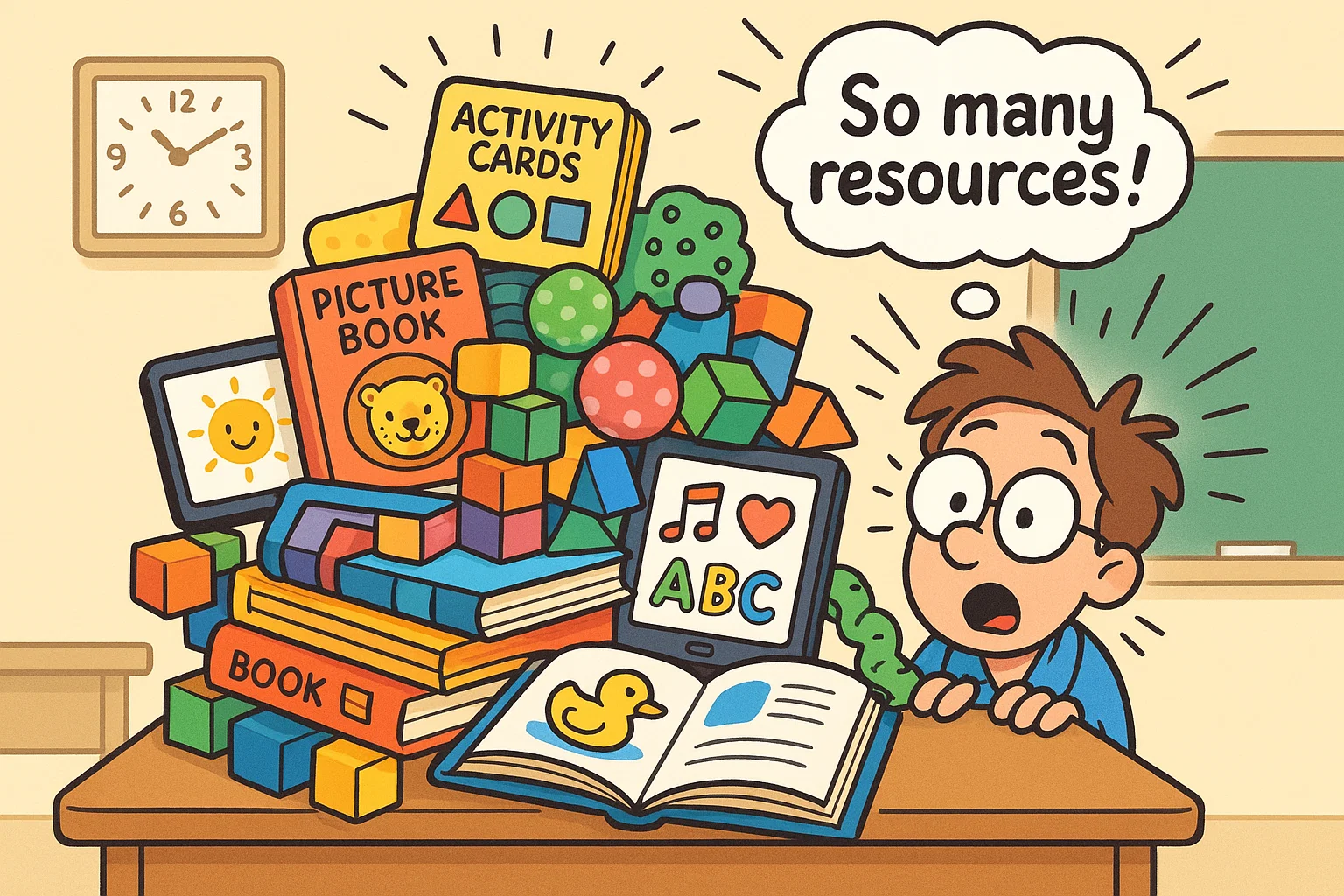
Learning resources are the physical and digital materials that bring the Cambridge Early Years curriculum to life. They must offer a variety of ways for children to become active learners and explore concepts.
Teaching Resources
Teaching resources are the essential items the educator uses to facilitate learning:
- Lesson Plans and Activity Cards: Pre-designed, flexible suggestions for engaging play-based sessions.
- Manipulatives: Concrete objects (e.g., blocks, counters, interlocking bricks) that give children hands-on experience with mathematical concepts.
- Classroom Organisation Tools: Materials helping to set up inspiring learning zones, ensuring continuous learning opportunities across the room.
- Assessment Tools: Observational guides and recording sheets tailored to the framework.
Learning Resources
Learner resources are directly interacted with by the children:
- Age-Appropriate Books: a rich variety of resources to support literacy development, including both fiction and non-fiction to build understanding the world.
- Sensory Tools: Materials like sand, water, playdough, and natural objects that encourage exploration and fine motor skills development.
- Play-based resources such as dress-up clothes, dolls, and construction materials.
Support and Guidance for Educators
Support and guidance for educators are paramount to high-quality early years education. Cambridge provides a network to ensure every early years practitioner can access timely help:
- Professional Communities: Online forums and local networks where educators can connect, share best practices, and connect with their peers.
- Best-Practice Recommendations: Regularly updated guides on effective pedagogy and activity design.
- Specialised Cambridge Support: Direct access to experts for specific curriculum or implementation questions.
Professional Development
Professional development is key to an educator’s effectiveness. Cambridge offers structured qualifications and training:
- Workshops and Webinars: Focused sessions on areas like effective phonics instruction, integrating mathematics through play, and enhancing social and emotional development.
- Certification Programmes: Formal qualifications that strengthen an early years practitioner’s expertise in the Cambridge methodology.
- Conferences and Events: Opportunities to engage with the latest research on early years teaching and learning.
Cambridge Programmes and Qualifications Pathway
The Cambridge Early Years programme is the essential first step in a globally recognised educational pathway:
- Cambridge Early Years (Ages 3–6): Focuses on play-based foundation for learning and development.
- Cambridge Primary (Ages 5–11): Strengthens core subjects and transitions learners towards more formal teaching and learning.
- Cambridge Lower Secondary (Ages 11–14): Develops subject knowledge and skills in preparation for IGCSE.
- Cambridge Upper Secondary (Ages 14–16): Leads to the internationally valued IGCSE qualification.
- Cambridge Advanced (Ages 16–19): Leads to A-Level qualification, preparing students for university.
Play-Based Activities in Cambridge Early Years
Play-based learning is the cornerstone of the Cambridge Early Years curriculum. It is defined as a context for learning and development through which children learn by exploring and experimenting with the world and people around them. In this context, play involves both child-initiated free play and adult-guided, purposeful activities. This approach ensures learning opportunities are joyful and highly effective.
Play-Based Learning Benefits
The advantages of play-based learning are multifaceted, contributing significantly to the whole child:
| Developmental Domain | Key Benefits of Play-Based Learning |
| Cognitive Development | Develops problem-solving, abstract thinking, and memory. Children build understanding of cause and effect. |
| Social and Emotional | Strengthens social and emotional development, including self-regulation, empathy, and the ability to interact with others and manage conflict. |
| Linguistic | Enhances communication and language skills, vocabulary, and narrative ability through dialogue and role-play. |
| Physical Development | Refines gross motor skills (e.g., climbing) and fine motor skills (e.g., handling small items). |
Common Misconceptions About Play-Based Learning
A typical myth is that “play is not academic” and doesn’t lead to measurable skill development. The reality, as evidenced in the Cambridge Early Years approach, is quite the opposite. Purposeful play-and-explore activities are not merely fun; it is the most efficient brain-building activity for young children. For example, building a tower requires mathematical thinking about balance, size, and structure; making mud pies involves understanding the world and early science concepts. Early years practitioners act as educators and guides, ensuring that free play time is rich with learning opportunities.
Creating Inspiring Activity Environments
The physical environment is the “third teacher.” To engage children fully, the school setting must offer clearly defined, purposeful zones:
- Reading Corner: A soft, quiet space with rich literature to support early literacy.
- Sensory Tables: Areas for water, sand, or textured materials to develop sensory processing and fine motor skills.
- Art Stations: Open access to art materials that encourage creativity and expressive skills.
- Outdoor Exploration Areas: Spaces that give children learning opportunities for gross motor skills development and understanding the world through nature.
Supporting Play-Based Learning as an Educator
The educator’s role is essential. They are not passive; they are reflective facilitators:
- Guided Play: Gently introduce a concept (e.g., sorting) during free play to strengthen a specific skill.
- Observation and Scaffolding: Get to know the learners by observing how children explore and then offering just enough support to help children succeed at a task that’s just beyond their current ability.
- Designing Prompts: Placing interesting, open-ended resources (e.g., magnifying glasses, different-sized boxes) in a zone to inspire specific types of exploration.
Play-Based Starting Points for Reading, Writing, and Mathematics
Nursery activities are designed to introduce core concepts in subtle, developmentally appropriate ways.
Playful Adult-Led Activities
These are slightly more structured tasks where the educator initiates and guides the learning and development:
- Role Play: Acting out familiar stories or scenarios to develop communication skills and social and emotional development.
- Simple Logic Games: Tasks like ‘I Spy’ or matching games that require asking questions and observation.
Reading Activities
- Storytelling and Retelling: Using puppets or props to encourage children to retell a story, boosting communication and language.
- Phonics Games: Activities that help children learn to recognise sounds, such as simple phonemic-awareness games.
Writing Activities
- Pre-writing Skills: Fine motor skills tasks like pouring, scooping, and using tongs to strengthen hand muscles.
- Creative Expression: Give children access to different media (paint, chalk, crayons) to make marks, which is the earliest form of writing.
Mathematics Activities
- Counting Games: Singing number songs or using objects like stones or blocks to practice rote and one-to-one counting.
- Shape Sorting and Pattern Recognition: Building towers with blocks of the same colour or size to introduce mathematical sorting concepts.
Activity Categories in Cambridge Early Years
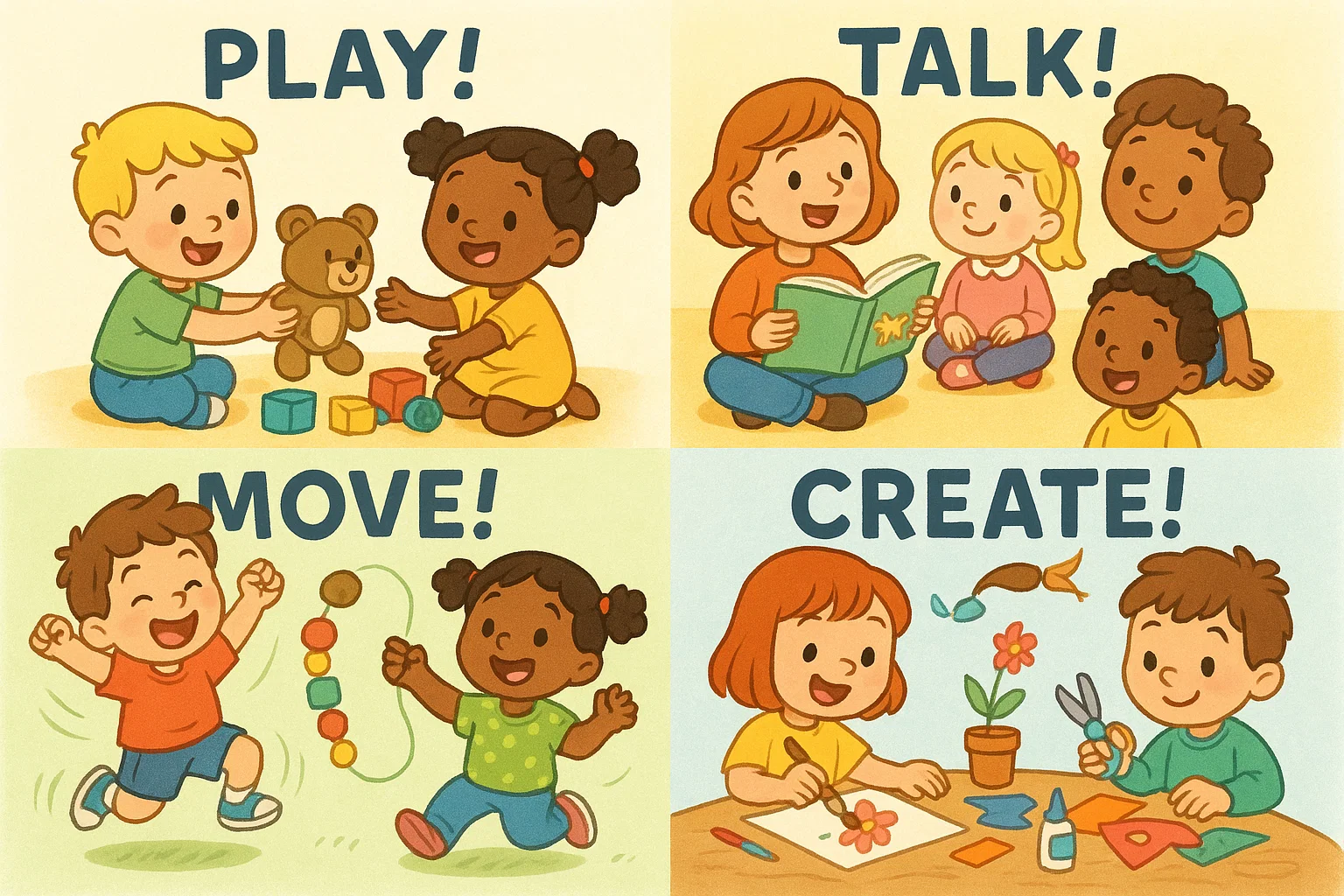
The Cambridge Early Years curriculum uses a variety of ways to categorise activities within a theme to ensure a balanced learning and development experience.
Social Skills Activities
These support a child’s ability to interact with others and build confidence:
- Cooperation Challenges: Building a large fort or completing a group puzzle, requiring negotiation and communication skills.
- Playing Alongside: Encouraging parallel play initially, and gradually moving toward interactive play.
Communication Skills Activities
- Circle Time: A daily structured time for listening, responding, and sharing, supporting the development of both receptive and expressive language.
- Role-Play Scenarios: Setting up a post office or a doctor’s surgery to encourage the use of appropriate vocabulary and gestures.
Motor Skills Activities
- Fine-Motor: Activities in this area include cutting paper with scissors, threading large beads, and building with small construction sets.
- Gross-Motor: Exploration on the playground, dancing, balancing on a line, and throwing/catching games strengthen gross motor skills.
Cognitive Development Activities
These tasks develop higher-order thinking and knowledge and understanding:
- Logic and Reasoning: Simple sequence puzzles or predicting the outcome of a small experiment.
- Early STEM Exploration: Asking questions like “What happens when…?” about materials in the surroundings.
Language and Literacy
- Vocabulary Building: Introducing a theme (e.g., ‘The Farm’) and varying the vocabulary used throughout the week.
Mathematics
- Quantity Comparison: Using balances and scales to compare the weight of objects and develop a mathematical sense of ‘more’ or ‘less’.
Art and Craft
- Creative Projects: Allowing children to choose their own materials to express a feeling or idea, supporting creativity.
Free Play
- Unstructured Play: Time in the indoor or outdoor environment where children explore without adult direction, crucial for problem-solving and self-regulation.
Music, Dance, Drama
- Movement Sessions: Using scarves or ribbons to vary movement, supporting physical development and expressive skills.
Theme-Based Learning
- Activity Blocks: Designing an entire week of activities within a single theme (e.g., ‘Mini-beasts’) to help children connect ideas.
Practical Activities (Non-Flame Cooking)
- Hands-on Exploration: Simple, safe tasks like making a fruit salad or mixing dough, which integrate mathematics (measuring), literacy (following a recipe guide), and fine motor skills.
Centre Support for Early Years Activities
For centres choosing to implement the Cambridge Early Years curriculum, comprehensive support ensures smooth and high-quality delivery.
Teaching Support
- Implementation Manuals: Detailed guides on translating the framework into daily practice, focusing on effective teaching and learning.
- Coaching Sessions: Support from Cambridge advisors to evaluate and strengthen the delivery of play-based activities within the centre.
Resource Access
Educators support their practice through:
- Cambridge International Digital Library: A portal for downloadable teaching materials, resources which can be used, and sample activity plans.
- Physical Materials: Access to official Cambridge resources, including curriculum books and assessment tools.
Case Studies and Real Examples
Cambridge provides case studies showcasing how centres successfully integrate early years activities. For instance, a bilingual centre might demonstrate how they vary the language used during free play and structured circle time to support both languages simultaneously, or how a nursery uses local natural materials to develop understanding of the world by helping children build deeper connections with their surroundings.
Becoming a Cambridge Early Years Centre
Becoming a Cambridge Centre is a quality assurance process:
- Requirements: A commitment to the holistic development and wellbeing of young children, appropriate facilities, and qualified staff.
- Activity Planning Fit: Centres must demonstrate they use a play-based pedagogy and can structure activities within the framework to support the curriculum.
News and Updates Related to Early Years Activities

Latest Releases
- New Resource Packs: The release of new theme-based packs (e.g., Early STEM exploration kits) to provide fresh learning opportunities for educators and children to develop knowledge and skills in innovative, play-based ways.
- Teacher Toolkits: Updated guides focusing on key areas like advanced phonics techniques or integrating mathematical concepts into the outdoor environment.
Event Announcements
- Global Early Years Conferences: Annual events where early years practitioners and educators can access cutting-edge research, attend workshops on activity design, and connect with peers.
- Webinar Series: Regular online sessions providing professional development on implementing new curriculum updates or enhancing classroom practice.
Activity Checklist for Educators
This reflective checklist, inspired by Cambridge materials, is designed to guide the early years practitioner in setting up and running effective, child-centric activities within the school setting.
Classroom Environment Checklist
| Item | Status (Yes/No) | Reflection & Action |
| Is the space clearly divided into purposeful learning zones (e.g., art, blocks, quiet reading)? | Does the arrangement support free play and self-selection? | |
| Are resources accessible and organised to support independence? | Are the materials varied enough to give children choice and inspire creativity? | |
| Are there areas for both active gross motor skills development and quiet focus activities within the indoor space? | Does the environment support the whole child’s wellbeing and energy levels? |
Activity Planning Checklist
- Clear Developmental Objective: Does the activity directly target a specific goal in the curriculum (e.g., fine motor skills, mathematical sorting, communication and language)?
- Materials Readiness: Are all necessary resources prepared and laid out to engage children immediately?
- Flexibility: Does the plan allow for the learner’s interests to vary the direction of the activity? (i.e., is it open-ended enough for exploration?)
- Inclusivity and Differentiation: Can the activity be adjusted to support all children’s development, including those with special learning and development needs?
Observation and Reflection Checklist
- Child Engagement: Did the children show sustained interest and joyful participation?
- Progress Evaluation: What specific knowledge and skills (e.g., phonics sounds, counting to 10) were demonstrated by the learners during the activity?
- Reflective Practice: What modifications should be made to the structure or resources next time to better support children’s learning and meet the developmental objectives?
Next Steps for Educators and Centres
Embarking on the Cambridge Early Years curriculum journey is a step toward providing a world-class foundation for young children.
Starting Activity Planning
- Focus on the Child: Begin by asking questions about your learners’ interests. If they love trains, use a train theme to introduce mathematics (counting carriages) and literacy (writing tickets).
- Use the Framework: Consult the official guide to ensure your activities within the week cover all six developmental domains.
- Start Small: Incorporate one new, purposeful play-based activity per day, then gradually increase.
Professional Development Opportunities
- Explore Qualification: Consider enrolling in a Cambridge qualification specifically for early years practitioners to master the pedagogy.
- Attend Workshops: Look for local professional development sessions focusing on hands-on activity design and assessment guides.
Support Channels
- Connect with the Cambridge Community: Join official forums to benefit from the collective experience of other educators globally.
- Contact Your Local Representative: Contact your regional Cambridge representative for personalised guidance and support in implementing the curriculum in your school setting.
By embracing the Cambridge Early Years approach to activities, you give children an invaluable head start, helping them build a strong foundation for lifelong learning and development through exploration and joyful discovery.

Take a short quiz to find out what your everyday choices say about your parenting style
When your child is curious about something new, what’s your instinct?
Take a short quiz to find out what your everyday choices say about your parenting style
“Can I download this app?” What happens next?
Take a short quiz to find out what your everyday choices say about your parenting style
When it comes to rules at home, which sounds most like you?
Take a short quiz to find out what your everyday choices say about your parenting style
If you could give your child one life skill today, what would you pick?
Take a short quiz to find out what your everyday choices say about your parenting style
Your child gets to choose what to watch. What would your ideal setup look like?
Take a short quiz to find out what your everyday choices say about your parenting style
Pick your parenting superpower ✨