


If you have ever watched trees sway or felt a sudden rush of air on a chilly afternoon, you have experienced the invisible power of nature. For children, understanding something they can feel but not see can be a bit of a mystery. This hands-on activity is designed to pull back the curtain on meteorology by showing kids how to build an anemometer – a scientific tool used to measure wind speed. Geared toward elementary-aged children, this project transforms simple household items into a functional weather instrument, fostering a strong connection between play and the scientific method.
Engaging in a homemade anemometer project does more than just fill an afternoon; it introduces basic concepts of physics and fluid dynamics. By the end of this experiment, young learners will understand how the movement of atmospheric gases translates into mechanical motion. Whether you are a parent looking for a weekend STEM project or a teacher planning a unit on weather, this guide provides everything you need to help children measure the wind speed while building confidence in their ability to observe and analyze the natural world.
Anemometer Basics for Kids
What an Anemometer Measures
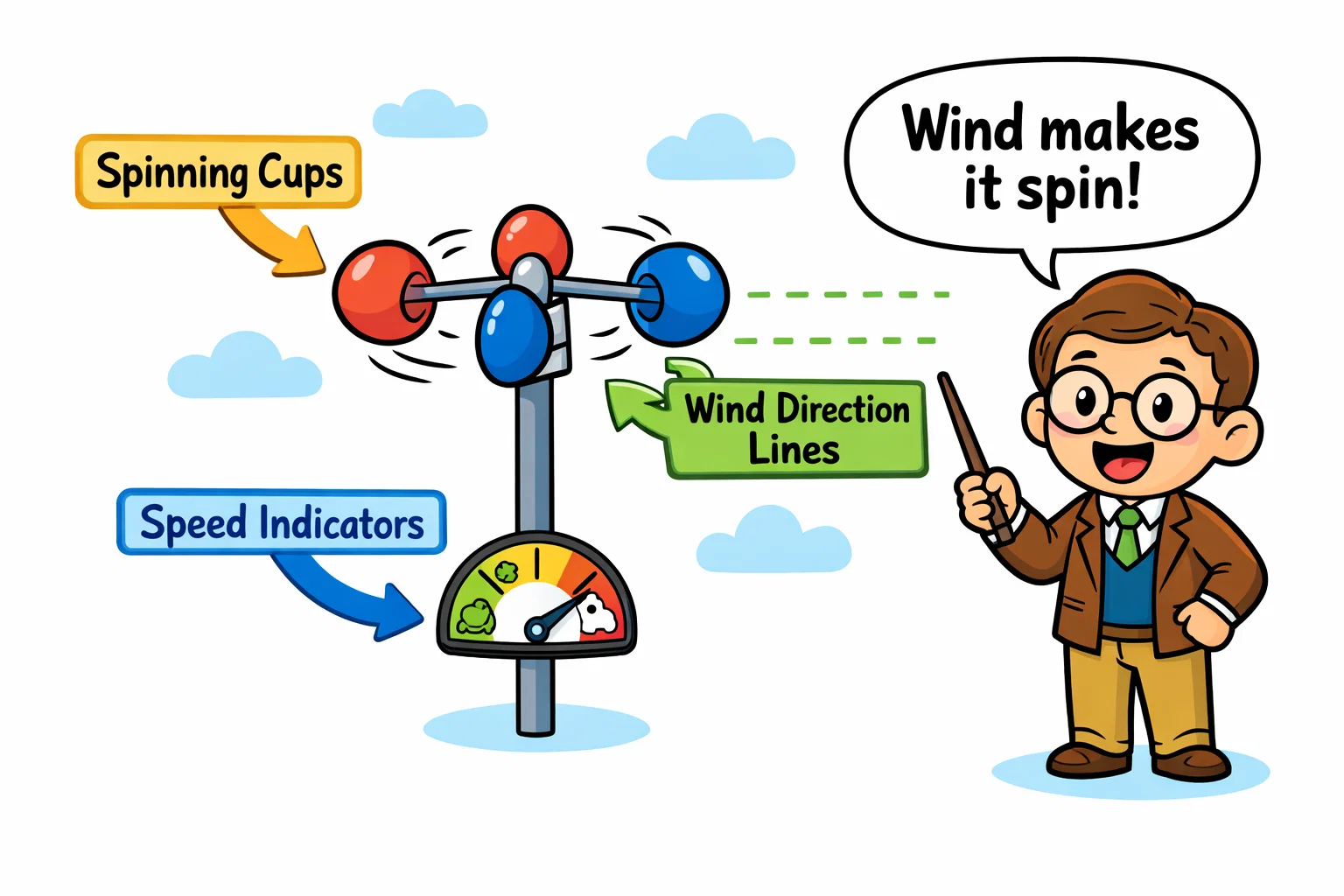
At its simplest, an anemometer is a device that tells us how fast the air is moving. While we can see leaves fluttering, scientists need a specific measurement to understand shifting weather patterns. The most common type is a cup anemometer, which uses hollow paper cups to “catch” the passing breeze. As the air hits the open side of one cup, it pushes it, causing the entire structure to spin. The faster the cups spin, the higher the measured wind speed.
Where Anemometers Are Used in Real Life
Anemometers aren’t just for science class! They are critical tools used in several industries:
- Airports: Pilots must know the wind speed and direction to take off and land safely.
- Meteorology: Weather stations use high-tech types of anemometers to predict storms and track intense wind gusts.
- Ships at Sea: Sailors use them to navigate safely when the sea becomes rough.
- Renewable Energy: Before building wind turbines, engineers need to know if a location has enough wind energy to produce power.
Why wind speed matters in weather
The velocity of air is a key indicator of changing conditions. A sudden change in wind speed can signal changing weather conditions or a change in temperature. For kids, understanding this movement is also about safety; knowing when a gust is strong enough to make outdoor play difficult helps them respect the power of the elements.
Wind Speed Experiment Learning Goals
Science Skills Developed During the Experiment
This hands-on activity touches on several core scientific competencies. Children will practice counting the number of rotations, recording results in a notebook, and using a timer to maintain consistency. These are the building blocks of data literacy and empirical observation.
Engineering thinking in simple builds
When kids make their own anemometer, they are acting as a junior engineer. If the device doesn’t spin freely, they must troubleshoot the mechanics. This involves checking if the cups rotate evenly or if the straw is attached to a vertical shaft correctly. This iterative process – build, test, fix – is the heart of the engineering design cycle.
Age and grade suitability
- Preschool (Ages 3-5): Focus on the visual “spinning.” Can they blow on the device to make it rotate?
- Lower Elementary (Ages 6-8): Focus on counting how many times the marked cup passes a fixed point.
- Upper Elementary (Ages 9-11): Introduce the calculation phase, where they determine revolutions per minute (RPM) using basic division.
Materials List for Anemometer Experiment
Common household materials
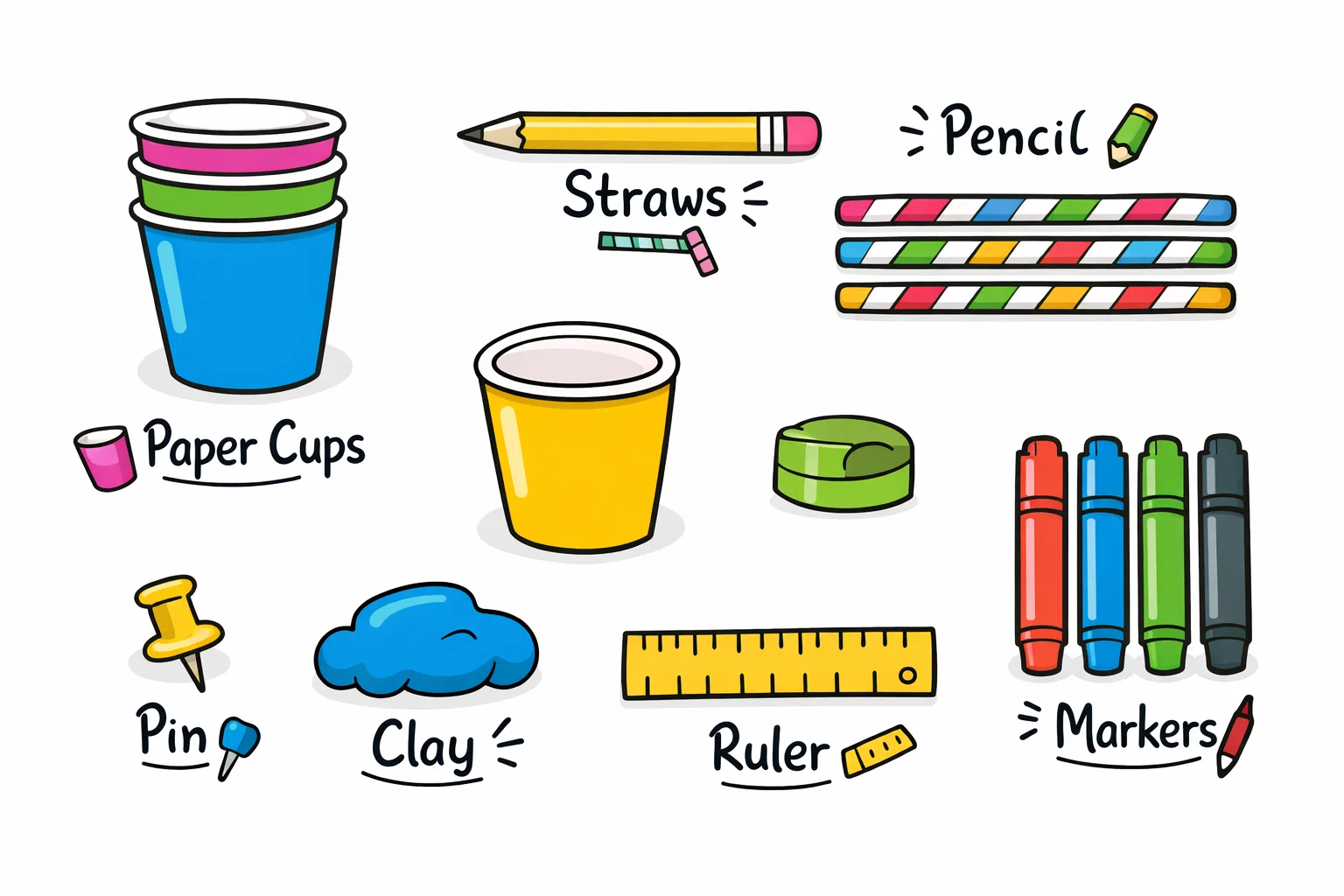
To make an anemometer, you likely already have these items in your kitchen or craft bin:
- 5 small paper cups (3 oz. size is ideal);
- 2 plastic straws;
- 1 pencil with a fresh pencil eraser;
- 1 push pin;
- Modeling clay (to create a weighted base);
- A felt-tip marker.
Optional classroom supplies
- A timer or stopwatch;
- A notebook for recording results;
- A portable fan (to simulate different wind conditions indoors).
Safety notes for materials
Since this project requires a push pin, adult supervision is mandatory when children attach the straws to the eraser of the pencil. Remind children to be careful with the sharp point and to stay aware of their surroundings when testing outdoors on a windy day.
How to Make Anemometer Step by Step
Preparing parts before assembly
- Mark the Lead Cup: Use a marker to color one of the cups or draw a large “X” on it. This helps you keep track of the rotation when you count how many times it circles the center.
- Punch Holes: Punch holes in the sides of four cups, about half an inch below the rim.
- The Base: Punch a hole in the bottom of the fifth cup – this will serve as your central hub.
Anemometer assembly instructions
- Cross the Straws: Place the two straws together in an “X” shape and secure the center with a small piece of tape.
- Attach Cups: Slide the ends of the straws through the holes in the four paper cups. Make sure the cups all face the same direction (e.g., all openings facing clockwise) so they catch the breeze properly.
- The Shaft: Push the pencil (pointy side down) through the bottom of your center cup and secure it into a base of modeling clay.
- The Pivot: Push the push pin through the intersection of the “X” straws and into the eraser of the pencil. Do not push it too far; the cups can spin better if there is a tiny gap for movement.
Testing spinning movement
Before heading outside to face the elements, give the cups a gentle flick. The anemometer should make a full revolution easily if the pin isn’t too tight. If it sticks, loosen the pin slightly so the cups spin without friction.
Wind Speed Measurement Activity
Counting rotations method
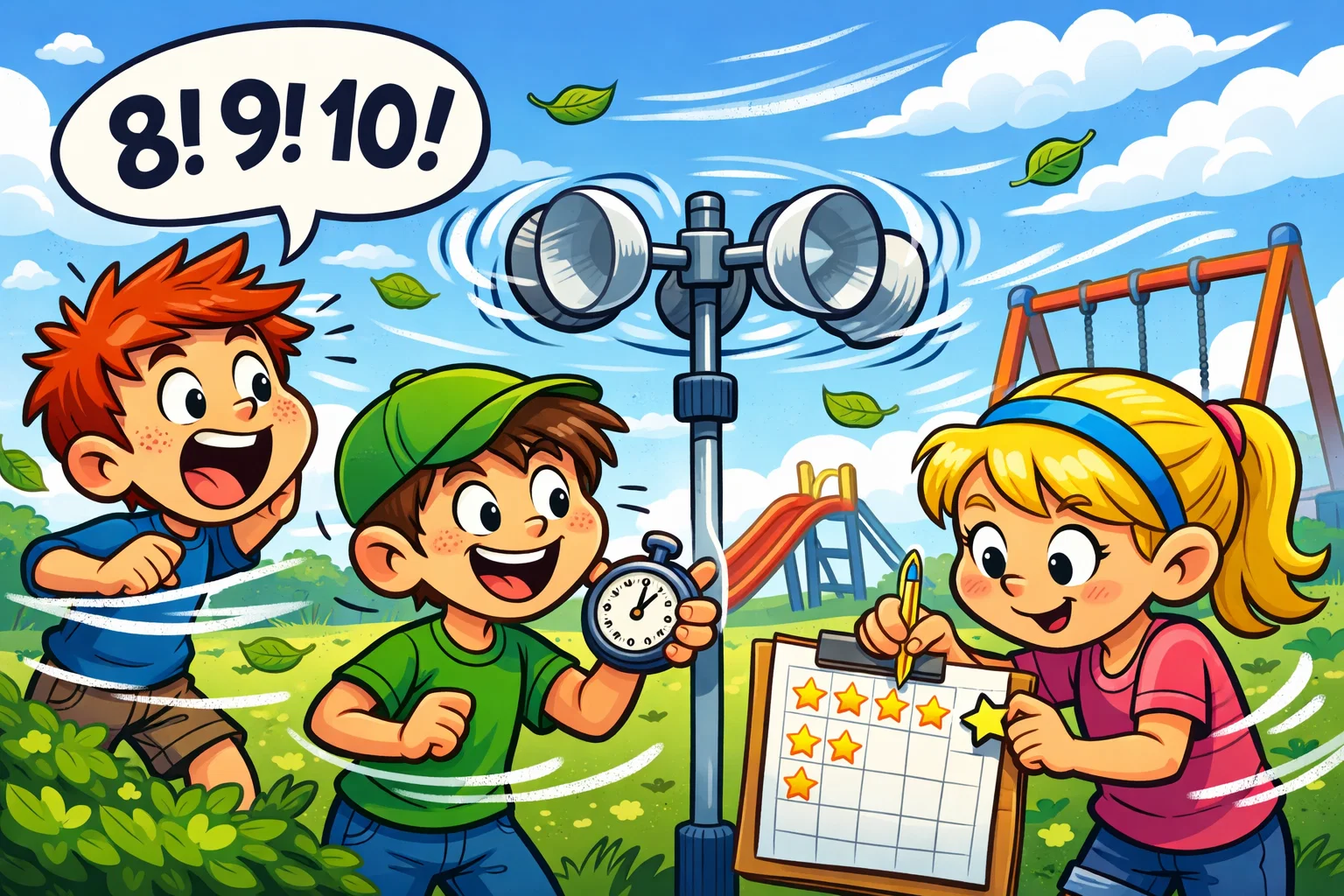
To measure the wind speed, you need to find the rate of rotation. Have one person hold the timer for one minute. The other person will count how many times the colored cup passes a fixed point. This gives you the rotations per minute or RPM.
Comparing wind speed in different locations
Take your homemade anemometer to different locations to see how geography affects air flow:
- Near a large wall (where the breeze might be blocked).
- In the middle of an open playground.
- At the top of a small hill or stairs.
Recording Results in a Simple Table
Use a table like the one below to keep track of your data and compare your findings.
| Location | Number of Rotations (1 min) | Air Description |
| Playground | 15 | Light Breeze |
| Near School Entry | 5 | Calm Air |
| Top of the Slide | 28 | Moderate Gusts |
Experiment Explanation for Kids
Why cups spin faster in strong wind
Air is actually made of moving molecules. When the atmosphere moves, these molecules hit the inside of the cup. Because the cup is hollow, it catches that energy. The more “push” the air has, the more force it applies, causing the cup anemometer to rotate faster.
How rotation relates to wind speed
The number of times the cups move in a circle is directly related to the velocity of the air currents. In 1846, John Thomas Romney Robinson invented this specific cup anemometer design. He showed that the rotation speed was proportional to the speed of the wind.
What affects measurement accuracy
Your measurement might change based on external factors:
- Friction: If the pin is too tight against the straw.
- Balance: If the straws are not perfectly centered.
- Weight: Heavier cups require more force to start a spin.
Weather and Energy Connections

Wind and weather changes
By counting the number of spins over a week, kids can see how weather patterns shift. Higher RPM can sometimes precede a cold front or a change in weather, as air masses begin to collide.
Wind energy basics
An anemometer is like a tiny turbine. In the real world, wind turbines use a rotor and blade system to turn that spinning motion into electricity. Engineers need to calculate the average speed of a site for several years before they decide to build a wind farm.
Classroom and Home Activity Ideas
Group experiment setup
In a classroom, divide students into engineering teams. Assign roles: one “Builder,” one “Timer,” and one “Recorder.” This encourages communication and shared responsibility.
Indoor Wind Tests Using a Fan
If it is a still day outside, use a three-speed box fan. This allows kids to calculate the RPM for “Low,” “Medium,” and “High” settings in a controlled environment, demonstrating how different intensities affect the device.
Assessment and Discussion Questions
Questions for kids after experiment
- “How many times did the anemometer spin when you stood behind the building?”
- “What happened when the air came from a different direction?”
- “Why did we need to mark one of the cups with a color?”
Troubleshooting Common Issues
Anemometer not spinning
Check the pencil eraser. If the push pin is pushed in too deep, the straw won’t be able to spin around. Also, ensure the cups are all facing the same direction; if they face opposite ways, the air forces will cancel each other out!
Uneven spinning problems
If the anemometer makes a wobbly circle, the straws are likely not centered on the pencil. Adjust the “X” so the push pin is exactly in the middle of the straws to maintain balance.
More Weather Experiments for Kids
Rain gauge experiment ideas
After mastering the study of air, move on to water! You can make a simple rain gauge using a plastic bottle and a ruler to complement your data on atmospheric movement.
Wind direction vane activity
While the anemometer tells you “how fast,” a wind vane tells you “which way.” Combining these two tools gives a complete picture of the speed and direction of the local weather.
“The air is a force that shapes our world. By teaching children to measure it, we give them the tools to understand the unseen laws of physics.” — Educational Perspective